The hard part of a Chinese holiday dinner is never any single dish. It's the moment, twenty minutes before guests sit down, when the duck is resting, the braise is still reducing, the wok is smoking, and three cold dishes are waiting on a counter that's already too small. I've ruined more holiday meals by trying to cook everything at the last second than by getting any one recipe wrong. The way out isn't a better recipe for char siu; it's a menu that mixes make-ahead braises, a single showpiece, and a handful of things you can plate cold.
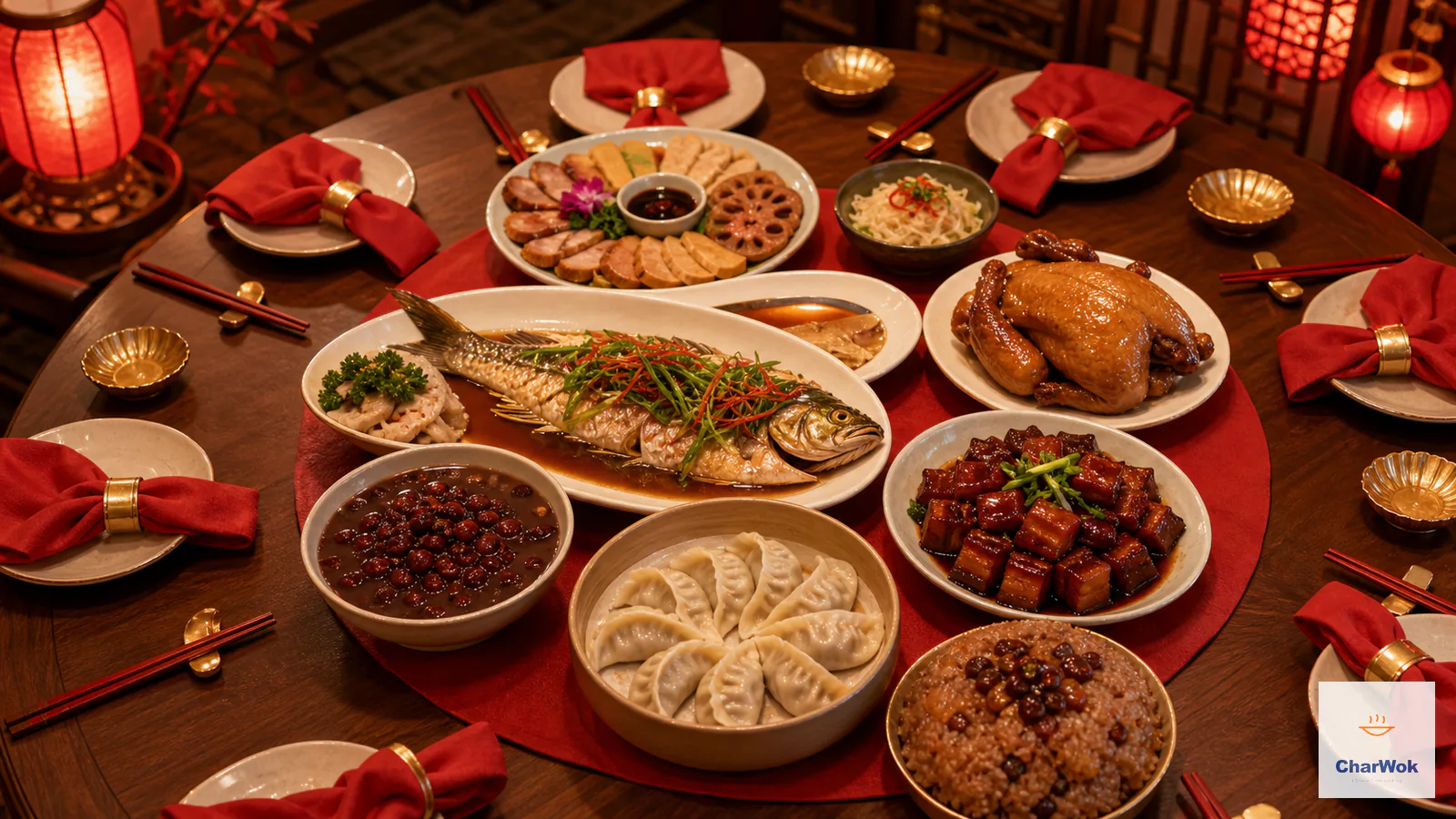
A festive Chinese table runs on contrast: one cold opener to anchor the eye, a glossy red-braised centerpiece, two quick stir-fries for heat and crunch, a soup to slow the room down, and a starch to soak everything up. Get that rhythm right and the individual dishes matter less than you think. The collection below is built around that rhythm, drawing on dishes from a showpiece Peking duck down to a tray of almond cookies you can bake three days ahead. Each choice below comes with the make-or-break detail the recipe card alone won't tell you.
At a glance: Plan eight to ten dishes for six people, and split them 2 cold / 1 showpiece / 2 stir-fries / 1 soup / 1-2 starches / 1 sweet. The single biggest time-saver is that red-braised and soy-braised dishes improve overnight in the fridge, so cook them the day before and reheat. Reserve the last 30 minutes before serving for one wok dish only; everything else should already be done or room-temperature.
The menu architecture
Holiday menu guide at a glance
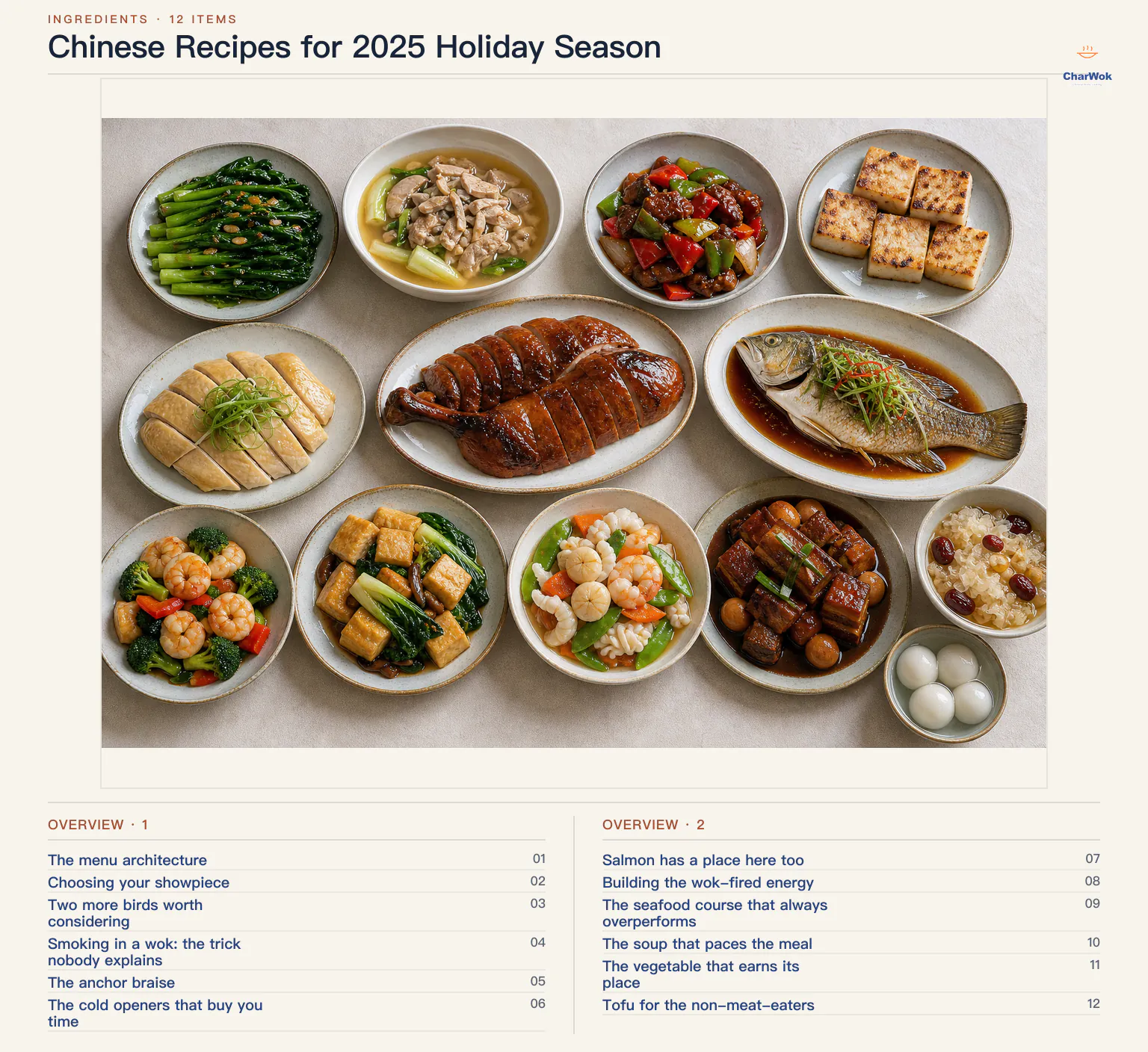
Western holiday menus are built around a single protein with sides arranged around it. A Chinese feast is the opposite: a sequence of independent dishes, each complete on its own, meant to be eaten together so flavors cross-pollinate. That changes how you plan. You are not hunting for a main; you are building a lineup with balance. Sweet against salty. Soft against crisp. Cold against scalding. The number of dishes is a symbol of generosity as much as appetite, which is why even a modest table runs six to eight plates.
For a party of six, I build around eight dishes plus a sweet. Two of the eight should be cold and fully plated before anyone arrives. One should be a braise done the day before. One is the visual centerpiece you time the whole evening around. The remaining four are quick stir-fries, a vegetable, and a starch. This structure means only one dish is ever demanding your active attention during the final push.
| Course slot | Role | Do it when |
|---|---|---|
| 2 cold openers | Set tone, give guests something to eat immediately | Plated hours ahead, refrigerated |
| 1 centerpiece | The dish everyone photographs; carries the table | Timed to rest as guests arrive |
| 1 long braise | Deep, savory backbone; the anchor flavor | Day before, reheated |
| 2 wok stir-fries | Heat, freshness, the live energy of the meal | Last 15-20 minutes |
| 1 vegetable | Cuts the richness, adds green and crunch | Right before serving |
| 1 soup | Slows the pace; digestive and symbolic | Holding warm on a back burner |
| 1-2 starches | Rice, noodles, or pancakes to anchor the meal | Hold warm or quick-finish |
| 1 sweet | Baked or no-cook; closes the meal | 1-3 days ahead |
Choosing your showpiece
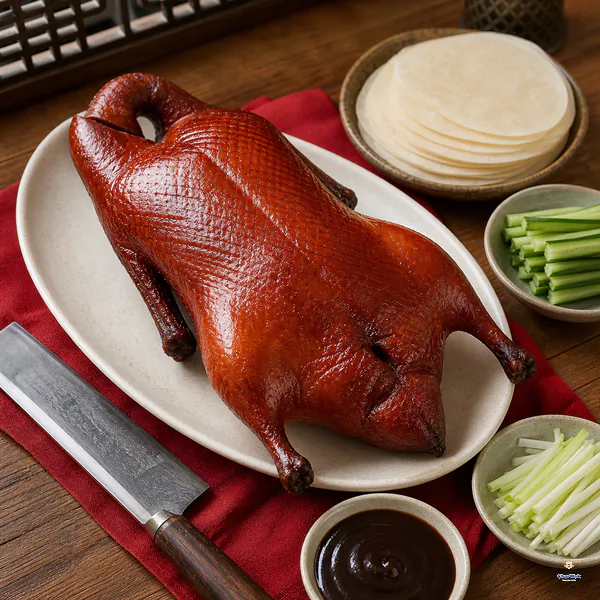
Choose one showpiece and give it the table's attention; roast duck becomes a complete centrepiece when pancakes, scallion, cucumber and sauce are ready before carving.
The centerpiece is the one dish you allow yourself to fuss over, because it's the dish the meal is remembered by. The logic for picking one is simple: it should look harder than it is, and it should hold or reheat without collapsing. A whole roast chicken fails that test the moment it sits ten minutes too long. A lacquered duck or a slow-braised pork belly passes it easily.
A home-version Peking duck is the highest-ceiling choice. The whole point of the dish is the contrast between the crackling skin and the soft meat beneath it, and that contrast comes from one technique most cooks skip: separating the skin from the meat and drying the bird, often overnight in the fridge, before it ever sees heat. Skip the drying and you get flabby skin no matter how good the recipe is. Serve it with thin pancakes, scallion brushes, and a dot of sweet bean sauce, and the table assembles its own bites. It is interactive food, which is exactly what a holiday table wants.
If a whole duck feels like too much, a five-spice roast chicken is the more forgiving centerpiece. Five-spice powder is a complete seasoning system in one blend: sweet, savory, anise, pepper, and a faint fennel edge. Rubbed under the skin rather than over it, it flavors the meat directly and lets the skin crisp instead of steaming under a wet spice paste. The one thing I watch is salt. Five-spice tastes less salty than it is, because the anise dominates the nose. Weigh your salt; do not guess, or the bird reads bland no matter how aromatic.
Two more birds worth considering
A holiday table rewards variety over quantity, so two birds plus a duck can feel like too much poultry. But if you want a second showpiece that travels in a totally different direction, salt-baked chicken and wok-smoked chicken both deliver maximum drama for the effort.
Salt-baking sounds like it needs a kilo of salt and a clay pot. The home version buries a marinated bird in a bed of hot coarse salt in a covered Dutch oven, and the salt acts as a heat battery that cooks the chicken evenly from every side while holding in moisture. The skin won't crisp the way a roast does; it turns pale and faintly translucent, and the meat is remarkably juicy. Eat it as a cold course the next day and it gets better, which makes it a strong make-ahead centerpiece.
Smoking in a wok: the trick nobody explains
Wok-smoked chicken is the one that surprises people. You steam the bird to cook it through, then line an old wok with foil, scatter sugar, tea leaves, and raw rice over the bottom, set the chicken on a rack above it, and clamp on a lid. The sugars and rice smoke rather than burn because you kill the heat the moment the smoke starts. Three minutes with the lid on is enough; any longer and the bird turns acrid. I ruined my first one by leaving it eight minutes and "building flavor." There is no building to do. You are tinting, not cooking.
The anchor braise
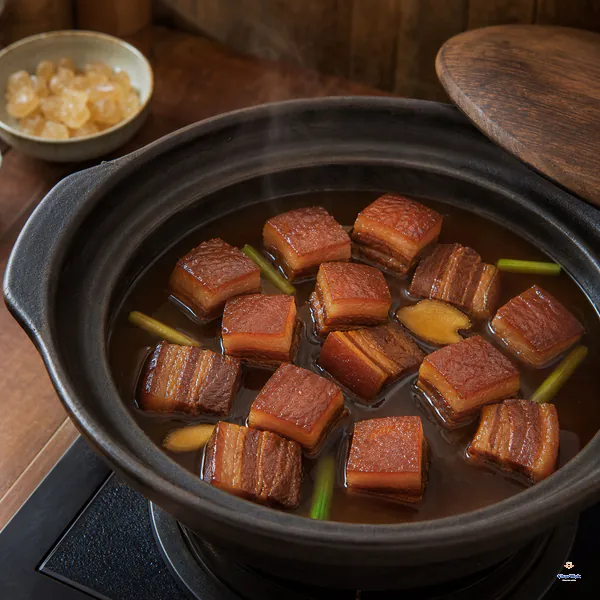
Keep the pork only about half submerged at a bare tremble, braise gently for about 90 minutes, then chill overnight so the anchor dish is ready to reheat.
Every festive table I cook has one long braise on it, and that braise is almost always made the day before. Slow-cooked pork is the emotional center of a northern Chinese holiday meal, and it is the single most make-ahead-friendly dish in the entire cuisine. The collagen in pork belly melts into the sauce over an hour and a half of gentle simmering, and that gelatin sets the sauce into a glossy cling when it cools. Reheated, the flavors have married overnight and the fat, which you can lift off as a solid disc from the chilled pot, no longer sits heavy on the palate.
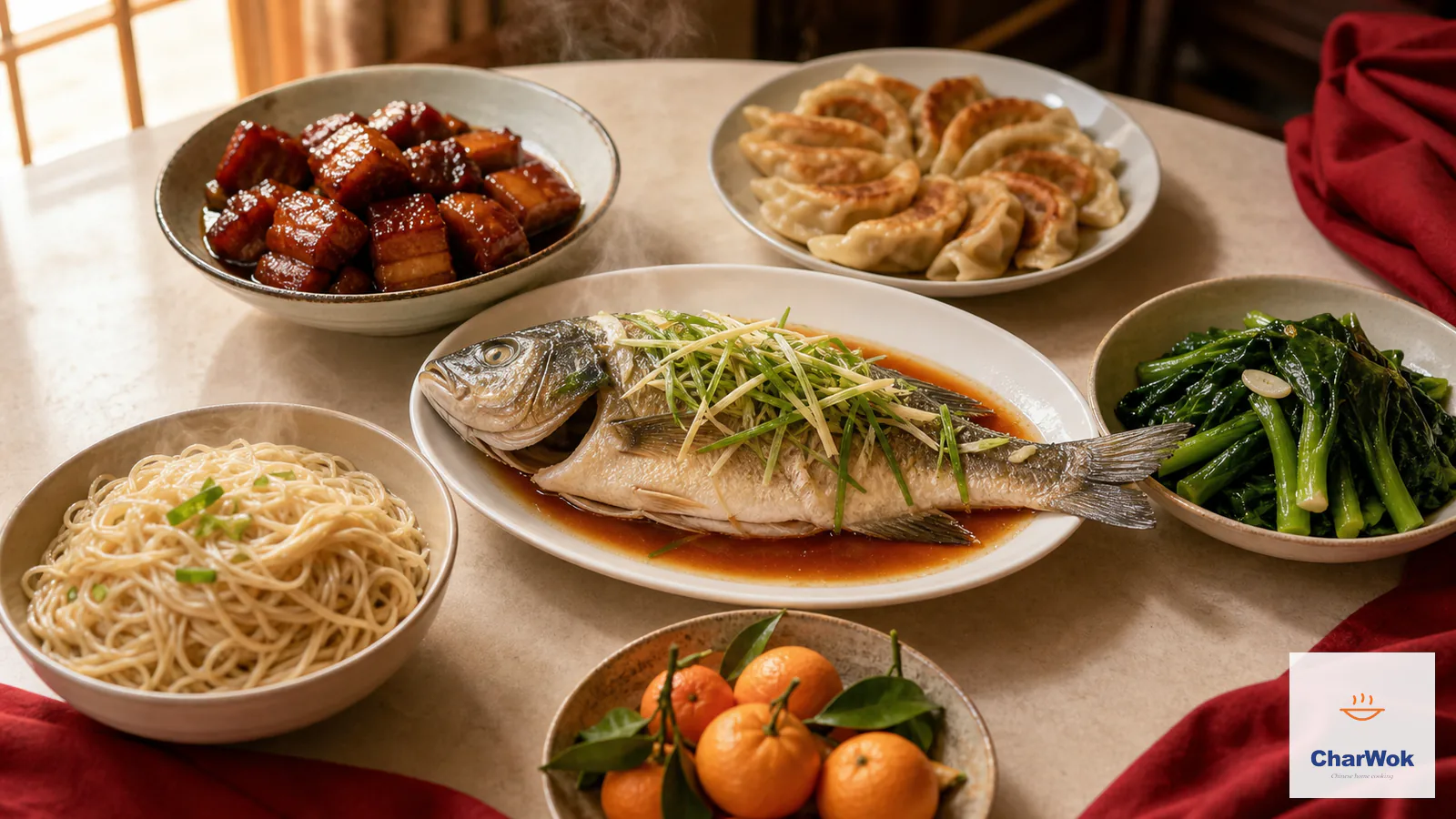
Red-braised pork belly (hong shao rou) is the canonical choice. The color comes from caramelized sugar, not from dark soy alone. You melt rock sugar in a little oil until it turns the color of strong tea, then immediately add the meat to stop the cooking; let the sugar go dark amber and it will turn bitter in the braise. The liquid is light and dark soy, Shaoxing wine, ginger, and just enough water or stock to come halfway up the meat. Full submersion boils the pork instead of braising it, and you lose the texture. Half-submerged, covered, on the lowest flame that holds a tremble, for ninety minutes. That is the whole technique.
For a leaner centerpiece that still gives you that slow-cooked depth, the easy red-cooked version uses belly in thinner strips so it finishes faster, and Chinese BBQ ribs take the same flavor logic into the oven. The ribs get a char siu-style marinade, roasted hot enough that the sugars caramelize and lacquer the bones. They are the rare braise-adjacent dish that's just as good at room temperature, which makes them a natural for a buffet.
The cold openers that buy you time
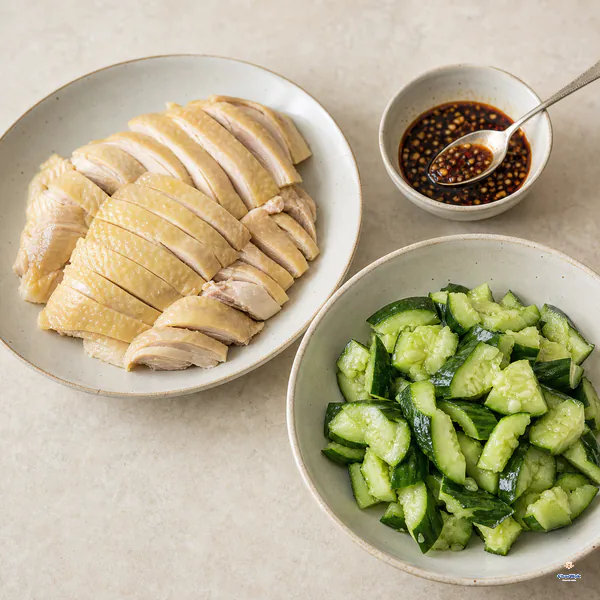
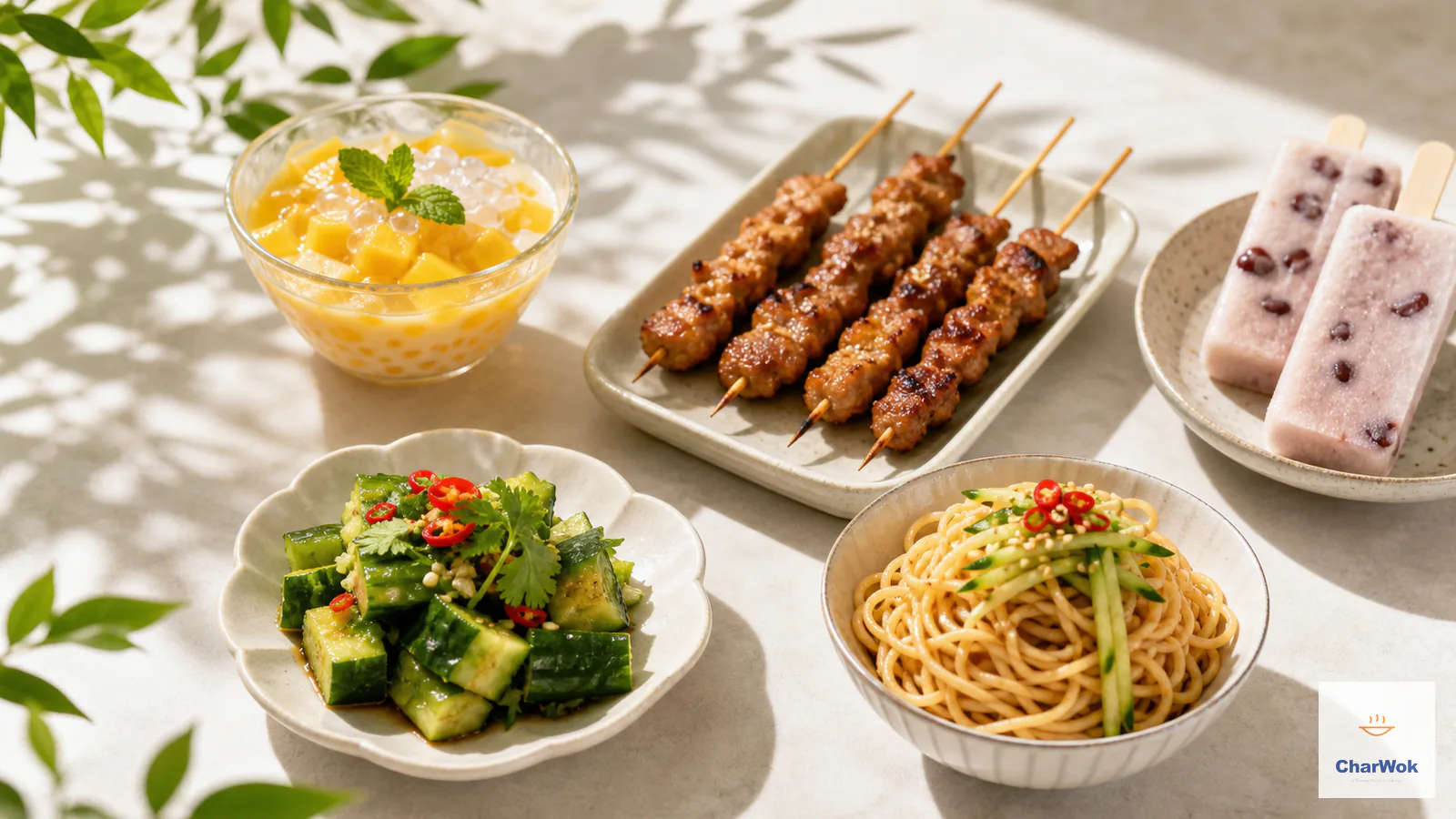
A substantial cold chicken dish can be prepared ahead; keep smashed cucumber drained and undressed until close to serving so it stays crisp.
Cold dishes are the secret weapon of a festive meal because they do double duty: they give arriving guests something to eat the instant they sit down, and they cost you zero last-minute labor. Plan two. One should be bright and acidic to wake the palate; one should be savory and substantial.
Smashed cucumber salad is the bright one. You whack the cucumbers with the flat of a blade so they split into jagged pieces, and those broken surfaces hold the dressing in a way a clean slice never can. Salt them for ten minutes, squeeze out the water, then toss with smashed garlic, black vinegar, sesame oil, and chili oil. Done an hour ahead, refrigerated, it sharpens as it sits. Done four hours ahead it goes watery, so time the salting for the window you'll actually serve it.
Salmon has a place here too
If you want a cold opener with more presence, scallion-ginger salmon works as well as any traditional Chinese cold plate, even though it's a Pacific Northwest ingredient in Cantonese clothing. Pan-fry it skin-down until the skin shatters, then pour a hot scallion-ginger oil over the top to bloom the aromatics into the flesh. Served warm it's a main; served chilled the next day it's a centerpiece cold course. The crisp skin softens overnight, so if you're serving it cold, eat the skin warm the night you cook it and refrigerate the flesh on its own.
Building the wok-fired energy
The stir-fries are where a Chinese table comes alive, because they are the dishes that arrive at the table still steaming and still smelling of the wok. This is the only moment of the dinner I allow myself to be actively cooking during service, and I limit it to one or two dishes so the wok is never doing two things at once. If you find yourself scheduling two wok dishes back to back, drop one.
Salt and pepper wings are the opener that doubles as a wok dish, with the crispiest skin in the lineup. The coating is a thin starch-and-flour dust, not a batter, and the wings are fried twice. The first fry at around 150°C (300°F) cooks them through and sets a pale shell. The second fry at 190°C (375°F), right before serving, is what makes them audibly crisp. Single-fried wings stay crisp for ten minutes; double-fried ones hold for forty, which is the difference between a passed appetizer and a soggy one by the time the second guest arrives.
Scallion chicken chops are my reliable second wok dish because they cook in under ten minutes and the sauce builds in the same pan. Boneless thighs are seared hard, lifted out, then a pile of scallion whites is fried in the rendered fat until deeply aromatic. The sauce, soy and sugar and a splash of wine, deglazes the pan and reduces to a glossy coat in the time it takes to return the chicken. The whole dish depends on the pan being hot enough that the sauce reduces, not simmers; a lukewarm pan gives you boiled scallions and a thin, broken sauce.
The seafood course that always overperforms
A steamed seafood dish reads as the most elegant thing on the table and asks for the least hands-on cooking, which is a combination I will take any holiday. Steamed garlic shrimp with vermicelli is the one I return to. The shrimp go on a bed of softened glass noodles in a shallow dish, a generous spoonful of sizzled garlic oil goes over the top, and the whole thing steams for six to eight minutes.
The detail that makes or breaks it is the garlic oil. You soften minced garlic in warm oil until it's fragrant but not browned, then spoon it raw-seeming over the shrimp before steaming. Brown the garlic in the oil and it turns bitter through the steam; use raw garlic with no oil and it stays sharp and aggressive. The middle path, oil just warm enough to bloom the aromatics, is the one you want. The vermicelli beneath isn't a filler; it drinks up every drop of the shrimp liquor and garlic oil and is often the first thing finished.
The soup that paces the meal
A Chinese feast almost always has soup, and it serves a structural purpose: it forces the table to slow down between courses. Hot and sour soup is the festive choice because it cuts through the richness of the braises and the fried wings without competing with them. The heat comes from white pepper, not chilies, and the sour from black vinegar added off the heat so it stays bright. Add the vinegar to a boiling pot and the aroma cooks off, leaving a soup that reads flat and one-dimensional.
The other make-or-break step is the cornstarch slurry. Hot and sour soup is a "thick" soup, and the thickness is what suspends the threads of egg you pour in at the end. Pour beaten egg into thin, watery soup and it disperses into cloudless streaks; pour it into properly thickened soup and it sets into the delicate ribbons the dish is known for. Stir the soup in one direction as you pour the egg in a thin stream, and you get silken threads. Stop stirring and you get one solid clump.
The vegetable that earns its place
Every holiday table I've cooked has had a vegetable dish go uneaten, usually because it was an afterthought boiled into submission. Give the vegetable a real technique and it becomes the dish the vegetarians at the table (and several of the meat-eaters) actually fight over. Two approaches cover most situations.
Dry-fried green beans are the loud option. The beans are wrinkled and blistered either in a shallow oil or, my preferred home method, dry-charred in a hot wok until the skins blister and the flesh sweetens. The flavoring is a small amount of ground pork, dried chilies, and preserved mustard greens or ya cai, added after the beans are done so the aromatics perfume rather than fry. The reason most home versions disappoint is that the beans are steamed, not blistered; you want them to look slightly collapsed and patchy, not bright green and taut.
Braised mushrooms with bok choy is the quiet option, and the one I'd choose for a table that's already loud with duck and wings. Dried shiitakes, soaked and squeezed, are braised in a soy-sugar stock until they turn meaty and absorbent; baby bok choy is blanched separately until the stems are tender-crisp, then arranged around the mushrooms. The mushrooms carry the flavor, the bok choy carries the crunch, and the two are plated together so each bite mixes both. Blanching the greens separately, rather than throwing them raw into the braise, is what keeps their color bright and their stems from going flabby.
Tofu for the non-meat-eaters
If you have guests who don't eat meat, give them a tofu dish with real presence rather than a sad afterthought plate. Salt and pepper tofu is the festive choice because it's the rare tofu dish that meat-eaters reach for first. Firm tofu is cubed, coated in cornstarch, and shallow-fried until the outside is golden and crisp while the inside stays soft and warm. Toss it, off the heat, with a mixture of finely minced garlic, ginger, scallion, white pepper, and a pinch of five-spice. The coating is fragile, so the toss has to be quick and gentle; do it in the wok you fried in, with a little of the residual oil still in it, and the aromatics cling without the tofu breaking apart.
Appetizers that bridge the gap
Between the cold openers and the centerpiece, a couple of passed bites keep the table moving. These are the dishes that benefit from being assembled rather than cooked, which makes them ideal for the chaotic window when you're pulling the main out of the oven.
Spring rolls are the obvious choice, and they freeze beautifully unfried, so you can roll them a week ahead and fry from frozen on the day. The detail that separates good spring rolls from great ones is moisture control in the filling. The filling must be cooked, cooled, and as dry as you can get it before rolling; any residual liquid turns the wrapper soggy from the inside and bursts the roll in the oil. Squeeze cooked napa cabbage in a cloth to extract water before mixing the filling, and you'll never have a blowout again.
Sichuan lettuce wraps are the no-cook-at-service option. Highly seasoned ground pork and mushrooms, cooked ahead and reheated, are spooned into crisp lettuce leaves at the table. The lettuce has to be ice-cold and bone-dry, or the wraps collapse in the hand. I core the lettuce, separate the cups, and soak them in ice water for ten minutes to crisp the leaves, then drain them upside down on a towel.
The starch question
A festive Chinese table usually has a starch or two, but they're never the focus the way a Thanksgiving turkey-side stuffing is. Rice is assumed and often not even listed. What earns a slot at a holiday meal is a starch that is itself a dish, something with texture and character that holds its own against the braises.
Scallion pancakes are my pick for a chewy, flaky option, and they pair particularly well with a duck centerpiece because they can stand in for the pancakes. The layers come from rolling the dough thin, brushing it with oil, rolling it into a log, coiling the log into a snail, and flattening the snail back into a disk. Each fold traps a film of oil that turns into a separate layer when fried. Skip the resting step between rolls and the gluten snaps back and fights you; rest the dough twenty minutes between each step and it rolls out paper-thin without resistance.
If you'd rather a soft, pillowy starch, folded steamed bao buns are the friendliest version to make at home, and they work as a vehicle for any of the braises or stir-fries above. The dough proofs once, not twice, which trims the timeline, and the folded shape means you don't have to fuss with pleats. Steam them in batches and hold them covered in a low oven with a damp cloth; uncovered, the surface dries and toughens within minutes.
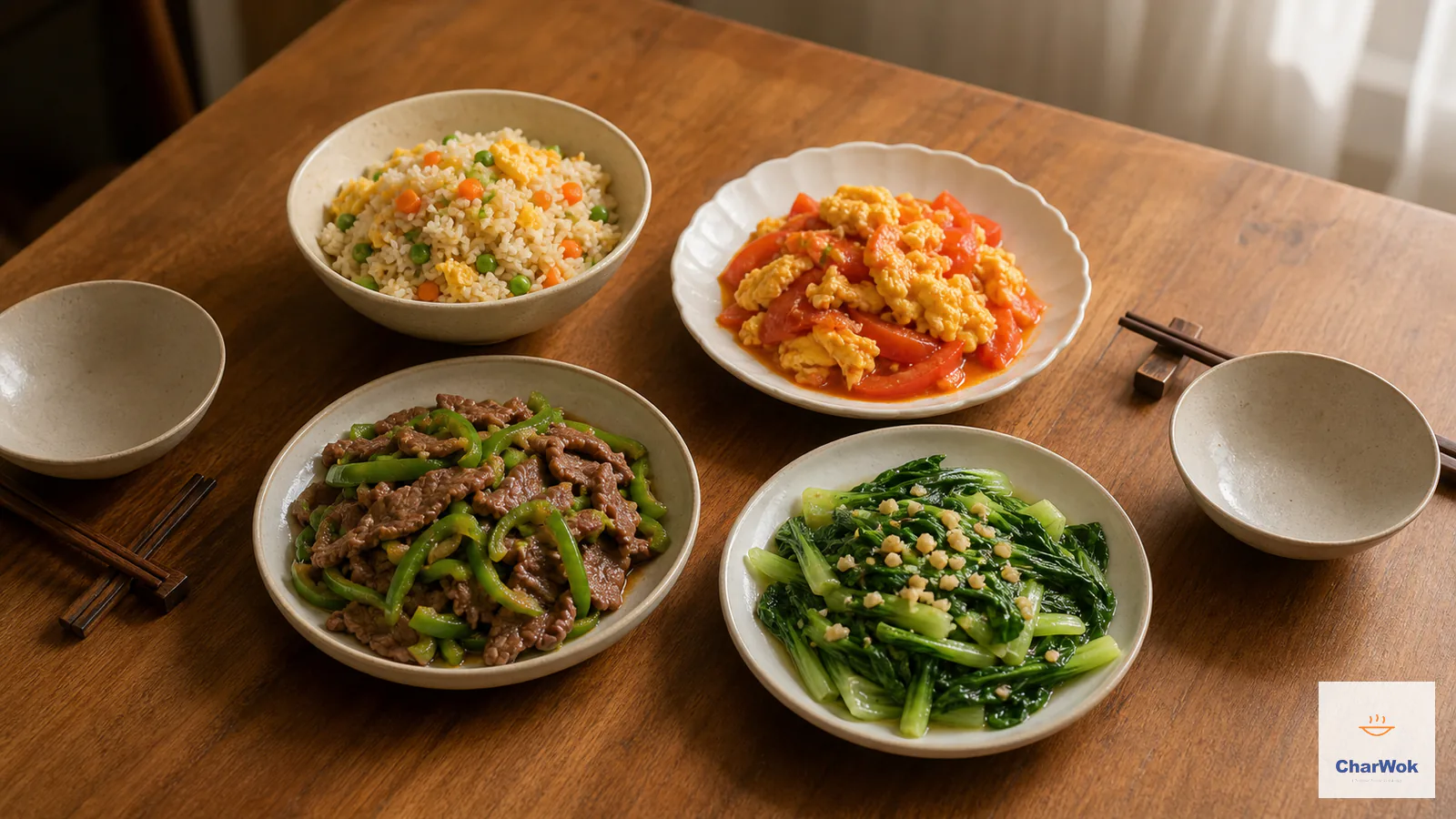
For a meal that's already starch-heavy from pancakes or bao, a plate of Yangzhou fried rice can tip into redundancy. My rule is one chewy starch (pancakes or bao) plus one rice option, and never both chewy and rice unless you're feeding a crowd of fifteen or more. When in doubt, choose the pancakes; rice is the easier thing to skip, and a table with duck and braise and soup and vegetables rarely misses it.
Noodles for a crowd
Noodles carry a specific meaning at a festive meal, particularly around the New Year: their length symbolizes longevity, which is why a birthday or new-year table almost always includes a noodle dish you are not supposed to cut. Chow mein is the workhorse option. The noodles are parboiled, drained, and then pan-fried until the bottom develops a crackling crust before the sauce and vegetables go in. The mistake I see most often is tossing the noodles constantly from the start; you have to let them sit undisturbed in hot oil for a full two minutes to develop that bottom layer, then flip once.
The sweet finish
Chinese holiday meals traditionally close with something sweet but not dessert-heavy; a small, nutty, slightly crumbly bite and fresh fruit, rather than a slice of cake. This is the part of the menu you should make days ahead, because the kitchen is the last place you want to be once the savory dishes are cleared.
Almond cookies are the canonical choice and they keep for a week in an airtight tin. The texture depends on two things: ground almonds or almond flour worked into the dough for fat and flavor, and a healthy pinch of baking powder that gives the cookies their characteristic crack and crumbly shortbread snap. Roll them gently; overwork the dough and the cookies turn hard and flat. I bake a double batch every December and they're the first thing gone from the tin, which tells you something about how a small finish can outshine the main course.
When in doubt, host a hot pot
If reading all of the above makes you want to skip the multi-dish planning entirely, there's a legitimate alternative: host a hot pot. Hot pot front-loads all the work into setup and removes the timing problem completely, because the cooking happens at the table. You simmer one or two broths, lay out platters of sliced meat, leafy greens, mushrooms, tofu, and noodles, and let guests cook their own. For a festive crowd that wants to linger, it is the lowest-stress high-impact meal you can host, and a spicy split pot gives you two flavor profiles from one piece of equipment.
Timing the whole table
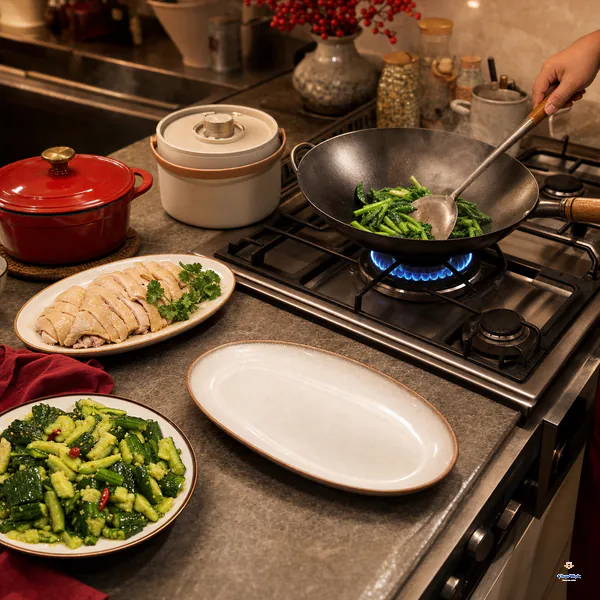
Reserve the final cooking window for one wok dish at a time; plate cold items early, keep braise and soup covered, and have the warm serving platter waiting.
The difference between a relaxed host and a frantic one is the timing sheet, and it's the thing almost no recipe collection gives you. Here is the one I cook to, working backward from a 7:00 pm sit-down. Adjust the clock for your own start time.
- Three days before: Bake the almond cookies; roll and freeze the spring rolls; mix the salt-and-pepper and char siu marinades.
- Two days before: Marinate the duck or chicken centerpiece and start it drying, uncovered, in the fridge. Soak dried mushrooms and shiitakes for the vegetable dish.
- One day before: Cook the red-braised pork belly in full, cool, chill. Make the spring roll filling and roll the spring rolls if not already frozen. Mix the hot and sour soup base (hold the egg and the cornstarch thickening for tomorrow).
- Morning of: Salt the cucumbers and dress them; refrigerate. Steam and smoke the chicken if using; refrigerate for a cold course. Make the bao dough; let it proof. Make the scallion pancake dough; rest it.
- Two hours before: Reheat the braise gently on the stove. Cook the salmon if serving it cold; chill the flesh. Roll out and cook the scallion pancakes; hold warm in a low oven under a damp cloth.
- One hour before: Roast or finish the centerpiece duck or chicken so it's resting as guests arrive. Steam the bao buns in two batches; hold warm.
- Thirty minutes before: First-fry the salt and pepper wings; drain. Set up the steamer for the garlic shrimp.
- At sit-down: Plate the cold openers and pass them. Carve the centerpiece.
- During the first course: Second-fry the wings. Steam the shrimp for six to eight minutes. Reheat the hot and sour soup, thicken, and pour in the egg.
- Mid-meal: Fire the scallion chicken chops in the wok. Blanch and plate the bok choy and mushrooms. Bring the fried rice or chow mein if serving.
- Finish: Bring out the almond cookies and fruit. Put the kettle on for tea.
What usually goes wrong
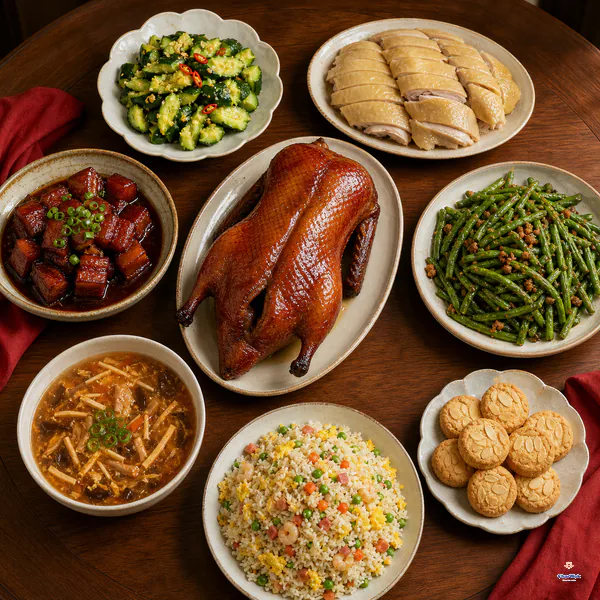
Avoid a table of equally heavy favourites: alternate cold and hot, rich and bright, crisp and soft dishes, and give every plate a distinct role.
After cooking this style of meal for years, the failures cluster into a small number of predictable problems. Here are the ones I've earned the hard way, and the fix for each.
- Everything hits the table lukewarm. You cooked too much in the final hour. The fix is structural, not culinary: only one wok dish is allowed in the last thirty minutes. Everything else is either cold, reheated, or holding warm in a 90°C (200°F) oven under foil.
- The braise tastes flat the day you make it. It always does. Red-braised pork needs overnight in the fridge for the soy, sugar, and wine to marry and for the gelatin to set the sauce. Taste it the next day before adjusting seasoning; what read as bland at midnight will be balanced by morning.
- The duck skin is rubbery. The bird wasn't dried enough before cooking. Next time, leave it uncovered on a rack in the fridge for a full twenty-four hours. A fan blowing across it for the last hour helps. There is no shortcut that rescues wet skin at the end.
- The spring rolls burst in the oil. The filling was wet, or the oil was too cool. Squeeze all liquid out of the filling before rolling, and fry at a steady 170°C (340°F). Frozen rolls go straight into 175°C oil; thawing them first guarantees blowouts.
- The hot and sour soup has no egg ribbons. The soup wasn't thickened before the egg went in, or you poured too fast. Thicken to a light syrup with cornstarch slurry first, get the soup swirling in one direction, then pour the beaten egg in a thin stream in a slow circle. Do not stir for ten seconds after.
- The stir-fried vegetables are soggy and pale. The wok wasn't hot enough or you crowded it. A home wok takes only one portion at a time. Cook in batches if you have to, and reheat the wok until a drop of water dances before the next batch goes in.
- The bao buns are dimpled and yellow. The dough overproofed, or the steam condensed on the lid and dripped back. Wrap the lid in a cloth to catch condensation, and don't let the buns go past doubled in size.
Variations and pairings
The menu above is a template, and the slots are swappable. For a smaller table of four, drop to six dishes: one cold opener, the centerpiece, the braise, one stir-fry, one vegetable, and a sweet. For a larger crowd of ten or twelve, add a second braise and turn the soup into a full hot pot course in the middle of the meal.
Drink pairings matter less than people pretend. A dry Riesling or an off-dry Gewürztraminer handles the range from five-spice to chili oil better than any red. If you prefer beer, a clean lager lets the food lead. For a non-alcoholic option, warm jasmine tea through the savory courses and a chilled osmanthus tea with the almond cookies closes the meal on the right note.
If you want to lean into a single regional theme rather than a pan-Chinese mix, pick a cuisine and let the dishes follow. A northern winter feast centers on wheat: scallion pancakes, dumplings, braised pork, and Peking duck. A Cantonese table emphasizes seafood, roast meats, and clear soups. A Sichuan celebration turns up the chili and pepper and adds cold tofu and mouth-watering chicken to the cold course. Each of these is a coherent meal in its own right, and narrowing the region is often easier than building a pan-Chinese lineup from scratch.
Storage and leftovers
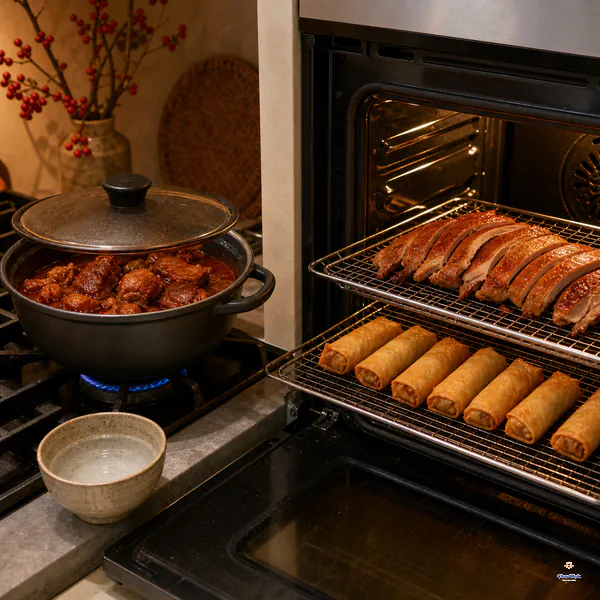
Reheat sauce-rich braises slowly with a splash of water, but restore poultry skin and fried foods with dry high heat; a microwave softens both crisp categories.
The good news about a Chinese holiday feast is that it produces leftovers that improve overnight, and several dishes are explicitly better the next day. The red-braised pork keeps four days refrigerated in its sauce and reheats gently on the stove. Smoked and salt-baked chicken become the cold plate for the next lunch. Fried rice and chow mein reheat best in a dry hot wok with a splash of water, never the microwave, which turns noodles gummy.
Spring rolls that weren't fried stay frozen for a month; fry them straight from frozen for a weeknight dinner. Almond cookies keep a week in a sealed tin at room temperature. The one dish I never save is the salt and pepper wings; the crisp skin doesn't survive refrigeration, so fry only what you'll eat, and keep any unfried, coated wings in the fridge for a second batch the next day.
Related recipes & further reading
If you want to widen the menu or dig deeper into the cooking behind a Chinese holiday table, here are recipes and collections that pair well with the lineup above, from a second showpiece down to the sweet that closes the meal.
- For a fuller grounding in planning a multi-dish spread, start with the guide to building a Chinese feast, which works through course balance and timing from the ground up.
- If you are assembling the whole table at once, browse twelve must-try authentic Chinese recipes for reliable anchors across regions.
- For a technique-first route through braises, wok dishes, and dough, use the core Chinese cooking skills guide.
- If a New Year meal is on the calendar, the Chinese New Year recipe collection covers symbolic dishes built around luck and longevity.
- For cold-weather hosting, the chilly-days recipe round-up leans into braises and soups that suit a winter feast.
- To offload cooking ahead of time, make-ahead Chinese recipes lists the braises and cold dishes that improve overnight.
- As a pork centerpiece with presence, lion's head meatballs bring drama to the table and reheat cleanly the next day.
- For a duck showpiece that skips the whole-bird drying step, aromatic crispy duck gives you shatteringly crisp skin in a more manageable format.
- A cold course with a festive edge, drunken chicken is marinated in Shaoxing wine and slices cleanly straight from the fridge.
- For a wok stir-fry with bright, sticky-sweet intensity, spicy orange beef lands in the same heat-and-gloss slot as the wings and chops.
- A whole steamed course reads as the most elegant plate on the table, and Cantonese steamed fish carries the symbolism of abundance a festive meal wants.
- To close the meal on a traditional note, steamed pear with rock sugar is a light, warming sweet that sits comfortably after a rich feast.
- For a richer closing, eight treasure rice pudding is a celebratory sticky-rice dessert assembled a day in advance.
- And if the food itself is the reason you host, a culinary tour of China is a long read on the regional dishes and markets that shape a table like this one.
Common questions
A few questions come up almost every time I talk someone through their first festive Chinese dinner. Here are the short answers.
Frequently asked questions
How many dishes do I really need? Count one dish per person, plus two, then round to an even number. Six people: eight dishes. Four people: six dishes. Even numbers matter symbolically at a festive meal, and the extra dish above headcount keeps the table looking generous without overloading it.
Can I make the braise the day before? Yes, and you should. Red-braised pork belly is measurably better after a night in the fridge. Chill it in its cooking liquid, lift off the solidified fat disc the next day, and reheat gently on the stove. The flavor will have deepened and the sauce will have set into a proper glaze.
What if I can't get a whole duck? Substitute a five-spice roast chicken or a salt-baked chicken; both carry a festive table. For the duck experience without the whole bird, you can also roast duck legs with the same drying step and serve them with the pancakes and scallions.
How do I keep stir-fried dishes hot until serving? Hold them, uncovered, in a 90°C (200°F) oven on a warm plate for no more than ten minutes. Beyond that the texture collapses. Plan the sequence so each wok dish goes straight from pan to table, and keep the cold dishes and the braise as your buffer.
Is rice mandatory? No. If you already have a chewy starch like scallion pancakes or bao buns on the table, rice is optional and often unnecessary. Skip it rather than overcrowd the menu; a guest who wants rice with everything can ask, and most won't on a table this full.
Can I prep the spring rolls in advance? Roll them up to a week ahead and freeze them raw on a tray, then transfer to a bag. Fry straight from frozen at 175°C (350°F) for a minute or two longer than the fresh time. Never thaw them first; thawing softens the wrapper and causes blowouts in the oil.
None of this is meant to be cooked all at once for a single meal, and that's the point. A festive Chinese table is a project you build over three days, not three hours, and the dishes here are ingredients for your own lineup rather than a fixed menu. Pick your showpiece, anchor it with a make-ahead braise, and fill in around them with whatever cold dishes and stir-fries suit your guests. The structure will hold, and the evening will run more calmly than any single one of these recipes suggests.