The first time I tried to make Chinese almond cookies at home, I produced a tray of small, dry rocks. The dough crumbled in my hands before it ever reached the oven, and the baked cookies tasted like sweetened sand with an almond on top. What I had missed was the one thing that separates a cookie you reach for a second time from one you quietly forget: fat, and how it carries the flavor of toasted nut through every bite.
A good almond cookie should shatter softly between your teeth, leave a film of oil and roasted-almond perfume on the roof of your mouth, and not be too sweet. That is the whole point of the cookie. Everything in the method below is in service of those three things, and once you understand why each step matters, the recipe becomes very hard to ruin.
At a glance. Oil-based dough, no egg, no chilling. Ratio to remember: roughly 2 parts all-purpose flour to 1 part almond flour by weight, with oil at about 40% of the flour weight. Bake at 180°C / 350°F for 18 minutes. The dough is meant to be crumbly and barely cohesive, so if it holds together when you squeeze a handful, you are done mixing. Toast the almonds or do not bother making these.
What these cookies are, and where they come from
Almond cookies sit in a fuzzy category of their own. They are not a delicate Cantonese pastry in the way mooncakes or snow skin mooncakes are, with their precise doughs and elaborate molds. They are a homey, everyday treat, the sort of thing a grandmother keeps in a tin and brings out with tea. The Chinese name, xing ren su (杏仁酥), literally means "almond crumbly-thing," and that crumb is the defining feature.
They became a fixture of Chinese New Year tables and of Chinese bakeries abroad, where their coin-like roundness came to stand for prosperity. You will often see them next to nian gao, the sticky rice cake that means "a higher year," and to fried sweets like sesame balls. On a holiday tray their job is to be the plain, reliable, deeply nutty one that everyone eats three of without noticing.
Why this dough behaves so differently from a Western cookie
This is the part most recipes skip, and it is the part that makes the whole thing click. A standard American butter cookie gets its tender crumb from two things working together: solid fat that interrupts the gluten, and creaming that beats air into that fat so the cookie is light. Chinese almond cookies use neither trick. The fat is liquid oil, and there is no creaming step at all.
Instead, the texture comes from three simpler mechanisms. Oil coats the flour particles and physically blocks them from forming long gluten strands, which is why you can stir the dough a fair amount without turning it tough. The almond flour adds its own fat and a coarse particle size that breaks up the structure further. And a small dose of baking powder and baking soda gives a faint lift in the oven so the cookies are not leaden. The result is a "short" dough (short meaning shortened, with the gluten kept short), in the same family as shortbread or a Mexican wedding cookie, but built from oil rather than butter.
The practical consequence: you should not expect this dough to feel like the dough for dumpling wrappers or even a pie crust. It is supposed to be sandy, to crack at the edges when you shape it, and to barely hold a ball when you press one between your palms. If you keep working it, trying to make it smooth, you will develop gluten and lose the crumb you are after. I have made that mistake. Resist it.
Ingredients
Ingredients at a glance
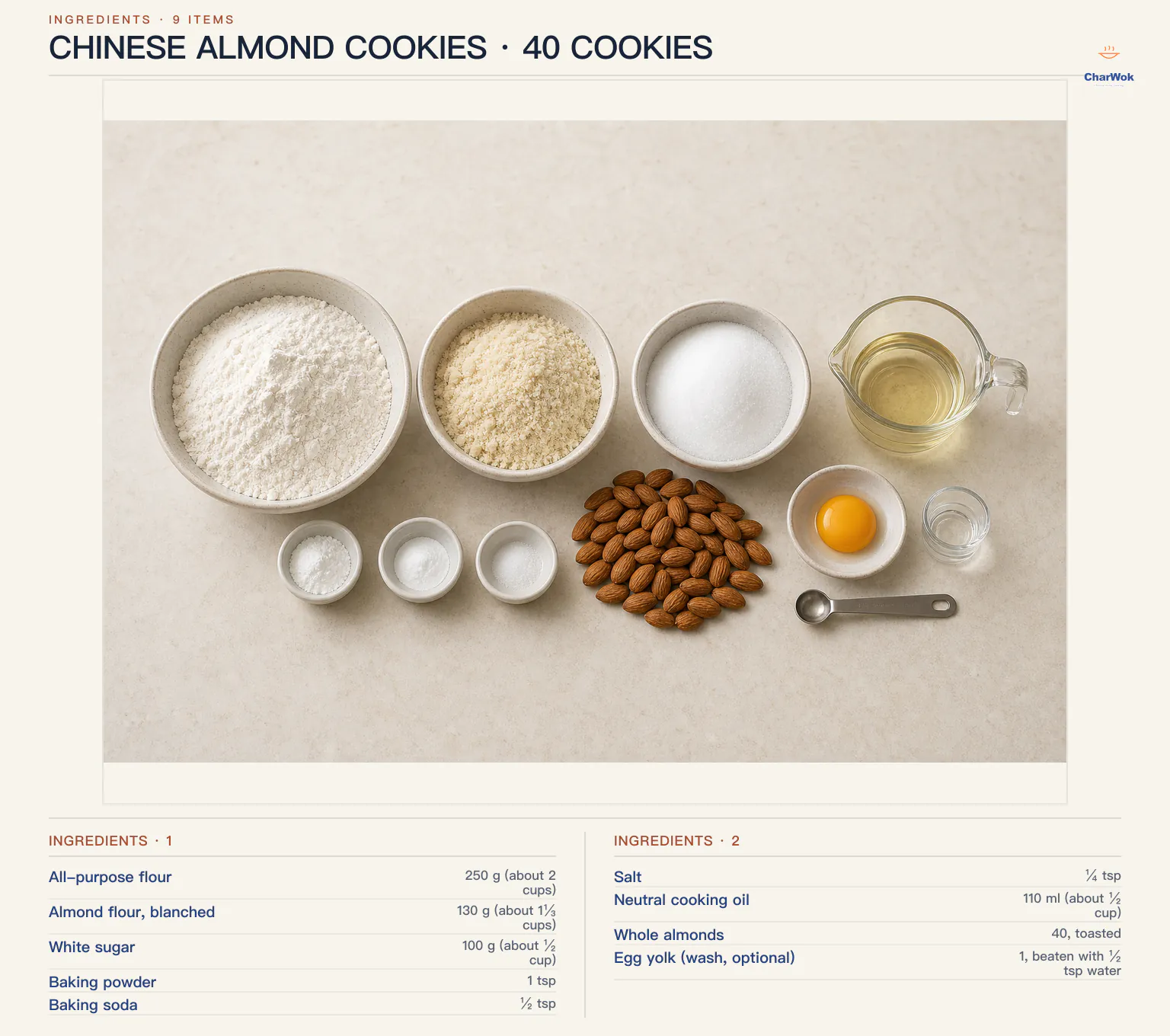
A note on the fat before the table: I am calling for neutral cooking oil here because it lets the almond flavor lead. This is the version that tastes most like the cookies in the red-lidded jar. Butter is a fine substitute if you want something crunchier and richer, but it will talk over the almond. The traditional fat, lard, makes the most crumbly and aromatic version of all; if you keep lard on hand for other holiday sweets, it is worth a batch. More on these swaps below.
| Ingredient | Amount | Notes / substitute |
|---|---|---|
| All-purpose flour | 250 g (about 2 cups) | Plain flour. Do not use bread flour; you want weak gluten. |
| Almond flour, blanched | 130 g (about 1⅓ cups) | Fine, skinless. Almond meal (with skin) works but is coarser and darker; the dough will be more fragile. |
| White sugar | 100 g (about ½ cup) | Superfine dissolves more evenly. Do not cut this much further; sugar also feeds the browning. |
| Baking powder | 1 tsp | Gives a gentle lift. |
| Baking soda | ½ tsp | Browns the surface and deepens the flavor through early Maillard reactions. |
| Salt | ¼ tsp | Don't omit; it sharpens the nuttiness. |
| Neutral cooking oil | 110 ml (about ½ cup) | Canola, grapeseed, or a light vegetable oil. For butter use 140 g melted; for lard use 110 g. |
| Whole almonds | 40, toasted | One per cookie. Toasting is not optional (see method). |
| Egg yolk (wash, optional) | 1, beaten with ½ tsp water | Gives a glossy, golden top. Omit for a fully vegan cookie. |
Toasting the almonds: do this first or regret it
Raw almonds are faintly grassy and bland. Toasted almonds are the entire reason these cookies exist. Spread the 40 almonds (and a few extra, for snacking and breakage) on a small tray and roast at 160°C / 320°F for 8 to 10 minutes, shaking once, until they smell distinctly nutty and the cut sides are pale gold. Cool them fully before using. If you buy pre-roasted almonds from the bulk bin, taste one; if the roast is weak, give them a quick re-toast. I have tried skipping this step when I was in a hurry, and the cookies were flat-tasting every time.
Step-by-step method
- Mix the dry ingredients thoroughly. In a large bowl, whisk the all-purpose flour, almond flour, sugar, baking powder, baking soda, and salt. Take ten seconds more than feels necessary, because lumps of baking powder show up as bitter spots in the finished cookie, and almond flour clumps easily.
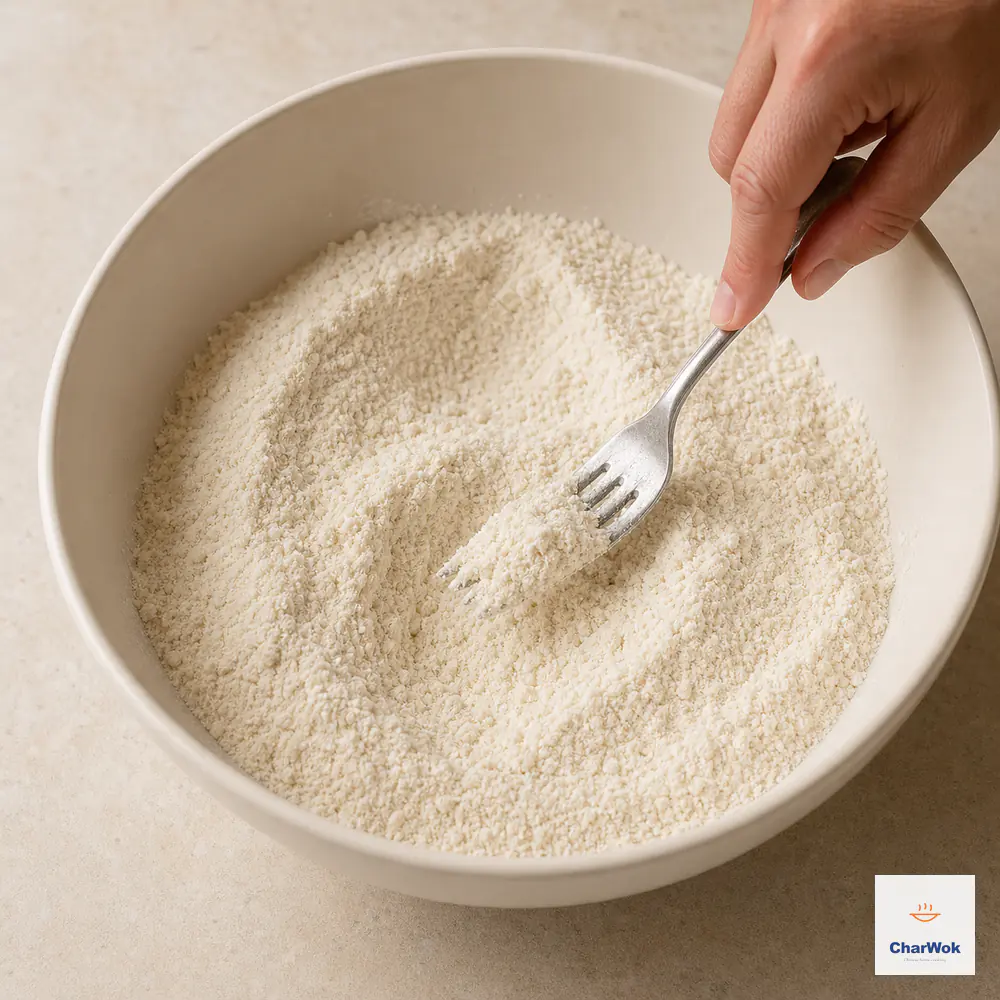
Mix all six dry ingredients until the color and texture are even and no leavener lumps remain; almond flour clumps need a few extra passes with the fork.
- Cut in the oil with a fork. Pour in the oil and stir, pressing and fluffing with the tines, until no dry flour remains and the mixture looks like damp sand with many small clumps. The goal at this stage is to distribute oil evenly, not to form a dough yet.
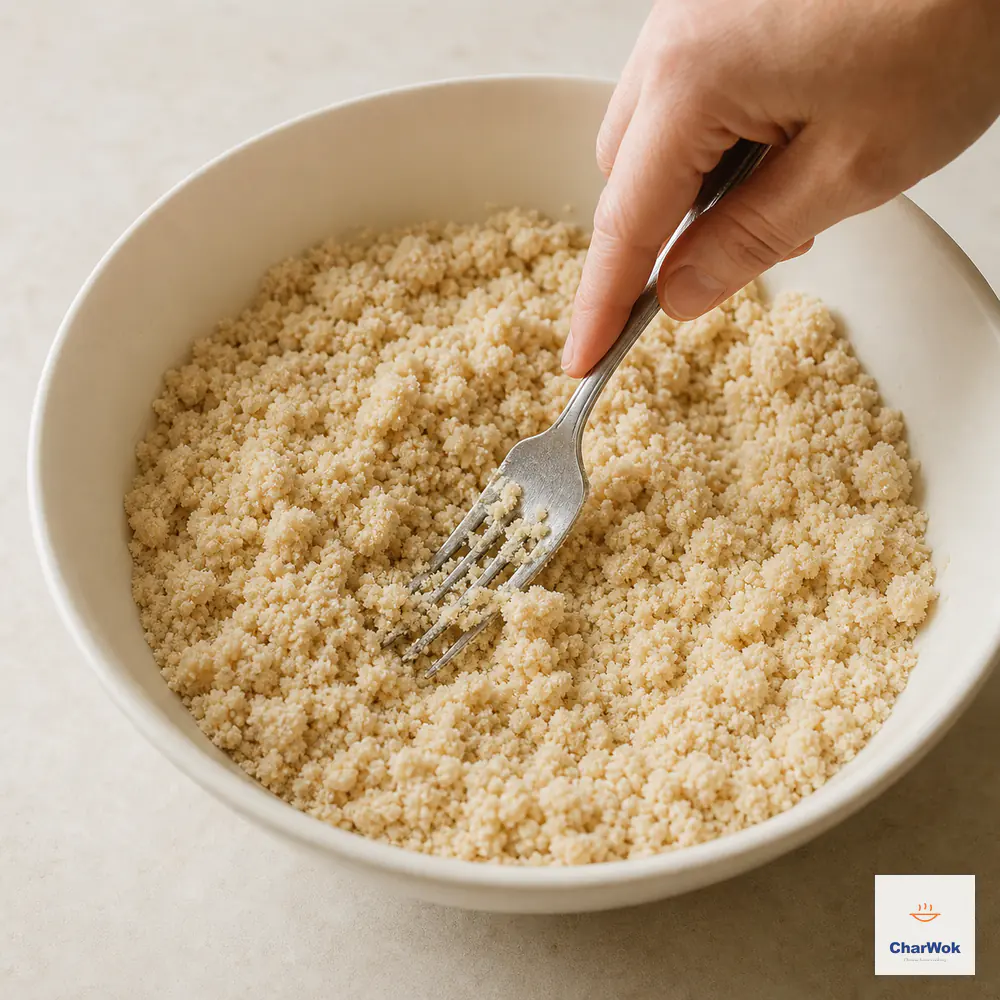
Press, fluff, and stir in the oil until no dry flour remains and many small damp-sand clumps form; do not force the mixture into one dough mass yet.
- Gather and press, do not knead. Squeeze a handful of the sandy mixture. If it holds together in a clump and holds a fingerprint, it is ready. Gather everything and press it lightly into a single mass. It will still crack and look rough, and that is correct. If a squeezed handful immediately falls apart, drizzle in another teaspoon of oil and toss again. Different brands and humidity levels change how much oil the flour wants, so adjust by feel.
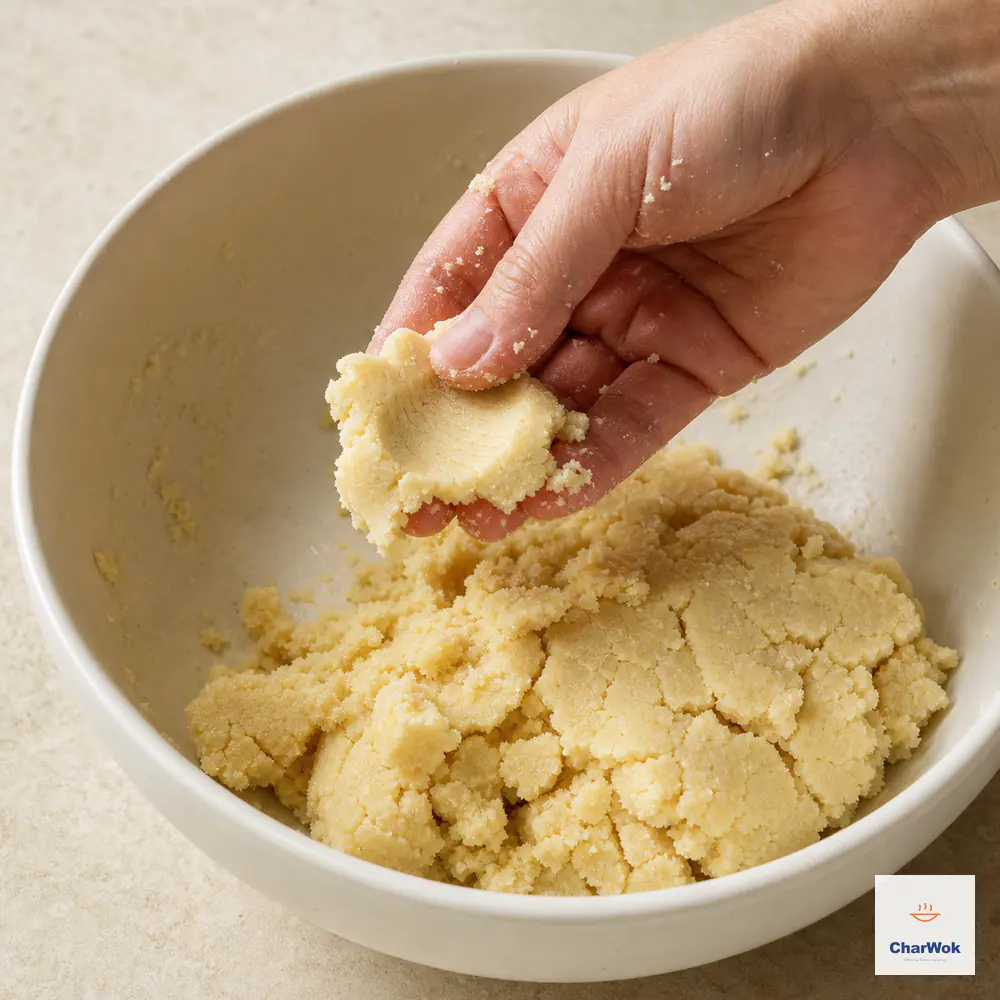
A squeezed handful is ready when it holds together and keeps a fingerprint; gather and press lightly without kneading, adding another teaspoon of oil only if it immediately falls apart.
- Portion the dough. A kitchen scale makes this painless: aim for about 15 g (½ oz) per piece, which gives a two-bite cookie. Roll each portion gently between your palms into a ball. The surface will be a little cracked; smooth is not the goal.
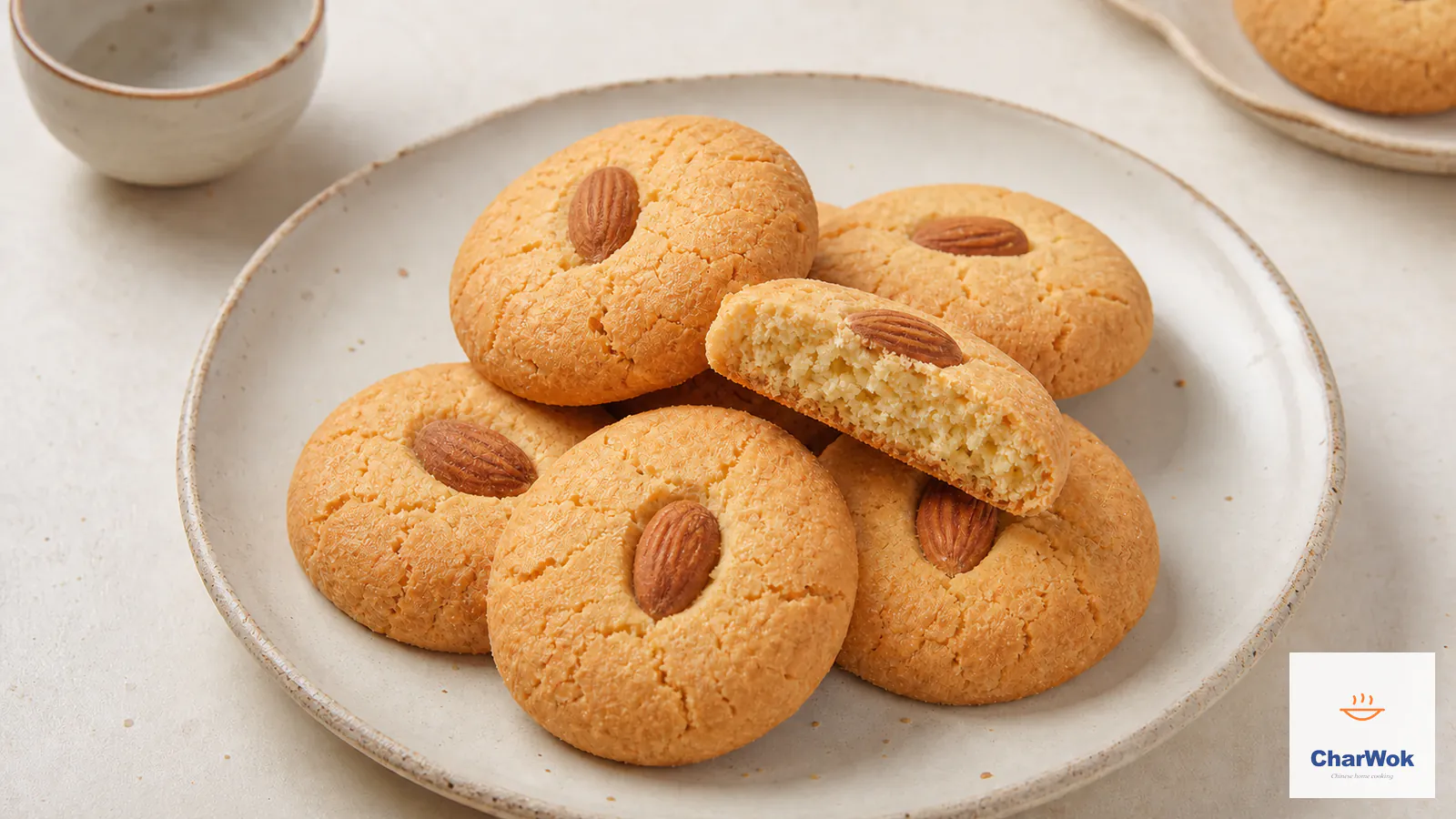
- Crown each cookie with an almond. Set a ball on your lined baking sheet. Press one toasted almond straight down into the top, about halfway in. Pressing flattens the ball into a thick disk and seats the almond so it does not tumble off in the oven. A few cracks around the edge are fine and even attractive.
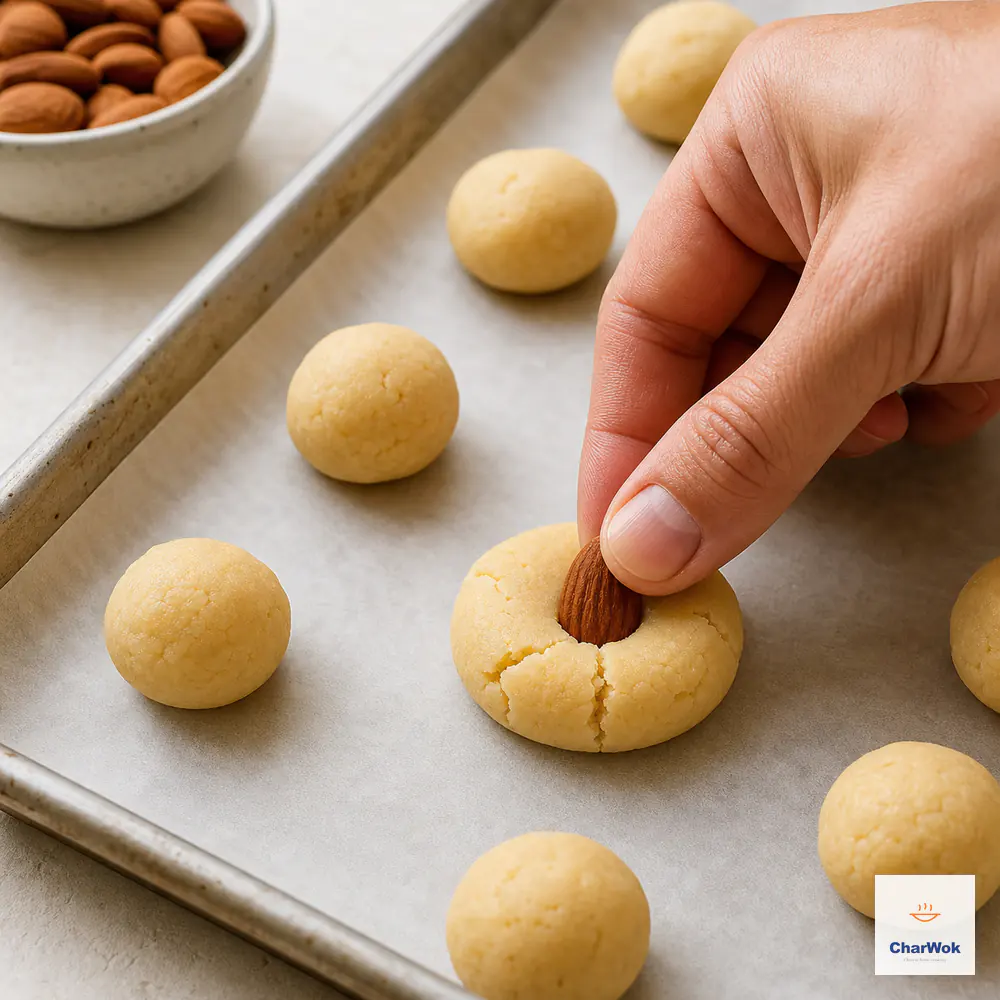
Press one toasted almond straight down halfway into each roughly 15-gram ball; the ball should become a thick disk and a few cracks around the edge are correct.
- Space them out. Leave at least 3 cm (just over an inch) between cookies. The baking powder will puff them slightly, and oil-based doughs spread a little. If you are using butter, spread is greater, so leave a full inch and a half.
- Apply the wash (optional). Beat the yolk with ½ tsp water and brush a thin layer over the exposed dough, avoiding the almond. This is purely for color; skip it for vegan cookies and they will simply be paler on top.
- Bake hot and watch closely. Oven to 180°C / 350°F (160°C / 320°F convection). Middle rack. Bake 18 minutes, checking at 15. Done is when the tops and edges are a warm, even golden brown, not pale. Underbaked almond cookies taste raw and oily; a slightly deeper bake is what drives off the raw-flour flavor and sets the crumb. Cool fully on a wire rack, because they finish firming up as they cool, and a warm cookie will crumble to dust in your hand.
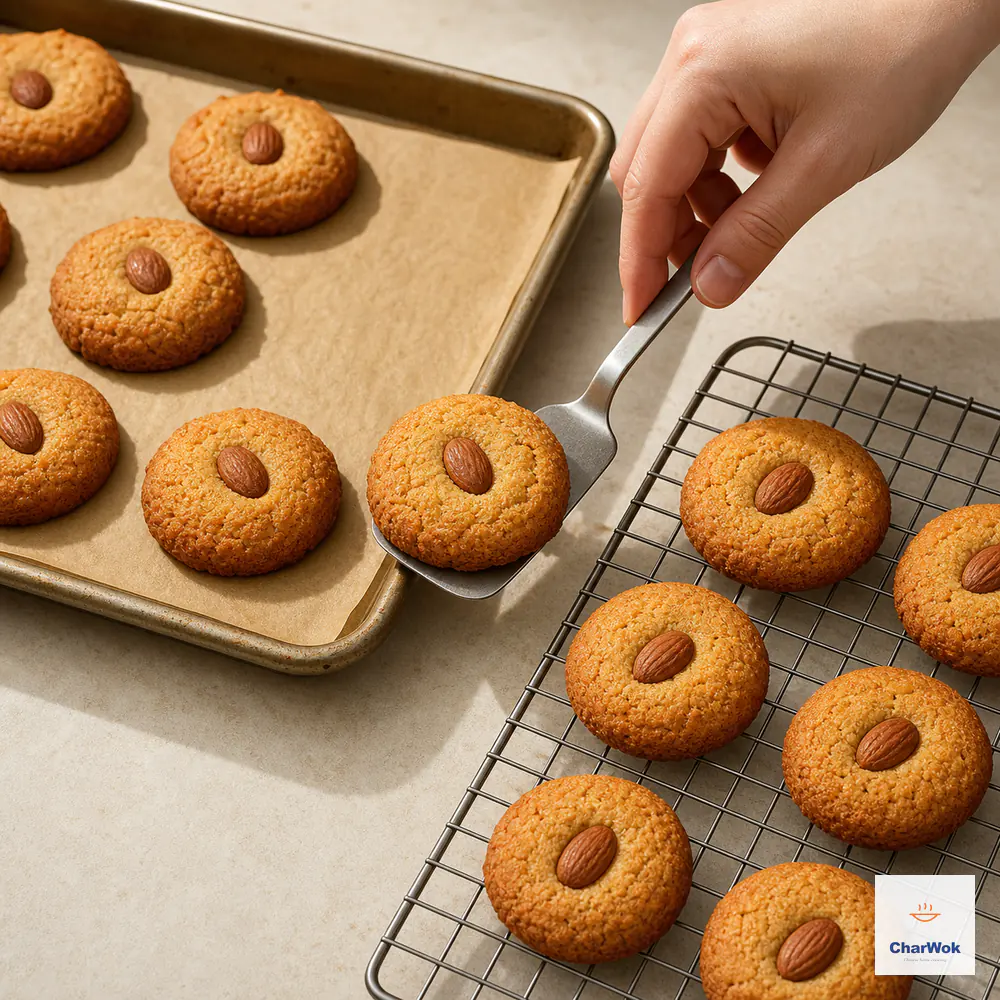
Bake at 180°C / 350°F, checking at 15 minutes, until the tops and edges are evenly warm golden rather than pale; cool fully on a rack so the crumb can firm.
When things go wrong
Because the dough is unconventional, the failures are specific and each one tells you exactly what to fix.
- The dough won't hold a ball and crumbles to powder. It is under-oiled, usually because your flour was dry or your measuring cup was packed. Add oil one teaspoon at a time, tossing well between additions, until a squeezed handful keeps its shape. Go slowly: the line between "too dry" and "greasy" is only a tablespoon or two of oil.
- The dough feels wet or greasy and the cookies spread into puddles. Too much oil, or you used butter and forgot to add the extra. Work in a tablespoon of all-purpose flour, rest the dough ten minutes so it can hydrate, and reshape. Also confirm your oven is actually hot; a slow-to-heat oven lets fat melt and run before the structure sets.
- The baked cookies are hard, not crumbly. You overworked the dough and built gluten, or you measured flour heavy. Next time, mix only until the oil is distributed and stop. This batch is still good dunked in tea.
- Pale, anemic tops and a raw taste. Underbaked. Give them another two or three minutes. Almond cookies want real color; the line between golden and burnt is wider than you think, but pale is a failure mode, not a safe choice.
- The almond falls off after baking. You set it on top instead of pressing it halfway in. Seat it deeper next time; the dough should close partway around it.
- Flat, bland flavor even though the texture is right. The almonds were not toasted, or the salt was omitted. Both are mandatory.
Fat swaps and what each one does
Oil, butter, and lard each make a recognizably different cookie, and the choice is a flavor decision more than a recipe decision.
Neutral oil produces the classic texture: the most crumbly, the most delicate, and the one where the almond comes through cleanest. It is also the easiest dough to handle. This is my default and the one in the table above.
Melted unsalted butter makes a cookie that is crunchier, denser, and browner, with a dairy richness that partially masks the almond. Use about 140 g of melted butter to replace the 110 ml of oil, because butter is roughly 80% fat and 20% water. Expect more spread and a shorter shelf life; butter goes rancid faster than oil.
Lard is the traditional choice and, for my money, the most interesting. Rendered pork fat makes the most tender, most shattering crumb of the three and carries a subtle savory depth that makes the cookies taste grown-up. Use 110 g of solid-at-room-temperature lard in place of the oil; cut it into the dry ingredients the way you would for biscuits, then proceed. If the idea bothers you, oil is still excellent. But lard is worth trying once.
Variations worth a batch
Once the base dough is familiar, the recipe bends easily. A few directions I keep coming back to:
- Black sesame version. Swap half the almond flour for an equal weight of finely ground toasted black sesame, or press the dough around a teaspoon of black sesame paste the way you would the almond. The cookie turns deep charcoal and tastes intensely nutty in a different register.
- Peanut or walnut. The recipe works with other nut flours. Peanut flour makes a softer, sweeter cookie; a toasted walnut half on top is wonderful if slightly more bitter. Adjust oil by feel, since nut flours vary in fat content.
- Almond extract, used sparingly. A quarter teaspoon bumps up the aroma, but anything more reads as artificial. Less is more here.
- Five-spice or orange. A pinch of finely ground five-spice, or a teaspoon of orange zest in the dry mix, turns these into something that pairs beautifully with strong tea after a holiday meal.
What to serve them with
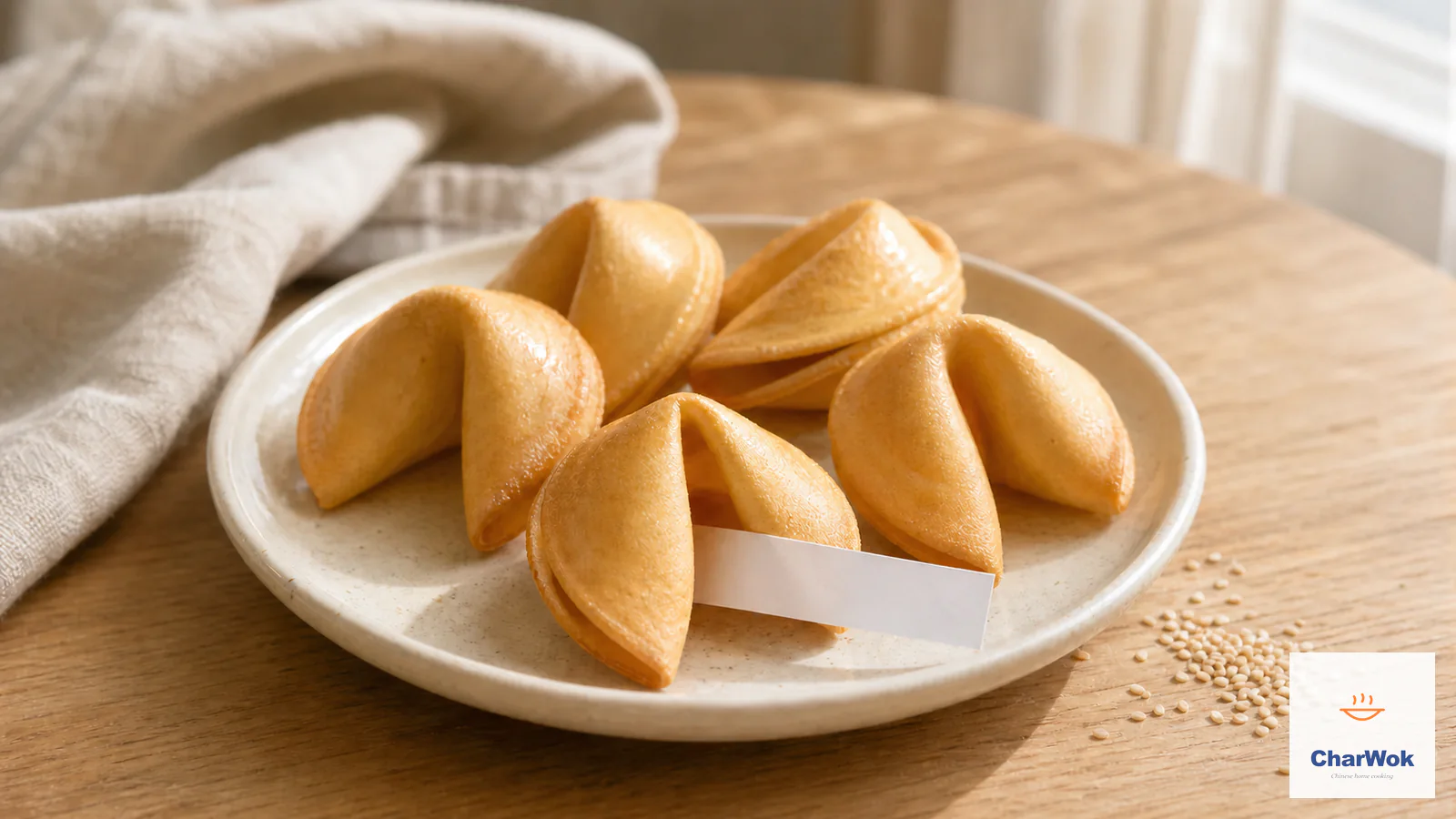
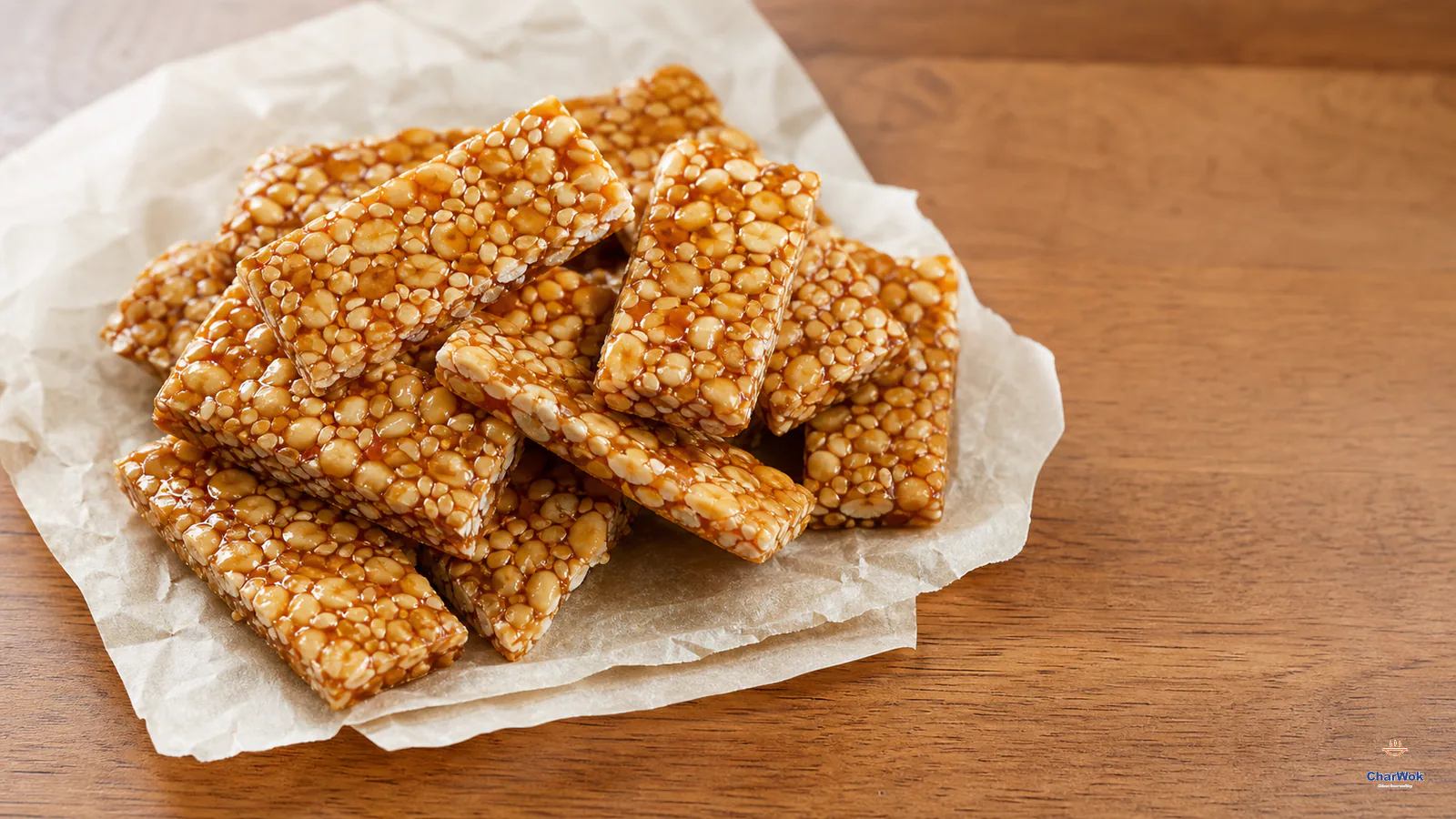
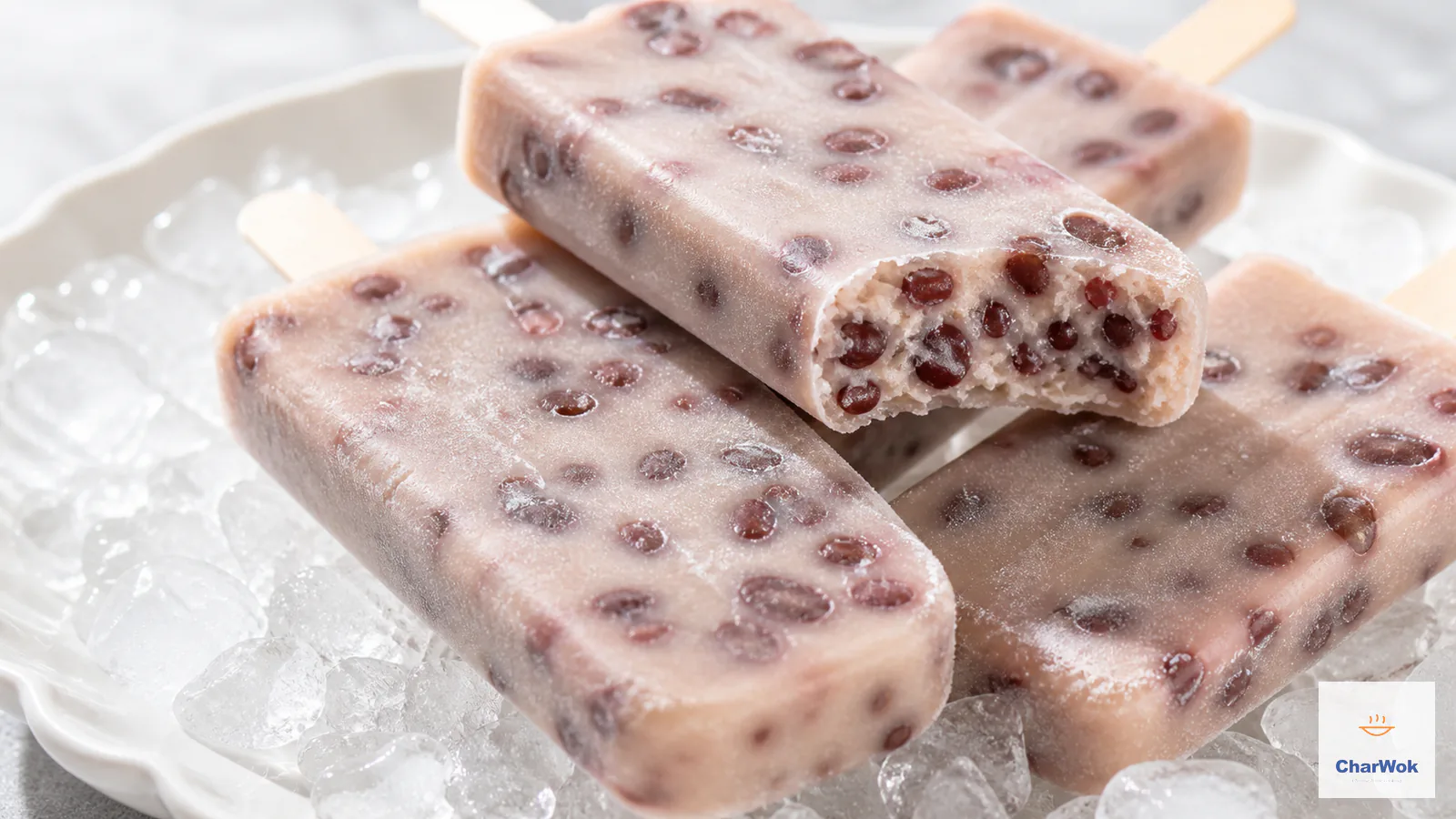
Almond cookies are a tea cookie first. They sit well alongside the milder end of the Chinese sweets shelf: a small bowl of sweet red bean soup, slices of lotus root stuffed with sticky rice, or a plate of homemade fortune cookies if you want a playful spread for guests. For a proper New Year tray, pair them with peanut and sesame brittle and a tinned selection from your festive-season baking so guests have a contrast of crisp, chewy, and crumbly. And they are not out of place at the end of a savory meal; after a spread of breakfast dishes or a simple bowl of noodles, one cookie and a cup of tea is a clean finish.
Keeping them, and bringing them back
Because they are oil-based and low in moisture, these cookies keep unusually well, which is exactly why they were a bakery-jar cookie in the first place. Let them cool completely, because any warmth trapped in a container turns to condensation and softens the crumb. Then store airtight at room temperature, away from light, for up to two weeks. They actually improve on the second day as the texture settles.
To freeze, layer them between sheets of parchment in a rigid airtight container and keep up to three months. Thaw at room temperature, still covered, so they do not pick up moisture. They do not take well to microwaving, which makes them greasy; if a stored cookie has gone soft, a brief five minutes back in a 150°C / 300°F oven crisps them up almost to fresh.
Common questions
Can I make the dough ahead? Yes. Press it flat, wrap tightly, and refrigerate up to three days or freeze a month. Cold dough will be very crumbly, so let it warm to room temperature before portioning, or it will not hold a ball.
Is this the same as an almond biscuit from a dim sum cart? Related, not identical. Cart biscuits are usually lard-based, larger, and drier; this is the smaller, more tender home version. They come from the same family of Chinese "su" pastries, which also includes holiday items like baked rice cake and the fillings thickened with rock sugar.
Can I make them gluten-free? Yes, by swapping the all-purpose flour for a one-to-one gluten-free blend that includes a binder like xanthan gum. Almond flour is already gluten-free, and an alkaline environment can affect browning, so do not also add the lye water used in some other Chinese baked goods here.
Why oil instead of butter for a "better" cookie? Because butter's flavor is loud and competes with the almond. Oil is transparent; it carries the nut's aroma without adding its own. For a purer almond cookie, oil is the correct choice.
That is the whole cookie. The dough will look wrong the first time you make it, too crumbly and too reluctant, and that is the dough telling you it is doing its job. Toast the almonds, trust the oil, and let them brown properly. Everything else follows.