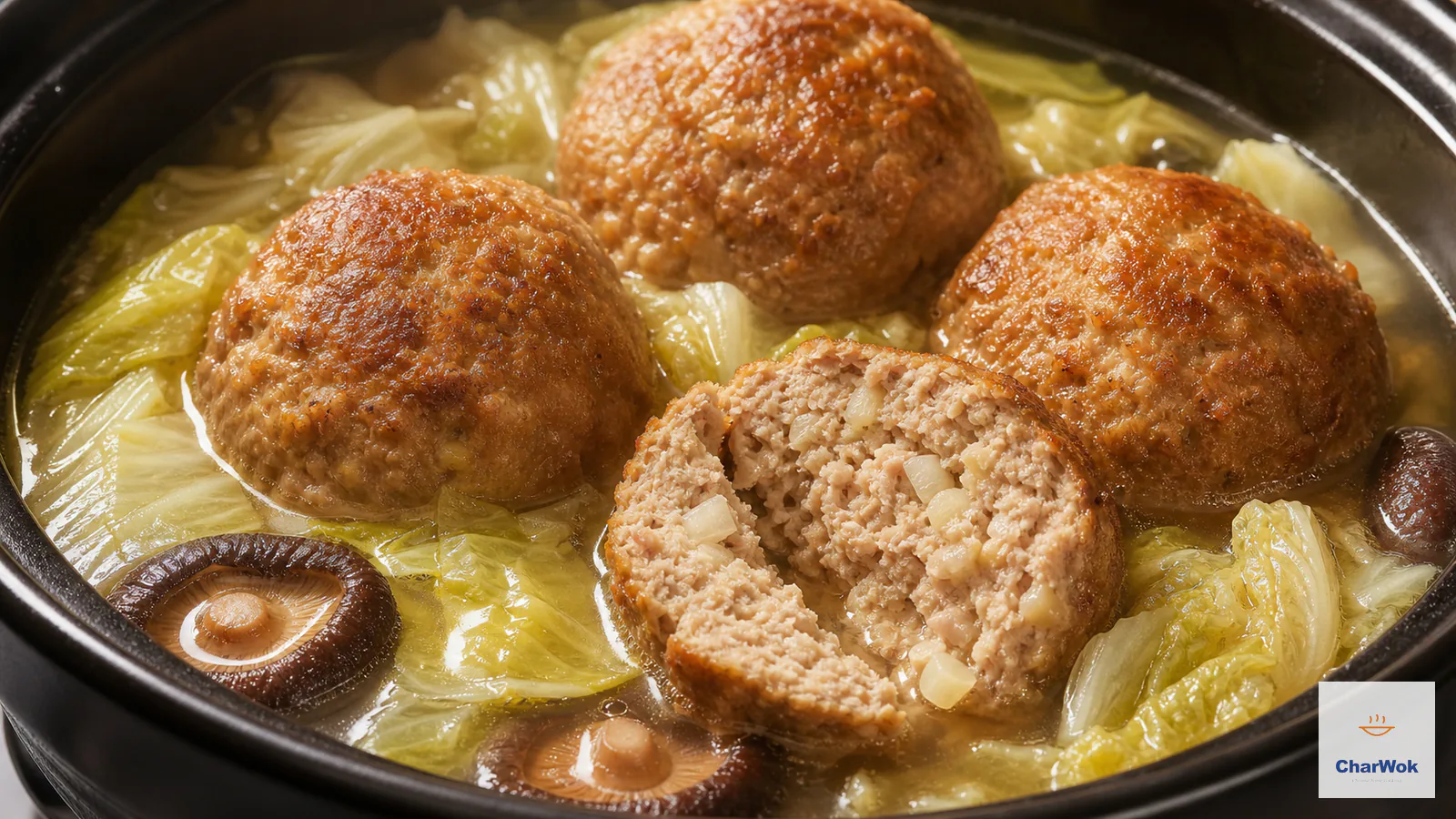
The first time I made Lion's Head Meatballs, I overworked the pork until it bounced like a rubber ball. The size was right, the broth was golden, and yet each bite fought back. A proper Shi Zi Tou should barely hold together, so tender that the surface of the meatball shivers when the pot trembles, and a spoon parts it almost without resistance. That featherlight, almost custardy interior is the whole point of the dish, and it comes from a single technique most home cooks skip: stirring the meat far longer than feels reasonable.
These oversized pork meatballs, braised with Napa cabbage in a clear mushroom broth, are a Huaiyang classic from the lower Yangtze. Yangzhou and Zhenjiang, specifically. The name comes from the shape: each meatball is the head, the long shreds of cabbage around it the lion's mane. It is festive food, the kind of dish that lands in the middle of the table at a New Year's dinner or a multi-course Chinese feast, and one meatball per person is exactly right.
At a glance: Six giant meatballs from 500 g total meat, hand-stirred for three to four minutes until the paste turns sticky and glossy, briefly deep-fried at 180°C (360°F) to set the crust, then simmered 20 minutes in Napa cabbage and shiitake broth. The stir is the whole dish — skip it and you get dense, bouncy balls instead of the melting, fork-tender texture that defines a real Lion's Head.
What makes a proper Lion's Head
Two things separate this from an ordinary meatball. The first is size. A Lion's Head is roughly the size of a tennis ball, around 7 cm (2.75 in) across. You cannot get that interior softness from a small meatball, because a small ball has too little mass relative to its surface. Scale matters. The second is the hand-stirred, water-bound paste. By beating the ground meat in one direction and working in liquid, you extract the soluble proteins (chiefly myosin) that coat the muscle fibers and lock them into a fine, continuous gel. This is the same protein behavior behind a good sausage farce or a springy pearl meatball, but taken further. The result is a meatball that holds its shape in the fryer yet breaks apart softly on the tongue.
The braise does the rest of the work. Cabbage, mushroom broth, and a gentle 20-minute simmer migrate moisture back into the crust and melt the rendered fat into the surrounding liquid. By the end, the meatball has gone from crisp-skinned to silken, and the broth has turned savory and faintly sweet from the cabbage. It belongs to the same family of gentle braises as red-cooked pork belly and Mei Cai Kou Rou, but lighter, paler, and built around the meatball itself.
The ingredients, and what each one is doing
Ingredients at a glance
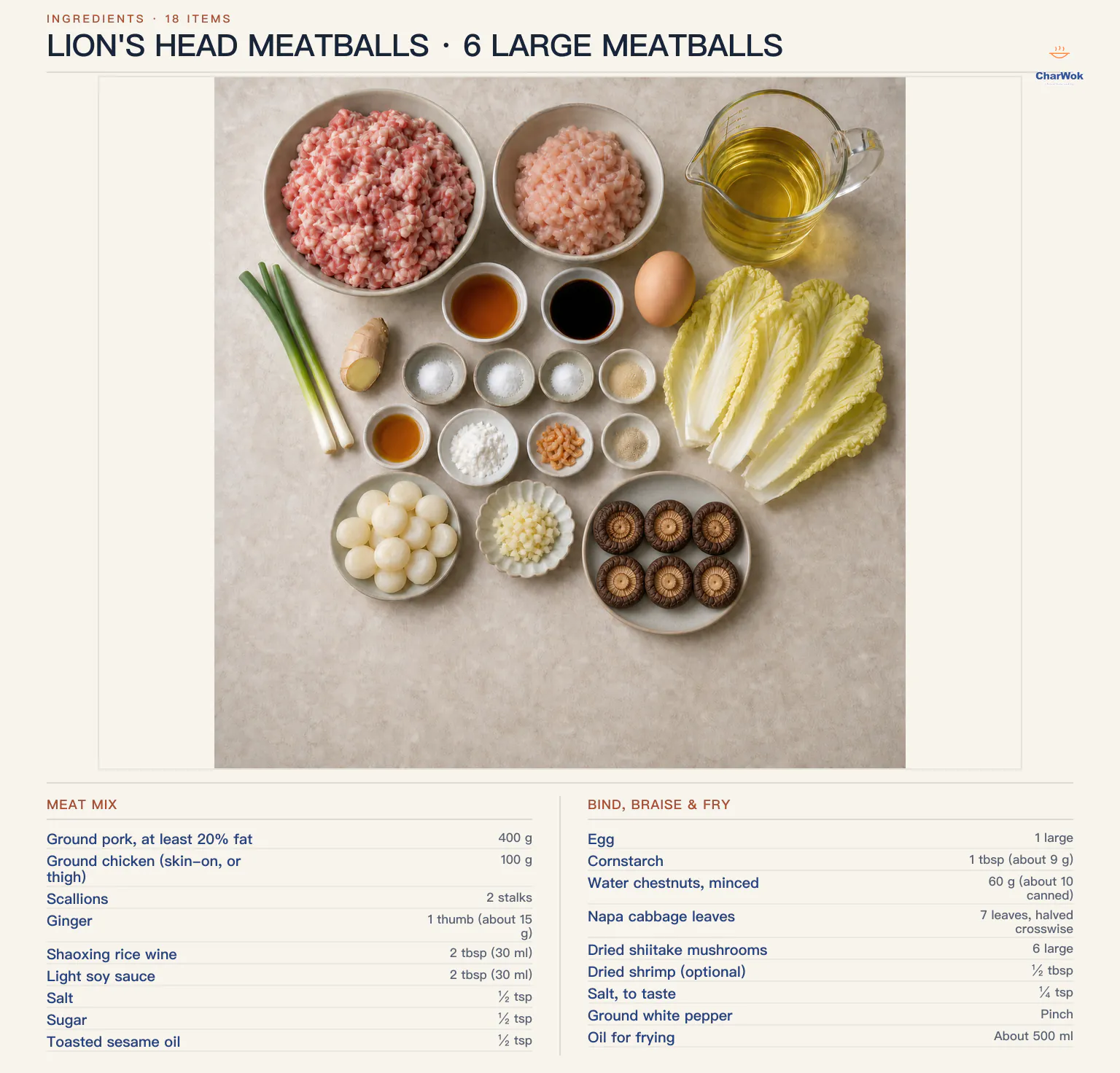
| Ingredient | Amount | Notes / substitute |
|---|---|---|
| Ground pork, at least 20% fat | 400 g | Shoulder or belly trim. Do not go lean; the fat is what makes the interior soft. Ask the butcher for a coarse grind if possible. |
| Ground chicken (skin-on, or thigh) | 100 g | Lightens the dense pork. Dark-meat chicken keeps it juicy; ground shrimp works too. |
| Scallions | 2 stalks | Split into two jobs: flavor the soaking water, then garnish. |
| Ginger | 1 thumb (about 15 g) | Thinly sliced for the soaking water. |
| Shaoxing rice wine | 2 tbsp (30 ml) | Shaoxing wine masks any pork gaminess. Dry sherry is the standard substitute. |
| Light soy sauce | 2 tbsp (30 ml) | Salt and color. See the light vs. dark soy sauce guide if you only have one kind. |
| Salt | ½ tsp | For the meat mix. |
| Sugar | ½ tsp | Rounds the soy; not sweet. |
| Toasted sesame oil | ½ tsp | Backnote only. Chinese sesame oil is strong, so go light. |
| Egg | 1 large | Binds without toughening. |
| Cornstarch | 1 tbsp (about 9 g) | Locks in the absorbed water during frying. |
| Water chestnuts, minced | 60 g (about 10 canned) | The contrasting crunch. Bamboo shoots or jicama are reasonable substitutes. |
| Napa cabbage leaves | 7 leaves, halved crosswise | Separate the firm white ribs from the leafy green tops; they go in at different times. |
| Dried shiitake mushrooms | 6 large | Soak overnight in 500 ml water; save that liquid, it is half the broth. See the shiitake guide for soaking times. |
| Dried shrimp (optional) | ½ tbsp | Adds savory depth. Rehydrate alongside the mushrooms; dried shrimp details here. |
| Salt, to taste | ¼ tsp | For the broth. |
| Ground white pepper | Pinch | Fruitier and cleaner than black; standard in pale Chinese soups. |
| Oil for frying | About 500 ml | Use a small, deep pot so you need less; you only need 5 to 6 cm of depth. |
The method, step by step
Before you start, note the timing: you can mix and fry the meatballs a day ahead, then braise them just before serving. That makes this one of my favorite make-ahead dishes when I'm feeding a crowd.
- Make the scallion-ginger water. Cut the scallions into sections (reserve a little green top for garnish) and slice the ginger. Drop them into a small bowl with 6 tbsp (90 ml) hot water and let it cool. This flavored water is what you'll beat into the meat; it seasons the inside evenly without leaving bits of scallion that would burn in the fryer.
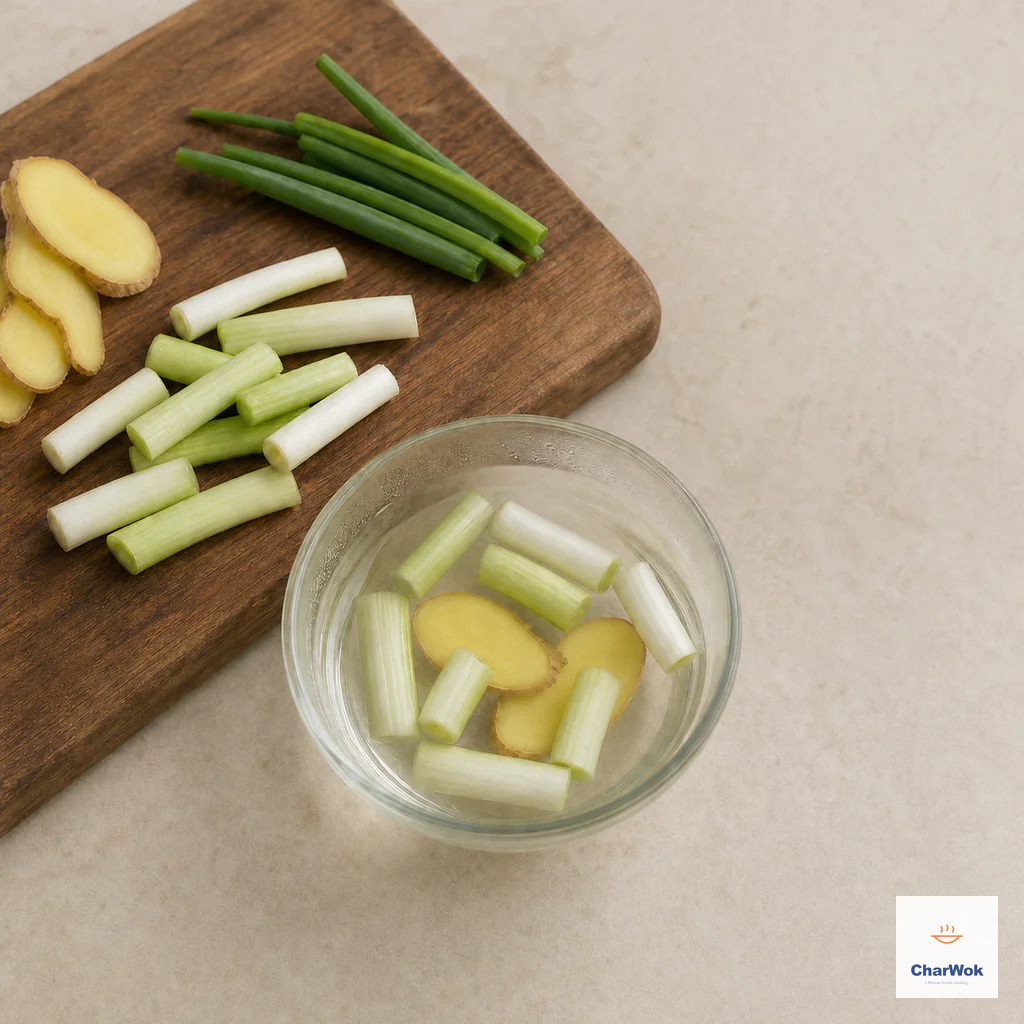
Steep scallion and ginger in 90 millilitres warm water, let it cool and reserve a little green top for serving.
- Stir the paste, the step that defines the dish. Combine the pork, chicken, wine, soy, salt, sugar, sesame oil, egg, and cornstarch in a wide bowl. Stir firmly in one direction only. After about a minute, start adding the cooled scallion-ginger water a spoonful at a time, waiting until each addition is absorbed before adding more. Keep going. Around the three-minute mark the texture changes: the paste turns sticky, glossy, and visibly lighter, and it will pull into strands as you lift the spoon. This is the protein network forming. When the meat looks almost jiggly, fold in the minced water chestnut and stop, because over-mixing after this point makes the ball dense.
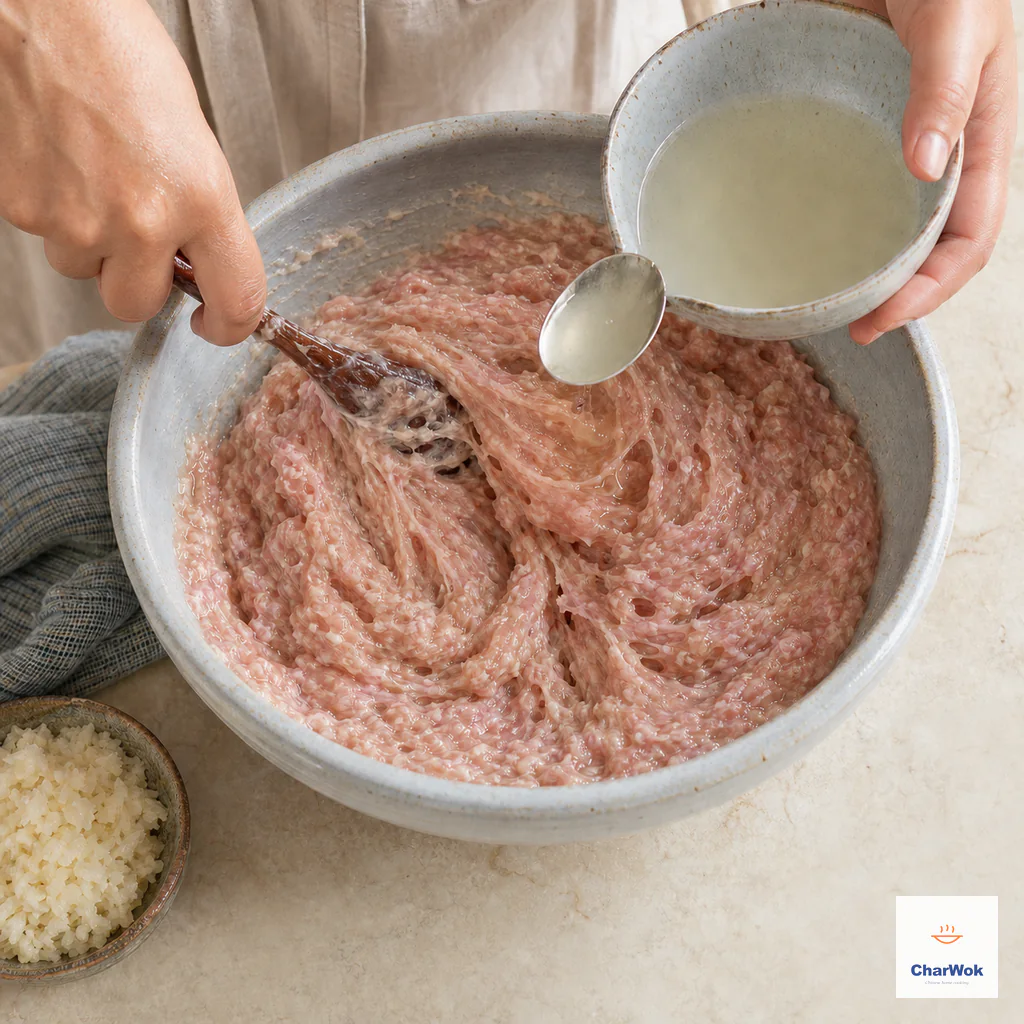
Stir in one direction and wait for every spoonful of cooled aromatic water to disappear before adding the next.
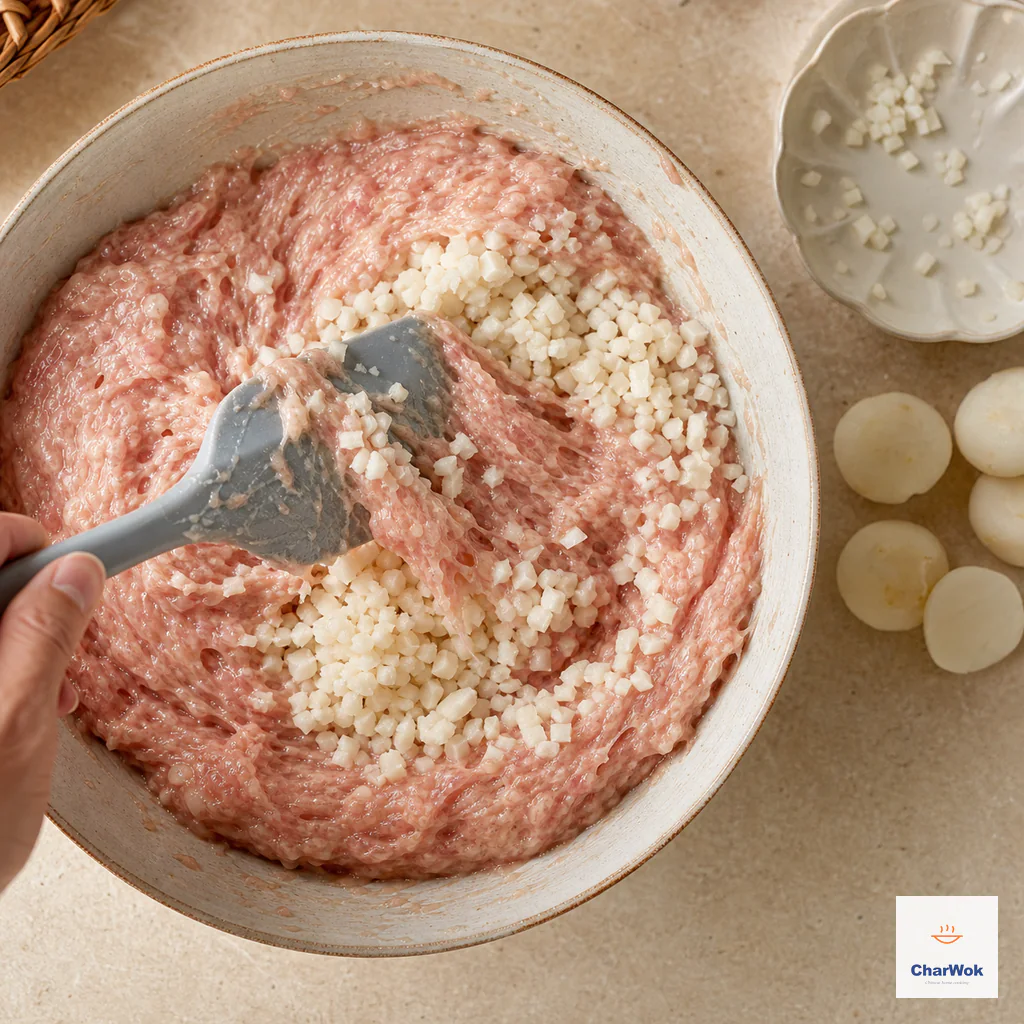
Once the paste is elastic and glossy, fold in the water chestnuts gently so their crisp pieces stay distinct.
- Shape with a bowl, not your hands. Divide the mix into 6 portions. For each one, scoop it into a small round bowl and press it against the side with the back of a spoon to mold a smooth ball. Hands warm the fat and leave the surface lumpy; the bowl method keeps the meat cold and the crust even.
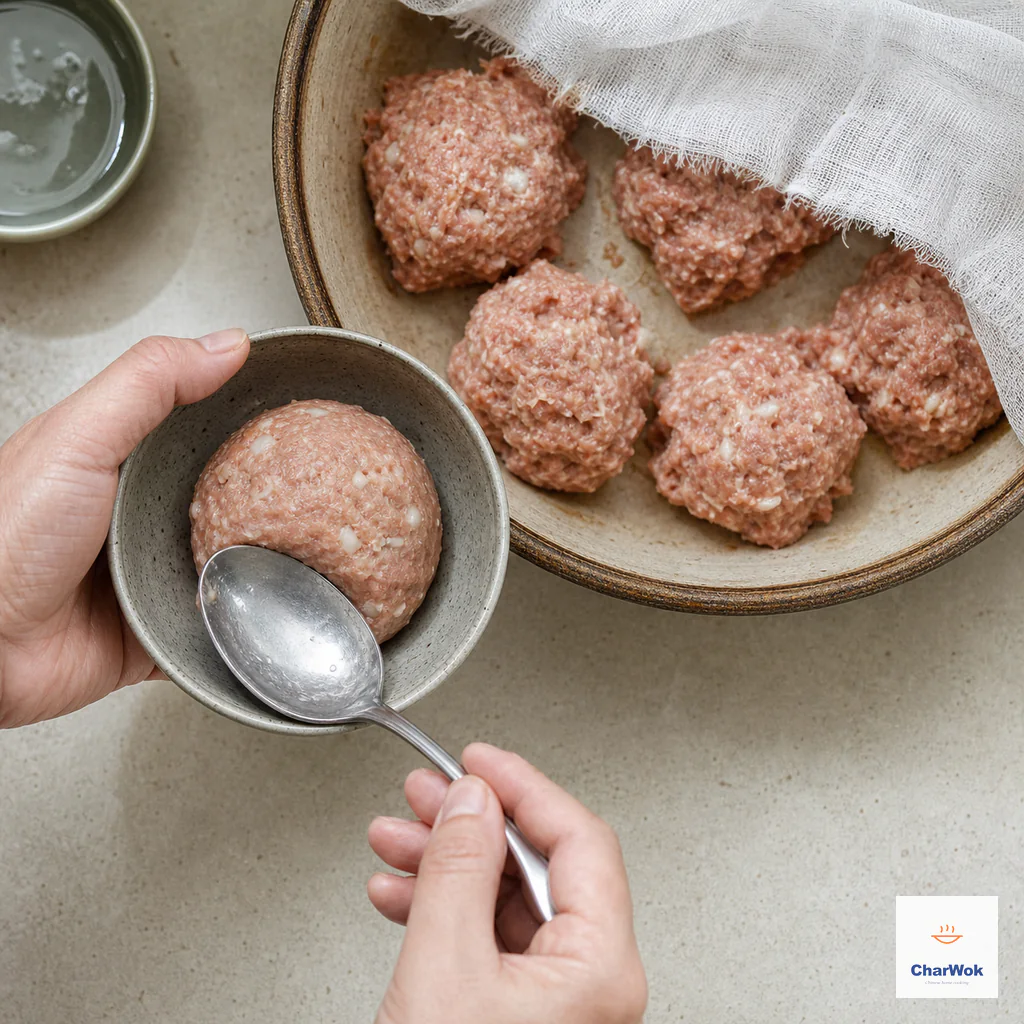
Shape one of six cold portions against a small bowl wall with a spoon, then fry it before shaping the next.
- Fry to set the crust, not to cook through. Heat the oil to 180°C (360°F). No thermometer? Drop in a tiny bit of the meat mix; it should sizzle immediately and brown at the edges in about 30 seconds. Slide in only one or two balls at a time so the temperature doesn't crash, and roll them gently so they color evenly. Pull them out when they're an even deep gold, around 3 minutes. They will still be raw in the center, and that's correct; the braise finishes them.
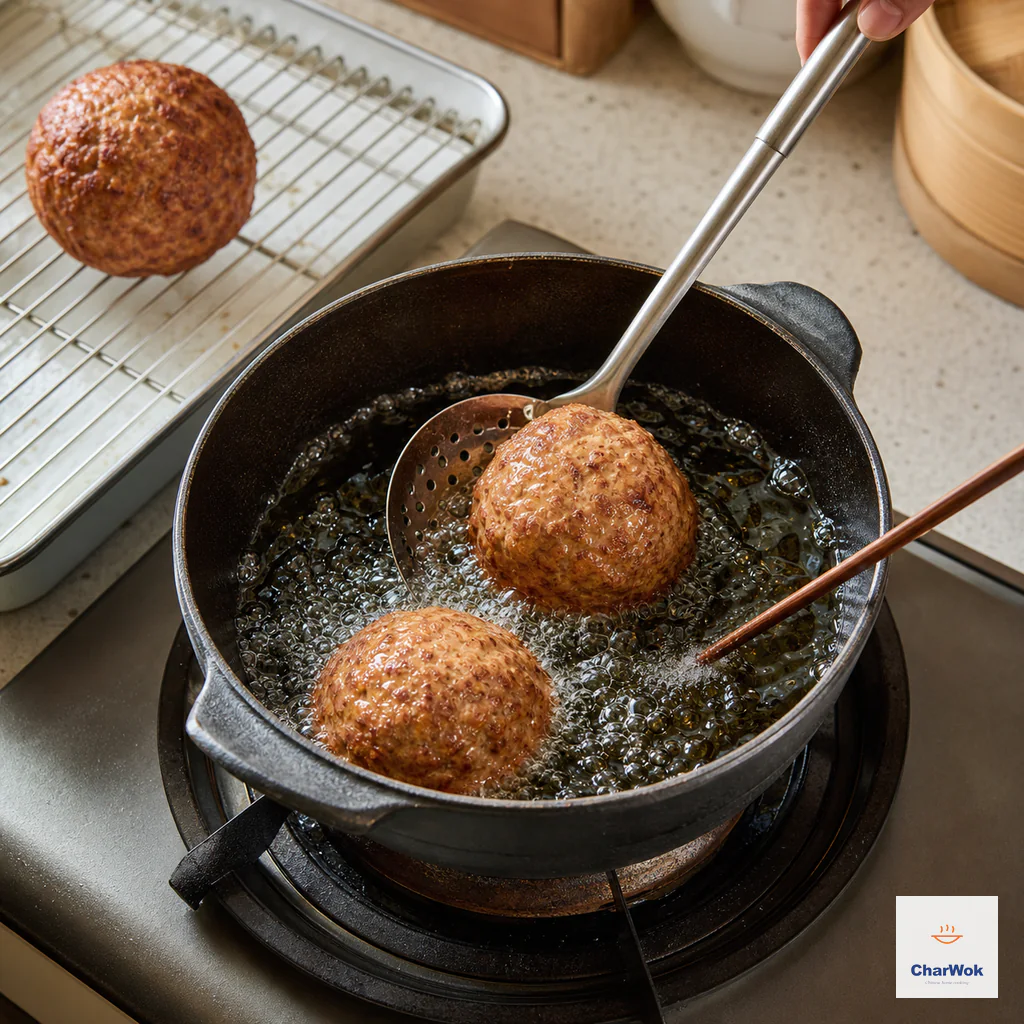
Fry no more than two at 180°C, rolling gently, and remove after about three minutes when the crust is evenly deep gold.
- Build the braise. In a wide, heavy pot (Dutch oven or clay pot), lay the white cabbage ribs across the bottom to form a bed. They protect the meatballs from scorching and sweeten the broth. Set the fried meatballs on top. Add the sliced shiitakes and pour in the soaking liquid slowly, leaving any grit behind. Tuck in the spent scallion and ginger from step 1, plus the dried shrimp if using. Season the liquid with the salt and white pepper.
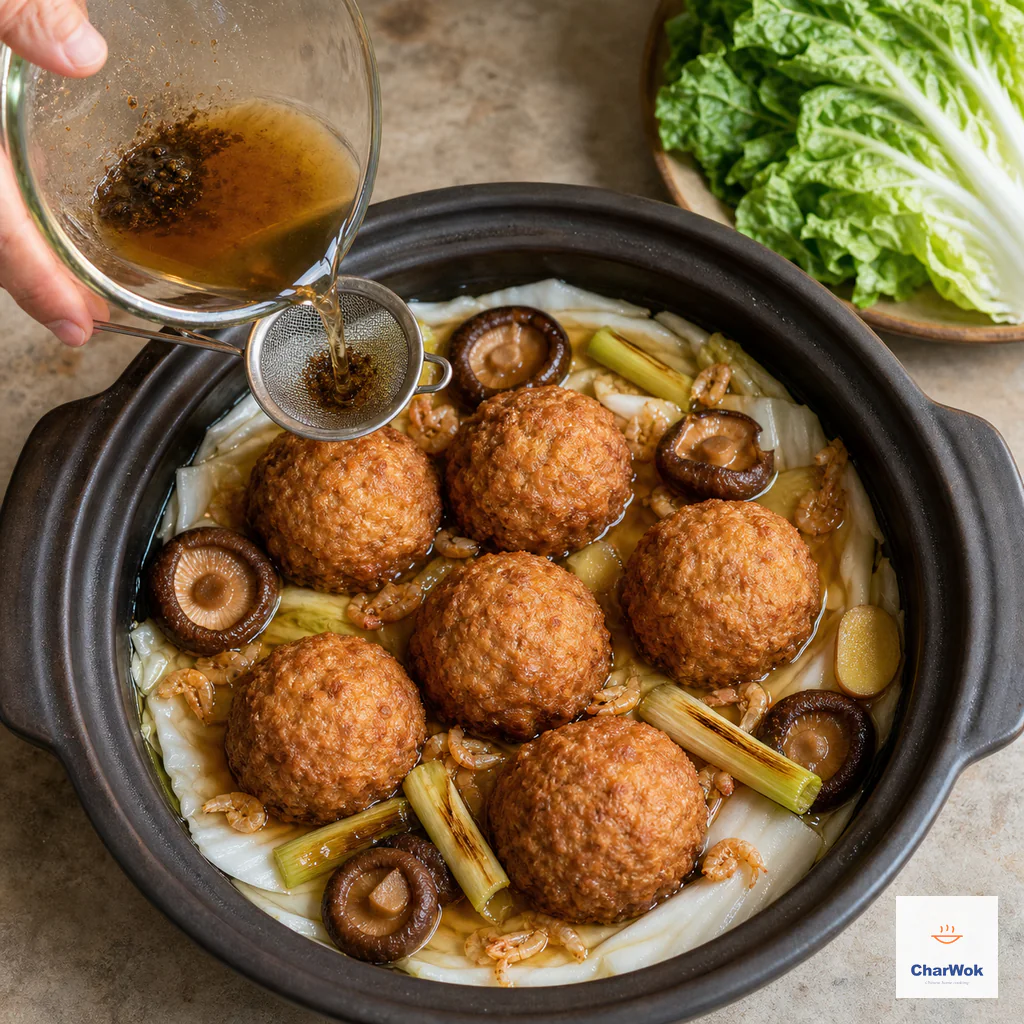
Protect the pot with firm cabbage ribs, add the meatballs and aromatics, then strain in shiitake soaking liquid without its grit.
- Simmer low and covered. Bring it to a full boil, then drop the heat to the lowest setting that still maintains a gentle tremble, cover, and cook 15 minutes. Now lay the leafy green cabbage tops over the meatballs (adding them now instead of at the start keeps them from dissolving to mush) and simmer another 5 minutes. The meatballs should give way the instant you press them with a spoon.
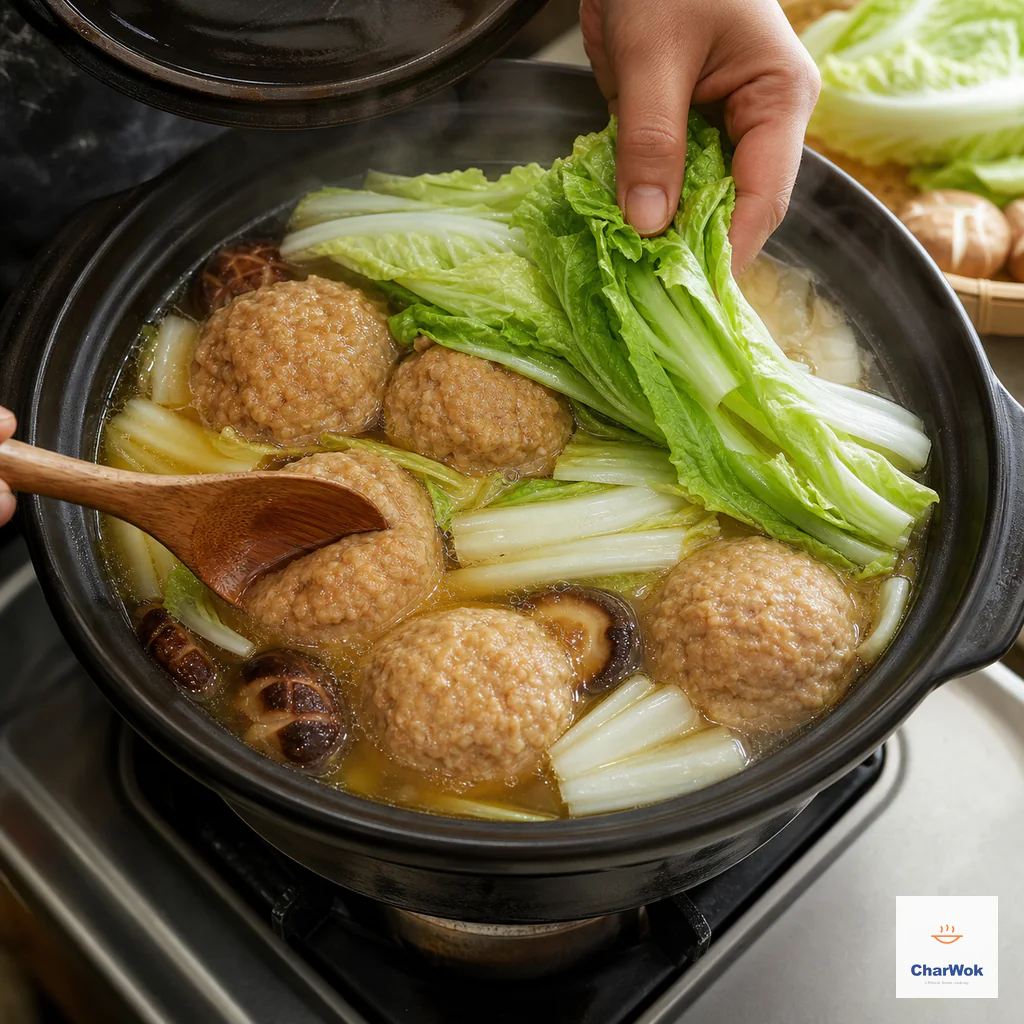
After 15 minutes at the gentlest covered simmer, add the leafy tops for only five more minutes and check the meatballs yield softly.
- Finish and serve. Scatter the reserved scallion green over the top. Serve in wide, shallow bowls with steamed jasmine rice, spooning broth over everything.
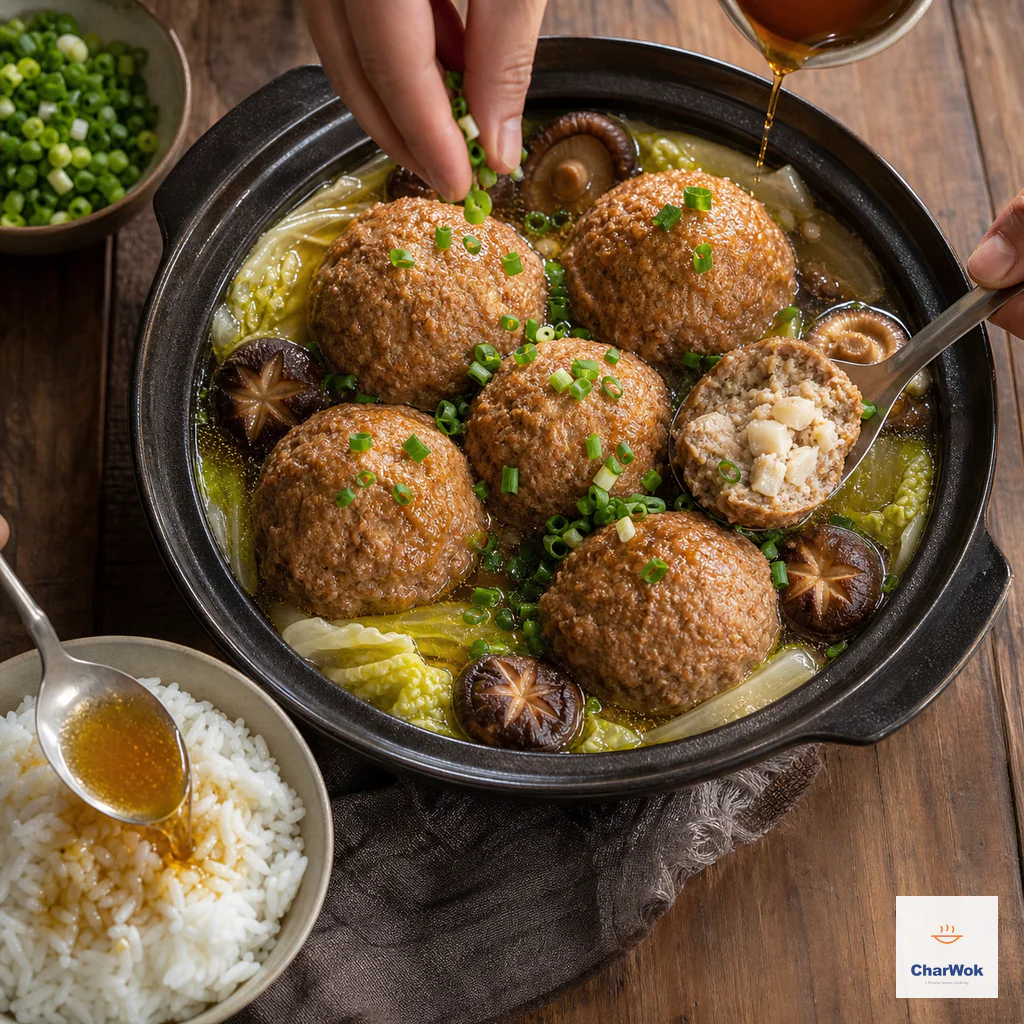
Scatter the reserved scallion greens, finish with a very small drizzle of sesame oil and serve the meatballs and broth with hot rice.
Why the meat turns out wrong, and how to read it
This is the section I wish someone had handed me before my rubber-ball batch. The failures all have a clear tell.
The meatball is bouncy and dense. You stopped stirring too early, or you stirred in two directions and broke the protein network. The paste should look noticeably paler and glossier than when you started, and it should pull in sticky strings off the spoon. If it still looks like raw ground meat, keep going; another minute fixes it. The water must also go in slowly. Dumping it in all at once makes the mix loose, and the proteins can't bind around it.
The balls fall apart in the oil. Two likely causes. Either the oil wasn't hot enough when they went in (below 170°C/340°F the crust never sets and they melt), or the meat was too warm. If the paste feels soft and warm after shaping, chill the portions for 15 minutes before frying. Frying only one or two at a time is non-negotiable; a crowded pot drops the temperature and you get greasy, splitting meatballs.
The crust is dark but the center is cold. The oil ran too hot, above about 195°C/380°F, so the outside browned before the interior warmed. Hold at 180°C/360°F and remember the fry is only to set the shell; the braise does the real cooking. If your burner runs hot, pull the pot off the heat for a few seconds between batches.
The broth tastes thin. It's almost always the mushroom soaking liquid. Pour it in slowly and stop before the grit at the bottom. If you used canned broth instead of rehydrating dried mushrooms, the dish loses half its character, because dried shiitakes carry the glutamate that makes the soup taste full.
Variations and what to serve alongside
The braise is flexible. A few directions worth trying:
- Brown sauce version (Hong Shao). Swap the pale broth for a dark soy and rock sugar braise, the same flavor base as sweet and sour meatballs without the vinegar. Deeper, sweeter, glossier, closer to banquet food.
- Steam-braised, no fryer. If deep-frying is a dealbreaker, you can bake the shaped meatballs at 200°C/400°F for 15 minutes to set a light crust, then proceed with the braise. The texture is slightly less rich but the dish is still excellent, and a lot less messy. This is honestly how I cook them on a weeknight.
- Crab or shrimp lift. Fold 80 g of finely chopped cooked crabmeat or minced raw shrimp into the paste with the water chestnuts. A Yangzhou-style crab-roe Lion's Head is a famous variant; even without the roe, the shellfish brightens the whole pot.
- Add a noodle or a soup. The braising liquid is a clean broth that loves carbs. Ladle it over a bowl of thin noodles for a one-bowl meal, or serve the meatballs as the centerpiece of a larger spread with a hot and sour soup starter and a quick vegetable like garlic bok choy.
For a full meal I'd put one Lion's Head per person at the center, flanked by rice, a stir-fried green, and something pungent. Pickled cucumber or a smashed cucumber salad cuts the richness of the broth nicely.
Storage and reheating
The meatballs actually improve after a night in the fridge; the flavors settle into the broth and the texture firms just enough to make them easy to lift. Store meatballs and broth together, covered, up to three days. To reheat, bring the pot back to a gentle simmer for about 8 minutes until heated through. Avoid a hard boil or the meatballs can crack. They also freeze well, before or after braising, for up to two months. Thaw overnight in the fridge.
Frequently asked questions
Do I have to use both pork and chicken? No, all pork works fine. The chicken is there to lighten the texture; if you skip it, use 500 g of fatty pork shoulder and the result will be richer and slightly denser.
Can I skip the deep-frying? Yes. Bake the shaped balls at 200°C/400°F for about 15 minutes to set a light skin, then braise as written. You lose some richness but the dish stays excellent.
Why stir in only one direction? It aligns the muscle fibers as the proteins bind, which keeps the texture smooth. Switching directions tangles that network and can make the meat feel chopped rather than set.
What if I can't find dried shiitakes? Rehydrated dried mushrooms give most of the broth's depth. If you must use fresh, add a teaspoon of soy sauce and an extra pinch of sugar to compensate, and expect a thinner-tasting soup.
How do I know the meat is stirred enough? When the paste is visibly paler, glossy, and sticky enough to pull in strings off the spoon, it's done, usually three to four minutes of steady stirring.