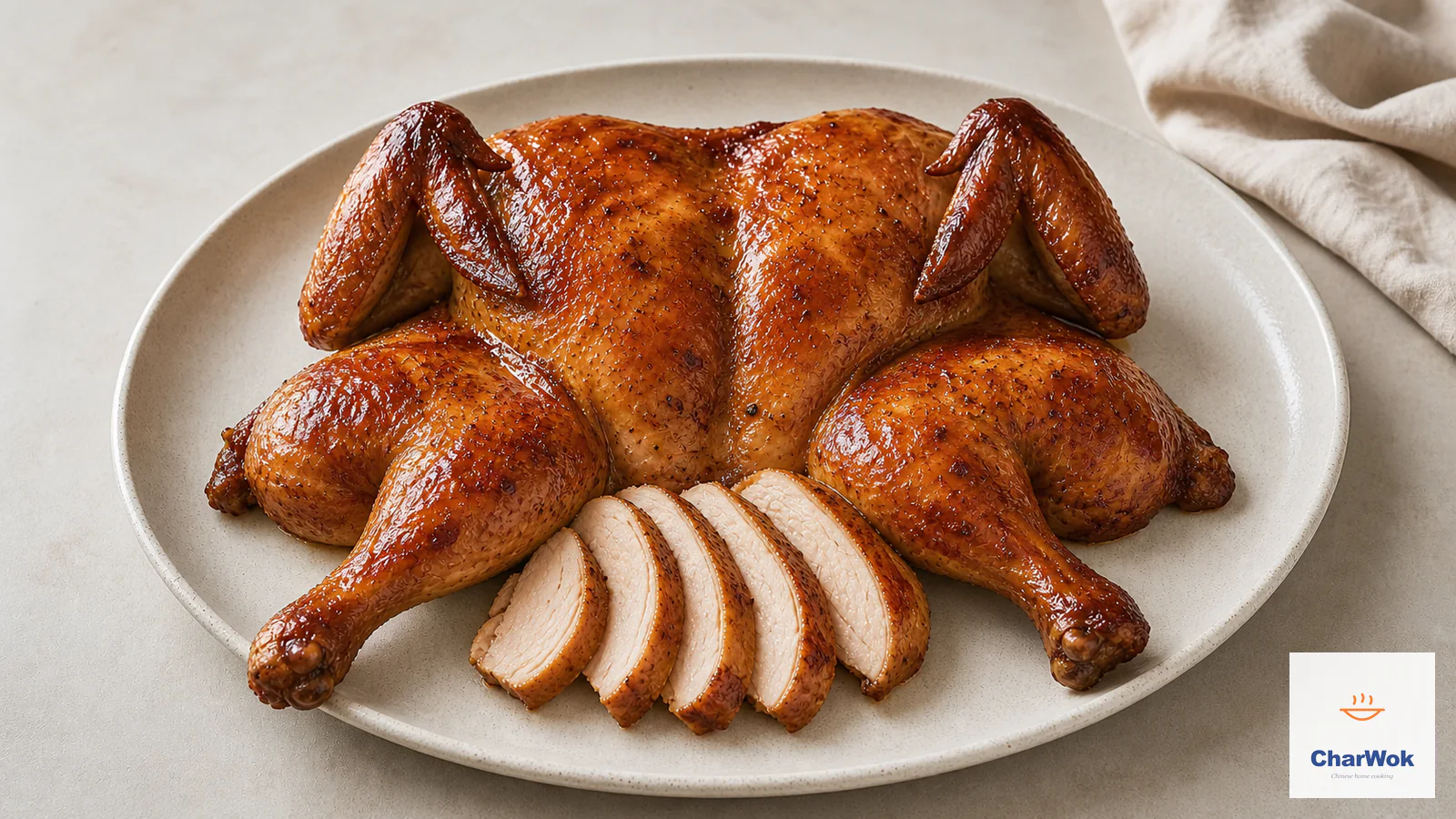
The hardest thing about roasting a whole chicken is that the parts cook at different speeds: the breast dries out while you wait for the dark meat to finish. Five Spice Chicken sidesteps that problem by removing the backbone and flattening the bird, then seasons it with a dry brine of salt and five-spice that works overnight. The result is meat that tastes seasoned all the way through, not just on the surface, and skin that crackles instead of going rubbery.
This roast shares its mahogany color with Soy Sauce Chicken and its sweet-savory glaze with Char Siu Chicken. Most of the preparation happens the night before, when the flattened chicken is seasoned and left uncovered in the refrigerator.
At a glance: butterfly a 1.8 kg (4 lb) bird, dry-brine it uncovered on a rack inside a rimmed tray in the refrigerator for 12 to 24 hours, then move it directly from the refrigerator to the prepared oven. Roast in three temperature steps, 200°C down to 160°C and back up to 200°C (400°F / 320°F / 400°F). Divide the honey-soy glaze into two clean portions before brushing. The times are checkpoints: remove the chicken only when the innermost thigh and wing and the thickest breast each reach 165°F (74°C), away from bone.
What makes this a Chinese roast chicken
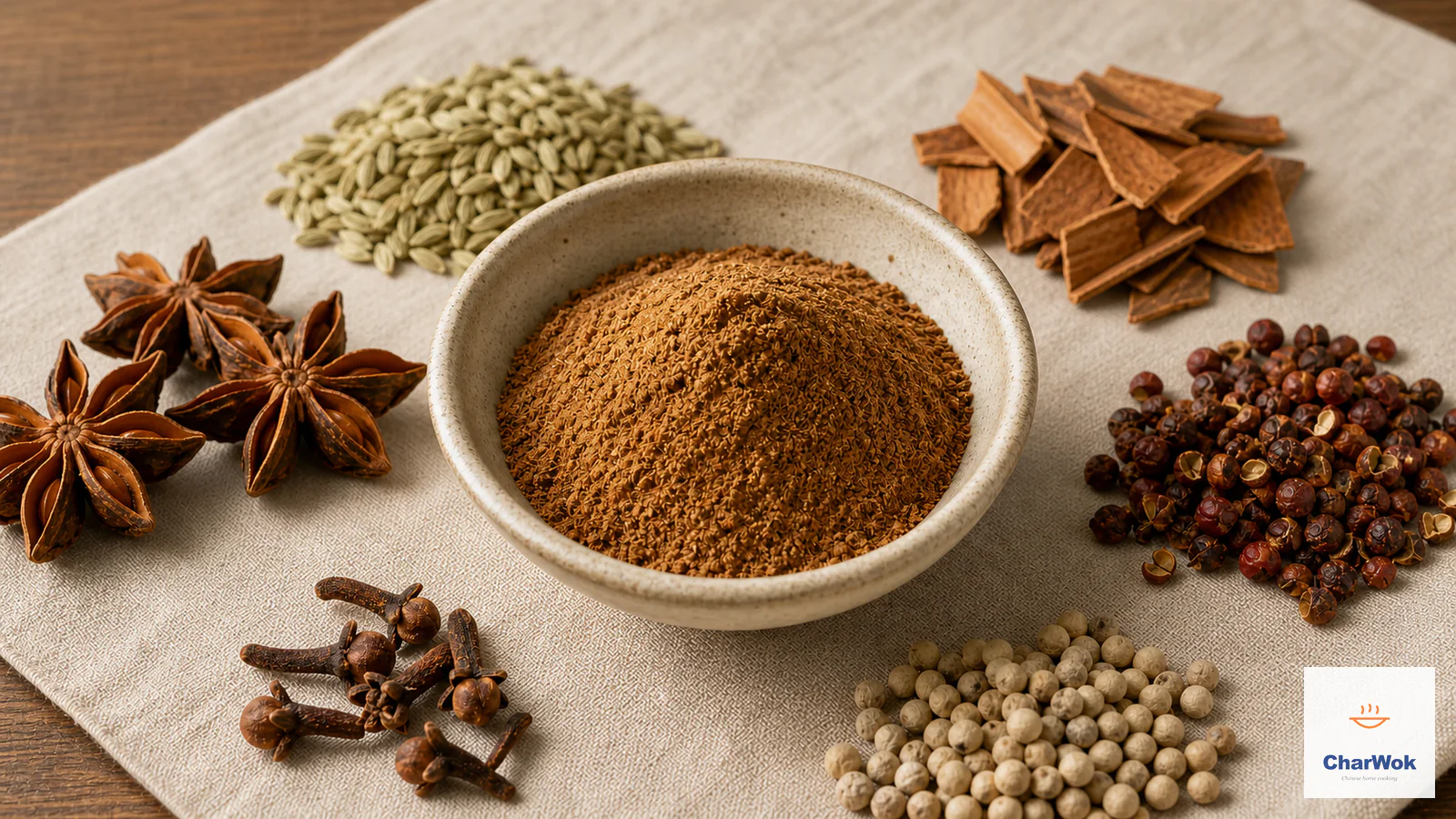
Five-spice powder is the main seasoning. It is commonly built around star anise, Sichuan peppercorn, fennel, clove, and cassia, and you can mix your own from scratch or buy a prepared blend. The remaining seasoning is salt, garlic powder, white pepper, dark soy sauce, and optional Shaoxing rice wine.
Dark soy sauce deepens the color of the rub and glaze. If you only have light or regular soy sauce, use it, but expect a paler bird.
Why spatchcock the bird
Spatchcocking, or butterflying, means cutting out the backbone so the chicken lies completely flat. With the bird flattened, the thighs, which need more time, sit up at the edges where the heat is strongest, while the breast, which overcooks in seconds, lies low and cooks gently. The whole bird finishes at roughly the same moment, and a 1.8 kg chicken roasts in about 45 minutes instead of the hour-plus a whole bird demands.
You need poultry shears or sturdy kitchen scissors. Set the chicken breast-down with the legs pointing toward you, find the backbone running down the middle, and cut straight down one side of it, then the other. Save the backbone for homemade chicken stock. Flip the bird breast-up and press firmly on the breastbone with the heel of your hand until you feel it crack and the bird lies flat. If it fights you, it has not cracked yet; press a little harder.
Ingredients
Ingredients at a glance
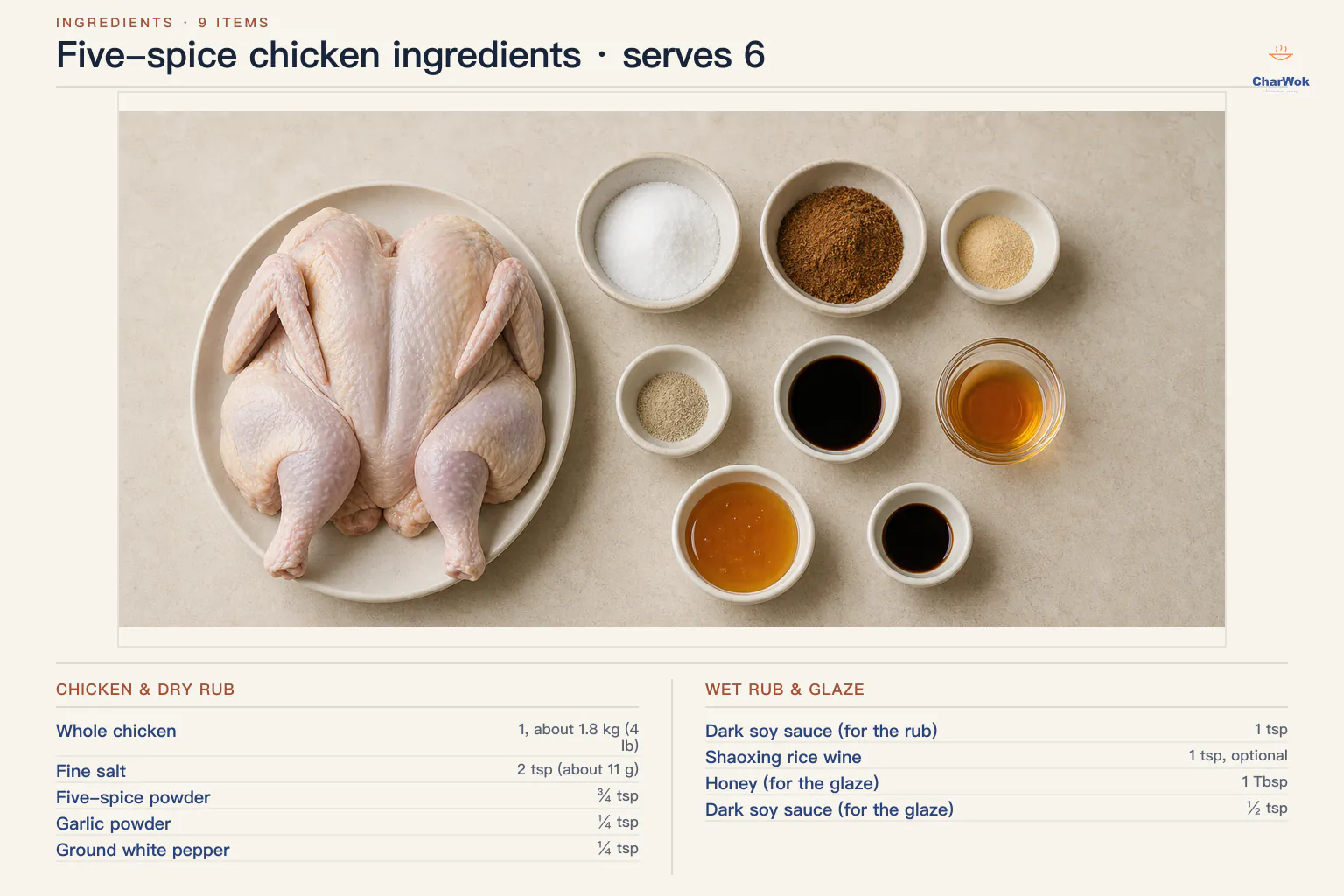
Scaled for one butterflied chicken around 1.8 kg (4 lb), serving 6.
| Ingredient | Amount | Notes / substitute |
|---|---|---|
| Whole chicken | 1, about 1.8 kg (4 lb) | Pasture-raised if you can get it. Do not go much over 2 kg; a huge bird overcooks before the skin browns. |
| Fine salt | 2 tsp (about 11 g) | Fine grain dissolves and spreads; coarse salt leaves salty spots. Diamond Crystal or Morton kosher both work if you grind them finer. |
| Five-spice powder | ¾ tsp | Homemade five-spice is brighter than the tin; either is fine. |
| Garlic powder | ¼ tsp | Garlic granules work. Fresh garlic burns at the high finishing heat, so use the dried version here. |
| Ground white pepper | ¼ tsp | Black pepper is visible on the skin and harsher; white pepper is the standard choice. |
| Dark soy sauce (for the rub) | 1 tsp | Regular soy sauce works but browns less. Add a pinch of sugar to compensate. |
| Shaoxing rice wine | 1 tsp, optional | Skip for an alcohol-free version, or sub dry sherry. |
| Honey (for the glaze) | 1 Tbsp | Maple syrup or maltose work; maltose is what Cantonese roast meats use for that glassy shine. |
| Dark soy sauce (for the glaze) | ½ tsp | Just enough to cut the sweetness and help the glaze adhere. |
The method
- Dry the bird thoroughly. After spatchcocking, pat the inside and outside dry with paper towels. Surface moisture is the enemy of crisp skin; the drier the skin goes into the fridge, the more it sets up overnight.
- Mix the dry rub (salt, five-spice, garlic powder, white pepper) in a small bowl, and the wet mix (soy sauce and wine) in another. Splitting them keeps the salt distribution even; if you wet the salt first it clumps and lands in patches.
- Season inside, then out. Lay the bird skin-down and rub half the dry mix over the cavity side, working it into the folds of the thigh and under the leg joints where flavor tends to miss. Flip it skin-up, brush the wet mix over the whole surface, then scatter and massage in the rest of the dry rub.
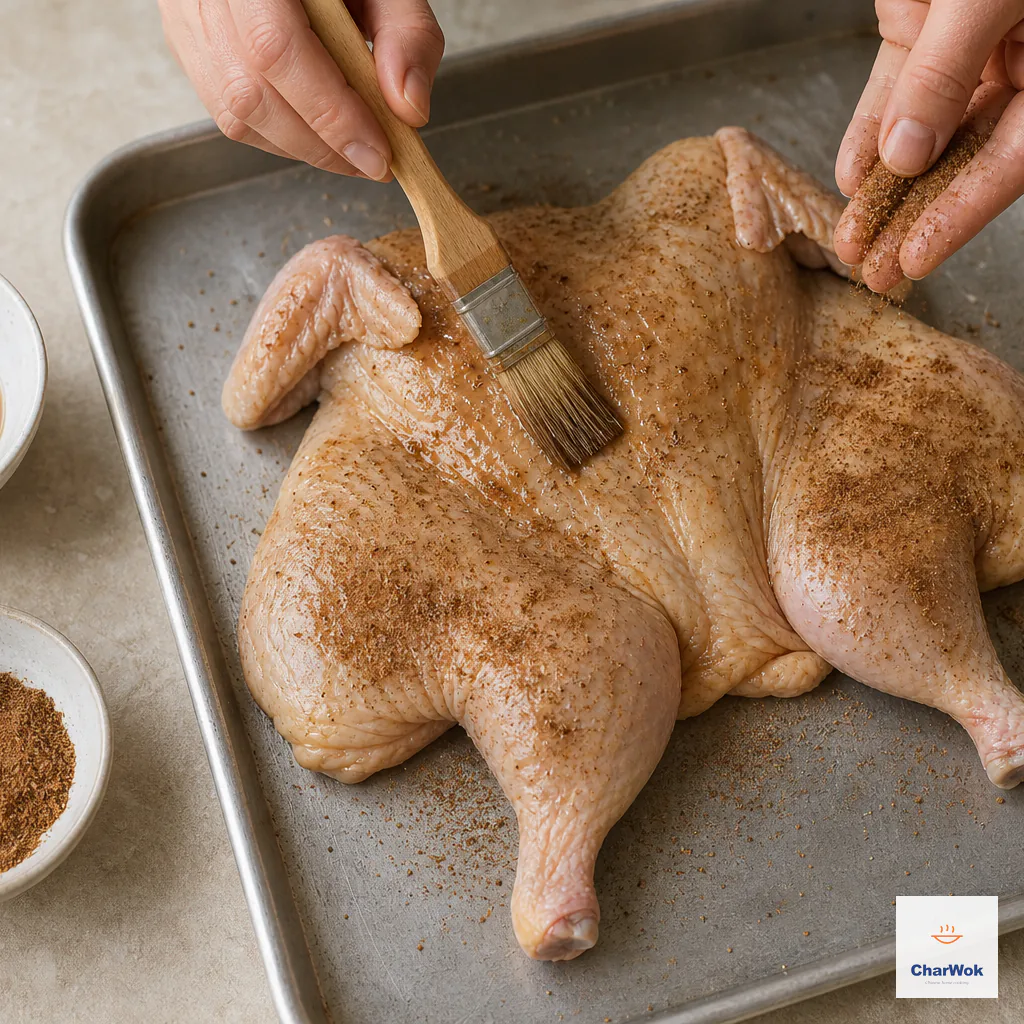
Brush the wet mix over the skin first, then scatter and massage in the remaining dry rub for an even coat
- Dry-brine uncovered, 12 to 24 hours. Set the bird skin-up on a rack inside a rimmed tray and place it on the lowest refrigerator shelf, separated from ready-to-eat food. Keep the refrigerator at 40°F (4°C) or below. The cold, dry air helps dehydrate the skin; the rimmed tray contains raw poultry juices.
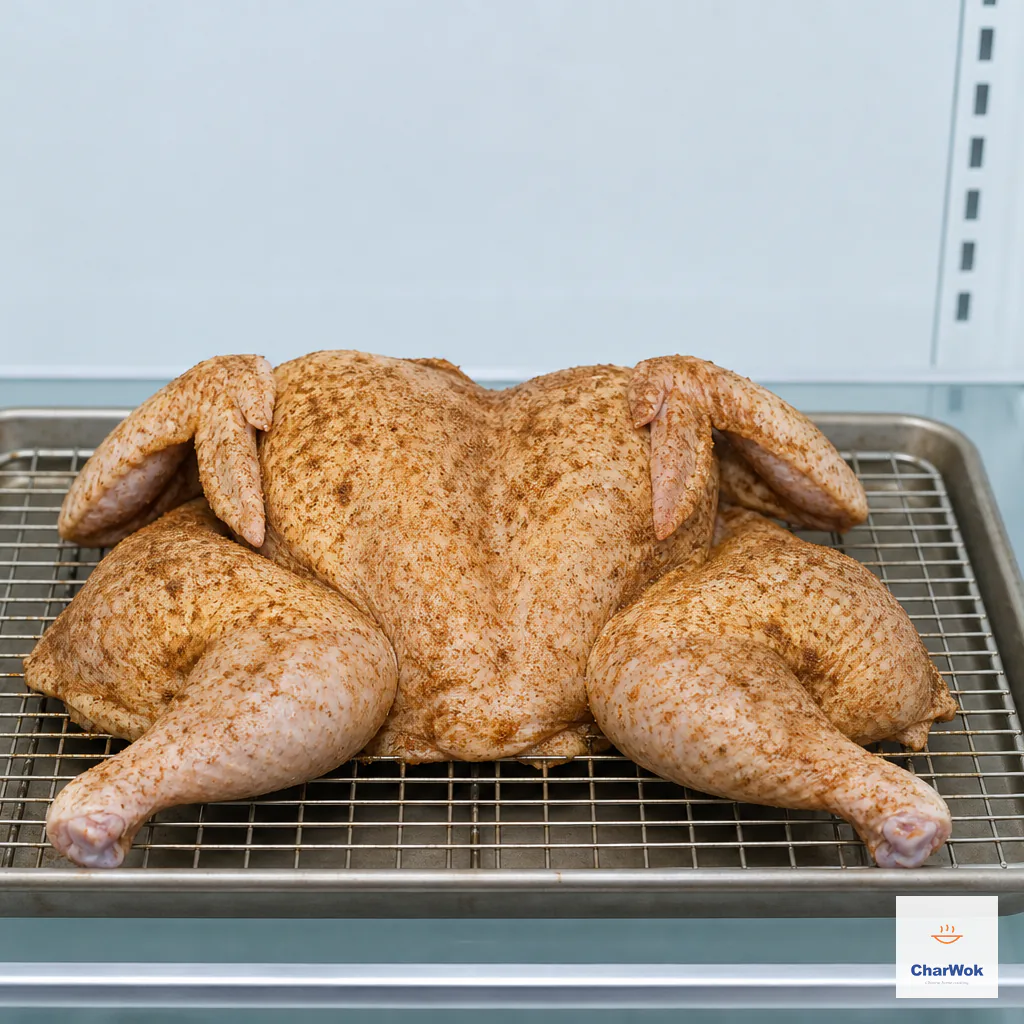
Dry-brine uncovered for 12 to 24 hours on a rack inside a rimmed tray on the lowest refrigerator shelf, away from ready-to-eat food
- Keep it cold until the oven is ready. Preheat the oven and prepare the water tray first, then transfer the chicken directly from the refrigerator to the rack. Do not leave raw poultry on the counter to warm up.
- Roast hot first. Heat the oven to 200°C (400°F) on convection, or 220°C (425°F) on conventional. Set the bird skin-up on a wire rack over a roasting tray, then pour water into the tray to a level below the rack. The water catches fat drippings so they do not smoke, and it keeps the oven humid enough that the skin blisters rather than splits. Roast 15 minutes. The initial blast sets the proteins on the surface and starts the Maillard browning.
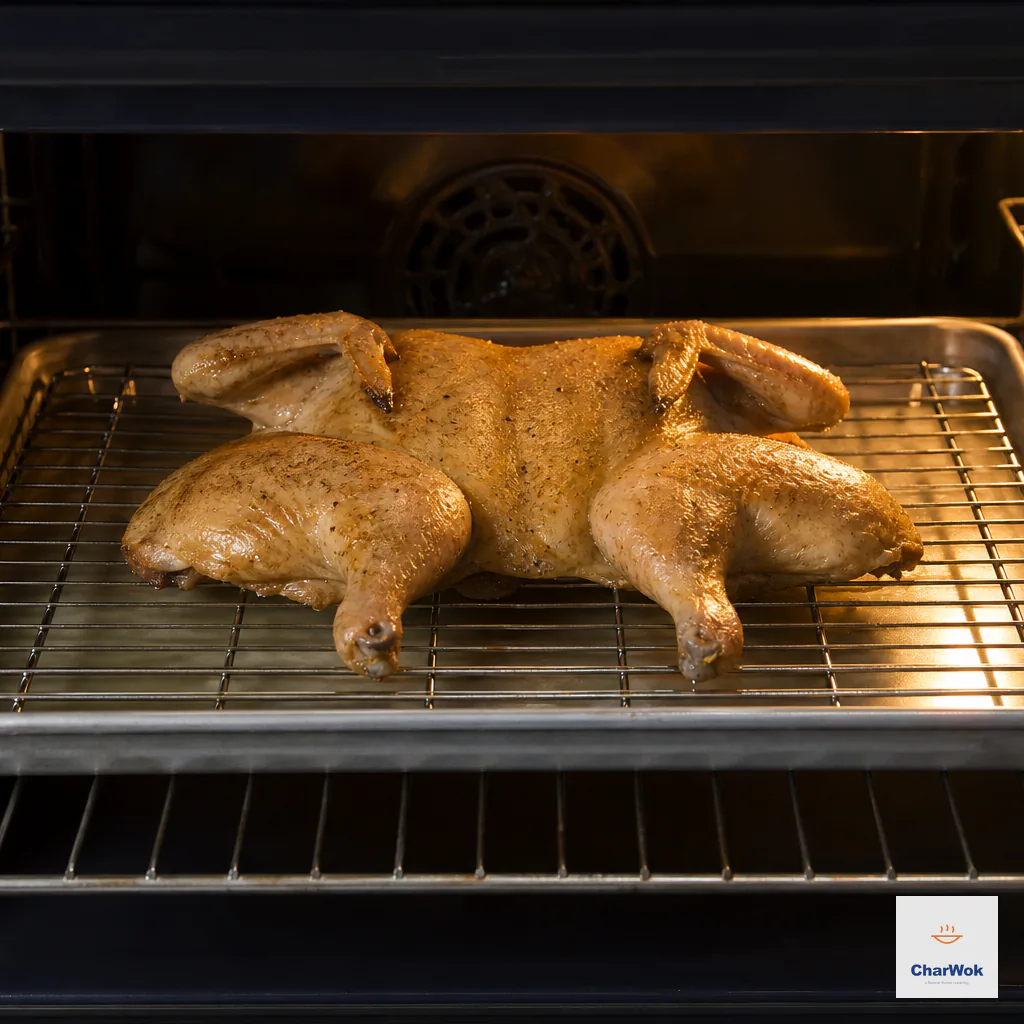
Keep the water below the rack: it catches dripping fat without letting the bird sit in liquid
- Drop the heat. Lower to 160°C (320°F) convection, or 180°C (350°F) conventional, and roast another 20 minutes. Treat this as a timing checkpoint rather than proof of doneness. Check the water level in the tray and top it up if it is close to drying out.
- Glaze twice in the final stretch. Whisk the honey and the ½ tsp dark soy, then divide the glaze between two small bowls and use a clean brush for each coat. Brush one thin layer and return the bird for 5 minutes. Turn the oven back up to 200°C (400°F), brush with the untouched second portion, and roast 5 minutes more.
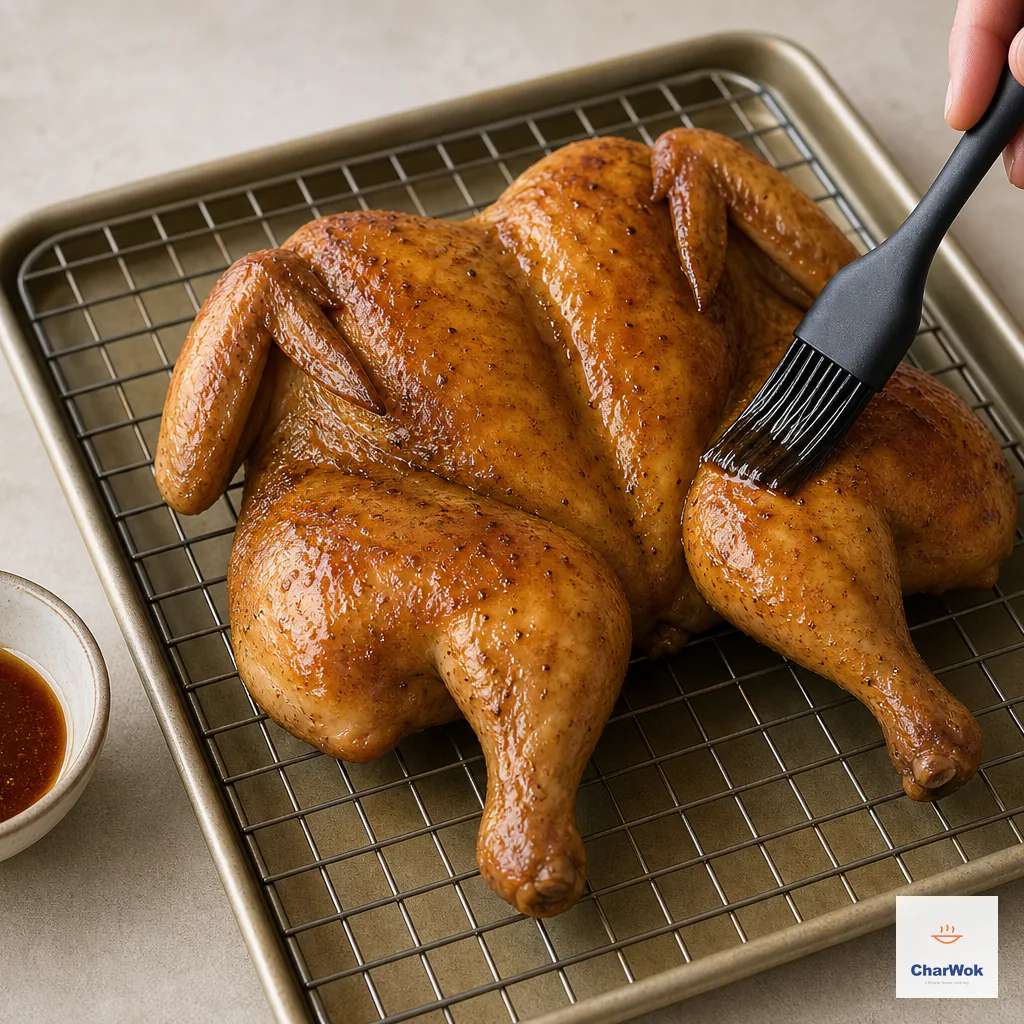
Divide the glaze into two clean portions; use a clean brush for each thin coat so the untouched second portion is not contaminated
- Check doneness, then rest. Use an instant-read thermometer in three places: the innermost part of the thigh, the innermost part of the wing, and the thickest part of the breast, without touching bone. Every site must reach 165°F (74°C). If any site is lower, continue roasting and check again. Rest the chicken for 10 minutes only after all three sites pass; color and clear juices are not reliable substitutes for a thermometer.
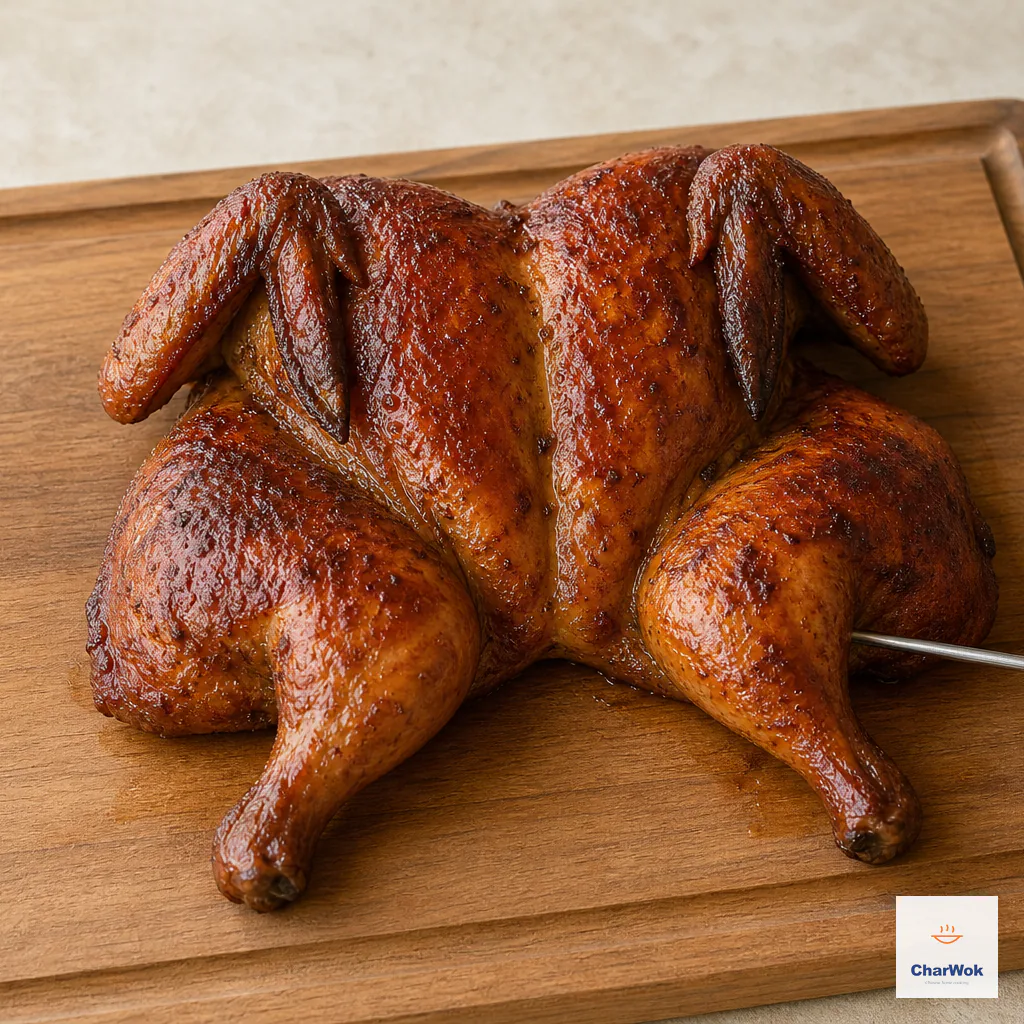
Check the innermost thigh and wing and the thickest breast away from bone; rest 10 minutes only after all three reach 165°F (74°C)
When it goes wrong
A few failures come up over and over, and they are all fixable.
Pale, rubbery skin. Almost always the overnight rest was skipped or the bird went in wet. Next time, dry-brine uncovered and pat the skin once more right before it goes in the oven. If the skin is already on the bird and pale at the end of cooking, run it under the broiler for 90 seconds, watching closely, to blister it.
Burnt patches on the wingtips and legs. The thin extremities brown and char before the body is done. Foil-wrap the wingtips and the ends of the drumsticks before roasting, then peel the foil off for the final glaze stage so they catch up in color.
Dry breast, juicy thigh. The breast cooked faster than the dark meat. A spatchcocked bird narrows that gap, but every checked site still needs to reach 165°F (74°C). Begin checking early and remove the chicken as soon as the thigh, wing, and breast all pass; if the skin is already dark, tent it loosely with foil while the remaining site finishes.
The glaze slid off and pooled on the tray. Either the skin was wet when you brushed, or the coat was too heavy. Towel the skin dry before the first brush, and apply the thinnest film you can manage. A silicone brush lays a finer coat than a basting spoon.
Smoke pouring out of the oven. The water in the tray evaporated and the dripping fat started burning. Top up the water whenever you check the bird. If it has already gone dry, pour water in carefully along the edge of the tray, never directly onto the hot pan, and ventilate the kitchen.
Variations and what to serve it with
The dry-rub technique is a template. Swap the five-spice for a cumin-and-chili blend and you are in the neighborhood of chili cumin chicken; lean into the pepper and you get something close to black pepper chicken. For a more aromatic bird, tuck smashed ginger and scallion under the skin before the dry-brine, the way you would think about for ginger chicken.
The bird works with steamed jasmine rice and a quick vegetable. A cold salad such as smashed cucumber salad or napa cabbage salad contrasts with the sweet glaze. A bowl of egg drop soup or another clear soup rounds out a larger spread; the planning approach in a multi-dish Chinese feast helps with timing.
Leftovers are the best part. Shred the meat and pile it into steamed bao buns with scallion and a smear of hoisin, or wrap it in Peking duck-style pancakes. The carcass and any scraps go straight into a pot for chicken noodle soup the next day; a five-spice-seasoned carcass makes stock that needs almost no further seasoning.
Storing and reheating
Carve leftover chicken into smaller pieces and refrigerate it in shallow containers within 2 hours of cooking, or within 1 hour when the room is above 90°F (32°C). Keep it at 40°F (4°C) or below and use within 3 to 4 days. Reheat pieces skin-up at 180°C (350°F), checking that the thickest piece reaches 165°F (74°C); 8 to 10 minutes is only an estimate. Freeze cooked poultry for 2 to 6 months for best quality and thaw it in the refrigerator. See FoodSafety.gov safe temperatures, its cold-storage chart, and USDA poultry brining guidance.
The raw, dry-brined bird can sit in the fridge up to 24 hours, but not longer; beyond that the salt continues to work and the meat turns dense and ham-like. If your plans change, freeze the brined bird before roasting.
A few honest limits
This timing is written for a chicken around 1.8 kg (4 lb), not a bird much over 2.2 kg (4.8 lb). A larger bird needs earlier and repeated checks at all three temperature sites; do not scale cooking time alone and assume the center is safe.
And convection ovens genuinely do this dish better than conventional ones, because the moving air dehydrates the skin from every angle. If your oven has a fan setting, use it. If it does not, expect to add 5 to 10 minutes and keep a closer eye on the glaze.
Frequently asked questions
Quick answers to the questions that come up most. The reasoning behind each is in the sections above.
- Do I have to rest it overnight? No, but the flavor suffers if you do not. A 4-hour minimum brine is workable for a same-day roast; anything shorter seasons only the surface.
- Can I use chicken pieces instead of a whole bird? Yes. Thighs and leg quarters work best. Begin checking earlier than for a whole bird and remove each piece only when its thickest part reaches 165°F (74°C), away from bone.
- Can I cook this in an air fryer? Use chicken pieces rather than forcing a whole butterflied bird into the basket. Follow the appliance instructions, keep pieces in a single layer, and verify 165°F (74°C) in the thickest part of every piece.
- The skin is browning too fast. Now what? Tent a sheet of foil loosely over the bird for the rest of the cook, then remove it before the final glaze stage so the skin can still set.
- Is the honey glaze necessary? It is what gives the lacquered finish and the sweet edge, but the bird is fully seasoned without it. Skip it for a more savory, drier-skinned roast.
- What temperature should five-spice chicken reach? Check the innermost thigh and wing and the thickest breast, avoiding bone. Every site must reach 165°F (74°C); clear juices and skin color do not prove doneness.