The first hot pot I ever hosted was a quiet disaster. I'd spent an afternoon slicing beef, soaking noodles, building two broths, and arranging everything on platters like a magazine spread. Then six guests sat down and the broth took twenty minutes to come back to a boil. For most of the meal we stared at lukewarm water while the meat oxidized on the plates. What I learned, the hard way, is that hot pot is not really a recipe. It is a heat-management problem disguised as a dinner party.
The soul of the dish is simple: a simmering pot of seasoned broth in the middle of the table, raw ingredients all around it, and each diner cooking bite by bite, then dipping. Every region of China has its own version, from the clear lamb-and-scallion pots of the north to the numbing, beef-tallow red oil of Sichuan. What never changes is the demand on the cook before anyone sits down. Get the setup right and the meal cooks itself. Get it wrong and you spend the evening apologizing to the heat source.
Plan on roughly 600 grams (about 1.3 pounds) of total food per adult, with plenty left for the second helpings hot pot invites, and a divided pot running a steady rolling boil, not a lazy simmer. The single most important decision is your heat source: weak heat ruins everything downstream, so budget for a real portable induction or gas burner before you spend a dollar on the beef.
What hot pot actually is, and why it rewards the patient
Hot pot (huo guo, "fire pot") upends the usual rhythm of a Chinese meal, where one cook works alone in the kitchen while everyone else waits. Here the cooking happens at the table, in real time, and the liquid gets better as the night goes on. Each slice of meat, each mushroom, each handful of greens gives up a little flavor to the broth, so what you ladle at the end is deeper than what you started with. That is why the closing bowl, noodles cooked down in the reduced broth, is so often the dish people remember.
This is also why hot pot is forgiving in a way stir-frying is not. Burn a stir-fry and it is gone. Overcook one slice of beef in the pot and you fish it out, learn the timing, and move on. It is one of the easiest ways to feed a crowd, lighter on the cook than a full multi-dish Chinese feast, because the table does the cooking. The barrier to entry is low once the table is set; the barrier is the table setting itself.
The equipment, and where I would not cut corners
A serviceable home hot pot needs four things: a heat source with real power, a pot that fits over it, long chopsticks, and enough small bowls for everyone to mix their own sauce. Let me be firm on the first one, because it is where most home attempts fail.
A portable induction or butane burner rated 1500 W or higher is what you want. The little electric "hot pot" pots sold online often top out around 800 to 1000 W, which is enough to keep a small volume warm but not enough to recover a rolling boil after you drop in a plate of cold beef. If you must use one, fill it only halfway and add ingredients in small batches. Never try to run hot pot off a single stovetop burner with guests standing around it; the cord, the reach, and the heat all fight you.
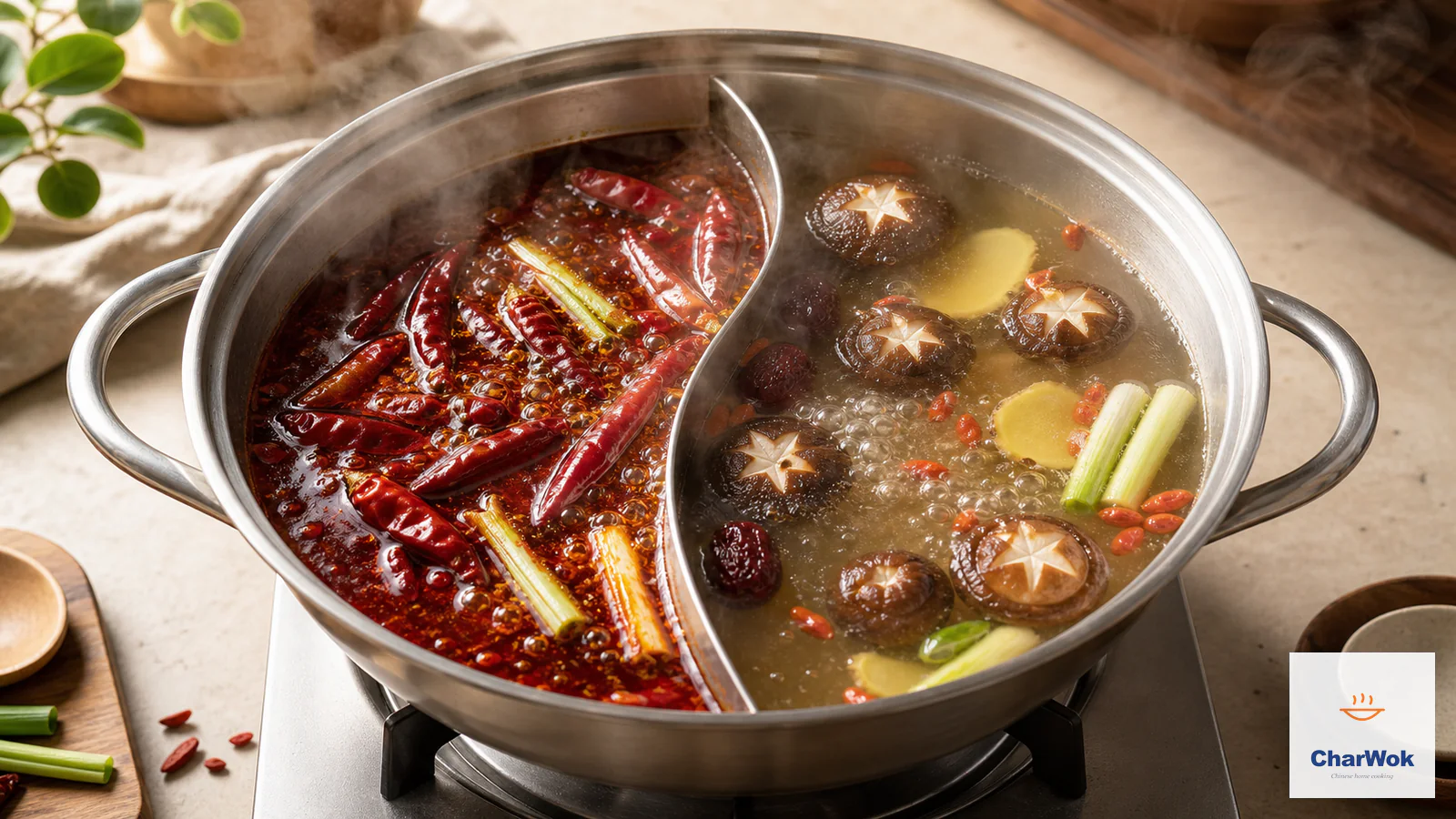
For the pot, a divided pot (yuan yang guo, named for the mandarin duck pair, which mate for life and are said to symbolize inseparable opposites) is genuinely worth the small investment if you plan to do this more than once. With one compartment for heat and another for calm, you can keep a fiercer red broth and a gentler clear one going at the same time, which settles the single most common argument at a hot pot table. If you only have one wide, shallow pot, that works too; just pick one broth and commit. Deep pots look generous but make fishing food out miserable. Shallow and wide is the goal.
Use the long hot-pot chopsticks, wooden or bamboo. The extra length keeps your hand back from the steam, and bamboo does not warp or get too hot to hold the way plastic and metal do at the surface. A slotted spoon or a small wire skimmer saves you from chasing slippery glass noodles around the pot for the tenth time.
How the meal actually runs
This is where I want to spend a moment before the broth and the shopping list, because the order of operations is what separates a smooth night from the lukewarm-broth disaster I opened with. Get the choreography right and everything else, which broth, which cut, which sauce, falls into place around it.
- Prep everything before guests arrive. Wash, slice, and plate all the ingredients, cover, and refrigerate the proteins. Hot pot rewards mise en place more than any other meal I cook; once you sit down there is no second chance to go wash greens.
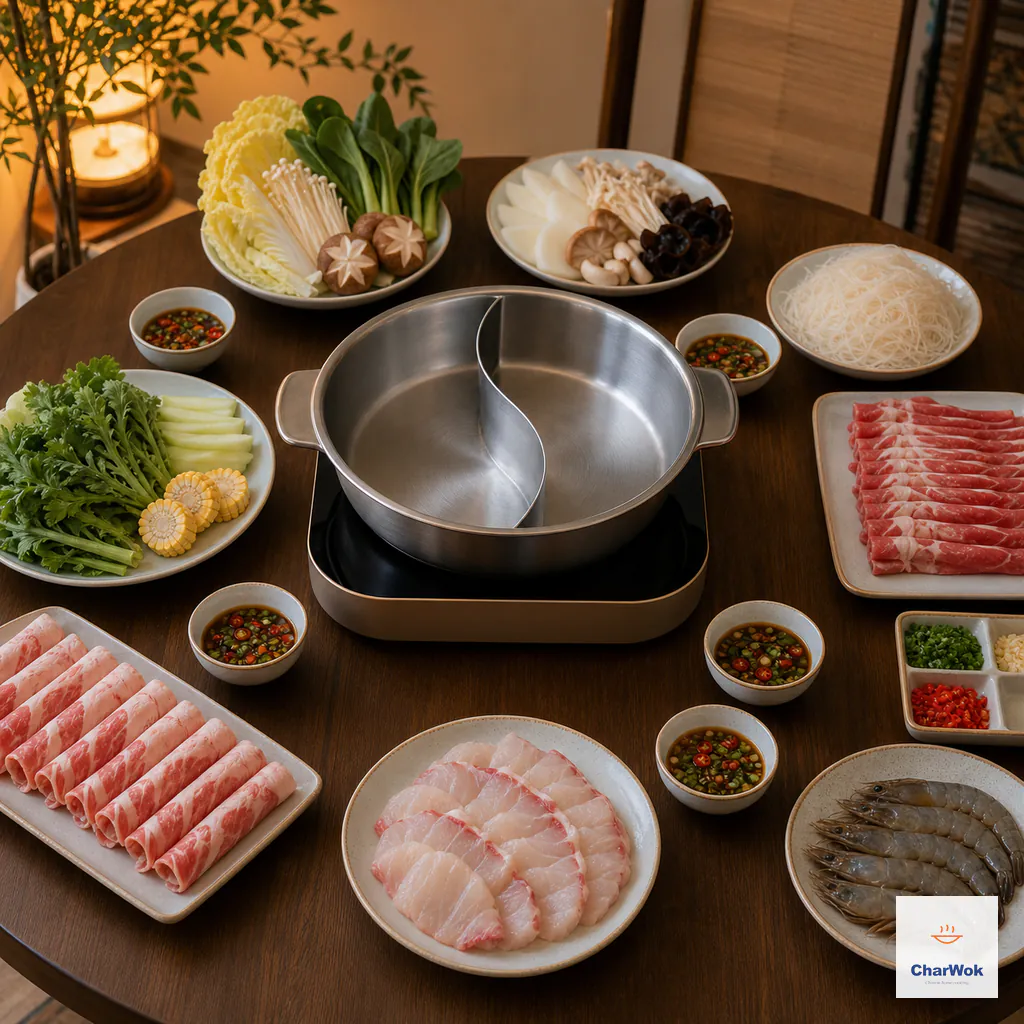
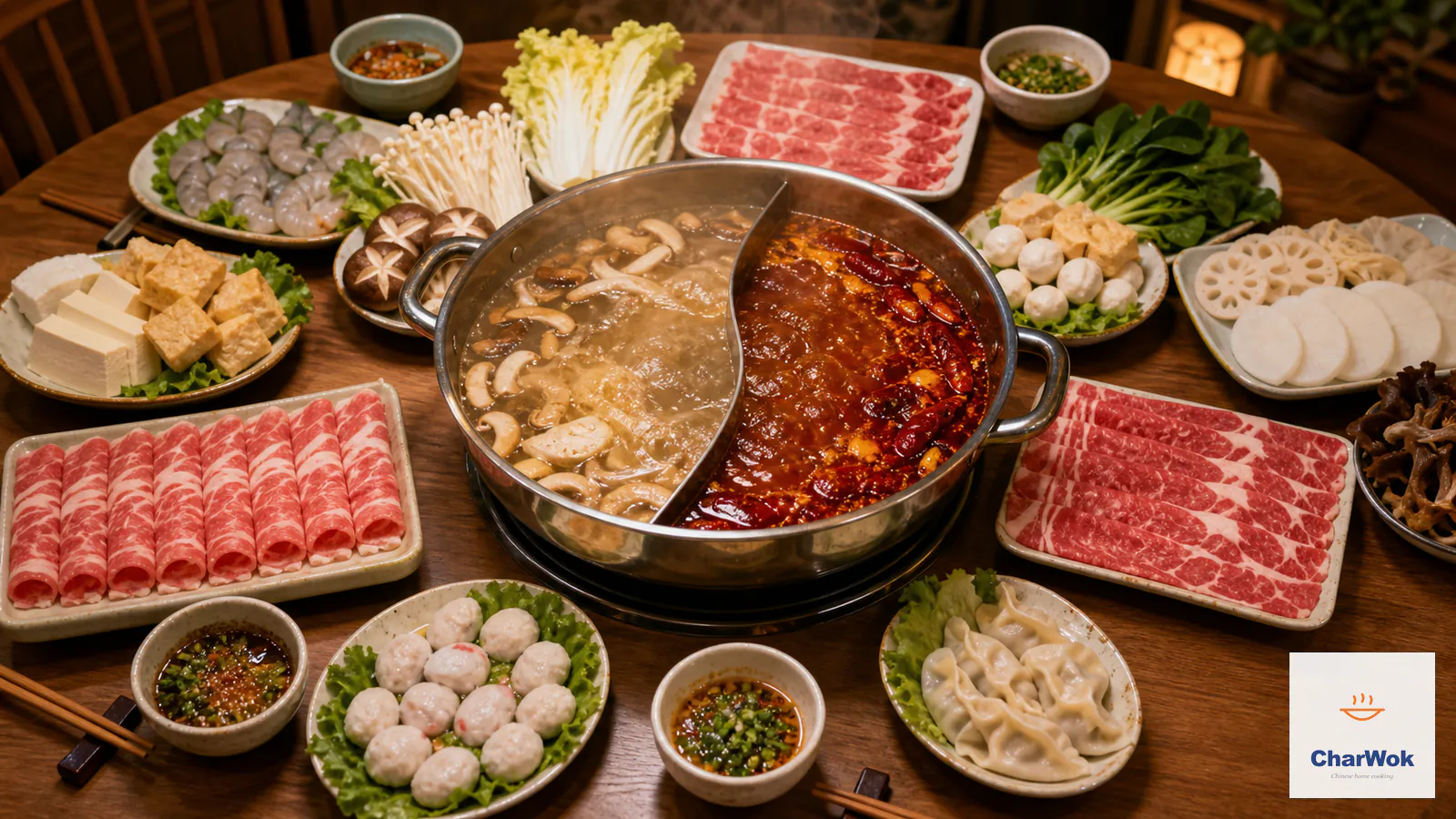
Wash, slice and plate everything before sitting down; keep every raw protein on its own chilled plate and give each person a dipping bowl.
- Get the broth to a hard boil first. Both sides should be rolling before the first ingredient goes in. A boil that won't hold means your heat is too weak, and adding cold food to a weak pot starts a death spiral the meal never recovers from.
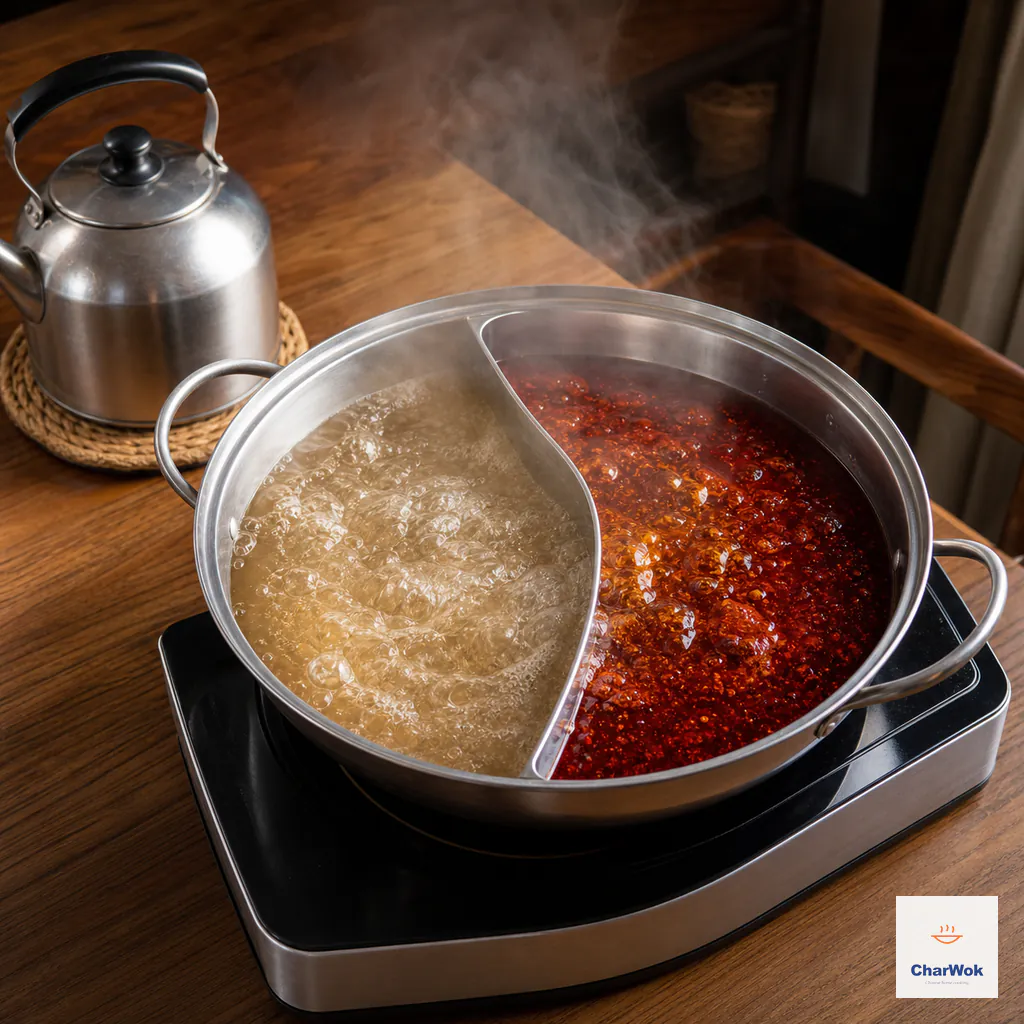
Bring both broths to a hard rolling boil before the first ingredient goes in, with near-boiling liquid ready for later top-ups.
- Add the slow ingredients first. Daikon, lotus root, potato, and frozen tofu need eight to twelve minutes. Drop them in at the start so they cook while everyone is still settling in and nibbling.
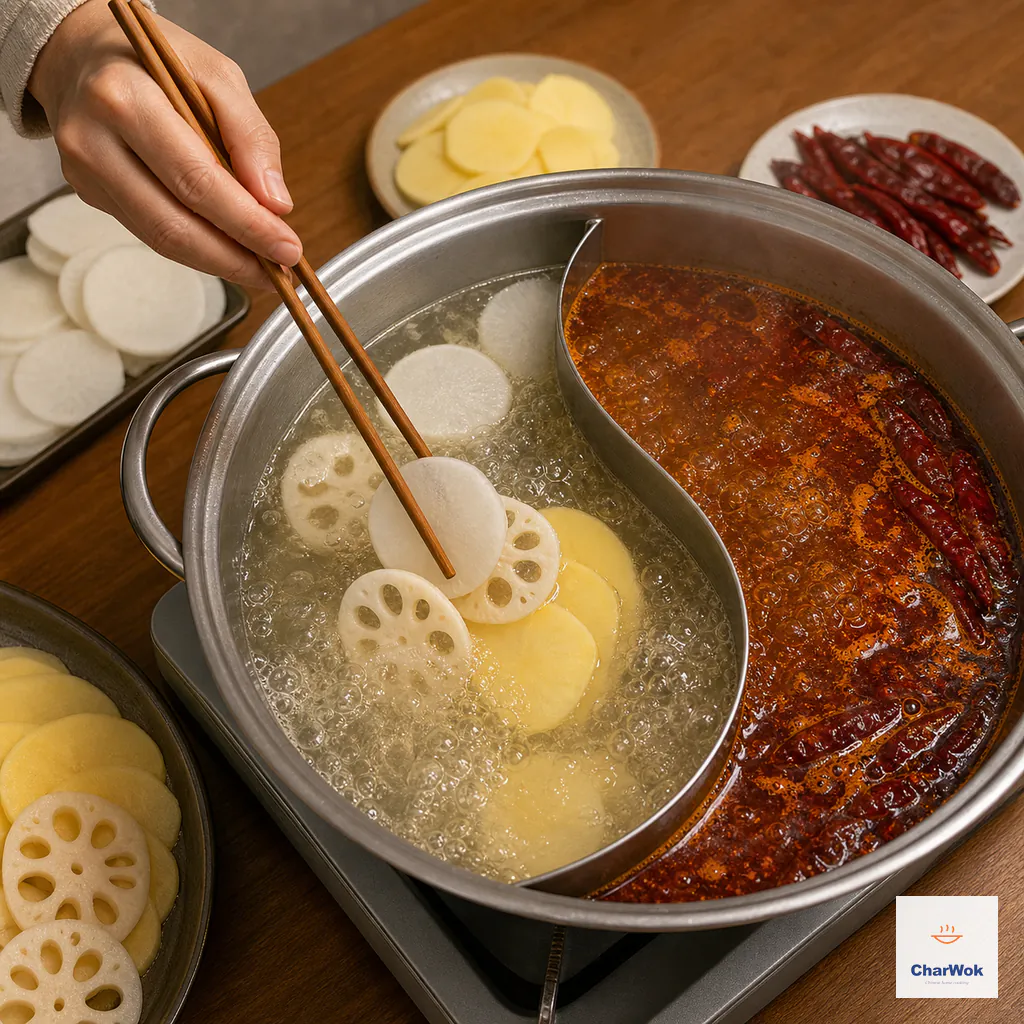
Start the slow daikon, lotus root and potato while everyone settles in; keep the batch small enough that the boil holds.
- Cook proteins in small batches. Swish thin beef slices for ten to fifteen seconds, no more. The reason is structural: hot pot beef is sliced thin enough that the heat passes through almost instantly, so the fat renders and coats the slice before the muscle fibers have time to seize. Leave it in for a minute and you get gray, chewy meat.
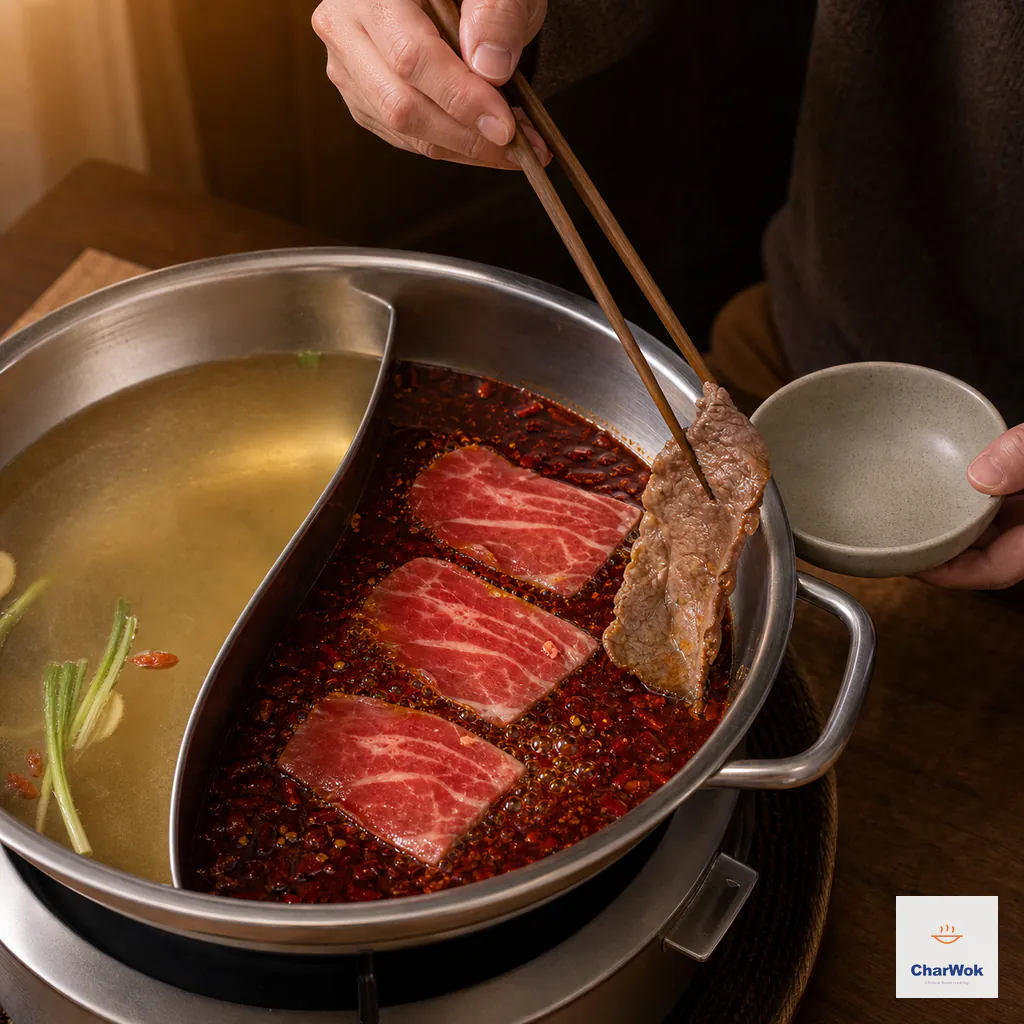
Swish paper-thin meat in small batches and lift it as soon as the colour changes, before the fibres tighten and turn chewy.
- Top up with hot liquid, never cold. The level will drop as steam escapes, so keep a kettle or a small pot of near-boiling stock on the back burner and add it the moment the broth runs low. Replenishing with hot stock (rather than water) holds the boil steady and props up the seasoning instead of washing it out; cold liquid of any kind collapses the boil and flattens everything you have spent an hour building.
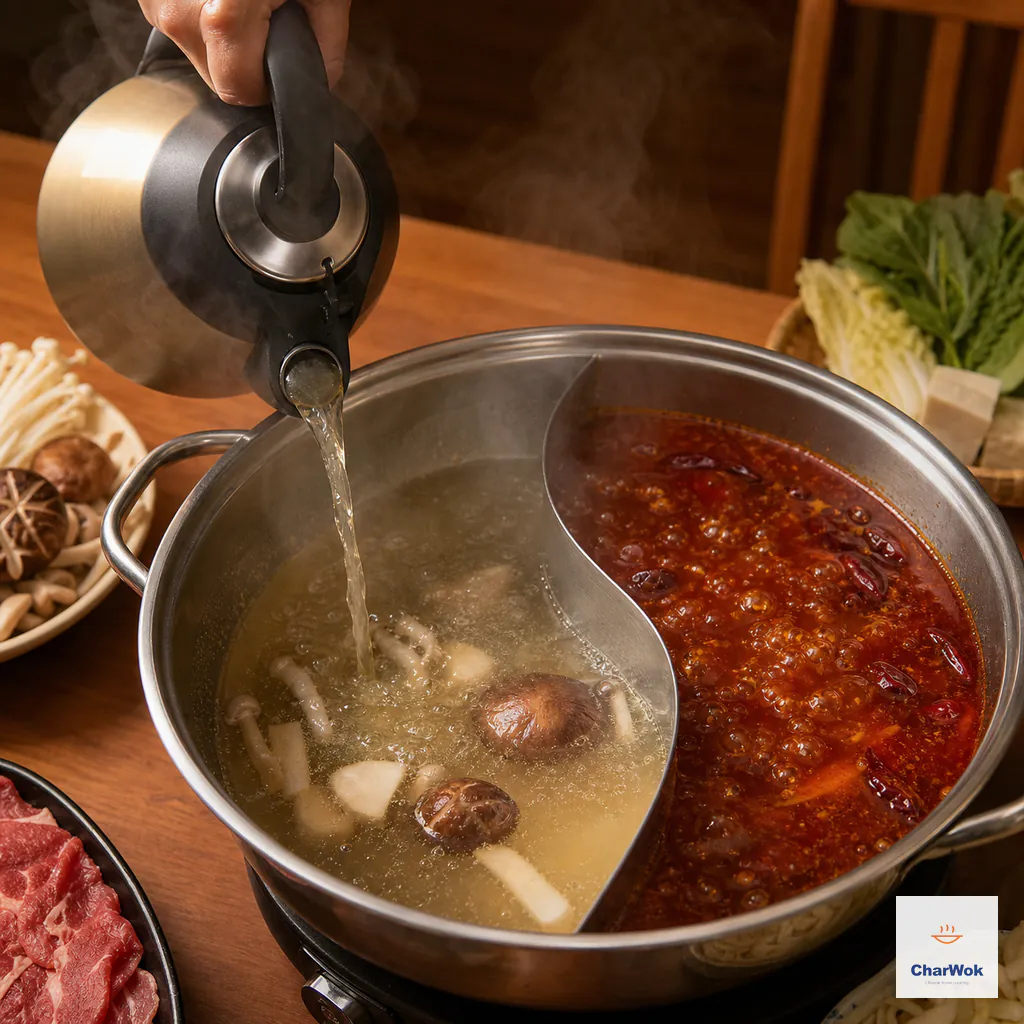
Top up a falling broth level with steaming stock, never cold liquid, so the boil and seasoning do not collapse.
- Skim the foam. Proteins throw off scum as they cook, especially on the mild side. A quick skim every so often keeps the broth clean and the finished bowl from tasting muddy.
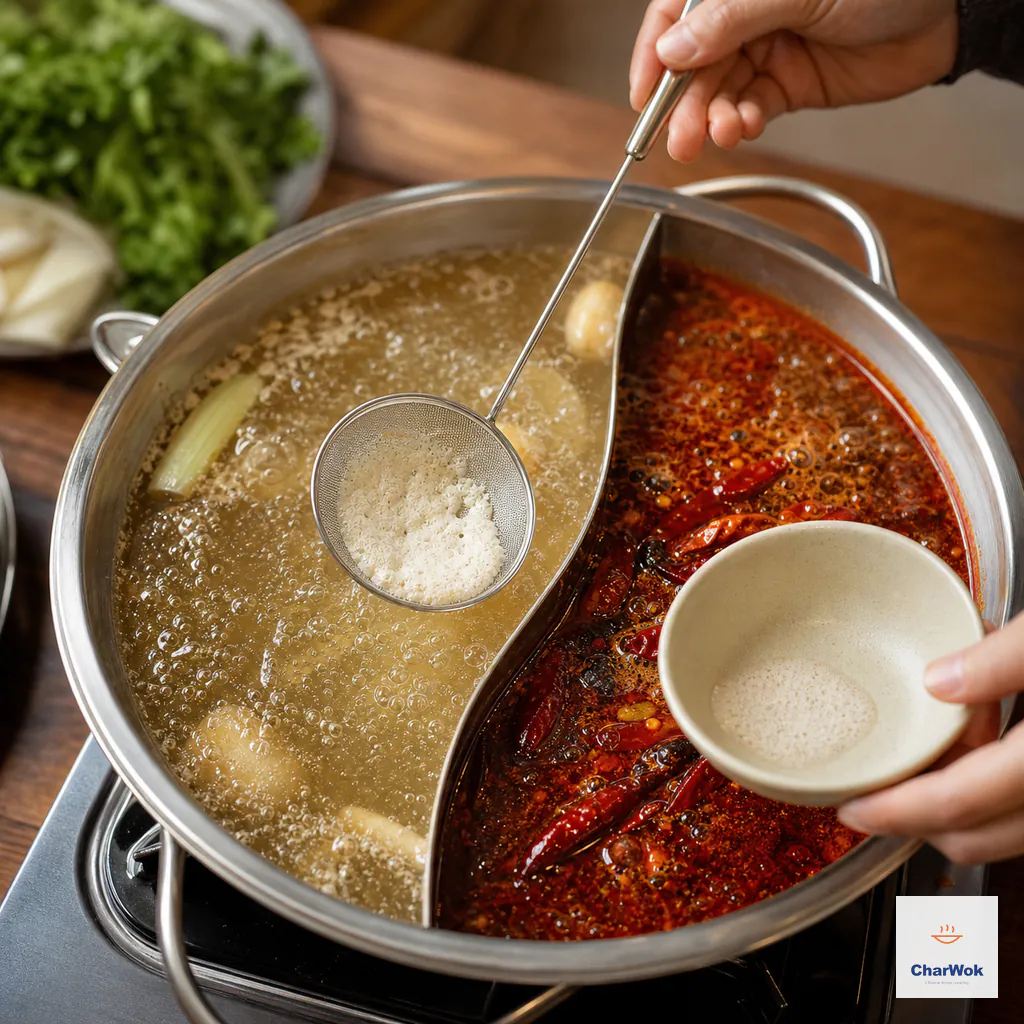
Skim the clear side whenever protein foam gathers; removing it keeps the broth clean instead of muddy.
- Finish with noodles and dumplings. By now the broth is at peak flavor. Drop in glass noodles, fresh wheat noodles, or a few dumplings, cook through, and serve in bowls with the broth ladled over. This is the course everyone remembers.
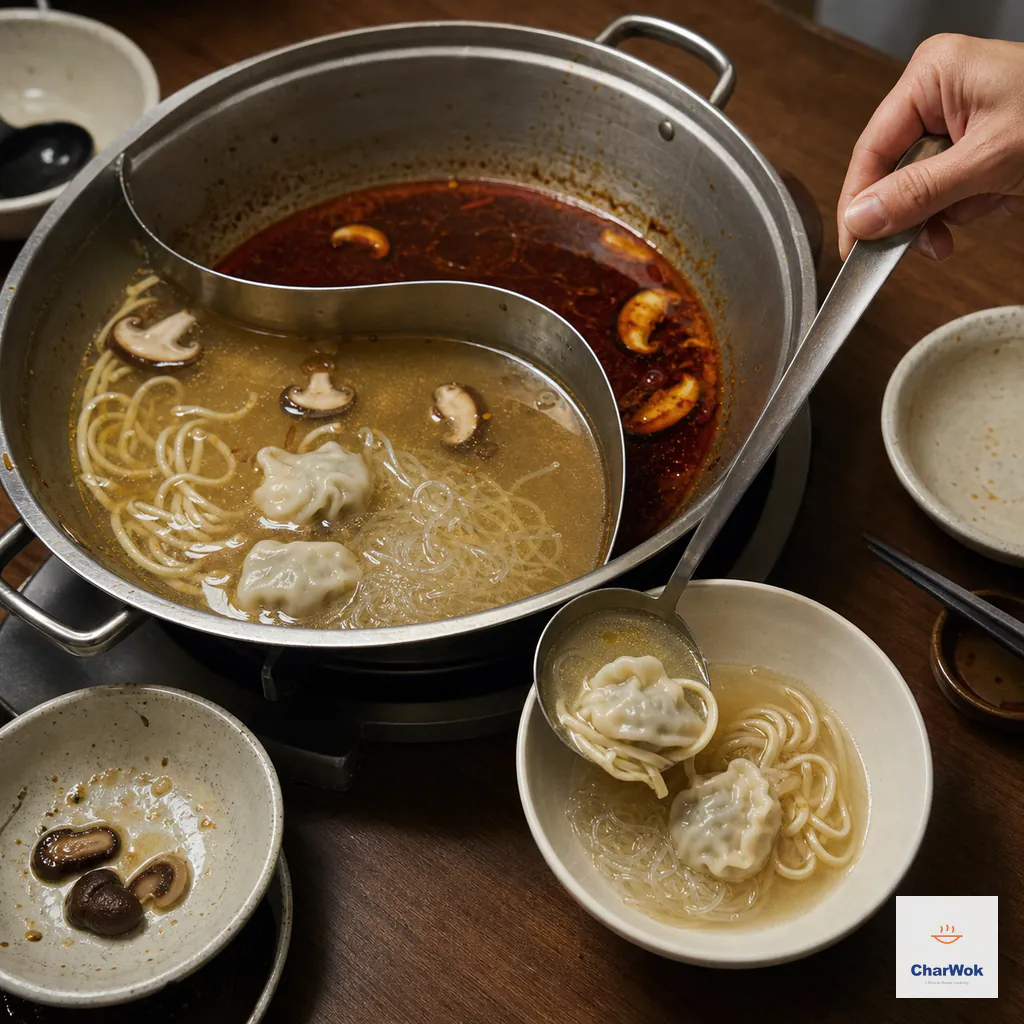
Save noodles and small dumplings for the final course, then ladle them into bowls with the broth at its most developed.
The broth: calm on one side, fire on the other
I almost always run a divided pot with one mild and one spicy broth. They serve different ingredients, and they keep timid and heat-loving eaters both happy. Here is the short version of each.
The mild, or clear, broth
A clear broth (qing tang guo di, "clear-soup pot base") is built on restraint: a good chicken or pork stock warmed through with a few gentle aromatics, the kind of thing you can see the bottom of. Scallion and smashed ginger do most of the work; rehydrated shiitake mushrooms, red dates, and a small handful of goji berries add roundness without color. Season lightly with salt; you can always add more. The point of the mild side is to let delicate ingredients, fish, leafy greens, tofu, taste like themselves. If you over-season it, you have defeated its purpose.
The spicy red oil broth
The classic Sichuan version (hong you guo di, "red-oil pot base") is the loud one. Its color and clinging richness come from chili bean paste rendered into fat with dried chilies and Sichuan peppercorns; the traditional fat is beef tallow, which is what gives the broth its lip-coating body. It is a project to build from scratch. For a first or second attempt I see no shame in starting with a packaged soup base from any of the reputable hot-pot makers, diluting it with hot stock instead of water, and upgrading from there. When you are ready, a from-scratch base cooked ahead in quantity and kept frozen in portions is dramatically better, and free of the preservatives in the packets.
One principle I will insist on: dilute packaged bases with stock, never plain water. The packet gives you fat, salt, and spice; the stock gives you the body the packet cannot. Water makes the spicy side taste thin and metallic once the night wears on.
What to put in the pot
Ingredients at a glance
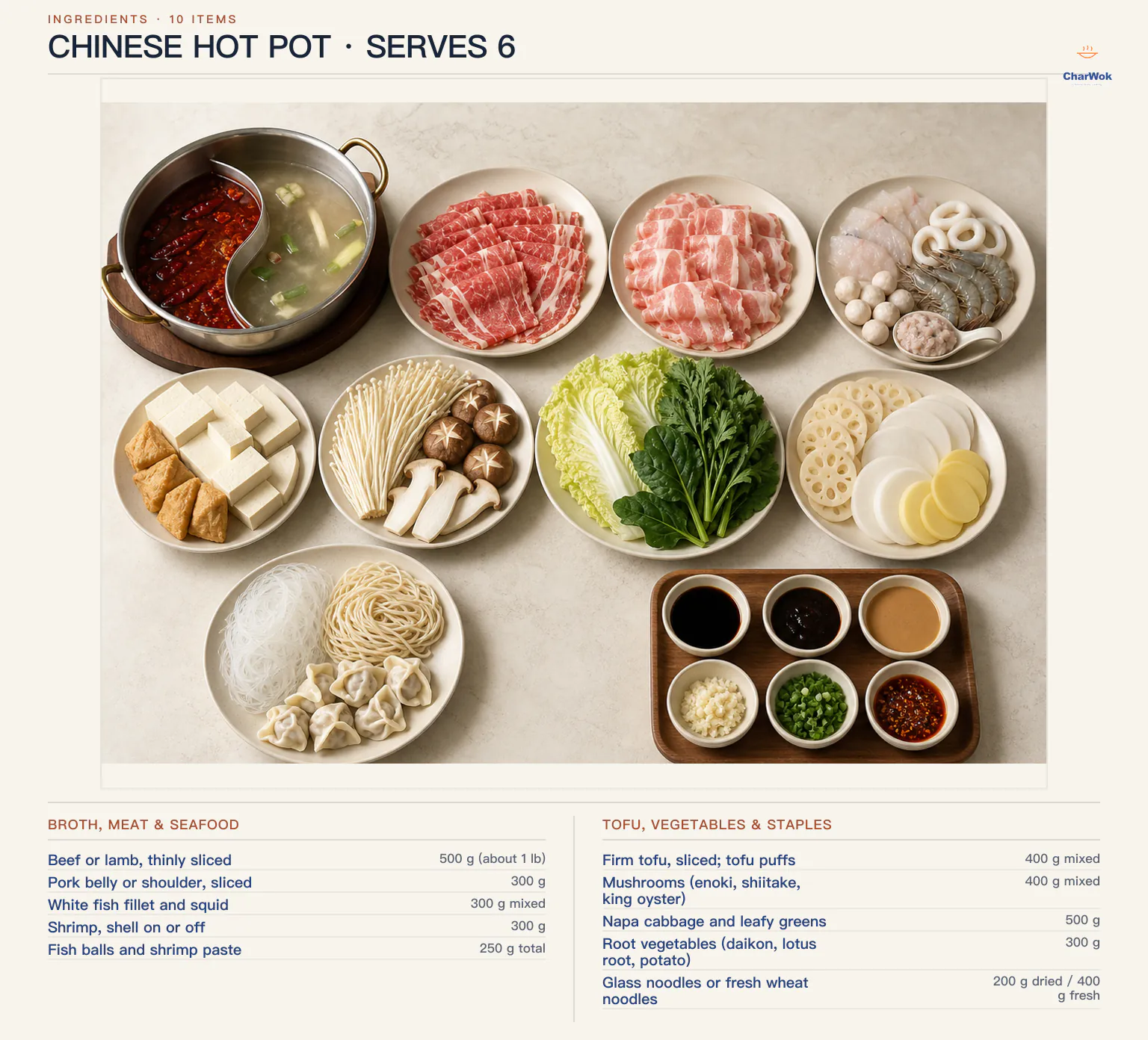
Almost anything edible can go in. The constraints are texture and cooking time, not tradition. Below is a workable spread for six adults. Scale up or down, lean heavy on whatever you love, and do not feel bound by the categories.
| Ingredient | Amount for 6 | Notes / substitute |
|---|---|---|
| Beef or lamb, thinly sliced | 500 g (about 1 lb) | For beef, favor well-marbled cuts like ribeye; for lamb, a leaner leg works well if sliced paper-thin. Partially freeze before slicing against the grain. |
| Pork belly or shoulder, sliced | 300 g | Sliced Spam-style luncheon meat (wu can rou) is a popular, easy swap. |
| White fish fillet and squid | 300 g mixed | Cod, sea bass, or catfish sliced thin, plus squid cut into rings. Firm, boneless fish; both overcook fast, so watch closely. |
| Shrimp, shell on or off | 300 g | Head-on adds flavor to the broth. |
| Fish balls and shrimp paste | 250 g total | Spoon shrimp paste into the broth in small quenelles. |
| Firm tofu, sliced; tofu puffs | 400 g mixed | Tofu puffs soak up broth like sponges. Frozen-then-thawed tofu does the same. |
| Mushrooms (enoki, shiitake, king oyster) | 400 g mixed | Tear enoki into bundles; slice king oyster lengthwise. |
| Napa cabbage and leafy greens | 500 g | Bok choy, choy sum, or water spinach all work. |
| Root vegetables (daikon, lotus root, potato) | 300 g | Slice thin; they need the most time, so add them first. |
| Glass noodles or fresh wheat noodles | 200 g dried / 400 g fresh | Soak dried glass noodles first. Save noodles for the end of the meal. |
Building your own dipping sauce
The sauce is where hot pot becomes personal, and every region has a strong opinion. Northern styles lean on sesame paste and fermented bean curd for richness. Sichuan and Chongqing styles want chili oil and ground Sichuan pepper for heat and numbing kick. Cantonese styles often go light, with scallion, cilantro, soy, and a splash of black rice vinegar to let the ingredient shine.
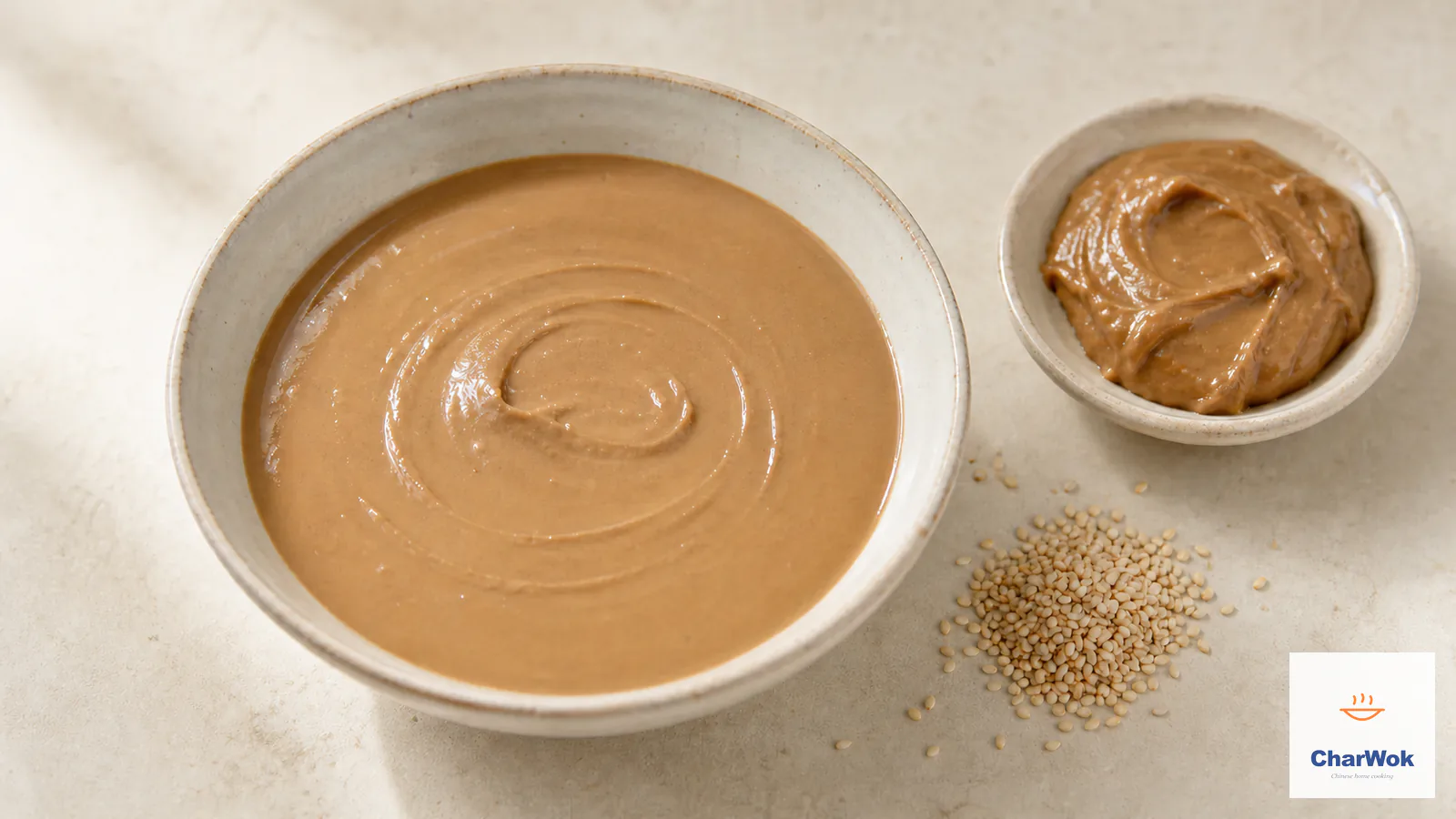
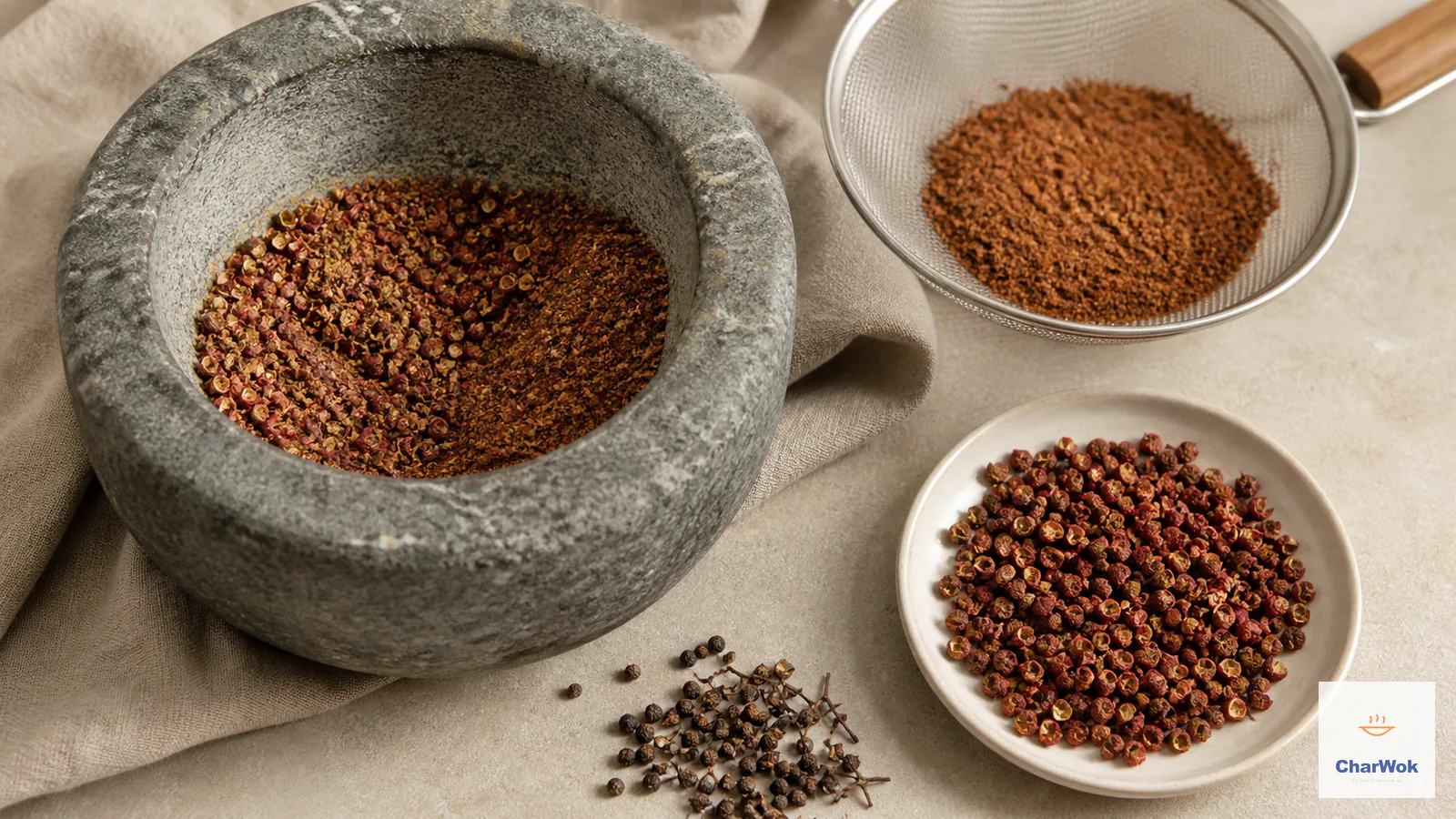
Set out small bowls and let people build their own from a buffet of: light soy sauce, oyster sauce, toasted sesame oil, sesame paste, shacha sauce (Chinese barbecue sauce, a savory standout for beef and seafood), peanut butter for those who like a richer, sweeter dip, minced garlic (reconstituted in a little warm broth), chopped scallion and cilantro, toasted sesame seeds, chili powder, and ground Sichuan pepper. Keep a jar of extra scallion and cilantro on the table; they run out fast.
If you want one dependable default for a nervous eater, try two parts sesame paste to one part light soy, a spoon of minced garlic, a drizzle of sesame oil, and a scattering of scallion and cilantro. Loosen it with a ladle of hot broth until it is the consistency of cream. That is the closest thing hot pot has to a universal sauce.
When things go wrong
The broth will not come back to a boil. Your heat source is underpowered, or the pot is too full. Move to a stronger burner next time. Right now, stop adding cold food, wait for a rolling boil, and add ingredients in smaller batches.
The beef is tough and gray. It stayed in too long. Thin slices need only ten to fifteen seconds. If you cannot slice it thin enough at home, partially freeze the block for forty minutes first, and cut across the grain, not with it.
The mild side tastes flat. Clear broth needs salt and a little fat to carry flavor. Add salt gradually, a few drops of sesame oil, and remember that the broth only reaches full flavor halfway through the meal. Be patient before seasoning aggressively.
The spicy side tastes harsh and one-note. Packaged bases can read as pure salt and chili. Diluting with stock instead of water fixes most of it. A spoon of sugar or a halved tomato simmered in the broth rounds off the sharp edges.
The pot boils over. You overfilled it. Hot pot broth should sit two-thirds up the side, never to the rim. A divided pot with a center wall boils over less because each side has a smaller surface area.
Variations and what to serve alongside
Hot pot is endlessly adjustable. A few directions I keep coming back to: a lamb-and-scallion northern style with just water, scallion, ginger, and a little salt, where the quality of the lamb is everything. A tomato base for a sweeter, kid-friendly pot, made by simmering chopped tomatoes into the clear broth until it collapses. A fully vegetarian version built on mushroom stock with extra king oyster mushrooms, tofu puffs, and greens, which is quietly one of my favorites.
Because the meal is so rich and the table so full, I keep sides minimal. A cold plate to cut the heat is ideal, a smashed cucumber salad or a simple cucumber in vinegar. For drinks, cold soy milk or barley tea both stand up to the spice better than beer, which tends to amplify the burn.
Storing the leftovers
Strain the leftover broth, chill it overnight, and lift off the solidified fat the next morning. The broth underneath is now a concentrated, deeply seasoned stock, the best part of the whole night. Freeze it in portions and use it as a base for noodle soups, to braise vegetables, or to start the next hot pot. Leftover raw proteins will keep one more day in the fridge, already sliced and ready. Cooked leftovers sitting in the broth should be eaten within a day; the greens go limp and the tofu gets waterlogged fast.
Questions I get asked
Can I make hot pot for two people?
Yes, but scale the spread hard. Pick one broth instead of two, three or four ingredients instead of ten, and use a smaller pot so a modest burner can still hold a boil. Hot pot's charm is variety, so swap breadth for a single great protein and two vegetables rather than a sad half-portion of everything.
Do I have to make my own broth?
No. A good packaged base diluted with real stock gets you eighty percent of the way for a fraction of the effort. Make it from scratch only once you are sure hot pot will become a regular thing in your house.
Is a divided pot worth buying?
If you will do this more than twice a year, yes. The spicy and mild split solves the most common argument at the table and lets you cook delicate fish and heat-loving beef at the same meal without compromise.
What if I do not have a portable burner?
Do the cooking at the stove and bring cooked ingredients to the table in batches. You lose some of the communal theater, but the food is identical. I have done this for small gatherings and no one minded.
Hot pot is one of the few Chinese meals where the cook gets to sit down with everyone else. Do the work beforehand, respect the boil, and the rest of the night takes care of itself. The leftover broth the next morning is your reward for getting the setup right.