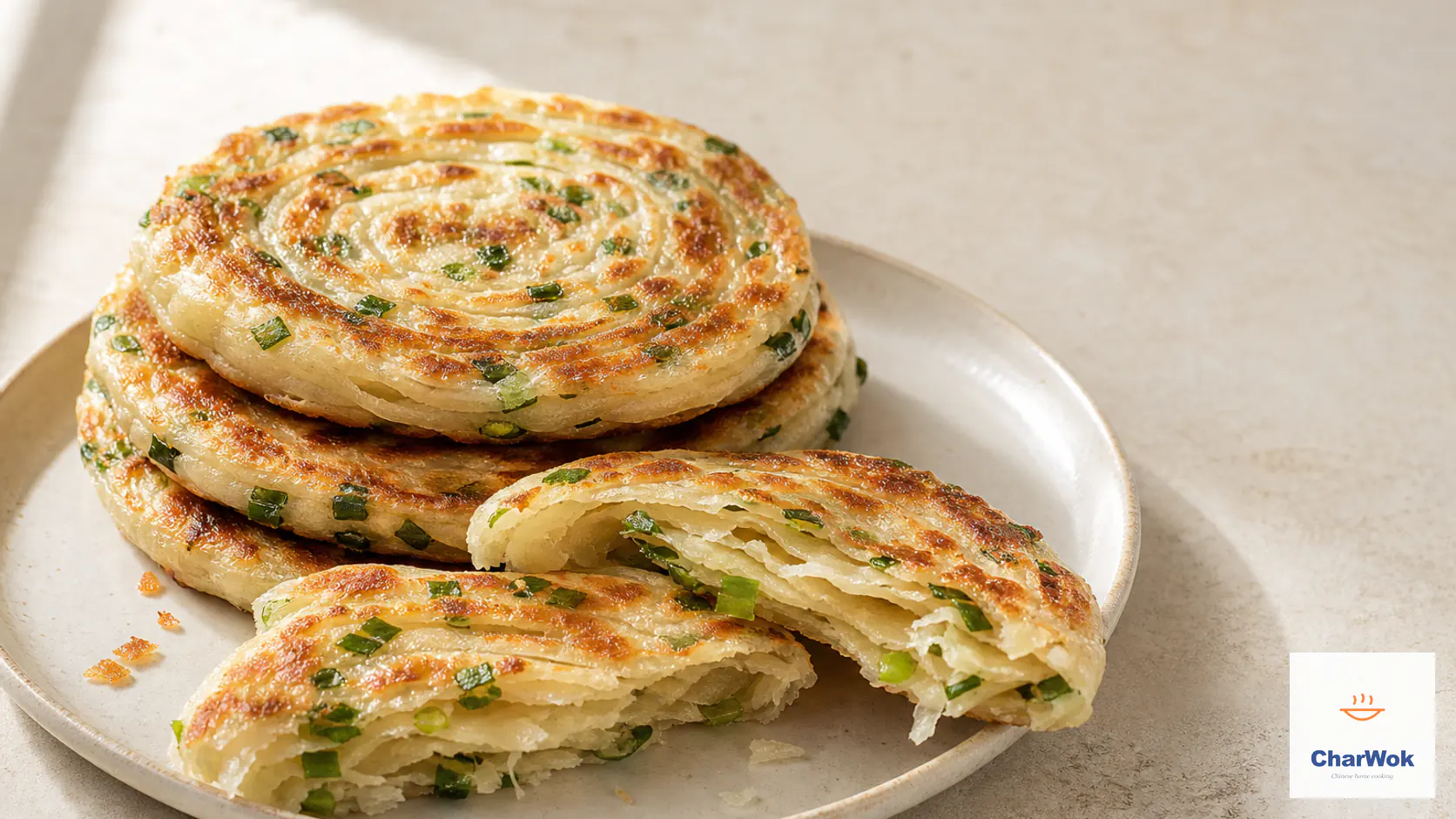
The first time I tried to make scallion pancakes at home I ended up with something closer to a rubber floor tile than a flatbread. The crust was pale, the inside was a single dense wall of dough, and when I bit in there were no layers to speak of. What I had missed was not a secret ingredient. It was a single piece of physics: a fat barrier trapped between two sheets of dough, and steam doing the lifting. Get that barrier right and the pancake shatters into flakes. Get it wrong and you are eating a chewy disk.
Cong You Bing, the layered scallion pancake, is the everyday flatbread of northern China, where wheat is king and rice is a guest. It sits in the same flour-and-oil family as youtiao, the breakfast fried-dough stick, and shares its dough logic with the stuffed Guo Kui flatbread and the meat-filled Xian Bing. What sets the scallion pancake apart is that it is unleavened and relies entirely on layering and a hot pan for its texture. No yeast, no baking powder, no waiting for a rise. The skill is all in the roll and the fold.
About 400 g of dough makes four thick pancakes, roughly 13 cm (5 inches) each, pan-fried 2 minutes per side over medium heat under a lid. The one decision that decides everything is the water temperature: 160 g of near-boiling water into 250 g of all-purpose flour. Hot water partially cooks the starch and tames the gluten, and that is why the finished pancake is tender instead of tough.
Why hot-water dough changes everything
This is the part most recipes gloss over, and it is the whole reason a scallion pancake is not just a flour tortilla with scallions in it.
When you pour water at around 80 to 95°C (175 to 205°F) over flour, two things happen fast. The starch granules on the surface of the flour particles swell and partially gelatinize, forming a soft, slightly sticky gel. At the same time, the hot water limits how much gluten can develop, because gluten forms most readily in cold water. The dough you get is pliable, almost silky, and it rolls out thin without snapping back at you. If you used cold water you would build a strong, elastic network, which is exactly what you want for dumpling wrappers but exactly what ruins a tender pancake.
The trade-off is that hot-water dough can feel sticky and strange at first. It will not come together into a clean ball the way cold dough does, and that is normal. You are not making bread. You are making a dough that wants to relax and spread.
Ingredients
Ingredients at a glance
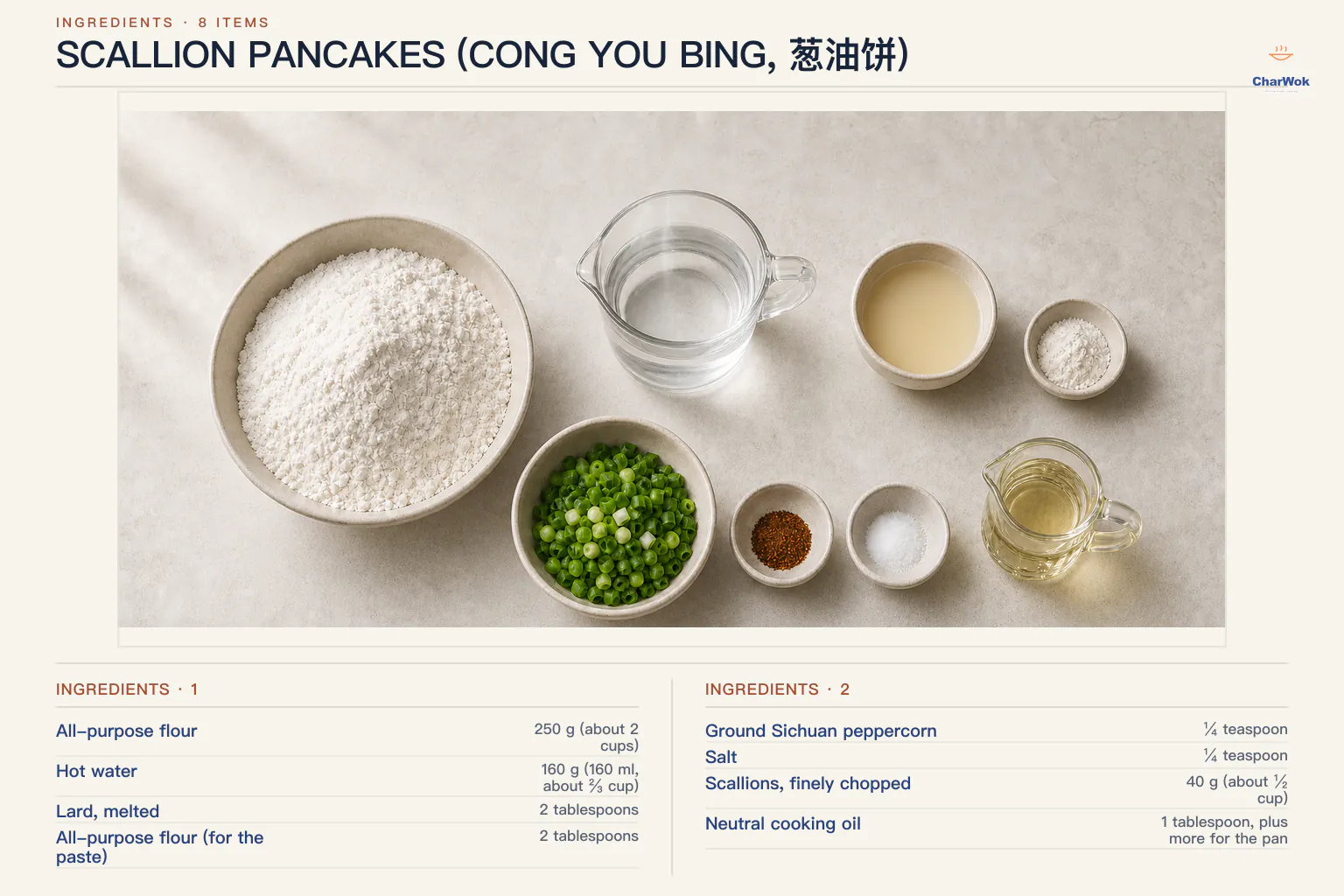
| Ingredient | Amount | Notes / substitute |
|---|---|---|
| All-purpose flour | 250 g (about 2 cups) | Standard US all-purpose, 10 to 11 percent protein. Bread flour makes it chewy; do not use cake flour or the dough tears when rolled thin. |
| Hot water | 160 g (160 ml, about ⅔ cup) | Just off the boil, 80 to 95°C / 175 to 205°F. If your kettle clicks off at a full rolling boil, let it sit 30 seconds before pouring. |
| Lard, melted | 2 tablespoons | This is the traditional fat and gives the flakiest result. Coconut oil (refined, not virgin) is the closest vegetarian substitute. Neutral vegetable oil works but yields a slightly less crisp crust. |
| All-purpose flour (for the paste) | 2 tablespoons | Mixed with the fat to make a spreadable paste. Skipping the flour and using oil alone makes the layers slide apart and the pancake greasy. |
| Ground Sichuan peppercorn | ¼ teaspoon | Optional but recommended, adds a mild tingle and woody aroma. Swap for Chinese five-spice powder if you prefer sweet-warm over numbing. Grinding your own from whole peppercorns is far better than pre-ground; see how under grinding Sichuan pepper. |
| Salt | ¼ teaspoon | Fine sea salt. The pancake should taste lightly seasoned, not salty, because the dipping sauce carries the rest. |
| Scallions, finely chopped | 40 g (about ½ cup) | Green and pale parts only. Pat them dry on paper towels before using; wet scallions bleed water into the layers and make them collapse. |
| Neutral cooking oil | 1 tablespoon, plus more for the pan | For coating the dough and the work surface, and for shallow-frying. Use an oil with a high smoke point: canola, grapeseed, or peanut. |
The filling paste is doing two jobs
The mixture of fat and flour you spread inside the pancake is not just flavor. It is the physical barrier that creates the layers, and the flour in it matters as much as the oil. Pure oil between two dough sheets will be squeezed out to the edges the moment you apply a rolling pin, leaving you with one merged slab of dough and a greasy pan. Mixing flour into the fat turns it into a stable paste that stays put, holds the two sheets apart during frying, and turns crisp and almost pastry-like under heat. This is the same logic behind a roux, and it is why I never skip the flour.
Lard is my default because it solidifies lightly at room temperature, which helps the paste set and the layers stay defined while you roll. Refined coconut oil behaves similarly. Plain vegetable oil stays liquid, so the paste is looser; you can still use it, just handle the dough gently after spreading.
Making the dough
- Combine flour and hot water. Put the 250 g of flour into a heatproof bowl. Pour in the 160 g of hot water and stir immediately with chopsticks or a wooden spoon. You are not trying to knead yet; you are distributing the heat evenly so the starch gelatinizes instead of cooking into hard lumps. Stop when no dry flour remains. The mixture will look shaggy and unappealing.
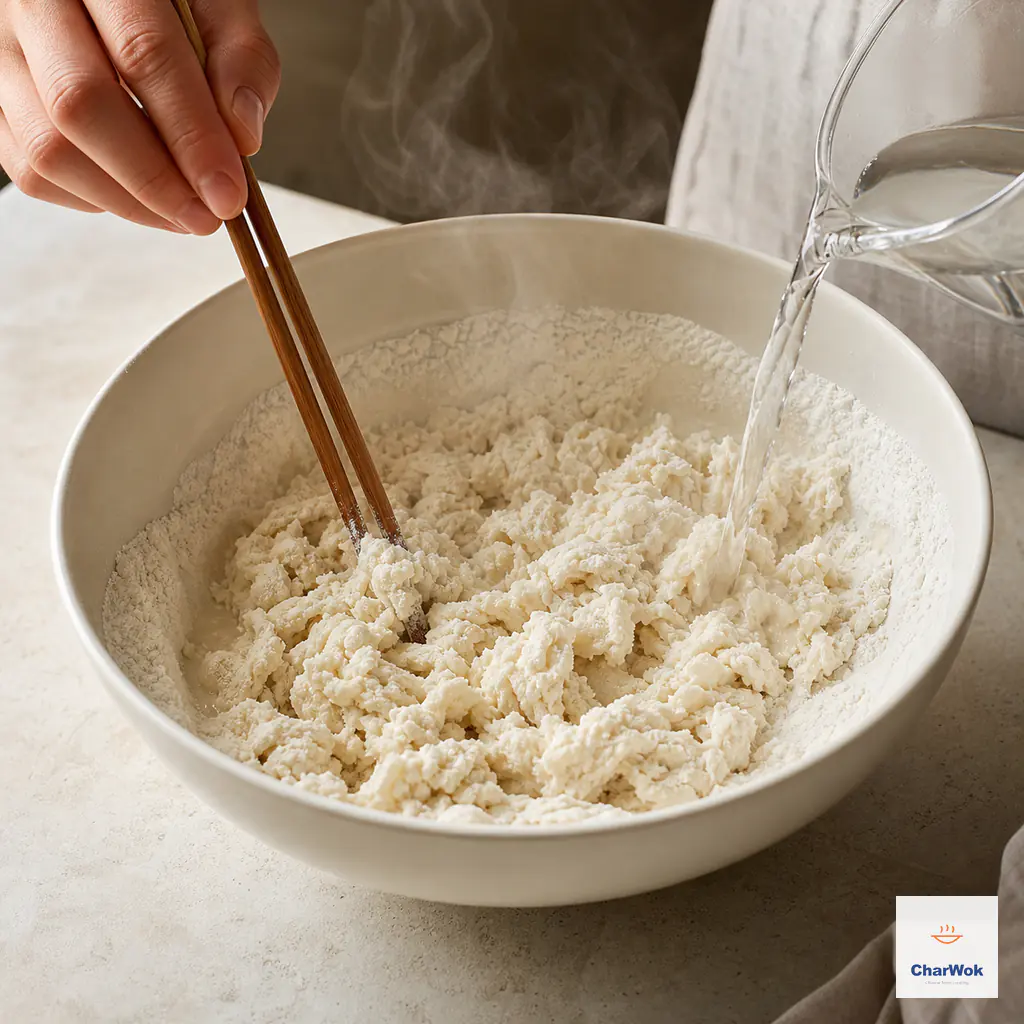
Pour in the 160 g hot water and stir immediately until no dry flour remains; the rough, shaggy texture is correct before the covered rest
- Rest, covered, for 15 minutes. Wrap the bowl tightly in plastic or cover with a damp towel. This rest does two things: it lets the partially cooked starch fully absorb the water and cool to a workable temperature, and it gives the little gluten that did form time to relax. Skip this and the dough will be both too hot to touch and too tight to roll.
- Knead briefly until smooth. Turn the dough out and knead for about a minute, just until it comes together into a smooth, soft ball. Over-kneading builds the gluten you have been working to avoid. Coat the ball and your work surface lightly with neutral oil. The oil stops sticking without adding more flour, which would tighten the dough.
Rolling and layering
- Roll into a thin rectangle. Flatten the dough and roll it out to a sheet roughly 40 by 30 cm (16 by 12 inches), about 2 mm thick. Aim for even thinness; a thick center means dense, doughy spots in the finished pancake. If the dough resists, pause for two minutes and let the gluten relax rather than forcing it.
- Spread the filling paste. Brush the lard-and-flour paste evenly over the entire surface, out to the edges. Scatter the chopped scallions and the ground Sichuan pepper and salt on top. Press them lightly into the paste so they do not roll away.
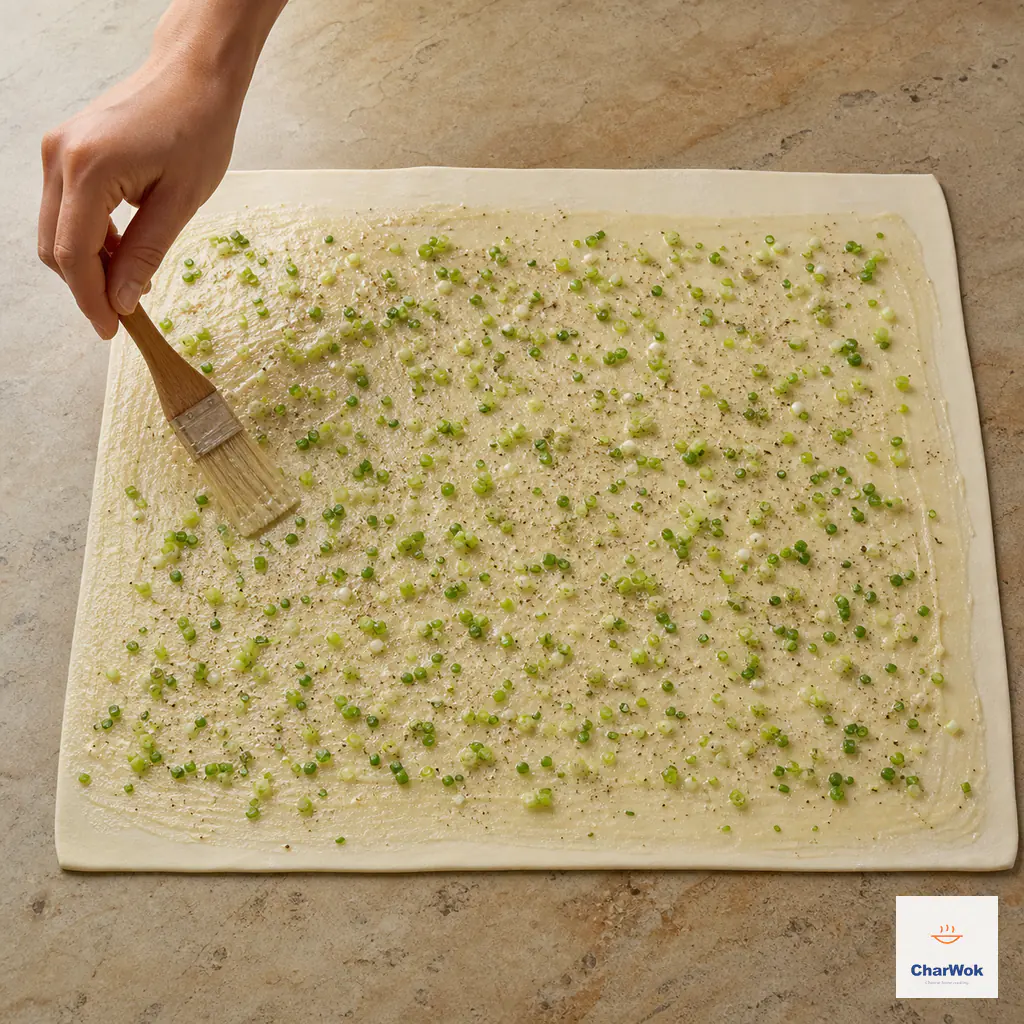
Use a flour-thickened paste, add well-dried scallions, and press them lightly so the filling stays between the sheets instead of sliding out
- Roll into a rope. Starting from one long edge, roll the dough up loosely into a cylinder. The word loosely matters. A tight roll squeezes the paste out and compresses the layers before they ever hit the pan.
- Cut and coil. Cut the rope into four equal pieces. Stand each piece on one of its cut ends, press it down gently with your palm to start the spiral, then roll it out to a circle about 13 cm (5 inches) across. The spiral pattern should be visible on top. Let the shaped pancakes rest for 5 minutes before frying so the gluten relaxes one last time and they hold their shape in the pan.
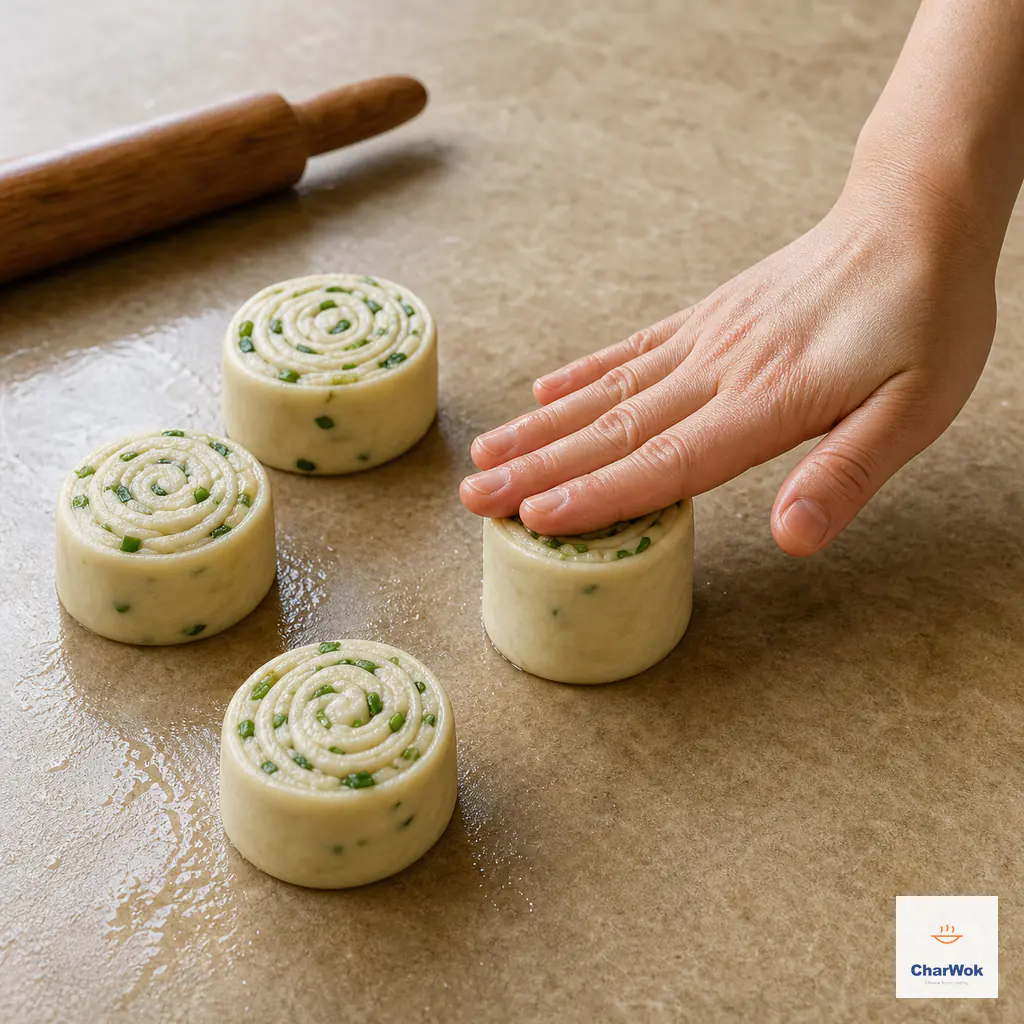
Cut four equal cylinders, stand each one on a spiral end, and press gently before rolling to about 13 cm so the layers stay upright
For a thinner, larger pancake, cut the rope into three pieces instead of four and roll each to about 23 cm (9 inches). The thin version is crisper and more shatter-y; the thick version is chewier with more contrast between the crackled outside and the soft middle. I prefer thick for eating on their own and thin for cutting into wedges to dip.
Frying: heat, lid, rest
- Heat the pan, then back off. Put a generous slick of oil in a heavy skillet over high heat. Test with a single scallion green: if it sizzles at once, the oil is ready. Turn the heat down to medium before the pancakes go in. Starting hot sears the surface; finishing on medium cooks the inside without scorching the outside.
- Cover and cook 2 minutes. Lay the pancakes in top-side down so the spiral faces the heat. Cover the pan. The lid traps steam, which helps the layers separate and the center cook through. After about 2 minutes the underside should be deep golden. Adjust the time by color, not by the clock.
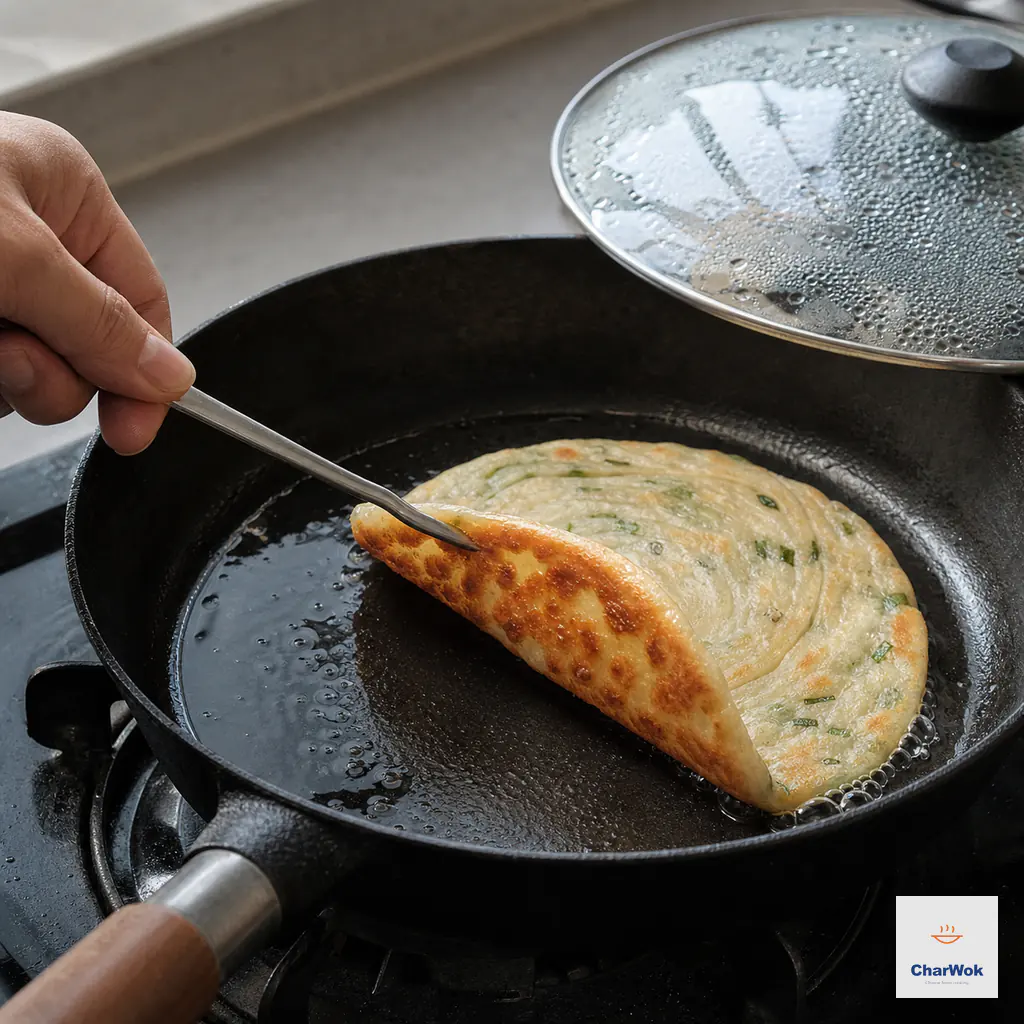
Cover and cook over medium heat for about 2 minutes, then judge by a deep-golden underside before flipping and covering again
- Flip and finish. Turn the pancakes, cover again, and cook the second side until it matches. Both sides should be crisp and well-colored; a pale pancake is a doughy pancake.
- Rest on a rack before serving. Move the finished pancakes to a wire rack for 1 to 2 minutes. This is not optional theater. On a plate, the trapped steam has nowhere to go and turns the crisp crust soggy within seconds. On a rack, the steam escapes and the residual heat finishes setting the center.
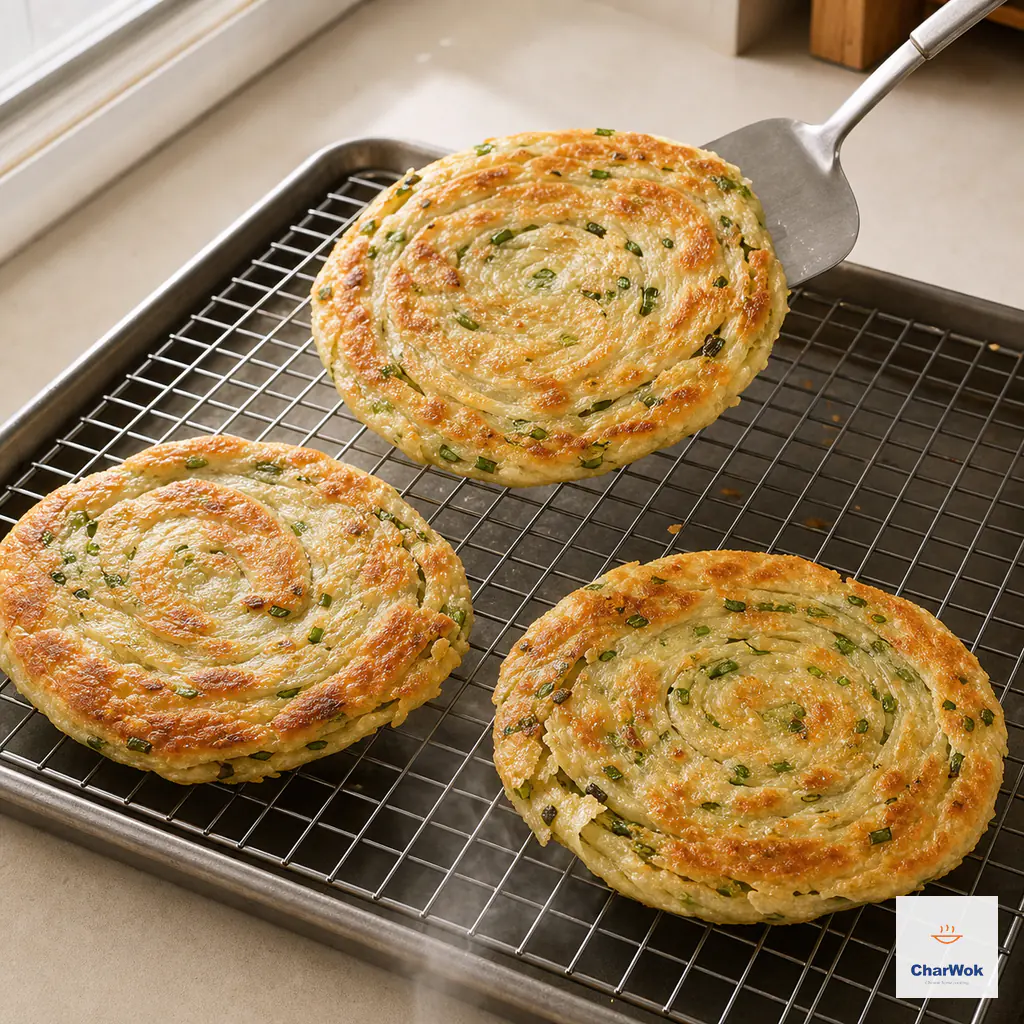
Rest every finished pancake on a wire rack for 1 to 2 minutes so steam escapes instead of softening the crisp underside
When things go wrong
The dough is too sticky to handle. It is probably still hot, or under-rested. Cover it and wait five more minutes. Dust your hands and the counter with oil, not flour; flour tightens the dough, oil keeps it soft. If it is still tearing, the water may not have been hot enough and too much gluten formed; a 10-minute rest helps, but next time use water closer to a boil.
The layers did not separate. Either the filling paste was too thin (too much oil, not enough flour), or you rolled the rope too tight, or you rolled the final pancake so hard that you crushed the layers flat. Spread a real paste, roll gently, and stop rolling the moment the circle is the size you want.
The crust is pale and soft. The pan or oil was not hot enough when the pancake went in, or you lifted the lid too often and let the heat escape. Preheat properly, then keep the lid on. Color is flavor here; the Maillard reaction that browns the starch is the same one producing the toasted, savory notes.
The scallions burned. They were exposed at the edges, or your heat was too high for too long. Tuck the scallions slightly inside the paste and keep the finishing heat at medium. Burned scallions go bitter fast.
The pancake is greasy. You used oil alone instead of a flour paste, or the oil in the pan was not hot enough so the pancake soaked it up instead of frying. Hot oil fries; warm oil absorbs.
Variations and how to serve them
The classic dip is dead simple: a spoonful of homemade chili oil, a splash of black rice vinegar, and a little light soy sauce, stirred together. The vinegar cuts the fat, the chili adds heat, and the soy brings salt and umami. For something less fiery, soy and vinegar alone, or soy with a few drops of toasted sesame oil, is plenty.
If you have a jar of scallion oil in the fridge, a teaspoon of it in the filling paste pushes the onion flavor further without adding more raw scallions that could burn. For a richer breakfast, slide a fried egg on top, or make the egg-and-scallion cousin Ji Dan Bing when you want something softer and faster than a layered pancake.
Scallion pancakes are best as part of a meal, not the whole meal. They sit happily alongside a bowl of congee for breakfast, or as a starch next to a saucy stir-fry at dinner. For a street-food spread, pair them with Jian Bing crepes or wrap pieces inside the soft Chun Bing pancakes used for Peking duck. And if you fall for this dough, the leavened scallion flatbread and the oven-baked Cong You Bing loaf are the natural next steps.
Storage and reheating
Cooked pancakes keep in an airtight bag in the fridge for up to 3 days. Reheat them in a dry skillet over medium heat for a minute or two per side, or in an oven or air fryer at 180°C (350°F) for about 6 minutes. The microwave will turn the crust rubbery; do not use it.
The better move is to freeze them uncooked. After shaping, stack the raw pancakes with parchment paper between each one and seal in a bag. Cook straight from frozen, exactly as written, but for the thick ones add a tablespoon of water to the pan and keep the lid on for the first side so the inside thaws and steams through before the outside burns. This is the same trick used for pan-fried dumplings, and it works because the problem is the same: cook the center without wrecking the crust.
A few honest limits
I will not pretend a home scallion pancake is identical to the one from a northern street cart. The cart version is rolled paper-thin by someone who makes a hundred a day, slapped onto a screaming-hot griddle, and smashed with a spatula mid-fry to break the layers open. You can get close. You will probably not get that exact shatter on the first try, and that is fine. What you will get is a tender, layered flatbread that beats anything from the freezer aisle, and once the hot-water dough and the flour paste click for you, the whole family of layered breads opens up.
Frequently asked questions
Can I use cold water instead of hot? You can, but the result is a different, tougher dough closer to a dumpling wrapper than a tender pancake. Hot water is what gives scallion pancakes their soft bite.
Why add flour to the oil for the filling? Plain oil gets squeezed out when you roll, and the layers merge. Flour turns the oil into a paste that stays put and crisps between the dough sheets.
Do I have to rest the shaped pancakes before frying? A short rest relaxes the gluten so the pancakes keep their shape in the hot pan. Five minutes is enough; skip it and they may shrink or fight the rolling pin.
Why rest them on a rack instead of a plate? Trapped steam on a plate turns the crisp crust soft within seconds. A rack lets the steam escape and lets residual heat finish the center.
Can I bake these instead of frying? Pan-frying is the traditional method and gives the best crust. For an oven version, the leavened scallion flatbread is built for dry heat and is a better fit than forcing an unleavened dough into the oven.