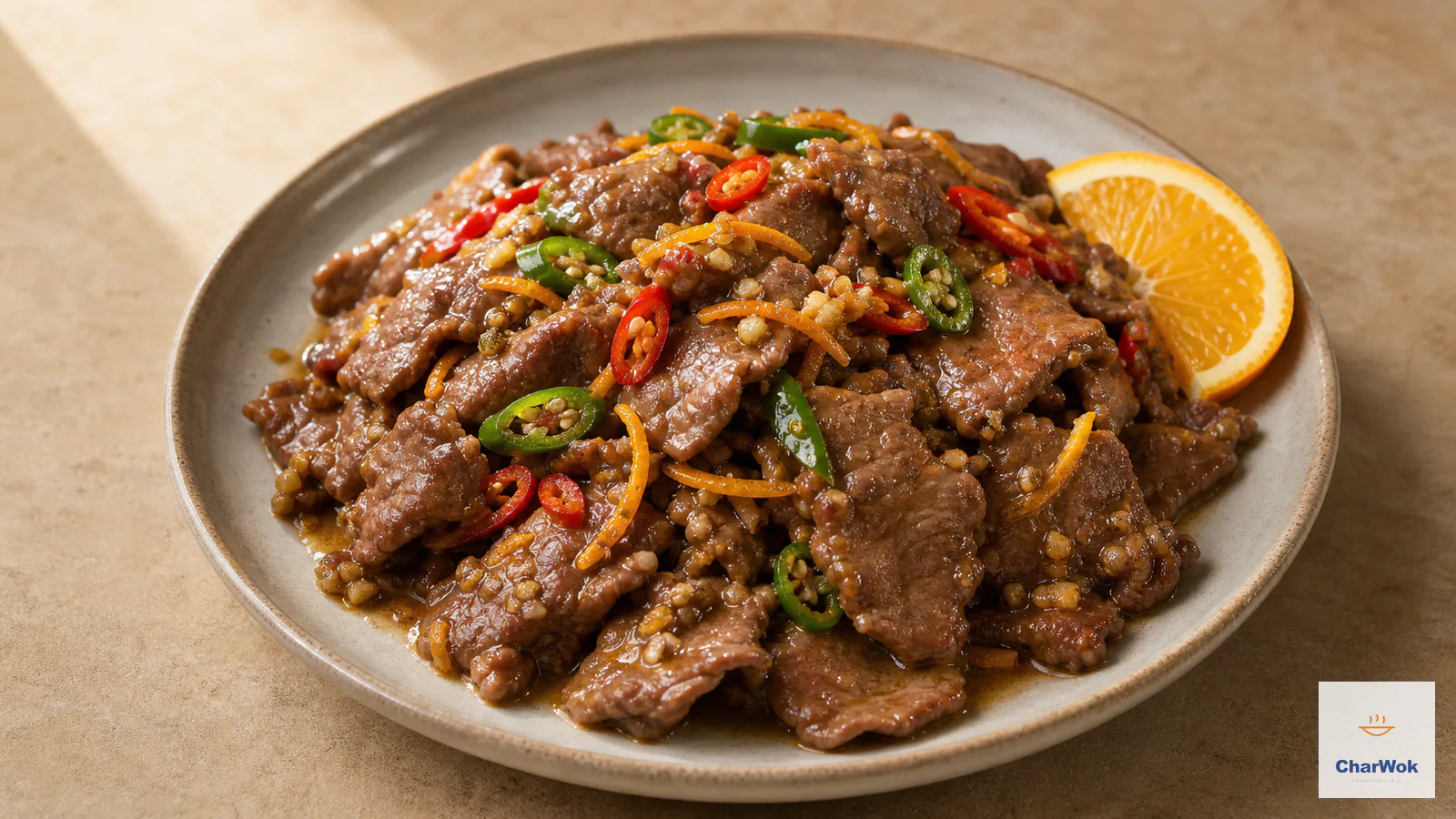
Most orange beef you find in Chinese-American takeout is candy: battered, deep-fried, glazed in something that tastes more like a orange-cream soda reduction than anything a tangerine ever touched. The version I keep coming back to is the opposite of that. Thin strips of flank, barely coated in starch, hit a screaming wok for under a minute, then get tossed with fresh orange zest, a slug of juice, soy, and enough fresh chili to make your nose run. It tastes like beef and it tastes like orange, and it is on the table in roughly the time it takes to steam the rice. That speed is the whole point, and also the whole trap.
The dish has a Sichuan ancestor called chenpi beef, which leans on sun-dried tangerine peel (chenpi) for a bittersweet, perfumed note. Dried peel is a beautiful ingredient when you can find it, but it is a slow, layered flavor. Fresh orange zest and juice give you something louder and more immediate: the volatile oils in the zest hit your nose the second they meet hot oil, and the juice's acidity does double duty, tenderizing the meat in the marinade and brightening the sauce at the end. The trade-off is freshness, which fades fast. This is not a dish that improves on the second day.
At a glance: Marinate thin flank strips in orange juice, Shaoxing wine, soy, and cornstarch for 10 minutes. Sear hot and fast, pull the beef out, bloom orange zest with chili, garlic, and ginger, then return the beef and hit it with a cornstarch-thickened orange-soy sauce. About 90 seconds of actual wok time. The make-or-break move is the two-stage fry: pull the beef while it is still slightly pink, or it turns to shoe leather.
Why this works: the science behind each step
Three things have to happen at once for a stir-fried beef dish to taste like a restaurant's and not a home cook's sad Tuesday. First, the meat has to stay tender, which means cutting across the grain to shorten the muscle fibers and using a thin starch coating to buffer the heat. Second, the wok has to be hot enough to sear before the juices leak out, which is why a proper carbon-steel wok matters more than the recipe admits. Third, the sauce has to glaze, not soup. That last one comes down to cornstarch and timing, and it is where most home versions fall apart.
The cornstarch in the marinade is doing two jobs. It coats each strip in a thin gel that absorbs the orange juice and soy instead of letting them pool in the bowl, and that same gel forms a faint crust in the hot oil that holds the meat's surface moisture in. This is the home-kitchen version of velveting without the oil-blanche step, and it works fine for a quick stir-fry like this where the beef is in the pan for under a minute. The juice itself helps too: its citric acid nudges the surface proteins toward tenderness in the short marinating window.
The zest is the real orange flavor. Zest is where the aromatic oils live; the juice is mostly water, sugar, and acid. If you skip the zest, or use a Microplane that shreds it to dust, the dish will read as a soy-garlic stir-fry with a faint fruity background, which is exactly the most common complaint I hear from people who tried an orange beef recipe once and walked away disappointed. Cut the zest into fine julienne and you get little bursts of citrus oil in nearly every bite.
Ingredients
Ingredients at a glance
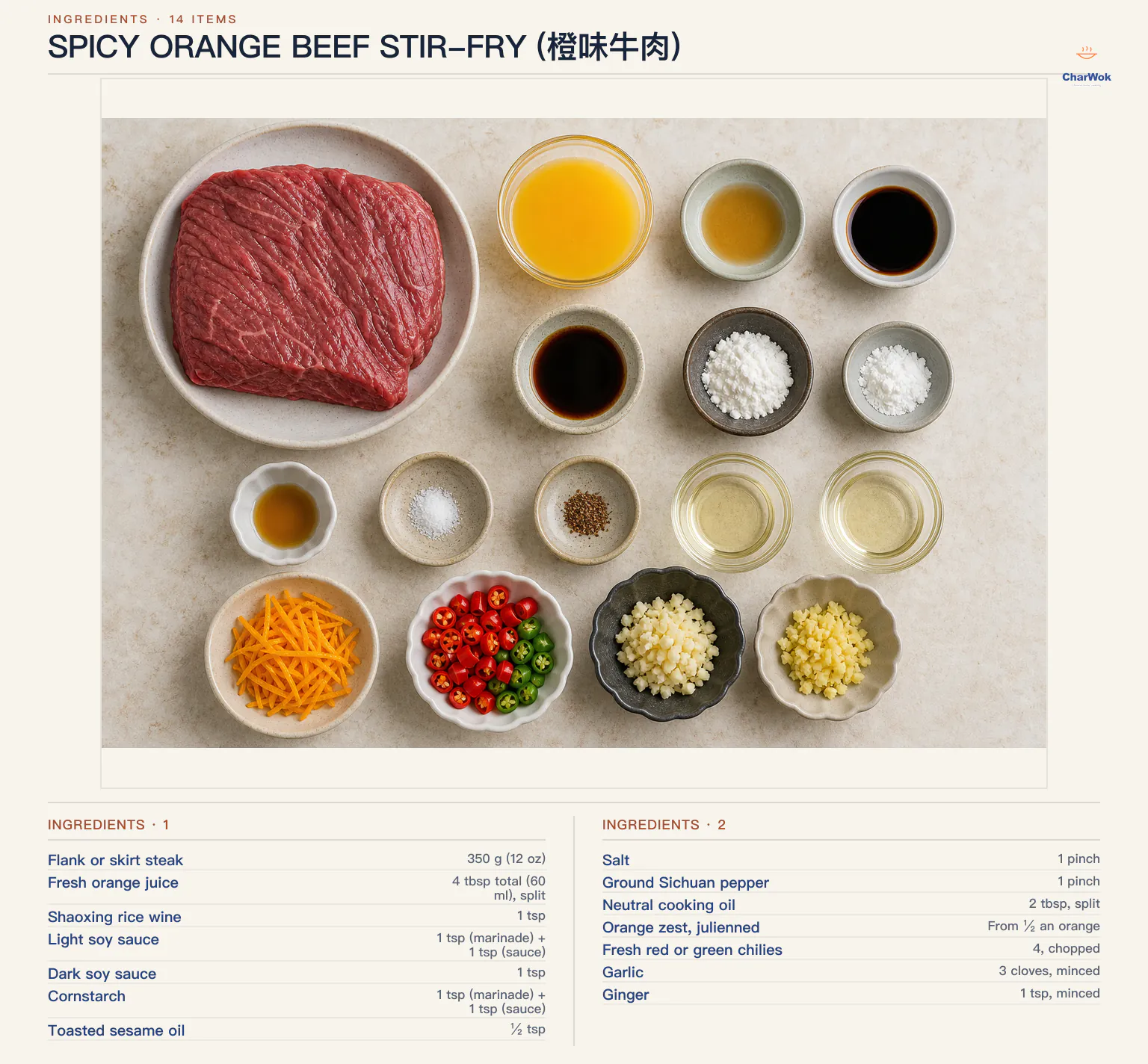
| Ingredient | Amount | Notes / substitute |
|---|---|---|
| Flank or skirt steak | 350 g (12 oz) | Slice 5 mm thick across the grain, then into strips. Hanger or flap meat also work. Avoid pre-sliced stir-fry beef, which is often cut with the grain. |
| Fresh orange juice | 4 tbsp total (60 ml), split | 2 tbsp for the marinade, 2 tbsp for the sauce. One medium orange usually yields enough. Bottled juice tastes flat; do not use it. |
| Shaoxing rice wine | 1 tsp | For the marinade. Dry sherry is the closest Western substitute. See my notes on Shaoxing wine. |
| Light soy sauce | 1 tsp (marinade) + 1 tsp (sauce) | Salt and umami. If you only have one soy, use the light one and add a few drops of molasses for color. |
| Dark soy sauce | 1 tsp | For color and a molasses-ish depth. Understand the difference between light and dark soy before substituting. |
| Cornstarch | 1 tsp (marinade) + 1 tsp (sauce) | Potato starch works and gives a glossier finish; use it if you have it. |
| Toasted sesame oil | ½ tsp | Into the sauce only. Cooking it kills the aroma. Here is more on Chinese sesame oil. |
| Salt | 1 pinch | Into the sauce. |
| Ground Sichuan pepper | 1 pinch | Adds the signature mouth-numbing hum. Toast whole peppercorns and grind fresh; see how in my Sichuan pepper guide. |
| Neutral cooking oil | 2 tbsp, split | 1½ tbsp to sear the beef, ½ tbsp for the aromatics. Peanut, canola, or grapeseed. Not olive oil. |
| Orange zest, julienned | From ½ an orange | Colored part only; the white pith is bitter. Use a vegetable peeler, then cut into thin matchsticks. |
| Fresh red or green chilies | 4, chopped | Thai bird's-eye or serrano. Seed them for a manageable heat; leave seeds in if you want it properly spicy. Dried chili oil is a lazy substitute, added at the end. |
| Garlic | 3 cloves, minced | |
| Ginger | 1 tsp, minced |
The method, step by step
Have everything measured and within arm's reach before you turn on the stove. Once the beef hits the wok you will not have time to hunt for the soy sauce.
- Slice against the grain. Look at the flank steak and find the direction the muscle fibers run. Cut perpendicular to those lines, in slices about 5 mm (¼ inch) thick. Then cut the slices into strips roughly 5 cm (2 inches) long. Cutting across the grain is the single biggest factor in whether the beef chews tender; cut with it and no amount of marinade will save you.
- Marinate for 10 minutes, not longer. Toss the beef with 2 tbsp orange juice, the Shaoxing wine, 1 tsp light soy, and 1 tsp cornstarch. Mix until the liquid is absorbed and the meat looks slightly sticky. Ten minutes is enough for the starch to set up and the acid to soften the surface. Going past 20 minutes starts to turn the texture mealy as the acid overworks the proteins.
- Mix the sauce and set it aside. In a small bowl combine the remaining 2 tbsp orange juice, 1 tsp light soy, 1 tsp dark soy, 1 tsp cornstarch, the sesame oil, the pinch of salt, and the pinch of ground Sichuan pepper. Stir it again right before you use it, because the starch settles fast.
- Prep the zest and aromatics. Cut the zest into fine julienne. Mince the garlic and ginger. Chop the chilies and decide now whether you are keeping the seeds.
- Heat the wok until it smokes. Set the wok over high heat until a drop of water dances and evaporates instantly, then add 1½ tbsp oil and swirl. You want the oil shimmering but not so hot that it smokes aggressively. If your stovetop is weak, let the pan preheat a full two to three minutes; a lukewarm wok is the number-one reason home stir-fries braise instead of sear.
- Sear the beef in one layer, then pull it. Add the strips and spread them out. Let them sit for 15 to 20 seconds before stirring so the surface can brown, then toss for another 30 to 45 seconds. The moment the outside is no longer raw and the strips are still slightly pink inside, dish them out onto a plate. Overcooking by 30 seconds here is what makes the whole dish chewy.
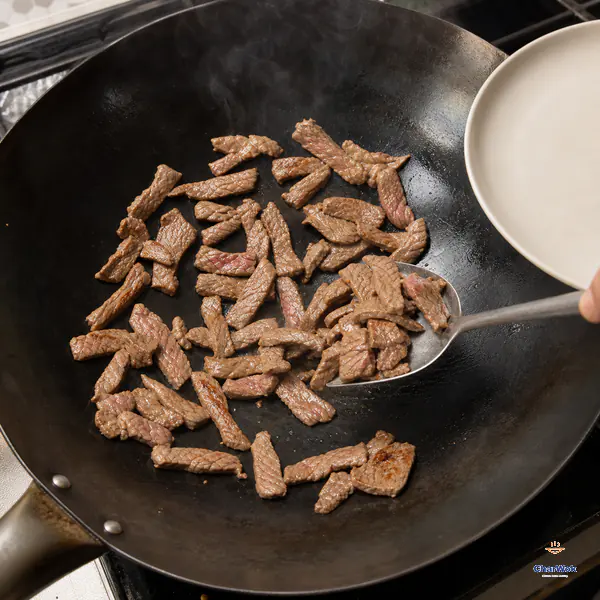
Keep the beef in one layer, leave it untouched for 15–20 seconds to brown, then toss only until the outside is no longer raw; lift it out while the thicker centers remain slightly pink.
- Wipe the wok and bloom the aromatics. Pour out any liquid in the wok (beef juice in the pan will turn the dish gray and boil the next step). Add the remaining ½ tbsp oil, then the julienned zest, chilies, ginger, and garlic. Stir for 15 to 20 seconds, just until you can smell the orange oil and garlic and the chilies brighten in color. The zest is here for aroma, not browning; if it darkens past amber you have gone too far.
- Return the beef and sauce it. Tip the beef back in, stir for about 30 seconds to combine, then give the sauce bowl a final stir and pour it in along the edge of the wok so it boils on contact. Toss constantly. Within 20 to 30 seconds the sauce will go from cloudy and thin to glossy and clinging. The second it coats the beef evenly, kill the heat and serve.
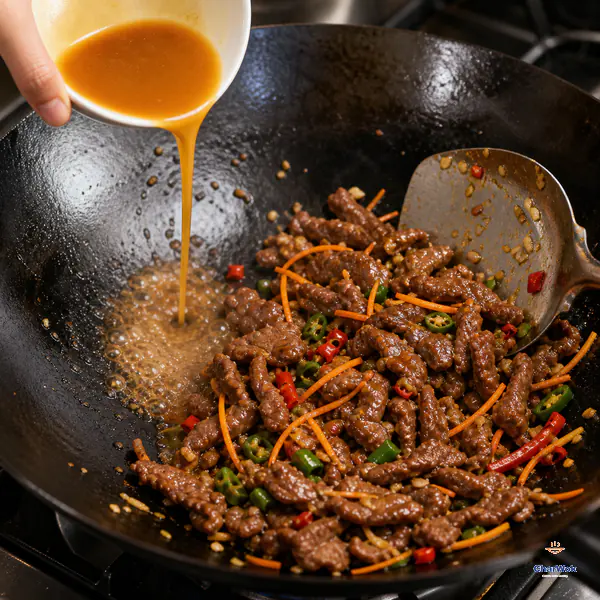
Stir the sauce immediately before pouring it onto the exposed hot wok edge, then toss constantly for only 20–30 seconds; stop as soon as it changes from cloudy and thin to translucent, glossy and clinging.
Where it goes wrong
I have made this dish badly in every way a person can, so here is the troubleshooting I wish I had read the first time.
- The beef is tough and chewy. Either you cut with the grain, or you left it in the wok too long on the first pass. Flank is unforgiving. Cut thinner next time (4 mm), and pull the meat the instant it loses its raw red on the outside.
- The orange flavor is barely there. This is the classic failure, and it almost always traces to the zest. Use more zest (a whole orange's worth is not excessive), cut it into visible julienne rather than microplaning it to powder, and do not let it scorch. A teaspoon of zest steeped in the hot oil for a few extra seconds before the garlic goes in also amplifies it.
- The sauce is watery and pools in the plate. Three likely causes: you did not stir the sauce right before pouring (the starch was sitting on the bottom), the wok was not hot enough when the sauce hit, or you skipped pulling the beef and its juices diluted everything. The fix is a hotter wok and a well-stirred, properly measured tablespoon of starch.
- The sauce clumps into jelly. Too much cornstarch, or the cornstarch hit a cold spot in the pan. Whisk the sauce until it is fully dissolved and pour it along the hot wok wall, not directly onto the meat.
- Everything tastes gray and boiled. Your heat is too low, or you crowded the pan and the beef steamed instead of searing. Cook in two batches if your wok is small. The same logic applies to other quick stir-fries like black pepper beef and Hunan beef; high heat and uncrowded pan are non-negotiable.
- The zest is bitter. You got into the white pith. Use a light hand with the peeler and shave only the colored layer.
Variations and pairings
Once the technique is in your hands, the orange-chili-soy frame is flexible. A few directions worth taking it:
- Tangerine or pomelo zest instead of orange. Tangerine zest is closer to the traditional chenpi flavor and more aromatic. Pomelo zest is floral and worth trying if you can find the fruit.
- Dried tangerine peel, rehydrated. If you have access to an Asian grocery, a 5 g piece of dried chenpi, soaked and chopped, deepens the dish toward its Sichuan roots. Combine it with the fresh zest rather than replacing it.
- Heat it up or down. For a fierier dish, add a teaspoon of doubanjiang to the aromatics, or finish with a spoonful of chili oil. To dial it back, halve the chilies and drop the Sichuan pepper.
- Add vegetables. Thinly sliced bell pepper or green beans blanched first can go in with the aromatics. Avoid wet vegetables like tomato; they will thin the sauce.
For the table, this is a saucy, intensely flavored main that wants plain rice and a quiet side. Steamed jasmine rice is the obvious anchor; a plate of smashed cucumber salad or a quick garlic bok choy gives you the cold and the green to balance the rich beef. A bowl of tomato egg drop soup alongside turns it into a proper meal without much extra work. If you are feeding a crowd, pair it with milder dishes like beef and broccoli or a simple pepper steak so the orange beef can be the loud one.
Storage and reheating
This is a cook-and-eat dish. Leftovers keep in the fridge for a day, but the beef tightens up as it sits and the fresh orange top note fades. If you must reheat, do it fast in a hot pan with a splash of water to loosen the sauce, never in the microwave, which turns the beef rubbery. I do not recommend freezing it.
Frequently asked questions
Can I use chicken or pork instead of beef? Yes. Boneless thigh cut into strips works for chicken; pork tenderloin or loin works for pork. Marinate the same way and pull the protein slightly before it is fully cooked. Cooking times are similar, just watch the visual cues rather than the clock.
Is there a way to make it without cornstarch? You can, but you lose the glossy glaze. Arrowroot or potato starch swap in one-to-one and actually give a clearer, shinier finish. Skipping starch entirely leaves you with a thin, watery sauce that will not cling.
How spicy is this with four chilies? With seeds removed, moderately spicy, a pleasant warmth that builds. With seeds left in, it is genuinely hot. Start with two seeded chilies if you are sensitive and taste your way up.
Can I skip the two-stage fry and cook it all at once? You can, but the beef overcooks while the aromatics soften. The whole point of pulling the meat is to keep it pink inside. It is one extra bowl to wash and the difference is large.
The honest summary: this is a 15-minute dish that lives or dies on two decisions, how you cut the meat and how long the first sear lasts. Get those right and the orange-chili-soy combination does the rest. It is one of those recipes that earns a permanent spot in the weeknight rotation precisely because it asks so little and delivers so much flavor, provided you respect the speed.