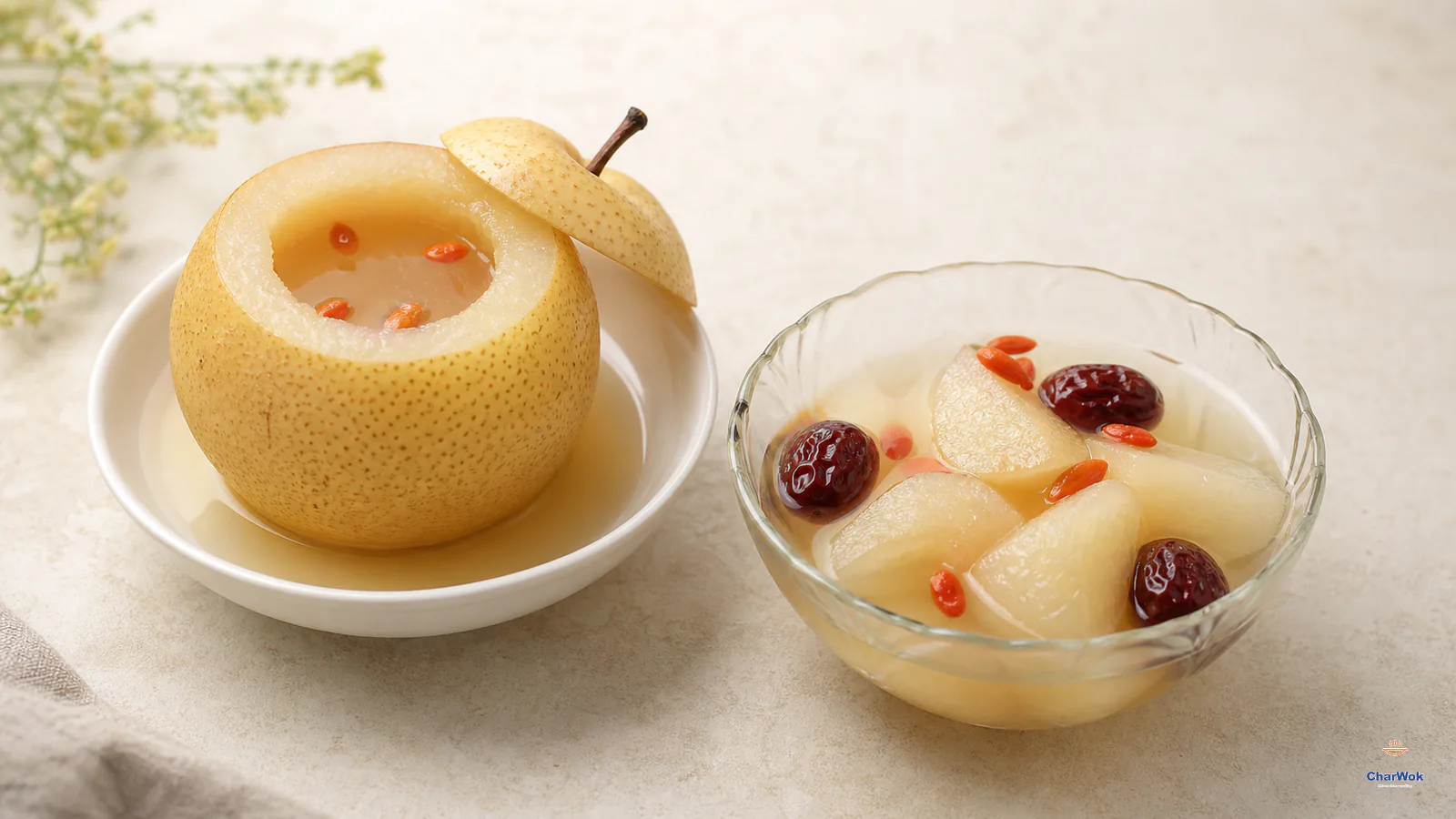
Steamed pear with rock sugar is the dish my mother produced the moment anyone in the house cleared their throat twice. It is also the dish I burned through three batches of before I understood why the timing mattered. The premise sounds too simple to fail — a pear, some rock sugar, a handful of goji berries, steam or simmer. Yet most home versions come out either chalky and undercooked or collapsed into gray mush. The difference between the two is one decision: how long you let heat meet fruit.
This is a northern Chinese winter dessert with roots in traditional tonic cooking, the same family of sweet, gently medicinal bowls that includes red bean soup and black sesame paste. In Mandarin it is called bing tang xue li, literally "rock-sugar snow pear." The "snow" refers to the pale, jade-flecked Asian pear, not the weather. I am not going to claim it cures your cough. I will claim it is the most comforting thing you can make in under an hour when the heat is on and your throat is scratchy.
At a glance. Two methods, one ingredient list. Steamed whole pear: 40 minutes over medium steam, intense flavor, holds its shape, and is the one to serve guests. Boiled slices: 18–20 minutes at a murmur, more broth, faster, and is the one for a sick Tuesday. Use rock sugar, not granulated; it sweetens without the sharp, candy edge of white sugar. Asian pear only. A Bosc pear will turn mealy and tasteless.
Why the pear matters more than the method
The single ingredient you cannot substitute is the Asian pear. You may know it as Nashi, Korean pear, apple pear, or Chinese white pear depending on the market. It looks like a round, sandy-colored apple and crunches like one when raw. That high water content and fine, sand-like cell structure is the whole reason this dessert works. Under heat, the cells collapse gently and release juice that, combined with the sugar, turns silky and translucent. A European pear (Bartlett, Bosc, Anjou) has a different cell chemistry: it ripens to buttery softness when raw but turns woolly and brown when simmered with sugar. I tried it once during a snowstorm when it was all I had. The result was edible. It was also depressing.
Peel or not is a real question, and I have a firm answer: peel for the boiled version, leave the skin on for the steamed whole version. Skin holds the pear's shape during the long steam, and the cooked skin slips off easily at the table if you do not want to eat it. For the boiled soup, skin floats free in ragged sheets and muddies the broth, so off it comes.
The supporting cast, and why each one earns its place
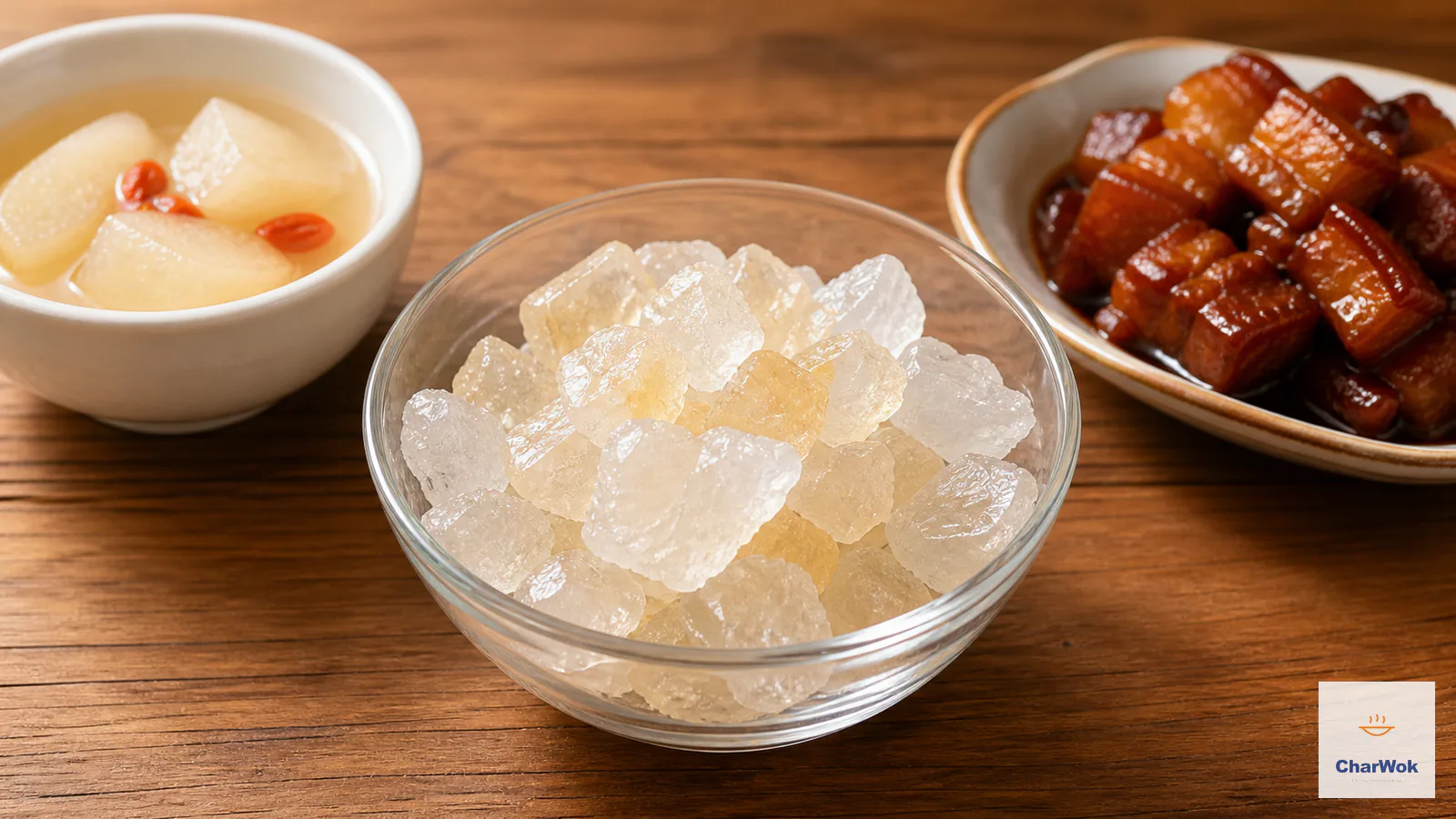
Rock sugar (rock sugar, or bing tang) is non-negotiable in name only. It is less sweet by volume than white sugar and has a clean, almost honeyed finish with none of the syrupy burn. If you cannot find it, raw cane sugar (turbinado) is the closest substitute; brown sugar works but darkens the broth and adds molasses flavor that fights the pear. Do not use honey in the pot; its aromatics cook off and turn bitter over 15 minutes. Add honey only to a cooled bowl.
Dried goji berries are mostly here for their ruby flecks and faint, raisin-tart note. They also happen to be the most recognizable "tonic" ingredient to anyone who grew up with this dessert. Soak them for five minutes if they look dusty, then drain.
Dried red dates (jujube) go into the boiled version only. They are not Medjool dates. Different fruit entirely, less sweet, more date-y in the sense of dried-fruit-with-a-core. They give the broth a deeper, almost caramel undertone and a warm amber color. Skip them in the steamed version because they crowd the small hollow of the pear and make the filling gritty.
Ingredients
Pear with rock sugar ingredients for both methods
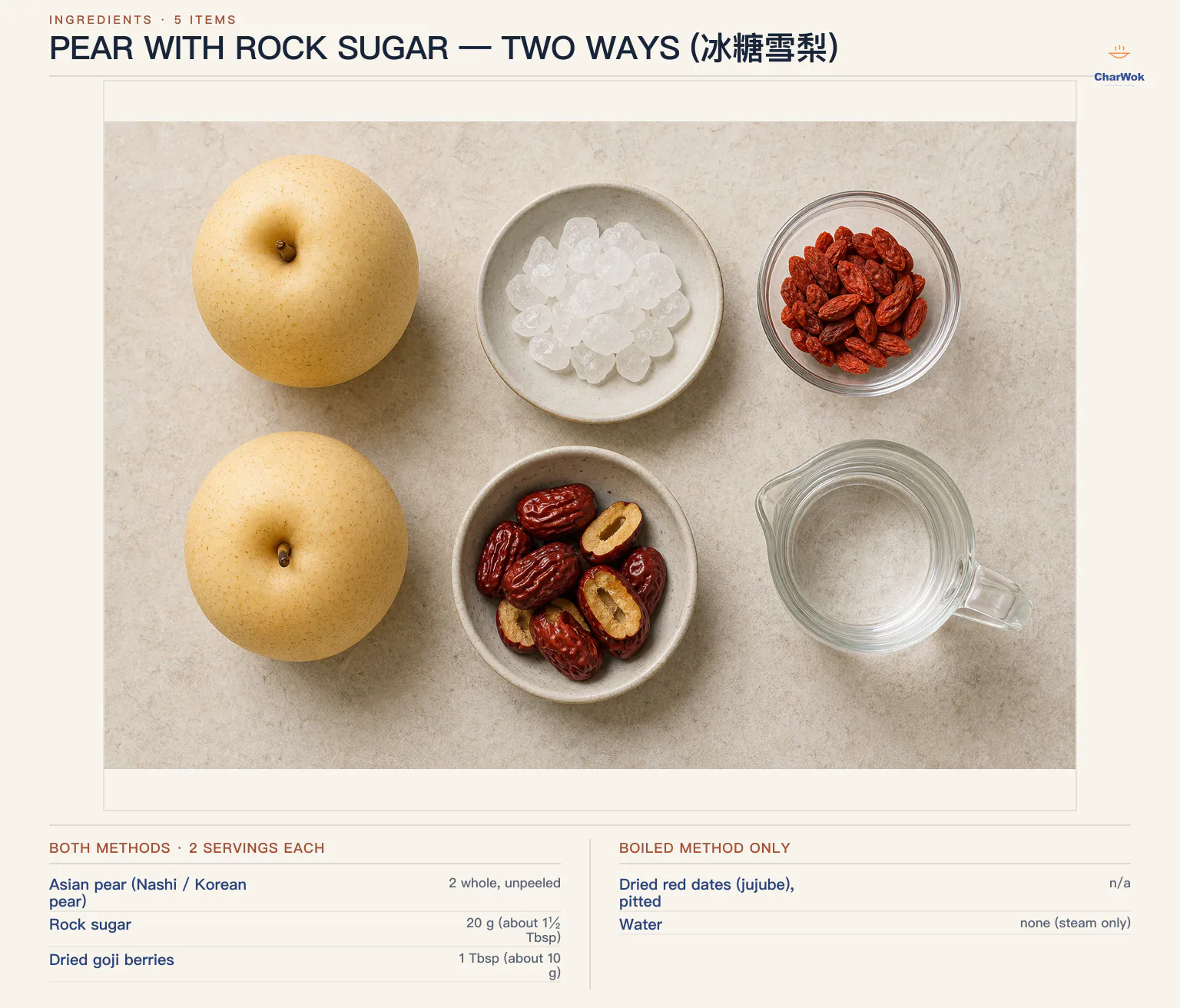
Each version serves 2. Nutrition per serving is roughly 138 kcal for the boiled version; the steamed version lands a little higher because the sugar concentrates.
| Ingredient | Steamed (2 servings) | Boiled (2 servings) | Notes / substitute |
|---|---|---|---|
| Asian pear (Nashi / Korean pear) | 2 whole, unpeeled | 2 whole, peeled | Do not swap for Bosc or Bartlett; they turn mealy. Choose firm, fragrant fruit. |
| Rock sugar | 20 g (about 1½ Tbsp) | 20 g (about 1½ Tbsp), or to taste | Sub: turbinado raw cane sugar. Avoid white granulated. |
| Dried goji berries | 1 Tbsp (about 10 g) | 1 Tbsp | Soak 5 min and drain if dusty. |
| Dried red dates (jujube), pitted | n/a | 6–8 | Boiled version only. Sub: 2 dried apricot halves for color, not flavor. |
| Water | none (steam only) | 360 ml (1½ cups) | Filtered water keeps the broth clear. |
Steamed pear, step by step
This is the version I make when someone is actually unwell, because nothing else soothes a raw throat the way warm pear juice does. The trade-off is time. You will need a steamer; if you do not own one, the bamboo steamer setup is worth it for this and for a dozen other dishes, but a metal vegetable steamer insert in a deep pot works fine.
- Slice off the lid. Cut the top quarter off each pear in one clean horizontal cut and set the "lids" aside. A serrated knife gives a cleaner cut on the skin than a chef's knife.
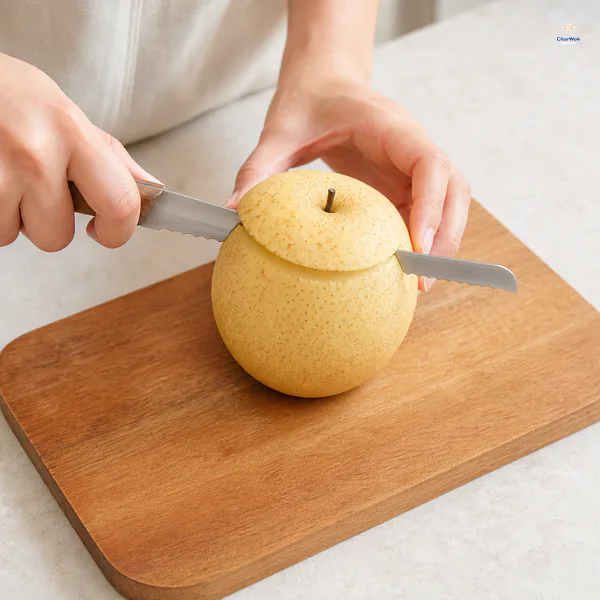
Slice off the top quarter in one clean horizontal cut and keep the pear lid intact for replacing later.
- Hollow the core with a teaspoon. Scoop out the seed cavity and the tough central fibers, leaving about a 1 cm wall of flesh so the pear holds its shape. Do not pierce the bottom, because if you do, the syrup leaks out and you lose the best part.
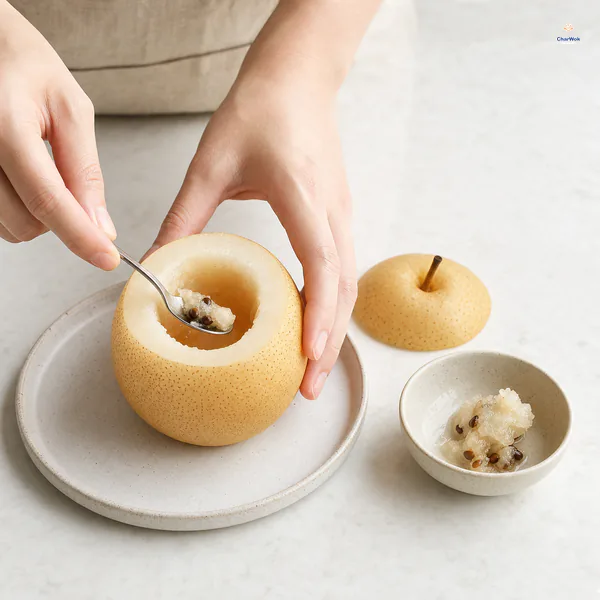
Scoop out the seeds and tough fibres, leaving about a 1-centimetre wall and an unpierced bottom so the syrup cannot escape.
- Stuff and cap. Divide the rock sugar and half the goji berries between the two cavities. Set the lids back on top and pin each one in place with a toothpick broken to length so it does not protrude. Stand each pear upright in a small heatproof bowl. The bowl will catch the syrup that seeps out, and that syrup is the whole point.
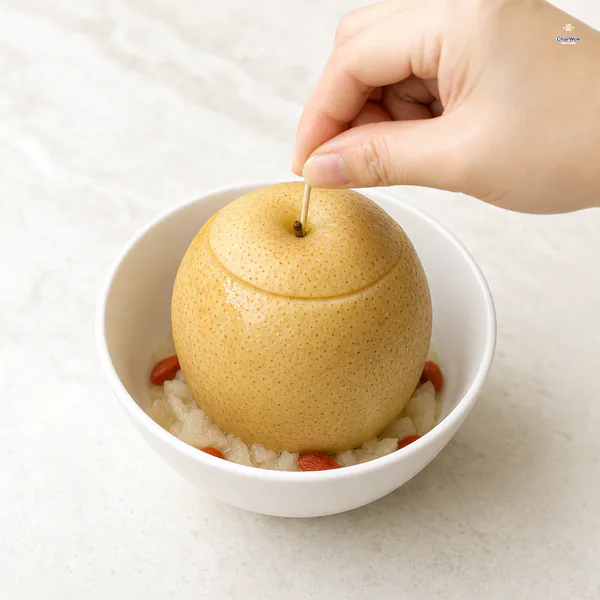
Fill with rock sugar and half the goji berries, replace the lid, secure it with one short toothpick and stand the pear upright in a bowl that will catch every drop of syrup.
- Steam, not boil. Bring the steamer water to a full boil first, then set the bowls in, cover, and drop to medium heat. Steam for 40 minutes. The pear is done when the flesh at the neck yields to a knife with no resistance and has gone translucent at the edges. Under-cooking is the failure I see most often: at 25 minutes the pear is still chalky and the sugar has not melted through.
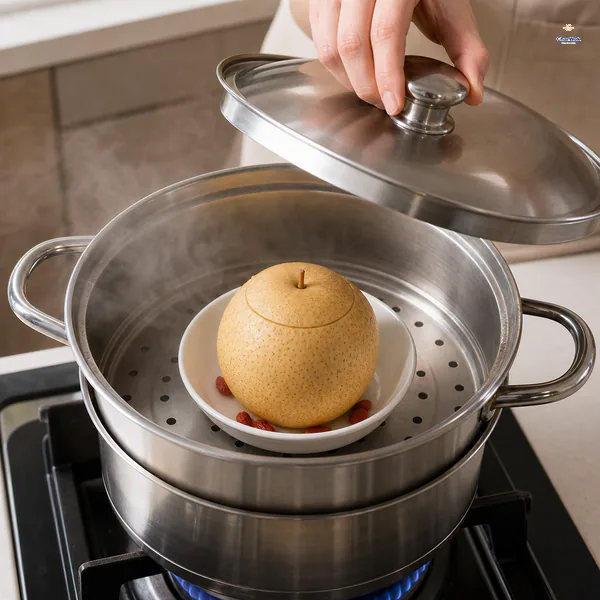
Put the bowl into an already steaming pot, cover and steam over medium heat for about 40 minutes until the neck yields without resistance.
- Rest one minute, scatter the remaining goji berries over the pooling syrup, and serve warm in the same bowl. Eat with a spoon; the skin slips off in one piece.
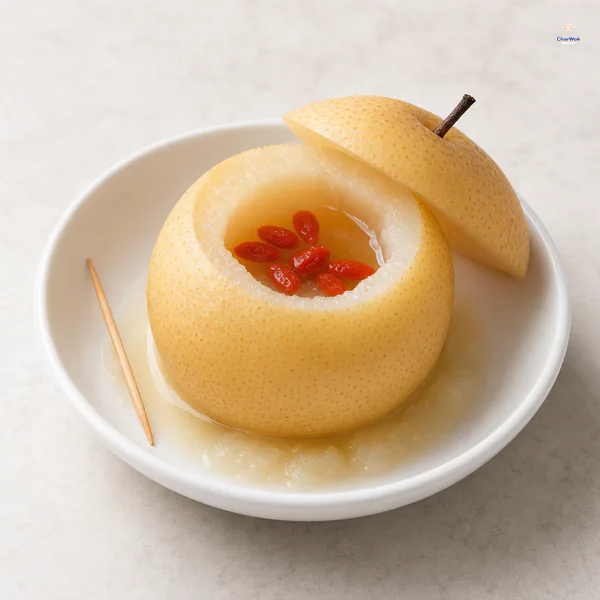
Rest briefly, remove the toothpick, scatter the remaining goji berries into the syrup and serve the whole pear warm in its bowl.
Boiled pear soup, step by step
This is the weekday version: faster, lighter, and you get a full bowl of broth, which I sometimes prefer to the intense steamed syrup. It pairs naturally with other restorative bowls on cold days; it sits comfortably on the same table as winter melon soup or a clear pork rib soup as the sweet finisher.
- Prep the fruit. Peel the pears, quarter them, and cut out the cores. Slice each quarter into 3 or 4 pieces, thin enough to soften through but thick enough not to disintegrate. Roughly 1 cm wedges.
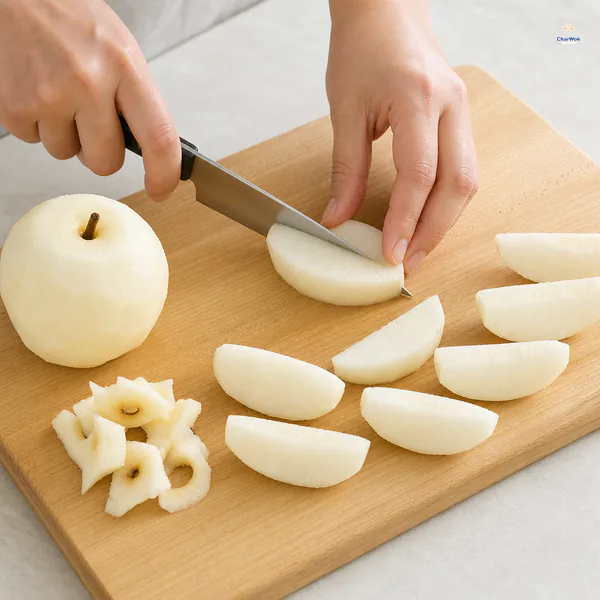
Peel and quarter the pears, remove every hard core and cut each quarter into three or four pieces about 1 centimetre thick.
- Combine cold. Put the pear, rock sugar, drained goji berries, pitted dates, and 360 ml water into a small saucepan. Start cold so the sugar dissolves evenly instead of catching on the hot pan floor.
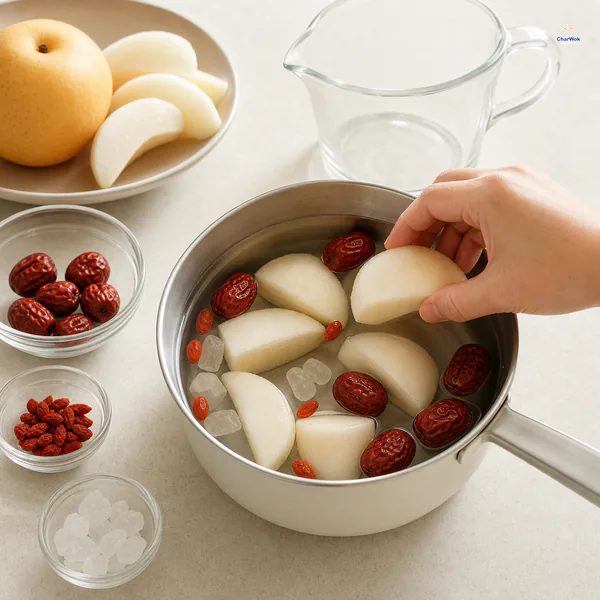
Combine the pear, rock sugar, drained goji berries, pitted red dates and 360 millilitres water in a cold saucepan so the sugar dissolves evenly.
- Bring up fast, then drop to a murmur. High heat until it just boils, then immediately low. This is the make-or-break move. A hard rolling boil will shatter the pear pieces into cloudiness; the barest simmer keeps the broth clear and the wedges intact.
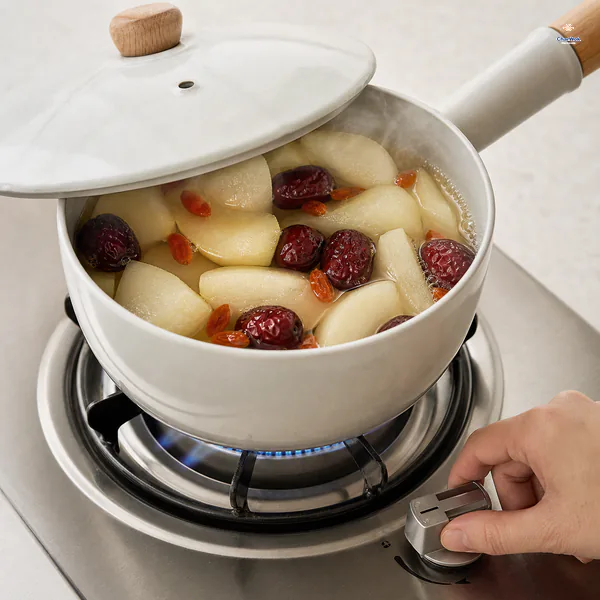
Bring the pot just to a boil, immediately reduce to the barest simmer and keep the lid slightly ajar; a rolling boil clouds the broth and breaks the pear.
- Simmer 15–20 minutes. Taste at 15. The pear should be tender all the way through but still hold its wedge shape, and the broth should taste cleanly of pear with a soft caramel back-note from the dates. Add another 5 minutes only if the pear is still firm at the center.
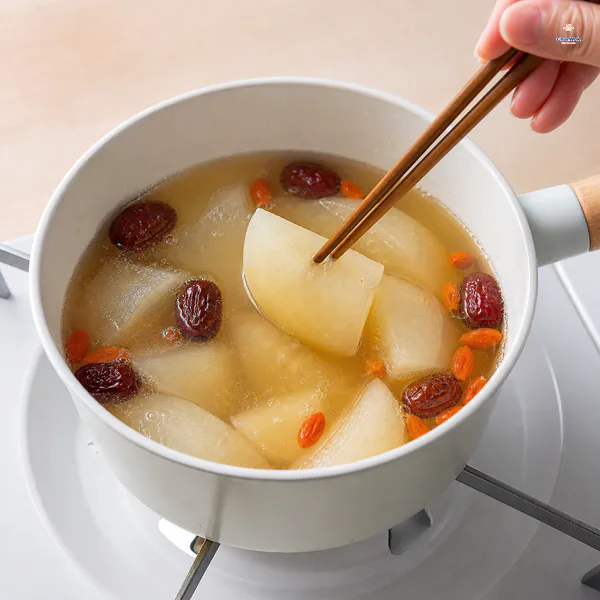
After 15 to 20 minutes, a chopstick should enter the pear easily while every wedge still holds its shape and the broth remains clear.
- Serve hot, or chill for at least 4 hours. Both are legitimate. I like it cold in summer with the same logic that makes mango sago refreshing: the chilled broth reads as a light fruit consommé.
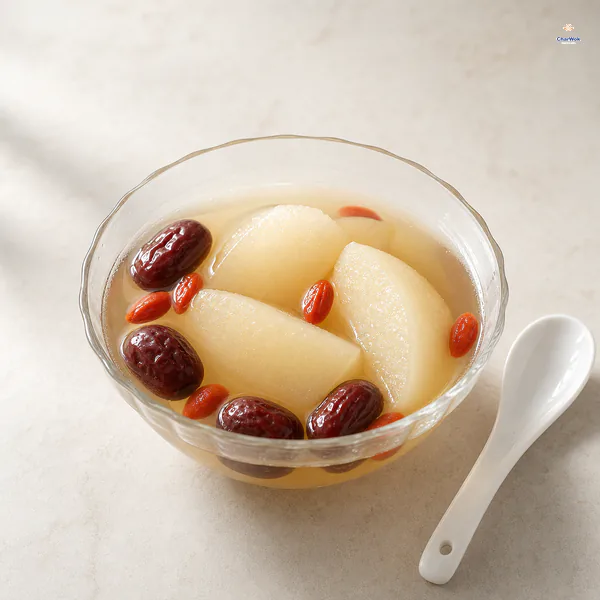
Serve the clear soup hot, or cool and refrigerate it for at least 4 hours before serving chilled.
When it goes wrong
I have made every mistake below, most of them more than once.
- The steamed pear is still chalky at 30 minutes. You undercooked it. Forty minutes is the floor for a full-size Asian pear; small ones may need only 35, but if you are unsure, steam longer, not shorter. The pear does not overcook into mush the way a boiled one does.
- The boiled broth is cloudy and gray. Two usual causes: you let it boil hard instead of simmer, or you used a European pear. Fix the method next time; for the current pot, strain it and serve anyway. It still tastes fine.
- The steamed pear collapsed and leaked all its syrup into the water below. You pierced the bottom while coring, or the lid fell off and the cavity opened. To rescue, pour the steamer water (now a thin pear tea) into the serving bowl with whatever sugar did not melt. Nothing is lost; the presentation is just less tidy.
- It tastes flat, not fragrant. Almost always under-sweetened, because rock sugar dissolves slowly and tastes less sweet than you expect at the pot. Taste at the end of cooking and add a few more crystals while it is still hot; they will melt in the resting bowl.
- The goji berries are tough and gritty. They were not hydrated. A five-minute soak in warm water fixes this. Do not soak longer than ten minutes or they go mushy and bleed color into the broth.
Variations worth keeping
Once you have the base, the dessert is friendly to small changes. Drop two thin coins of fresh ginger into the boiled version for a sharper, more warming broth, excellent when a cold is genuinely settling in. It is the same ginger principle that powers ginger milk curd. A single dried tangerine peel (chenpi), soaked and added to the pot, gives a perfumed, bittersweet top note that I actually prefer to plain.
For texture, add a small handful of sticky-rice-stuffed lotus root slices or a few cooked tang yuan balls to the bowl at serving. Suddenly a throat remedy reads as a proper dessert, in the spirit of eight treasure rice. To go fully in the banquet direction, serve it after a New Year spread alongside nian gao and a plate of sesame balls; it cuts the oil beautifully. For a quieter night in, it sits happily next to a bowl of congee as the sweet course.
Storing and reheating
Both versions keep, covered, in the fridge for up to three days. The broth actually deepens overnight; the pear keeps lending flavor. Reheat the boiled soup gently on the stove or in the microwave at 50% power; a hard boil will dull the aroma. The steamed whole pear reheats best in the steamer for 5 minutes, or eat it cold straight from the fridge, which is how I take my leftovers. Do not freeze; the texture breaks down and turns grainy on thaw.
FAQ
Quick answers to the questions I get most often. If you are cooking for a holiday table, this dessert fits right into a Chinese New Year menu or any festive-season spread, and it lands especially well among the recipes built for chilly days.
Can I use a regular Bartlett or Bosc pear?
No, not with good results. European pears turn woolly and brown when simmered with sugar. Asian pear is the whole reason the texture comes out silky. If you cannot find it, this is not the dessert to force.
Is rock sugar really necessary?
Close to it. It sweetens without the sharp candy edge of white sugar and melts slowly into the juice. Turbinado raw cane sugar is the best stand-in. Brown sugar works but darkens and flavors the broth.
Does this actually help a cough?
Anecdotally, yes. Warm pear juice and sugar soothe a scratchy throat the way any warm, sweet liquid does. I would not call it medicine. I would call it the most pleasant thing you can swallow when your throat hurts.
Why is my steamed pear still hard after 30 minutes?
It is undercooked. A full-size Asian pear needs about 40 minutes of steam to turn tender and translucent at the edges. Steaming longer will not hurt it.
Can I make it ahead for a dinner party?
Yes. Make the boiled version a day ahead and reheat gently, or steam the whole pears an hour before and hold them warm, covered, in their bowls. The presentation actually improves as the syrup pools.