A useful Chinese home-cooking collection should do more than gather twenty appealing dishes. It should show how the same few techniques travel from one recipe to the next. This guide groups familiar home dishes into three practical threads: controlled low heat, high-heat wok cooking, and rested dough with well-mixed fillings.
Use this page as a technique-first curriculum rather than a ranking. Each dish has one main lesson, one common failure point, and a logical next recipe. Follow a thread in order and you will build reusable kitchen instincts instead of collecting disconnected recipes.
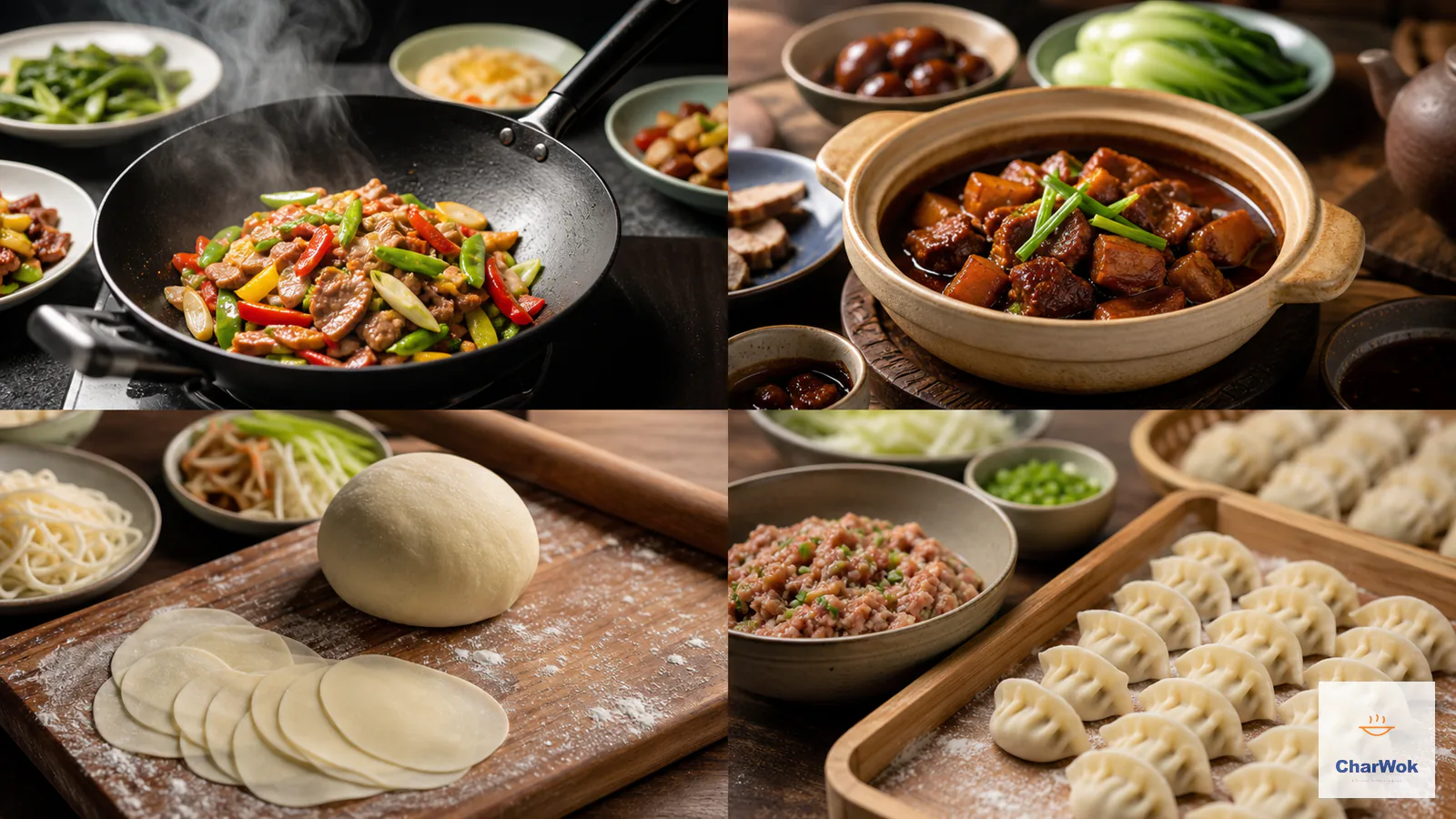
At a glance: start with controlled low heat for tender protein (braises, steamed eggs, soy-bathed chicken), then practice high-heat wok work in under ten minutes (fried rice, chow mein, chow fun), and leave an unhurried afternoon for rested dough (scallion pancakes, meat pies, dumplings and wontons). Master one dish in each column and the rest become easier to read.
The recipes are not arranged from best to worst. Red-braised pork belly rewards patience and forgives small timing differences, while a flawless Peking duck demands careful drying and heat control. The sections below make that difference explicit so you can choose a realistic next step.
Why these dishes belong in one skills guide
20 Chinese recipes that build core cooking skills
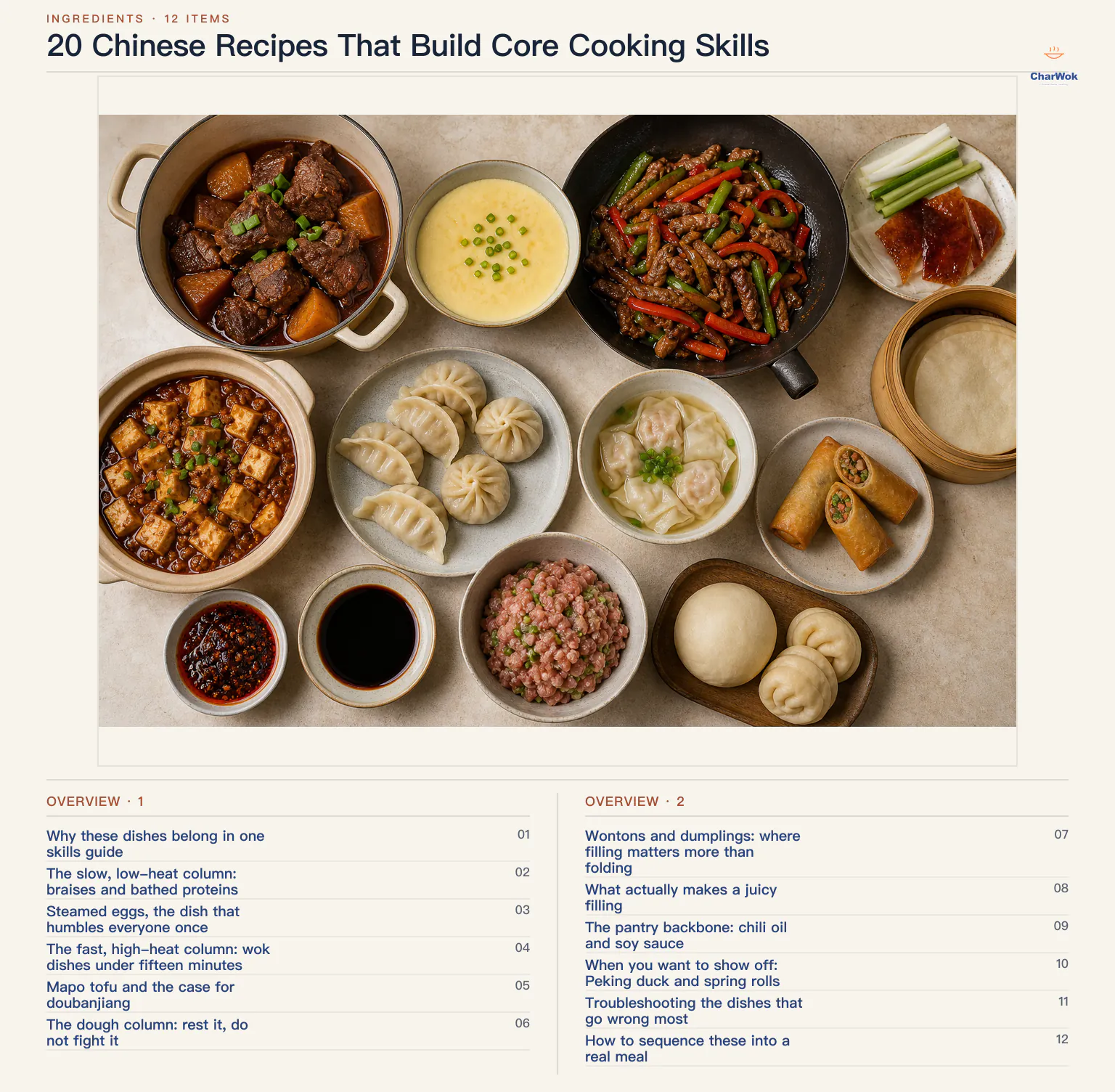
Look closely and a pattern shows up. Nearly every recipe on this list teaches one transferable principle you can carry into the next dish. Egg fried rice teaches you to control moisture in a wok; once that clicks, the noodle stir-fries stop feeling random. Steamed eggs teach gentle heat and the water-to-egg ratio; that same instinct protects the custard-soft silken tofu in mapo tofu. The braise in hong shao rou is the same sugar-and-soy reduction you will meet again in sweet and sour ribs, only shorter and sharper.
This is why I tell new cooks not to bounce randomly through the list. Pick a thread and follow it. If you want to understand wok hei, cook fried rice, then chow mein, then graduate to the rice-noodle stir-fries. If you want to understand dough, start with scallion pancakes, a forgiving no-yeast dough, move to meat pies, and only then tackle wontons, where thinness starts to matter.
The slow, low-heat column: braises and bathed proteins
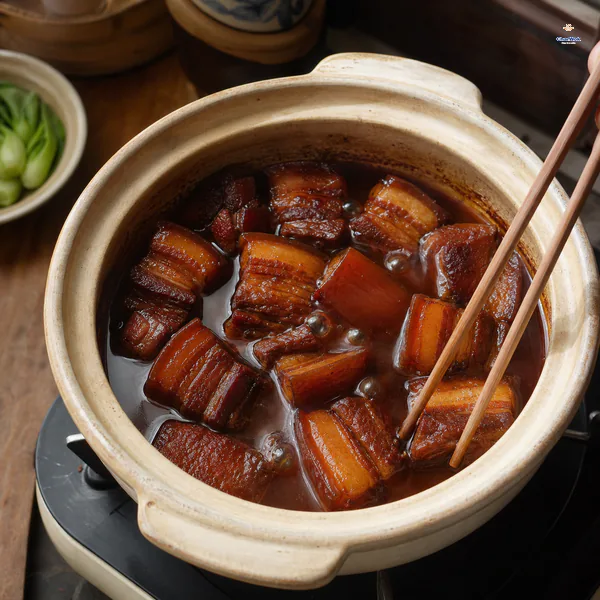
A braise should barely tremble with an occasional lazy bubble; a rolling boil tightens the meat even when the sauce still tastes good.
These are the dishes that look fussy and are secretly the most relaxed. You set a temperature, cover the pot, and walk away. The reason they taste restaurant-grade is time plus collagen, not skill.
| Dish | Core technique | Make-or-break detail |
|---|---|---|
| Red-braised pork belly (Hong Shao Rou) | Caramelize rock sugar, then braise in soy and wine | Cut the belly into uniform 3 cm cubes so they finish at the same moment; skim the scum before reducing |
| Sweet and sour ribs (Tang Cu Pai Gu) | Short braise, then glaze with vinegar and sugar | Add the black vinegar at the end, off high heat, or the acid goes flat |
| Soy sauce chicken (See Yao Gai) | Poach in a master-stock-style soy bath at a bare simmer | Hold the liquid around 85 °C (185 °F); a rolling boil tightens the breast into rope |
| Char siu (Chinese BBQ pork) | Marinate, roast, glaze twice | Use pork shoulder or a fatty loin end, not lean loin; the sugar in the marinade is doing the browning work |
| Chinese steamed eggs | Steam a savory egg custard over water | 1 part egg to 1.5 parts warm water, strained, covered with foil, on low heat |
| Hot and sour soup | Build a savory broth, thicken, then add acid and white pepper last | Rehydrate the dried ingredients separately so their grit does not cloud the broth |
The single biggest mistake I see in this whole column is heat that is too high. A braise is not a boil. When the surface of the pork liquid is shivering with the occasional lazy bubble, that is correct. When it is erupting, the meat fibers squeeze out their juice and you end up with something stringy floating in a good sauce. The sauce can still be delicious while the meat disappoints you, which is the cruel part.
For char siu, the principle flips. You want high heat for short bursts so the honey and sugar in the marinade caramelize without burning. I roast at 200 °C (400 °F), pull the pork out twice to brush, and finish under the broiler for the last two minutes. If your oven runs hot, tent foil over the tips of the strips so they do not char before the center warms through.
Soy sauce chicken deserves a special warning because it looks so simple. The classic failure is a dry breast. The fix is not in the recipe, it is in the thermometer or your eyeball: keep the pot at the shivering stage, dunk the bird a few times so the cavity fills and drains (this evens out the temperature), and pull it when the thigh reads 74 °C (165 °F). Let it rest in the warm liquid off the heat for ten minutes and the carryover cooking finishes it gently. The balance of light and dark soy sauce in the bath is what gives the skin that mahogany color, so do not substitute one for the other.
Steamed eggs, the dish that humbles everyone once
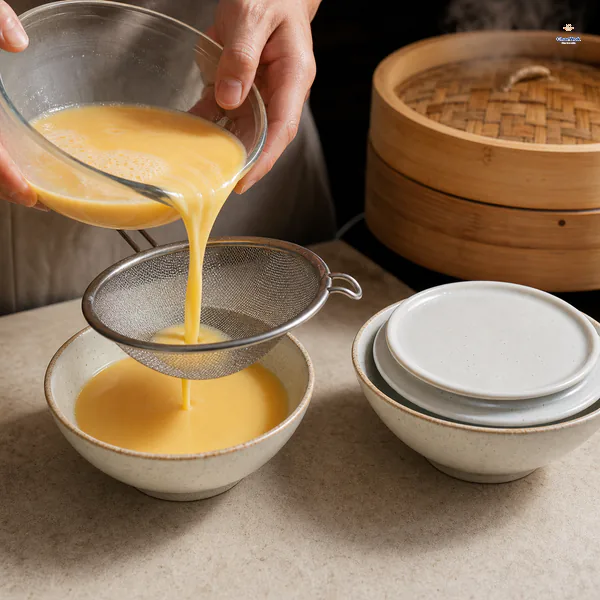
Mix egg with warm liquid, strain away cords and foam, then cover the bowl so condensation cannot pockmark the custard during low steaming.
I am giving steamed eggs its own section because it is the dish most likely to look right in the photo and feel wrong on the tongue. The custard should be silky, like a savory flan with no crust. The first time I made it I got a bowl of something between an omelet and a kitchen sponge.
Three things fix it. First, the ratio: one part beaten egg to roughly 1.5 parts warm (not hot) water or stock. Second, strain the mixture through a fine sieve to remove the chalazae, those white cords that turn into tough threads. Third, cover the bowl tightly with foil or a plate so condensation does not rain back down and pockmark the surface, and steam over the lowest flame that still produces visible vapor. If you can, leave the lid of the steamer cracked for the last three minutes. Done right, a spoon pressed into the center should leave a clean dent that slowly fills back in.
The fast, high-heat column: wok dishes under fifteen minutes
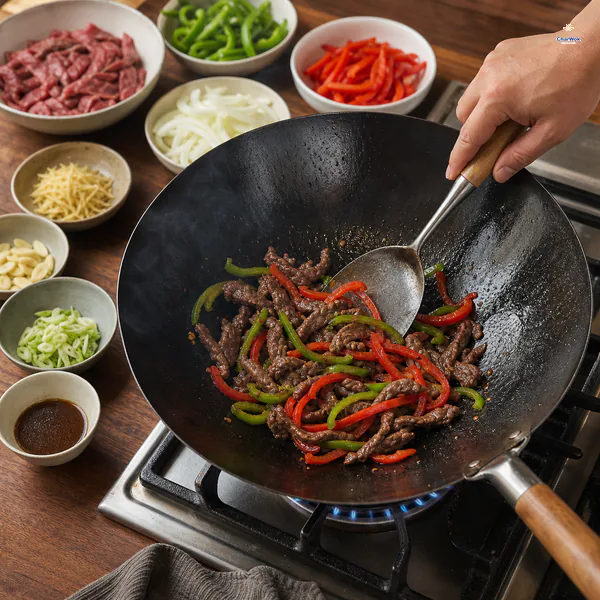
Prepare everything before heating the wok, keep ingredients dry and cook modest batches so they sear instead of steaming in released moisture.
These are the weeknight workhorses, and they all fail for the same reason: a wok that is not hot enough, crammed with too much food. Wok hei is not magic. It is the Maillard reaction happening in the seconds before moisture drowns it.
- Prep everything first. Once the wok is on, there is no chopping window. Have your aromatics cut, sauce measured into one bowl, and protein sliced thin and patted dry. Wet meat in a hot wok equals gray, steamed meat.
- Heat the wok until it smokes lightly, then add oil and swirl. This seasons the surface and creates a temporary nonstick layer. Add the oil after the pan is hot, not before, or the oil burns while you wait for the steel.
- Cook in batches. Overcrowding drops the temperature and you get soggy instead of charred. Push each component up the side of the wok as it finishes and add the next.
- Add liquid seasoning around the rim, not into the center. Hitting the hot metal first caramelizes the soy and wine slightly before they meet the food. This is why restaurant versions taste deeper.
- Finish and serve immediately. These dishes lose their texture in under two minutes off the heat. Plate, then call people. Do not let fried rice sit on the counter.
The rice rule deserves its own line. Use rice that was cooked at least a few hours ahead and chilled uncovered so the surface dries. Fresh, warm rice has too much surface starch and moisture; it clumps and steams instead of frying. Day-old jasmine rice is my default. If you forgot to make rice ahead, spread fresh rice on a tray and fan it, or give it ten minutes uncovered in a low oven to dry the grains. For noodle stir-fries the same logic applies to beef chow fun and Singapore mei fun: rinse the parcooked noodles, drain them bone-dry, and toss with a little oil so they separate.
For the Sichuan-leaning dishes in this column, the order of operations is everything. Kung Pao chicken and Dan Dan noodles both depend on toasted Sichuan peppercorns and dried chilies bloomed in warm oil before anything else hits the pan. Bloom them too hot and they char bitter; too cool and they never release their fragrance. I hold the oil at the point where a wooden chopstick dipped in produces a slow steady stream of bubbles, roughly 150 °C (300 °F), and let the aromatics steep for twenty seconds before turning the heat up.
Mapo tofu and the case for doubanjiang
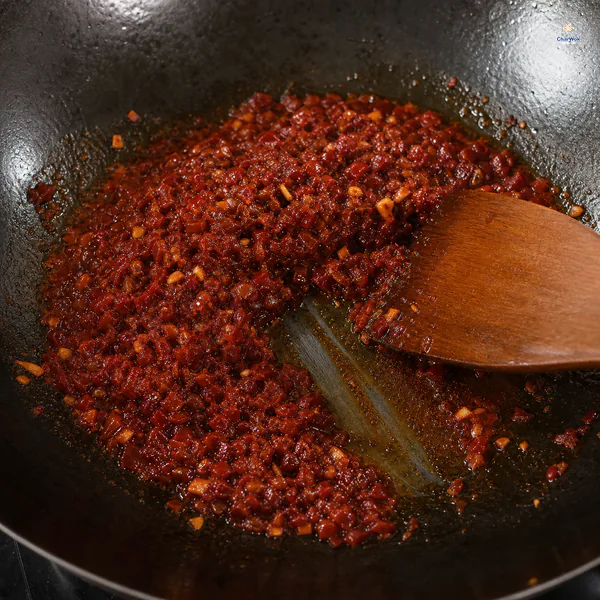
Fry chopped doubanjiang patiently over medium-low heat until its raw aroma cooks off and red oil separates before the tofu and liquid enter.
Mapo tofu sits between the two columns because the actual cooking is fast but the flavor-building is patient. The dish rises or falls on one ingredient: Sichuan chili bean paste, doubanjiang. You fry a couple of tablespoons of it in oil over medium-low heat until the oil turns red and the raw bean smell cooks off, maybe three or four minutes. Skip that step and your mapo tastes like chili powder floating in soy sauce.
The tofu itself wants gentle handling. Use silken or soft tofu, cut into clean cubes, and blanch them in salted water first. Blanching does two things: it firms the surface so the cubes do not disintegrate when you fold them into the sauce, and it warms them through so they do not drop the sauce temperature. Fold with the back of a ladle, pushing sauce under and over rather than stirring through. The final flourish is ground roasted Sichuan pepper and a pour of hot chili oil right before serving. Mapo is one of the rare dishes that is noticeably better in the first sixty seconds after plating.
The dough column: rest it, do not fight it
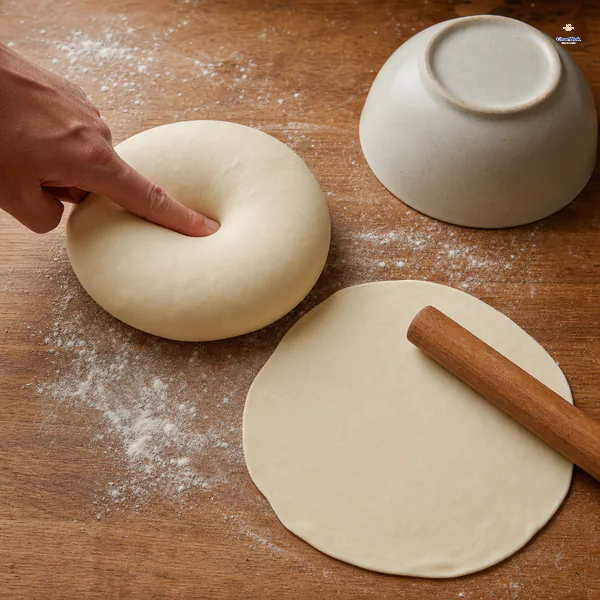
Cover and rest hot-water dough until the gluten relaxes; it should accept an indentation and roll thin without fighting back or needing excess flour.
Dough is where home cooks give up too early, and almost always for the same reason: they try to roll a dough that has not rested. Gluten needs time to relax. If you force a springy dough flat, it springs back, you add more flour, it gets tough, and you conclude you are bad at this. You are not. You are impatient.
The fix is universal across scallion pancakes, meat pies, and wrappers for wontons or the broader dumpling family: mix the dough, knead briefly until it holds together, then cover and rest it for at least thirty minutes, an hour is better. Come back and the same dough rolls like soft clay. For hot-water doughs (scallion pancakes, meat pies), the boiling water partially gelatinizes the starch, which is what gives the finished bread that pliable, layered chew rather than a cracker snap. Use water just off the boil and stir it in with chopsticks before the gluten even forms, so you never overwork it.
For scallion pancakes specifically, the layers come from a fat barrier between sheets of dough. Brush the rolled-out round with oil, scatter scallions and a pinch of salt, roll it into a log, coil the log into a snail, flatten, and roll again. Each fold doubles the layer count. If your pancakes come out dense instead of flaky, you either skimped on the oil between layers or pressed too hard on the final roll and squeezed the fat out. I have done both.
Wontons and dumplings: where filling matters more than folding
What actually makes a juicy filling
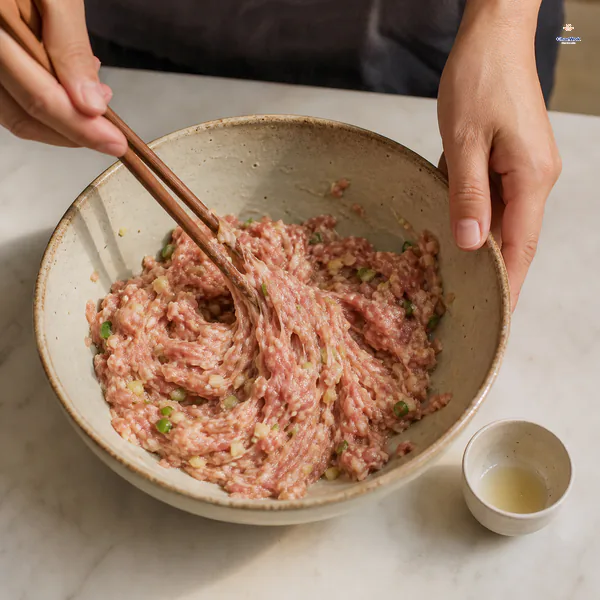
Add stock in small splashes and stir in one direction until each addition disappears and the meat becomes glossy, sticky and cohesive.
People obsess over pleats. The pleats do not matter nearly as much as the filling texture. A juicy dumpling or wonton filling is an emulsion: beaten water or stock worked into ground meat until it turns sticky and stretchy, with fat suspended through it rather than pooled at the bottom of the bowl. I add the liquid in three splashes and stir the meat in one direction until each addition disappears before the next goes in. Skip this and your filling is dense little meatballs. Overdo it and the wrapper leaks during cooking.
For wonton soup, the broth does half the work. A clean, well-seasoned broth made from good chicken stock, finished with a few drops of sesame oil and a scatter of scallion greens, turns a plain pork wonton into a meal. The wonton itself should be small enough to eat in one or two bites; oversized wontons are the most common home mistake because the wrapper is hard to seal around a mound of filling.
The pantry backbone: chili oil and soy sauce
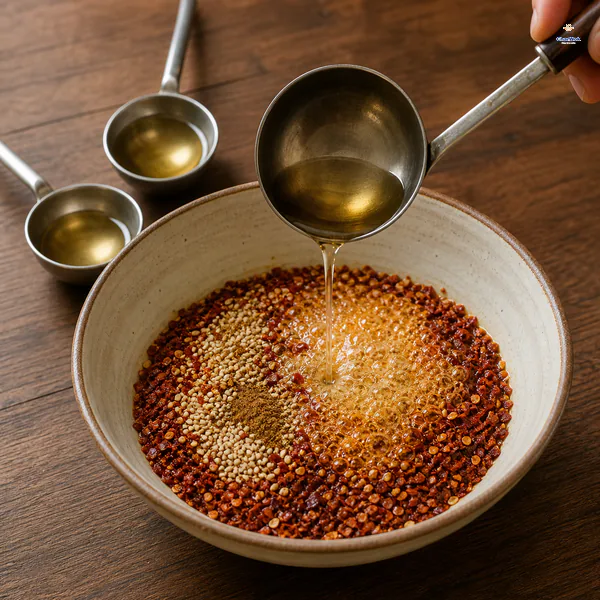
Pour the oil in stages rather than all at once: the first heat develops color and kick, while later cooler pours preserve aroma and brightness.
Two pantry items appear in almost every dish on this list, and they are worth making or choosing well rather than grabbing whatever the supermarket stocks. Homemade chili oil is the one I would put in front of any new cook, because the store-bought version is usually flat and the homemade one takes ten minutes of mostly-waiting. The principle is temperature layering: pour oil at three different temperatures over a bowl of ground chili, sesame, and spice, so the hot oil extracts color and kick, the warm oil extracts aroma, and the cool oil preserves the fresh chili brightness. Dump it all in at once and you get one note.
Soy sauce is the subtler one. Most home kitchens need two bottles, not one: a light (thin, salty, for seasoning) and a dark (thicker, less salty, for color and body). The difference between the two explains why a recipe asks for both, and why substituting one for the other gives you either a too-pale or too-salty dish. If you can only buy one, get light; you can fake some of the dark's color with a pinch of sugar and a longer reduction.
When you want to show off: Peking duck and spring rolls
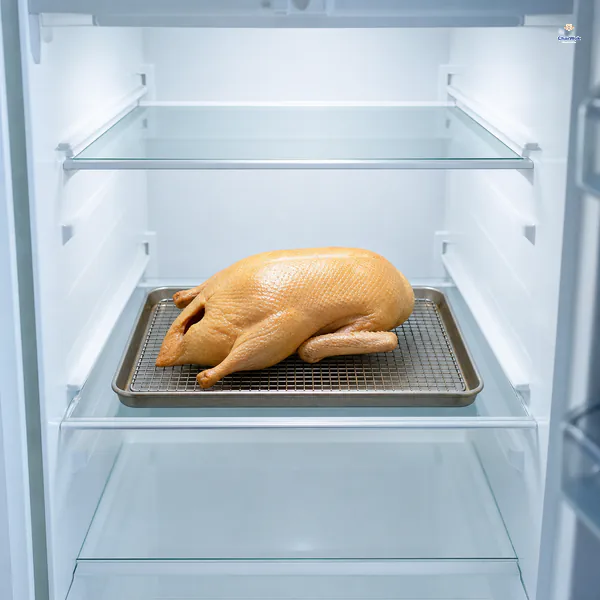
Dry the tightened, thinly glazed duck uncovered on a rack overnight so rendered fat can leave the skin instead of soaking it during roasting.
Both of these are projects, and both are easier than their reputation once you understand the one trick each depends on.
Peking duck lives or dies on crisp skin, and crisp skin lives or dies on drying the skin before roasting. The traditional method separates the skin from the meat and pumps air underneath, but a reliable home shortcut is to pour boiling water with a little vinegar over the duck to tighten the skin, brush it with a maltose or honey glaze, and then hang or rest it uncovered in the fridge overnight, ideally with a fan blowing on it. The fridge does the work the air pump would do. Roast on a rack so the fat renders away from the skin instead of soaking back into it.
Spring rolls are the other project dish, and the common failure is a soggy, exploding roll. The defense is moisture control in the filling: cook and fully cool the filling first so the residual heat does not steam the wrapper from inside, and dust the wrapper with a little cornstarch if your filling is wet. Seal the edges with a flour-water paste, not just a damp finger, because the paste actually glues during frying. Fry at 175 °C (350 °F) in batches so the oil temperature does not crash when the rolls go in. An air fryer works too if you brush the rolls lightly with oil first.
Troubleshooting the dishes that go wrong most
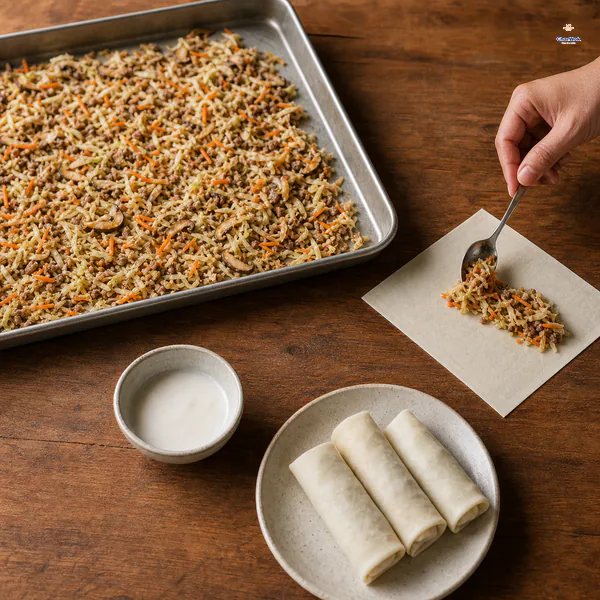
Cool the cooked filling completely and spread it so moisture escapes, then use modest portions and flour paste to prevent soggy or bursting spring rolls.
- Braised pork belly is tough, not gelatinous. You pulled it too early or boiled it too hard. Braise at the shiver for at least 75 minutes, and test a cube by pressing it with a chopstick; it should yield with almost no resistance. If in doubt, give it another 20 minutes.
- Fried rice is gummy and clumped. The rice was too wet or too fresh. Next time chill the rice uncovered overnight. To rescue it now, spread it on a tray and blast it under the broiler for two minutes to dry the surface, then fry in smaller batches.
- Steamed eggs are porous and full of holes. Heat was too high or condensation dripped in. Cover tightly, drop to the lowest flame, and crack the steamer lid near the end.
- Scallion pancakes are dense, not flaky. You either under-rested the dough, skimped on the oil between layers, or rolled the final round too aggressively. Rest longer and roll gently.
- Char siu is dry inside. You used lean loin or overcooked it. Use shoulder or a fatty loin end, and pull it the moment the center reaches 65 °C (150 °F); the glaze finishes under the broiler.
- Mapo tofu cubes break apart. You stirred instead of folded, or skipped the blanch. Blanch first, fold with a ladle, and accept that some breakage is fine, even traditional.
- Wonton wrappers tear or open during cooking. Filling too wet, wrapper too dry at the seal, or too much filling per wonton. Use less, seal with water on the edges, and squeeze the air out before closing.
- Kung Pao or Dan Dan tastes one-dimensional. You bloomed the chilies and peppercorns at the wrong temperature or skipped the toasting step. Re-bloom a fresh batch of aromatics in warm oil and you will taste the difference instantly.
How to sequence these into a real meal
If you want to turn a few of these into one dinner, think in columns rather than courses. A lazy Sunday might be braised pork belly started early, steamed eggs as a quick side, and fried rice to use the leftover rice and absorb the braise's sauce. A weeknight could be chow mein with a bowl of hot and sour soup. A dumpling session scales: make a big batch of filling, fold wontons and potstickers from the same bowl, and serve some in broth and some pan-fried. For a crowd, char siu and soy sauce chicken can both be prepped ahead and served at room temperature with thin pancakes or wrappers and a bowl of chili oil on the side.
The most underrated pairing on the whole list is hot and sour soup with almost any of the rich pork dishes. The acid and white pepper cut through the fat the way a pickle cuts through barbecue. Once you taste it, you stop reaching for the soup only when you are sick.
Storage and reheating
- Braises and soy-bathed proteins keep four days in the fridge and improve overnight as the fat absorbs the seasoning. Reheat gently in the liquid over low heat; microwaving toughens the meat.
- Fried rice and stir-fried noodles are best eaten immediately. Reheat in a dry hot pan, not the microwave, to bring back some texture. They will never be quite as good as fresh.
- Steamed eggs do not reheat well; make what you will eat.
- Uncooked dumplings and wontons freeze beautifully on a tray, then transfer to a bag. Cook from frozen, adding one extra minute and one splash of cold water to the pot.
- Scallion pancakes freeze raw between sheets of parchment. Cook from frozen with a slightly lower flame and a lid for the first minute to thaw the center.
- Chili oil keeps for weeks at room temperature and months in the fridge; it only gets rounder.
Related recipes & further reading
Once you have cooked your way through the dishes above, these pages pick up the threads. A few are sibling collections that go deeper on a single category, and the rest are individual recipes worth bookmarking for a weeknight or a gathering.
- 12 must-try authentic Chinese recipes: a curated starting point if you want a focused short list before branching out.
- 20 easy Chinese recipes for beginners for the dishes that forgive a tired evening and a dull knife.
- 20 best weeknight recipes for fast wok dishes built around what you already keep on hand.
- 20 classic Chinese noodle recipes to follow the stir-fried-noodle thread past chow mein and chow fun.
- 16 best Chinese dumpling recipes once you are ready to move from wontons to pleated jiaozi.
- Easy char siu (Chinese BBQ pork): the full recipe for the glazed pork discussed in the low-heat column.
- Lu rou fan (Taiwanese braised pork rice bowl), a cousin of red-braised pork belly finished with a glossy soy reduction.
- Three cup chicken (San Bei Ji), a one-pan crowd favorite built on soy, sesame oil, and rice wine.
- Spicy orange beef stir-fry: a sweet-tart beef wok dish in the same high-heat column as Kung Pao.
- Tomato egg stir-fry: the foundational egg dish to make right after you master steamed eggs.
- Chinese hot pot at home for a project meal that scales from two people to a full table.
- How to choose, season, use, and maintain a wok — the reference behind the wok advice in the FAQ.
Common questions
Which of these should a complete beginner start with?
Egg fried rice or steamed eggs. Both teach a foundational skill (wok heat control, or gentle steaming), need cheap ingredients, and forgive mistakes. Save the braises and duck until you trust your stove's low settings.
Do I really need a wok?
For stir-fries, a wide heavy skillet works on a home burner and is honestly easier to control. A wok shines on a high-BTU burner; on a typical home range its sloped sides can actually slow you down. Get a flat-bottomed carbon-steel wok only if you cook Chinese food weekly.
Can I make these gluten-free?
Most of the protein dishes adapt well with tamari instead of soy sauce and a gluten-free dumpling wrapper. Watch for hidden wheat in doubanjiang and Chinkiang vinegar; both have certified gluten-free versions now. The wheat-dough dishes, scallion pancakes and meat pies, do not have a satisfying gluten-free equivalent and I would skip them rather than compromise.
Why do my stir-fries taste bland even when I follow the recipe?
Usually the wok was not hot enough or the pan was overloaded. Both trap steam and dilute flavor. Cook in smaller batches on higher heat, add sauce around the rim of the pan, and finish with a few drops of toasted sesame oil off the heat.