Most home cooks discover Sichuan food through a single takeout box and walk away thinking the whole cuisine is just "spicy." That misunderstanding is the biggest barrier to cooking it well at home. Sichuan food is built on a specific balance: the tingling numbness of roasted peppercorns, the deep red funk of fermented bean paste, the snap of a quick stir-fry, and a layering of sour, sweet, and savory that a hot pan alone can never produce. The heat is a vehicle, not the point.
I have cooked these dishes hundreds of times, and I have ruined plenty of them. I once dumped raw doubanjiang straight into hot oil and watched a whole batch of Mapo Tofu turn bitter and black. The lesson stuck: this cuisine rewards patience and punishes shortcuts in very specific, repeatable ways. Once you know the handful of techniques below, the twelve dishes here stop being intimidating recipes and start being a working repertoire you can pull from any night of the week.
Sichuan cooking runs on five pantry items, not five hundred. Stock a good doubanjiang, roasted Sichuan peppercorn, chili oil, light and dark soy, and Chinese black vinegar, and you can cook roughly 80 percent of the dishes here. The other 20 percent is technique: low-oil frying the paste, deglazing with wine, and finishing raw aromatics off the heat.
What makes Sichuan food different
12 Sichuan recipes at a glance
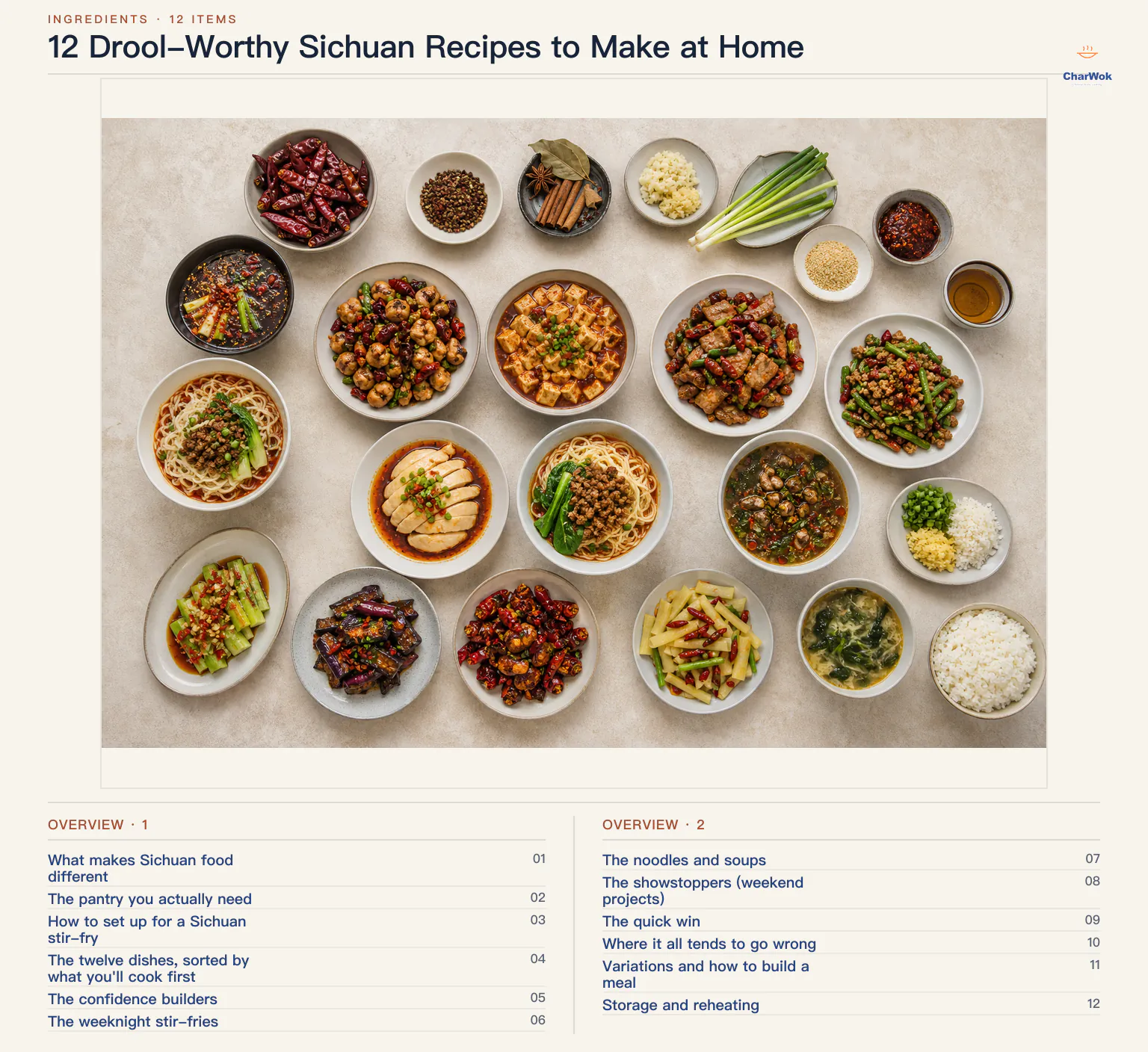
Sichuan cooking is one of China's eight great regional cuisines, and it is defined less by heat than by a flavor the cuisine has all but patented: mala, the buzz of numbing (ma) layered over spicy (la). The numbing comes from Sichuan peppercorn, which is not actually spicy at all. It contains a molecule called hydroxy-alpha-sanshool that triggers your tactile nerve endings, producing that characteristic tingling and a slight dilation of the pores in your lips. The spicy side comes from dried chilies and chili oil. Put them together and the numbing actually mutes the burn of the chili, which is why a well-made Sichuan dish can carry a lot of chili without tasting punishing.
Beyond mala, the cuisine leans on three other signature flavor profiles: yu xiang (fish-fragrant, built from pickled chili, garlic, ginger, and vinegar with no fish in sight), guai wei (strange-flavor, a deliberate clash of salty, sweet, sour, spicy, and numbing used in cold dishes), and jia chang (home-style, grounded in doubanjiang and soy). Once you can name these, the dishes here sort themselves into families instead of feeling like twelve unrelated recipes.
The pantry you actually need
You can cook these dishes with a surprisingly short shopping list. Below is the core pantry. The brand notes matter more than you might expect, especially for the fermented items, where quality varies wildly between the mass-market jar and the good stuff.
| Ingredient | What it does | Notes / what to buy |
|---|---|---|
| Sichuan chili bean paste (doubanjiang) | The red, funky backbone of nearly every savory Sichuan dish | Pixian doubanjiang is the benchmark. Look for one with visible bean bits and a dark, oily surface. Avoid the smooth bright-red supermarket jars, which taste flat. |
| Sichuan peppercorn | Provides the numbing (ma) half of mala | Red Sichuan peppercorn for general use. Toast dry until fragrant, then grind fresh. Pre-ground loses its buzz in weeks. |
| Chili oil (with sediment) | Heat, color, and a toasty aroma for cold dishes and finishing | The oil should carry flaky sediment, not be clear. The sediment is where the flavor lives. |
| Light and dark soy sauce | Salt and seasoning (light); color and body (dark) | You need both. Light is saltier and lighter in color; dark adds the mahogany tint to braises. |
| Chinese black vinegar (Chinkiang) | Acid and depth for cold dishes, soups, and sweet-sour balances | Chinkiang is malty and complex. Rice vinegar is too thin to substitute here. |
| Dried red chilies (facing-heaven, er jing tiao) | Whole-chili aroma and a slower, fruitier heat than flakes | Er jing tiao are mild and fragrant; facing-heaven are hotter. Soak before frying to stop them scorching. |
| Shaoxing rice wine | Deglazing and removing meat gaminess | Dry sherry works in a pinch. Skip the salted "cooking wine." |
| Sugar (rock or granulated) | Rounds off chili harshness; the sweet edge in Kung Pao and yu xiang | Rock sugar dissolves slowly and gives braises a glossy finish. |
How to set up for a Sichuan stir-fry
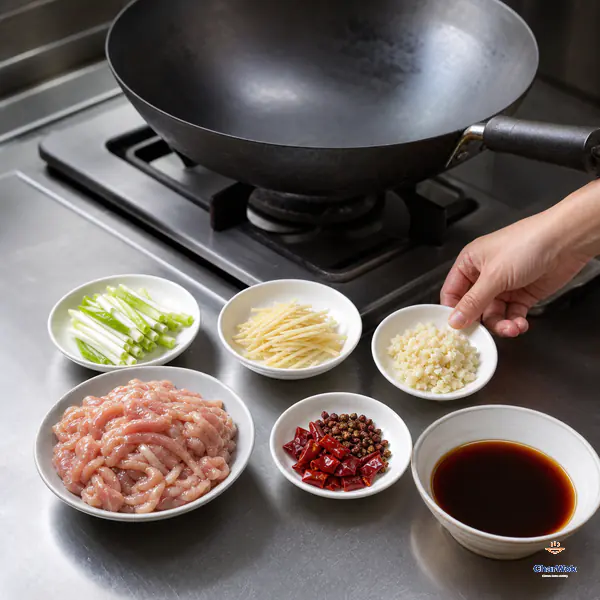
Before heating the wok, slice the protein evenly, coat it with only a thin velveting film, separate the aromatics by how quickly they cook and mix the complete sauce in one bowl. Once a Sichuan stir-fry starts, there is no safe pause to chop or measure.
More than half of these dishes are stir-fries or pan-fries, and almost all of them fail for the same handful of reasons. Here is the sequence I run every time, and why each step matters.
- Mise en place is non-negotiable. Stir-fries move in under three minutes once the pan is hot. Have the aromatics chopped, the sauce pre-mixed in one bowl, and the protein sliced and marinated before you turn on the stove. There is no window mid-fry to go mince ginger.
- Cut everything to a matching size. The even cooking of a stir-fry depends on uniform pieces. If your pork strips vary in thickness, the thin ones dry out before the thick ones are done. This is the single most common reason a stir-fry turns out uneven.
- Velvety the protein (the step people skip). Toss sliced meat or chicken in a little cornstarch, soy, oil, and wine for ten minutes before cooking. The cornstarch forms a thin gel around the fibers that slows moisture loss, so the meat stays tender through high heat. This is the difference between silky restaurant-style pork and rubbery home pork.
- Get the pan genuinely hot, then temper it. Heat carbon steel or a heavy skillet until it shimmers and just starts to smoke. Add oil, swirl, and the surface is seasoned for the cook. A wok that is too cool will steam the food in its own liquid instead of searing it.
- Fry the doubanjiang low and slow. This is the step I botched for years. Add the paste to medium oil, not screaming-hot oil, and stir constantly for 30 to 60 seconds until the oil turns red and smells sweet instead of raw. Burned doubanjiang is bitter and there is no rescuing it; start over.
- Layer aromatics by hardness. Dried chilies and whole spices go in first to flavor the oil. Ginger and doubanjiang next. Garlic last, because it scorches in seconds and turns acrid. If a recipe lists them together, add them in that order.
- Deglaze, then pour the sauce down the side. Splash the wine onto the hot pan wall to flash off the alcohol and lift the fond. Pour the mixed sauce around the edge of the wok so it boils and thickens instantly, coating the food instead of pooling.
- Finish with raw aroma off the heat. Sesame oil, ground Sichuan peppercorn, and scallion greens go in after the burner is off. Heat kills their volatile aromatics, which is the entire reason you add them.
The twelve dishes, sorted by what you'll cook first
I have arranged these by how approachable they are, not alphabetically. Start at the top and work down through the week. By the fourth or fifth dish you will notice the techniques repeating, which is exactly the point.
The confidence builders
Smashed Cucumber Salad. The gateway dish, and a lesson in the guai wei cold-dressing style. You smash the cucumber rather than slice it so the irregular surfaces grab the dressing. The classic version is garlic, black vinegar, soy, chili oil, and a pinch of sugar, and it comes together in five minutes. The fail mode is a watery salad: salt the smashed pieces, wait ten minutes, then squeeze the liquid out before dressing. Skip that and you get a puddle.
Kung Pao Chicken. The dish most people have eaten and almost no one has eaten done right. A proper Kung Pao is a tight balance of tart, sweet, and numbing, built around three signatures: dry-fried peanuts, whole dried chilies (just a handful, not a carpet of them), and a sauce thickened just enough to cling. The mistake I made for years was crowding the pan and boiling the chicken in its sauce. Fry the chicken in one layer, set it aside, build the aromatics and sauce, then return the chicken only long enough to coat.
Dry Fried Green Beans. The dish that turns vegetable skeptics. The technique is dehydration: you wring the moisture out of the beans so the surface blisters and wrinkles, which is where the savory flavor catches. Deep-frying does this fastest, but a dry skillet with a tablespoon of oil and patience works nearly as well without the mess. The failure is under-dehydrating, which leaves the beans soggy and the ya cai flavor sitting on top instead of fusing in.
The weeknight stir-fries
Sichuan Pork with Garlic Sauce (Yu Xiang Rou Si). The textbook yu xiang dish, and the one that teaches you the fish-fragrant flavor profile has no fish in it. Shredded pork is velveted, stir-fried with pickled chili, then reunited with a sauce of garlic, ginger, vinegar, sugar, and soy. The pickled chili is what gives it that signature tangy-red perfume. Substitution warning: do not swap in plain chili flakes. You lose the ferment that defines the dish.
Twice-Cooked Pork (Hui Guo Rou). The name is literal: the pork belly is boiled once to set it and render some fat, then sliced and stir-fried with doubanjiang and sweet bean paste. The fast version skips the long boil by starting with thinner slices, and honestly for a weeknight I prefer it. The make-or-break detail is letting the sliced belly render in a dry pan until the edges curl and brown before the sauce goes in. Rush that step and you get flabby pork.
The noodles and soups
Dan Dan Noodles. Street food in origin, bowl food in practice. The genius of Dan Dan is the bottom-of-bowl sauce: sesame paste, soy, vinegar, chili oil, and a little sugar, hidden under the noodles so each mouthful drags through it as you mix. The topping is a dry-fried seasoned pork that should be deeply savory, not wet. The most common home failure is a soupy bowl, usually from not draining the noodles well enough. For more ideas in this family, browse the broader Chinese noodle recipe collection.
Suan La Fen (Hot and Sour Glass Noodle Soup). Slippery sweet potato noodles in a punchy, slick broth. This one is fast, cheap, and almost infinitely adjustable to taste at the table. The vinegar and chili oil are added to your own serving bowl, so you can dial the heat and sourness per person. Soak the noodles until fully translucent before serving, otherwise the center stays chalky.
Hot and Sour Soup. The good version is glossy, deeply savory, and balanced between the black vinegar's tang and white pepper's bite, not the cornstarch-thickened afterthought that ships with takeout. A from-scratch hot and sour soup is built on a real stock and finished with a slow stream of beaten egg stirred into the vortex. The fail mode is adding the cornstarch slurry too fast, which clumps. Pour it in a thin stream while stirring and stop the moment it coats the back of a spoon.
The showstoppers (weekend projects)
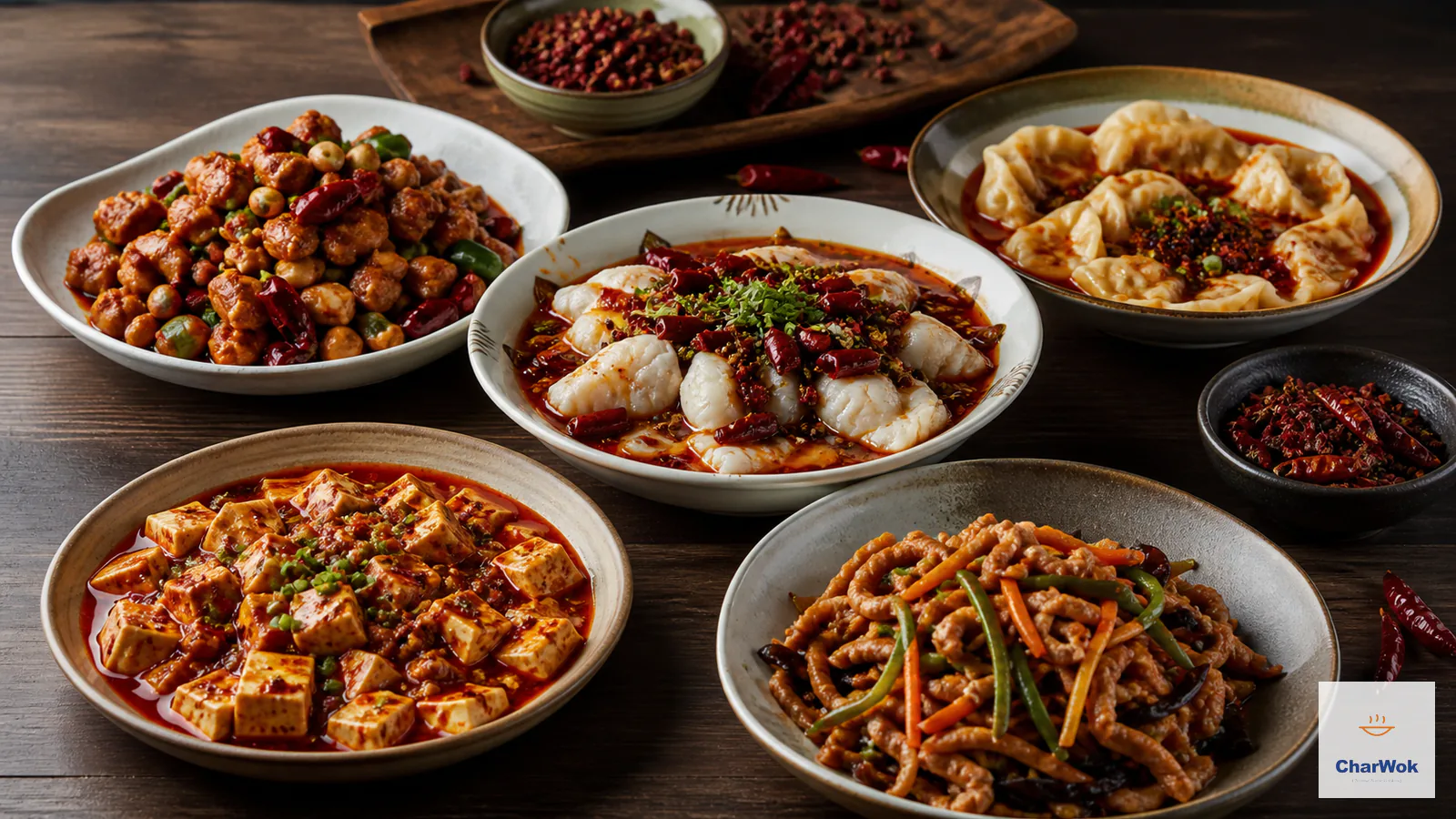
Mapo Tofu. The dish that taught me to respect doubanjiang. Silken tofu in a glossy, oily, numbing sauce with a small amount of seasoned ground meat. The authentic version finishes with a generous scatter of ground roasted Sichuan peppercorn added off the heat. Two things make or break it: frying the doubanjiang gently until the oil runs red, and adding the tofu so gently it never breaks into crumbs. Use a sliding motion with a spatula, never a stirring one.
Mouth-Watering Chicken (Kou Shui Ji). Cold poached chicken drenched in a complex chili-oil dressing. The dish lives or dies on two things: poaching the chicken gently so the breast stays juicy (an ice bath the moment it is done is not optional), and building the dressing in layers. The dressing should hit you with chili, then sesame, then soy, then a slow numbing tail from the peppercorn. This is the guai wei philosophy in one bowl.
Sichuan Boiled Fish (Shui Zhu Yu). The most dramatic of the set: tender fish fillets poached in seasoned broth, then doused with raw garlic, dried chilies, and ground Sichuan peppercorn, and finally a ladle of smoking-hot oil poured over the top to flash-fry the aromatics in the bowl. The full recipe rewards a free afternoon. The technique also works beautifully with beef, and the beef version is more forgiving for a first attempt at the style.
The quick win
Sichuan Spicy Wontons in Chili Oil (Hong You Chao Shou). Plump pork wontons tossed in a fragrant red-oil sauce. The whole thing comes together in about thirty minutes once you have wrappers, and the sauce alone is worth learning. The secret to a good wonton is a tight, well-seasoned filling and a fold that seals out the air, so the wonton does not open during the boil.
Where it all tends to go wrong
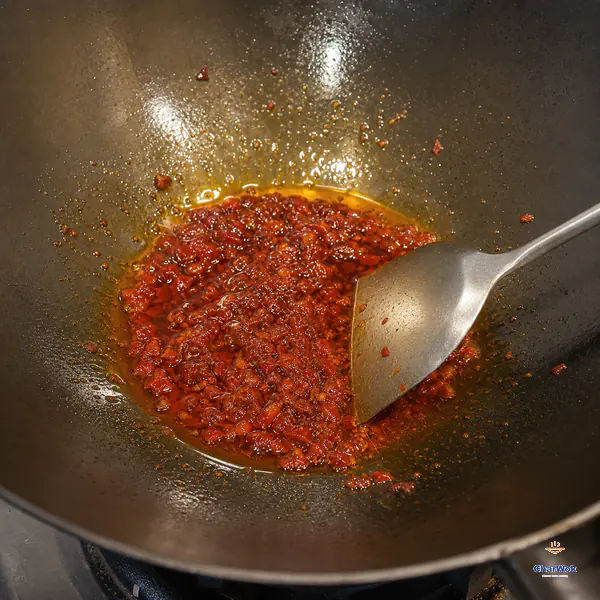
Fry chopped doubanjiang over medium rather than fierce heat, stirring constantly for about 30 to 60 seconds. Move on when the oil separates into a clear red ring and the paste smells rounded instead of raw; if it darkens and turns bitter, discard it and restart.
Across every dish above, the failures cluster into a small number of patterns. Most of them are fixable once you can name them.
The dish is bitter, not spicy. You burned the doubanjiang or the dried chilies. Both need medium, not high, heat. Once chili paste goes dark and acrid there is no recovery; toss it and start the oil over. To prevent it, add a splash of water or oil the instant the paste darkens past brick-red.
The Sichuan peppercorn does nothing. It was stale or pre-ground. Buy whole, keep it sealed, and toast-and-grind in small batches. Freshly ground pepper will make your lips hum within seconds; old pepper just tastes dusty.
The meat is tough and stringy. Two causes. Either you skipped velveting, or the pan was not hot enough and the meat stewed in its own juice. Slice across the grain, velvet for ten minutes, and sear hard in a single layer.
The tofu breaks to mush. You stirred instead of pushed. Handle soft tofu with a flat spatula in a gentle folding motion, and add it after the sauce is built so it only needs to warm through, never boil hard.
The stir-fry is wet and pale. Crowded pan, or you added the sauce before the wok was hot enough. Cook in batches if your pan is small, and never load a wok past half full. Restaurant-style takeout dishes get their wok hei from a wok that is genuinely smoking; a home burner can fake most of it if you keep the volume down.
Variations and how to build a meal
Once the base techniques click, the dishes rearrange freely. Shred the leftover poached chicken from Kou Shui Ji and toss it through cold noodles for a lazy summer dinner. Use the yu xiang sauce on eggplant instead of pork and you have a vegetarian version that many people prefer to the original. Swap the beef in a twice-cooked pork for pressed tofu to make it meatless.
A balanced Sichuan meal usually pairs one bold, saucy main with a cooling vegetable and a soup. For four people, I would make a Kung Pao or a twice-cooked pork, add a plate of smashed cucumbers or dry-fried green beans to cut the richness, and finish with a light hot and sour soup. Two of the three dishes will be quick; the third is the one you spend your attention on. The cold cucumber salad and the soup both benefit from sitting, so make them first and let them wait while you stir-fry.
Storage and reheating
Stir-fries keep two days in the fridge and reheat best in a hot dry pan rather than the microwave, which turns the vegetables limp. Mapo Tofu and the boiled dishes actually improve overnight as the tofu and fish absorb the sauce; reheat gently on the stove, never a hard boil, or the protein toughens. Cold dishes like Kou Shui Ji and smashed cucumber should be dressed close to serving, since salt draws water out of both cucumber and chicken over time. Dan Dan sauce and chili oil keep for weeks in the fridge, so make a double batch of the sauce base and you are two minutes from a noodle bowl any night.
Related recipes & further reading
Once the twelve dishes above are in your rotation, these recipes push the same techniques further or fill in the gaps around a Sichuan table.
- For a numb-and-tingly bowl without the long cook, Chongqing street noodles (xiao mian) lean on the same chili oil and peppercorn pantry.
- Dry pot cauliflower (gan guo cai hua) applies the dry-fried green beans logic to a vegetable main, finished with chili and a sprinkle of ground peppercorn.
- Cold Sichuan-dressed noodles (liang mian) are the warm-weather cousin, built on a sesame and chili oil sauce.
- Mala chicken (Chongqing laziji) takes the mala balance to its fiery extreme, buried in a mountain of dry-fried chilies.
- A plate of Sichuan garlic pork slices (suan ni bai rou) is a cold-dish classic that sharpens the same garlic-and-chili-oil dressing as the cucumber salad.
- Zhong dumplings swim in a sweet-salty-spicy soy and chili oil sauce that showcases the guai wei profile from a different angle.
- For a tofu main when Mapo feels heavy, home-style braised tofu (jia chang dou fu) runs on doubanjiang with a softer finish.
- Sichuan fish with sour mustard greens (suan cai yu) trades the numbing heat for a tangy, milky broth that is just as iconic.
- Tiger skin peppers (hu pi qing jiao) blister green chilies in a dry pan until wrinkled, then dress them in vinegar and soy.
- Spicy orange beef stir-fry pairs the chili-forward pantry with a bright citrus glaze for a weeknight main.
- A fresh pot of properly toasted and ground Sichuan peppercorn is the single upgrade that lifts every dish on this list.
- When you are ready to widen beyond Sichuan, the must-try authentic Chinese recipes list and the core Chinese cooking skills guide are good next stops.
Questions home cooks actually ask
These come up again and again in comments and messages. Short answers below.
Is Sichuan food always very spicy?
No. The numbing peppercorn actually softens the chili burn, so a balanced dish can carry real chili heat without tasting punishing. You can also dial the dried chili quantity up or down freely; start with less and add chili oil at the table.
Can I substitute regular chili flakes for Sichuan ingredients?
Partially. Chili flakes cover the heat, but nothing substitutes for doubanjiang's fermented depth or Sichuan peppercorn's tingle. For a credible result, get at least those two. Plain chili flakes alone will give you a dish that is hot but flat.
I can't handle the numbing sensation. What do I do?
Cut the Sichuan peppercorn by half and toast it longer, which mellows the buzz while keeping the citrusy aroma. You can also strain it out of a sauce after it has flavored the oil, so you get the perfume without the tingle on your lips.
Do I really need a wok?
A heavy carbon-steel or cast-iron skillet works for nearly all of these on a home burner. A wok shines for high-volume stir-fries and deep-frying, but a 12-inch skillet will carry you through every dish on this list. Heat it harder and longer than feels comfortable, and you are most of the way there.
How do I know the doubanjiang is cooked enough?
Watch the oil. It will turn from cloudy orange to a clear, vivid red, and the raw, slightly metallic smell will mellow into something sweet and savory. That usually takes 30 to 60 seconds over medium heat. The moment the color darkens toward brown, you have gone too far.
Start with the cucumber salad and the dry-fried beans. Both teach you a single technique without pressure, and they will change how you think about the cuisine within the first bite. From there the stir-fries open up, and by the time you attempt Mapo Tofu or the boiled fish, the pantry and the pan are already on your side. The first time a Sichuan dish comes out of your own kitchen tasting better than the takeout version, you will understand what the cuisine is actually about, and it was never just the heat.