Dim sum is the one corner of the Chinese kitchen that quietly terrifies home cooks, and I understand why. You sit down in a Cantonese restaurant and a cart rolls past stacked with translucent pleated shrimp dumplings, soup-filled buns that somehow hold together, and rice noodle rolls so slick they slide off the plate. Then you go home, fold one wrapper, and it splits down the middle. The gap between what you ate and what you made feels enormous.
Here is the thing I want you to take away from this guide: most of that gap is not talent. It is sequence. Dim sum dishes reward a specific order of operations, and almost every "fancy" item on the cart is built from the same handful of techniques. Once you can steam a dumpling without the skin sticking, pleat a wrapper without tearing it, and judge oil temperature by eye, the whole menu opens up at once.
This is a working guide to the dishes that matter most at home. I have grouped them by the technique that defines them, not by the order you'd find them on a restaurant checklist. Start with one cluster, nail the principle, and the rest compound. If you want the broader landscape of folded and filled things, the best Chinese dumpling round-up covers the northern half of the family; dim sum is mostly the Cantonese half, though the two overlap more than people admit.
Dim sum at home comes down to three skills: a dough or batter you can trust, a filling that holds its juice, and steady steam or oil heat. Pick one dish that exercises all three (I suggest har gow or siu mai), make it three times in a month, and every other item on the cart gets noticeably easier.
What dim sum actually is (and what it isn't)
15 dim sum recipes at a glance
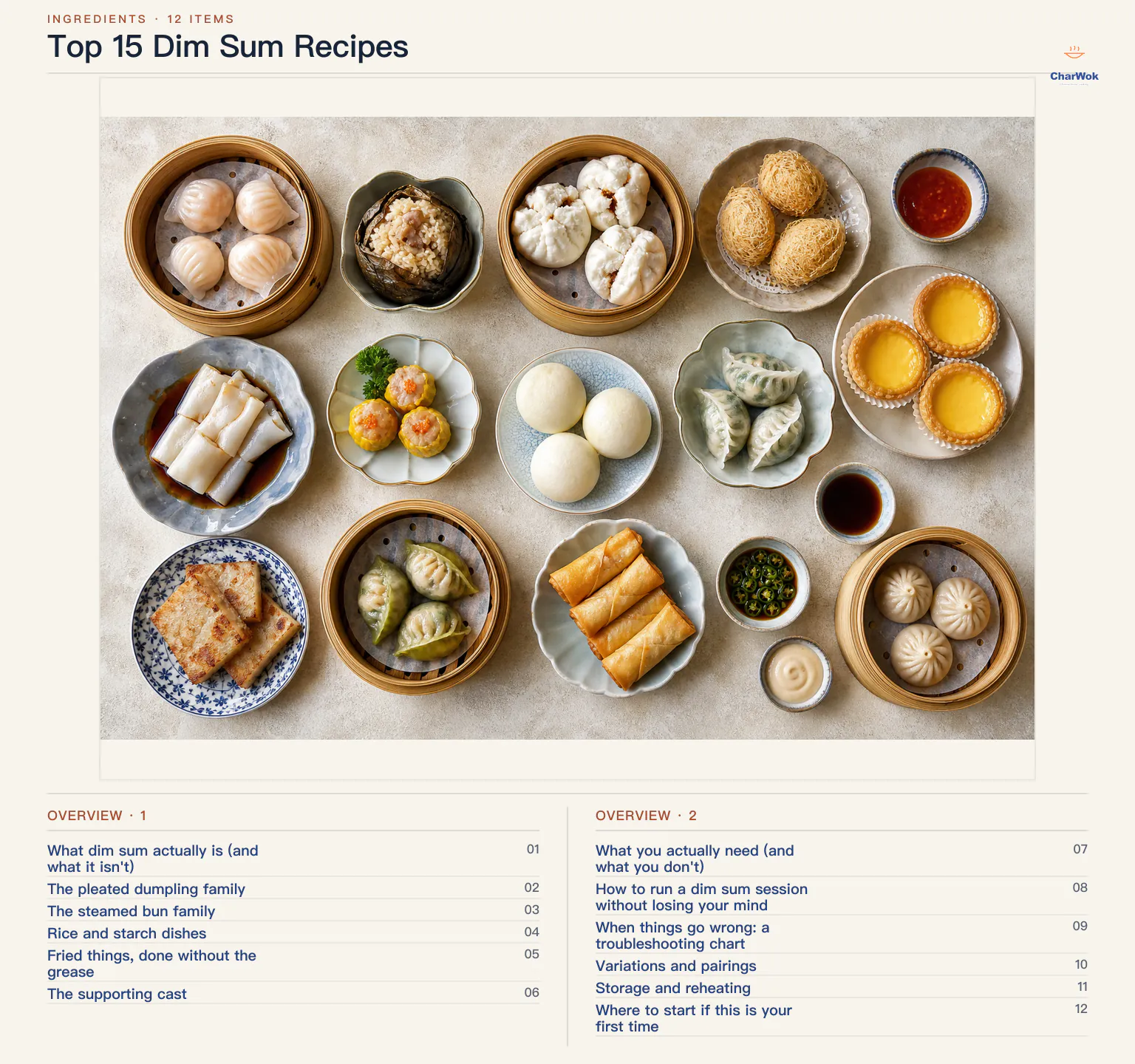
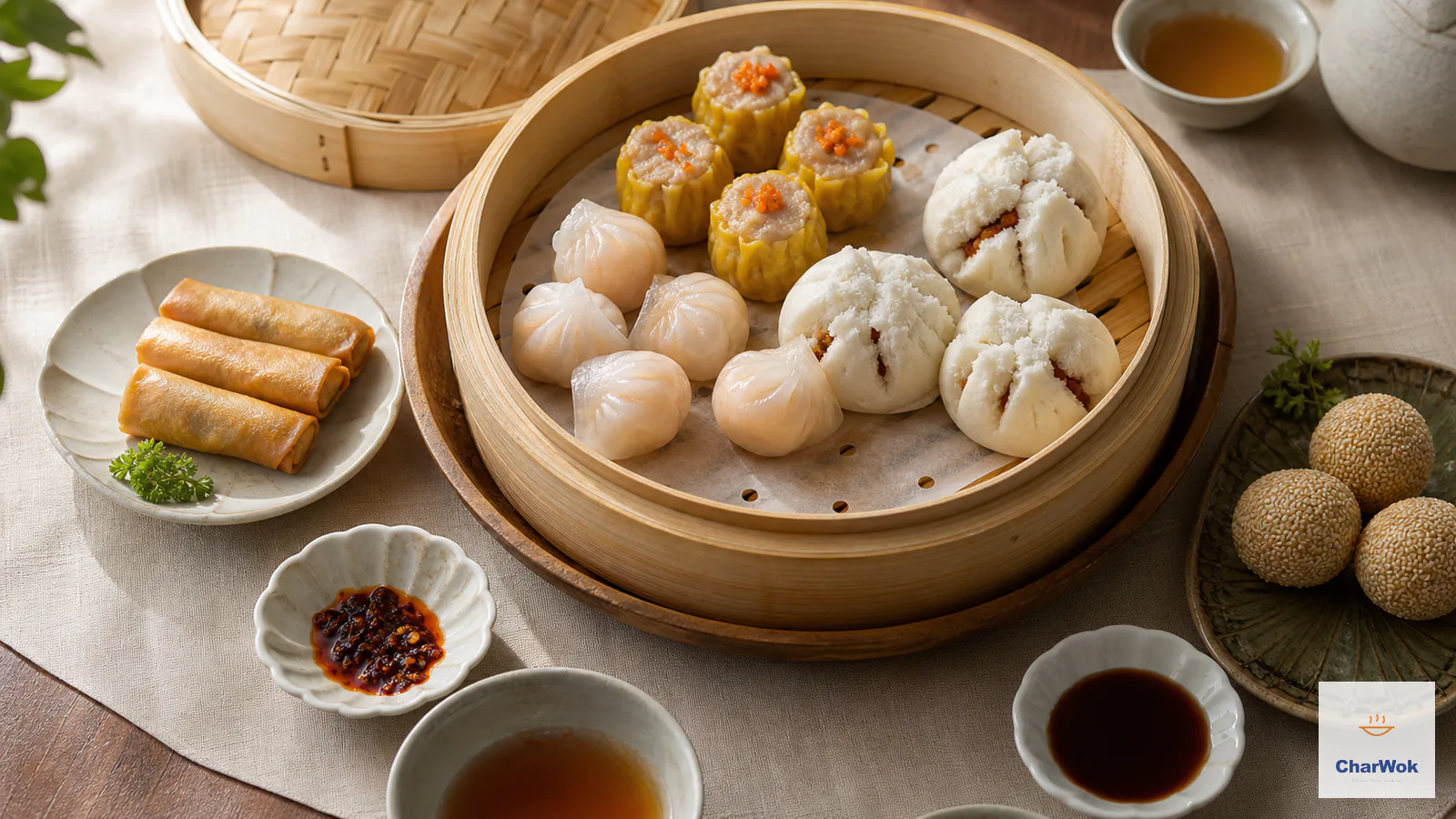
The phrase dim sum means "touch the heart," a small bite meant to accompany tea, and the full experience is yum cha, literally "drinking tea." The tradition is Cantonese, rooted in the teahouses along the Pearl River delta, where travelers stopped for rest and a cup. Over time the snacks grew into a genre of their own: small, made to order in batches, brought to your table in stacked bamboo steamers.
So dim sum is not a single dish or a fixed menu. It is a meal format, and the cart can hold everything from delicate steamed dumplings to deep-fried Sesame Balls, from a bowl of plain congee to sticky rice wrapped in lotus leaf. That breadth is exactly why a focused home cook should not try to make fifteen things in one afternoon. You will be happier making two or three items well, with tea, on a weekend morning, than producing a tired, lukewarm replica of the whole cart.
The pleated dumpling family
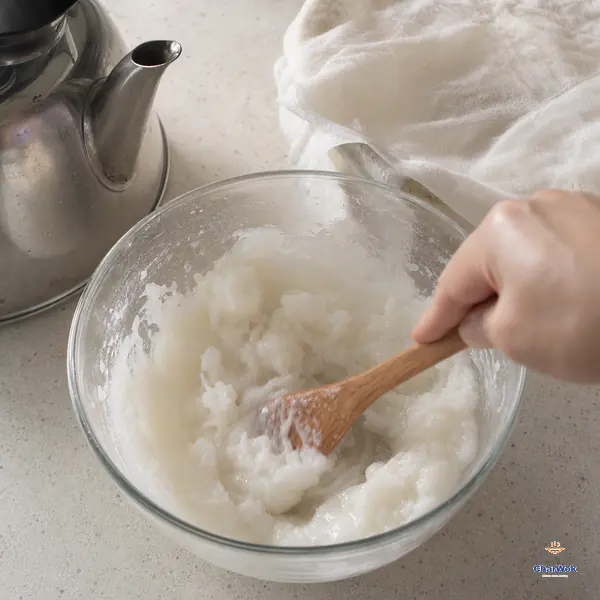
Pour genuinely boiling water onto the wheat starch and stir immediately while the mixture is hot, until the powder hydrates into a cohesive semi-translucent mass. Keep every unused portion under a damp cloth because crystal-wrapper dough cracks quickly once exposed.
Three dumplings define this group: har gow, siu mai, and soup dumplings. They look related but ask for completely different skills, and the differences are worth naming.
Har gow (crystal shrimp dumplings) is the technical peak of the cart. The wrapper is made from heated wheat starch, not flour, which is what gives it that glassy, almost translucent skin after steaming. The filling is whole or roughly chopped shrimp, snapped into shape with a little fat and crunch. What trips people up is the dough: wheat starch hydrates differently from regular flour, and a wrapper that sits uncovered for two minutes will crack along the pleats. Work with a damp towel over the unused dough and pleat quickly. My har gow recipe walks through the starch-dough timing in detail.
Siu mai (shumai) is the friendlier cousin. The wrapper is a round of ordinary wheat-flour dough, and the dumpling is left open at the top so the filling shows. That open top is not laziness, it is the design: the exposed meat browns slightly and firms up in the steam, giving siu mai its characteristic "standing cup" look. A pork-and-shrimp filling is the classic, and the trick is mixing it to a sticky, almost paste-like consistency so it holds the cup shape instead of collapsing. See the method in my siu mai recipe.
Soup dumplings (xiao long bao) are a different animal entirely. The broth inside is not poured in; it is a savory pork or chicken stock that has been reduced and chilled until it gels, then folded into the filling as a solid. As the dumpling steams, the aspic melts back into soup. The wrapper here has to be thin enough to read through but strong enough to hold hot liquid, which is a genuine engineering problem. This is the one item on the cart I would not hand to a first-timer, but it is deeply satisfying once you commit to it.
If you have never folded anything before, do not start here. Build hand strength and pleating rhythm on a northern-style boiled dumpling first, where a torn wrapper just means a slightly leaky dumpling rather than a lap full of broth. The on-ramp is a basic pleated dumpling with an ordinary flour wrapper, then siu mai, then this.
The steamed bun family
Buns are the most forgiving branch of dim sum, because yeast does most of the work and a slightly ugly pleat still steams into a soft, pillowy parcel. Two buns anchor this group.
Char siu bao is the fluffy white bun with a glossy pork filling, the one that cracks open along the top in a way that looks accidental but is actually a controlled split. The signature texture comes from a lean dough that proofs twice and is cut with a little sugar and oil for tenderness. The filling is char siu, Cantonese BBQ pork, chopped and bound in a sweet-savory sauce that thickens as it cools. If you are going to make only one filling from scratch, make it the char siu itself; the buns are only as good as the pork inside them, and the full char siu bao recipe leans on that.
Custard buns (nai wong bao) take the same dough and swap in a rich egg-and-milk filling that stays creamy after steaming. The difficulty is not the dough, it is the filling: too much liquid and it leaks out the pleats; too little and it turns dry and cakey. The steamed custard bun recipe nails the ratio, and the same lean bun dough will carry you into red bean buns and beyond without learning anything new.
One honest note: the dough is where most home buns fall short, not the filling. If your buns come out dense or slightly chewy instead of cottony, you are under-proofing or over-flouring. The principles in my bao bun page cover this directly, because a steamed bun is a steamed bun, whether it holds pork, custard, or nothing at all.
Rice and starch dishes
This is the cluster where the "magic" is really just batter science, and where I see the most stubborn home-cook myths.
Cheung fun, those slippery steamed rice noodle rolls, look impossible to recreate but come down to one ratio: rice batter thin enough to spread, just thick enough to peel off the pan in one sheet. A flat pan, a thin pour, a quick steam, and a confident roll. The most common failure is a batter that is too thick, which gives you a gummy noodle that tears when you try to lift it. The cheung fun recipe gives you the tested batter formula and the four classic fillings.
Turnip cake (lo bak go) sounds like dessert and is firmly savory. Grated daikon is cooked down with soaked rice flour and cured meats, then the whole slab is steamed, chilled, and sliced for pan-frying. The two-step process is the point: steaming sets the structure, and the pan-fry builds the crisp crust that makes it a dim sum star rather than a soft pudding. Many families make a big batch around Lunar New Year, and the turnip cake recipe scales for exactly that.
Lo mai gai, the sticky-rice parcel wrapped in lotus leaf, is the easiest "impressive" dish on the cart. Glutinous rice is cooked with soy-braised chicken, mushroom, and sausage, then wrapped and steamed until the leaf perfumes the rice. The leaf is flavor and packaging in one. If you cannot find lotus leaf, parchment or banana leaf will do for steaming, though you lose the earthy aroma. The lo mai gai recipe uses a simplified weeknight method.
Fried things, done without the grease
A dim sum spread wants a couple of fried items for crunch against all that steam, and two are worth making at home.
Spring rolls are the reliable choice. The work happens before the oil ever heats: a tight filling that is as dry as you can make it, so the wrapper crisps instead of steaming from the inside out. I do not pre-cook the filling in my spring roll recipe, which sounds lazy but is deliberate, because a wet, pre-cooked filling is the single biggest reason spring rolls go soggy. You can deep-fry or air-fry; both work, and I will tell you plainly that the air-fryer version is not identical to deep-fried but is genuinely good and far less mess.
Sesame balls (jian dui) are the stubborn ones. The dough is a sticky-rice flour paste that puffs in the oil and gets rolled in sesame seeds, with red bean paste inside. The make-or-break detail is oil temperature: start lower than you think, let the balls expand and float, then raise the heat so they brown without bursting. The sesame balls recipe lays out the temperature curve, because following it is the difference between hollow, crisp balls and dense little rocks.
The supporting cast
A few dishes round out the cart without being dumplings or buns, and they are the items I make most often on a weeknight because they skip the folding entirely.
Steamed ribs with black beans is a sleeper favorite. Bite-sized pork ribs are coated in fermented black bean, garlic, and starch, then steamed until tender, with the starch turning the juices into a glossy sauce that clings to the meat. It is one of the most forgiving dim sum dishes for a beginner. The steamed ribs recipe is short and reliable.
Chicken feet (phoenix claws) scare people on paper and convert them on first bite. They are deep-fried, then softened in a long braise, then steamed in black bean sauce, which leaves the skin puffed and gelatinous enough to pull off the bone. It is a texture dish, not a meat dish. The home-style chicken feet recipe skips the restaurant deep-fry without losing the texture.
What you actually need (and what you don't)
| Item | Do you need it? | Notes / substitute |
|---|---|---|
| Bamboo steamer (9–10 in / 23–26 cm) | Yes | Cooks evenly and absorbs moisture. A metal steamer insert works but drips condensation onto the food; line it or tent a cloth. |
| Round parchment / cabbage leaf liners | Yes | Stops dumplings from fusing to the bamboo. Napa cabbage leaves work and add flavor. |
| Dumpling rolling pin (small, tapered) | Helpful | A cut broom handle or a 1-in (2.5 cm) dowel works as well as any branded pin. |
| Flat-bottomed pan or griddle, for cheung fun | Only for cheung fun | A sheet pan that fits inside your steamer or a dedicated cheung fun tray. No substitute if you want clean sheets. |
| Thermometer for frying | Yes, for sesame balls | Clip-on candy thermometer. Guessing oil temp is the main reason sesame balls fail. |
| Lotus leaves (for lo mai gai) | No | Parchment or banana leaf steams fine; you lose aroma only. |
| A dim sum cart | No | Plates and a bamboo stack are how home kitchens actually do this. |
How to run a dim sum session without losing your mind
The restaurant makes this look effortless because three cooks are working in parallel. At home, with one of you, the only way to land a spread warm is to sequence it. This is the order I use, and it works for any combination of the dishes above.
- Day before: make every dough, batter, and filling. Char siu, custard filling, turnip cake (steamed, un-fried), and the har gow starch dough all improve overnight in the fridge. Aspic for soup dumplings must be made ahead; there is no shortcut.
- Same morning, cold prep: fold dumplings and buns while everything is still cool. Folded har gow and siu mai can sit on a cornstarch-dusted tray, covered, for an hour. Do not leave wheat-starch dough uncovered; it cracks.
- Start the long steams first: lo mai gai and turnip cake slices take the longest in the steamer. Get them going, then fill the rest of the stack with dumplings in batches.
- Fry last, right before eating: spring rolls and sesame balls cool into grease if they sit. Have everything else on the table, then fry and serve immediately.
- Reheat with steam, never the microwave: a 30-second microwave turns a soft bun rubbery and a crisp wrapper soggy. A covered steamer over low heat for 3–5 minutes brings almost any dim sum item back without damage.
When things go wrong: a troubleshooting chart
This is the section I wish someone had handed me the first time I tried har gow, because the failures all look different and most have the same handful of causes.
| What went wrong | Likely cause | Fix |
|---|---|---|
| Har gow wrapper cracks along the pleats | Dough dried out before folding | Cover unused dough and folded dumplings with a damp cloth. Re-knead a cracked dough with a few drops of boiling water; wheat starch needs heat to bind. |
| Har gow skin turns opaque white, not translucent | Water wasn't hot enough when you mixed the starch | Pour genuinely boiling water onto the starch and stir immediately. Lukewarm water leaves the starch ungelatinized and the skin cloudy. |
| Siu mai collapses flat in the steamer | Filling too loose, or under-mixed | Beat the filling in one direction until it turns sticky and pulls away from the bowl. This develops the myosin that traps fat and holds the cup shape. |
| Soup dumplings leak or burst | Wrapper too thin at the top, or aspic not set when folded | Chill the aspic until fully firm before folding. Pleat the top extra-thick, twist to seal, and place seal-up in the steamer. |
| Buns come out dense, not fluffy | Under-proofed, or too much flour kneaded in | Let the shaped buns double in size before steaming, covered, in a warm spot. Hold back flour; a tacky dough steams softer than a stiff one. |
| Cheung fun tears when you try to roll it | Batter too thick, or steamed too short | Thin the batter to a crepe-like consistency and steam just until the surface loses its wet shine, no longer. |
| Turnip cake falls apart when sliced | Not chilled long enough before cutting | Steam, then chill the slab at least 4 hours, ideally overnight. Cold sets the starch so it slices and fries clean. |
| Spring rolls go soggy | Filling too wet, or fried at too low a temp | Drain or cook out filling moisture first. Fry at 175°C / 350°F so the wrapper sets instantly. |
| Sesame balls burst in the oil | Oil heated too fast, or over-filled | Start at 150°C / 300°F, let them float and expand, then raise to 175°C / 350°F to finish. Do not stuff them past two-thirds full. |
| Everything sticks to the bamboo | No liner, or liner shifted | Use parchment with holes punched, or napa cabbage leaves, under every item. Re-seat the liner between batches. |
Variations and pairings
Once the techniques are yours, the cart bends to your pantry. A few directions I keep coming back to:
- Swap the filling, keep the technique. Any dumpling wrapper carries whatever you have. Shrimp siu mai becomes pork-and-mushroom, or a fully plant-based version following a vegan dumpling logic.
- Color the dough. Spinach or pumpkin puree in a wheat wrapper turns ordinary dumplings into the bright versions on the cart.
- Pair tea, not beer. A lightly oxidized oolong like Tieguanyin cleans the palate between rich items like char siu bao and sesame balls. Heavy beer blunts the delicacy of har gow.
- Add a noodle course. A small bowl of wonton noodle soup or a plate of soy pan-fried noodles turns a snack spread into a meal without extra technique.
- Dip with intent. Chili oil and black vinegar are not interchangeable. Vinegar cuts the richness of siu mai and soup dumplings; chili oil belongs with the blander buns. Browse the dumpling sauce options rather than defaulting to soy.
Storage and reheating
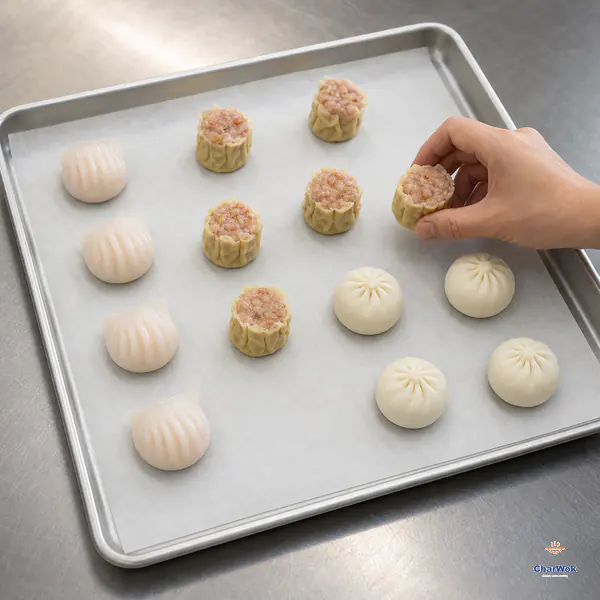
Set uncooked dumplings and buns on a lined tray with clear gaps and freeze until completely firm before transferring them to a bag. Keeping them apart at this stage prevents the wrappers from welding together; steam them straight from frozen with a little extra time.
Folded, uncooked dumplings and buns freeze well. Lay them on a tray until solid, then transfer to a bag; do not let them touch before they freeze or they weld together. Steam from frozen, adding 2–3 minutes to the time. Steamed items like turnip cake and lo mai gai keep 3 days in the fridge and reheat best in a dry pan or back in the steamer. Fried items do not reheat well; make only what you will eat, and fry the next batch fresh.
For making the whole thing lighter on the day, the make-ahead recipes page lists which components hold and which must be done last. As a rule: anything dough- or batter-based improves with a rest; anything fried does not.
Where to start if this is your first time
If you have read this far and feel paralyzed by the menu, ignore most of it and pick one dish. My honest recommendation for a first attempt is siu mai: the wrapper is forgiving, the open top means no leak anxiety, and the filling teaches you the mixing technique you will reuse in every other dumpling. From there, char siu bao is the natural second step, because the bun dough carries you into a whole family of filled breads. Leave har gow and soup dumplings for round three, when your hands know what a wrapper is supposed to feel like. Among the beginner-friendly recipes on the site, those two are where I would point anyone serious about dim sum.
The cart is not a test. It is a vocabulary, and you learn it one word at a time.
Related recipes & further reading
Once you can fold and steam with confidence, the same techniques carry into a wider ring of recipes. These are the dishes and guides I reach for when a dim sum session grows into a fuller meal, or when I want to stretch a single skill across new fillings and formats.
- Wonton noodle soup, the broth-and-dumpling course that turns a snack spread into a sit-down meal.
- the ultimate Chinese dumpling guide for the folding and mixing technique shared by siu mai and every other pleated dumpling.
- mantou steamed buns when you want the soft, pillowy bun dough from char siu bao without any filling.
- red bean paste made two ways, the sweet filling inside sesame balls and steamed custard buns.
- pearl meatballs, sticky-rice-coated meatballs steamed in the same bamboo stack as your dumplings.
- fan tuan sticky rice rolls, another glutinous-rice format if lo mai gai wins you over.
- a pot of congee to anchor a weekend yum cha spread the way it does in a Cantonese teahouse.
- Chinese tea eggs, a quiet, make-ahead side that fits the pace of a tea-led morning.
- the bamboo steamer guide, since every dish in this round-up depends on getting your steamer set up right.
- the Chinese breakfast round-up for more morning dishes that sit naturally next to a dim sum spread.
- must-try Chinese recipes if you want a curated starting point beyond the cart.
- the core Chinese cooking skills guide for a technique-first route beyond dim sum.
Common questions
Can I make dim sum without a bamboo steamer?
Yes. A metal steamer insert or a plate set on a rack inside a covered pot works, but metal drips condensation onto the food. Tent a clean cloth under the lid to catch drips, and line whatever the food sits on.
Why do my har gow wrappers crack?
The dough dried out, or the mixing water was not hot enough. Cover the dough and finished dumplings with a damp cloth, and pour genuinely boiling water over the wheat starch so it gelatinizes. Cracked dough can be rescued with a few drops of boiling water and a quick re-knead.
What is the best dish to try first?
Siu mai. The wrapper is ordinary wheat dough, the open top removes the leak risk, and the filling technique transfers to almost every other dumpling. Char siu bao is the best second project.
Can dim sum be made ahead and frozen?
Folded dumplings and shaped buns freeze well on a tray before steaming, then steam straight from frozen with a few extra minutes. Steamed lo mai gai and turnip cake keep three days in the fridge; fry the cake fresh each time.
Is deep-frying necessary for spring rolls and sesame balls?
Deep-frying gives the best texture, but spring rolls air-fry well if the filling is dry. Sesame balls really do need oil, because they expand by floating in it; the air fryer cannot replicate that puff.