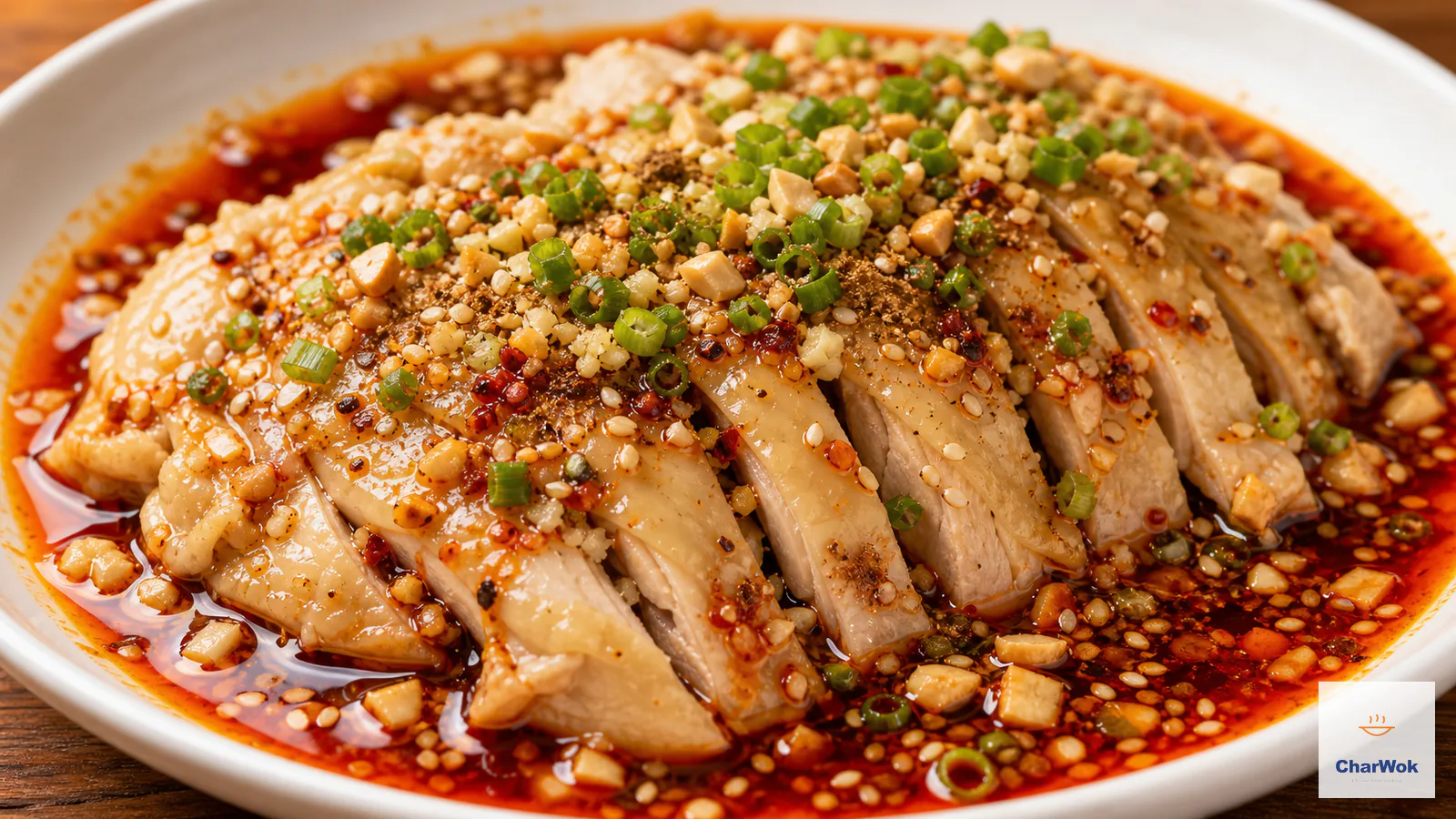
Kou Shui Ji, or "mouth-watering chicken," is a Sichuan cold appetizer of gently poached chicken dressed with a savory, tangy sauce, fragrant chili oil, Sichuan pepper, and crunchy nuts. The Chinese name describes the appetite the dish is meant to stir. The key is to cook the chicken gently, verify its temperature, and chill it promptly before slicing.
What separates a restaurant version from a home version is not the chili oil, and not the Sichuan pepper. It is the poaching. Get the chicken right and the rest is assembly. Get it wrong and no amount of chili oil will hide it.
At a glance
Three bone-in chicken legs (about 750 g total) start with 10 minutes at a bare simmer and 10 minutes off the heat under a lid. Those times are checkpoints, not proof of doneness: check each leg in its thickest part without touching bone, and keep cooking until every piece reaches 165°F (74°C). Then chill in clean ice water for about 10 minutes before dressing with stock, light soy, black vinegar, sesame oil, Sichuan pepper, and clear red chili oil.
Where this dish comes from
Kou Shui Ji is a Sichuan restaurant classic, part of the same family of cold, oil-sauced chicken dishes that includes Bang Bang Chicken (which is pounded, not sliced) and Scallion Oil Chicken (which skips the chili). All three descend from a broader Sichuan tradition of cold appetizers designed to open a meal. The Sichuan term is liang cai, literally "cold dishes."
The dish earns its place at a feast because the flavor profile is engineered to wake up the palate: the tingle of Sichuan pepper (the famed ma), the heat of chili oil (la), sour vinegar, sweet sugar, salt, raw garlic, toasted sesame, and crunchy nuts. Eight flavors stacked in one spoonful. It is the kind of dish that belongs on a New Year or festive table precisely because you can poach the chicken a day ahead and dress it at the last minute.
Why the chicken has to be bone-in, skin-on
Chicken legs (thigh plus drumstick, bone in, skin on) give the poaching liquid more body, while the skin helps the cooled meat hold together when sliced. Boneless thighs also work, but they cook faster and produce a lighter poaching liquid; start checking their temperature earlier.
Whole legs run roughly 250 g each; three of them feed three people generously as a starter, or two as a main with rice. You can scale to boneless skinless thighs or even wings, but add the bones back to the pot to build the broth, or start with a spoonful of homemade chicken stock if you are going boneless.
Ingredients
Mouth-watering chicken ingredients at a glance
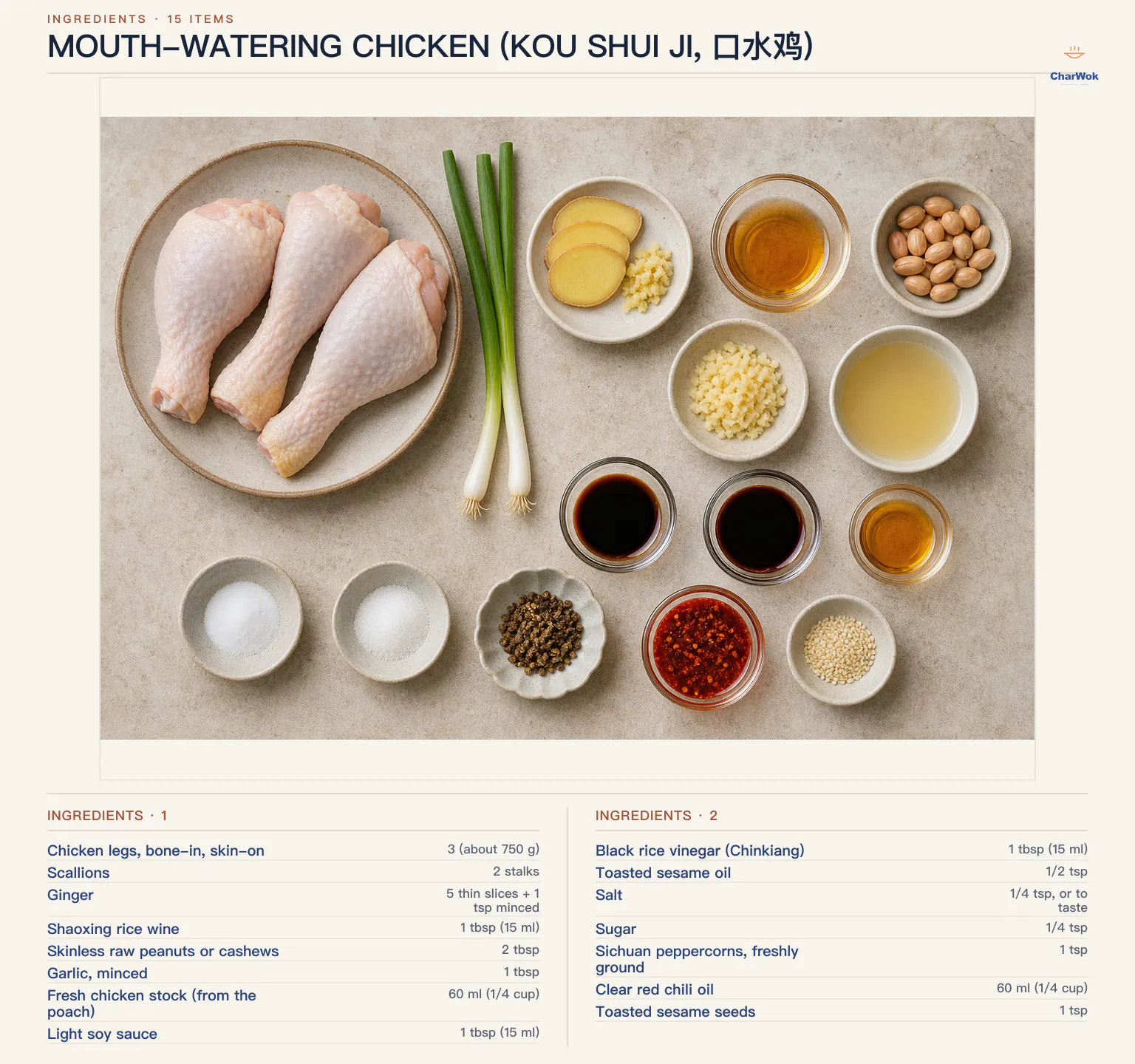
US notes in the right column. The Sichuan pepper and the chili oil are not the place to cut corners.
| Ingredient | Amount | Notes / substitute |
|---|---|---|
| Chicken legs, bone-in, skin-on | 3 (about 750 g) | Thighs or a small whole bird work; avoid boneless skinless |
| Scallions | 2 stalks | 1 halved for the pot, 1 finely chopped for garnish |
| Ginger | 5 thin slices + 1 tsp minced | Peeled; the slices flavor the poach, the mince goes in the sauce |
| Shaoxing rice wine | 1 tbsp (15 ml) | Dry sherry is the standard US substitute; skip the salt-laden "cooking wine" |
| Skinless raw peanuts or cashews | 2 tbsp | Toasted, cooled, crushed; leave out for nut allergy |
| Garlic, minced | 1 tbsp | About 3 medium cloves; mash to a paste for a smoother sauce |
| Fresh chicken stock (from the poach) | 60 ml (1/4 cup) | The poaching liquid, strained; this is what makes the sauce taste like chicken, not like dressing |
| Light soy sauce | 1 tbsp (15 ml) | Not dark soy; it would muddy the red oil. See the soy sauce guide |
| Black rice vinegar (Chinkiang) | 1 tbsp (15 ml) | Brown rice vinegar or balsamic-cut-with-water in a pinch; black rice vinegar is correct |
| Toasted sesame oil | 1/2 tsp | A little goes far; toasted sesame oil, not cold-pressed |
| Salt | 1/4 tsp, or to taste | The stock and soy already carry salt; taste before adding more |
| Sugar | 1/4 tsp | Just enough to round the vinegar; not sweet |
| Sichuan peppercorns, freshly ground | 1 tsp | Toast whole, then grind. See how to grind Sichuan pepper |
| Clear red chili oil | 60 ml (1/4 cup) | Strained, flake-free for the classic look; make your own chili oil |
| Toasted sesame seeds | 1 tsp | For the final sprinkle |
The method, step by step
Read through the poaching steps before you start. The window between "perfectly juicy" and "dry and gray" is a matter of minutes, and it is controlled by temperature, not time alone.
- Start the poach cold and flavor the water. Put the legs in a pot with the halved scallion stalk, the 5 ginger slices, and the Shaoxing wine. Add cold water to cover by about 2 cm. Starting cold lets the protein tighten gradually and pushes less flavor into the water than a hot start, though here you want flavor in the water, because that water becomes your sauce. The rice wine and ginger are there to mute any barnyard note from the bone.
- Bring to a full boil, then drop to the faintest simmer. Once it boils, turn the heat down until you see only the occasional bubble break the surface. Cover and hold there for about 10 minutes. A hard boil can make the meat firmer and disturb the skin.
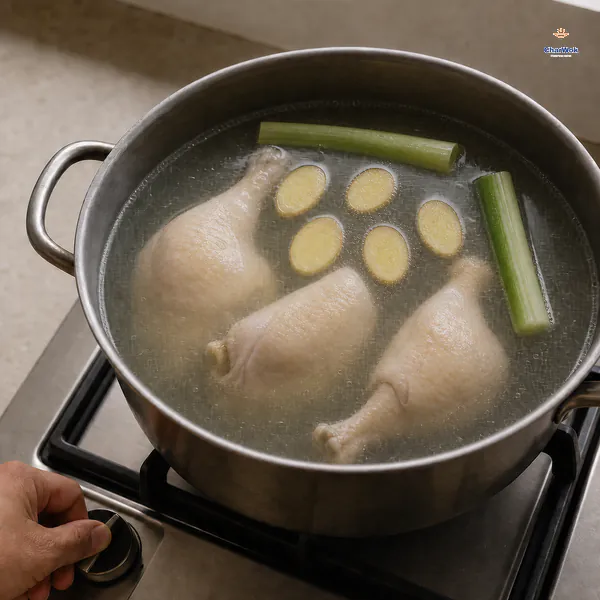
After the cold start reaches a full boil, reduce the heat immediately to only occasional tiny bubbles, cover and hold for 10 minutes; a rolling boil makes the meat tough.
- Use the covered rest as a checkpoint. Take the pot off the burner, keep the lid on, and leave the legs in the hot water for about 10 minutes. Then check each leg with an instant-read thermometer in the thickest part, without touching bone. If any piece is below 165°F (74°C), return the pot to a gentle simmer and recheck before chilling. Size, starting temperature, pot, and burner all change the actual cooking time. USDA explains why color and time are not reliable safety checks.
- Chill only after the chicken reaches a safe temperature. Transfer the cooked legs with clean utensils into a clean bowl of potable ice water for about 10 minutes, until well chilled. This stops carryover cooking and firms the skin for cleaner slicing. Strain the poaching liquid while hot, reserve only what you need for the sauce, and cool any extra promptly in a shallow container.
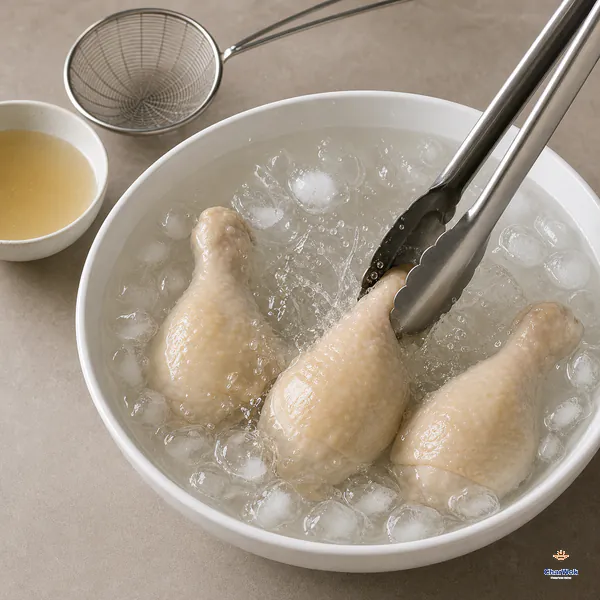
Move the cooked legs straight into ice water for 10 minutes to stop the cooking and firm the skin, then strain and reserve the poaching liquid for the sauce.
- Toast the nuts while the chicken rests. Raw skinless peanuts or cashews go into a dry wok or skillet over low heat. Move them constantly. The moment you smell them and see a few golden spots, pull them. They keep cooking off the heat and the line between toasted and burnt is thin. Cool, then crush roughly in a mortar or under a heavy knife.
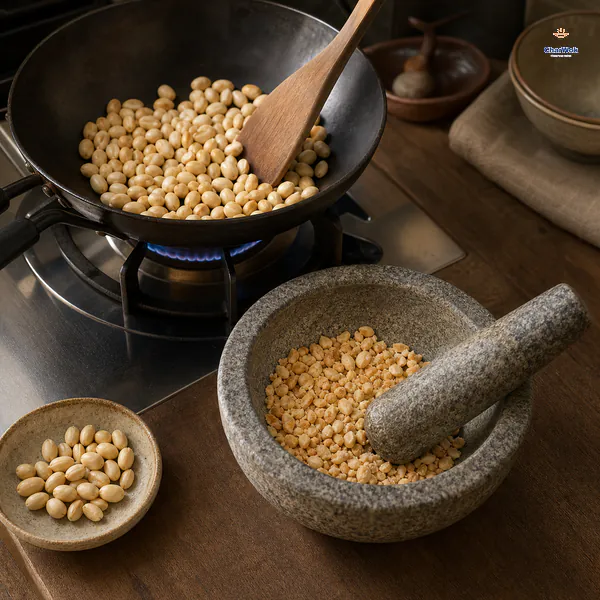
Toast the skinless peanuts over low heat until fragrant with a few golden spots, cool them completely, then crush them into irregular pieces rather than powder.
- Build the sauce. In a bowl, combine the minced ginger, minced garlic, the 60 ml of strained poaching liquid, light soy sauce, black rice vinegar, sesame oil, salt, sugar, and the freshly ground Sichuan pepper. Stir. Taste it. It should read salty-sour first, with a warm numbing hum underneath and a faint sweetness at the edges. If it tastes flat, the fix is usually more vinegar, not more salt.
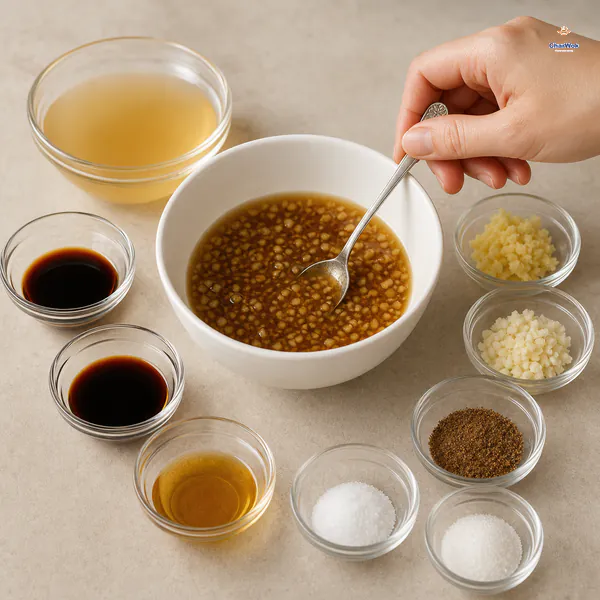
Stir the strained poaching liquid with ginger, garlic, light soy, black rice vinegar, sesame oil, salt, sugar and freshly ground Sichuan pepper; the chili oil is added only at the finish.
- Debone and slice. Pull a leg from the ice water. With a thin knife, cut down to the bone along the back of the thigh and around the drumstick joint, then scrape the meat off the bone in one piece, keeping the skin attached. Slice across the grain into strips about 1.5 cm wide. Arrange them skin-side up on a shallow serving plate.
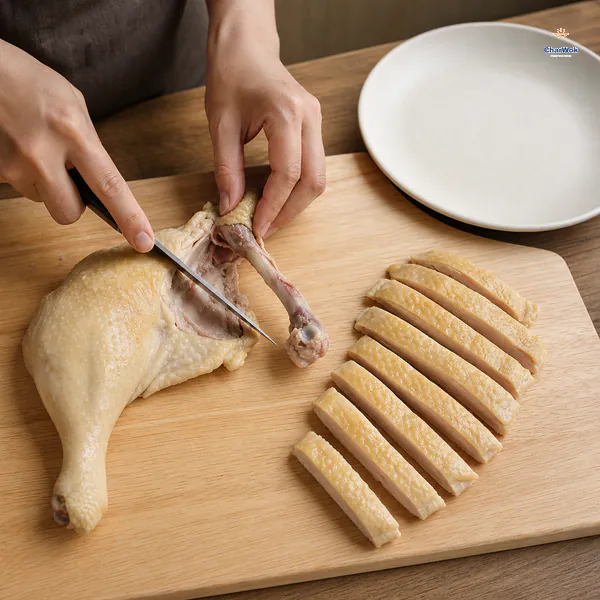
Cut along the bone and joint, lift the meat away in one piece with its skin attached, then slice across the grain about 1.5 centimetres wide and arrange skin-side up.
- Dress and finish. Pour the sauce over the chicken; it should pool around, not drown, the slices. Scatter the crushed nuts and chopped scallion. Spoon the clear red chili oil over the top so it sits on the surface in a glossy red layer. Finish with toasted sesame seeds and serve chilled. Keep it refrigerated until serving.
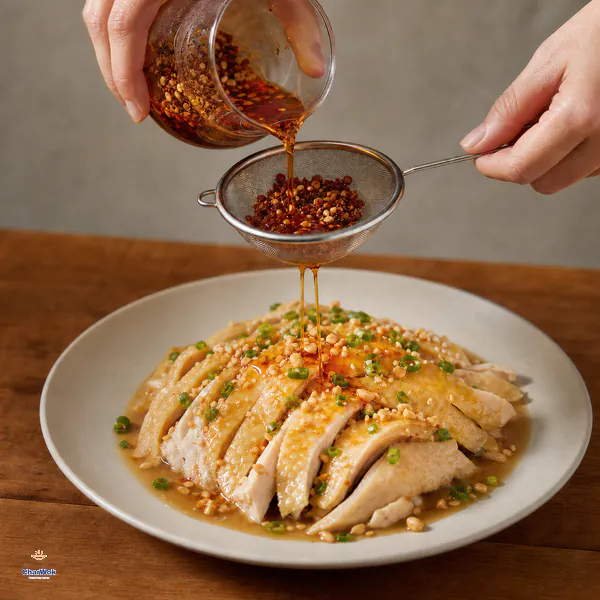
Pour the base sauce around the chicken, scatter crushed nuts and scallion, then strain the chili oil and spoon only its clear red layer over the top before adding sesame.
When the chicken goes wrong: troubleshooting
Most texture and flavor problems can be traced to heat control, temperature checking, chilling, or sauce balance.
- Gray, rubbery meat. You let it boil. The fix is heat control: a true simmer, not a rolling boil. If your stove's lowest setting still boils, move the pot halfway off the burner.
- Pink or slippery near the bone. Color cannot confirm safety. Check every leg in its thickest part without touching bone; each must reach 165°F (74°C) before it goes into the ice bath. Continue at a gentle simmer and recheck any cooler piece.
- Slices falling apart into shreds. Either you used boneless skinless meat, or you didn't ice-bathe it. Skin-on plus an ice shock is what gives you clean planks.
- Sauce tastes thin or one-dimensional. You used water or boxed stock instead of the strained poaching liquid. The poaching liquid is concentrated chicken essence; it is the difference between a sauce and a marinade. If you are stuck with boxed stock, reduce 100 ml of it down to 60 ml to concentrate it first.
- Chili oil looks cloudy or brown instead of jewel-red. You poured the chili flakes in with the oil. For the classic look, strain the oil through a fine sieve and use only the clear red liquid, saving the flakes for cold noodles or dumplings.
- Too spicy, or not spicy enough. Heat lives in the chili oil, and different oils vary wildly. Start with half the oil, taste, and add. The numbing ma from Sichuan pepper is separate from the la heat; if you want more tingle without more burn, add pepper, not oil.
Variations and pairings
The classic version is hard to beat, but the sauce is a template. A few directions worth taking:
- Nut-free: Skip the peanuts and add toasted sesame seeds and a spoonful of crushed roasted soybeans for the crunch.
- Milder, fragrant version: Halve the Sichuan pepper and add a teaspoon of finely ground roasted sesame paste (zhi ma jiang) to the sauce for a creamy, sesame-noodle-adjacent note. This also softens the heat for guests who can't take it.
- Boozy cold chicken: For a different cold-chicken direction entirely, Chinese Drunken Chicken poaches the bird then steeps it in Shaoxing wine: same tenderness logic, completely different flavor.
- What to serve it with: It opens a meal beautifully, so follow it with something milder and starchier: plain rice, a clear soup, or a stir-fry. For a full cold-table spread, pair it with smashed cucumber salad and a plate of other chicken dishes if you are feeding a crowd. In hot weather it earns a permanent spot on the summer table.
Storage and leftovers
Refrigerate the chicken and reserved poaching liquid within 2 hours of cooking, or within 1 hour when the room is above 90°F (32°C). Use shallow, covered containers and keep the refrigerator at 40°F (4°C) or below. Cooked chicken is generally safe refrigerated for 3–4 days, although this dish has its best texture within 1–2 days. Store the chicken, sauce, nuts, and chili oil separately and dress just before serving. See the USDA leftovers guidance.
Do not freeze dressed chicken; the chili oil separates and the skin turns waxy on thaw. If you want to get ahead for a party, poach and slice the day before, make the sauce the morning of, and assemble ten minutes before guests sit down. The reserved poaching liquid also freezes well for future batches.
Frequently asked questions
Do I have to use chicken legs, or will breasts do? Breasts cook faster and produce a lighter poaching liquid, but they can be used. Start checking earlier and do not chill them until the thickest part reaches 165°F (74°C).
Can I make the chili oil the quick way? Yes. A freshly made oil may be less complex than one infused slowly, but you can adjust the amount to taste. Follow the storage instructions for the specific chili-oil recipe or product you use.
Is the ice bath really necessary? It is useful for stopping carryover cooking and firming the skin for cleaner slices. First verify that every piece has reached 165°F (74°C), then use clean utensils and a clean bowl of potable ice water.
How far ahead can I poach the chicken? For the best texture, poach it 1–2 days ahead. Refrigerate it within 2 hours in a shallow, covered container at 40°F (4°C) or below, and keep the sauce and garnishes separate until serving.
The sauce split / the oil pooled on top, is that normal? It is. A layered look is traditional: sauce underneath, glossy red oil floating on top. Stir gently at the table so each slice gets a coat of both.
How do I know the poached chicken is safe to chill and serve? Measure every leg in the thickest part without touching bone. Each piece must reach 165°F (74°C); time, pink color, and clear juices are not reliable substitutes for a thermometer.
The one thing to remember
Use 10 minutes at a whisper of a simmer and about 10 minutes off the heat as starting points, then let the thermometer decide: every piece must reach 165°F (74°C) before it goes into clean ice water. Once the chicken is safely cooked and chilled, adjust the salt, vinegar, chili oil, and Sichuan pepper to taste.