The first time I tried to "fix" a lazy weeknight stir-fry with pre-ground Sichuan pepper from a jar, I understood why my grandmother kept a separate, smaller mortar just for huā jiāo. The jar smelled of nothing. The dish tasted of dust. What should have been that tingling, citrus-pine hum that lifts a bowl of Dan Dan Noodles or a plate of Mapo Tofu into another gear was simply absent. Ground Sichuan pepper is a perishable aromatic, not a shelf-stable powder, and almost everything that matters about it dies within a week of being crushed.
So this page is the short version: a five-minute pantry task that gives you fresh-ground Sichuan pepper on demand. It is not a dish. It is the single ingredient that makes the difference between a Sichuan recipe that hums and one that whispers. Buy whole, toast, grind cool, sift, use within two weeks. Everything below explains why each of those verbs matters and where people, including me, have gotten it wrong.
Toast whole husks in a dry pan over medium-low for about 2 minutes, grind only when fully cool, then sift out everything that will not pass a fine mesh. A heaped tablespoon of cleaned husks yields roughly a teaspoon of usable powder, and that powder is at its best for ten to fourteen days. Two moves ruin it fast: grinding hot, and skipping the sieve.
What Sichuan pepper actually is (and is not)
Sichuan pepper is not pepper. It carries the word only because European traders reached for the nearest familiar name. Botanically these are the dried husks of a prickly ash, a cousin of citrus and rue, and the aromatic oils that give the husks their character are chemically closer to a lemon zest and a grapefruit peel than to anything in a black-peppercorn vine. That citrus-pine fragrance and the low-frequency buzzing on your tongue come from molecules called sanshools, which sit in the oil glands on the outside of the husk.
This matters for grinding in two ways. First, the oil is volatile and surface-exposed, so the moment you shatter a husk the clock starts. Second, only the papery outer husk is worth eating. The glossy black seed inside each pod, and the tough yellow stem end attached to it, are hard, bitter, and gritty, and they have no numbing value at all. A good bag is almost all open husk. A bad bag is a third seeds and twigs, and grinding it without sorting is what gives people the "eating sand" experience.
Which variety to buy
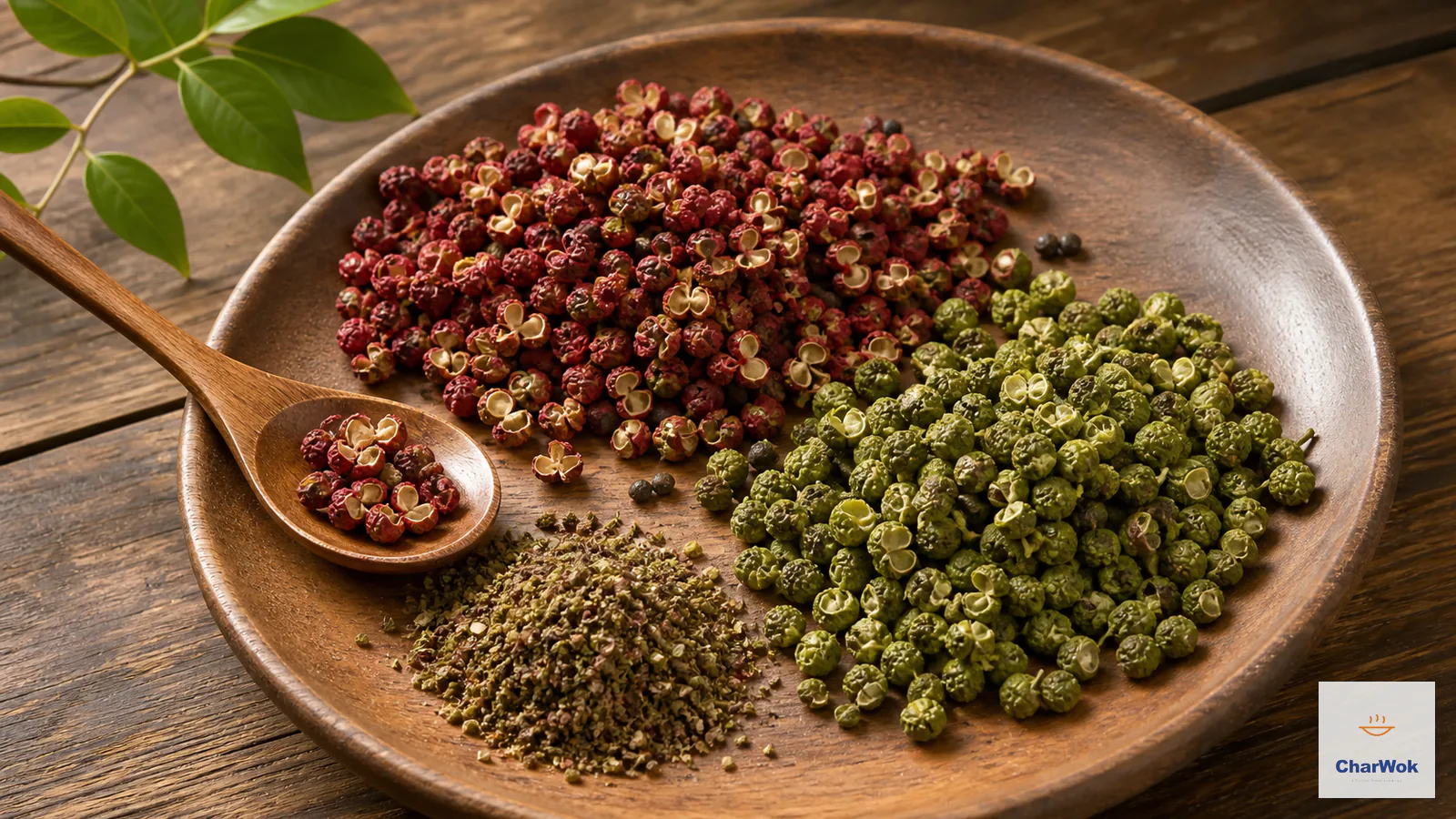
If a shop gives you a choice, reach for red Sichuan pepper (hong huā jiāo, 大红袍 is the common cultivar) for everyday cooking. It is the warm, citrus-forward, strongly numbing type that powers classic Sichuan home cooking. Green Sichuan pepper (qing huā jiāo), fresher and more herbal, is wonderful but more perishable and better used whole in hot pot broths or infused into oil than as a fine table powder. For a deeper look at the varieties, regions, and grading, the full Sichuan pepper Q&A on this site covers the questions that don't fit in a how-to-grind page.
Ingredients and equipment
Ingredients at a glance
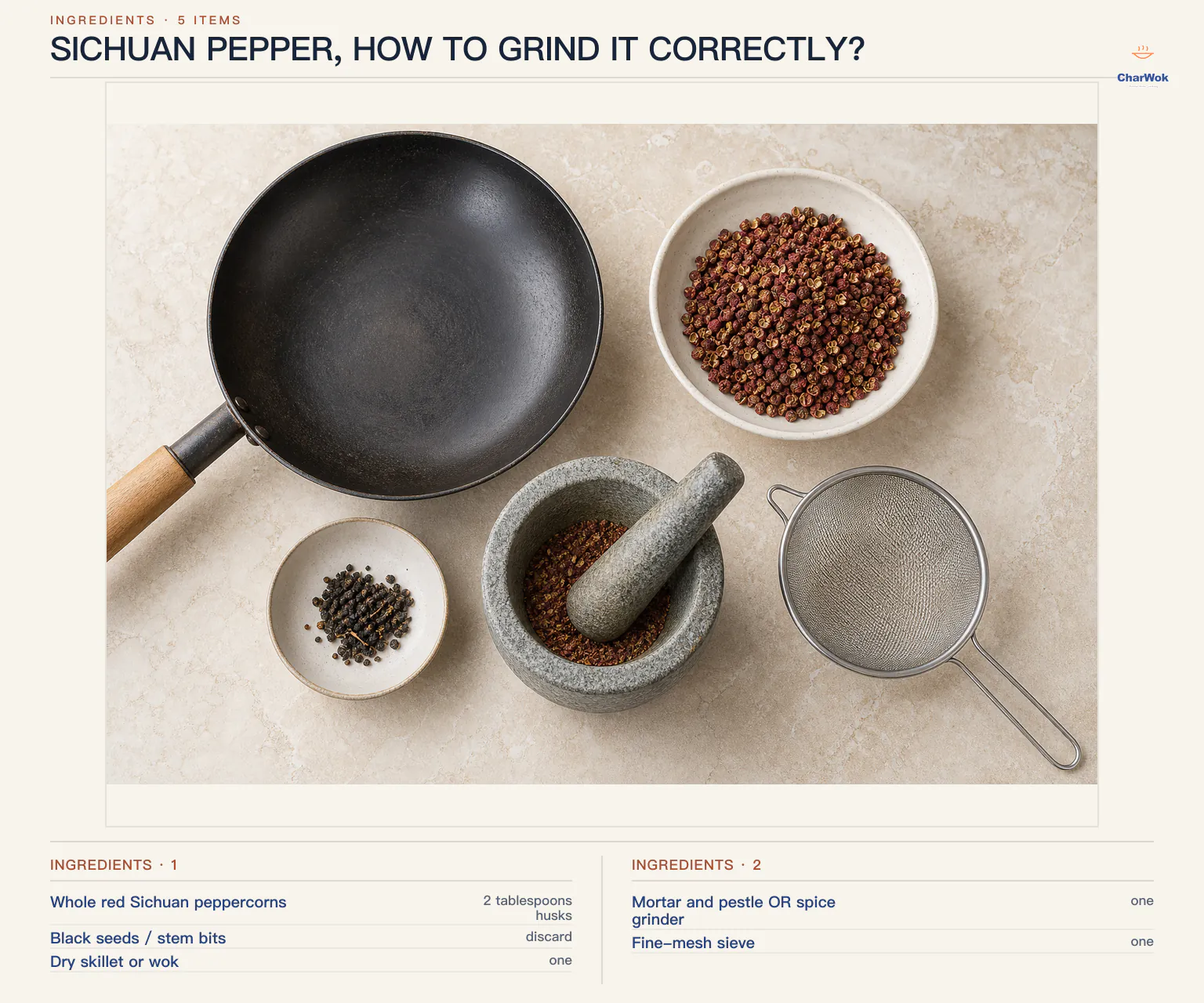
| Ingredient / tool | Amount | Notes / substitute |
|---|---|---|
| Whole red Sichuan peppercorns | 2 tablespoons husks | Yields about 2 teaspoons powder. Use only clean, open reddish-brown husks. |
| Black seeds / stem bits | discard | Hard, tasteless, gritty. Pick out before toasting. |
| Dry skillet or wok | one | Cast iron or carbon steel hold heat evenly; nonstick works but watch the temperature. |
| Mortar and pestle OR spice grinder | one | Mortar gives the most control and won't overheat the oils. A dedicated coffee grinder works but builds heat fast. |
| Fine-mesh sieve | one | A tea strainer or confectioner's sieve. Anything coarse enough to let husk flakes through defeats the next step. |
The method, step by step
- Pick over the husks. Spread the peppercorns on a pale plate and cull any whole closed pods, loose black seeds, and the tiny yellow stem nubs clinging to some husks. A minute here saves the entire batch later; grit you remove now is grit you never have to sieve out, and a single black seed ground fine will sandy up a whole teaspoon of powder.
- Toast dry, medium-low, moving constantly. Put the cleaned husks into a cold, completely dry pan, then set it over medium-low heat. No oil, ever. Shake the pan or stir with a dry spatula the whole time. You are not browning the husks; you are warming the oil glands just enough to make them fluid and fragrant. The signals are smell and sheen, not color: a sudden wave of citrusy, almost mentholated aroma, and the husks taking on a slightly glossy look as their oil rises to the surface. This typically takes about 2 minutes, sometimes less.
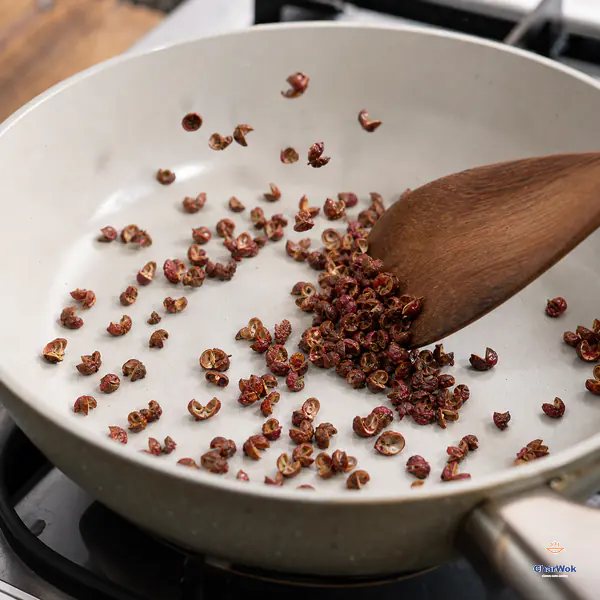
Toast the cleaned husks dry over medium-low heat, moving constantly, and pull the pan as soon as the citrus aroma rises and a faint oil sheen appears; do not wait for colour change.
- Pull the pan off the heat the instant it smells right. The gap between perfectly toasted and scorched is narrow, and scorched Sichuan pepper turns bitter and stays bitter. When in doubt, stop early. Residual pan heat will keep working for a few seconds after you lift it.
- Let the husks cool completely. Spread them on a plate and wait until they are cool to the touch. This is the step everyone skips and it is the one that costs you the most aroma. Grinding hot husks volatilizes the very oils you just toasted to release; they vanish into the air instead of staying in the powder. Ten minutes of patience here is non-negotiable.
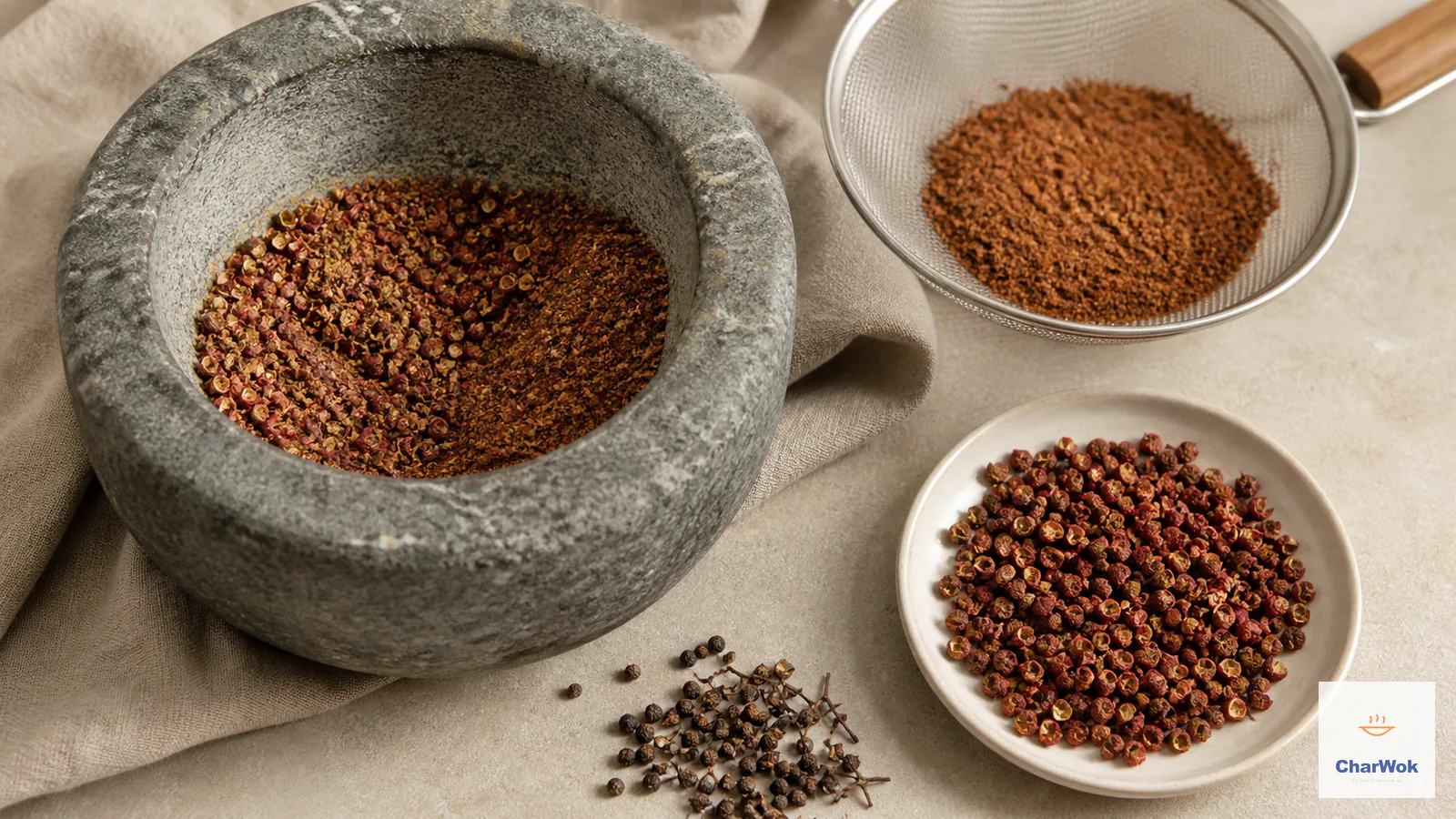
- Grind cool. Crush the cooled husks in a mortar with a firm, circular motion, or pulse in short bursts in a spice grinder. You are not trying to pulverize them to dust against their will; toasted and cooled, they shatter easily into a fluffy, rust-red powder. If you are using an electric grinder, stop and shake it between pulses so it never warms up.
- Sift, and do not skip it. Push the ground pepper through a fine-mesh sieve into a clean, dry jar. What falls through is your finished powder. What stays in the sieve, the flecks of husk vein, stubborn seed fragments, and stem ends, gets discarded. This is what separates a powder that melts invisibly into a sauce from one that crunches between your teeth.
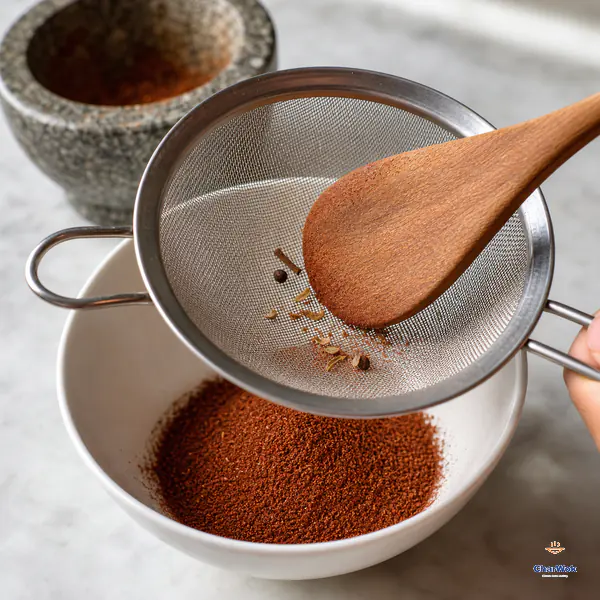
Press the completely cooled ground pepper through a fine sieve, keep only the fluffy powder below and discard every hard fragment left above rather than grinding it back in.
Where it usually goes wrong
Most failures land in one of four boxes, and I have personally checked all of them.
- "It tastes like sand." The husks went into the grinder whole, with the seeds still inside, and were never sifted. Fix it at the source: sort before toasting, sieve after grinding. No amount of extra grinding fixes grit; it just makes the grit smaller.
- "It's bitter, not numbing." The husks got scorched in the pan, or sat in a hot pan too long after coming off the flame. Toast only to the point of fragrance and pull the pan off the burner the moment the aroma peaks. A scorched batch should be thrown out; bitterness does not cook out.
- "It smells of nothing after a week." Ground pepper was stored warm, in light, or in a leaky jar, or simply too long. The sanshool oils are volatile and light-sensitive. Grind small batches, keep the powder in a tightly closed jar in a dark cupboard, and aim to use it within two weeks. Whole husks, by contrast, keep their punch for many months in the same conditions.
- "The mortar just smeared it into a paste." The husks were still warm from toasting, so their oils turned liquid and clumped instead of shattering. Cool them fully first. If a paste still forms, spread it thin on a plate, let it dry for an hour, then re-grind and sift.
A confession on that last one: for years I used a cheap, shallow ceramic mortar that flung husks across the counter with every stroke. A heavy, wide granite mortar changed grinding from a fight into a thirty-second job. If you grind spices more than once a month, the tool pays for itself in aroma.
Where to use your fresh powder
Fresh-ground Sichuan pepper belongs anywhere you want that numbing-citrus hum. Stir a pinch into the soy-sesame dressing for cold mouth-watering chicken or classic Bang Bang chicken, where it carries the sauce. Dust it over a bowl of Chongqing xiao mian just before serving, the way a Sichuan street stall does. Fold a little into the meat for dumpling fillings or into the chili oil that pools under red-oil wontons.
It also does quiet work you might not expect. A pinch lifts the chili-bean sauce in Sichuan boiled beef and water-boiled fish, balancing the chili heat with a cooling tingle. Stirred into the seasoned salt for salt and pepper shrimp or salt and pepper tofu, it is what separates restaurant-style seasoning from the plain salt-and-pepper you get at home. And it is the secret background note in a good bowl of spicy beef noodle soup.
Storage and make-ahead
Grind in small batches, two tablespoons of husks at a time. Store the powder in a small, airtight jar (a repurposed spice jar with a tight lid is ideal) in a dark, cool cupboard, away from the stove and the window. Use it within ten to fourteen days; after that the numbing edge softens noticeably even if it still smells fine. Whole husks keep far longer in the same conditions, so buy whole and grind on demand. If you want a flavor-oil shortcut for longer storage, infuse toasted whole husks into neutral oil over very low heat for a few minutes, then strain; that oil holds the aroma for weeks and is a good base for chili oil.
Frequently asked questions
Can I just use my regular pepper mill? No. A pepper mill is built for hard, dense black peppercorns and leaves the papery Sichuan husks torn and gritty, not powdered. Use a mortar and pestle or a dedicated spice grinder instead.
Why sift? Isn't the coarse stuff flavorful too? What the sieve holds back is mostly seed and stem, which are bitter and gritty, not aromatic. Sifting keeps the silky, fragrant powder and throws away the part that ruins the texture.
How much powder will I get? About a half-teaspoon of finished, sifted powder per tablespoon of cleaned husks. Plan for roughly a five-to-one loss, partly because you discard the seeds and stems and partly because the fluffy powder compacts in storage.
Whole husks or powder, which keeps longer? Whole husks, by a wide margin. The husk is a natural sealed package for the oil; grinding breaks it open. Keep husks whole and grind only what you will use in two weeks.
My powder lost its numbing kick. Is it off? Probably not rancid, just stale. The numbing sanshools fade faster than the citrus aroma, so a powder can still smell fine but no longer tingle. Start a fresh batch and keep the old one for cooked applications where the flavor, not the tingle, is what you want.
The short version
If you remember one thing, make it this: toast gently, grind cool, always sift. Three verbs, each protecting a different thing you can lose. The aroma goes if you scorch. The tingle goes if you grind hot or store long. The texture goes if you skip the sieve. Get those three right and the rest of your Sichuan cooking gets noticeably better, because the pantry ingredient underneath it finally tastes the way it is supposed to.