You can build a respectable Sichuan pantry without a lot of jars, but if you keep only one fermented thing on the shelf, make it doubanjiang. Mapo tofu does not exist without it. Twice-cooked pork does not exist without it. The reason your home version of a Chengdu restaurant dish tastes flat next to the real thing is almost always the same: you under-fried the paste, or you used the wrong jar.
I have bought at least a dozen brands over the years, including the sweetened stuff in squeeze bottles that lives next to the hoisin at American grocery stores. That is not the same ingredient. This guide is about the real thing, the fermented broad bean paste from Pixian, what makes it work, and how to make it work for you.
Buy Pixian doubanjiang with broad beans listed first, fry it in oil over low heat until the oil runs red (about 60 to 90 seconds), and never eat it raw. A typical stir-fry for two to four people takes 1 to 2 tablespoons. If your dish tastes harsh or one-note, the paste was either under-fried or the brand is the problem, not your cooking.
What actually goes into the jar
Sichuan chilli bean paste guide at a glance
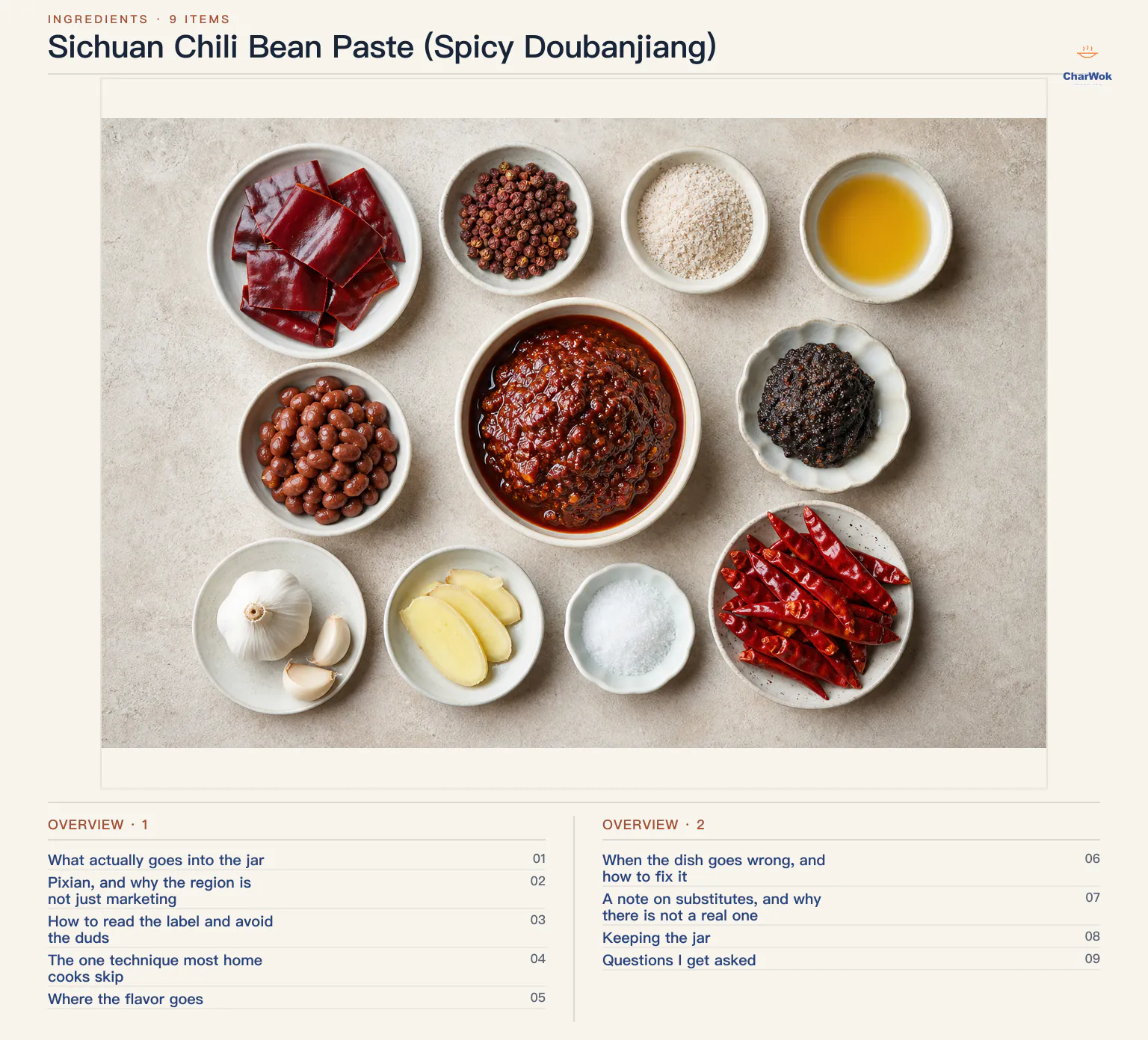
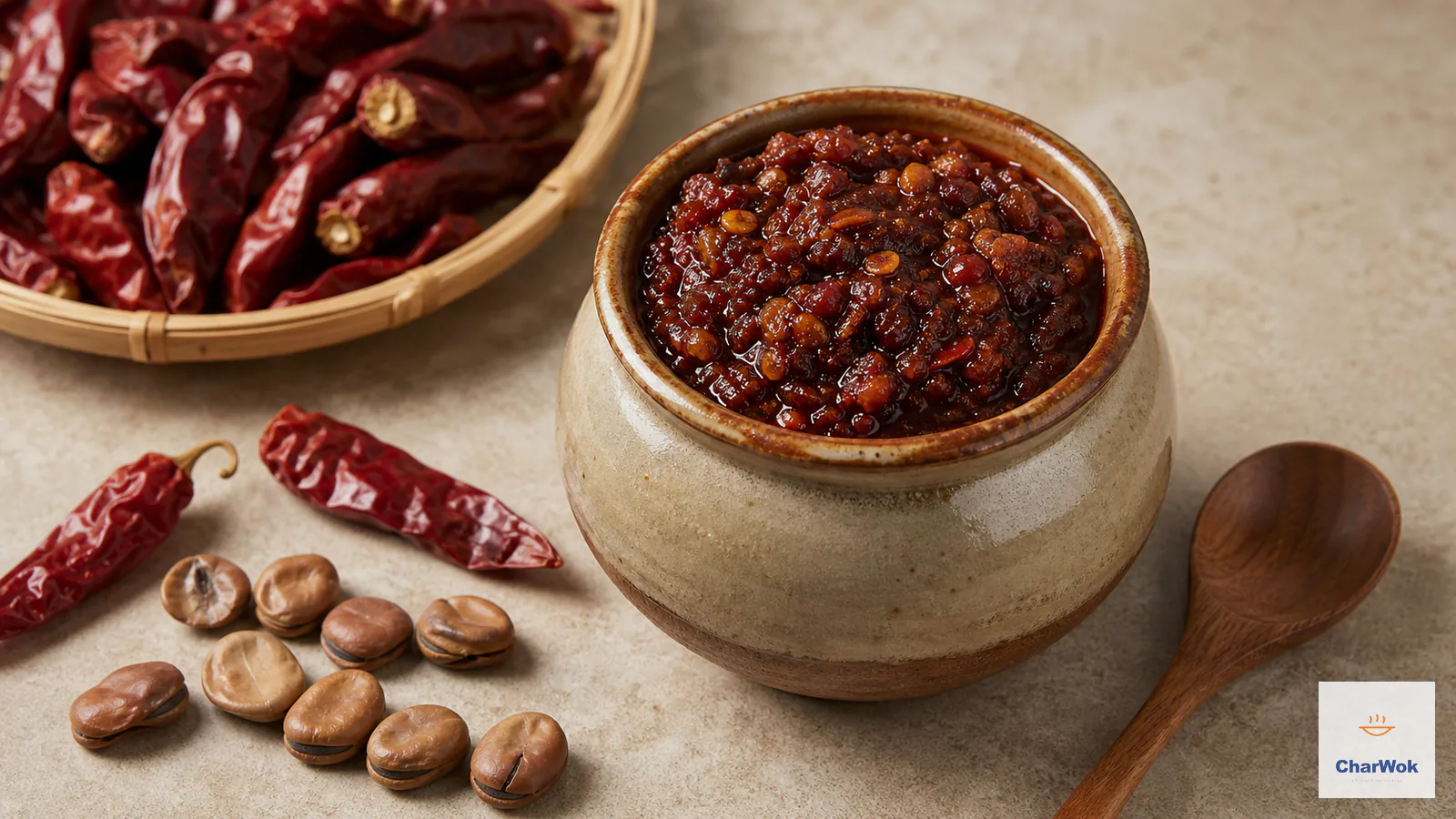
Real Sichuan chili bean paste is built from three things: broad beans (also called fava beans), er jing tiao or similar red chilies, and salt, with a little wheat flour to feed the fermentation. That is the honest version. The beans are cooked, inoculated with a mold culture, and fermented with the chopped chilies in open clay vats that are turned and sun-dried over months, sometimes years.
What you taste at the end is not just "spicy." The fermentation converts the bean proteins into free amino acids, which is the literal source of the savory depth. The chilies lose their sharp edge and turn aromatic. The slow sun exposure concentrates everything and lets the oil separate out red. This is why a one-year and a three-year Pixian taste like relatives rather than twins. It is also why there is no shortcut: a jar of chili powder stirred into bean paste will never get there.
Do not confuse this with its cousins. Korean gochujang is sweet and sticky from glutinous rice and does not have the broad-bean funk. Northern Chinese yellow bean sauce (huang dou jiang) is made from soybeans, not fava beans, and it brings salt and umami without the chili. Doubanjiang from outside Sichuan is often a soybean-and-chili product that skips the fava bean entirely. If broad beans or fava beans are not the first ingredient, keep looking.
Pixian, and why the region is not just marketing
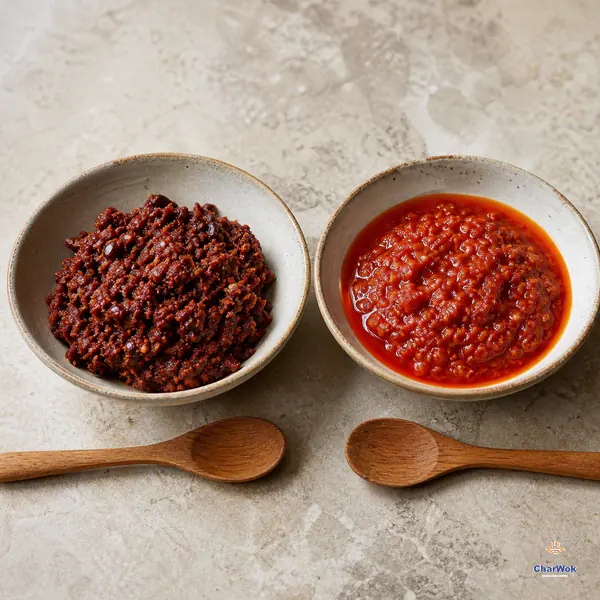
Regular aged Pixian is darker, denser and coarser; the red-oil style is brighter, looser and already carries extra chilli oil, so choose depth for braises and convenience for quick cooking.
Pixian (now administratively Pidu District, on the edge of Chengdu) has a geographic protection for its doubanjiang for the same reason Champagne has one. The basin climate, warm and humid with a long sun-exposed autumn, lets the vats ferment in conditions that are hard to fake. The traditional method calls for turning the mash by hand through a full annual cycle, sometimes three. Cheaper producers compress this into weeks using additives and heat. You can taste the difference immediately if you put them side by side.
There are two styles you will see on the shelf, and the choice matters more than people admit.
| Type | What it is | Best use |
|---|---|---|
| Regular Pixian (郫县豆瓣) | The aged paste straight from the vat. Dark red, dense, chunky, deeply savory, slower to release color. | Braises, stews, hot pot base, and any dish where the paste simmers in liquid for a while. My default for mapo tofu and spicy beef noodle soup. |
| Red-oil douban (红油豆瓣) | The aged paste blended with chili oil. Brighter red, looser, hotter, more fragrant up front, less aged depth. | Quick stir-fries where you want immediate color and heat: twice-cooked pork, dry-fried green beans, weeknight sauces. |
How to read the label and avoid the duds
English packaging uses the names interchangeably and mostly unhelpfully: broad bean paste, chili bean sauce, tobanjiang, doubanjiang, spicy bean paste. Ignore the front. Turn the jar over and check three things.
- Ingredient order. Broad beans (or fava beans) should be first or second. If wheat flour or sugar leads the list, it is a diluted product.
- Added sugar and additives. A long chemistry column of thickeners and preservatives signals a fast-made paste. Sugar is acceptable in the red-oil style but should not dominate the regular.
- Aging claim. Labels marked "aged" or showing a year count (1 year, 3 year) indicate real slow fermentation. Generic doubanjiang with no aging claim is usually the fast kind.
The jar I reach for is an aged Pixian from the Juan Cheng, Dan Dan, or Chuan Laoren lines. I am not a fan of the ubiquitous Lee Kum Kee Toban Djan in the squeeze bottle. It is consistent and easy to find, but it reads as flatly salty next to a real aged Pixian, and once you have cooked with the good stuff it is hard to go back.
If your local Asian market selection is thin, look for the two characters 郫县 or the pinyin "Pixian" anywhere on the label. Showing those characters to a shop assistant is the fastest way to get pointed to the right shelf.
The one technique most home cooks skip
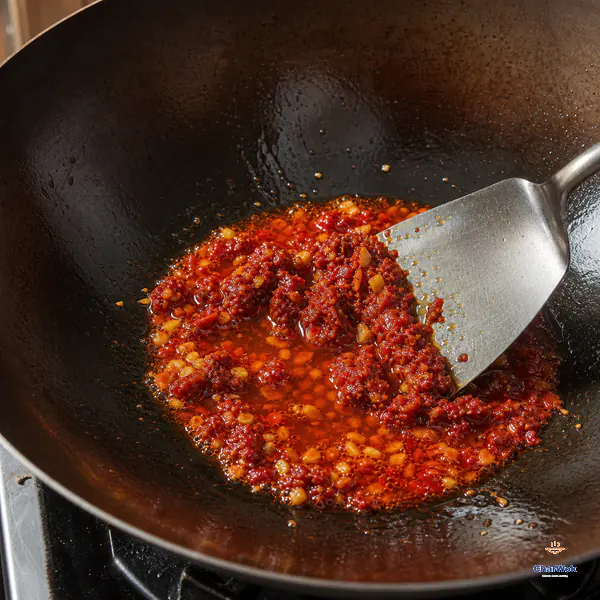
Fry finely chopped paste over low heat, pressing and stirring, until the surrounding oil turns clear brilliant red in about 60 to 90 seconds; add the next ingredient before any edge darkens.
Here is the step that separates a flat dish from a bright one. You fry the paste in oil, on low heat, before anything else goes into the wok.
The reason is simple chemistry. The color compounds in the chilies are oil-soluble, not water-soluble. A short spell in warm oil pulls the red pigment and the aromatic volatiles out of the paste and into the cooking fat, which then carries that color and flavor over every surface of the dish. Skip this and you get a gray, muddy result no matter how much paste you add. This is also why Sichuan recipes so often call for more oil than seems necessary: the oil is the delivery system.
- Heat 1 to 2 tablespoons of neutral oil in a wok over low heat. The oil should be warm, not smoking. High heat scorches the paste and turns it bitter instantly.
- Add aromatics first if the recipe calls for them. Sichuan peppercorns, minced ginger, and garlic bloom in the oil for 10 to 15 seconds before the paste goes in.
- Add the doubanjiang. For a stir-fry, this is roughly 1 to 2 tablespoons. Coarsely chopped regular Pixian fries more evenly, so give chunky paste a quick mince on the board first.
- Stir and press the paste against the wok. Within 60 to 90 seconds the oil will turn a clear, brilliant red and you will smell toasted chilies. That is your signal. Add the next ingredient immediately to stop the browning.
One rule I will state plainly: do not eat this paste raw. Unlike soy sauce or chili oil, doubanjiang is not a table condiment. It is harsh and flat until it has been cooked. Mixing it into a cold dipping sauce or a salad dressing is a mistake I made once and did not repeat.
Where the flavor goes
Doubanjiang is the backbone of the Sichuan canon. Once you have a jar, the following dishes become available, and most of them are not nearly as hard as their restaurant versions suggest.
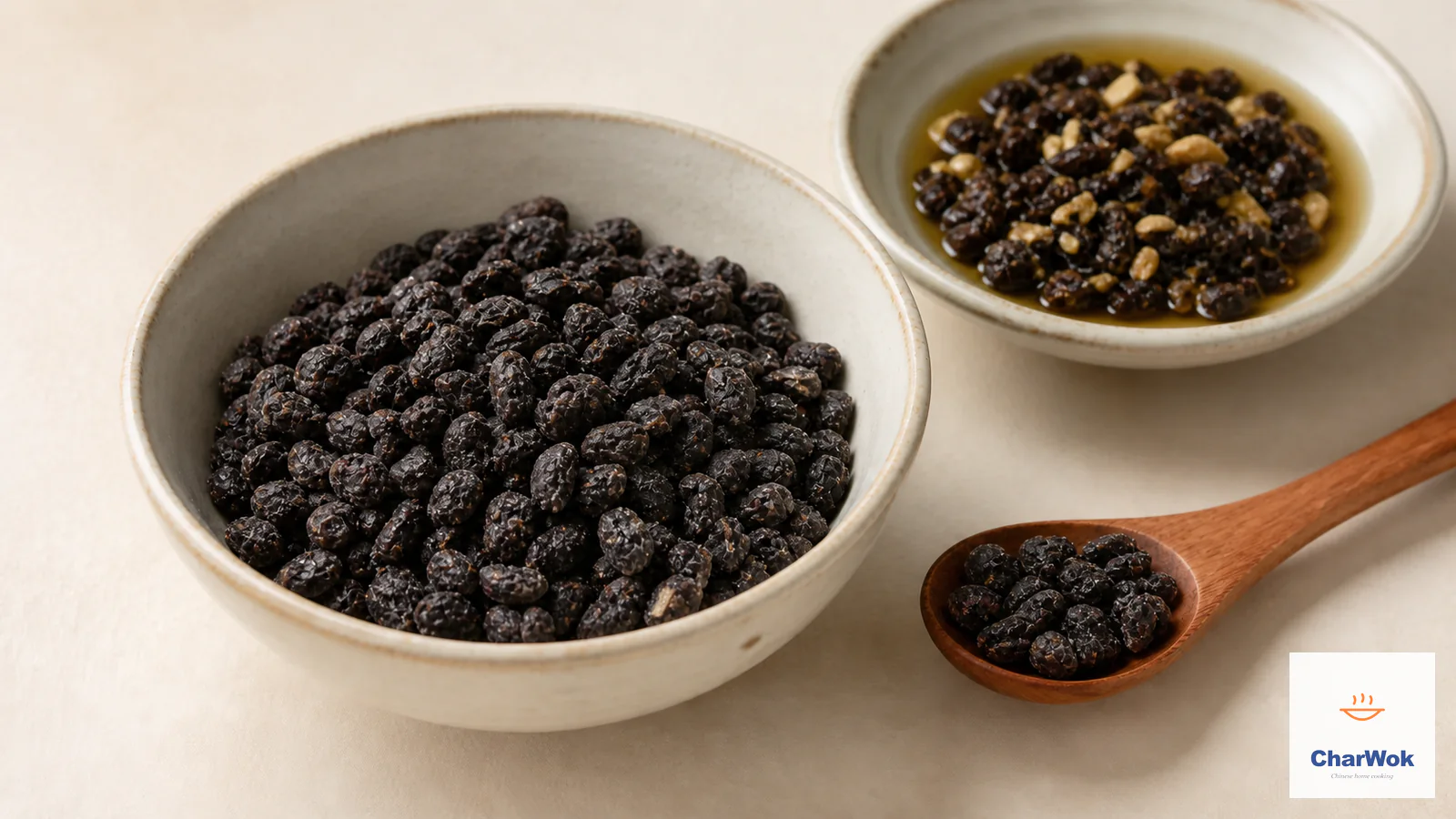
- The red-braised classics. Twice-cooked pork and fish-fragrant pork both lean on the paste for their salty, savory base. Pair it with fermented black beans and you have the backbone of half the Sichuan stir-fry repertoire.
- The water-boiled dishes. Sichuan boiled fish and Sichuan boiled beef get their deep red broth from a long, careful fry of the paste before the stock goes in.
- The long braises. Spicy beef noodle soup uses doubanjiang as the seasoning for the beef broth, where the paste has time to mellow into something rounded.
- The quick noodle and tofu dishes. Ants climbing a tree (the vermicelli stir-fry) and home-style braised tofu both depend on the paste for their character.
- Hot pot base. A real Sichuan hot pot broth is not authentic without it. The paste provides both the salt and the foundational aroma under the chilies and peppercorns.
- Variations on a theme. The same flavor logic drives fish-fragrant eggplant and the sauce on Dan Dan noodles.
If you want a single tour through what the ingredient can do, work through the recipes in our Sichuan recipe collection; nearly every one of them uses the paste in a slightly different role.
When the dish goes wrong, and how to fix it
| Symptom | What happened | The fix |
|---|---|---|
| Dish tastes harsh and raw, heat hits the back of the throat | The paste was not fried long enough, or it was added too late with the liquid. | Next time, fry the paste in oil first. To rescue the current batch, scoop out most of the liquid into a small pan and reduce it hard for a minute to cook the raw edge off. |
| Color is dull brown or gray, not red | Paste went into water or stock without an oil-fry, or the oil was too cold to extract pigment. | Warm a tablespoon of oil in a separate pan, fry a little more paste until the oil runs red, then stir the red oil back in. |
| Bitter, scorched flavor | Paste burned on high heat. Doubanjiang scorches far faster than you expect. | Keep the fry step on low heat and move fast once the oil turns red. Burned paste cannot be saved; dilute and start the sauce over. |
| Chunks of bean skin floating in a smooth sauce | Regular Pixian is coarse and you skipped the mince. | Chop the paste on the board before cooking, or press it through a fine sieve for a silky sauce. |
| Dish is too salty | The paste is salty, and the recipe also called for soy sauce plus stock. | Cut the soy sauce, taste before adding salt, and balance with a pinch of sugar or a splash of water. |
| Heat is one-dimensional, no depth | You used a fast-made non-Pixian brand. | Switch to an aged Pixian for the next batch and you will taste the difference immediately. |
A note on substitutes, and why there is not a real one
I will be honest: nothing else tastes like properly aged Pixian. There is no clean swap. If you are cooking a dish that calls for it and you do not have it, you are making a different dish, and that is fine, as long as you know it.
If you must approximate, the closest moves are these. A spoonful of black bean sauce or a fermented black bean product like Laoganma chili black bean sauce gives you the fermented-bean savoriness, though without the chili depth. For the heat, lean on chinese chili oil or a plain chili-garlic paste. Mixing a fermented soy product (yellow bean sauce, miso, or Korean doenjang) with a hot chili element gets you into the same neighborhood, though never the same address.
Whatever you use, taste it first. Salt levels vary wildly, and most substitutes are either saltier or sweeter than the real thing. Cut the quantity in any recipe that also adds soy sauce, and adjust upward only after tasting.
Keeping the jar
Unopened, a jar of aged Pixian keeps for a long time and the flavor actually improves with a year or two of rest. Check the date on the label and use it within that window, but do not panic if you find an older unopened jar at the back of the cupboard. It is almost certainly fine.
Once opened, refrigerate it. Keep the surface covered in its own oil, use a clean, dry spoon every time, and seal the lid. Treated this way an opened jar lasts a year or more without going off. If you see white spots that look like mold rather than the normal salt crystals, or if the smell turns from savory to sour, throw it out. Cross-contamination from a wet spoon is the usual killer, not age.
Questions I get asked
Below are the most common questions that come up about this ingredient. The answers are kept short here; the detail lives in the sections above.
None of the common substitutes truly replicate the flavor of properly aged Pixian doubanjiang, so once you find a good jar, buy two. The first will teach you what the second is supposed to taste like, and by then you will not need this guide anymore.