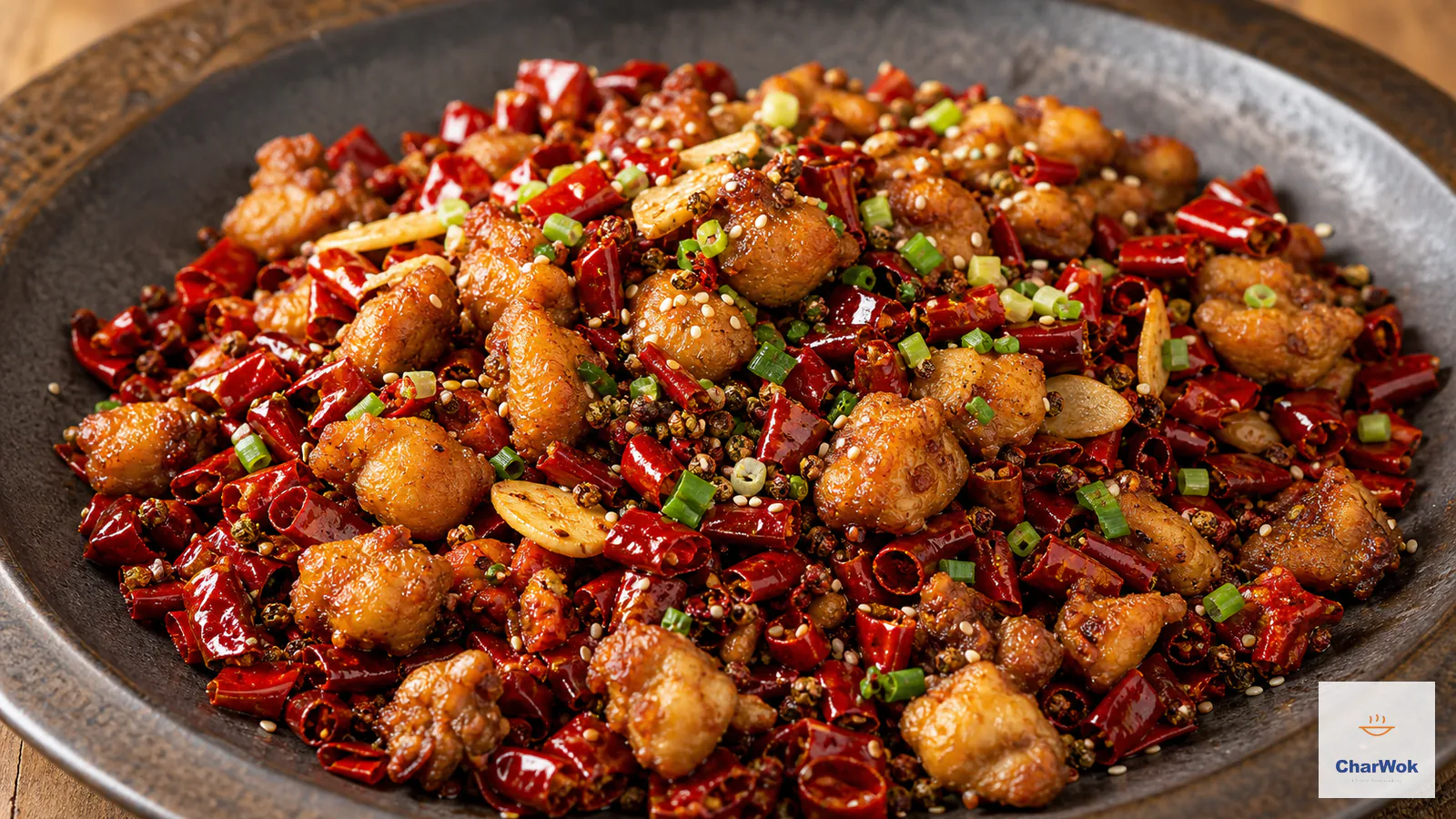
Chongqing Laziji is a pile of crimson dried chilies and Sichuan peppercorns with crispy chicken buried somewhere inside. The first time I made it at home, I dumped in a whole bag of chilies the way a restaurant does and spent the next ten minutes coughing while the oil turned bitter and black. That failure taught me the one thing most recipes skip: the dish is not actually about the chilies. It is about how you build aroma without scorching them, and how you fry the chicken twice so the crust stays glassy after the wok toss.
Here is the version I have settled on after many burnt-batch corrections. It uses a sane ratio of chilies to meat, skin-on thigh for the chew, and a double fry that is non-negotiable. If you skip the second fry, the chicken is fine. It is also not Laziji.
At a glance: Fry the marinated chicken at 160°C/320°F for ~3 minutes, pull it, raise the oil to 180°C/356°F, and fry again for 1 minute. The crust hardens in the second dip because surface moisture is gone. Aromatics go in on medium-low heat afterward; burned chilies wreck the whole dish. Bone-in is traditional, but boneless skin-on thigh is what I cook at home.
What this dish is, and where it comes from
Laziji (辣子鸡, "spicy chicken") is a Chongqing specialty that spread across China in the 1990s and became a Sichuan-region icon. The name tells you the technique: small pieces of chicken flash-fried, then tossed in a mountain of dried chilies and Sichuan peppercorns. The mala (麻辣) profile, hot and numbing, is the whole point. If you want a sharper read on that numbing backbone, the Sichuan pepper guide breaks down why the red and green types behave so differently on the tongue.
A real Chongqing joint uses bone-in bird cut into nuggets, and the diner works through bone and spice together. I prefer boneless, skin-on thigh at home. The skin renders a little fat into the crust during the fry, which is what gives the meat that sealed-in juiciness you lose with breast. Breast will work if that is what you have, but it dries out fast in the second fry and you will eat around it.
People often confuse Laziji with Kung Pao. They share a province and a chili, not much else. Kung Pao chicken is a quick stir-fry finished with a glossy sauce and peanuts; Laziji is a fried dish where the chilies and peppercorns are the sauce. For more dishes in this same numbing register, the Sichuan recipes collection is the right rabbit hole.
The ingredients, and why each one is here
Mala chicken ingredients at a glance
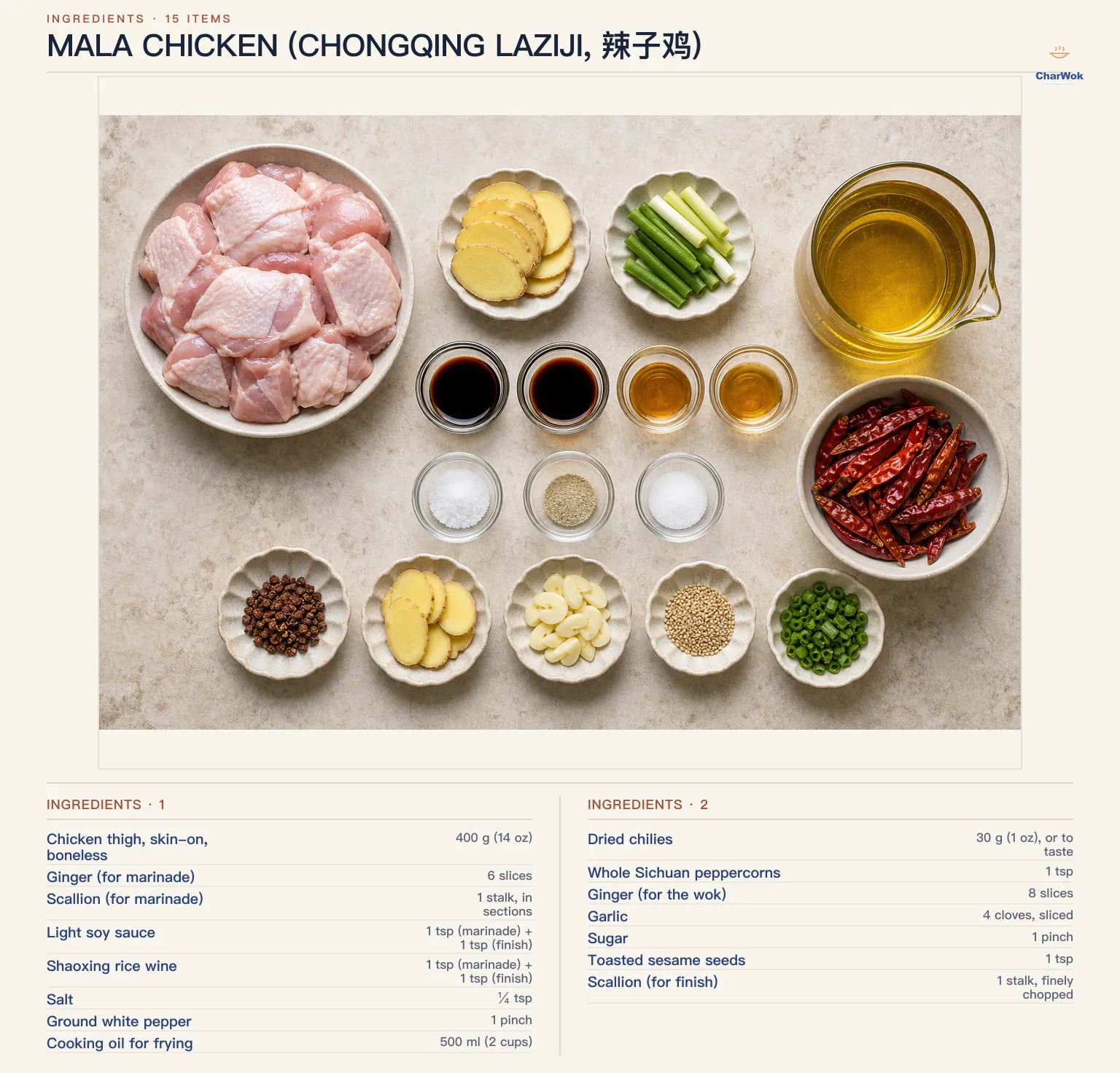
| Ingredient | Amount | Notes / substitute |
|---|---|---|
| Chicken thigh, skin-on, boneless | 400 g (14 oz) | Bone-in is traditional; I use boneless for easier eating. Skin matters, do not remove it. |
| Ginger (for marinade) | 6 slices | Removed before frying so it does not burn in the oil. |
| Scallion (for marinade) | 1 stalk, in sections | Green or white, either works here. Removed before frying. |
| Light soy sauce | 1 tsp (marinade) + 1 tsp (finish) | Use a thin, salty Chinese light soy, not the dark thick kind. |
| Shaoxing rice wine | 1 tsp (marinade) + 1 tsp (finish) | Dry sherry is the closest substitute; skip the salt-laden cooking wine. |
| Salt | ¼ tsp | To taste. The finish is salty enough that you can ease back. |
| Ground white pepper | 1 pinch | Rounder and less harsh than black pepper for marinades. |
| Cooking oil for frying | 500 ml (2 cups) | Neutral, high-smoke oil: peanut, canola, or grapeseed. Amount depends on your wok width. |
| Dried chilies | 30 g (1 oz), or to taste | Whole, fragrant, pliable. See choosing notes below. |
| Whole Sichuan peppercorns | 1 tsp | Green (májiao) numbs harder; red is more aromatic. I use green here. |
| Ginger (for the wok) | 8 slices | Thinner than the marinade slices so they perfume the oil fast. |
| Garlic | 4 cloves, sliced | Sliced, not minced, so they brown slowly instead of acrid. |
| Sugar | 1 pinch | Rounds the heat; you are not making it sweet. |
| Toasted sesame seeds | 1 tsp | For the finish. Toast them yourself if store-bought taste flat. |
| Scallion (for finish) | 1 stalk, finely chopped | Green parts only for color and a raw bite. |
On the chilies: in Chongqing they blend three Sichuan-grown types, each tuned for a different ratio of heat to aroma. You will not find all three easily in the US, and you do not need them. Look for dried chilies that are still leathery and deeply red, not dusty gray or brittle. Er jing tiao and facing-heaven (chao tian jiao) are the most common good options; guajiao adds fragrance with modest heat. The trick is to seed them. Capsaicin concentrates in the pith and seeds, and thirty grams of whole seeded chilies tastes very different from thirty grams of unseeded ones.
On the peppercorns: green Sichuan peppercorns (májiao) deliver a brighter, more electric numbing than the red. They are worth seeking out for this dish specifically. If you can only get red, the dish is still excellent, just more perfumed and less tingly. Either way, toast them dry for ten seconds in the wok before the oil goes in and your whole kitchen will smell right.
Step-by-step method, with the why built in
- Cut and marinate the chicken. Cube the thigh into roughly 2 cm (¾ inch) pieces, keeping the skin on each piece. Toss with the marinade ginger, scallion sections, soy, wine, salt, and white pepper. Twenty minutes is the floor; overnight in the fridge is better because the salt has time to work into the meat and the wine loosens the protein so it stays tender through two fries. Pull the ginger and scallion out before frying — wet aromatics spit and scorch in hot oil.
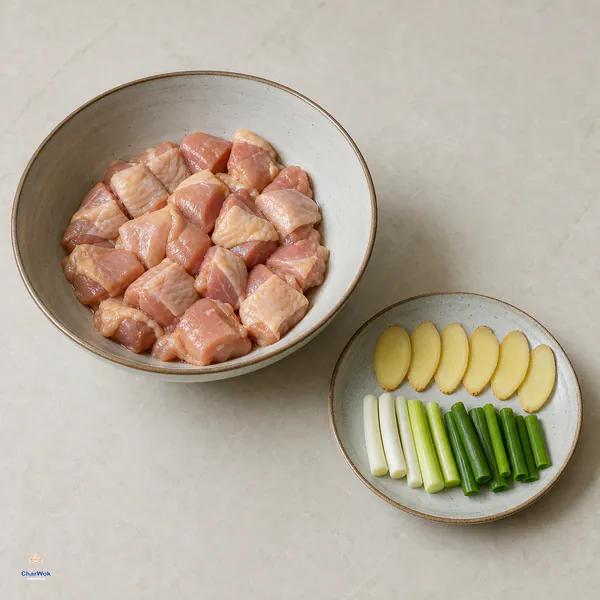
Marinate the chicken until lightly glossy, then remove every ginger slice and scallion segment before the chicken goes into the hot oil.
- Prep the chilies. Snip each dried chili in half lengthwise and shake out the seeds over the trash. Keep the halves intact. You want the chili present in every bite for aroma, not as a capsaicin bomb.
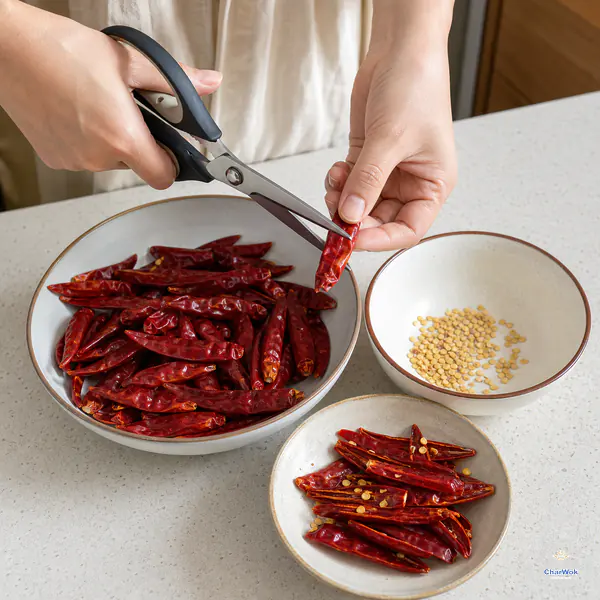
Split the dried chilies lengthwise and shake or scrape out most of the seeds before frying so their aroma stays prominent without excessive heat.
- First fry, 160°C / 320°F. Heat the oil in a wok or deep pan over high heat. Test with one piece of chicken: it should sink, then bubble steadily and rise within a couple of seconds. That is your 160°C cue if you do not own a thermometer. Slide the rest in, and fry about 3 minutes, until the edges are pale gold and the surface looks set. The goal here is to cook the meat through and drive off surface moisture, not to brown it. Lift the chicken out to a rack.
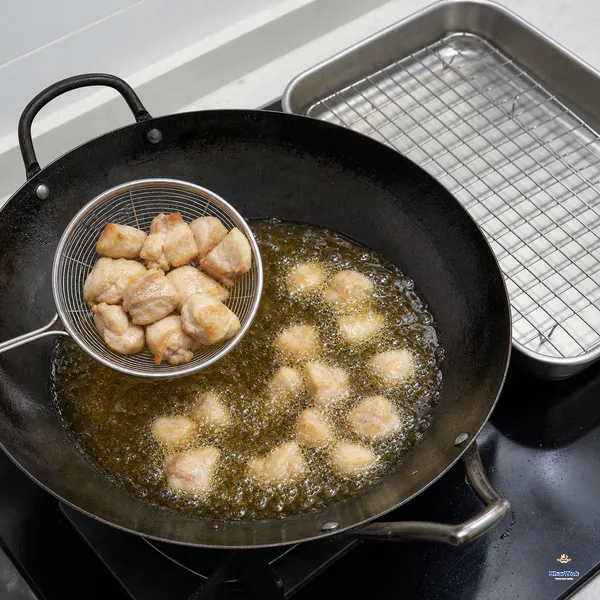
For the first fry, hold the oil near 160°C and cook for about 3 minutes, just until the surface sets and the edges turn pale gold.
- Second fry, 180°C / 356°F. Let the oil climb. At 180°C the surface quiets and a thin wisp of smoke rises. Return the chicken all at once; the oil will roar back to a hard boil as residual moisture flashes off and the crust crisps to deep gold. One minute is plenty. This is the step that separates Laziji from ordinary fried chicken: the first pass set the protein, the second pass hardens the crust so it survives the sauce toss without going soft.
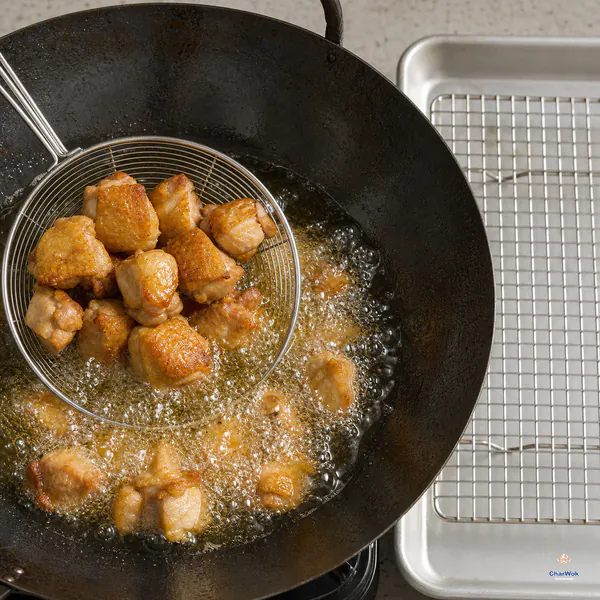
Raise the oil to 180°C and fry again for about 1 minute, until the uncoated exterior is deep gold, firm and crisp.
- Drain the wok, build the aroma. Pour off all but about 1 tablespoon of oil. Drop the heat to medium-low. Add the wok ginger, sliced garlic, and whole Sichuan peppercorns and let them sizzle gently for a minute. Add the dried chili halves and keep them moving. This is the make-or-break moment. If the heat is too high the chilies char in seconds and the entire dish turns bitter and ashy. You are looking for them to darken slightly and smell toasted, not blackened. Lower the flame if you are unsure; there is no prize for speed here.
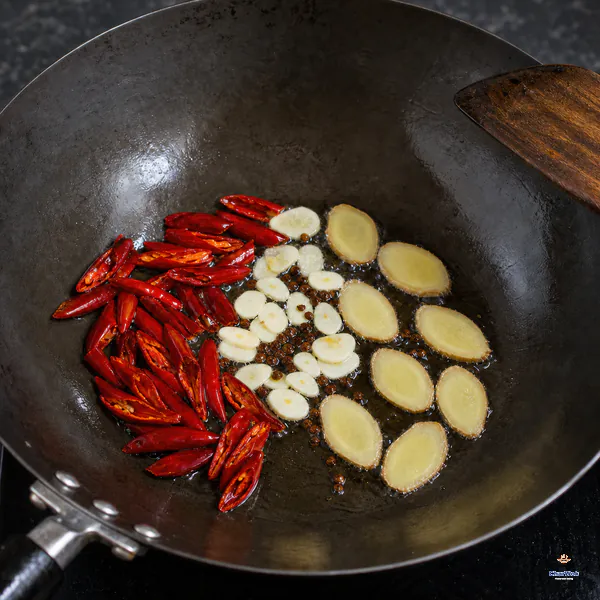
Bloom the ginger, garlic and Sichuan peppercorns first over medium-low heat, then add the seeded chili halves and keep them glossy red rather than black.
- Bring it together. Return the chicken to the wok. Add the second teaspoon each of soy and wine and the pinch of sugar. Toss for about 2 minutes so the chicken drinks in the chili oil. Kill the heat, scatter the sesame seeds and chopped scallion, toss once, and plate. The scallion goes in off the heat so it stays bright green and raw-edged.
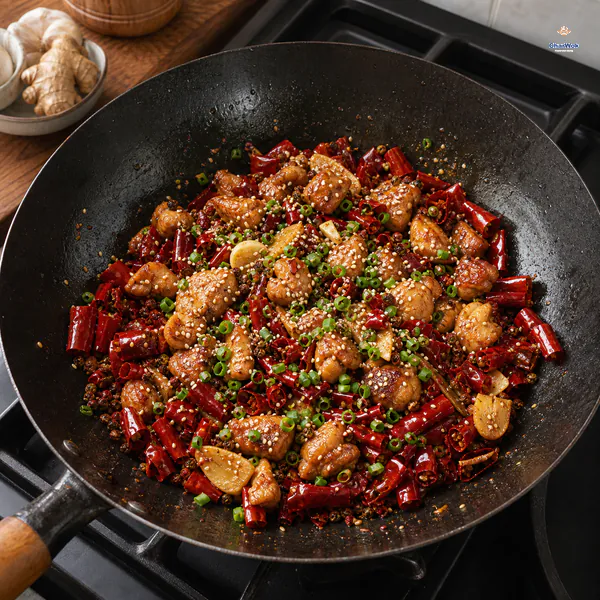
Return the chicken, toss with soy sauce, sugar and Shaoxing wine for about 2 minutes, then turn off the heat before adding sesame and scallion.
When it goes wrong, and how to fix it
The chicken is pale and the crust softens fast. The oil never got hot enough for the second fry, or the pieces were crowded and the temperature collapsed when you added them. Fry in two batches if your wok is small, and let the oil recover to 180°C before the second dip.
The chilies turned black and the oil tastes bitter. Heat too high in the aroma stage, or you left them in too long. Black chilies cannot be saved; strain them out, wipe the wok, and start the aromatics over with fresh ones. Once you have done this once you will respect medium-low heat forever.
The chicken is dry. You almost certainly used breast, or you overcooked the second fry. Thigh is forgiving; breast is not. If breast is all you have, cut the second fry to 45 seconds and accept a softer crust.
It is brutally, inedibly hot. Two usual culprits: you did not seed the chilies, or you used a superhot variety like facing-heaven at full strength. Seed them, swap part of the hot chilies for mild er jing tiao, or cut the quantity to 20 g. Heat should build across the meal, not flatten you on bite one.
It is greasy on the plate. You left too much oil in the wok before the aroma stage, or the chicken was not drained well after frying. A rack beats paper towels here; paper towels steam the crust from underneath.
Variations and what to serve it with
The classic upgrade is to toss in a handful of dry-roasted peanuts at the end, the same mala peanuts you can make on their own as a snack. Roasted cashews work too. Some cooks add chunks of lotus root or potato for a starchy contrast; both are good, and the potato version drifts toward the dry-stir-fry family of spicy potato dishes.
For heat that hits a different nerve, a spoonful of chili oil or a dab of doubanjiang stirred into the wok at the finish deepens the red color and the savory base. Keep it to a teaspoon; this is already a loud dish.
Pair it with plain steamed rice and a cooling vegetable to take the edge off. A simple cucumber smash, or garlic bok choy, resets the palate between bites. Cold Sichuan appetizers are a natural opener; mouth-watering chicken or garlic pork slices set the table without competing. And if you want to keep the numbing theme going across the meal, mapo tofu, Sichuan boiled fish, or dan dan noodles all live in the same flavor world, as does a mala hot pot broth if you are feeding a crowd.
Storing and reheating
Laziji is best the day it is made. Leftovers keep two days in the fridge in an airtight container, and the chili flavor actually deepens overnight. To reheat and recover the crunch, spread the chicken on a rack in a 200°C/400°F oven or air fryer for 5 to 7 minutes. The microwave will turn the crust rubbery; do not do it. The chilies can be saved and dropped into a stir-fry or noodle soup the next day for a second life of flavor.
A few honest limits
This is a deep-fried dish, and there is no honest way around that. Shallow frying in a flat pan works in a pinch if you turn the pieces, but the crust is uneven and the second fry suffers. If you hate deep frying, this is not the recipe to compromise on; make a quick Hunan chicken stir-fry or a cumin lamb instead, and save Laziji for a night when the oil is already out. It also makes a mess. Line your stove with foil before you start; you will thank yourself when it is over.
If you are cooking for someone who cannot handle heat at all, this is the wrong dish to coax them with. Dialing the chilies down to five grams produces a perfectly fine crispy chicken, but it stops being Laziji. Better to point them toward lemon chicken or three cup chicken, and save this one for the spice eaters.
Frequently asked questions
Can I shallow-fry instead of deep-fry? Yes, in a flat pan with about 1 cm of oil, turning the pieces twice. Expect an uneven crust and a softer result; it is a fair shortcut, not an equivalent.
Do I have to seed the chilies? Only if you want control over the heat. Seeding drops the capsaicin load sharply and lets the aroma come through. Leave them in only if your chilies are mild and you want a real burn.
Bone-in or boneless? Bone-in is the Chongqing original and gives the most authentic chew. Boneless skin-on thigh is easier to eat and easier to fry evenly at home. Pick by appetite, not by correctness.
Is Laziji the same as Kung Pao? No. Kung Pao is a sauce-thickened stir-fry with peanuts; Laziji is fried chicken folded into chilies and peppercorns with no real sauce. They share a region, not a method.
What oil temperature if I have no thermometer? For the first fry, a test piece should sink, bubble hard, and float within two seconds. For the second, the oil surface goes still and a faint smoke rises before the chicken goes back in.