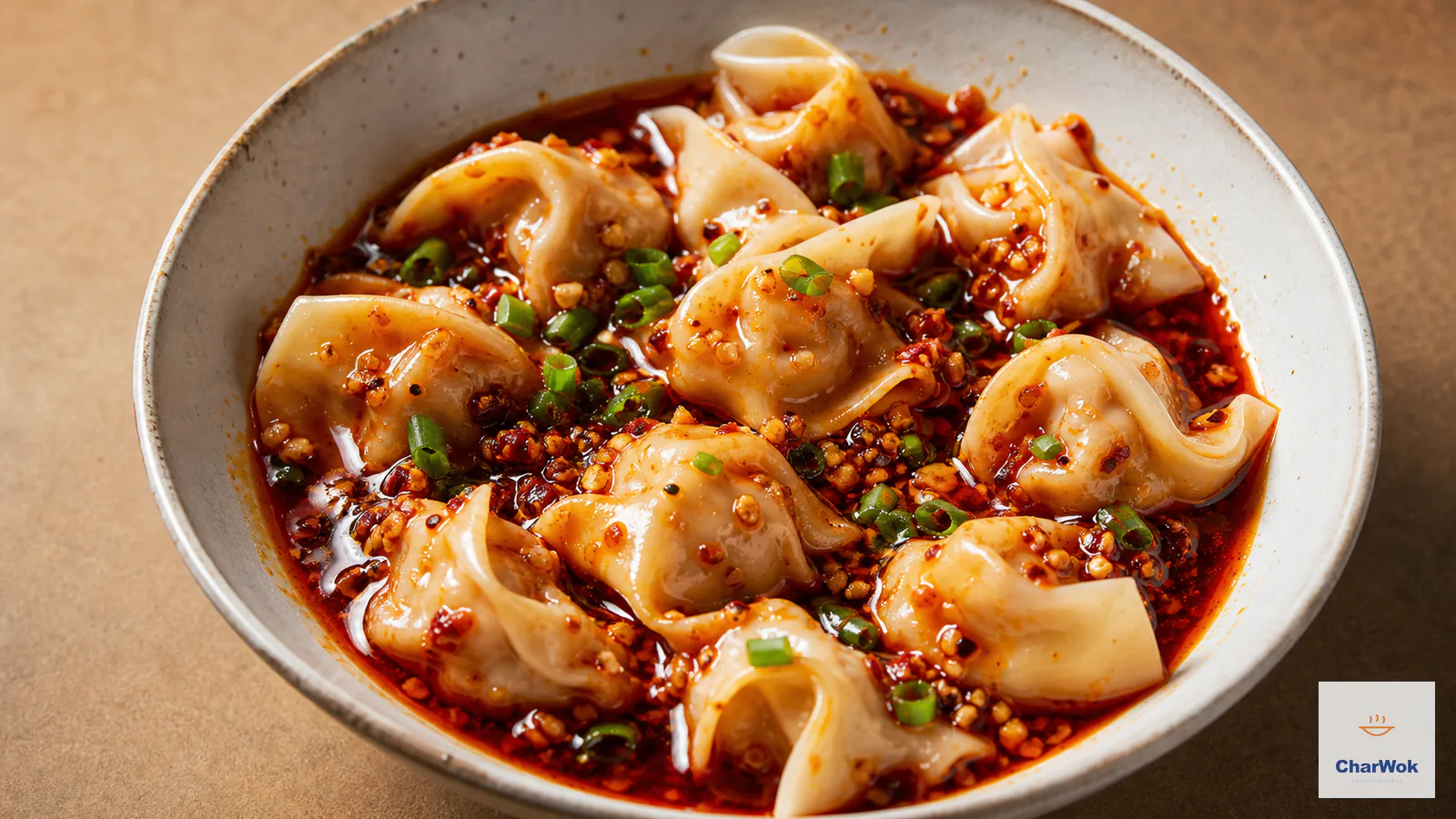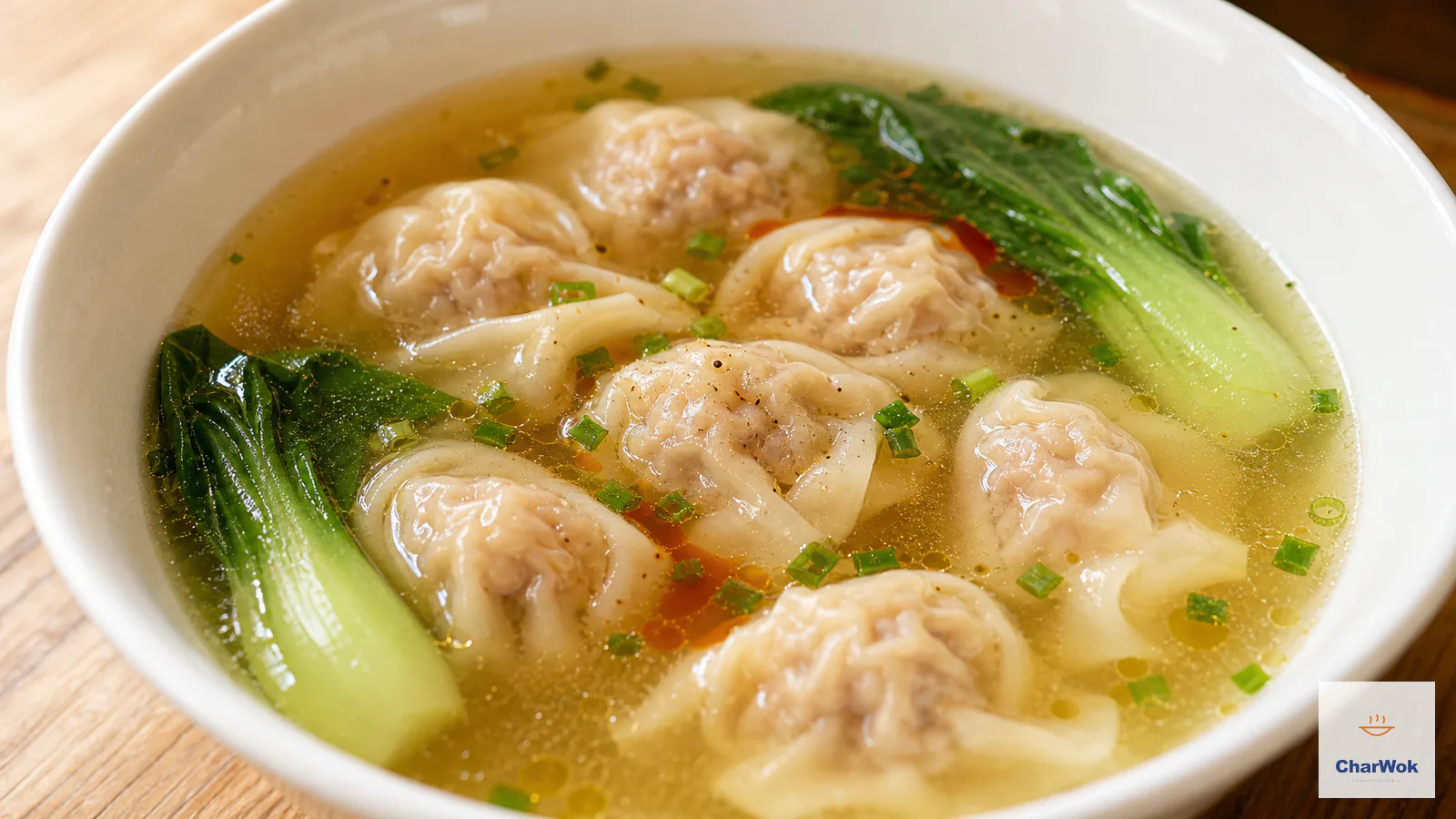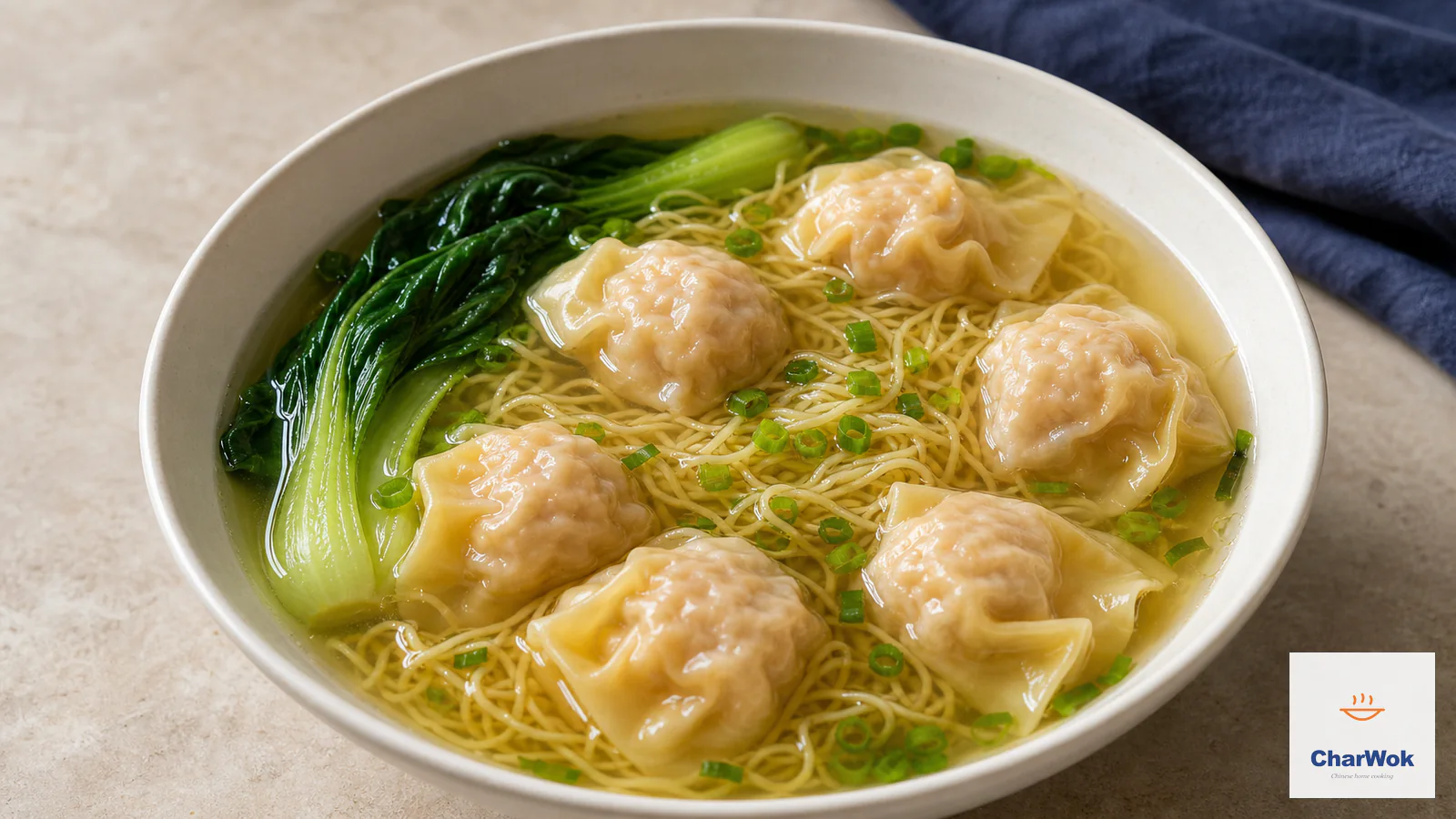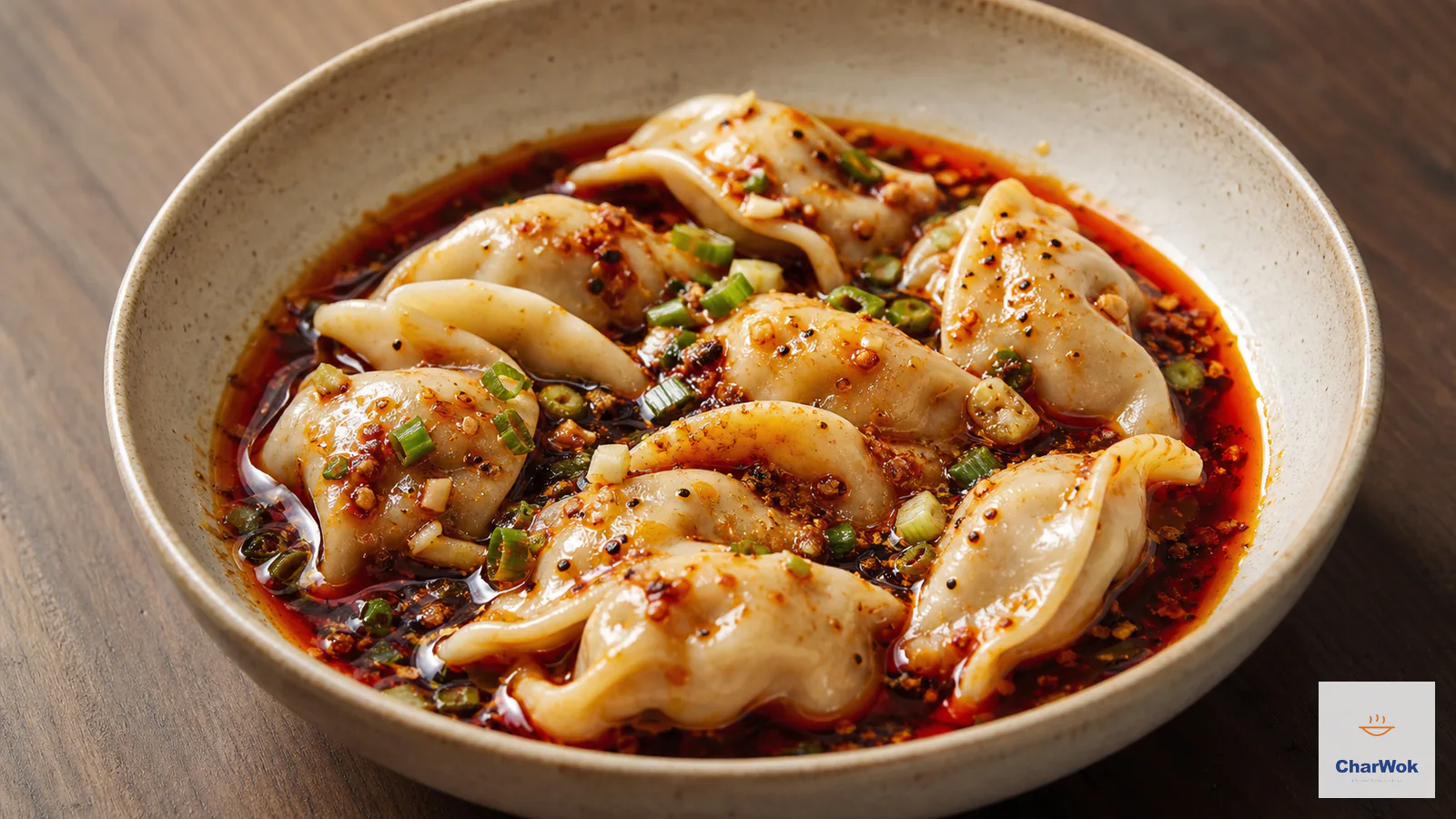
Boiled pork dumplings drenched in a glossy, sweet-and-savory sauce with chili oil and raw garlic: that is Zhong dumplings (Zhong shui jiao / 钟水饺), the Chengdu street snack that proves a dumpling doesn't need to be stuffed with anything fancy to be unforgettable. The filling is plain ground pork. All the personality lives in what gets spooned over the top.
The sauce is the part that needs patience. It looks like ordinary soy sauce at first, but the signature seasoning is a spiced sweet soy sauce: dark, lightly syrupy, and scented with star anise and cassia. A gentle uncovered simmer extracts those aromas and concentrates the sauce; stopping while it is still watery leaves the finished bowl flat and salty.
At a glance: Zhong dumplings are boiled pork dumplings served dry (no soup) and dressed tableside with a spiced sweet soy sauce reduced by a third, raw minced garlic, and chili oil. Plan ~25 minutes of unattended simmering for the sauce, a 10-minute aromatic-water infusion for the filling, and a three-addition boil for the dumplings. The single biggest judgment call is the sauce reduction: pull it too early and the dish collapses into salty water.
What makes a dumpling "Sichuan"
Northern dumplings (jiaozi) are usually dunked in a quick mix of black vinegar and chili oil, or eaten in their cooking water as soup dumplings. Chengdu does it differently. The dumplings arrive dry in a shallow bowl, and the cook lays the seasoning on top, so every dumpling gets coated as you stir. The seasoning has three layers working against each other: sweet from reduced soy and sugar, numbing-malic tingle from Sichuan peppercorn, and a sharp garlic-and-chili kick. Stale peppercorn reads as dusty rather than tingling, so freshness matters more here than in almost any other dish.
This is the same flavor family you find across Sichuan cold dishes. The garlic-pork classic Suan Ni Bai Rou and the cold Bang Bang chicken both lean on sweet soy, raw garlic, and chili oil. Once you internalize the combo, a lot of Sichuan cooking clicks into place. The dumpling version is just the most lovable delivery system.
Ingredients
Ingredients at a glance
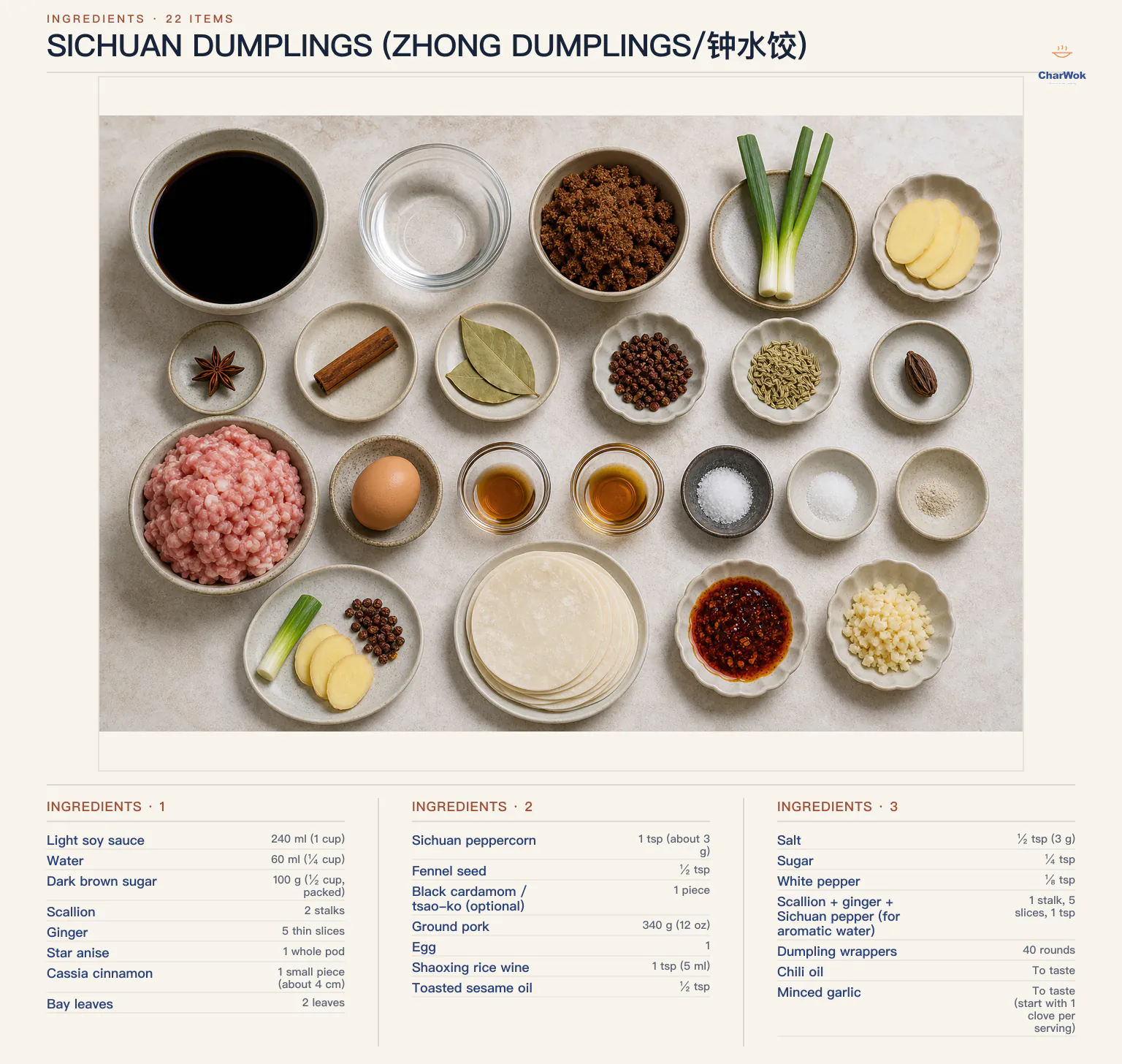
The recipe is in two halves: the spiced sweet soy sauce and the dumplings themselves. Quantities are metric-first, with household volume measures in parentheses.
For the spiced sweet soy sauce (makes about 200 ml / ¾ cup, enough for several batches):
| Ingredient | Amount | Notes / substitute |
|---|---|---|
| Light soy sauce | 240 ml (1 cup) | Use a Chinese light soy, not Japanese; light vs. dark soy matters here, and do not swap in dark soy, it will turn bitter when reduced this far |
| Water | 60 ml (¼ cup) | Just to give the aromatics something to steep in |
| Dark brown sugar | 100 g (½ cup, packed) | Yellow rock sugar is the traditional choice and gives a cleaner sweetness; light brown works if that's what you have |
| Scallion | 2 stalks | Cut into 5 cm lengths, lightly crushed |
| Ginger | 5 thin slices | Smash them with the side of a knife to release oil |
| Star anise | 1 whole pod | One is enough; two turns it medicinal |
| Cassia cinnamon | 1 small piece (about 4 cm) | Cassia is bolder than true cinnamon and is what Sichuan kitchens use |
| Bay leaves | 2 leaves | Standard bay is fine |
| Sichuan peppercorn | 1 tsp (about 3 g) | Toasted lightly first for more aroma |
| Fennel seed | ½ tsp | Whole seed, not ground |
| Black cardamom / tsao-ko (optional) | 1 piece | Smoky and dark; skip if you can't find it, it's not in every Chengdu version |
For the dumplings (about 40):
| Ingredient | Amount | Notes / substitute |
|---|---|---|
| Ground pork | 340 g (12 oz) | 70–80% lean. Too lean and the filling is dry; too fatty and the dumplings weep grease. Ask for "shoulder, ground" if your butcher will do it |
| Egg | 1 | Acts as a binder; it's what lets you beat in the aromatic water without the filling separating |
| Shaoxing rice wine | 1 tsp (5 ml) | Real Shaoxing, not "cooking wine" with salt added |
| Toasted sesame oil | ½ tsp | A whisper, not a glug; Chinese sesame oil is a seasoning, not a cooking fat |
| Salt | ½ tsp (3 g) | Adjust if your soy sauce is very salty |
| Sugar | ¼ tsp | Rounds the salt; you should not taste sweetness in the raw filling |
| White pepper | ⅛ tsp | White, not black; black specks the filling |
| Scallion + ginger + Sichuan pepper (for aromatic water) | 1 stalk, 5 slices, 1 tsp | Steeped in 80 ml (⅓ cup) hot water, then strained |
| Dumpling wrappers | 40 rounds | Store-bought Shanghai-style are fine and traditional here; homemade wrappers are thinner and more tender if you have the time |
| Chili oil | To taste | Homemade chili oil is worth the ten minutes; the jarred stuff is often just heat with no aroma |
| Minced garlic | To taste (start with 1 clove per serving) | Raw. Do not cook it; the bite is the point |
Making the sweet soy sauce (do this first)
The reduction is where the sauce gains body. Put every sauce ingredient into a small saucepan, bring it to a full boil, then lower the heat to small, lazy bubbles. Simmer uncovered for about 25 minutes, stirring once or twice, until the liquid has dropped by roughly a third and coats a spoon like thin syrup. Strain out the solids and let the liquid cool before dressing the dumplings so the wrappers stay tender.
Why reduce at all instead of just using less water? The gentle simmer gives the whole spices time to infuse while evaporation concentrates the soy and dissolved sugar. It is not caramelization—the water-rich sauce does not reach dry-caramel temperatures. Stop when the volume has fallen by about one third and the cooled sauce lightly coats a spoon; use that visual endpoint rather than forcing an exact time.
The filling: why an aromatic water
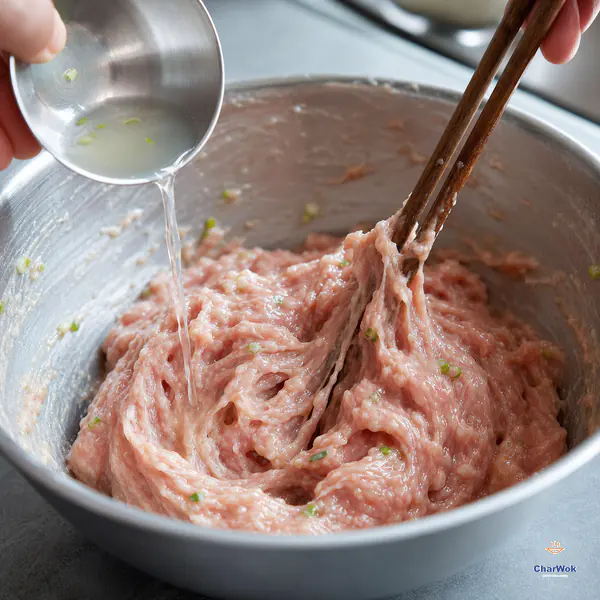
Beat in the aromatic water gradually and always in one direction, waiting for each addition to disappear; the filling is ready when glossy, cohesive and tacky with no free liquid.
The filling looks plain: pork, salt, a little wine. That is the whole idea. The texture is what you're after, a soft, almost paste-like interior that's juicy without being watery. The trick is the aromatic water.
You steep scallion, ginger, and Sichuan peppercorn in hot water for ten minutes, strain it, and then beat that liquid into the pork a little at a time. This does two things raw aromatics cannot. It flavors the meat without leaving fibrous bits of scallion or ginger in the bite (which read as a mistake in a smooth filling). And it physically loosens the proteins so the pork holds water and turns bouncy instead of dense. Stir in one direction the entire time; this isn't superstition, it's how you align the myosin into the stretchy network that traps the juice. The finished filling should look glossy and hold a soft peak when you pull the chopsticks up. If it's still crumbly, beat it more; it isn't done yet.
For a deeper dive into the technique across many fillings, the fillings chapter of the dumpling guide walks through ratios for pork-and-cabbage, shrimp, and vegetarian versions.
Folding: these are the easy dumplings
Here's the good news: Zhong dumplings are traditionally folded as a plain half-moon. No pleats, no fancy crimp. You put a teaspoon of filling in the center of a wrapper, fold it over, and press the edge shut. That's it. This is why the dish became a street snack: it's fast to make in volume.
If you're using store-bought wrappers (the dry, slightly yellow Shanghai rounds), wet the rim with a finger dipped in water before pressing; they will not seal on their own. With freshly made wrappers, the dough is sticky enough that you just pinch. Lay finished dumplings on a lightly floured tray without letting them touch, especially if the wrappers are fresh, because they will weld themselves to a neighbor and tear when you try to separate them.
If you want to graduate past the half-moon, the dumpling guide's ten folding techniques start simple and get showy. For this dish, though, plain is correct.
The three-water boil
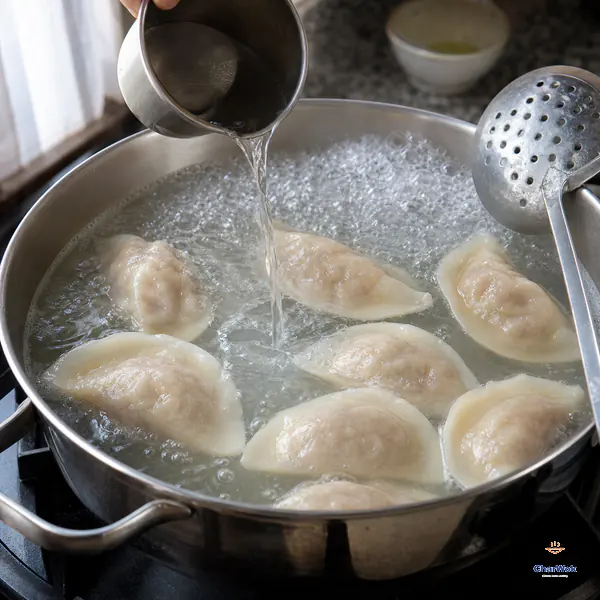
After each return to a boil, add about 120 ml cold water and cover again. After three additions, puffing and floating mean check 2–3 large dumplings from different pot positions; every pork centre must reach 160°F / 71°C.
Bring a wide, deep pot of water to a rolling boil. Slide in the dumplings without crowding the pot and give them one gentle stir with the back of a spoon to lift them off the bottom. Cover. When the water returns to a full boil, tilt the lid away from you, pour about 120 ml (½ cup) cold water down the inside wall, and cover again. Repeat twice more. After the third return to a boil, puffed, floating dumplings with translucent seams are ready to check, not automatically safe. Take 2–3 of the largest dumplings from different parts of the pot and insert a clean thin-tip thermometer through the side into the centre of the pork filling. Every sample must reach 160°F / 71°C; if one is lower, simmer another minute and recheck with a cleaned probe. This endpoint follows the USDA safe-temperature chart.
The cold-water additions moderate the boil so tender wrappers are not battered apart while their starch hydrates. Three additions are a useful cooking rhythm, not a food-safety guarantee; dumpling size, starting temperature, filling density, batch size, and pot recovery all change the time needed to reach 160°F / 71°C.
Keep the pork-and-egg filling at 40°F / 4°C or below while working, and use or freeze it within one day. Wash hands, board, bowl, utensils, and the thermometer probe after contact with raw filling; never return cooked dumplings to the raw-filling tray.
When things go wrong
These common failures are easier to fix once the cause is clear.
- The sauce tastes thin and one-dimensionally salty. You didn't reduce it enough. Pour it back in the pan and go another ten minutes. It should coat a spoon and leave a film. The fix is easy and forgiving: you can always reduce more.
- The filling is dense and dry, like a meatball. Either the pork was too lean, or you didn't beat in enough aromatic water. Next time add the water more slowly and keep stirring until the filling is glossy and slightly sticky. You can rescue a too-dry batch by beating in another tablespoon of water and letting it rest ten minutes.
- The dumplings split open in the pot. You overfilled them, or the seal wasn't tight. A teaspoon of filling per wrapper is plenty. Also check that you're not boiling too hard; a violent roll will rip them. A gentle boil with the lid on between water additions is what you want.
- The wrappers turn to mush on the plate. The sweet soy was still hot when you dressed the dumplings, or you let them sit in the sauce too long before eating. Dress and serve immediately; this is not a make-ahead-and-reheat dish once the sauce is on.
- The filling weeps greasy liquid into the wrapper. The pork was too fatty. Mix in a tablespoon of finely chopped water chestnut or napa cabbage next time to absorb the fat, or ask for a leaner grind.
- The Sichuan pepper tastes dusty, not tingly. Your peppercorns are stale. Buy fresh, toast them dry in a skillet for 30 seconds, then grind. Old peppercorn is worse than no peppercorn.
Variations and what to serve alongside
The most useful variation is structural, not ingredient: turn the same components into Sichuan spicy wontons in chili oil (hong you chao shou). Same sweet soy, same garlic, same chili oil, but the wrappers are thin square wonton skins and the fold is different. It's the lazy-weeknight version because wonton wrappers are faster to fill.
If you want heat with depth rather than just burn, fold a teaspoon of doubanjiang into the sauce, or top with a spoonful of pickled chili-garlic sauce (duo jiao) for a fermented, bright edge. For a crisp textural contrast, a plate of smashed cucumber salad or any of the three cucumber salads alongside is the classic Chengdu move, cold and crunchy and vinegary and ready in five minutes.
Drink-wise, cold soy milk or a light lager. Heavy red wine fights the numbing spice.
Storage and reheating
Cool the sweet soy sauce promptly, transfer it to a clean covered container, and refrigerate it separately from the dumplings. Use it within 3–4 days or freeze it in small portions. Keeping the sauce separate protects the wrappers and also makes it useful on plain boiled pork and napa cabbage dumplings or dan dan noodles.
Freeze assembled raw dumplings in a single layer, then transfer them to a sealed freezer bag once solid. Boil them straight from frozen without thawing. One extra cold-water addition is only a cue for the first temperature check: sample 2–3 large dumplings from different pot positions and require every pork centre to reach 160°F / 71°C. For cooked leftovers, refrigerate dumplings and sauce in separate shallow containers within 2 hours—or within 1 hour when the room is above 90°F / 32°C. Use within 3–4 days and reheat the dumpling centres to 165°F / 74°C before adding sauce. See the USDA leftovers guidance.
Frequently asked questions
Can I use frozen dumplings from the store? Yes. Choose plain pork dumplings and follow the package directions. Boil from frozen without thawing; an extra cold-water addition is only the first-check cue. Measure 2–3 large dumplings from different parts of the pot and make sure every pork centre reaches 160°F / 71°C.
How do I know the pork dumplings are done? Floating, puffing, and translucent seams only tell you when to start checking. Measure 2–3 of the largest dumplings from different parts of the pot; every pork centre must reach 160°F / 71°C. If one is lower, simmer another minute and recheck with a cleaned probe.
Is there a substitute for Sichuan peppercorn? Not really. The numbing tingle is unique and there's no Western stand-in. If you can't find it, leave it out rather than using black pepper; the result will just be a good garlic-soy dumpling rather than a Zhong dumpling.
How spicy is this? Only as spicy as the chili oil you add. The base sauce is sweet and savory, not hot. Start with a teaspoon of chili oil per serving, taste, and build up. Raw garlic is the sharper heat; dial that back too if you're sensitive.
Can I pan-fry instead of boil? You can, but you're then making a different dish, closer to pan-fried dumplings. The boiled, tender wrapper is part of what lets the sauce cling, so for the authentic Zhong experience, boil.
One last thing. If you make the sauce once and keep the jar, the rest is a weeknight meal you can pull together in the time it takes to boil water. That is the real case for learning Zhong dumplings: not the dumplings themselves, which are simple, but the sauce that turns plain pork into something you'll want on a Tuesday.