Take a pork meatball, roll it in soaked glutinous rice, and steam it. That is the whole trick. Yet most home versions come out with the rice half-raw or clumped, the meat dense and rubbery, the dish somehow less than the sum of its parts. The gap between a restaurant pearl meatball and a homemade one is not the ingredient list, which is short and forgiving. It is a handful of decisions the recipe rarely spells out: how long the rice really needs to hydrate, why you stir the filling in one direction, and what the meat should look like before it ever meets the rice.
I have wrecked this dish more times than I want to admit. Under-soaked rice that stayed chalky in the center. A filling I overworked into a bouncy puck. The plate I forgot to oil, so half the rice tore off when I lifted the meatballs off. The recipe below is what I cook now, after those failures, and each step tells you the why behind it.
At a glance. Soak the glutinous rice a full 4 to 6 hours (overnight is fine); under-soaking is the number one cause of chalky grains. Stir the pork filling in one direction until it turns visibly sticky and stringy, which takes about 3 minutes by hand. Steam over fully boiling water for 15 minutes for 4 cm (1½-inch) balls. Rice-to-meat ratio to remember: roughly 1 part soaked rice to 2.5 parts meat by weight.
What pearl meatballs actually are
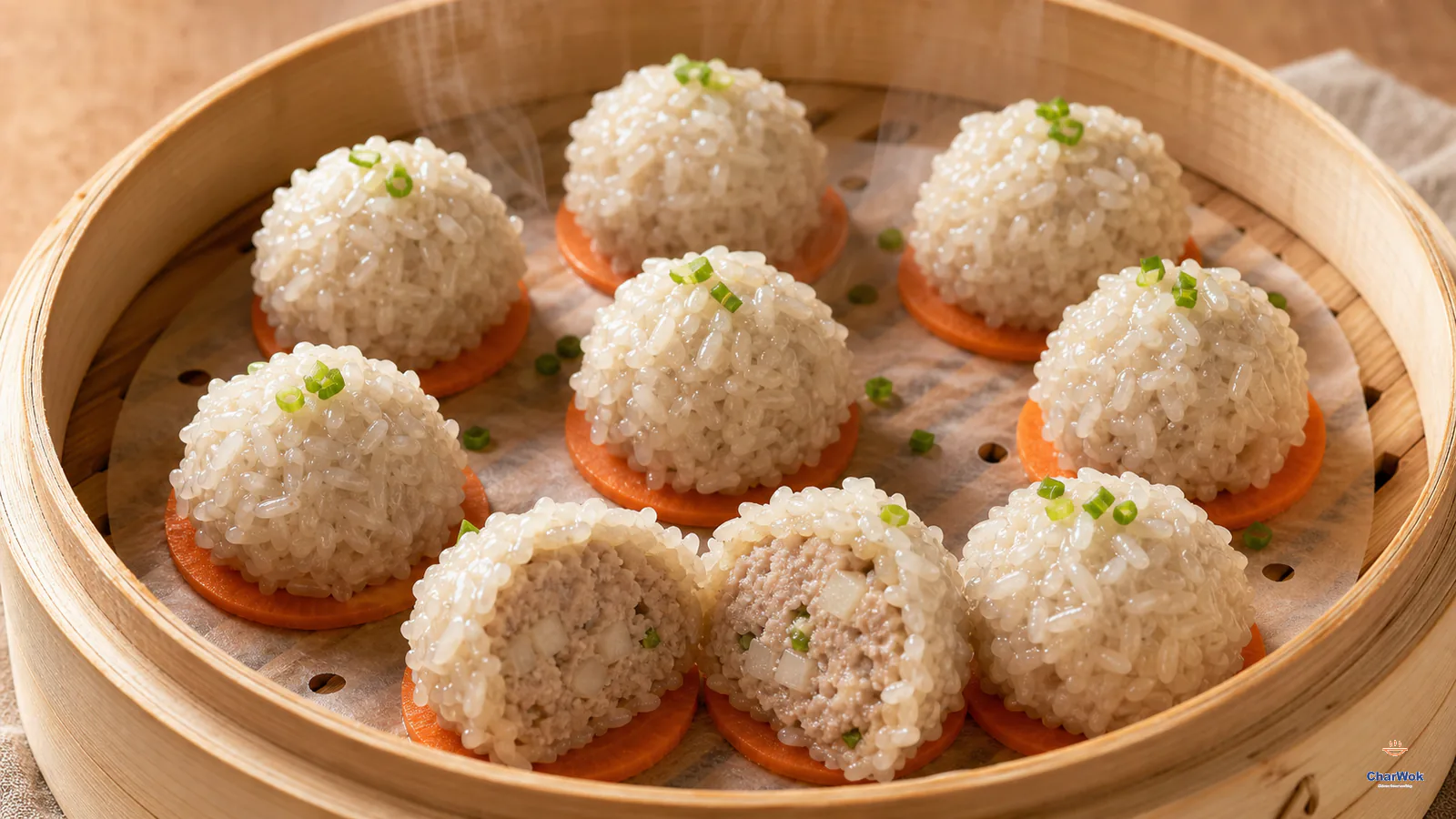
Pearl meatballs (珍珠丸子) are a steamed dish from the Hubei region of central China, part of a broader love the area has for steamed food. The idea is simple in the mouth and fussy in the making: a seasoned pork ball is cloaked in glutinous rice, and the steam does two things at once. It cooks the meat gently, so it stays juicy, and it gelatinizes the starch on the surface of the grains so they swell, turn translucent, and cling together in a soft, slightly chewy shell. Cut one open and you see the layers: a glossy translucent outer coat, then the seasoned meat, then, if you were generous with the water chestnuts, little white flecks of crunch.
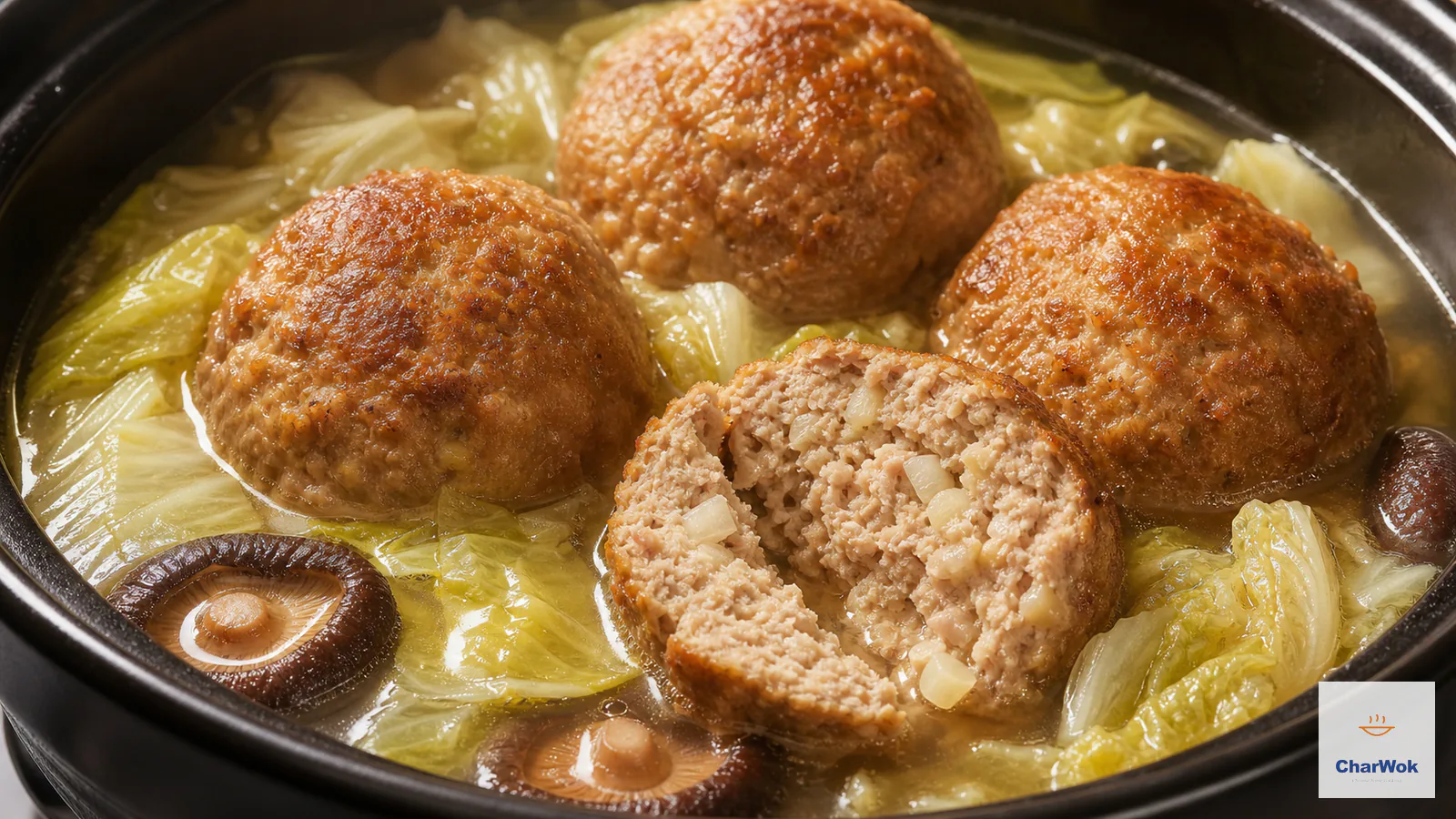
The "pearl" name comes from that translucent coating catching the light. It is a festive dish, the kind that shows up on a Chinese New Year table or at a family banquet precisely because it looks more expensive than it is. If you are building a holiday spread, it sits comfortably next to other steamed showpieces like steamed ribs with black beans or a centerpiece of Lion's Head meatballs. Pearl meatballs are the quieter cousin, the one that disappears first anyway.
The two ingredients that decide everything
Before the method, two ingredients deserve their own conversation, because they are where this dish lives or dies: the glutinous rice and the pork.
Use glutinous rice, also called sweet rice or sticky rice. This is not the same as jasmine or short-grain sushi rice, and no amount of extra soaking will turn regular rice into sticky rice. Glutinous rice is almost entirely amylopectin starch, which is why it gets that characteristic cling when it gelatinizes. A common confusion: the word "glutinous" refers to the stickiness, not to gluten. Glutinous rice contains no gluten at all. Long-grain and short-grain glutinous rice both work; short-grain gives a rounder, plumper pearl. You will find it in any Asian grocery and many standard supermarkets now.
For the pork, use ground pork that is not too lean. A ratio around 80/20 to 85/15 meat to fat is what you want. Extra-lean pork makes a dry, tight meatball no matter how carefully you steam it. If your market only sells very lean ground pork, ask the butcher for a small piece of fatty pork belly and grind it in, or substitute a spoonful of the rendered fat from making char siu. The fat is not optional flavor here; it is structural. It is what carries the seasoning through the meat and what keeps the ball juicy inside its rice coat through 15 minutes of steam.
Glutinous rice is the same grain behind a whole family of sticky, festive dishes worth knowing: the savory zongzi leaf-wrapped dumplings, the sweet banquet closer Eight Treasure Rice, and everyday stir-fried sticky rice. Once you buy a bag for pearl meatballs, you have opened the door to all of them.
Ingredients
12 ingredients for pearl meatballs
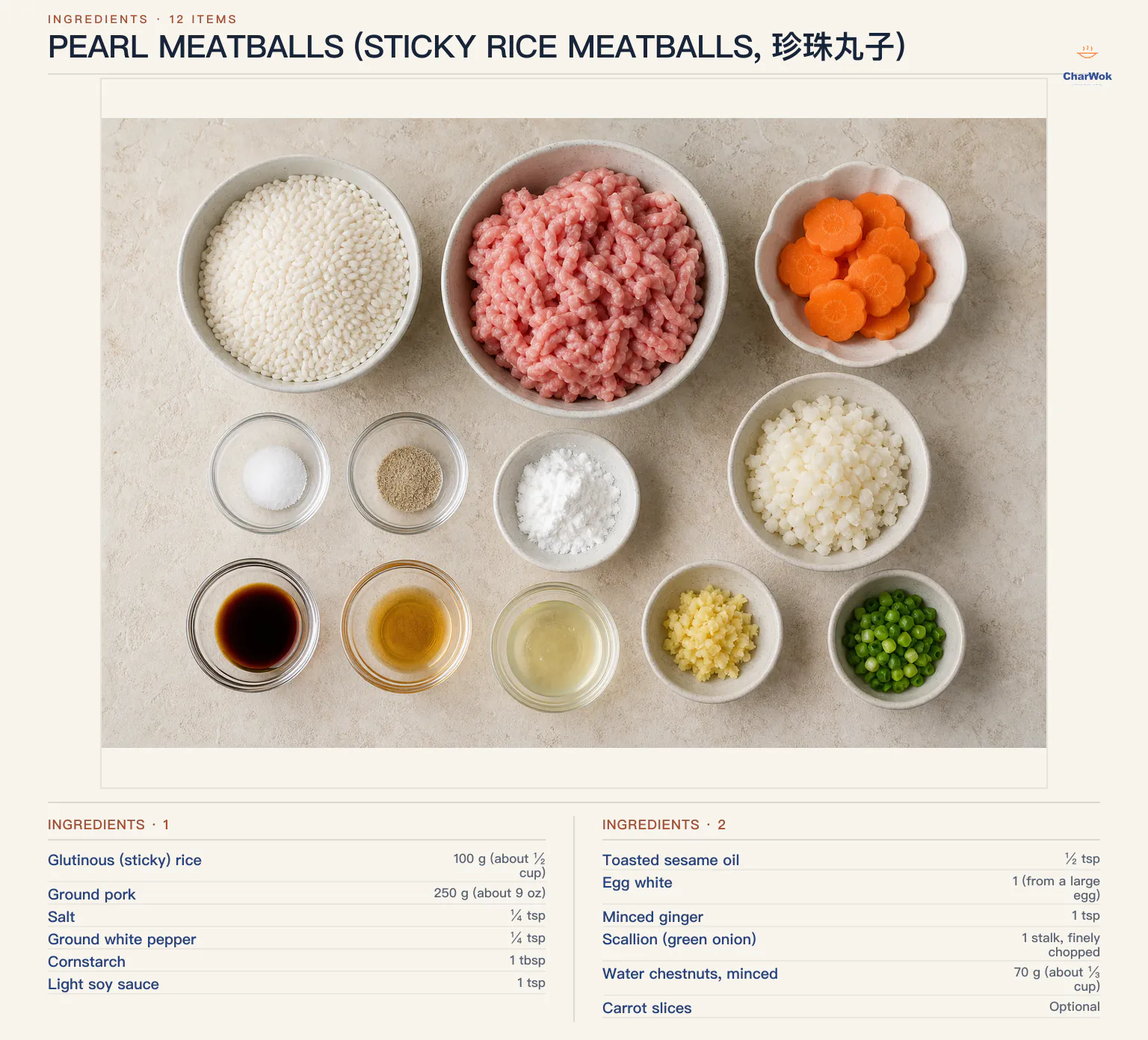
Makes about 15 meatballs, enough for 2 as a main or 4 as part of a larger meal. The quantity of rice looks small next to the meat, and that is correct: it is a coating, not a filling.
| Ingredient | Amount | Notes / substitute |
|---|---|---|
| Glutinous (sticky) rice | 100 g (about ½ cup) | Sweet rice. Do not swap for jasmine or sushi rice. Short-grain preferred for plumper grains. |
| Ground pork | 250 g (about 9 oz) | 80/20 to 85/15. Ground chicken thigh works; breast will be dry. |
| Salt | ¼ tsp | Kosher or fine sea salt. |
| Ground white pepper | ¼ tsp | Substitute ⅛ tsp five spice powder or ⅛ tsp ground Sichuan pepper for a different aromatic. |
| Cornstarch | 1 tbsp | Tapioca, potato, or sweet potato starch all work equally well. |
| Light soy sauce | 1 tsp | Use tamari or gluten-free soy sauce to make the dish gluten-free. |
| Toasted sesame oil | ½ tsp | A little goes far; do not increase or it dominates. |
| Egg white | 1 (from a large egg) | Helps bind and keeps the texture tender. Skip the yolk. |
| Minced ginger | 1 tsp | Fresh, peeled, minced fine. Grating works too. |
| Scallion (green onion) | 1 stalk, finely chopped | Reserve a pinch of green for garnish. |
| Water chestnuts, minced | 70 g (about ⅓ cup) | Canned is fine. Substitute bamboo shoot, lotus root, or celery for crunch. |
| Carrot slices | Optional | Used as a base so the meatballs do not stick to the plate. |
Method, step by step
Read through before you start. The longest part is the rice soak, which is entirely hands-off, so plan it first and let it run while you do everything else.
- Soak the rice 4 to 6 hours, or overnight. Put the glutinous rice in a bowl, cover it with at least 5 cm (2 inches) of cold water, and leave it. Why this matters: the grains need to be fully hydrated all the way to the core before they go in the steamer. Steam alone cannot penetrate a dry grain in 15 minutes, which is exactly how you end up with chalky centers. The test is feel, not time. Pinch a grain between your fingernails; if it splits cleanly with no opaque, hard center, it is ready. Two hours is the absolute minimum and often not enough; I soak overnight by default now.
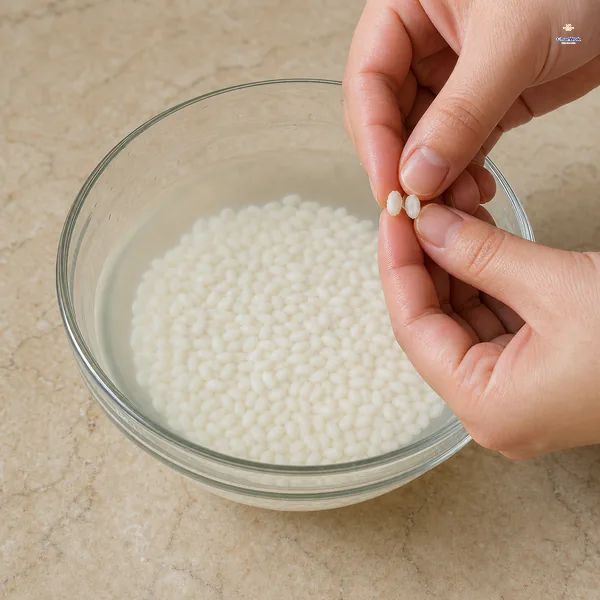
Cover the glutinous rice with at least 5 centimetres of cold water and soak for 4 to 6 hours or overnight; a ready grain splits cleanly with no hard opaque core.
- Mix the filling, then stir it aggressively in one direction. Combine the pork, salt, white pepper, cornstarch, soy sauce, sesame oil, egg white, ginger, and most of the scallion (save a pinch of green for garnish) in a bowl. Now the part people skip: stir with chopsticks or a spatula, always in the same direction, for 2 to 3 minutes, until the mixture turns visibly sticky and pulls in strings when you lift the spoon. This is the same one-direction stirring that builds the texture of a great dumpling filling or pork and cabbage dumpling. Mechanically, you are drawing out the salt-soluble myosin protein from the meat, which forms a sticky network that traps water and fat. Skip it and your meatball will be crumbly and loose; overdo it to the point of paste and it goes bouncy. Stop when it looks stringy and slightly lighter in color.
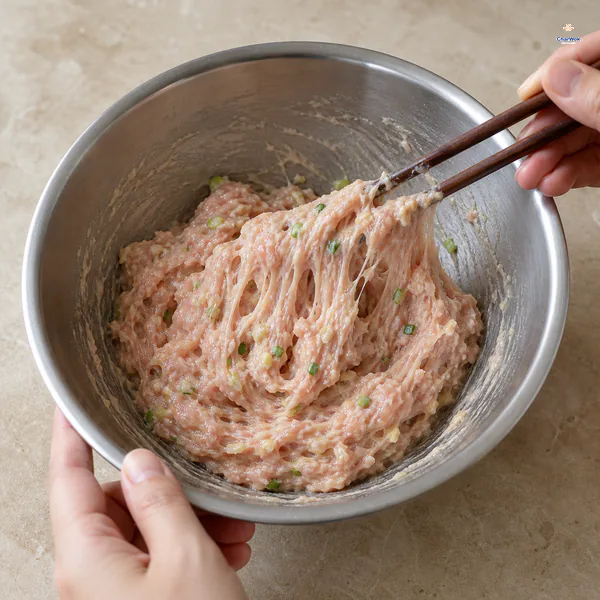
Combine the pork with every seasoning, the egg white, ginger and most of the scallion, then stir firmly in one direction for 2 to 3 minutes until sticky, stringy and slightly lighter.
- Fold in the water chestnuts last. Add the minced water chestnuts and stir just until distributed. Folding them in at the end preserves their crunch; if you mash them in during the aggressive stirring, you lose the textural contrast that is half the point of the dish. Cover and rest the filling in the fridge for 15 to 30 minutes if you have time. Cold filling is firmer and easier to roll.
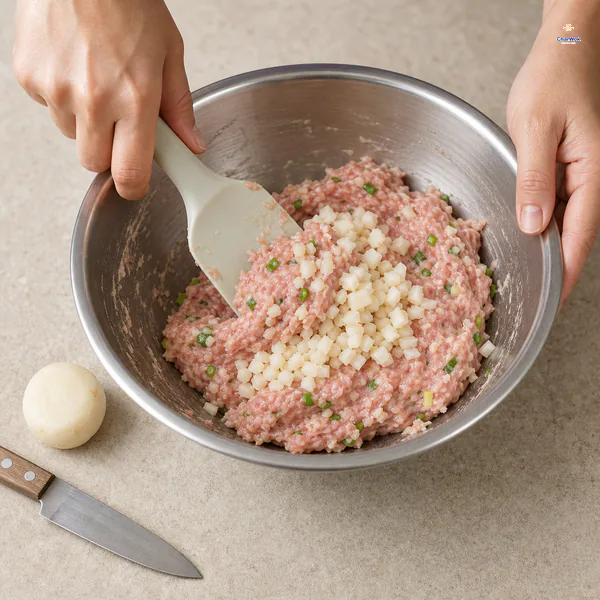
Fold the finely minced water chestnut through the sticky filling only until evenly distributed so the pieces keep their crunch; chill for 15 to 30 minutes if time allows.
- Drain the rice and spread it on a plate. Drain the soaked rice well in a sieve, then spread it in a single layer on a wide plate or in a shallow dish. A single layer matters because the meatball needs to pick up rice on contact, not dig through a pile, which crushes the grains unevenly.
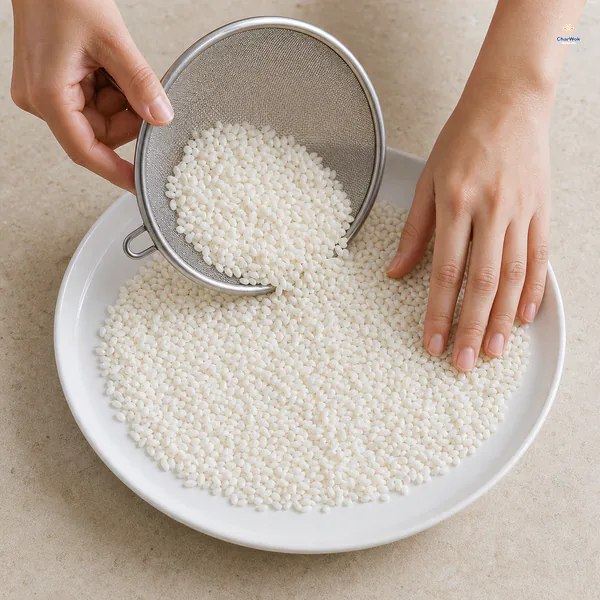
Drain the soaked rice thoroughly, then spread it in one thin even layer on a wide plate so each meatball can pick up grains without crushing through a deep pile.
- Shape the meatballs. Scoop a generous tablespoon of filling. Roll it lightly between damp palms into a ball about 4 cm (1½ inches) across. Damp hands stop the meat sticking to you and give a smoother surface for the rice to cling to. Aim for consistent size so they finish steaming at the same time.
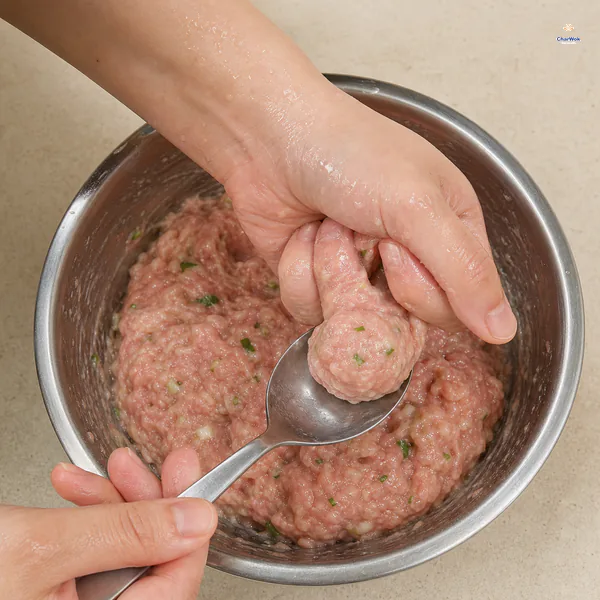
With damp hands, shape generous tablespoons of chilled filling into even balls about 4 centimetres across so every one finishes steaming at the same time.
- Coat each ball in rice. Drop a meatball onto the rice and roll it gently with your palm or lift the plate and tilt it in a circle. Press very lightly so the grains embed without mashing. You want even coverage with the meat barely visible underneath. Set the coated ball on your steaming plate and repeat, leaving a small gap between each one. They will expand as the rice swells, and crowding makes them fuse.
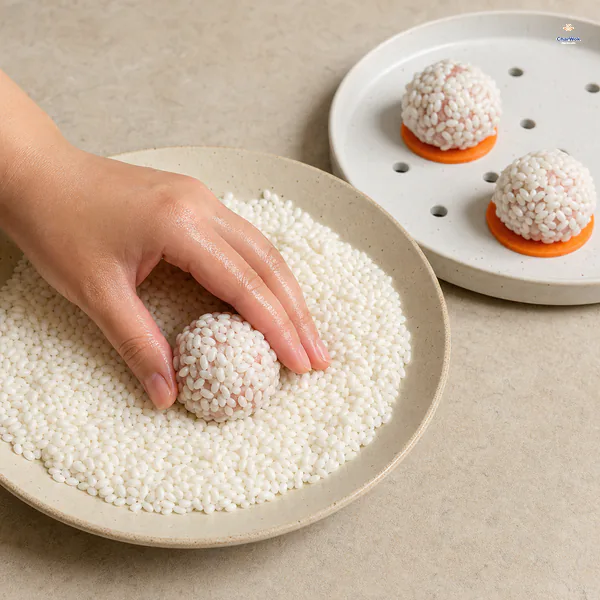
Roll and press each ball very lightly in the drained rice until the meat is barely visible, then set it on a carrot slice with a finger-width gap from its neighbours.
- Steam over fully boiling water for 15 minutes. Get the water to a rolling boil before the plate goes in. Use a steamer rack holding a flat plate, or a bamboo steamer. If using a plate, lay carrot slices underneath the meatballs to stop sticking, or brush the plate with a thin film of oil. Cover and steam 15 minutes for 4 cm balls; add 2 to 3 minutes if yours are larger. The steam has to be vigorous and consistent the whole time, because steady heat is what gelatinizes the starch evenly. Do not lift the lid to check.
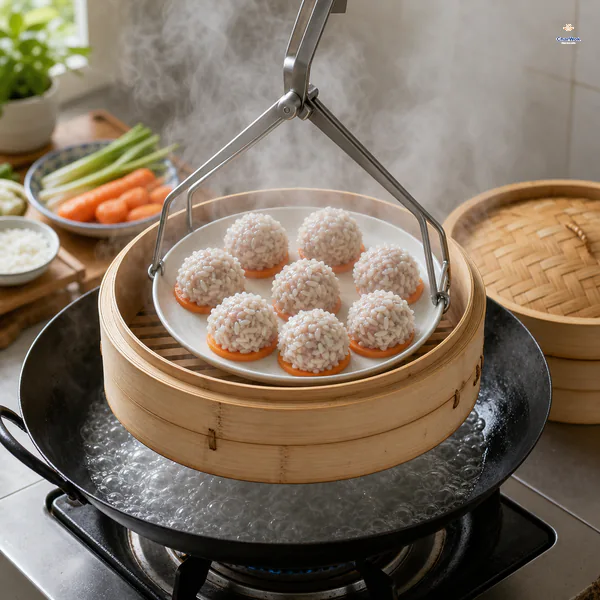
Bring the water to a full rolling boil first, safely lower in the spaced meatballs, cover and keep the steam vigorous for 15 minutes without lifting the lid.
- Serve immediately, garnished with the reserved scallion green. The texture is best the moment they come out of the steamer. The rice is at its glossiest and the meat is at its juiciest.
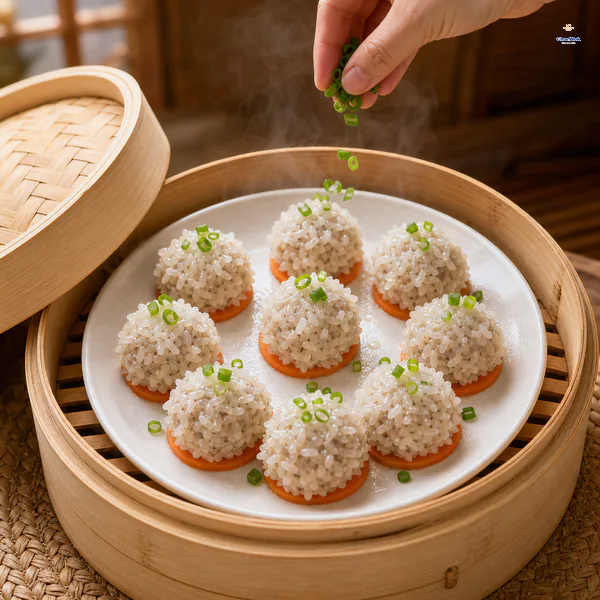
When the rice is plump and translucent, scatter over the reserved scallion and serve immediately while the coating is glossy and the pork is at its juiciest.
When things go wrong
Most pearl meatball failures fall into four buckets. Here is how to read and fix each one.
The rice is chalky or has a hard white core. This is almost always under-soaking, not under-steaming. Next time, soak at least 4 hours, or overnight. If you are stuck with rice that did not soak long enough, you can extend the steam to 20 to 22 minutes, but the texture will never be as clean as properly soaked rice. A secondary cause is steam that was not at a full boil the whole time, so check that your water level did not run low.
The meat is dense and rubbery. You overworked it. The one-direction stirring has a stop point: the moment the mixture turns sticky and stringy. Past that, you keep tightening the protein network until the meatball bounces. There is no rescue for an overworked batch; just stir less next time. The opposite failure, crumbly loose meat, means you stopped too early or skipped the egg white and cornstarch binder.
The rice tears off when you lift the meatballs. The plate was not greased or lined. The gelatinized rice is sticky by design, and it sticks to ceramic just as happily as it sticks to itself. Use carrot slices, napa cabbage leaves, or a light oil brush. Let the meatballs cool on the plate for 2 to 3 minutes before moving them; the rice sets up slightly as it cools and releases more cleanly.
The meatballs flatten or fuse together. You crowded the plate. They need a finger-width of space because the rice swells outward as it cooks. Cook in two batches rather than packing the plate.
Variations and a few good pairings
The basic formula is sturdy enough to take changes. A few that I cook regularly:
- Shrimp and pork. Replace a third of the pork with finely chopped raw shrimp. It lightens the meatball and adds sweetness. This is the same logic behind shrimp and pork shumai, where the two proteins play off each other.
- Five-spice or Sichuan-pepper aromatic. Swap the white pepper for ⅛ tsp of five spice powder for a warmer, sweaters-weather version, or ⅛ tsp ground Sichuan pepper for a faint tingling note. Reduce the amount; these are louder than white pepper.
- Mushroom and water chestnut. Add 30 g of finely minced rehydrated dried shiitake alongside the water chestnut. It deepens the umami without changing the structure.
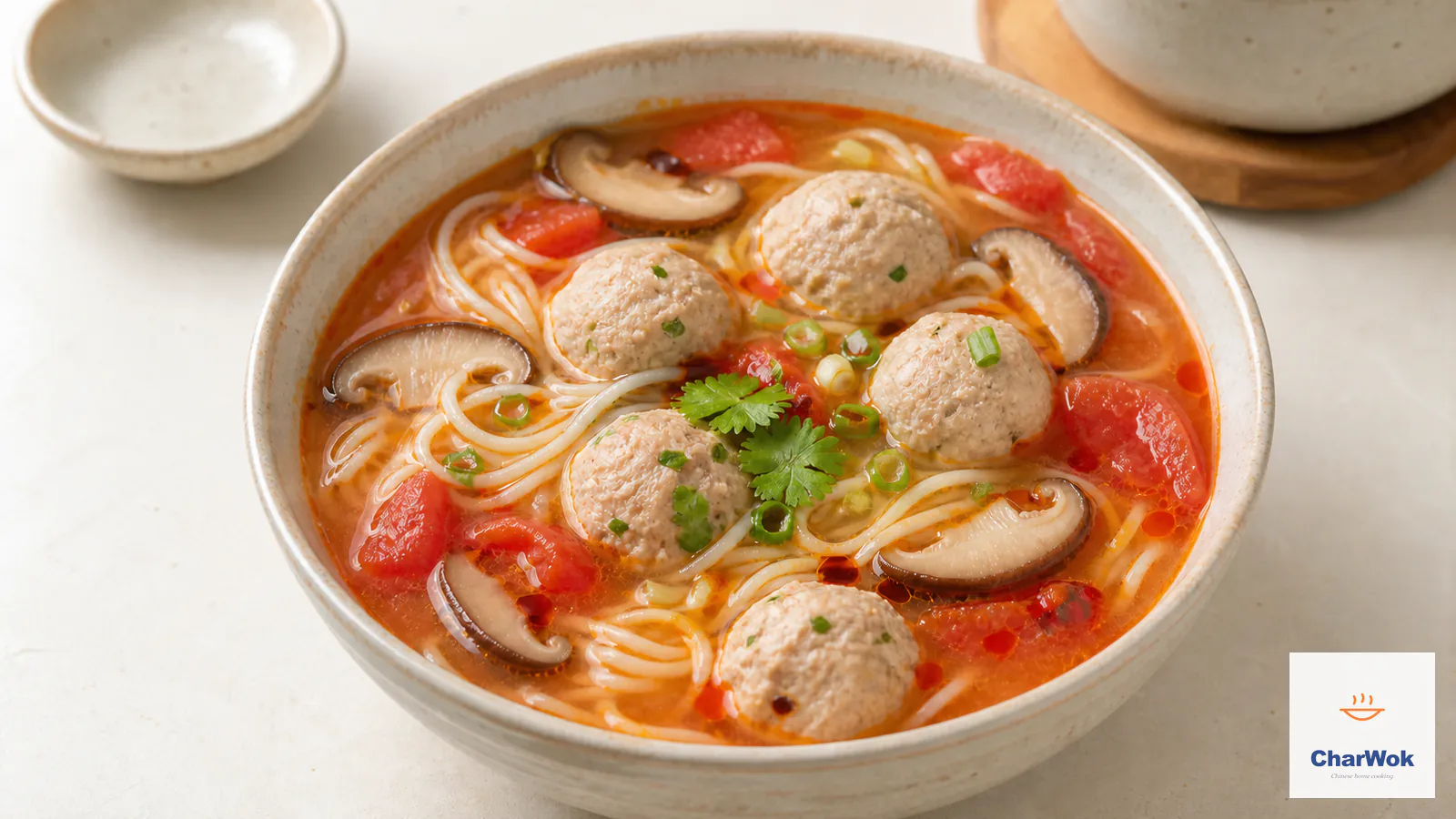
For a complete meal, pearl meatballs want bright and acidic things around them, because the rice coating is soft and rich. A plate of garlicky cucumber salad cuts through the starch cleanly. A bowl of tomato egg drop soup adds acidity and liquid. And because the meatballs are already part rice, you can skip a separate starch entirely, or serve a small bowl of plain steamed jasmine rice for the people who want one. If you would rather fold the leftovers into the next day, the meatballs reheat beautifully on top of a pork fried rice or a plate of soy sauce fried rice.
Storing and reheating
Cooked pearl meatballs keep in the fridge, covered, for up to 3 days. The rice firms up as it chills, which is normal starch retrogradation, not a flaw. To reheat, steam them for 5 to 6 minutes until the rice is translucent again. A microwave works in a pinch but tends to toughen the meat and dry the rice edge; if you must, cover them loosely and use medium power.
You can also freeze them raw or cooked. To freeze raw, coat them in rice, then arrange on a tray lined with parchment and freeze solid before transferring to a bag. Steam from frozen, adding about 5 extra minutes. Cooked leftovers freeze for up to a month and reheat straight from frozen in the steamer. I will admit the raw-frozen texture is marginally less tender than fresh, so if you are cooking for guests, make them same-day.
A note on the steaming setup
You do not need a bamboo steamer. A metal steamer rack in a wide pot with a lid, or even a heatproof plate set on a small overturned bowl inside a deep pan, works fine. The two non-negotiables are a tight-fitting lid, so the steam stays in, and enough water that it does not boil dry over 15 minutes. Check the water level before you start; about 5 cm (2 inches) in the pot is usually right. Steaming is also the technique behind steamed dumplings and steamed cabbage rolls, so the same setup will get a lot of use.
Common questions
A few things readers ask over and over, answered short.
Can I use regular rice instead of glutinous rice? No. Regular jasmine or short-grain sushi rice will not cling the same way and will not turn translucent. The sticky coating is the dish. Glutinous rice is sold as sweet rice or sticky rice and is cheap; it is worth the trip.
Is the long soak really necessary, or is two hours enough? Two hours is the published minimum and often leaves a hard center. Four to six hours is safer, and overnight is ideal. The grain should split cleanly under your fingernail with no opaque dot inside.
Can I bake or air-fry these instead of steaming? Not really. Dry heat will not gelatinize the rice coating; you will get hard, raw-tasting grains on a dried-out meatball. Steaming is the whole method. If you want a crisp finish, pan-fry already-steamed meatballs briefly in a little oil, but treat that as an add-on, not a replacement.
Why stir in only one direction? It lines up the sticky myosin protein from the meat into a consistent network that traps water and fat. Random stirring still develops the protein but in a tangled, weaker way, so the meatball is softer and more prone to falling apart. One direction gives a juicy, sliceable bite.
Can I make the filling ahead? Yes. Mix and shape it up to a day in advance and keep it covered in the fridge. Coat in rice and steam just before serving. Cold filling is actually easier to roll.
That is the whole dish. Get the rice soak right, build the filling with the one-direction stir, and steam over full heat. The rest is garnish. Once it clicks, pearl meatballs become one of those dishes you make for a crowd without thinking twice, because the work-to-impression ratio is hard to beat.