A bamboo steamer is the quiet workhorse of a Chinese home kitchen, and most people who own one use it wrong for years before they notice. The basket looks simple enough that it does not seem to deserve much thought. Then your bao buns come out soggy on the bottom, your dumplings stick and tear, and you blame the dough. Nine times out of ten the dough was fine. The steam was.
Steam is the whole point of this tool, so it helps to know what it actually does. Steam carries a large amount of latent heat, and when it hits cooler food it condenses, dumping that heat into the surface all at once. That condensation is why a steamer cooks gently but quickly, and it is also why the wrong setup leaves a puddle on your food. A bamboo basket manages this better than metal because the wood absorbs some moisture instead of letting it rain straight back down. Cantonese dim sum kitchens figured this out a long time ago, which is why nearly everything in those bamboo baskets comes out glossy instead of wet.
One basket, one wok, one inch of water. Buy a 10-inch bamboo steamer, rest it on the rim of a wok with the water never touching the bamboo, line it before any food goes in, and drop the heat to medium the moment steam shows at the lid. That single dial-down is the step most home cooks skip.
What a bamboo steamer actually is
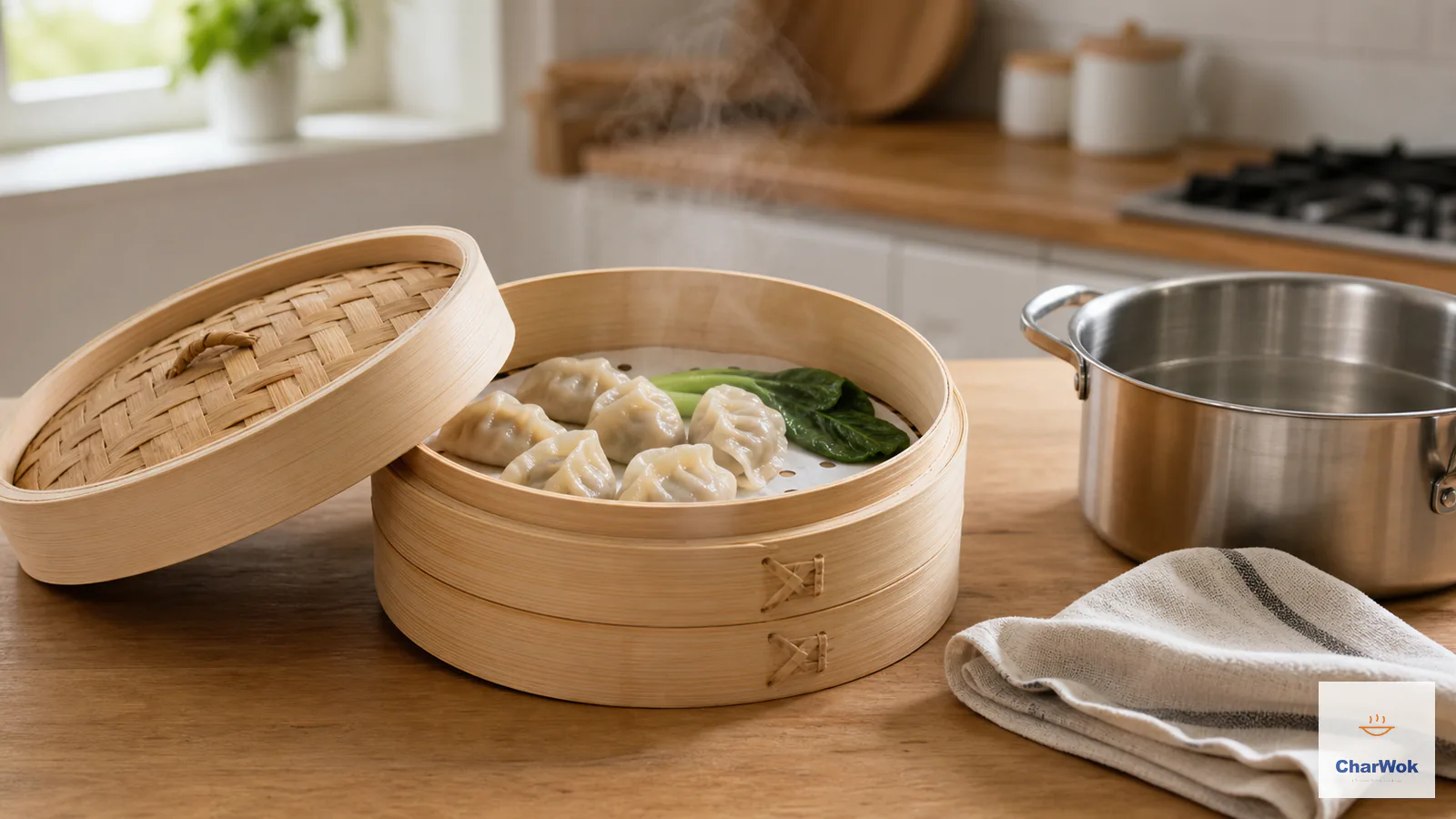
A complete home bamboo-steamer setup at a glance
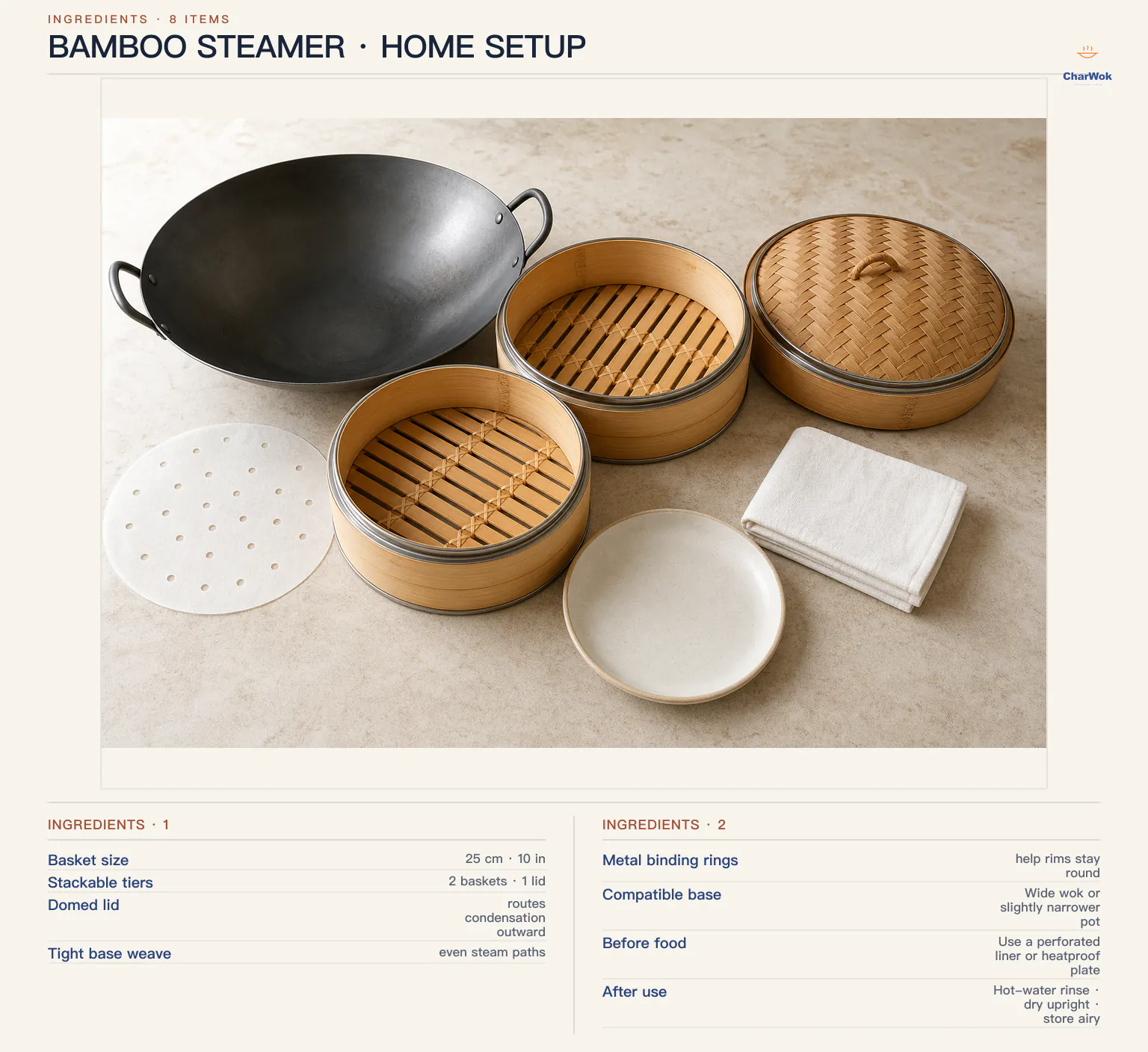
Picture a shallow round tray of woven bamboo capped by a tall domed lid, and that is the whole tool. Steam rises through the slatted floor, and the curved lid earns its keep: moisture that condenses on it runs down the slope to the outer wall instead of dropping straight onto the food below. A flat lid behaves like a dripping ceiling. The dome routes that water away from your dinner.
Bamboo itself matters for two reasons. It breathes, so a small amount of steam escapes rather than pooling, which keeps doughy foods like bao buns and mantou from going clammy. And it is a poor conductor compared with stainless steel, so the basket wall stays cooler than a metal one and sheds less aggressive condensation. Metal stacking steamers work, but for any yeasted or dough-based item bamboo still gives a better surface. I have done the side-by-side. The bamboo bun is drier on the bottom, every time.
Choosing one you will not regret
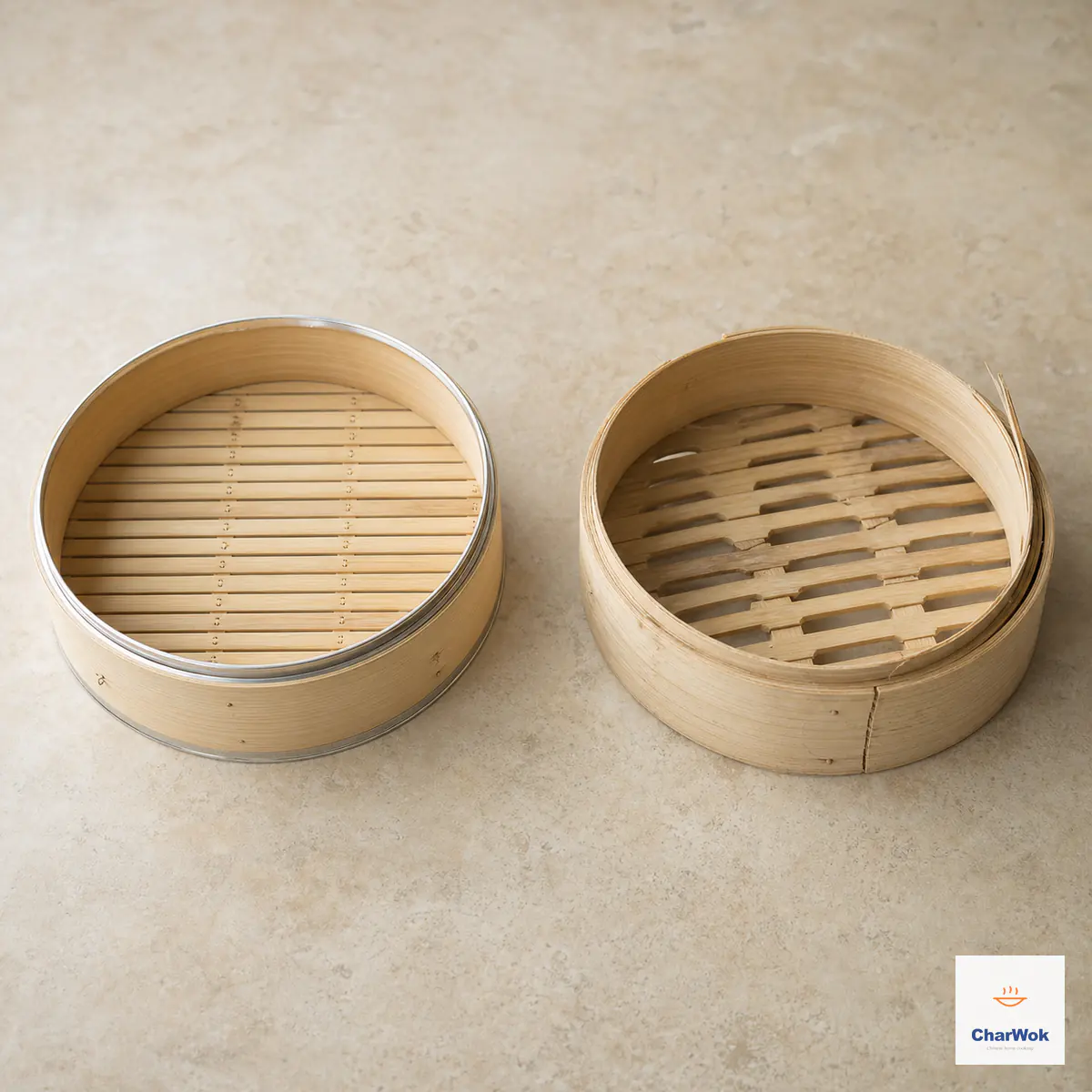
Choose a basket that stays round, has a tight even base weave and smooth edges, and shows no loose gaps, cracks, or splinters.
If you cook for one to four people, get a 10-inch (25 cm) basket. Eight-inch is fine for a solo cook, but it is small enough that a standard dinner plate will not sit flat inside, and you end up steaming in two batches. Larger than 12 inches and you start hunting for a pot wide enough to hold it. The 10-inch hits the sweet spot: it fits a 9-inch plate, stacks neatly, and stores on top of the fridge.
When you are shopping, run your hand over the base weave first. You want it close and uniform, because a loose, gappy weave sends steam up in uneven columns and one side of the basket ends up hotter than the other. Feel the rim for rough spots and splinters, since those will snag a parchment liner and shed fibers into the food. And the baskets that survive are the ones clamped with thin metal rings at the top and bottom edges: unbound bamboo cups its rims and begins splitting after a season or two of steam, and those rings are what keep it round.
The setup: basket, water, heat
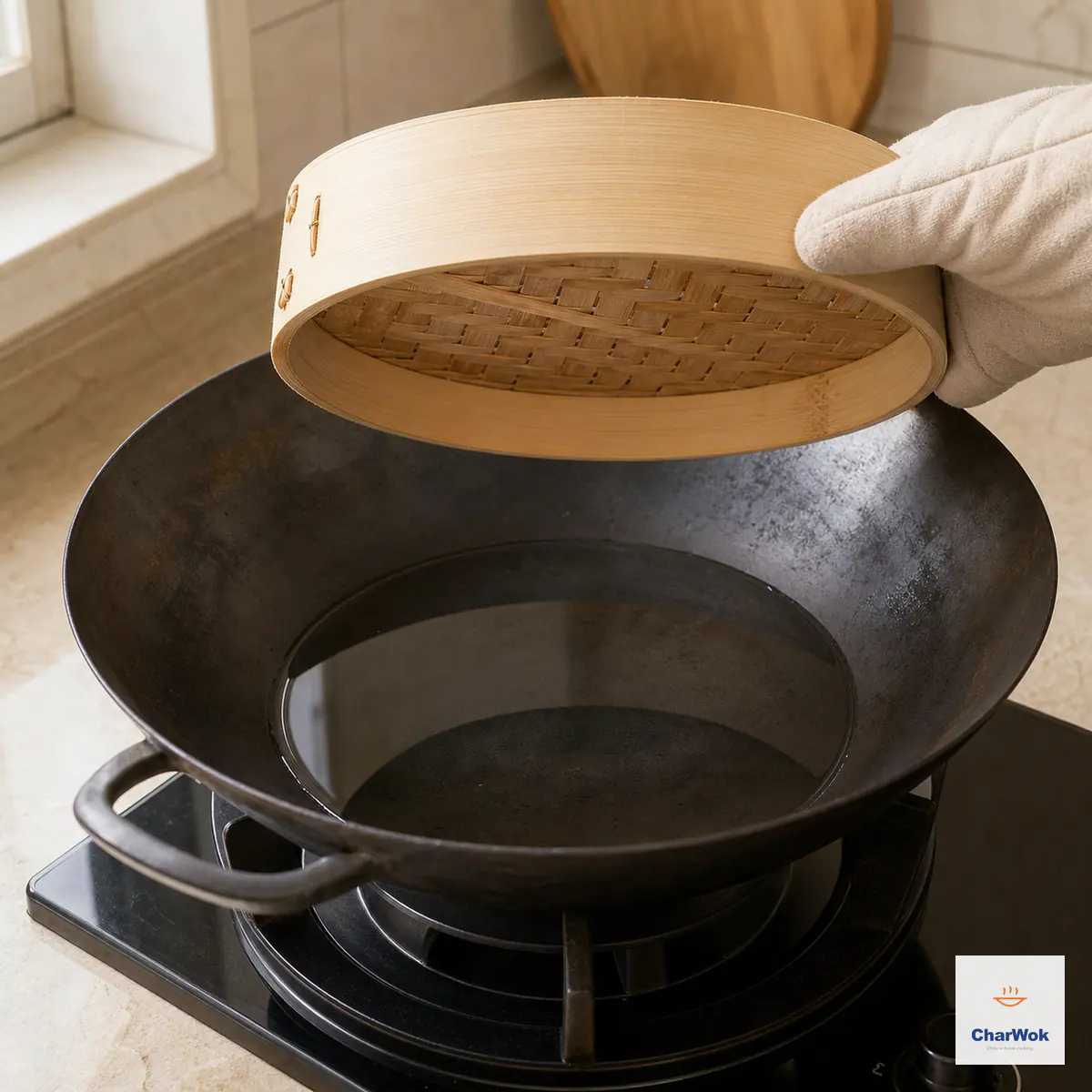
Keep enough water in the wok to make steady steam, but leave the basket base above the water so the bamboo never boils or soaks.
Use a wok or a wide, straight-sided pot. The basket should rest on the sloped wall of the wok or sit on the rim of a pot that is slightly narrower than the basket. In every case the bottom of the bamboo must clear the water. Pour in about 2.5 cm (1 inch) of water, enough to generate steady steam for 15 to 20 minutes without boiling dry. The bamboo itself should stay mostly dry. Some cooks plop the basket straight into the water, and yes, it will cook the food, but the bamboo soaks, swells, and rots faster, and you risk sloshing dirty water into a clean dumpling. Do not do it.
Two ways to start, and the choice is not arbitrary. A cold start, where food goes in with cold water and heats gradually, suits anything that needs a slow rise: steamed bao buns straight from the fridge, dense doughs, frozen items, anything prone to collapsing if shocked. A boiling start, where you wait for a rolling boil before the basket goes on, suits quick, delicate things like whole steamed fish, silky steamed eggs, and shrimp, where you want fast, even heat and a clock you can trust. When a recipe tells you which to use, it is telling you for a reason.
Liners: the thing that decides whether dinner sticks
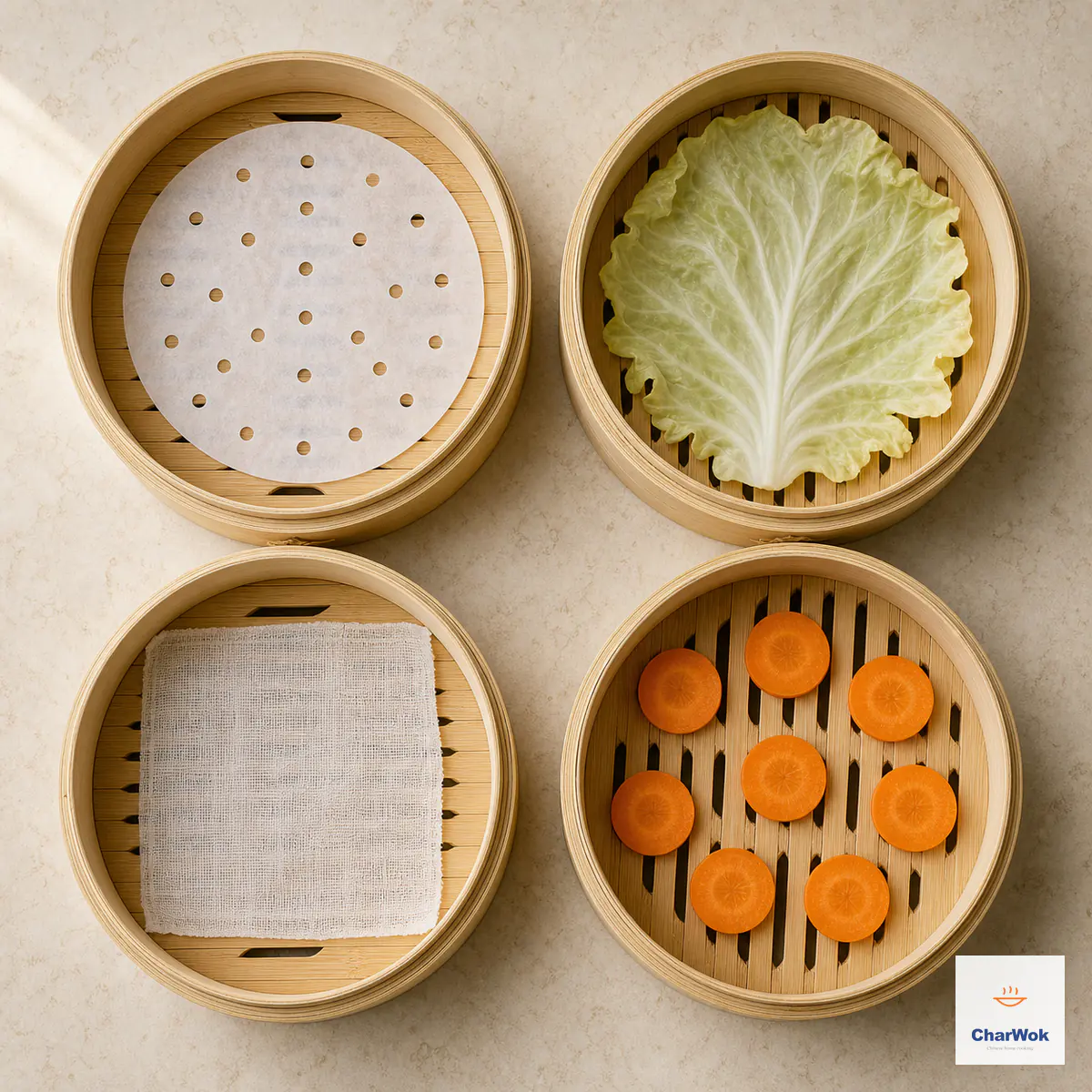
Perforated paper, leafy vegetables, damp cloth, or spaced vegetable slices prevent sticking while leaving open paths for steam.
Food should almost never sit directly on raw bamboo. The exception is marinated proteins in their own heatproof dish, like steamed ribs with black beans or steamed chicken with shiitake, where a plate catches the sauce and the steam comes around the sides. For everything else, line the basket.
- Parchment with holes punched through. Cut a round of parchment to the basket diameter and poke holes every couple of centimeters with a chopstick or skewer. The holes are the point: solid parchment dams up steam and you get a puddle. This is my default for steamed dumplings and baozi.
- Cabbage, lotus, or banana leaves. Traditional and free if you are already cooking with them. A cabbage leaf lays flat, breathes enough to keep the bottom dry, and you eat it. Lotus leaves add fragrance for savory buns and sticky rice.
- Carrot or daikon slices. The dim-sum trick for har gow and shumai. Each dumpling sits on its own round of carrot, which lifts it off the bamboo and looks clean on the plate.
- Cheesecloth. Good for steaming loose items like enoki mushrooms or grains that would fall through the weave.
- Silicone mesh liners. Reusable, dishwasher-safe, fine for everyday. They trap a touch more moisture than parchment, so I still prefer paper for breads.
The steaming method, step by step
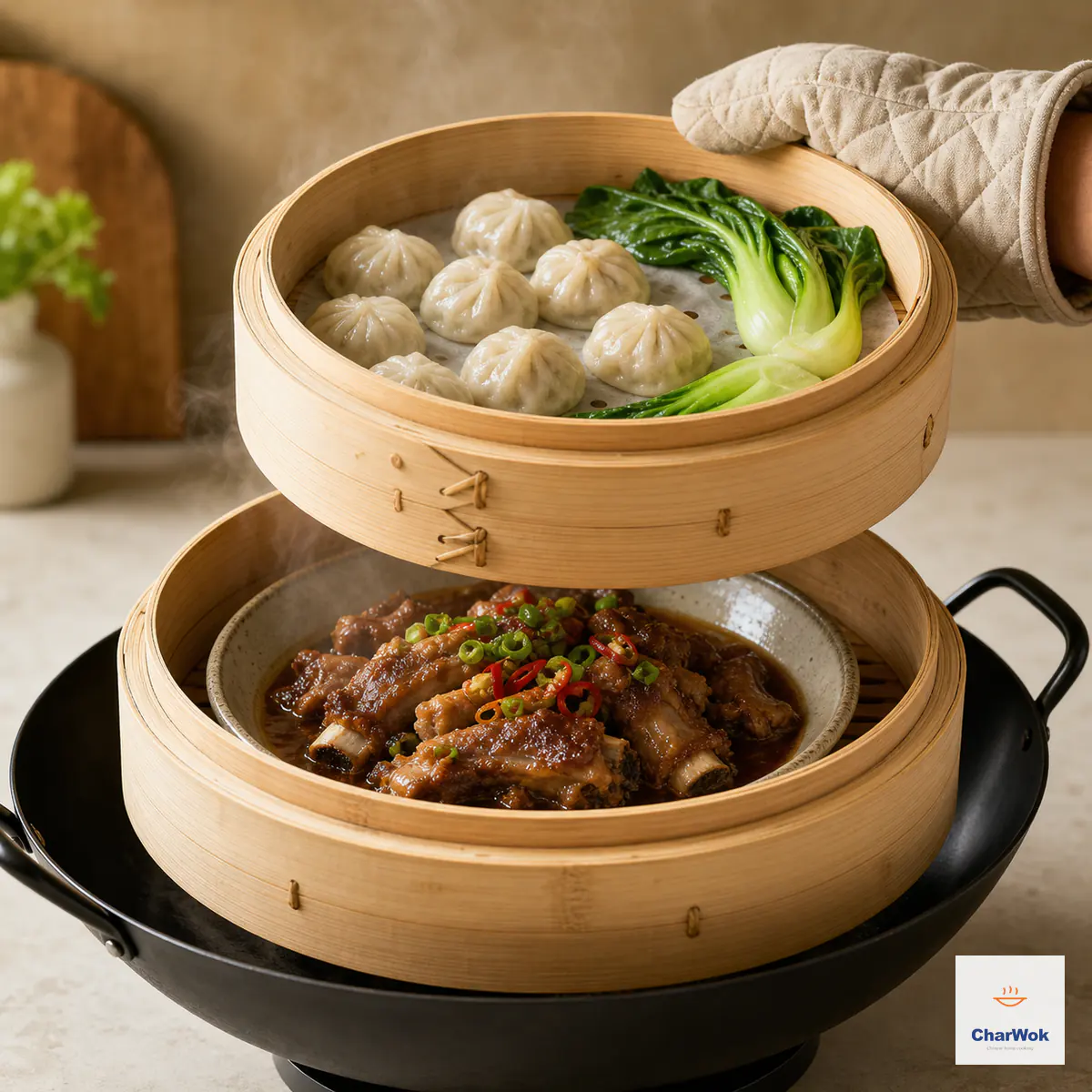
Put slower, heavier dishes such as ribs in the lower tier and quicker foods such as dumplings or greens above, then remove finished tiers as needed.
- Set up the water level first. Put the empty basket on the wok, add water until it sits about 2 cm (a thumb's width) below the bamboo, then lift the basket out. Now you know the level is right before any food is at risk.
- Choose cold start or boiling start based on the food, as above. For doughs from cold proofing, start cold. For proteins and eggs, bring the water to a full boil first.
- Line the basket with one of the liners above. Leave the outer centimeter of the rim clear so steam can rise around the edge and not just through the center.
- Load with gaps. Dumplings and buns expand as they cook. Leave at least 2 cm between them or they fuse into one shapeless mass. I have a photo of this from my second-ever batch of char siu bao and it is not pretty.
- Cover and watch for steam. Put the domed lid on. The moment you see steam curling from the lid seam, start your timer and turn the heat down to medium. High heat does not cook faster in a sealed steamer; it just wastes water and risks scorching the bamboo where the flame licks up the wok wall.
- Check the water once on long cooks. Anything over 20 minutes, lift the basket with oven mitts and top up with hot water from a kettle. Cold water kills the boil and adds minutes you did not plan for. I keep a clean coin in the bottom of the pot; once the water gets shallow it begins to chatter against the base, a handy cue if you have stepped away.
- Stack smarter if you use two or three baskets. Stacking changes the timing less than people fear, provided every tier holds the same thing. The trick is mixing foods: put the long, slow items, like ribs or chicken pieces, in the lowest basket closest to the heat, and the quick-cooking greens or dumplings up top. Pull the upper tier off the moment it is done and let the lower one carry on.
- Rest a minute before opening. Lift the lid away from you, let the first rush of steam clear, then plate. Buns and dumplings are fragile for the first 30 seconds out of the steam and tear if you move them too soon.
When steaming goes wrong
This is the section I wish someone had handed me with my first basket. Most steaming failures are not recipe failures. They are setup failures.
- Soggy bottoms on buns and dumplings. Cause: too much condensation raining down, usually from a lid that is not domed, a liner with no holes, or a pot that is too tall so steam barely reaches the top basket. Fix: punch more holes in the liner, keep the water level lower, and never stack more baskets than the steam can reach. For a single basket this is rarely a problem.
- Food stuck to the liner. Cause: you moved the food while it was still raw-wet on the bottom, or you skipped the liner entirely. Fix: let doughs rest 30 seconds after the lid comes off before lifting, and always line.
- One side raw, the other overcooked. Cause: uneven steam, from a basket with loose weaving or a burner flame concentrated on one side of the wok. Fix: rotate the basket 180 degrees halfway through, and on a small burner use a diffuser.
- Burnt bamboo smell and a scorched ring on the basket. Cause: the flame licked above the water line on the wok wall. Fix: lower the heat. Steaming needs a gentle boil, not a roar.
- Steamed eggs full of craters. That is not a steamer problem, it is a heat problem: too high, too fast. The fix lives in the egg recipe, but the steamer part is to keep the heat gentle throughout (a steady simmer, never a rolling boil), strain the egg mixture, and leave the lid cracked or loosely covered. A dome lid also helps; the condensation that ruins custards comes off flat lids.
- Dumpling wrappers turning translucent then collapsing. Cause: usually dough that is too thin, over-proofed, or overheated in the steam, so the wrapper softens faster than it sets. It can also happen when the liner has no holes and water pools under the dumplings. Fix: roll the wrappers a touch thicker, do not over-proof, and always use a liner that drains. Follow the recipe's cold or boiling start; both are legitimate for dumplings.
- Fish that is mushy near the belly and tight at the back. Cause: too long, or the fish was too thick for the steam to penetrate evenly. Fix: a 500 g fish needs about 8 minutes from a boiling start; overcooking by two minutes is visible. Shrimp are even less forgiving, pull them the second they curl.
One honest limitation. A bamboo steamer will not give you a crust, a char, or any Maillard browning. If you want the crisp bottom on a dumpling, that is a different tool and a different method, and steaming first then pan-frying is how you get both. For pure steamed texture, though, bamboo is still the best surface I know.
Variations and what to cook first
If you are new to the basket, start with forgiving foods. Enoki mushrooms in a dish with garlic and soy take 5 minutes and are nearly impossible to ruin. Steamed eggplant dressed with chili oil is the dish that convinced me the steamer was worth the cupboard space. From there move to steamed egg custard, then dumplings, then yeasted breads.
You can flavor the steam itself. Add ginger and scallion to the water when steaming fish and the kitchen smells clean rather than fishy. A splash of Shaoxing wine in the water leaves a faint fragrance on breads. A few goji berries or a slice of ginger under a steamed egg turns a breakfast item into something a little more considered. None of this is load-bearing, but it is the kind of detail that separates a steamed dish from a steamed dish worth eating.
Care: the part that decides whether the basket lasts a year or ten
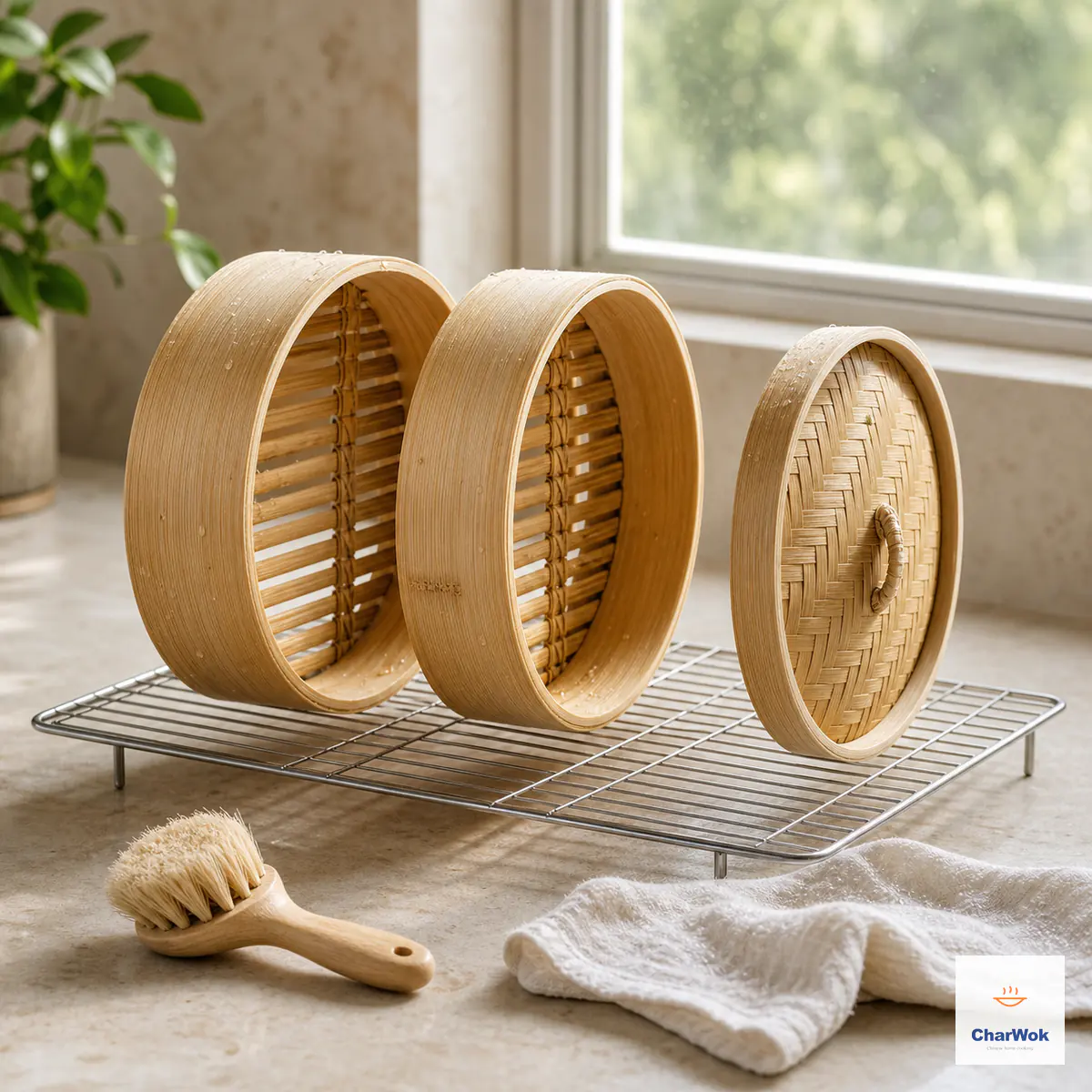
Rinse promptly, brush only where needed, then dry every piece upright with air on both sides before storing it in a ventilated place.
- Season it once, with steam, not oil. A brand-new basket smells like fresh bamboo. Wash it with hot water, then steam it empty for 10 minutes. Do not oil it. Bamboo is not a carbon-steel wok, oil will go rancid in the weave.
- Clean while warm. After cooking, let the basket cool just enough to handle, then scrape off any stuck food with a dull knife or the back of a spoon. Rinse with hot water only. No dish soap; bamboo holds the smell.
- Never soak. A long soak swells the strips and loosens the weaving. If something is truly stuck, lay a wet paper towel on it for five minutes, then scrape.
- Dry it bone-dry before it goes away. Stand the baskets upright in a warm spot with airflow, or pop the empty stack back over warm (not boiling) water for a minute to drive off moisture. Then air-dry another hour.
- Store open to air. Not in a sealed cabinet or a plastic bag. A hook on the wall, the top of the fridge, anywhere with circulation. Dust rinses off. Mold does not.
Spot mold? Take a soft brush and hot water to it, then run the empty basket through a 20-minute steam to knock out the spores. If the growth has burrowed into the weave or the musty smell survives that treatment, retire the basket. They are inexpensive, and mold has no place near food.
What if you do not have one
A metal steamer rack set inside a wok or deep pot does most of the same job for everyday steaming, and it is what I reach for when I am steaming a single plate of food. Electric steamers and multi-cookers on steam mode work for batch cooking. The trade-off is always the same: metal surfaces drip more condensation, so for bao, dumplings, soup dumplings, and anything where a wet bottom ruins the texture, bamboo still wins. If you only steam vegetables and fish, a metal rack is enough. If you steam dough, get the bamboo.
Questions I actually get asked
A quick run through the things people email me about most often.