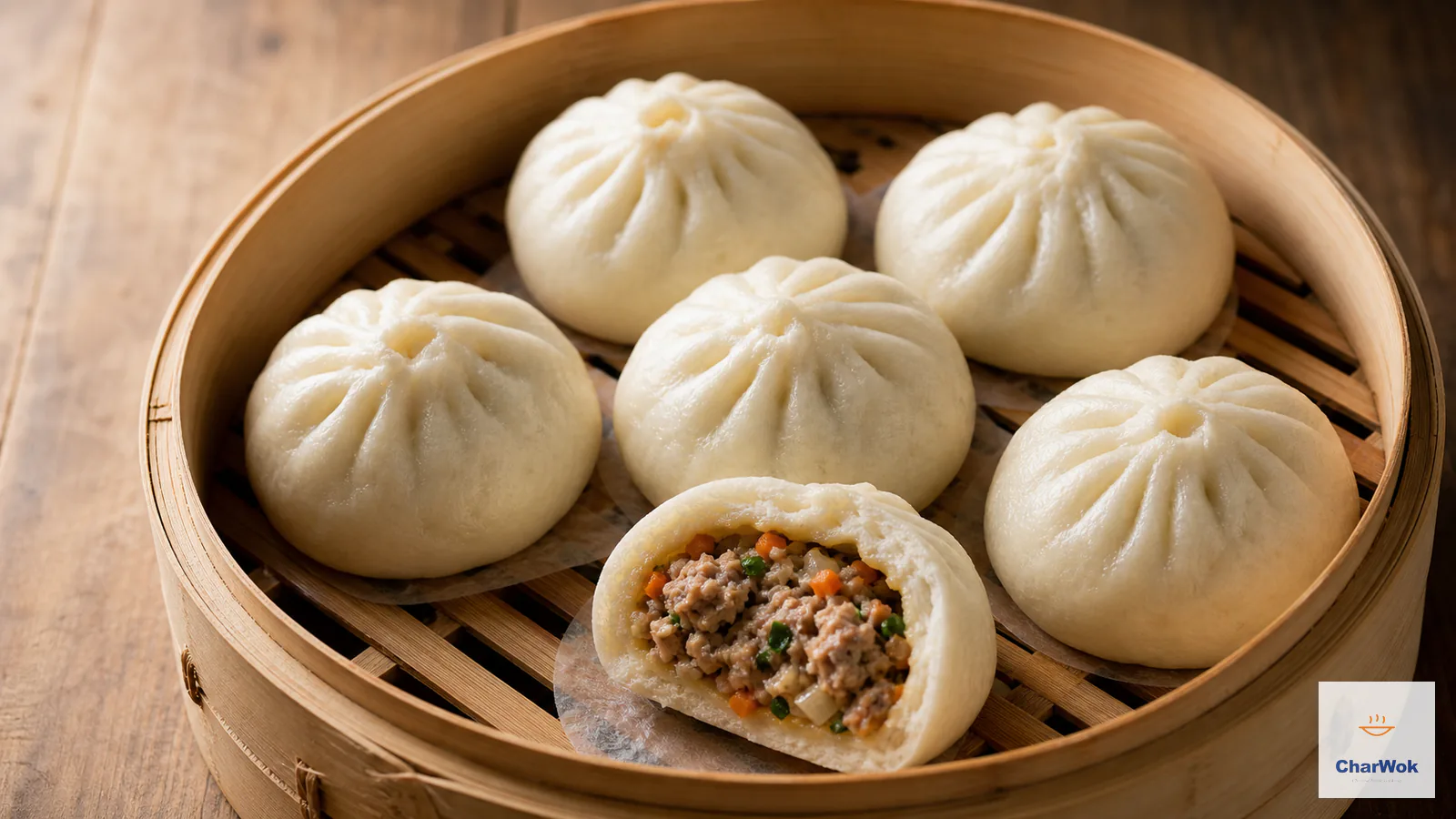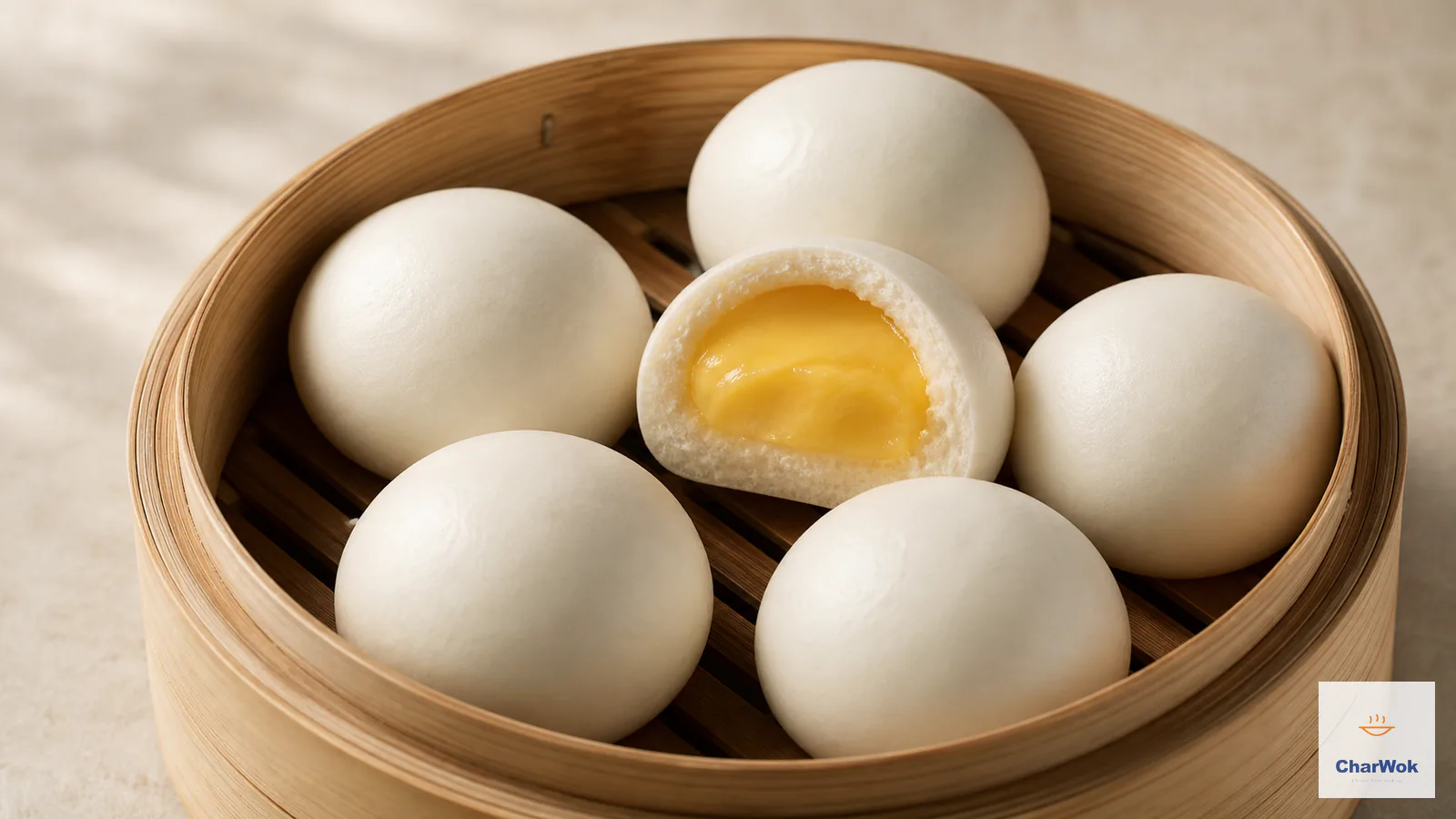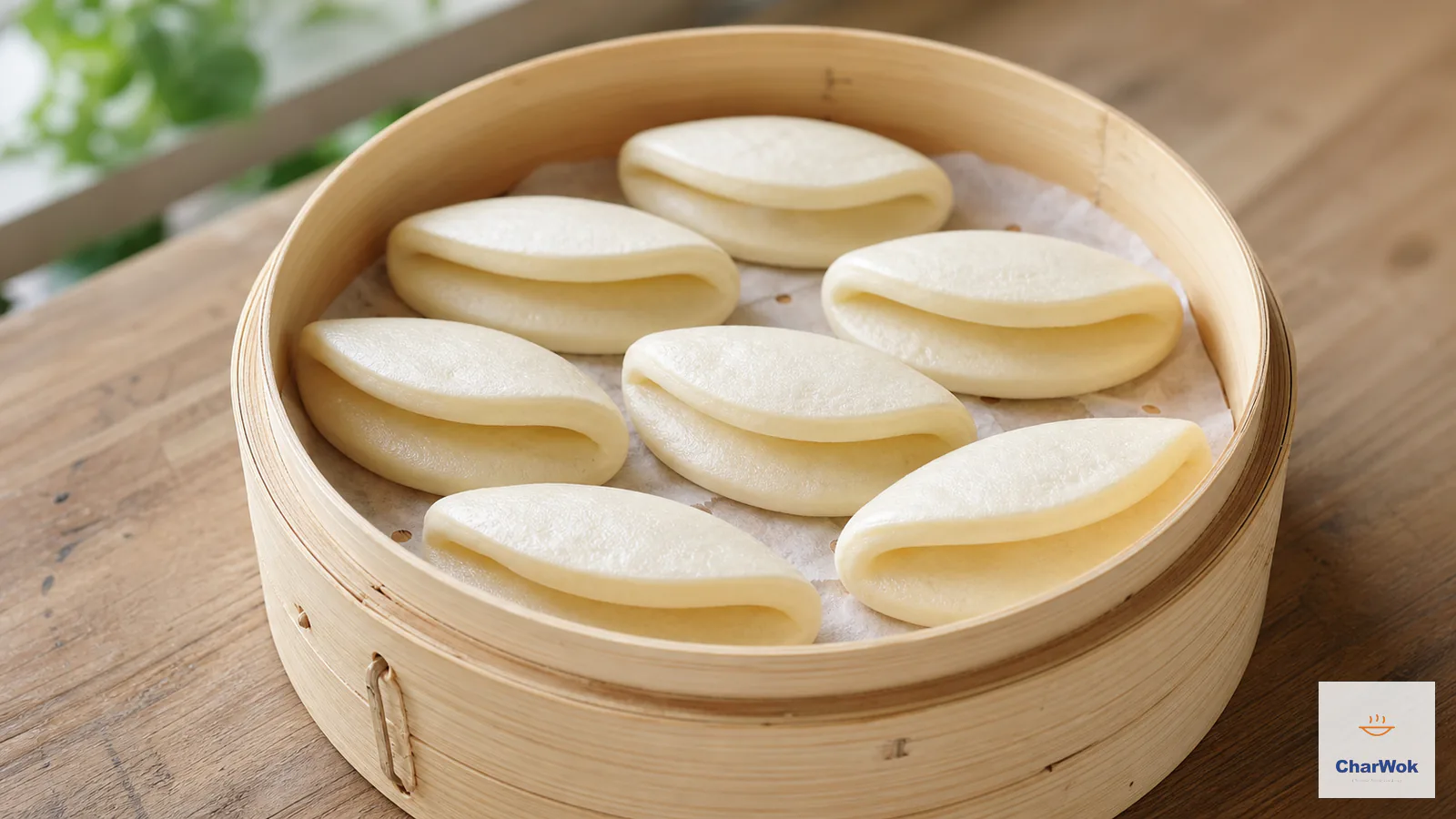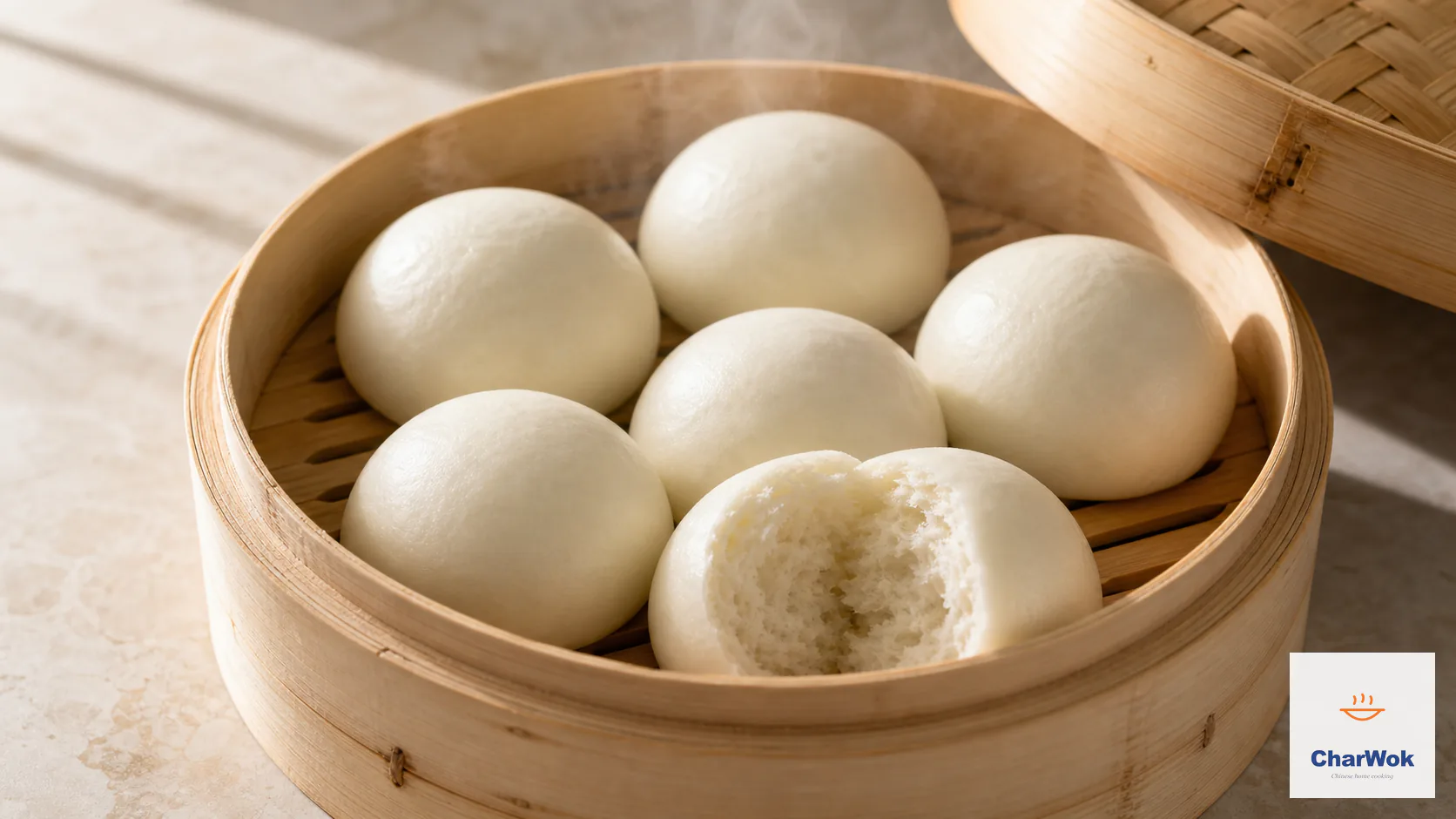
A mantou is a plain wheat-flour bun cooked in steam rather than an oven, and on its best day it is one of the most quietly satisfying things you can make from flour and water. The crust is smooth and slightly tacky, the crumb pulls apart in soft layers, and a faint sweetness sits underneath the wheat. The hard part is the obvious one: most first attempts come out puckered, dense, or collapsed. Mine certainly did, for years. The fix is not a secret ingredient. It is two things you can control on any Tuesday night, gluten development and how long you let the shaped buns sit before the lid goes on.
What follows is a single-proof method that uses both yeast and baking powder, so the whole batch is on the table in under an hour of active time. I will also tell you where this method cuts corners on the older, yeast-only tradition, and why I still reach for it most weeks. If you want the unhurried double-proof version, the steamed bao approach is the closer cousin; this recipe trades some of that depth for speed and a wider margin for error.
One rest, not two. Knead the dough until it is smooth and bounces back when you press it, shape it right away, then let the buns sit uncovered in the basket for roughly 30 minutes at about 25°C/77°F before steaming over cold water brought to a full boil, then 10 minutes at medium-low. If the dough springs straight back under your finger, it has not rested enough; if it slumps and does not push back at all, it has gone too far.
What mantou actually is
Mantou (馒头) is the older, plainer relative of every filled Chinese bun you have met. No pork, no custard, no scallion oil, just dough that has been fermented, shaped, and steamed. It is the daily carbohydrate across northern China the way rice is in the south, and for a long time it carried more weight than that. The legend everyone repeats, that the name records the Three Kingdoms strategist Zhuge Liang substituting dough heads for real ones to ford a river on his southern campaign, is almost certainly folk etymology. What is real is the festival role: in Shandong, Shanxi, and Henan households, plain and sculpted mantou are made in bulk before Lunar New Year, sometimes stacked into elaborate towers and studded with dried jujubes for luck and a little chewy sweetness.
The filled branch of the family, the bao, took the same dough and folded savory or sweet fillings inside, then kept steaming. The pan-fried branch became sheng jian bao, with a crisp bottom. The rolled, scallion-scented branch became the flower roll, which is technically a mantou that picked up a filling of oil and herbs along the way. Plain mantou is the root stock for all of them, which is why getting it right pays off across the rest of your steamed-bread cooking.
Why this recipe uses yeast and baking powder
Traditional mantou rises on yeast alone. You mix and knead, wait for the dough to double, shape, wait again, then steam. Done well it gives a deeper wheat flavor and a slightly chewier crumb, and it is the only way I would make mantou if I had a free Saturday. The catch is the timeline. At 25°C/77°F you are looking at 1 to 2 hours of proofing, and the window between properly proofed and collapsed is narrow because the entire structure rests on live yeast that keeps producing gas until heat kills it.
Adding a small amount of baking powder shifts the math. Baking powder is double-acting: a portion of its gas releases the moment it meets water, and the rest releases under heat, in the steamer. That second release is the insurance policy. Even if your yeast underproofs because the kitchen is cold, the baking powder gives the buns a final push the moment the steam hits. The trade-off is a slightly less complex flavor and a marginally softer bite than a fully yeast-risen bun. For weeknight cooking and for anyone still learning to read dough, it is the right call.
This is also why I keep the sugar low. Sugar is yeast food, but more than a tablespoon per 250 g of flour starts to soften the crumb and slow browning, which you do not have anyway in a steamer. One tablespoon is enough to wake the yeast up without turning the buns sweet.
Ingredients
Ingredients at a glance
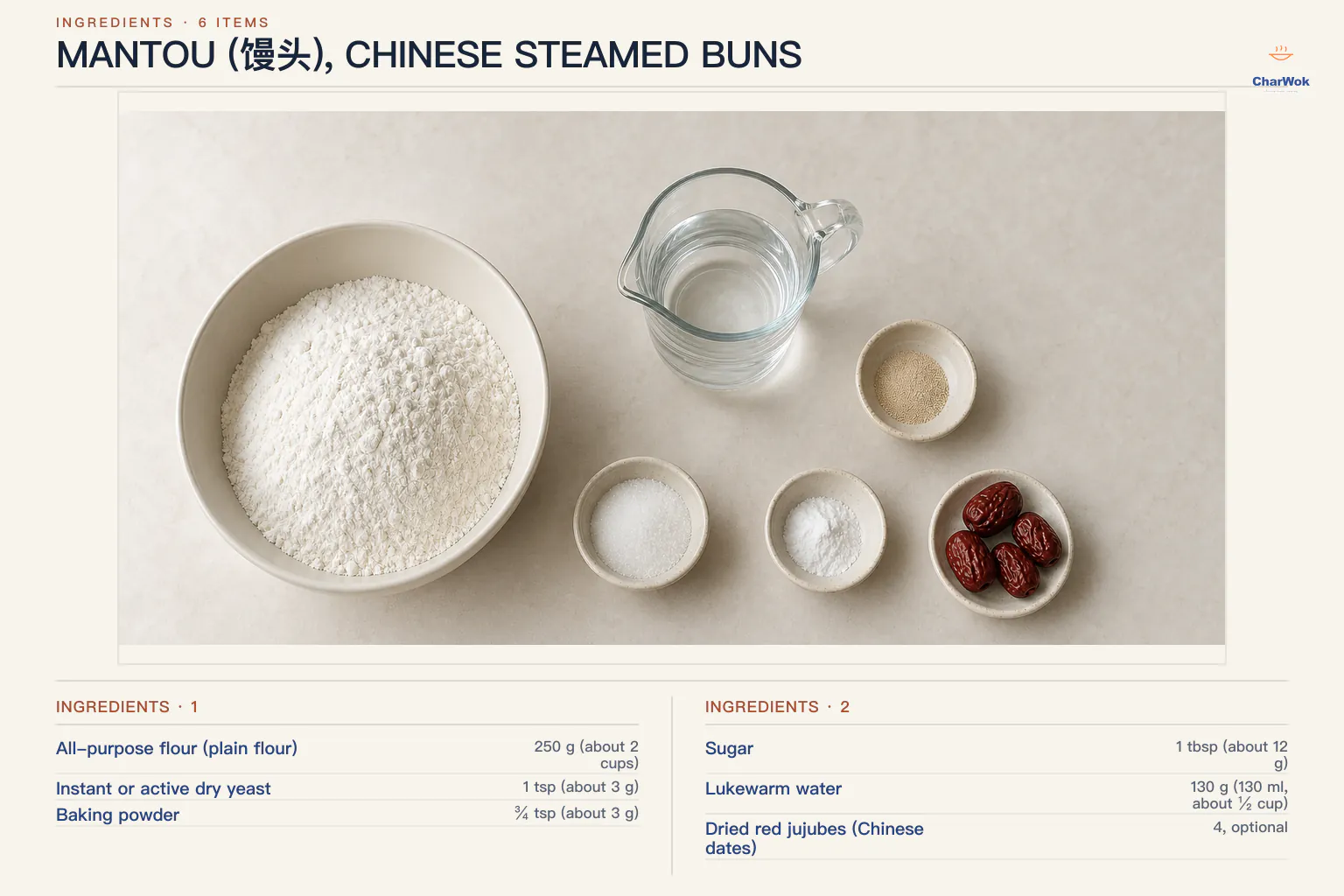
Makes 6 round buns, or 4 larger flower-shaped buns. Scaling is linear; doubling to 500 g flour is the most common move, and it fits a two-tier bamboo steamer in one pass.
| Ingredient | Amount | Notes / substitute |
|---|---|---|
| All-purpose flour (plain flour) | 250 g (about 2 cups) | 10 to 11% protein is ideal. Bleached AP works; for a chewier crumb swap 20 to 30 g for bread flour. Avoid whole wheat here, it dulls the color and tightens the cromb. |
| Instant or active dry yeast | 1 tsp (about 3 g) | Instant goes straight in. Active dry likes a 5-minute soak in the lukewarm water first. Check the date; dead yeast is the single most common failure. |
| Baking powder | ¾ tsp (about 3 g) | Aluminum-free, double-acting. Skip it only if you are committed to a full double-proof yeast method. |
| Sugar | 1 tbsp (about 12 g) | Plain white. Up to 2 tbsp if you want a breakfast-style sweetness; the buns will brown slightly less and soften a touch. |
| Lukewarm water | 130 g (130 ml, about ½ cup) | Body temperature, around 35 to 38°C/95 to 100°F. Stay comfortably below 45°C/113°F, which is the safe ceiling; much hotter and you risk stressing or killing the yeast. Weigh the water; measuring by volume is the second most common failure. |
| Dried red jujubes (Chinese dates) | 4, optional | Only for the flower-shaped buns. Pitted, halved. A single raisin or a piece of dried apricot works if you cannot find jujubes. |
Equipment that actually matters
A bamboo steamer is the traditional tool and still the best, and the reason is structural. The wooden walls are porous and not perfectly sealed, so the steam that hits them tends to dissipate through the sides instead of collecting on a flat surface overhead. A metal steamer has a smooth, cool lid where steam beads up and falls in heavy drops, and those drops pit the top of the dough. The fix is a clean kitchen towel bound over the lid, which absorbs the water before it can bead and fall. Skip it only if you do not mind a pockmarked surface, because no amount of kneading will undo those marks after the fact.
You also need something between the dough and the basket. Perforated steamer parchment is the easy answer. If you only have sheet parchment, cut circles about 2 cm wider than each uncooked bun, so the paper expands with the dough instead of constraining it. A light brush of neutral oil on a metal steamer works too, but it is less forgiving.
How to make the dough
- Combine the dry ingredients. Whisk the flour, yeast, baking powder, and sugar in a wide bowl so the leavening is evenly distributed. Uneven baking powder shows up later as lopsided buns.
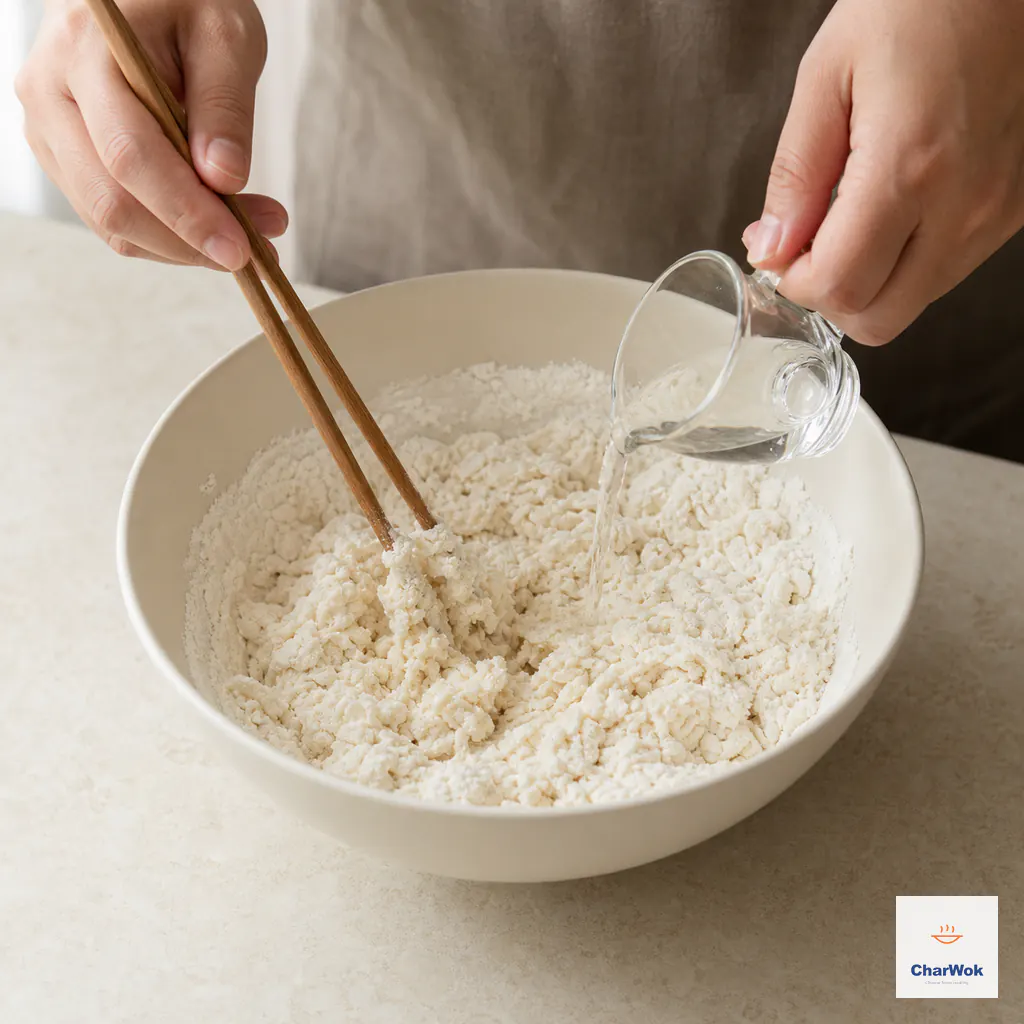
Add the 130 g water gradually and stir until shaggy flakes form with no loose pockets of flour
- Wet the flour in stages. Pour in the water a little at a time, stirring with chopsticks or a spatula until shaggy flakes form and no dry pockets remain. Adding all the water at once just makes a messier hydrate and a longer cleanup.
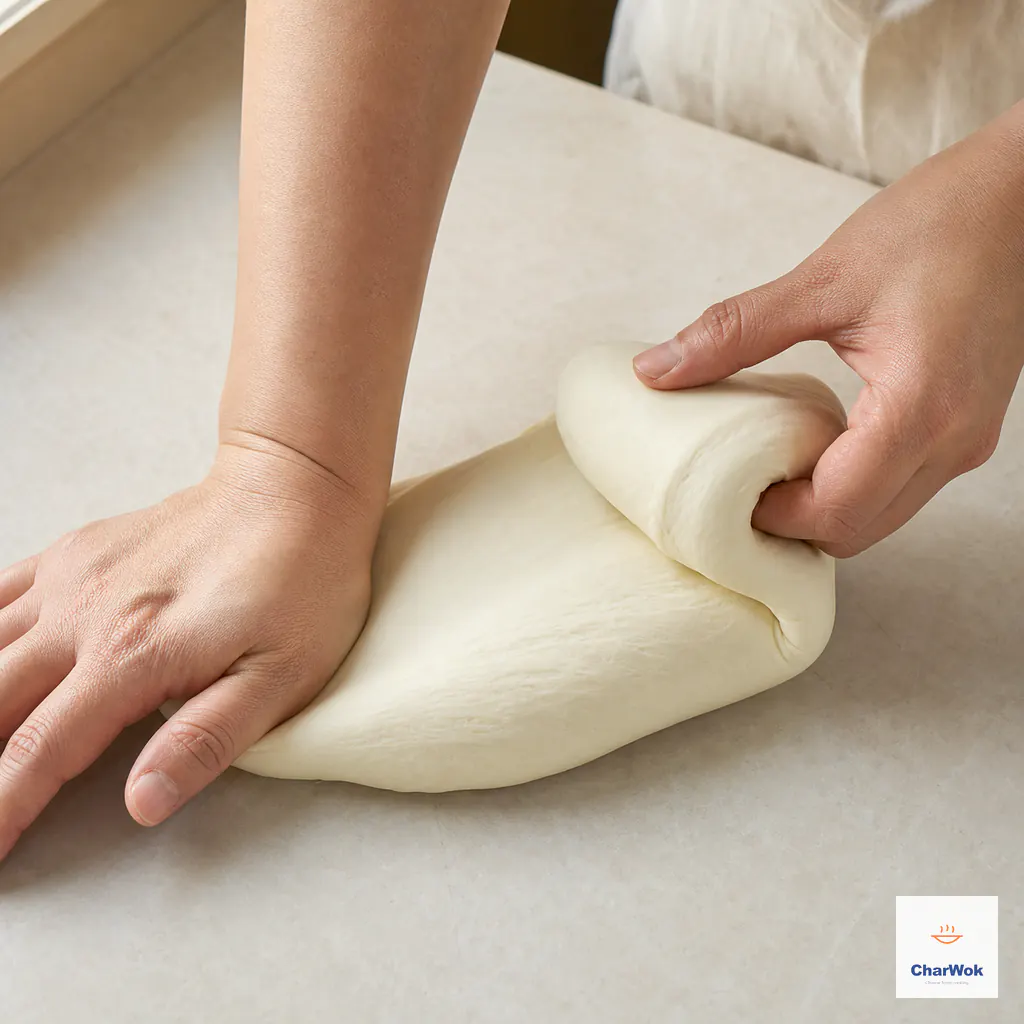
After the 10-minute rest, knead for 5 to 7 minutes until the dough is smooth, slightly shiny, and springy
- Bring it together, then stop early. Press the shaggy mass into a rough ball, cover, and walk away for 10 minutes. This is the autolyse rest, and it is the single biggest favor you can do yourself. The flour hydrates and the gluten strands begin to align on their own, so the second knead takes a fraction of the effort and produces a smoother dough than grinding it out cold.
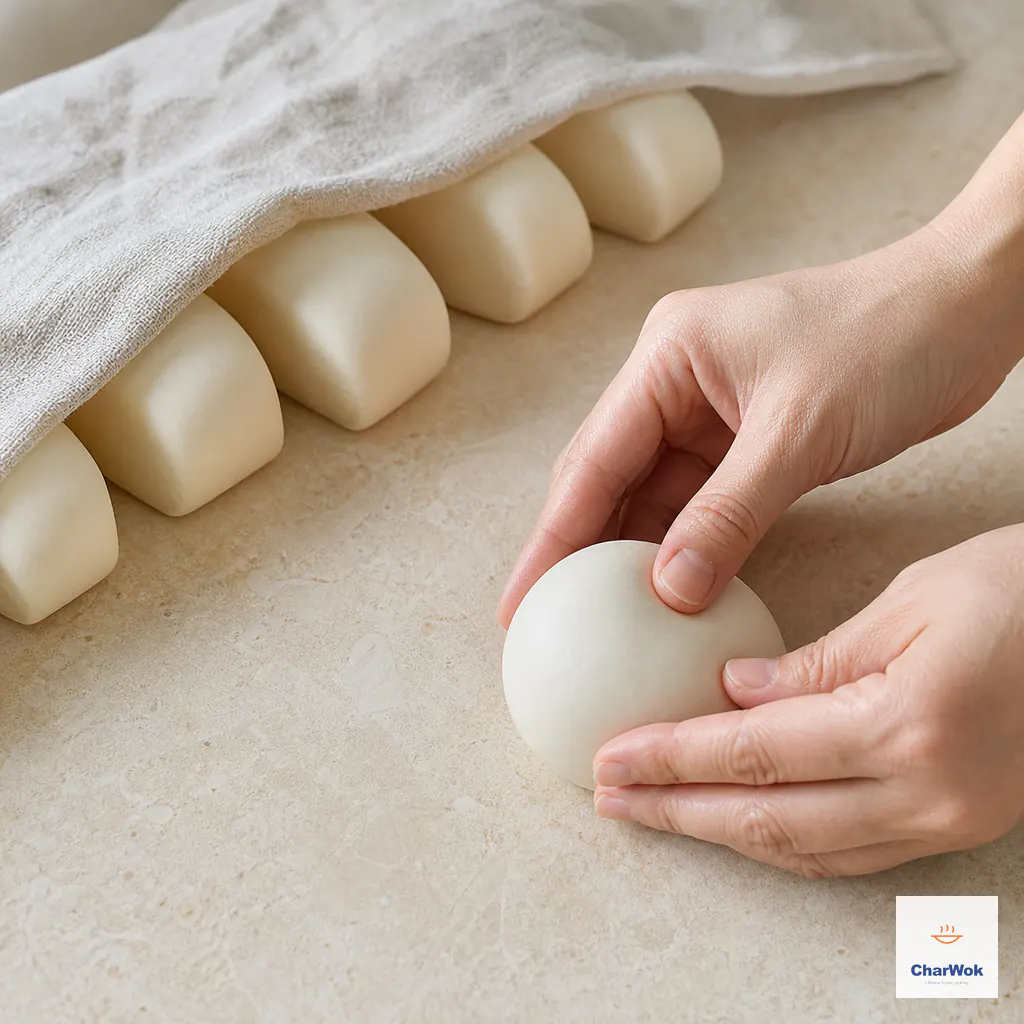
Divide into six, fold each cut edge underneath, then cup and roll just until a smooth dome forms
- Knead to a windowpane-ish smoothness. After the rest, knead on an unfloured surface for 5 to 7 minutes by hand, pushing the dough away with the heel of your palm, folding it back, quarter-turning, repeating. You are done when the surface is smooth, slightly shiny, and springs back when poked. A stand mixer on low does this in about 8 minutes; finish with 1 minute of hand kneading to check the texture and pull the surface tight.
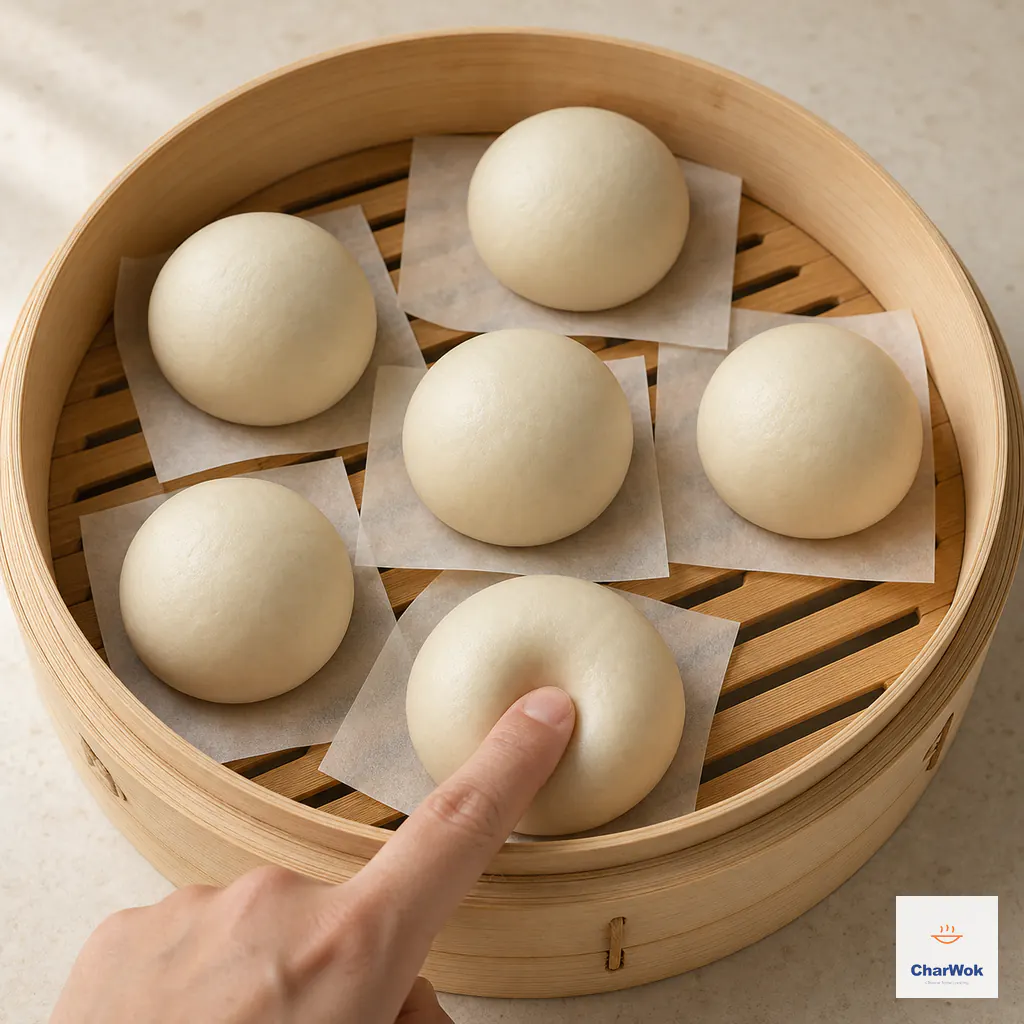
At about 25°C, proof for roughly 30 minutes: look for visible puffing, not doubling, and a slow fingertip rebound
- Skip the bulk rise. This is the shortcut that defines the single-proof method. Shape right away. If your kitchen is cold, 5 to 10 minutes of rest before dividing will make the dough easier to portion, but do not wait for it to double.
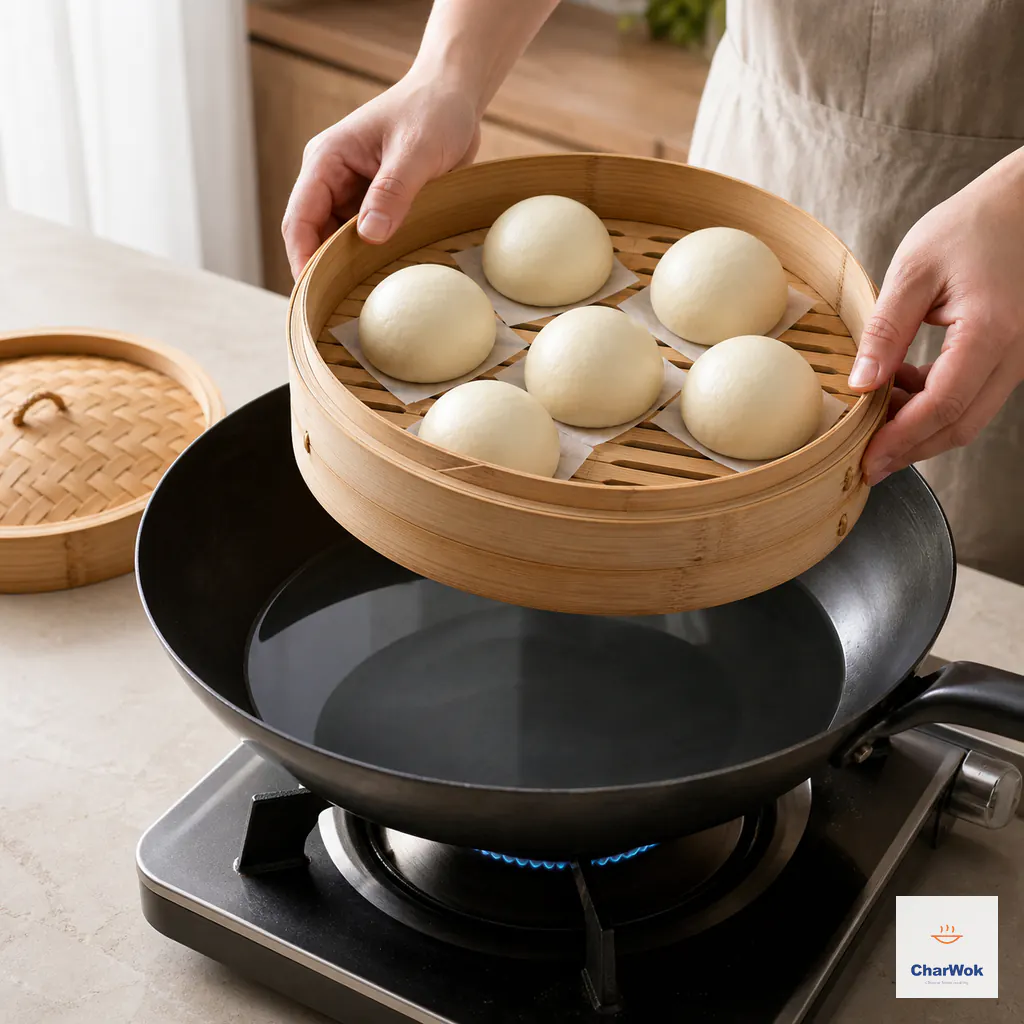
Set the basket over cold water and start on high heat; reduce to medium-low once a full boil sends out steady steam
Two ways to shape
Divide the dough into 6 equal pieces for round buns, or 4 for larger flower buns. A bench scraper and a small kitchen scale will save you from one fat bun and one sad one. Keep the unused pieces covered with a damp towel while you work so they do not skin over.
Round buns
- Flatten a piece into a disc, then fold the edges toward the center, turning the dough as you go. You are gathering the rougher surface to the underside and leaving the smooth top intact.
- Flip it seam-side down. Cup your hand loosely over it and roll in quick circles on the counter, letting the friction close the seam and build a slight dome on top.
- Stop when the ball is smooth and holds a gentle dome on top. Over-rolling knocks gas out and flattens the dome into a hockey puck.
Flower buns with jujube
- Roll a piece into a long, thin rope, about the thickness of a finger. Even thickness matters more than the exact length; thin spots break when you fold.
- Curl each end toward the middle in opposite directions so the rope coils into a loose S, then a near-circle. The two coils should meet in the center.
- Pinch the center with a pair of chopsticks from two sides, squeezing gently until the coils flare into petals. Drop a halved jujube into the pinched center to hold the shape.
The one rest that decides everything
Arrange the shaped buns in the lined steamer with ample space between them, because they will roughly double in the basket and again in the steam. Now comes the judgment call that separates a smooth bun from a wrinkled one.
Leave them to rest at room temperature for about 30 minutes at 25°C/77°F. In a cooler kitchen, push to 45 minutes; in a warm one, check at 20. The clock is only a rough guide; the dough itself tells you when it is ready. Look for two things together. The buns should have visibly puffed and taken on a softer, almost swollen look without doubling. Then nudge one with a fingertip: if it pushes back hard and at once, the gluten is still tight, give it more time; if it gives and then slowly finds its way back toward its shape, leaving a soft impression, it is ready. A dough that holds the dent and shows no push-back has already overproofed, and you are heading for collapse.
This is the failure mode worth dwelling on. Proofing is a race between two forces: gas being produced, and the gluten sheet holding that gas in. Leave the buns too long and the yeast wins the race. The bubbles inside coalesce into one big void, and the gluten film stretched across it goes thin and ragged. Steam holds that void inflated while the heat is on. The moment the heat stops and the steam pressure inside drops, the gas contracts, the thin gluten wall has nothing pushing back against it, and the bun folds in on itself. The lesson is not about a magic number of minutes. It is that the longer and warmer the rest, the closer you drift to the line where the structure tears, and once it has torn, no cooking trick will rebuild it. Overproofing, not lid-lifting, is what collapses buns.
Steaming without the drama
- Start in cold water. Put the basket over a pot or wok filled with cold water, then bring it to a boil over high heat. A gradual warm-up gives the buns one last gentle rise before the heat sets the structure. Dropping cold dough into a fully boiling steamer shocks the outside and stunts the rise.
- Drop to medium-low at a full boil. The moment steam is pouring from the lid, reduce the heat so the water maintains a vigorous but not violent boil. Violent steam jostles the buns and batters the surface; a steady boil cooks evenly.
- Time 10 minutes from the boil. Add 2 minutes for larger flower buns. Resist opening the lid to peek; every peek drops the temperature and lengthens the cook.
- Off and open. Turn off the heat and lift the lid. Some recipes call for letting the steamer sit a few minutes before uncovering, on the theory that a slow cool keeps the buns from falling. The trouble is that the bun's structure has already set in the steam; what determines whether it holds is the proof, not the last few minutes of resting. A well-proofed bun comes out smooth the moment the lid lifts. An overproofed one will collapse whether you wait or not.
- Cool briefly in the basket. Let them sit two minutes so the surface dries slightly and they release cleanly from the paper.
When things go wrong
| Symptom | Likely cause | Fix |
|---|---|---|
| Bun collapses and wrinkles after steaming | Overproofed. The 30-minute estimate is for 25°C/77°F; a warm kitchen will finish proofing in 20. | Next time, start checking at 18 minutes. Press-test, do not clock-test. |
| Dense, heavy crumb | Underproofed, or the dough was not kneaded enough to develop gluten. | Knead until truly smooth and springy. Extend the rest until the slow-fingertip-spring cue appears. |
| Sticky, hard-to-shape dough | Too much water for your flour, or the dough is warm and sweaty. | Knead in flour a tablespoon at a time. The finished dough should be barely tacky, not adhesive. |
| Pockmarked surface | Condensation dripped from an unwrapped metal lid. | Wrap the lid in a towel, or switch to bamboo. Some also rotate the lid occasionally to shed water. |
| Buns stick to the paper | Paper too small, or buns lifted while still hot and tacky. | Cut wider circles. Let the buns cool 2 minutes before peeling. |
| Raw, gummy center | Steam not at full strength, or buns too large for 10 minutes. | Confirm a full boil before timing. Add 2 minutes for flower buns or any larger-than-average bun. |
| Flat tops, no dome | Over-kneaded or over-handled during shaping, which knocked out gas. | Shape with fewer passes. Round, dome, stop. |
Variations worth keeping
The dough is a blank canvas. A few directions that work well and stay inside the same hydration:
- Pumpkin or sweet potato mantou. Replace 60 g of the water with an equal weight of mashed, cooked pumpkin or roasted sweet potato. The added moisture and sugar soften the crumb and turn the buns sunset-orange. Let the mash cool before mixing or it will cook the yeast.
- Purple sweet potato or ube swirl. Divide the dough, knead a tablespoon of mashed purple sweet potato into one half, then stack and roll the two into a log for a marbled cross-section.
- Whole-wheat compromise. Swap no more than 30% of the flour for whole wheat; beyond that the crumb tightens and the buns go heavy.
- Pantry-stuffed version. The same dough wraps sweet red bean paste for red bean buns, or a flowing custard for custard buns. Use the round-shaping method and seal the seam tightly.
- Skillet-crisped leftover. Slice a day-old mantou, pan-fry the slices in a little oil until golden, and serve with condensed milk. The Maillard reaction does for cold mantou what the steamer could not.
How to eat and serve
Plain mantou is a staple, eaten warm alongside savory dishes the way bread or rice would be. In a northern meal it might anchor a spread of stir-fries and a bowl of congee or soup, the way steamed rice anchors a southern one. Split and filled with a fried egg it is a quick breakfast; split and spread with chili oil, fermented bean curd, or black bean sauce it becomes a savory snack. For a sweet version, dunk warm pieces in condensed milk or honey.
If you want to build a full bread-and-filling meal around this dough, the char siu bao filling, the Chinese pork burger assembly, and the gua bao fold all reward the same hand skills you build here. On the bread side, scallion pancakes and the leavened scallion bread sit on the same northern table, as do youtiao for breakfast and a wrapped egg and scallion crepe. For a broader read on the category, the introduction to Chinese bread lays out how these pieces fit together.
Storage and reheating
Cool the buns completely on a rack before storing, otherwise trapped steam turns the surface slick and the buns stick together. Once cool, seal them in an airtight bag. They keep 4 days in the fridge or about 2 months in the freezer; freeze them spaced on a tray first, then bag, so they do not freeze into a single block.
To reheat, steam straight from cold. Chilled buns take 5 minutes, frozen buns take 7 minutes, with no need to thaw. A microwave will revive the softness for about 30 seconds before it turns the bun gummy and hard at the same time, which is a trick I do not recommend. If you pan-fry slices, do it straight from cold; thawed slices go limp in the pan.
Questions I get often
A few that come up repeatedly, with the short version of each answer.
Do I have to use baking powder?
No. Leave it out and switch to a full double proof: let the dough double after kneading, shape, then let the buns proof again until puffy before steaming. Expect 1 to 2 hours total at room temperature, and a slightly chewier, more flavorful crumb.
Why are my buns wrinkled?
Almost always overproofing. The dough produced more gas than the gluten could hold, so a big pocket opened inside and the bun sagged when the steam stopped. Cut the rest shorter and rely on the fingertip-spring test, not the clock.
Can I use bread flour instead?
Yes, but it absorbs more water, so add an extra 5 to 10 g of water or the dough will be tight and the crumb dense. Bread flour gives a chewier, more bouncy bun, closer to a good baozi. All-purpose is the safer starting point.
Should I really start in cold water?
For this single-proof method, yes. Cold water gives the buns a gradual final rise as the steamer heats. If you have already fully proofed the buns yeast-only, dropping them into a fully boiling steamer is fine and even safer, because you are not relying on extra expansion.
Why wait before uncovering after steaming?
The reasoning behind that advice is a slow cool keeps the buns from falling. The catch is that the crumb sets during steaming, so what decides whether a bun holds its shape is how it was proofed, not how long the lid rests afterward. A correctly proofed bun keeps its shape the moment you lift the lid; an overproofed bun collapses whether you wait or not. Get the proof right and the lid comes off straight away.
One honest note to close on. The single-proof method here is forgiving, and that is exactly why I reach for it. What it is not is the platonic ideal of mantou. A proper yeast-only dough, proofed long and slow, has a wheat sweetness and a resilient chew that baking powder cannot fully imitate. If you make this version a few times and start to love it, do yourself the favor of trying the slow road once. You will taste the difference, and you will know which one belongs on your weeknight table and which one you save for a weekend.