The first time I tried to roll my own sticky rice log at home, the rice tore, the fried dough went limp against the hot grain, and I ended up eating something closer to congee than breakfast. The thing I had been chasing was fan tuan, the Jiangnan street roll where a crisp golden youtiao hides inside a sleeve of warm, faintly sweet glutinous rice. What I learned, after a few soggy failures, is that the dish is not really a recipe. It is a temperature problem wrapped in a texture problem, and once you respect both, it comes together in minutes.
Below I walk through the version I now make on weekends: properly steamed sticky rice, a freshly crisped Chinese doughnut stick (youtiao), pork floss, preserved mustard stem, scallion, sesame, and a smear of chili garlic sauce. It belongs squarely in the family of grab-and-go Chinese breakfasts, alongside jian bing crepes and a bowl of rice porridge. The point of this guide is not to reproduce a street cart exactly. It is to show you which two decisions decide whether your roll is springy and crackling or dense and damp.
At a glance. Steam 360 g of glutinous rice that has soaked at least 6 hours for 30 to 35 minutes, then roll it around a youtiao while the rice is still steaming hot and the doughnut is fresh out of the oil. The whole assembly lives or dies on two things: rice temperature (hot = pliable; cool = brittle) and youtiao crunch (re-crisp it right before rolling, never let it sit). Assemble and eat immediately.
What fan tuan actually is, and where it comes from
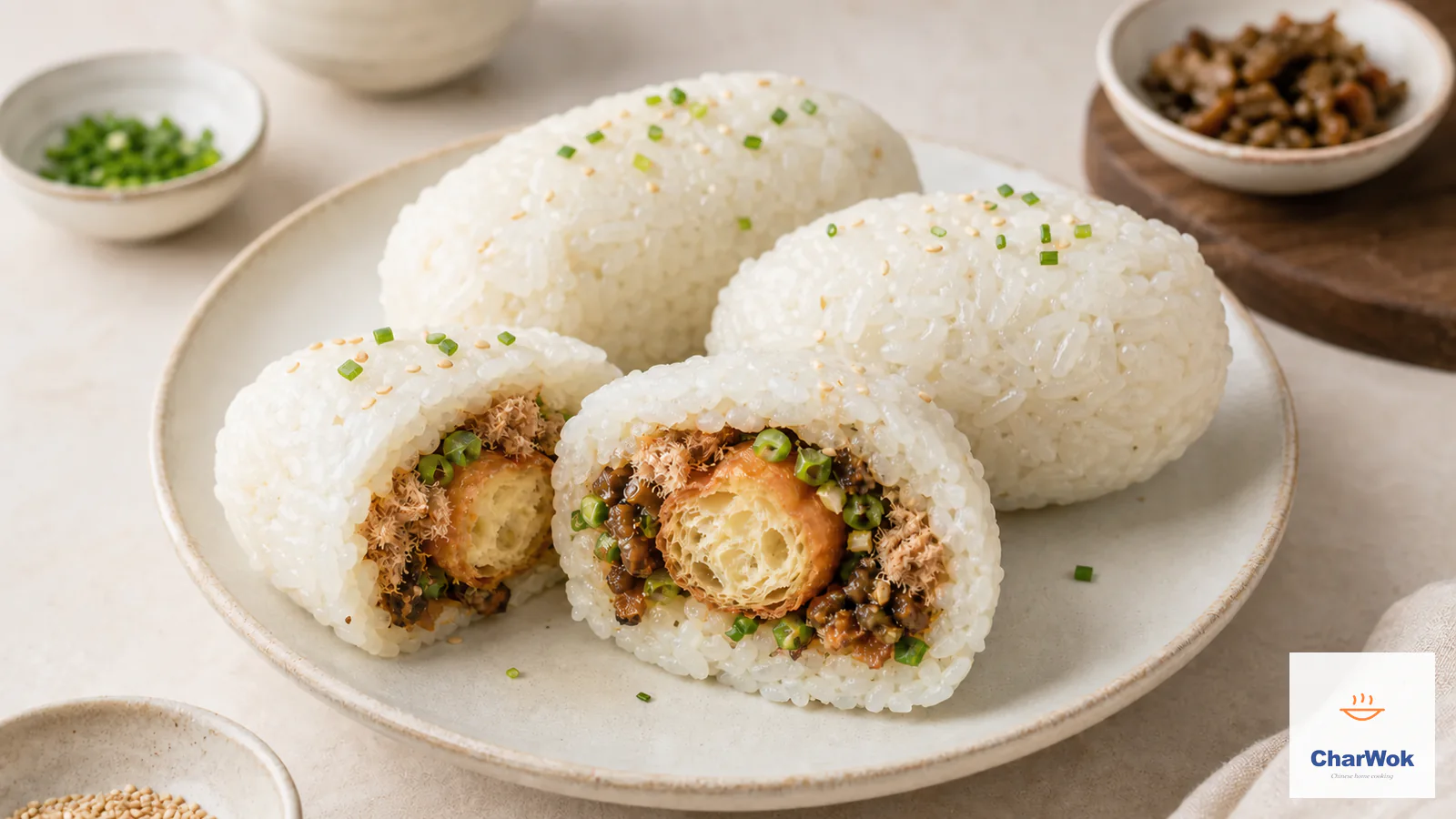
Fan tuan (饭团), more formally ci fan tuan (粢饭团), is a Shanghainese and broader Jiangnan breakfast classic. A vendor scoops hot sticky rice onto a cloth, lays in a strip of fried dough and a scatter of savory fillings, then twists the cloth so the rice collapses around the filling into a tight oblong log. In some cities the same dish goes by nuo mi bao youtiao, literally "sticky rice wrapping a doughnut stick," which is about as honest a name as food gets.
What makes it worth making at home is the contrast. Glutinous rice is almost entirely amylopectin, the branched starch molecule, which is why it cooks up sticky and slightly chewy rather than fluffy and separate like long-grain rice. Wrap that soft, giving layer around something shatteringly crisp and you get the texture combination that keeps the dish in business: yield, then snap. Lose the snap and you have a heavy rice brick, which is exactly what happens if you assemble ahead and let it sit.
The two fillings that matter, and the ones you can argue about
I think of fan tuan fillings in tiers. The first tier is non-negotiable: youtiao. Without the fried dough you do not have fan tuan, you have a rice ball. The second tier is where the personality lives, and in my house that means pork floss (rou song) and pickled mustard stem (zha cai). Everything else is garnish.
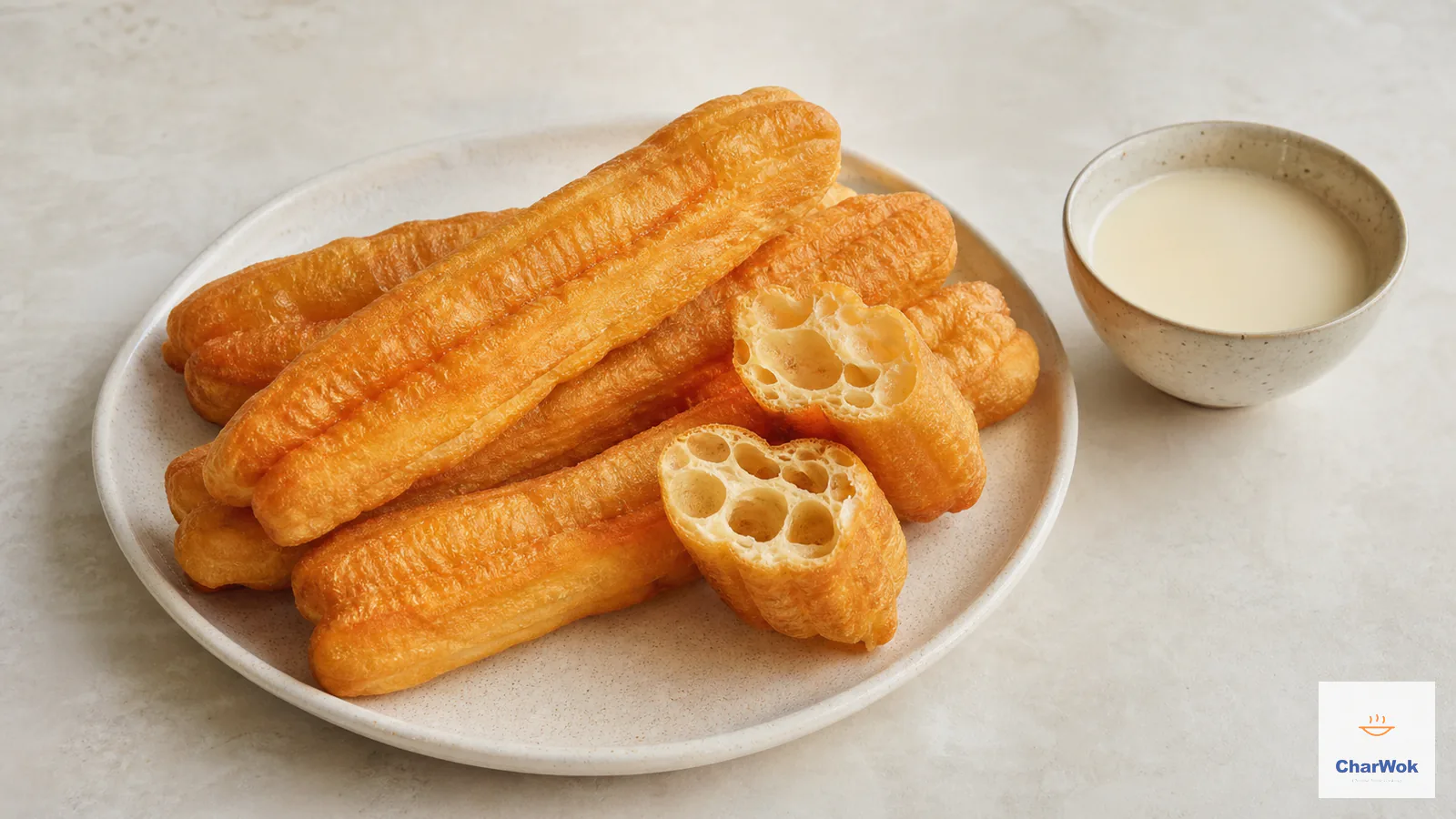
Youtiao is the structural backbone. Its job is to stay crunchy inside wet rice, which is a tall order. That air-pocket interior is what you are paying for, because air does not absorb moisture the way dense bread would. A stale, dense doughnut will turn to paste within a minute. If you cannot find good fresh ones, frozen youtiao from an Asian grocer re-crisped in a 190°C (375°F) oven for a few minutes beats a sad bakery one every time.
Pork floss is dried, shredded, seasoned pork fluffed into a cottony mass. It carries salt, sugar, and a clean hit of umami, and its fibrous texture grips the sticky rice so it does not all fall out the back of the roll. Beef, chicken, and fish floss all exist and behave the same way; pick by taste, not tradition.
Zha cai, pickled and salted mustard stem, brings the acidic, mineral edge that keeps the whole thing from reading as one-note sweet. Rinse it lightly, squeeze it dry, and chop it fine. If your market does not stock it, quick-pickled vegetables or preserved radish make a reasonable stand-in. The goal is something salty and slightly tangy with a firm bite.
From there you can improvise. Toasted sesame seeds on the outside give a nutty smell the moment you bite in. Finely chopped scallion adds fresh onion bite. A thin swipe of pickled chili garlic sauce is nontraditional but, if you like heat, it cuts the richness of the floss beautifully. I have seen modern carts stuff in a fried egg, slices of marbled tea eggs, salted egg yolk, or even Chinese ham sausage. A bacon-and-cheese version exists and, against all instinct, is genuinely good. My one rule: keep the total filling moderate. Overstuff and the rice cannot close around it.
Ingredients
Ingredients at a glance
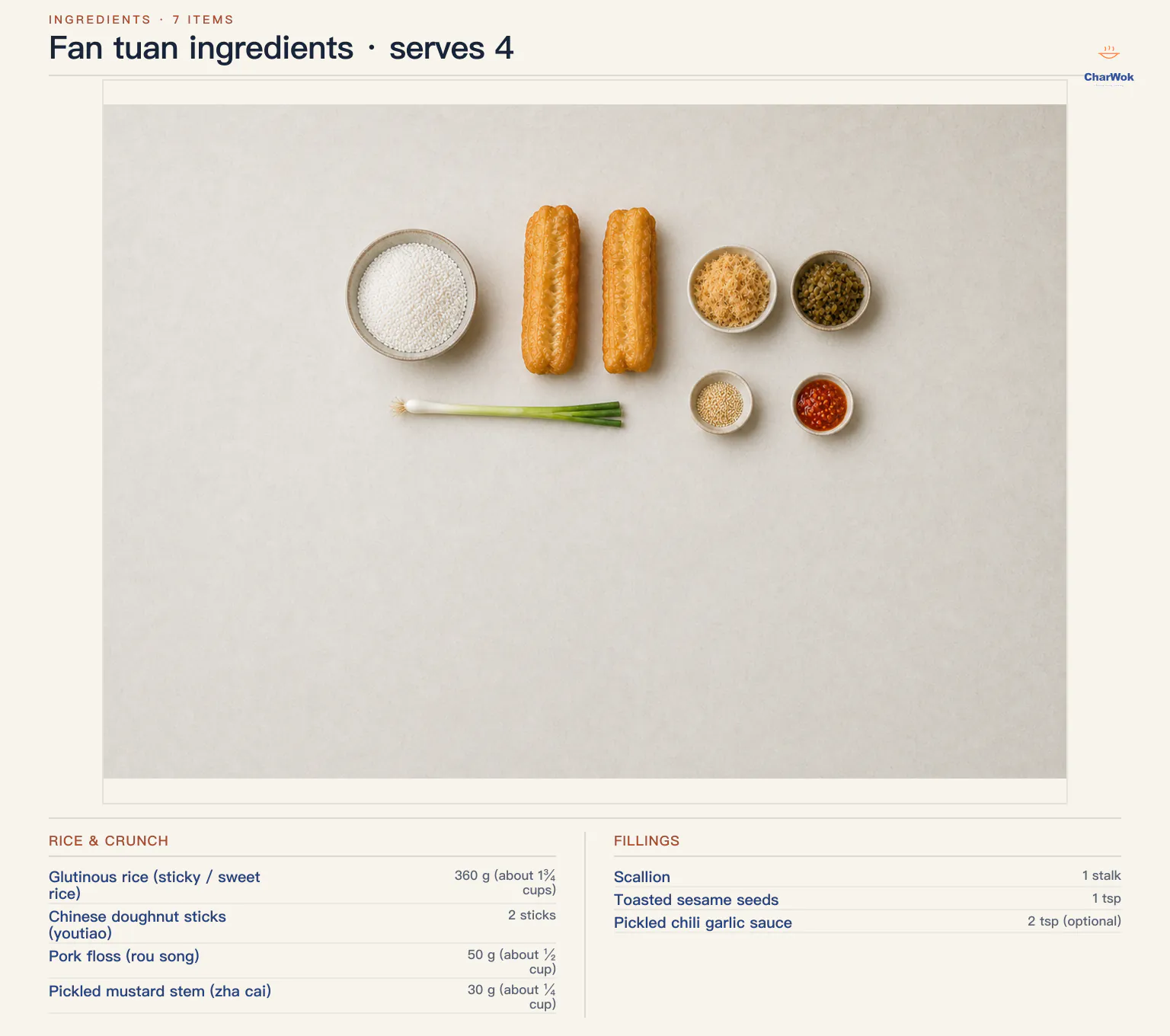
Makes 4 rolls. Scale the rice up or down freely; the fillings are flexible.
| Ingredient | Amount | Notes / substitute |
|---|---|---|
| Glutinous rice (sticky / sweet rice) | 360 g (about 1¾ cups) | Thai long-grain or Japanese short-grain both work. Do not use jasmine or regular long-grain. |
| Chinese doughnut sticks (youtiao) | 2 sticks | Fresh, or frozen re-crisped in a 190°C / 375°F oven until crackling. |
| Pork floss (rou song) | 50 g (about ½ cup) | Beef, chicken, or fish floss substitute fine. |
| Pickled mustard stem (zha cai) | 30 g (about ¼ cup) | Rinse, squeeze dry, finely chop. Preserved radish or yard-long beans work. |
| Scallion | 1 stalk | Finely chopped. Add at the last second so it stays bright. |
| Toasted sesame seeds | 1 tsp | For the outside of the roll. |
| Pickled chili garlic sauce | 2 tsp (optional) | Or any chili oil / doubanjiang-based sauce you like. |
How to steam the rice so it is chewy, not mushy
Cooking glutinous rice is the part most home cooks get wrong, because the instinct is to treat it like regular rice and boil or rice-cook it in water. That works, sort of, but you lose the bouncy texture that defines the dish. Steaming is the traditional method for a reason: the grains cook in their own surface moisture rather than swimming in water, so they stay intact and springy. If you want the full lowdown on equipment, our bamboo steamer guide covers setup, but any steamer that keeps the rice out of the boiling water will do.
- Rinse, then soak a long time. Wash the rice in several changes of cold water until the water runs nearly clear. Cover with water by a few centimeters and soak at least 6 hours, preferably overnight. This is the step you cannot shortcut. Soaking lets the grain hydrate fully so the starch gelatinizes evenly during steaming; under-soaked rice stays chalky in the center no matter how long you steam.
- Line the steamer and spread the rice thin. Drain well. Lay a damp piece of muslin, cheesecloth, or a clean linen tea towel in the basket and spread the rice in an even layer no thicker than about 2 cm. A thick mound steams unevenly, with mush on the outside and hard kernels inside. Fold the cloth over the top so the rice is fully enclosed.
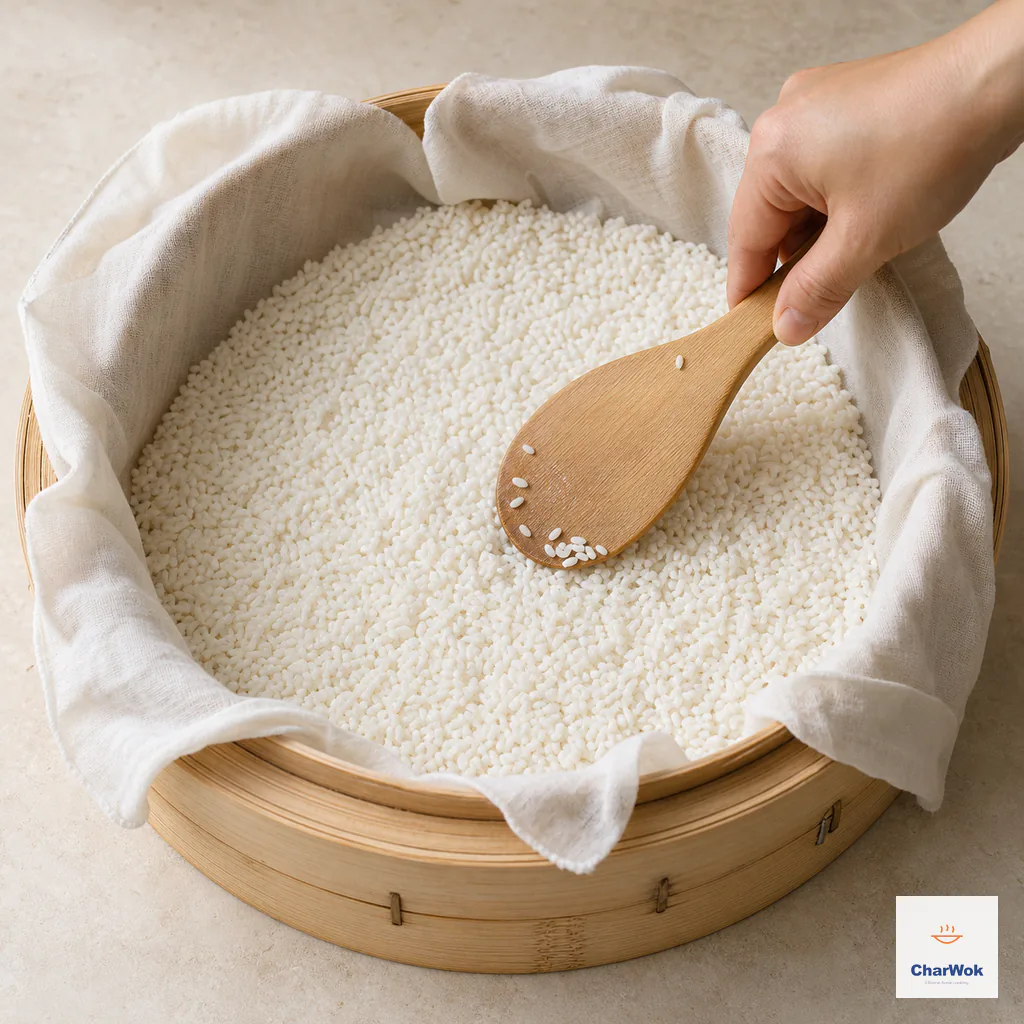
Keep the drained rice in a thin even layer so every grain steams at the same rate
- Steam over already-boiling water for 30 to 35 minutes. Get the water to a full rolling boil first, then set the basket over it, cover, and drop the heat to medium-low. Check the water level at the halfway mark; you do not want the pot to boil dry, but you also do not want to add so much cold water that the steam collapses. Top up with boiling water from a kettle, not cold.
- Test a grain, then hold it hot. At 30 minutes, bite into a grain. It should be tender all the way through with a slight, pleasant chew. Give it another 5 minutes if the center is at all firm. Then leave the rice in the covered steamer, off the heat if you must, until the moment you assemble. Fan tuan rice goes hard and brittle as it cools, and once that happens no amount of reheating fully brings back the pliancy.
A rice cooker with a dedicated sticky-rice (sometimes labeled "sweet rice") setting is an acceptable alternative and removes the water-level anxiety. A plain rice cooker on the standard cycle tends to over-hydrate the grain and leave it gummy, so I would not rely on that for this dish.
Assembling the roll
You do not need a bamboo mat or any special tool. A piece of plastic wrap is enough, because sticky rice is so cohesive it does most of the shaping itself once it is hot.
- Re-crisp the youtiao now, not earlier. This is the make-or-break detail and the one I keep harping on. Whether fresh or frozen, get the doughnut stick crackling hot right before you roll. Cold or soggy youtiao defeats the entire dish.
- Lay out plastic wrap and seed it with sesame. Spread a sheet of wrap on the counter and sprinkle half the sesame seeds across it. The seeds end up on the outside of the roll, where they do the most aromatic good.
- Spread half the hot rice into a rough square. Pile half the rice on the wrap and, with wet hands or a wet spatula, press it into a square roughly the length of a youtiao stick. Keep a bowl of water next to you and re-wet constantly; wet surfaces are the only thing sticky rice will not cling to.
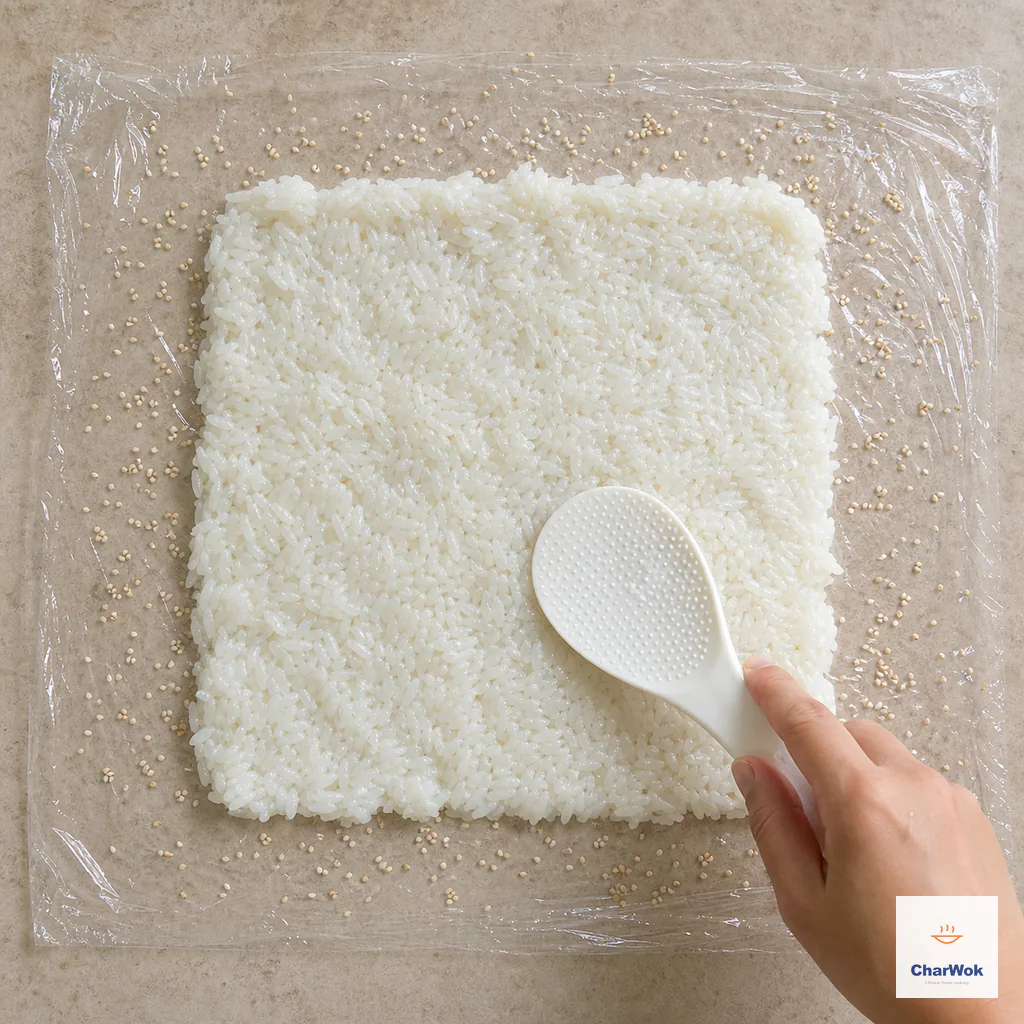
Work while the rice is hot and flatten it evenly, leaving clear plastic-wrap borders
- Layer the fillings down the center. Smear on the chili garlic sauce if using, then scatter half the scallion, pork floss, and chopped zha cai in a strip down the middle, leaving a border of bare rice on each side so the edges can seal.
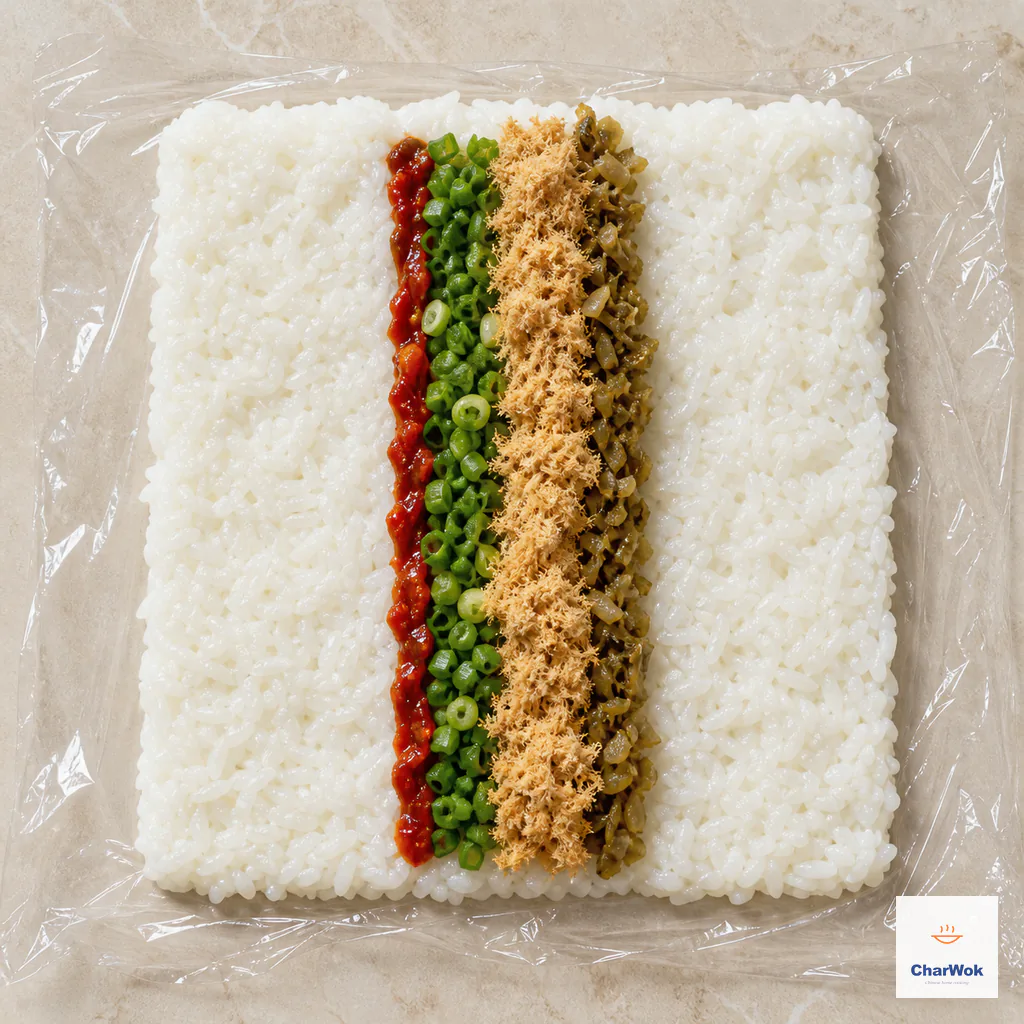
Keep the fillings compact in the center and leave wide bare rice borders for sealing
- Set the youtiao on the filling and roll. Lay one doughnut stick on top of the filling strip. Lift the two edges of wrap parallel to the stick and bring them up so the two bare rice borders meet over the top. Press firmly along the seam and all around the log so the rice hugs the filling. Twist the ends of the wrap to tighten.
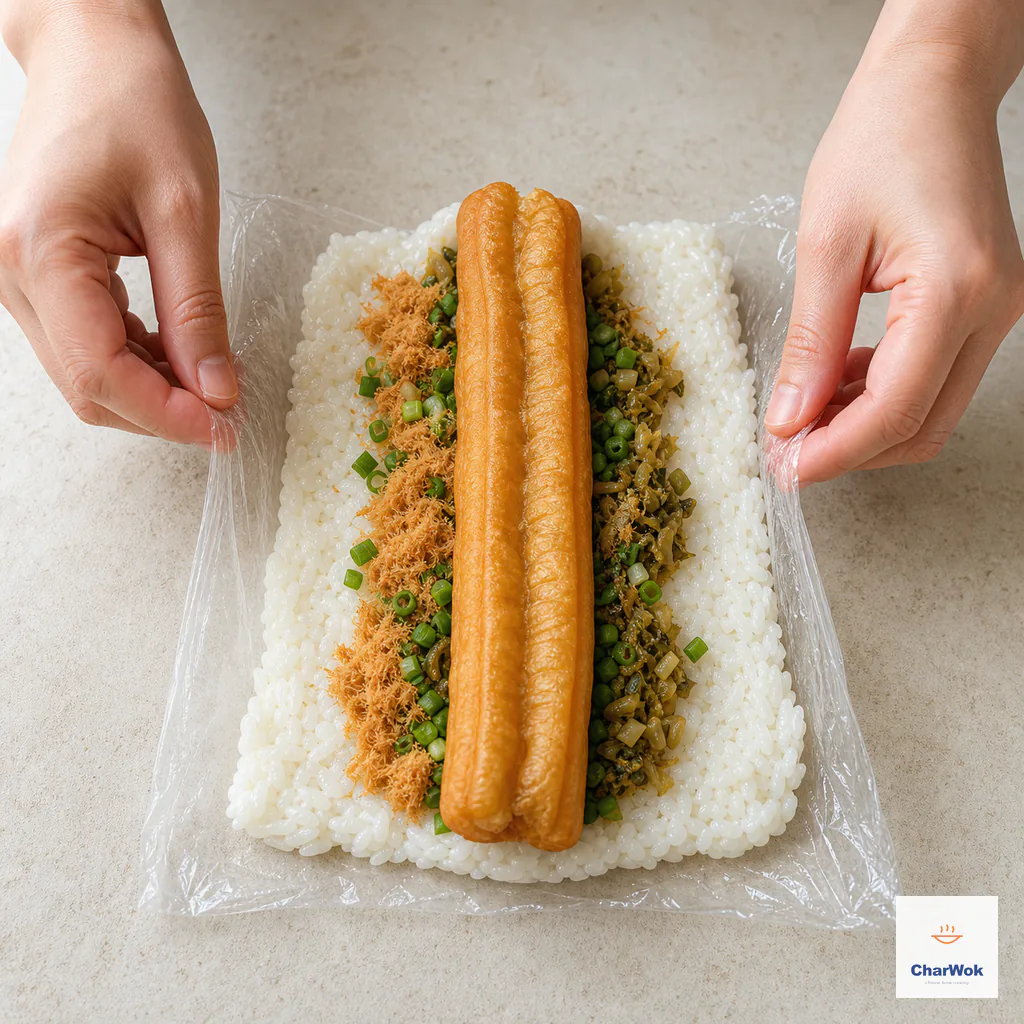
Center one whole youtiao, bring the rice edges together with the wrap and press into a tight cylinder
- Repeat for the second roll, then cut and eat. Make the second roll the same way. Halve each with a serrated knife, peel back the wrap from the open end as you eat, and serve immediately.
When it goes wrong, and how to fix it
Most fan tuan problems trace back to one of three things. Here is how I diagnose them.
- The rice cracks or will not seal. It has cooled too much. Glutinous rice loses its stretch below about 50°C (122°F). Put it back over simmering water for two minutes to re-warm, then work fast. If it is still cracking, your layer may be too thin; aim for at least 1 cm of rice all around the filling.
- The youtiao is soft by the time you bite in. Either it was not crisp to begin with, or too much time passed between crisping and rolling. Reheat the doughnut last, roll within a minute, and eat within five. There is no fix once it has gone limp; this is a dish that punishes delay.
- The roll falls apart when cut. You did not press it firmly enough, or the filling mound was too tall. Re-roll it through the wrap, squeezing harder, and trim any overfilling next time.
- The rice is gummy or wet. It was over-hydrated, usually from being cooked in too much water or a non-sticky-rice cycle. Next time, steam rather than boil, and spread the soaked rice thinner in the basket so steam can move through it.
- Everything tastes flat. You were shy with the zha cai or the chili sauce. The rice is deliberately mild; the fillings carry the salt and acid. Taste your zha cai alone first, then season up.
Variations and pairings
Once the basic roll is reliable, fan tuan takes well to reinvention. For a heartier version, tuck in a thin fried egg or a few slices of tea egg before rolling; the yolk enriches the rice without competing with the youtiao. A vegetarian version swaps pork floss for toasted peanuts crushed with a little sugar and salt, and uses extra scallion and pickled vegetable for punch.
If you are serving fan tuan as part of a larger breakfast spread, it pairs cleanly with a clear soup. A small bowl of tomato egg drop soup or a light seaweed soup alongside gives you something hot and liquid to balance the dense, dry roll. A cup of soy milk is the classic drink and not optional in my opinion; its faint sweetness is what the street vendors pour for a reason.
Storage and reheating
Fan tuan is a same-day food. If you must hold a roll, wrap it tightly and refrigerate for up to three days, then reheat by steaming for about five minutes until the rice is soft and pliable again. Accept that the youtiao will have surrendered its crunch; the roll is still good, just texturally different. Microwaving works in a pinch but tends to toughen the rice at the edges, so I avoid it. Do not freeze assembled rolls; the rice weeps on thaw and the texture never recovers.
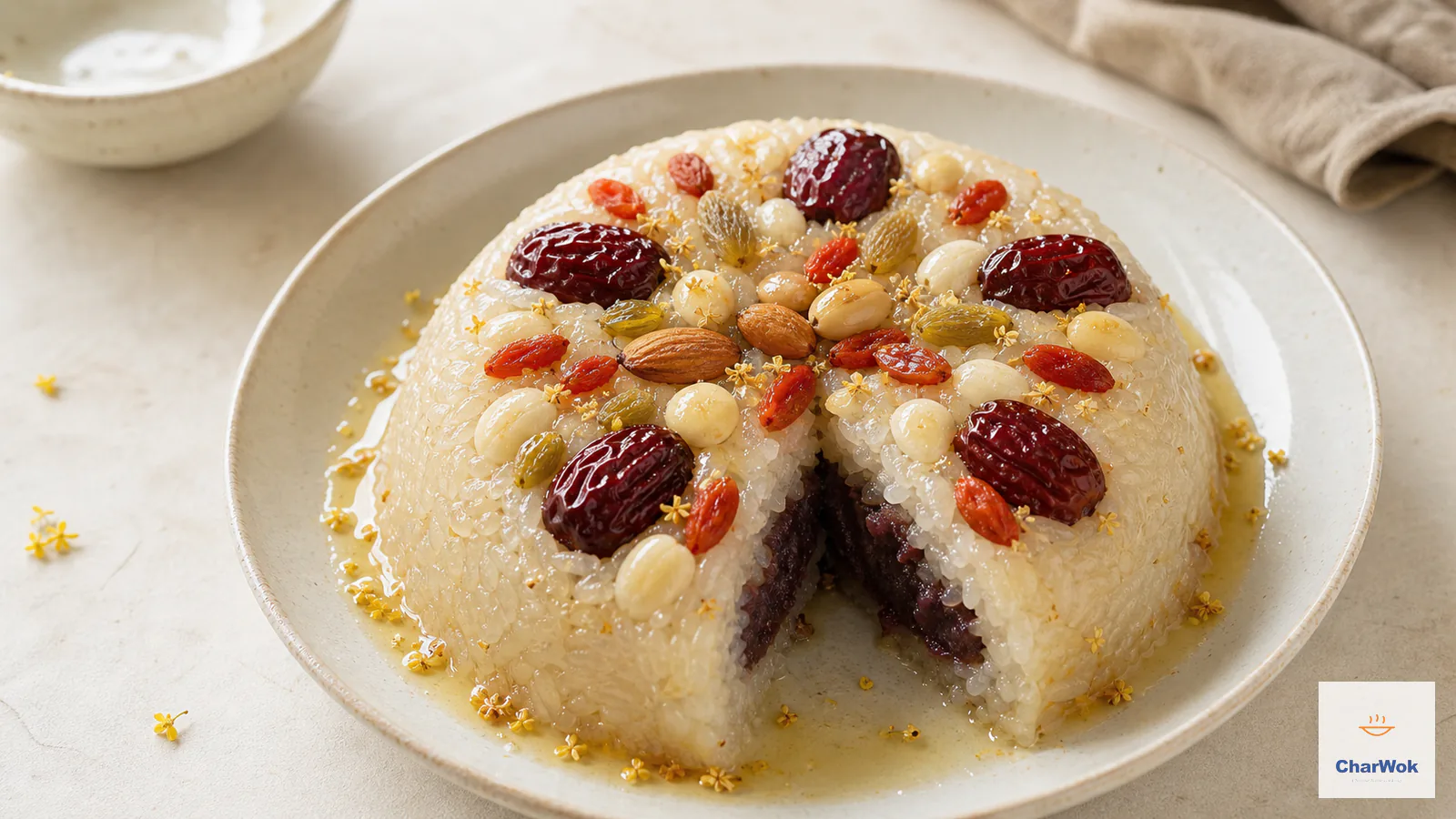
If you end up with leftover steamed rice and no youtiao, do not throw it away. It becomes the base for sticky rice with chicken, the filling for leaf-wrapped zongzi, a sweet turn toward eight treasure rice pudding, or even lotus root stuffed with sticky rice. Glutinous rice is one of the most reusable leftovers in the Chinese kitchen.
Frequently asked questions
A few questions that come up again and again when people make this for the first time.
That is the whole dish. Get the rice hot, get the youtiao crisp, roll fast, and eat faster. Everything else is preference.