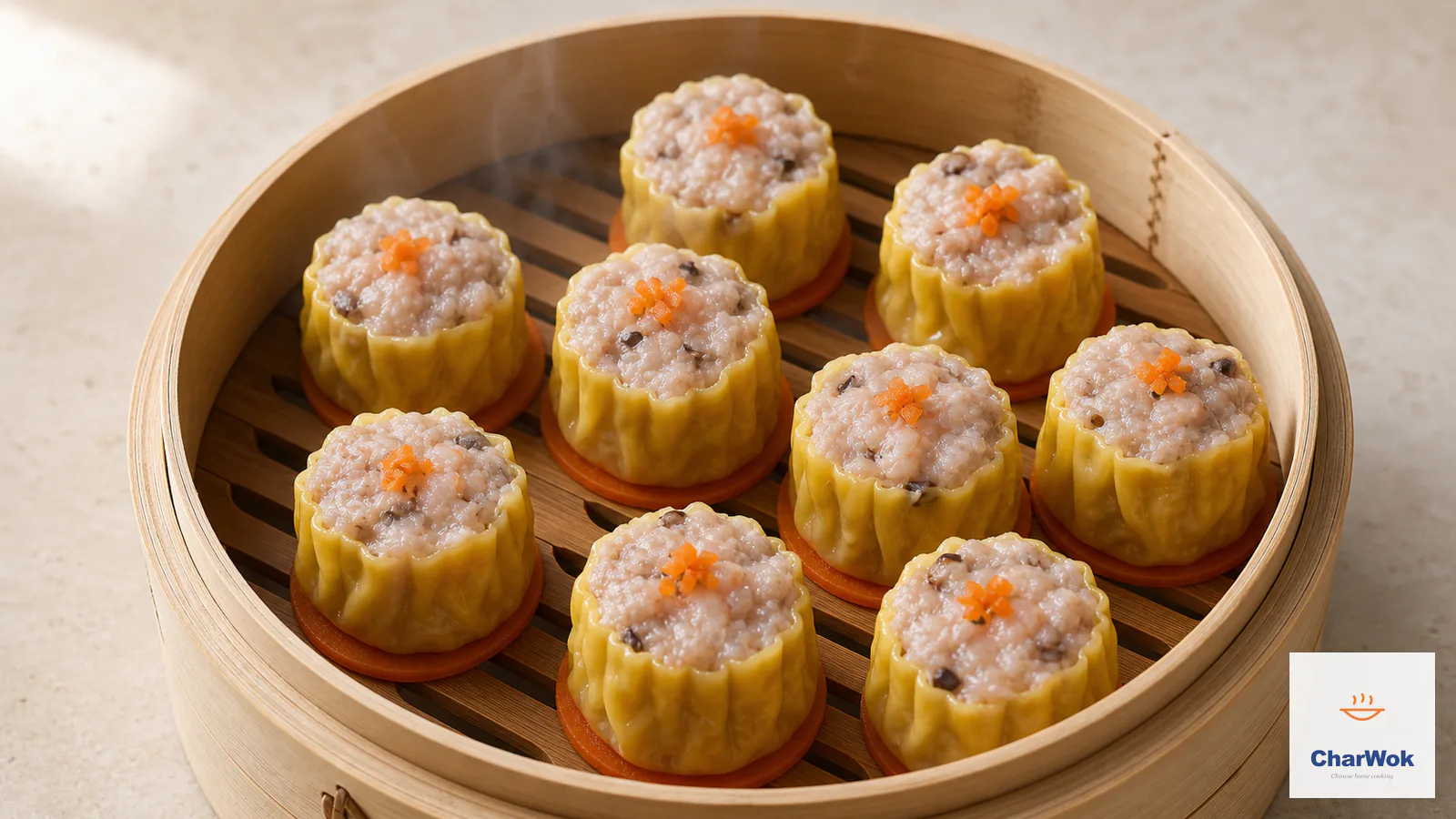
Open a bamboo basket at any Cantonese tea house and the first thing you reach for is almost always siu mai. The pleated little cup, glossy pork-and-shrimp dome on top, a single dot of carrot or crab roe for color, is the dish that defines a dim sum cart. The version below, pork and shrimp with rehydrated shiitake, is the one most home cooks actually want to make.
Here is the part that trips people up at home. You follow a recipe, the filling tastes fine, and the dumplings steam into something dense and mealy that collapses when you pick it up with chopsticks. The restaurant bite, that slight spring, the way the filling holds its shape and gives a clean snap, is not about a secret ingredient. It is about how the meat was mixed, and almost every home recipe underexplains it. I ruined two batches before I understood why.
At a glance: siu mai lives or dies on one move, beating the pork filling in a single direction for about five minutes until it turns sticky and stringy. Use 80% lean ground pork, cube the shrimp rather than mincing it, and steam on a hard rolling boil for 7 minutes (10–12 from frozen). The open-top shape means the wrapper is a thin skirt, not a sealed pouch, so the filling has to be cohesive enough to stand on its own.
What siu mai is, and where it comes from
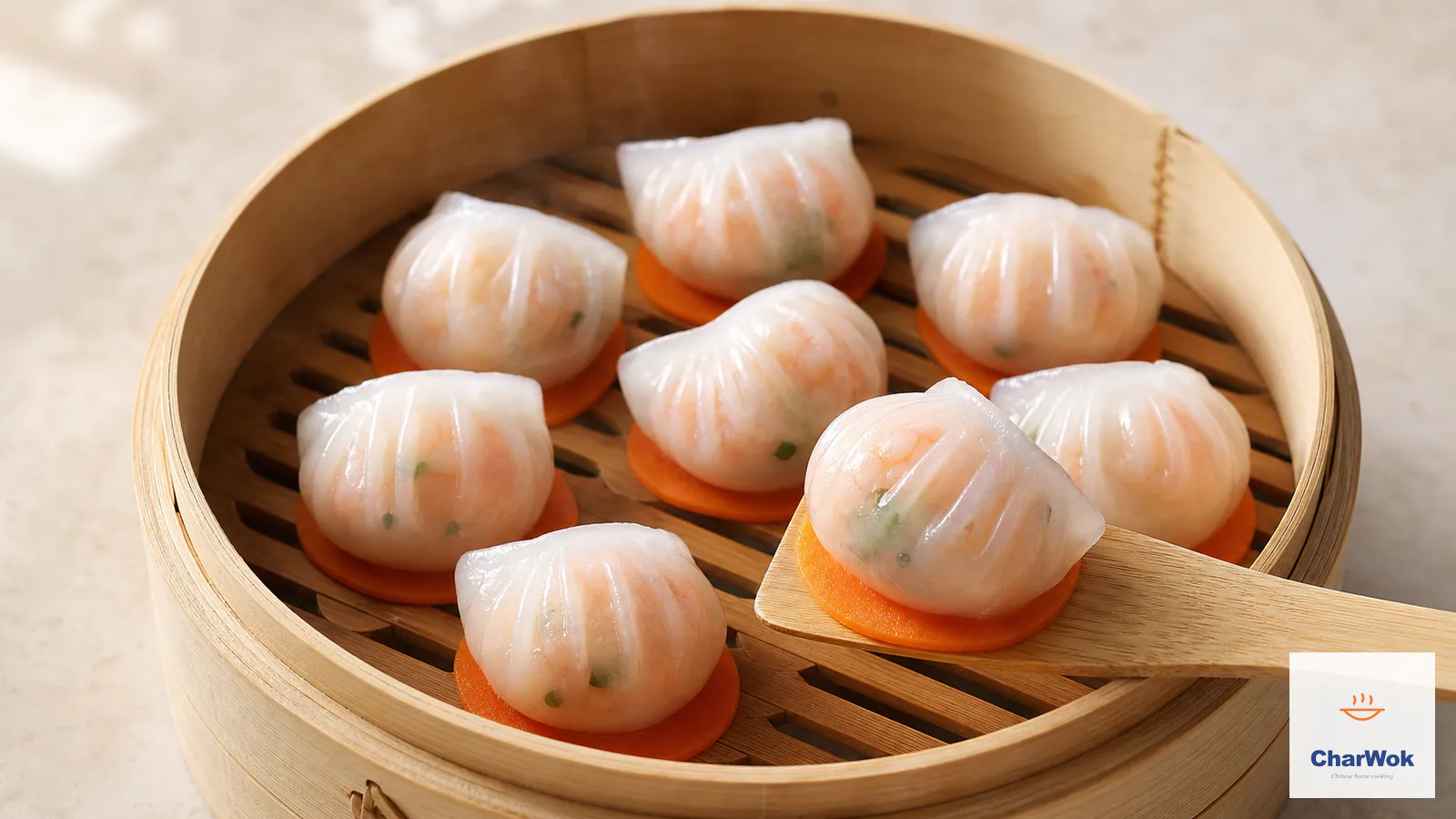
Siu mai (燒賣, also spelled shumai or shaomai) is a steamed, open-topped dumpling and one of the canonical items of Cantonese dim sum, served alongside har gow the crystal-skinned shrimp dumpling, and xiao long bao. The southern, Cantonese version is what most English-speaking cooks mean by "siu mai": a yellow wheat wrapper, the top left open to show off the filling, the dome garnished with crab roe or finely diced carrot.
Travel north and the dumpling changes shape and meaning. Inner Mongolia and Shanxi have their own shaomai, a much smaller, pinched-top parcel, usually lamb and green onion. The Beijing shaomai is similar, a closed-top flower shape. Those are different dishes that happen to share a name. This recipe is the Guangdong pork-and-shrimp dim sum version, the round yellow-skinned one, because that is the one you can actually build with store-bought wrappers in a home kitchen and have it come out convincingly.
The two things that decide everything
First: you must beat the filling until the proteins unwind and trap water. Ground pork mixed loosely is just seasoned meat. Ground pork stirred hard in one direction, with a splash of liquid worked in, becomes a sticky paste that holds onto the moisture you give it and sets into a tender, bouncy mass when it steams. Chefs call the texture "stringy" or "drawing silk." If you stop early, you get meatloaf. This is non-negotiable, and it is the single biggest difference between a home batch and a cart batch.
Second: cube the shrimp, do not mince it. Big chunks (about the size of a green pea, or a quarter-inch dice) give you the pops of sweet shrimp that distinguish a good siu mai from a pork-only one. Minced shrimp melts into the pork and you might as well not have paid for it. The same logic applies to the shrimp stir-fries where you want to feel each piece.
Ingredients
Ingredients at a glance
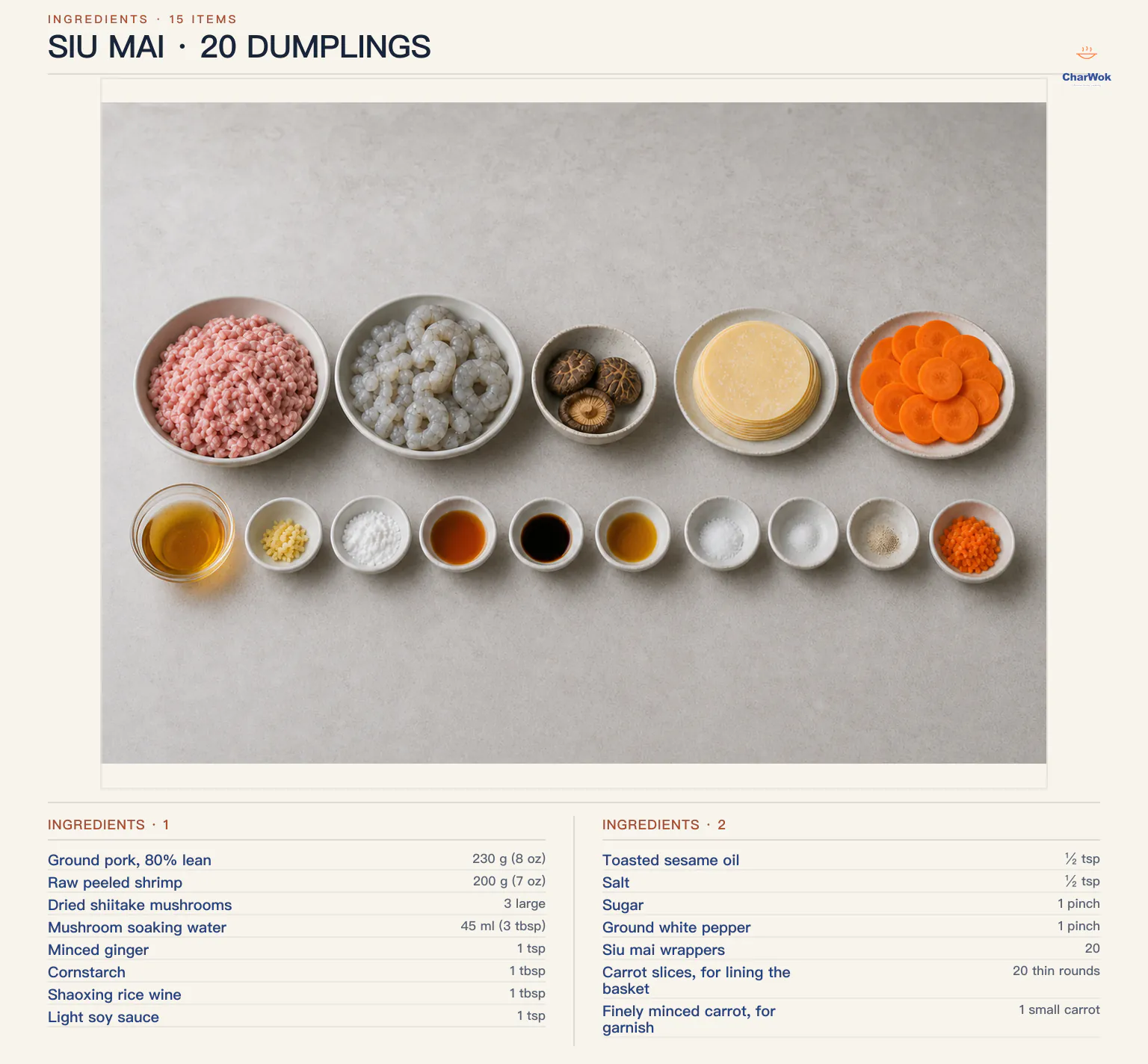
The amounts below make 20 siu mai, which fills one 10-inch bamboo basket in a single layer. I lean on a few pantry staples you should already have if you cook Chinese food often: Shaoxing rice wine, light soy sauce, and toasted sesame oil, so I will not spend time justifying them beyond what each one does in the bowl.
| Ingredient | Amount | Notes / substitute |
|---|---|---|
| Ground pork, 80% lean | 230 g (8 oz) | Not too lean, or the filling dries out. 75–80% lean is the sweet spot. |
| Raw peeled shrimp | 200 g (7 oz) | Medium or large shrimp, cut into ¼-inch cubes. See note on texture below. |
| Dried shiitake mushrooms | 3 large | Rehydrate, then mince. Dried shiitake gives a depth fresh mushrooms cannot. See pantry note. |
| Mushroom soaking water | 45 ml (3 tbsp) | The liquid the mushrooms soaked in. This is the water you beat into the pork. |
| Minced ginger | 1 tsp | Fine grate; you want flavor, not chunks. |
| Cornstarch | 1 tbsp | Helps the filling hold water and gives the bounce. Do not skip. |
| Shaoxing rice wine | 1 tbsp | Cooking wine from a Chinese grocer. Dry sherry in a pinch. |
| Light soy sauce | 1 tsp | Seasoning only; you do not want the filling brown. |
| Toasted sesame oil | ½ tsp | Finish aroma. A little goes a long way. |
| Salt | ½ tsp | Diamond Crystal measure. Morton is denser; use a touch less. |
| Sugar | 1 pinch | Balances the salt, does not make it sweet. |
| Ground white pepper | 1 pinch | White, not black, to keep the filling pale and clean. |
| Siu mai wrappers | 20 | Yellow, round, thin. Thin wonton wrappers cut into rounds are a fine substitute. |
| Carrot slices, for lining the basket | 20 thin rounds | Prevents sticking. Parchment with holes works too. |
| Finely minced carrot, for garnish | 1 small carrot | For the orange dot on top. Optional but traditional. |
On the pork: ask for 80% lean, 20% fat. If your ground pork looks very pink and lean, the filling will be tight and dry. I have made this with 90% lean and regretted it; you can rescue it by beating in an extra tablespoon of water and a few drops of oil, but it never gets the same softness.
On the shrimp: peel, devein, pat very dry, then cube. Wet shrimp weeps water into the filling and dilutes it. The dry surface also helps the pieces stick to the pork instead of sliding out when you bite.
On the mushrooms: pour hot water over the dried shiitake and let them sit 30 minutes (cold water for an hour or two gives a cleaner flavor). Squeeze them out, mince them, and save that dark soaking liquid; it is free umami. Strain it through a fine sieve first, because grit always settles at the bottom.
The method
If you have made a good dumpling filling before, the beating step here is the same idea pushed further. If you have not, read the first step carefully; it is the whole ballgame.
- Beat the filling. Put the pork, mushroom, ginger, cornstarch, wine, soy sauce, sesame oil, salt, sugar, and white pepper into a wide bowl. Add two tablespoons of the strained mushroom soaking water and hold the rest in reserve. Stir with chopsticks or a stiff spatula in one direction only (clockwise is fine, just do not reverse). Press the meat against the bowl as you go. After three to four minutes the mass will look wetter and start climbing the spatula in sticky strings. Add the remaining tablespoon of water and keep going another minute or two, until a spoonful lifted an inch above the bowl forms a slow, stretchy strand before dropping. Five minutes total is normal; if your pork was very cold it may take six. The science: you are physically extracting and aligning the muscle protein myosin, which then traps the water you added so it cannot escape during steaming.
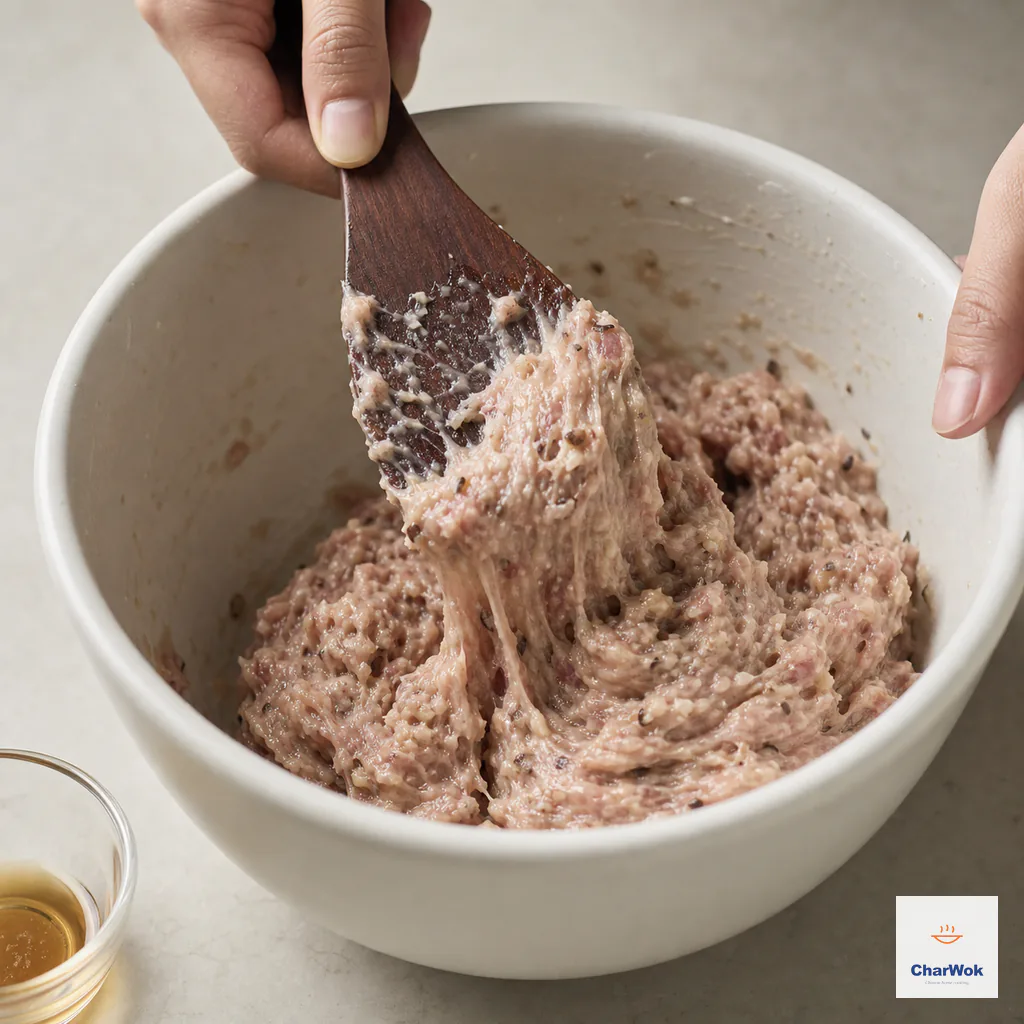
Beat the pork, mushroom, seasonings, and soaking water in one direction until sticky, then fold in the shrimp so the filling stays cohesive without losing its distinct bite
- Fold in the shrimp. Add the shrimp cubes and stir gently, just to distribute, about ten strokes. If you beat the shrimp into the paste you destroy the texture you are trying to build.
- Rest the filling. Cover and chill 15 to 30 minutes. Cold filling is firmer and far easier to portion into the wrappers, and the starch needs a few minutes to hydrate. I sometimes make it the night before and it is better for it.
- Set up your folding station. Have the wrappers, a small bowl of water, and a flat surface ready. Keep the stack of wrappers under a damp towel; siu mai wrappers crack along the edges within minutes in dry air.
- Shape the dumpling. Lay a wrapper across the circle made by your thumb and index finger on your non-dominant hand, like a drumhead stretched across a ring. Put a generous tablespoon of filling in the center, then use a butter knife or frosting spatula in your other hand to press the filling down firmly and flat, so the wrapper molds around it and the meat comes up flush to the rim. Add a little more filling on top and level it again. You want the dumpling to look fat and full, the meat flush with the top edge, the wrapper pleating itself naturally around the sides as a thin yellow skirt. Press the base once on the counter to flatten it so the dumpling stands.
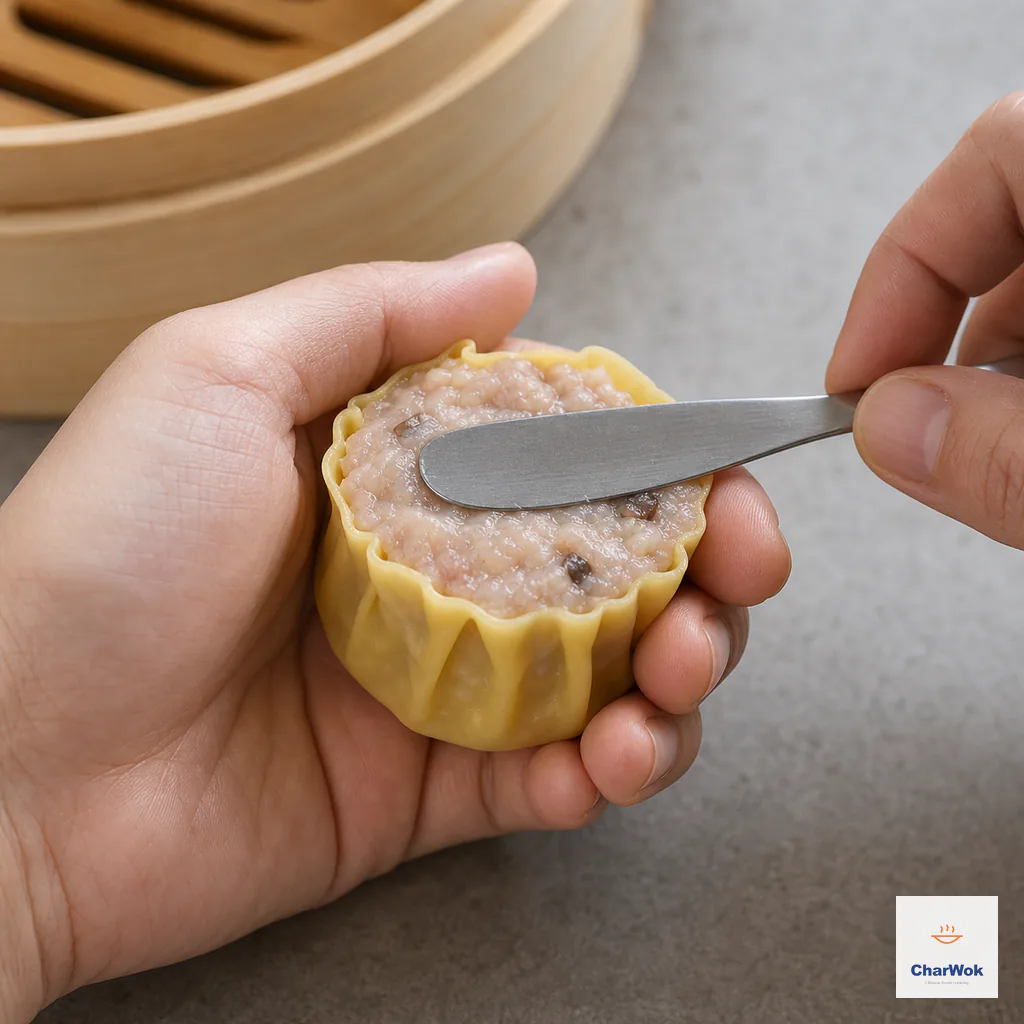
Form a ring with your thumb and index finger, press the filled wrapper through it, and flatten the open top with a butter knife to make the classic siu mai shape
- Garnish. Press a pinch of minced carrot onto the top of each. Tradition also allows a sliver of crab roe or a single goji berry; the carrot is what most home kitchens have.
- Line and load the steamer. Scatter the thin carrot slices across the bottom of your bamboo steamer and stand the dumplings on top with a finger of space between them; they expand slightly. If you do not have carrots, a round of perforated parchment or cabbage leaves works.
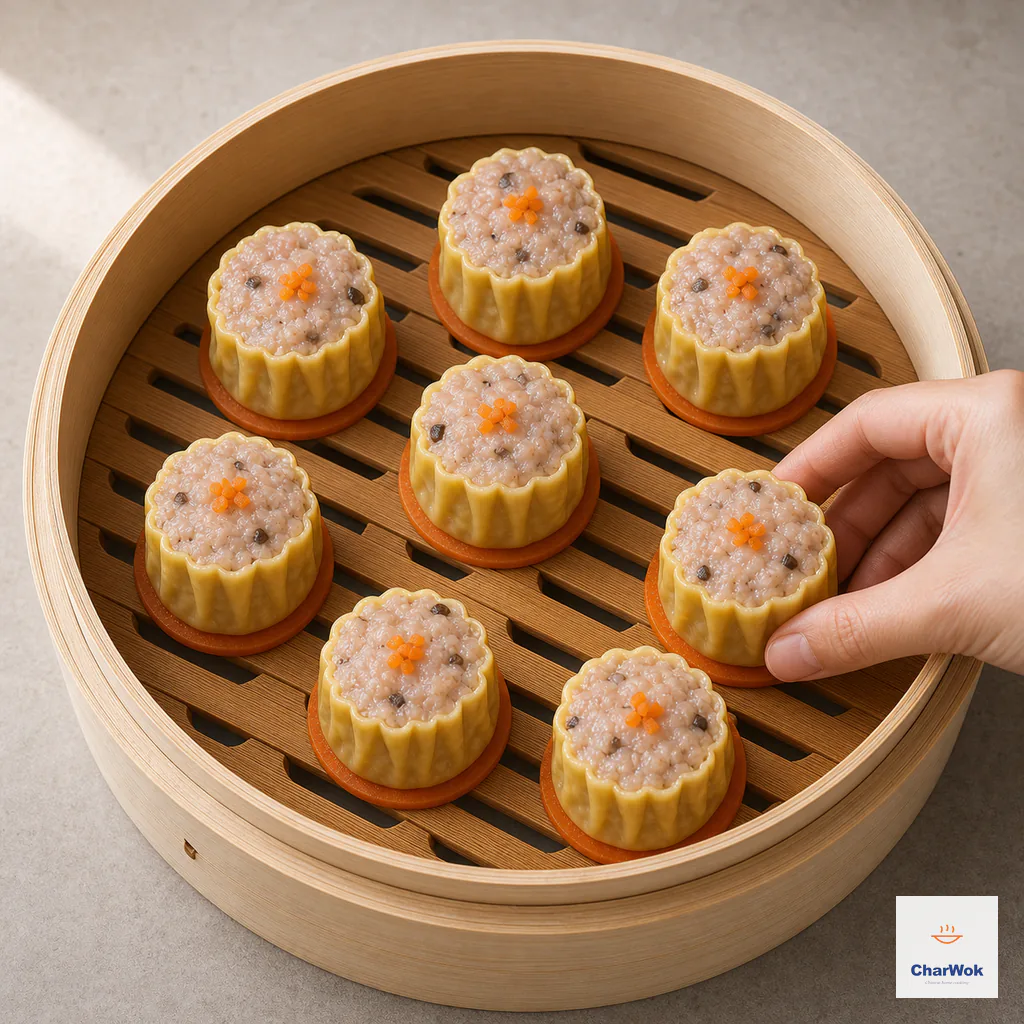
Set each dumpling on one carrot slice and leave space between them in the steamer so the wrappers do not stick as they expand
- Steam hard. Bring the water in your wok or pan to a full, rolling boil before the basket goes on. Stack baskets if you have them. Steam over high heat, covered, for 7 minutes. The hard boil matters: a timid simmer leaves the wrapper doughy and the filling grey. Use the full 7 minutes for a fresh batch.
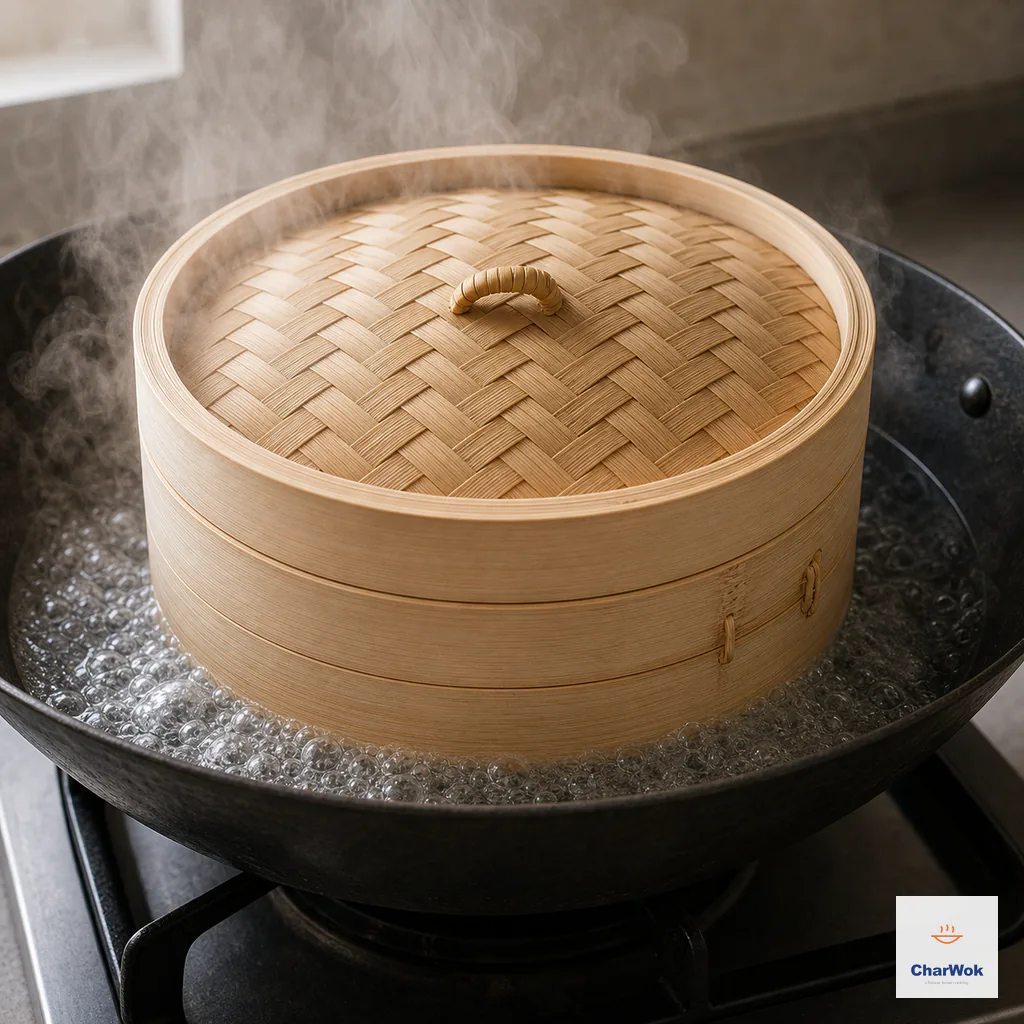
Wait for a full rolling boil before setting the covered basket over the pot; the strong, steady steam cooks the filling evenly
- Serve immediately. Lift the lid, let the condensation drip off away from the dumplings, and bring the basket straight to the table. Siu mai is best the minute the lid comes off; ten minutes later the wrapper starts to toughen.
When it goes wrong, and how to fix it
I keep a short list of the failures I have actually eaten, because they are common and most are fixable on the next batch.
- The filling is dense and crumbly, not bouncy. You stopped beating too early, or you reversed direction. Next time, set a five-minute timer and pick a direction you will not break. You cannot over-beat by hand.
- The filling wept a puddle into the basket. The shrimp was wet when you cubed it, or the pork was too lean to hold the water. Pat shrimp bone-dry next time, and use 80% lean pork. Adding a second tablespoon of cornstarch also helps bind.
- The wrappers tore while folding. Either they dried out (keep them covered) or the filling is too wet and heavy for the wrapper. Drain any liquid from the bowl before portioning, and do not overfill; a level tablespoon, pressed, is enough.
- The dumplings stuck and tore on the way out. You skipped the carrot slices or parchment, or you let them touch. Use the lining and leave gaps.
- The wrapper turned out gummy and pale. The water was not at a full boil when the basket went on, or you steamed at medium heat. Siu mai wants aggressive steam for the full time.
- The shrimp disappeared into the pork. You minced it instead of cubing it, or you beat it in with everything else. Cube to pea-size and fold it in last.
Sauces, sides, and how to build a proper tea-house spread
Siu mai is rich enough to eat plain, but a dip makes the difference between a snack and a meal. My default is black rice vinegar with a thin strip of ginger and a few drops of chili oil floating on top. The vinegar's low, malty acidity cuts the pork fat without drowning the shrimp. A soy-and-ginger dip or a straight chili-oil dunk also works; if you want a full menu, the six classic dumpling sauces are worth learning.
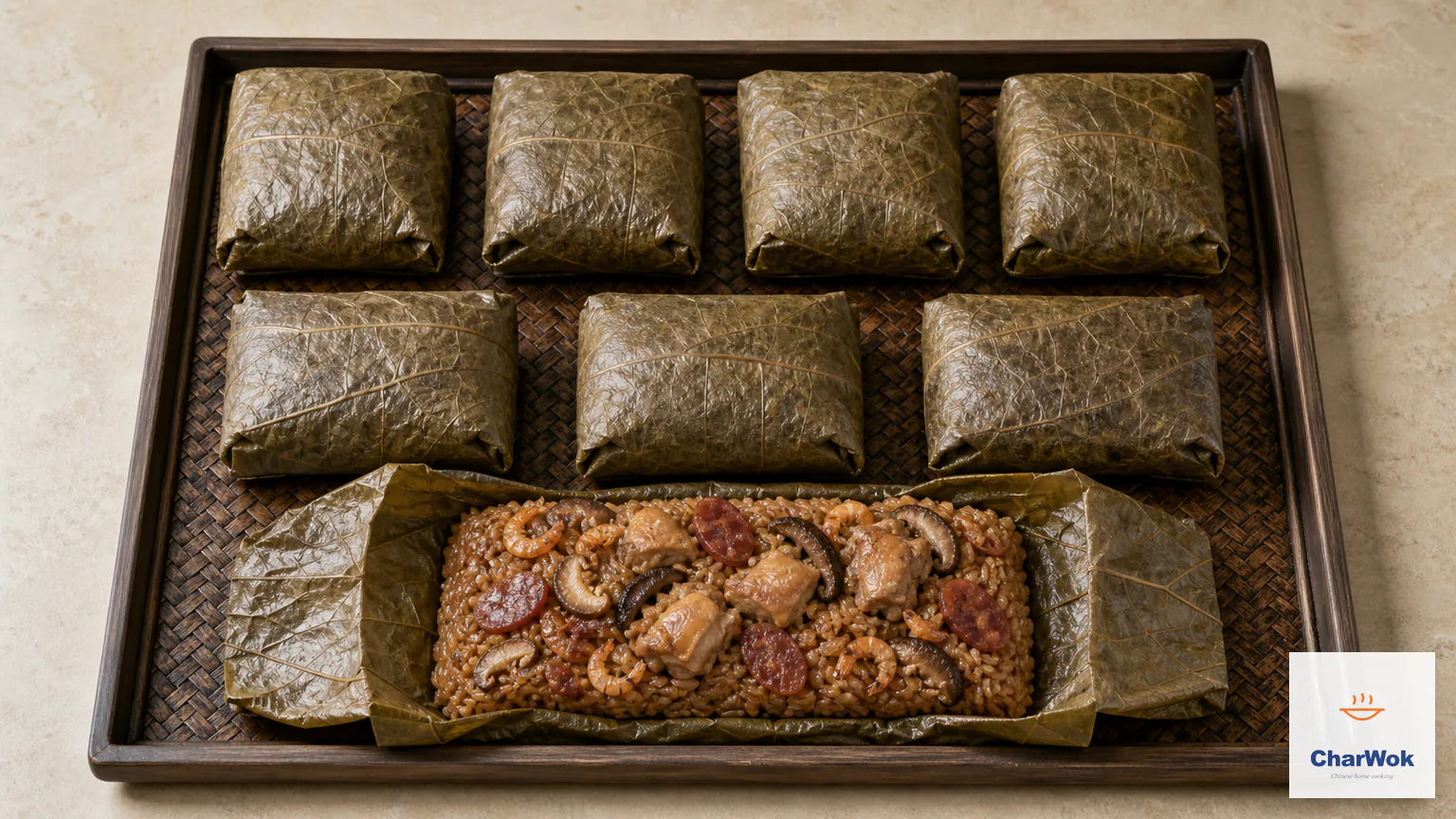
To turn a basket of siu mai into an actual dim sum lunch, pair it with one or two other steamed items that share the same burner. Cheung fun rice noodle rolls and lo mai gai sticky rice in lotus leaf both steam alongside with no extra equipment, so you are running one pot of water for the whole meal. A plate of smashed cucumber or blanched greens on the side keeps the richness honest.
Variations worth a try
- Fish-paste siu mai. Replace half the pork with pounded fish paste for a lighter, whiter, more springy filling, closer to what you get in Hong Kong seafood houses.
- Mushroom-forward, lower-meat. Double the shiitake to six and drop the pork to 150 g for a less rich, more earthy dumpling.
- Crab roe top. Press a small piece of crab roe (or a sliver of cured salted egg yolk) onto each top instead of carrot for the traditional golden finish.
- Spicy version. Fold a half-teaspoon of Chiu Chow chili oil into the filling for a slow, oily heat that plays well with the shrimp.
Make ahead, freeze, and reheat
This is one of the better make-ahead dumplings because the open top means there is no sealed seam to crack. Assemble them fully, set them on a tray in a single layer, and freeze until solid. Once hard, transfer to an airtight bag and keep them up to three months. Do not thaw before cooking. Steam straight from frozen for 10 to 12 minutes over a hard boil, adding a minute if your kitchen is cold.
Reheating already-steamed siu mai is the one place I will tell you to leave the steamer alone. Re-steaming makes the wrapper soggy and the filling rubbery. A better path is to reheat them in a covered skillet with a tablespoon of water over medium-low heat for about three minutes, which warms the filling through without punishing the wrapper.
Frequently asked questions
A few short answers to the questions I get asked most often after a batch lands on the table.
Can I use wonton wrappers? Yes. Thin square wonton wrappers work if you trim them into rough rounds or just fold them loosely into a cup shape; they are thinner than real siu mai skins, so pleat gently and do not overfill.
Do I really have to stir for five minutes? Yes, if you want the bouncy texture. Under four minutes the proteins have not aligned enough to trap water, and the filling steams dense. A stand mixer with a flat beater on medium does the same work in about two.
Why is my filling grey instead of pale? Usually too much dark soy, or black pepper instead of white. Keep to light soy, white pepper, and skip any dark coloring ingredient, and the dome stays appetizingly pale.
Can I pan-fry these instead of steaming? Not well. Siu mai wrappers are thin and the open top means there is nothing to protect the filling in a dry pan. Steaming is the right method; for a crispy-bottom dumpling, you want a sealed pan-fried dumpling instead.
How do I know the shrimp is done? The cubes turn from translucent grey to opaque pink and firm. At 7 minutes of hard steam this is reliable; cut one open if you are unsure and add a minute if the center still looks glassy.
Siomai rewards the one boring step everyone wants to skip. Beat the filling properly, cube the shrimp, hit it with a hard steam, and the rest of the recipe mostly takes care of itself. The first time you pick one up with chopsticks and feel that slight resistance before the bite gives way to pork, shrimp, and mushroom, you will understand why this dumpling has held the top spot on the dim sum cart for as long as there has been a cart.