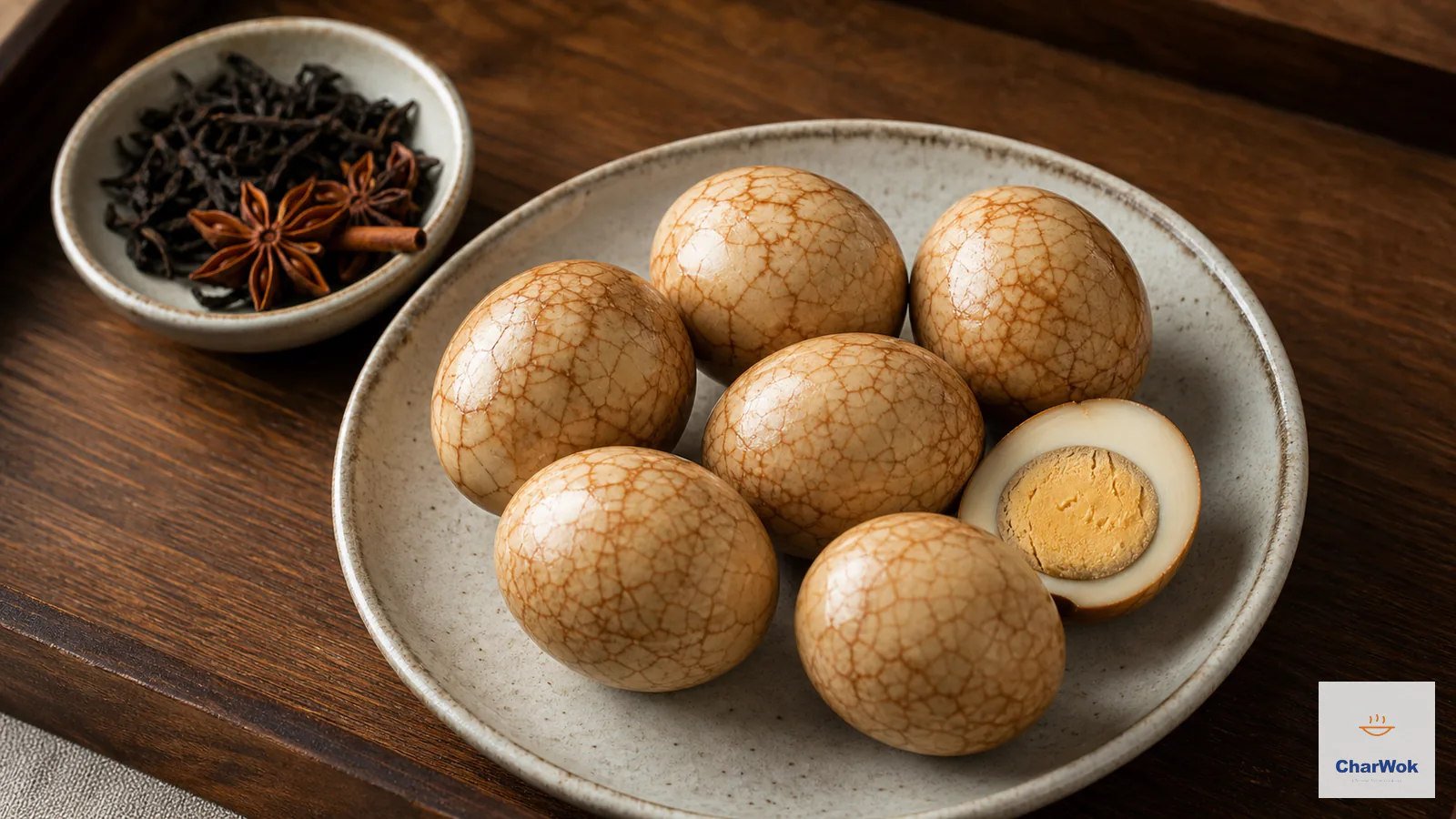
A good tea egg is two things at once: a savory snack and a small work of marbled pottery. Crack the shell just so, simmer it in tea and warm spices, and the dark brew seeps through the fractures to vein the white in brown rivers. The yolk, meanwhile, turns creamy and faintly mineral, the way a long, low braise transforms anything it touches.
Where most home cooks go wrong is treating it like a hard-boiled egg with food coloring. It is not. The marble is a controlled accident, and the flavor needs a full day of patience before it is anything special. I once pulled a batch out after four hours because I was hungry, and they tasted like nothing, just boiled eggs with a tan. The technique is easy. The waiting is the whole dish.
At a glance: Boil eggs 8 minutes, shock in cold water, crack the shells in a fine spider-web (do not peel), then steep in a black tea, soy, and spice broth for at least 12 hours, ideally 24. One batch keeps a week in the fridge and the marinade can be reused three or four times. The single biggest decision: how hard you crack the shell decides whether you get marble or mud.
What tea eggs are, and where they come from
Tea eggs (ye dan in Mandarin) are a street snack with a thousand mothers. You will find versions across mainland China, Taiwan, Hong Kong, and into Southeast Asia, sold from steam carts at train stations and tucked into convenience-store warmers next to the soy-milk and bun shelf. In Taiwan they are practically a national comfort food, simmered all day in electric pots at every 7-Eleven. The Chinese version tends to be more spiced and less sweet; the Taiwanese leans softer and saltier.
They belong to a wider family of soy-braised foods, cousins to red-cooked pork belly and the master stock used for beef shank, but the egg is unique because the shell stays on as a stencil. No other braise works like this. The same impulse that gives us century eggs, preserved with alkali until the white turns amber jelly, runs through tea eggs too: a Chinese love of transforming a humble egg through chemistry and time. Tea eggs are just the friendlier, prettier branch of that family.
The ingredients, and why each one is there
Ingredients at a glance
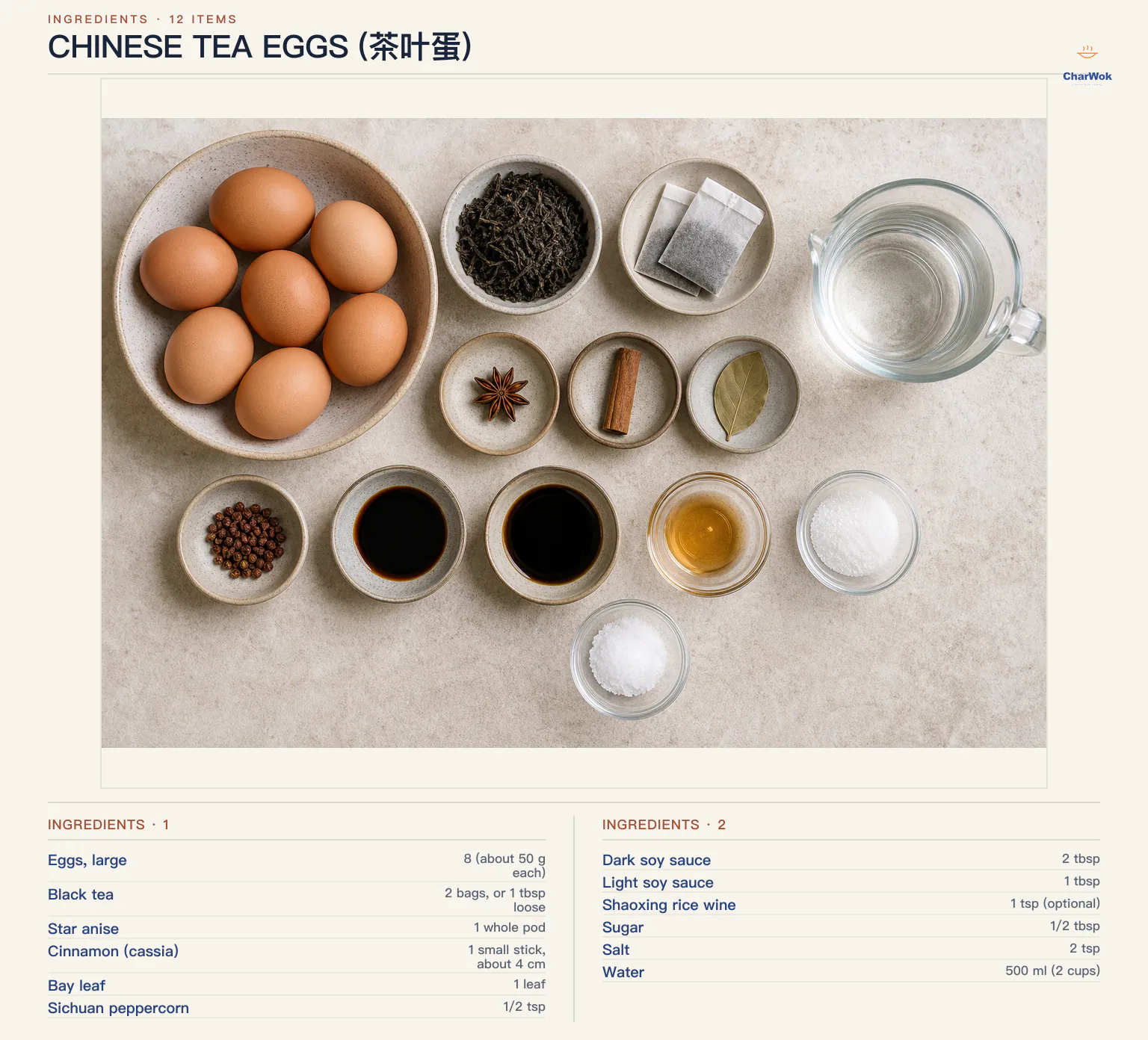
Most recipes read like a spice-cabinet inventory. Mine is short on purpose, because every item is pulling weight. Here is the full lineup for 8 eggs.
| Ingredient | Amount | Notes / substitute |
|---|---|---|
| Eggs, large | 8 (about 50 g each) | Room temperature so they don't crack in the boil. Older eggs peel cleaner than very fresh. |
| Black tea | 2 bags, or 1 tbsp loose | Lapsang souchong or a basic Chinese black tea like keemun. Avoid Earl Grey, the bergamot fights the spices. |
| Star anise | 1 whole pod | The backbone of the aroma. Two pods if yours are old and faded. |
| Cinnamon (cassia) | 1 small stick, about 4 cm | Cassia is traditional and warmer than true Ceylon cinnamon. A cassia bark piece works. |
| Bay leaf | 1 leaf | Any bay leaf is fine. It rounds the back of the flavor. |
| Sichuan peppercorn | 1/2 tsp | Adds a low hum of citrus and a faint tingle. Toast lightly first if yours smell flat. See the full guide to Sichuan pepper for sourcing. |
| Dark soy sauce | 2 tbsp | For color. Dark soy is thicker, less salty, and molasses-toned. If you want to understand the difference, read up on light vs. dark soy sauce. |
| Light soy sauce | 1 tbsp | For salt and savory depth. Regular soy sauce works if you only have one bottle. |
| Shaoxing rice wine | 1 tsp (optional) | Softens any sulfurous edge from the yolk. Cooking sherry is a fair substitute; good Shaoxing wine is worth keeping around. |
| Sugar | 1/2 tbsp | Rocks are traditional. Either dissolves fine. Rock sugar gives a cleaner sweetness. |
| Salt | 2 tsp | Adjusts to taste. The soy sauces already carry salt, so taste the cooled broth. |
| Water | 500 ml (2 cups) | Just enough to submerge the eggs in their steeping container. |
Why this works, before you start
Three things are happening, and understanding them is what separates a pretty egg from a good one.
One, the 8-minute boil sets the white and leaves the yolk tender. A fully hard, 12-minute yolk turns chalky and gray-ringed after a long soak and refuses to absorb flavor. Eight minutes gives you a just-set yolk that turns custardy and almost fudge-like by day two. Want it runny? Pull at 7, but know a runny yolk dilutes the broth and the egg won't keep as long.
Two, the shell is a stencil. Cold water shocks the egg and shrinks it away from the shell, so the shell cracks instead of the white. The finer and more even your crack network, the more the broth can travel. A few heavy taps give you big brown blotches; a thorough all-over press gives you lace.
Three, the steep is a low extraction, not a boil. Tea tannins and spices need time, not heat. Boiling the eggs in the broth for an hour would overcook the white into rubber and turn the tannins bitter. Three minutes of simmer builds the broth; twelve to twenty-four hours of cold steep builds the egg.
The method, step by step
- Boil the eggs 8 minutes. Bring a generous pot of water to a rolling boil, enough to cover the eggs by a couple of inches. Lower the heat so it's bubbling steadily but not violently, then slip the eggs in with a slotted spoon. Start the timer at 8 minutes for a tender, just-set yolk. Do not salt the water, it does nothing for the shell and is folklore.
- Build the broth while the eggs cook. In a separate saucepan, combine the tea, star anise, cinnamon, bay leaf, Sichuan peppercorn, both soy sauces, wine, sugar, salt, and 500 ml water. Bring it to a boil, then let it simmer 3 minutes. Pull it off the heat. This short simmer is enough to bloom the spices and pull color and tannin from the tea without going bitter.
- Shock the eggs in cold water. The instant the timer goes, lift the eggs straight into a bowl of cold water, ideally with ice. Leave them two to three minutes until you can hold one comfortably. This fast chill is what contracts the egg inside the shell and makes the next step possible instead of a mess.
- Crack the shells in a fine web, and leave them on. Take each egg and press it gently against the counter, rolling it under your palm so it cracks all over. You want a network of fine fractures, not a few deep gashes. The shell stays on. This is the step that makes tea eggs tea eggs. Do not peel. Do not be shy, but do not crush: too few cracks and you get bald patches, too many and the shell collapses into the broth and you lose the pattern.
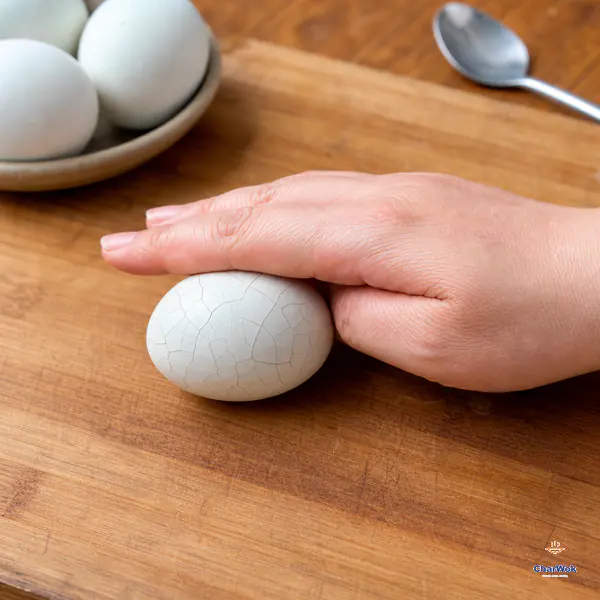
Once the eggs are cool enough to hold, roll each one gently under your palm or tap with a spoon until fine cracks cover the whole shell. Keep both shell and membrane attached; deep gashes or missing pieces produce blotches instead of marbling.
- Steep, refrigerated, 12 to 24 hours. Pack the cracked eggs into a container they fill snugly, so you need less broth to cover them. Pour the broth, tea bags and spices and all, over the top; submerge fully. Cover and refrigerate. At 12 hours you have a flavored egg. At 24 you have a tea egg. Turn the eggs once halfway if any poke above the liquid.
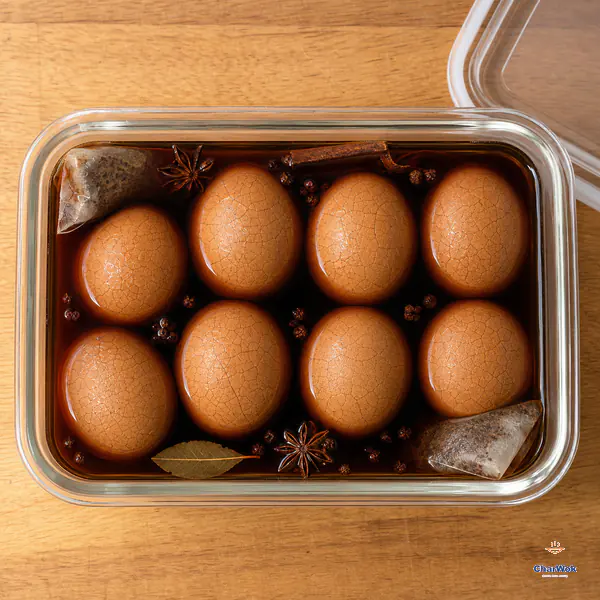
Pack all eight cracked eggs into a snug container, pour in the completely cooled tea-and-soy broth and keep every egg below the surface. Cover and refrigerate for 12 to 24 hours, turning once halfway only if an egg rises.
- Peel and serve, warm or cold. Peel under a thin stream of cold water, it gets between membrane and shell and lifts both. The marble reveals itself now. Eat cold from the fridge, or warm one gently in a bowl of hot water for two minutes. Never microwave, the yolk goes sulfurous and tough.
When the marble goes wrong
This is the part that frustrated me for years, because the failure is invisible until you peel. Here are the four common ones and how to read them.
Big brown blotches instead of veins. Your cracks were too few and too deep. Next time roll the egg firmly under your palm to make dozens of tiny fractures rather than tapping it in a few spots. Think spider web, not hammer.
The white is barely stained. Either the steep was too short, or the broth was too dilute. Tea eggs need a deep, almost black tea. If your tea was weak or stale, the color never develops. Use fresh black tea and steep the full 24 hours before judging.
The yolk has a gray-green ring. You overcooked the initial boil, or the egg sat too long at a high simmer. The ring is iron sulfide, harmless but ugly and dry-tasting. Drop to 7 or 8 minutes and ice-shock immediately.
The shell won't come off cleanly. Your eggs were very fresh. The membrane bonds tightly to fresh whites. Use eggs that are a week old, shock them thoroughly in ice water, and peel under running water. I keep a dedicated dozen in the fridge door marked "for boiling."
Variations and how to serve them
The classic flavor is warm spice, but the broth is a template. Drop in a dried chili or two if you want a slow heat, or a thumb of smashed ginger for brightness. A spoon of five-spice powder is a shortcut that pulls the whole spice profile into one teaspoon, useful when you don't keep whole star anise around. For a darker, sweeter Taiwanese lean, swap some of the sugar for rock sugar and add an extra tablespoon of dark soy.
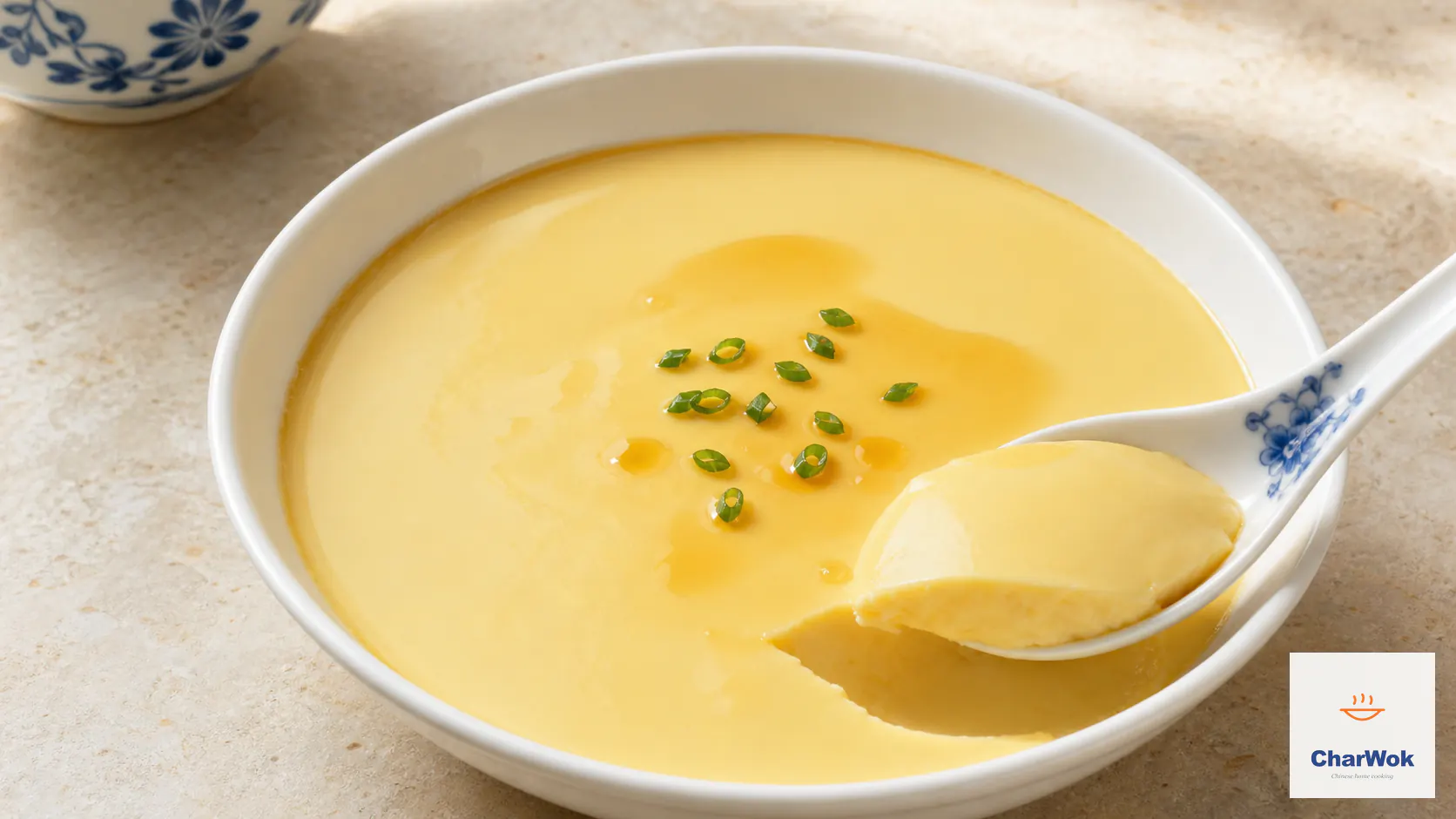
As a snack they need nothing. As part of a meal, tea eggs slot in anywhere you'd want a cold, savory bite. They are excellent alongside a bowl of plain rice congee for breakfast, or as one plate among many at a dim sum spread, where they sit happily next to the usual steamed and fried things. On a hot afternoon, halve two and serve them with quick-pickled vegetables and a dish of chili oil for dipping. They belong in the same cold-case universe as the classic Chinese breakfast table, alongside silky steamed eggs and egg foo young, and they pair just as well with a glass of cold soy milk.
If you want to lean fully into the pantry, a single shelf of the ten condiments every Chinese kitchen needs will stock you for this recipe and a hundred others, the soy sauces, wine, and rock sugar here are all on that list.
Storage and reheating
Keep peeled or unpeeled tea eggs submerged in their broth, covered, in the fridge for up to a week. They keep getting better for the first three days, then plateau. To serve warm, lower a peeled egg into a bowl of just-boiled water for two minutes; the yolk turns silky without ever toughening.
The broth is reusable and that is half the point of making a big batch. Strain it, bring it back to a full rolling boil for three minutes each time to keep it safe, then cool and freeze. Top up with fresh tea and spices every second use, because the tannins exhaust. This is the same logic as a master stock, and the disciplined version of what serious cooks do when they keep a long-aged master stock on the back of the stove. Three or four cycles is realistic before the broth tastes tired and you start over.
FAQ
Do I peel the eggs before steeping?
No. The shell stays on. That's what creates the marble pattern as the broth seeps through the cracks. If you peel first, you just get uniformly brown eggs.
Can I use green or oolong tea?
Black tea is traditional because it gives the deepest color and the most tannin. Oolong works but stains paler and tastes lighter. Green tea lacks the tannin to penetrate the white and will barely mark it.
How long do I really need to steep?
12 hours minimum, 24 for the full effect. Anything under 8 hours and you'll be disappointed, the flavor won't have reached the yolk.
Why are my eggs bland even after 24 hours?
Usually weak tea or a thin broth. Use a robust black tea, don't skimp on the salt, and make sure the eggs are fully submerged, the half above the liquid stays pale.
Are tea eggs safe at room temperature?
For a few hours, yes, but they keep best refrigerated. The salt and soy help, but they don't make the egg shelf-stable. Cold storage, up to a week.