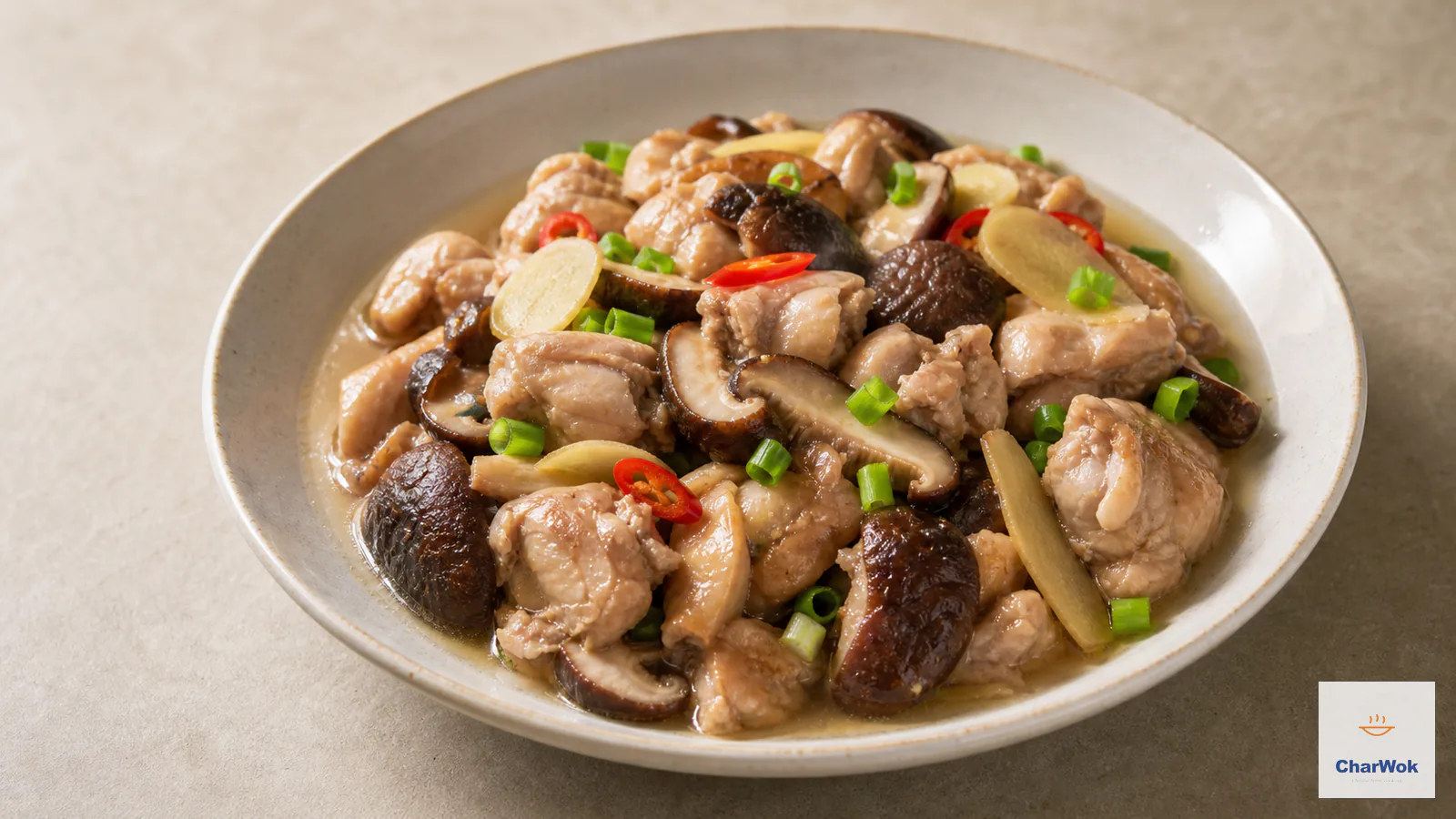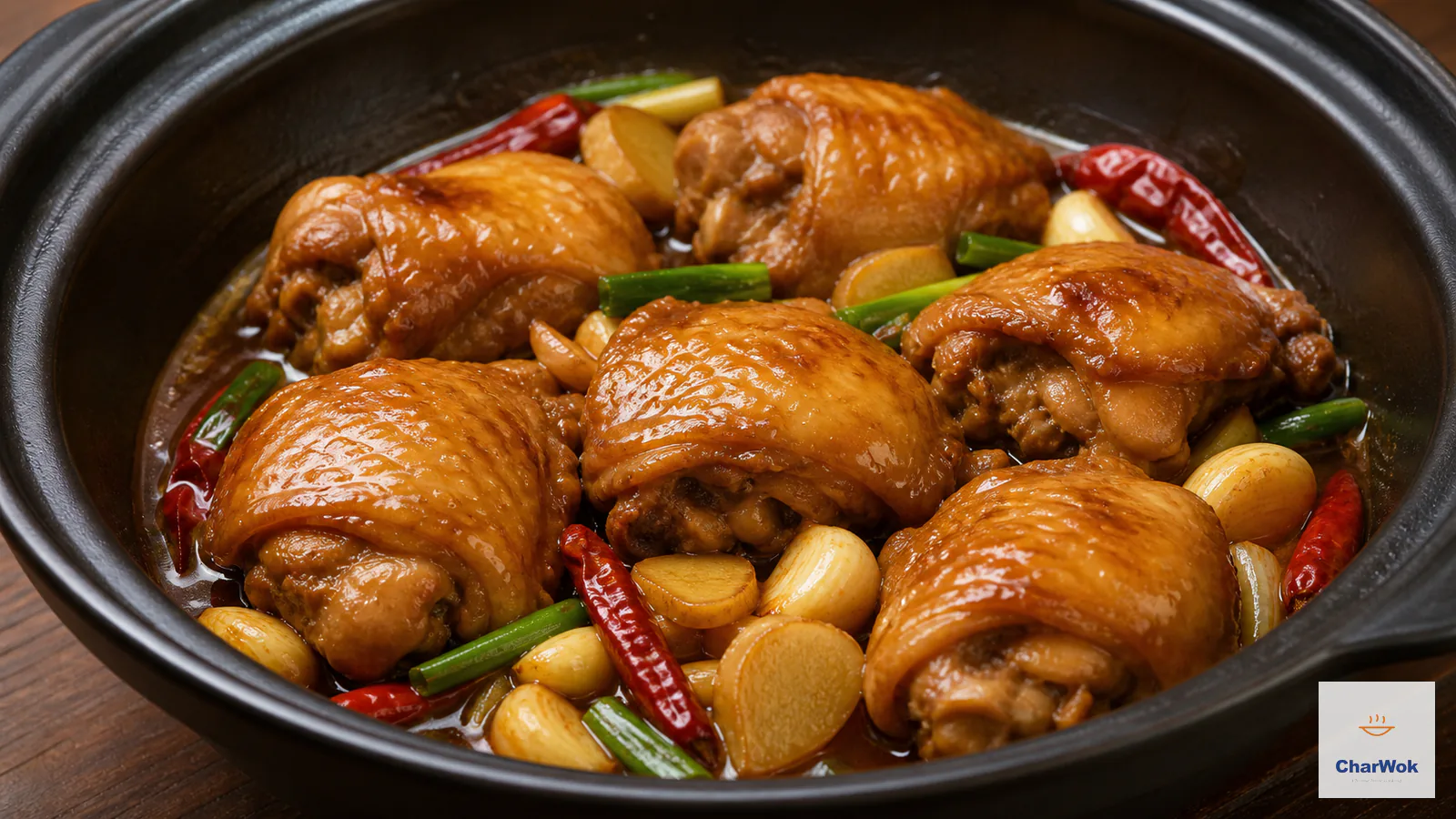
Soy sauce chicken gets its deep colour from a soy-and-spice braising liquid rather than an oven. A whole bird needs careful turning or basting so that it cooks and colours evenly; bone-in thighs are easier to keep in one layer and measure for doneness.
This version uses six skin-on, bone-in thighs. They cook at a gentle simmer, are turned once, and are finished only when the thickest parts reach the safe temperature for poultry.
Braise six bone-in chicken thighs (about 1 kg / 2.2 lb) in a soy-spice broth at a bare simmer. Turn them after 35 minutes, then begin checking after another 10 minutes. Every thigh must reach 74°C / 165°F at its thickest point, away from the bone.
What this dish actually is
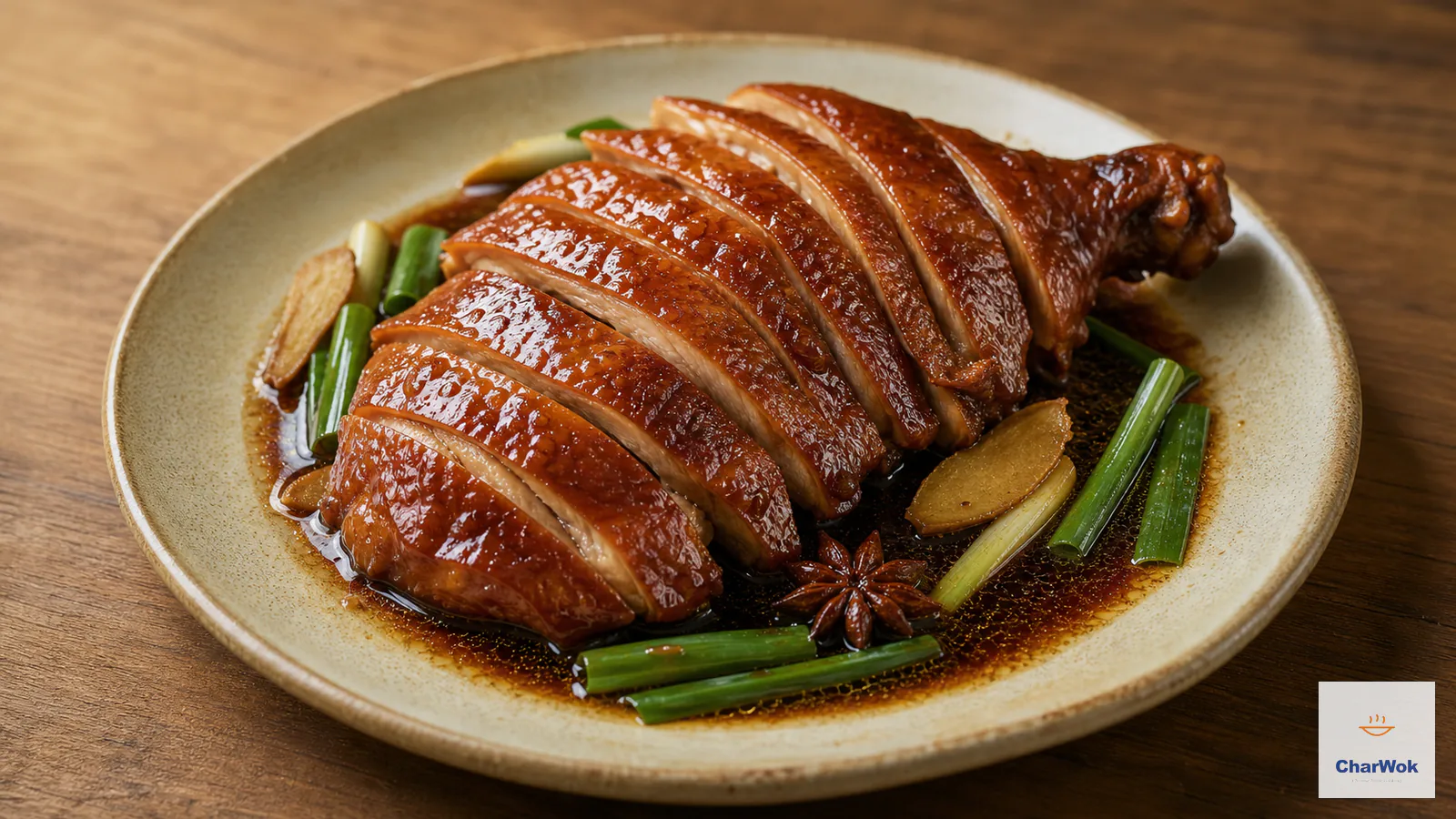
See Yao Gai (豉油鸡) belongs to the siu mei family, the Cantonese roast-and-braise counter meats you see hanging on hooks alongside char siu chicken, roast goose, and crisp-skinned pork. What sets soy sauce chicken apart is that it never meets the oven. The deep reddish-brown color and the faintly sweet, savory depth come entirely from the braising liquid. Done right, the skin has a soft, jelly-like sheen and the meat near the bone is faintly pink and still juicy, not the gray of overcooked poultry.
Colour near the bone is not a reliable doneness test. Check several of the largest thighs with a food thermometer; each must reach 74°C / 165°F at the thickest point without touching bone. See the FoodSafety.gov safe-temperature chart.
Why thighs, and why bone-in
Skin-on, bone-in thighs suit this gentle braise and are forgiving to cook. Chicken breast can be used, but it should be checked earlier and removed as soon as it reaches 74°C / 165°F; scallion chicken chops are a quicker alternative. Drumsticks and wings also work, but their size changes the cooking time.
Bone-in thighs take longer than boneless pieces, so they should not share a fixed cooking time. Whatever cut you use, temperature—not colour, clear juices, or tenderness—is the finishing test.
If you want the full traditional experience with a whole chicken, the technique changes and so does the difficulty. Whole-bird versions like salt baked chicken, five spice chicken, and wok-smoked chicken each demand their own method. For a first pass at this particular dish, thighs are the honest answer.
The braising liquid, broken down
Ingredients at a glance
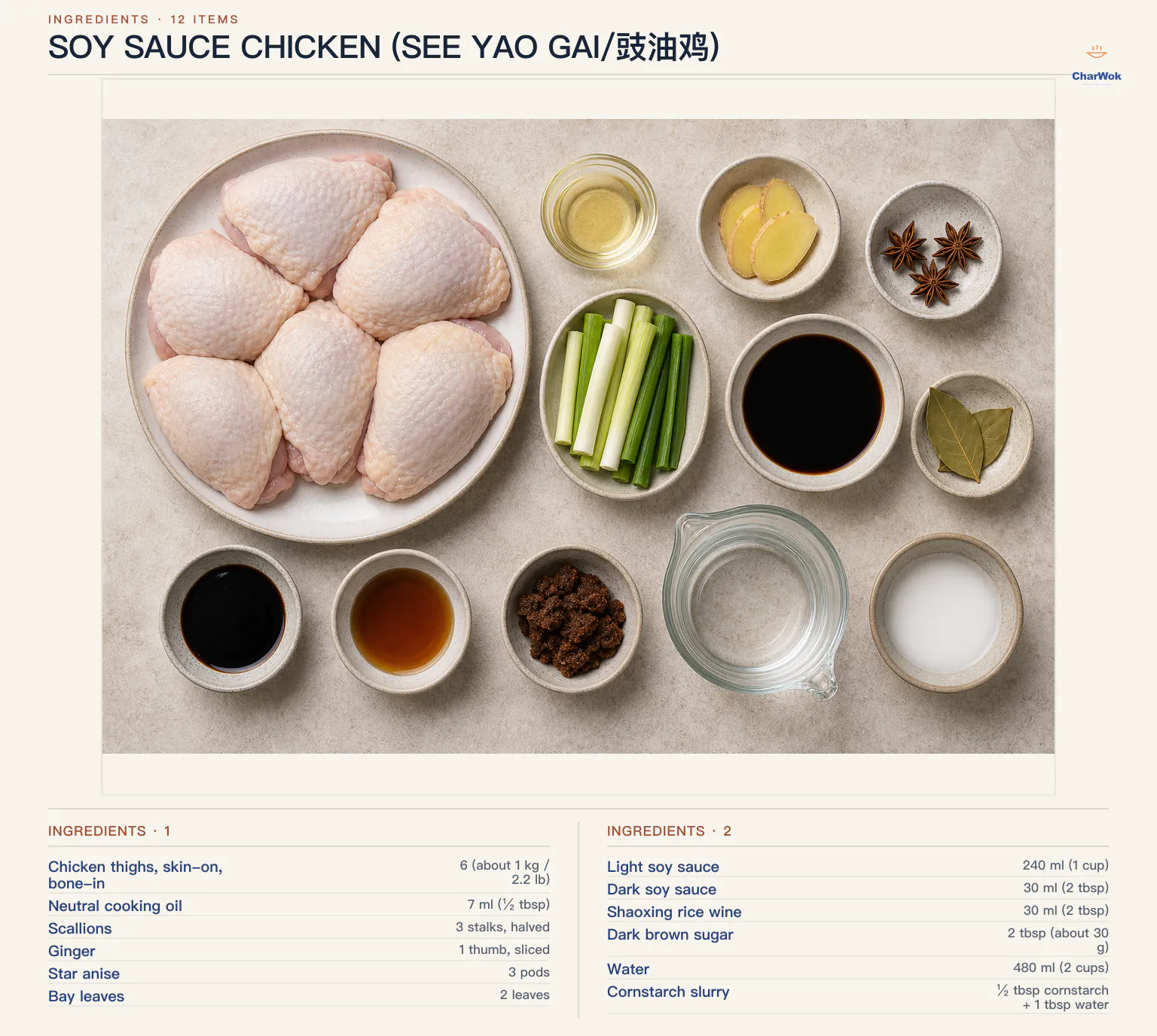
This broth is the whole dish, so it is worth understanding what each part does. There is a lot of soy sauce relative to water here, and that is deliberate. The liquid needs to be concentrated enough to season the meat in a relatively short braise rather than a long stew.
| Ingredient | Amount | Notes / substitute |
|---|---|---|
| Chicken thighs, skin-on, bone-in | 6 (about 1 kg / 2.2 lb) | Drumsticks, wings, or breast need separate temperature checks |
| Neutral cooking oil | 7 ml (½ tbsp) | Any high-smoke-point oil; avocado, canola, peanut |
| Scallions | 3 stalks, halved | The green tops give aroma; keep both parts |
| Ginger | 1 thumb, sliced | About 20 g; smash the slices to release more oil |
| Star anise | 3 pods | The defining spice; do not skip |
| Bay leaves | 2 leaves | Add cassia, cloves, or a Tsao-ko pod if you have them |
| Light soy sauce | 240 ml (1 cup) | If you only have one soy sauce, use it here in full |
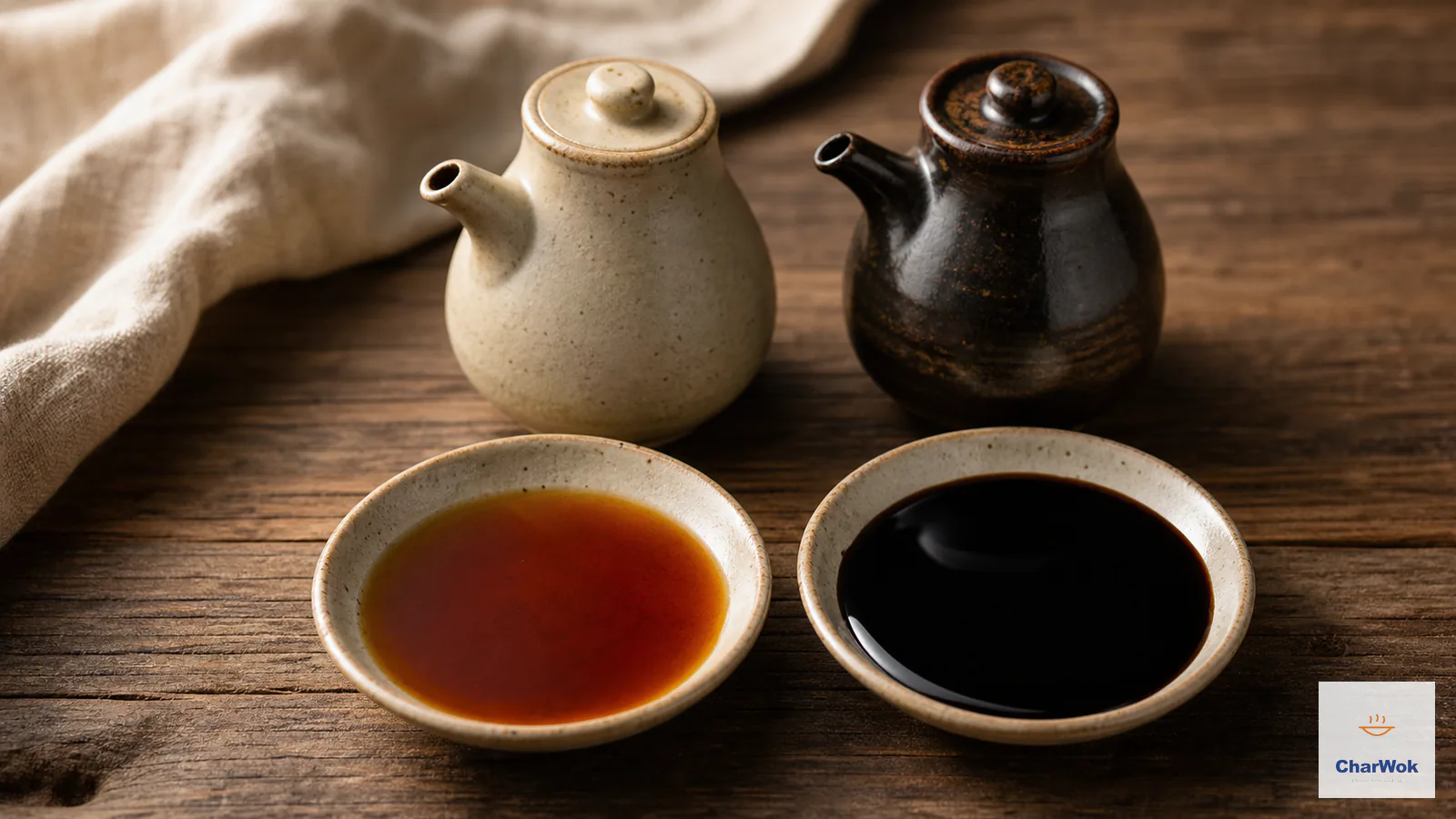
| Dark soy sauce | 30 ml (2 tbsp) | For color and a faint caramel note; see light vs. dark soy |
| Shaoxing rice wine | 30 ml (2 tbsp) | Or Chinese rose wine (mei gui lu jiu) for the authentic Cantonese aroma; Shaoxing wine is the easy substitute |
| Dark brown sugar | 2 tbsp (about 30 g) | Or 40 g rock sugar; either works |
| Water | 480 ml (2 cups) | Adjust so the liquid covers two-thirds of the meat |
| Cornstarch slurry | ½ tbsp cornstarch + 1 tbsp water | Only for the finishing sauce, optional |
The two soy sauces and why you want both
Light soy sauce supplies most of the seasoning; dark soy sauce mainly deepens the colour and adds a mild sweetness. If you only have all-purpose soy sauce, use it in place of the light soy and omit the dark soy. Brands vary in sodium, so compare labels and dilute the braising liquid with about 60 ml more water if needed.
A word on the sugar and the wine
Rock sugar or brown sugar can supply the sweetness. Chinese rose wine adds a floral note, while Shaoxing rice wine is an accessible substitute. For an alcohol-free version, omit the wine; the soy, ginger, and spices still season the broth.
How to cook it
Pick a pot or wok that holds the thighs in a single layer without much wasted space. Too wide and you will need extra liquid to cover; too narrow and the meat stacks. A 28 cm wok or a 24 cm Dutch oven is about right for six thighs. The wok guide explains pan selection and seasoning.
- Sweat the aromatics. Add the oil, scallions, ginger, star anise, and bay leaves to the cold pan, then set it over low heat. Starting cold and going low lets the spice oils bleed into the fat gradually instead of scorching. You want the scallions and ginger to take on a light tan at the edges and the kitchen to smell warmly of anise. This takes three to four minutes. Burn the star anise and the whole pot turns bitter.
- Build the broth. Pour in the light and dark soy sauce, the wine, the sugar, and the water. Turn the heat to high and bring it to a full boil. Boiling first does two things: it dissolves the sugar completely and it drives off the harsh alcohol edge from the wine before the meat goes in.
- Slide in the chicken, skin down. Lower the thighs in gently so you do not splash. Arrange them skin side down in a single layer, with no overlap. Add a splash more hot water if needed so the liquid comes at least two-thirds of the way up the meat. The skin side down start helps the fat render and the skin pick up color early.
- Drop to a real simmer. When the broth returns to a boil, lower the heat until you see only the occasional bubble break the surface. A hard boil will toughen the protein and cloud the broth. Cover and simmer for 35 minutes.
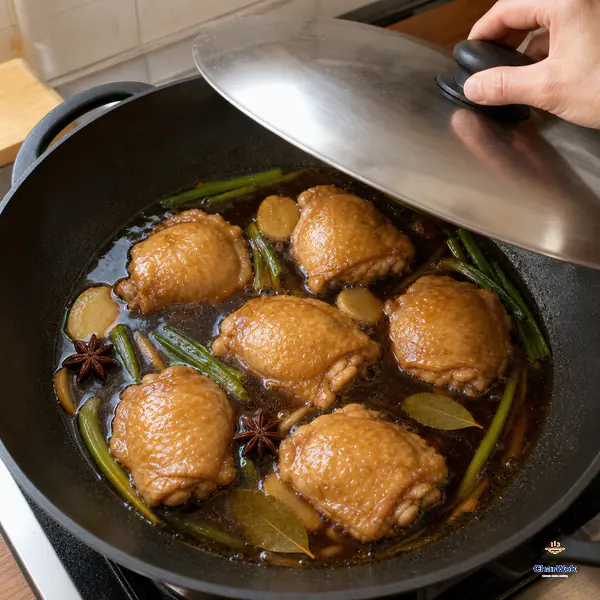
After the first 35-minute simmer, turn every thigh so the previously pale side enters the broth. Cover and simmer about 10 minutes more, then check several thick parts away from bone; every piece must reach 74°C / 165°F.
- Flip, then check by temperature. Turn every thigh so the paler side enters the liquid. Cover and cook for another 10 minutes, then insert a food thermometer into the thickest part of several large thighs without touching bone. Continue simmering until every piece reaches 74°C / 165°F. Move any piece that reaches temperature early to a clean plate.
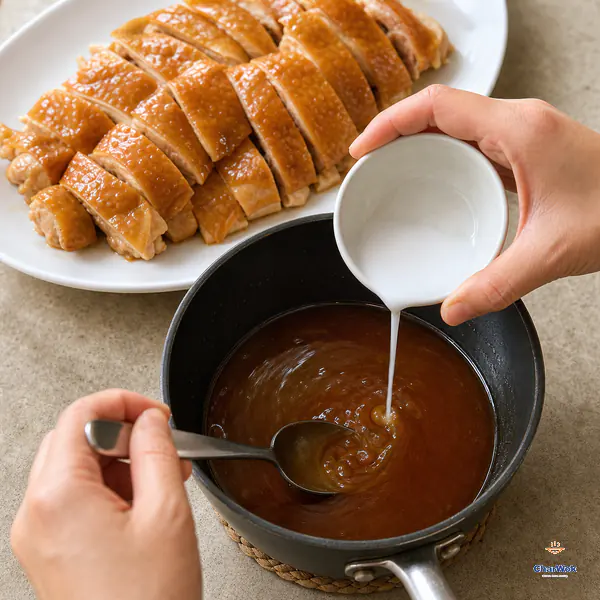
Keep about 120 ml of broth and heat it just below a boil, then add the well-stirred slurry gradually while stirring; remove it as soon as the sauce turns smooth, translucent and lightly glossy.
For wings, begin checking around 25 minutes; for drumsticks, around 35 minutes; and for whole legs or leg quarters, around 45 minutes. Boneless thighs may be ready sooner. These are starting points only: spread pieces in one layer and confirm that each reaches 74°C / 165°F. For a faster boneless method, see scallion chicken chops.
When it goes wrong
Most problems come from excessive heat, an overcrowded pan, or soy sauce with an unexpectedly high sodium level.
- Too salty. Almost always the soy sauce. Different brands vary wildly in salt content. Fix it this time by serving the chicken with plenty of plain rice and a lighter hand on the finishing sauce; fix it next time by adding 60 to 120 ml more water, or swapping in a lower-sodium soy for a third of the light soy.
- Pale, uneven skin. The heat was too low, the liquid did not actually cover enough of the meat, or you skipped the flip. The flip at 35 minutes is not optional; it is what dyes the top half.
- Skin torn or ragged. You moved the chicken too soon, or you boiled instead of simmered. Let the thighs sit undisturbed in the first phase. A bare simmer keeps the connective tissue intact.
- Tough, dry meat. Two causes: a rolling boil that seized the muscle fibers, or overcooking. A thermometer ends the guesswork.
- Thin, watery finishing sauce. Simmer the reserved broth a little longer, then stir the slurry again before adding it. Stop when the sauce lightly coats a spoon.
Finishing and serving
Lift the thighs out and let them rest until you can handle them. To serve boneless, lay a thigh skin side down, cut along the bone with the tip of your knife, trim the meat free, and pull the bone out. Slice the meat across the grain into strips about a finger wide.
For the glossy sauce you see in restaurants, keep about 120 ml (½ cup) of the broth in the pan, heat it gently, and stir in the cornstarch slurry just before it boils. Pull it off the heat the moment it thickens to a syrupy consistency and pour it over the sliced chicken, or serve it alongside in a small bowl for dipping. Left plain, the chicken is still excellent; the sauce is a richness choice, not a requirement.
For a shared meal, arrange the slices on a platter and spoon over a little sauce. For a one-bowl meal, serve them over jasmine rice or noodles with greens on the side; clay pot rice offers another way to pair seasoned meat with rice.
Save the broth safely
Treat the cooking liquid as a leftover, not as an indefinitely maintained master stock. Strain it into shallow, clean containers and refrigerate within 2 hours of cooking—or within 1 hour when the room is hotter than 32°C / 90°F. Use within 3 to 4 days or freeze it. The same soy-spice profile appears in braised beef shank and red-cooked pork belly, but do not mix partially cooked meats or their liquids.
Before reusing the broth, bring it to a rolling boil and add fresh aromatics as desired. Any newly added chicken must still reach 74°C / 165°F; pork or beef must reach the safe temperature for that cut. Discard broth that has exceeded its storage window even if it looks or smells normal. See the USDA leftovers guidance.
Variations and cousins
Once you own this method, a small family of dishes opens up. Swap the soy-and-anise base for oyster sauce and ginger and you are in oyster sauce chicken territory. Add sesame oil, soy, and a generous pour of rice wine and reduce to a glaze and you have the Taiwanese classic three cup chicken. Poach the bird and steep it in a wine brine and it becomes drunken chicken. And the lighter, scallion-oil cousin scallion oil chicken uses the same poach-then-dress instinct with none of the dark soy. Each of these is its own dish, but they share a core idea: cook the chicken gently, build the flavor in the liquid, let the meat rest in it.
For pairing, serve with something clean and green to cut the richness. A quick stir-fried bok choy, smashed cucumber with garlic, or a simple sticky-rice side all work. Avoid two heavy soy-braised dishes at the same meal; one of these at the table is plenty.
Storing and reheating
Refrigerate the chicken in shallow containers within 2 hours of cooking, or within 1 hour above 32°C / 90°F. Use within 3 to 4 days or freeze. Reheat only the portion you need, with a little broth if desired, until it reaches 74°C / 165°F throughout.
Frequently asked questions
Can I use chicken breast for soy sauce chicken? Yes. Keep it separate from the thighs, begin checking it earlier, and remove it as soon as its thickest part reaches 74°C / 165°F. Do not rely on the thigh timing.
Why can cooked chicken still look pink near the bone? Colour can remain pink after safe cooking, so it is not a dependable test. Check several thick pieces away from the bone; each must reach 74°C / 165°F.
How many times can I reuse the soy sauce chicken broth? This recipe treats it as a one-batch leftover rather than an indefinite master stock. Refrigerate it promptly and use within 3 to 4 days, or freeze it. Bring it to a rolling boil before reuse and cook any newly added meat to its own safe temperature.
Can I make soy sauce chicken without a wok? Yes. Use any wide, heavy pot that holds the thighs in one layer. A Dutch oven is especially steady at a low simmer.
How do I keep soy sauce chicken from becoming too salty? Compare sodium labels because brands vary. Dilute the braising liquid with about 60 ml more water if needed, serve the finishing sauce sparingly, and adjust the next batch rather than extending the cooking time for colour.
Can I make soy sauce chicken ahead and reheat it? Yes. Refrigerate it within 2 hours of cooking, use within 3 to 4 days, and reheat the portion you need to 74°C / 165°F throughout.
A last note
If you remember nothing else, remember the simmer. A broth that barely trembles will give you juicy meat and a glossy broth. A broth that rolls will give you tight, gray chicken and a cloudy pot. Everything else in this recipe, the aromatics, the sugar, the second soy sauce, is negotiable. The heat is not.