The first few times I made sweet and sour ribs at home, I ruined them the same way every Western takeout recipe tells you to: I added the vinegar too late, the sugar too early, and I was left with ribs swimming in something closer to candy glaze than sauce. The version that finally worked had nothing to do with deep-frying or ketchup. It came down to one boring detail. I trusted the braise to do the work, and I stopped fighting the sugar.
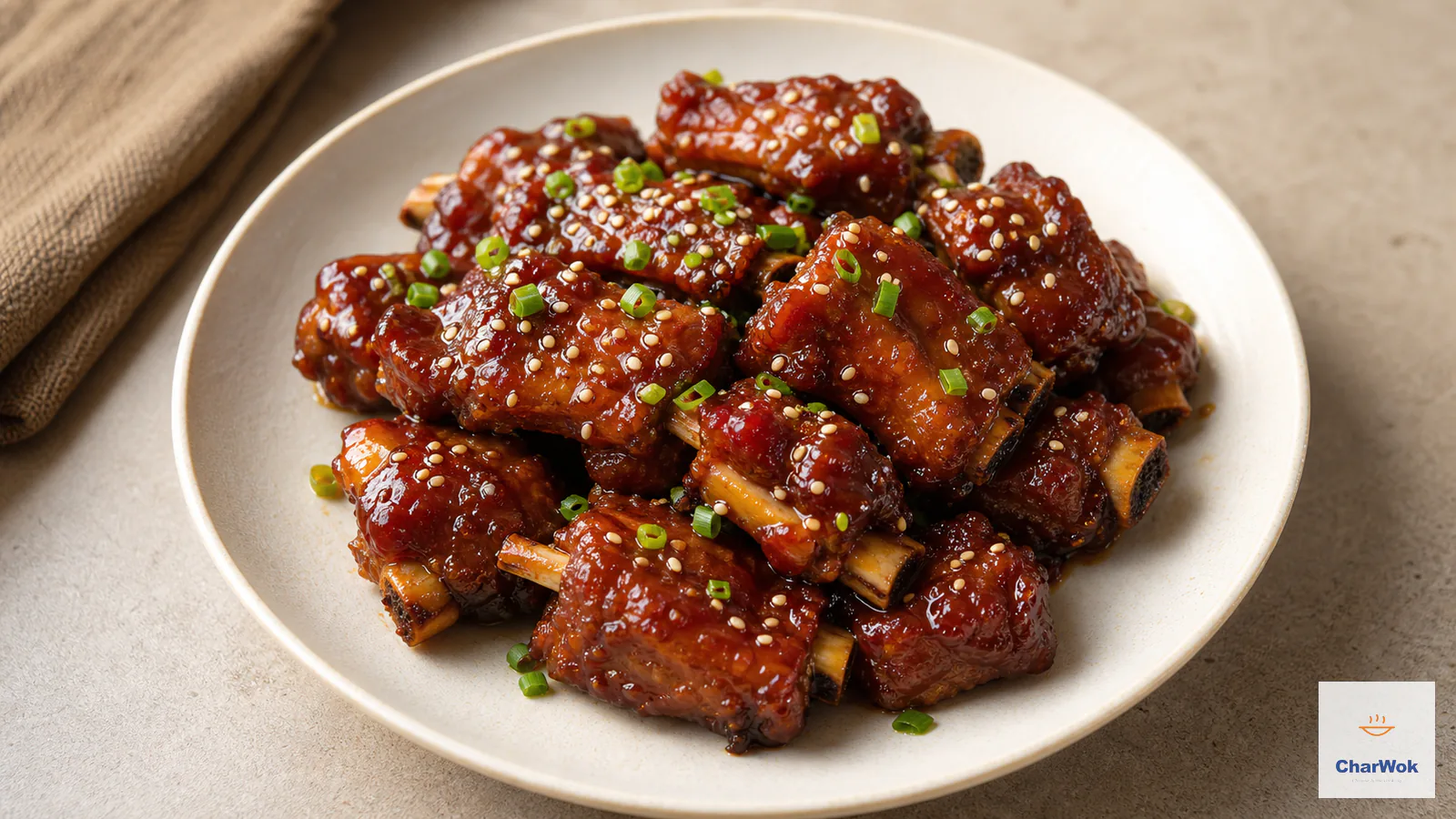
This is the dish the Chinese call Tang Cu Pai Gu (糖醋排骨), and it is one of the most quietly demanding things you can cook. Done right, the meat slides off the bone with a tug, and the sauce is dark, glassy, and balanced enough that you want it on rice. Done wrong, you get chewy pork in a syrup that tastes burnt at the back of the throat. The gap between the two is not the recipe. It is the last ninety seconds.
At a glance
Cut ribs small, blanch from cold water, braise covered for 50 minutes, then reduce uncovered on high heat. Keep the sugar a shade heavier than the vinegar, by volume, and the glaze finds its balance. Pull the pan off the heat while the sauce still runs freely, because the surface sets up further once it leaves the flame and scorches in a heartbeat if you wait.
What kind of dish is this, really
Sweet and sour as a flavor pairing runs through nearly every regional cuisine in China, but the pork rib version is most associated with the cooking of the lower Yangtze, Shandong, Sichuan, and Jiangsu. Each region leans a little differently. Jiangsu and Shanghai versions tend to be sweeter and glossier, with the meat barely holding onto the bone. Northern and Sichuan versions push the vinegar harder and sometimes add a dried chili for warmth.
The English name describes a taste. The Chinese name describes the technique. Tang (糖) is sugar, Cu (醋) is vinegar, and the dish is literally built from those two ingredients in tension. There is no tomato, no pineapple, no bottled sauce. The shine and the cling come from sugar alone, reduced long enough that it thickens without any starch. If you have only ever met sweet and sour as the bright red takeout glaze, this is a different animal.
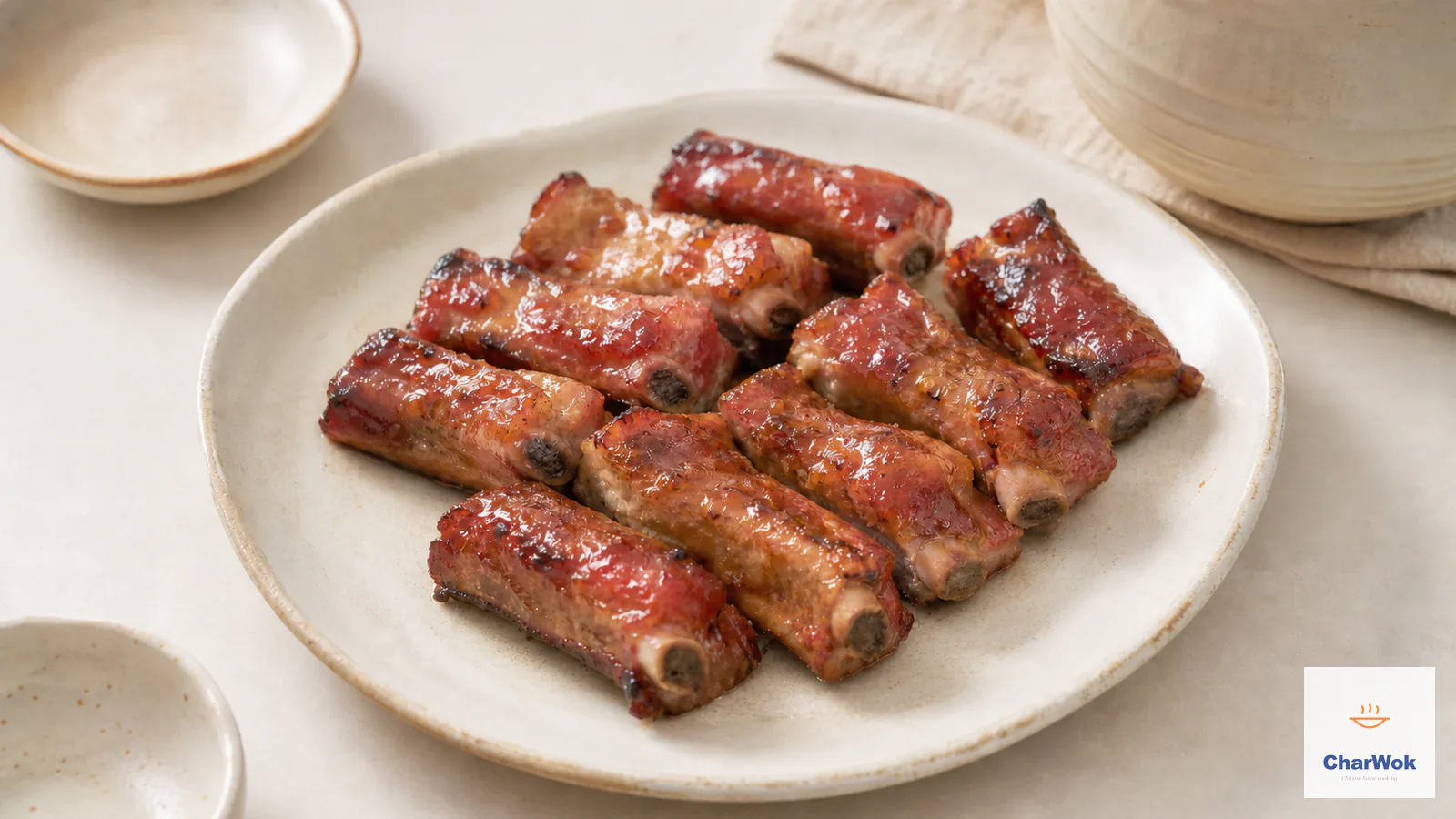
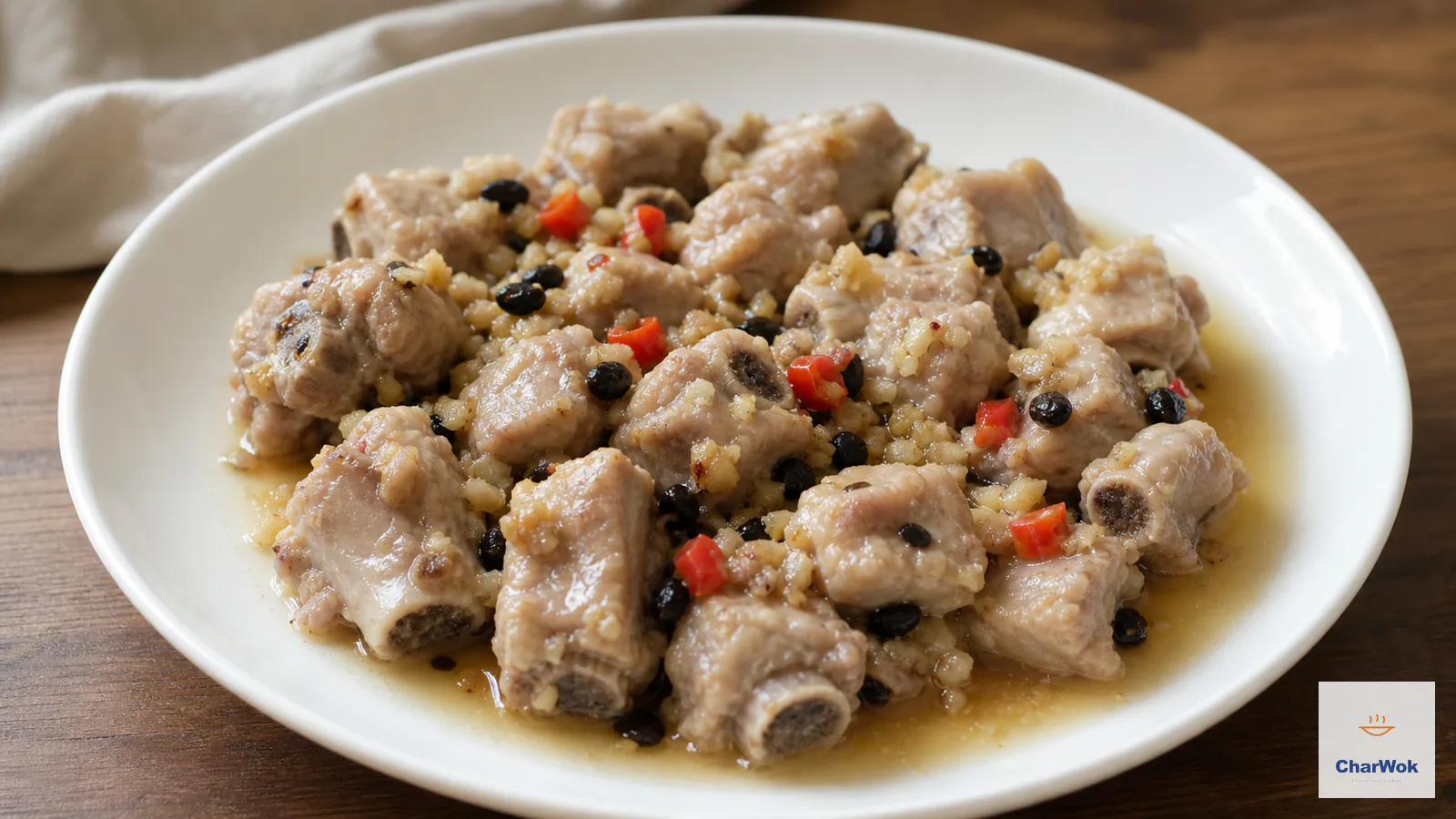
It sits in the same family of slow, glossy pork braises as red braised pork belly and char siu style ribs, but it is lighter and more acidic than either. Where red braising goes deep and savory, sweet and sour ribs aim for brightness. They make a good foil to blander dishes on a table, which is why they show up so often at family meals and celebrations alongside steamed ribs with black beans or lion's head meatballs.
Why this method beats the classic one
The traditional technique is called Chao Tang Se, or frying sugar color. The idea is to take sugar to a hard caramel stage in oil, then seize that brief window to lock the meat in before the sugar turns bitter. Done by a skilled cook in a restaurant wok, it produces extraordinary color. Done by most of us at home, it produces burnt sugar, splattering oil, and a pan you will be scrubbing for a week.
This recipe skips that step entirely. The sugar goes into the braise raw and dissolves over the long simmer. Caramelization happens only at the very end, gently, in the sauce itself, where you can watch it and stop it. You give up a little of the deep mahogany that frying sugar color gives, and you gain a dish that is nearly impossible to wreck. I will take that trade every time in a home kitchen.
The ingredients, with the choices that matter
Ingredients at a glance
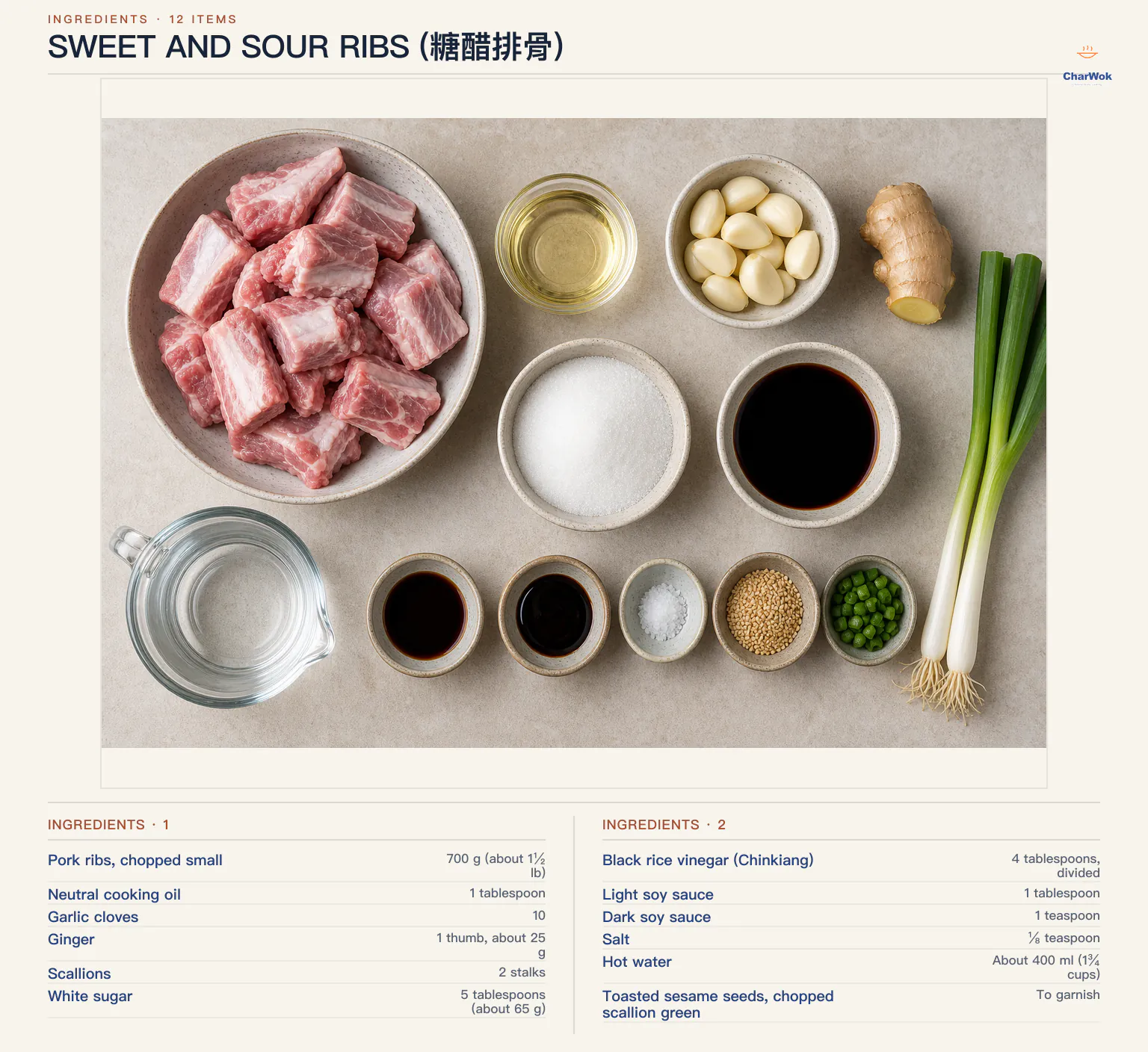
Most of this list is standard Chinese pantry staples. The quantities below feed three as a main, alongside rice and a vegetable; scale them straight up or down for more or fewer people, since the ratios hold. The two you cannot improvise are the vinegar and the sugar, so I will be specific about both.
| Ingredient | Amount | Notes / substitute |
|---|---|---|
| Pork ribs, chopped small | 700 g (about 1½ lb) | Ask the butcher to chop into 3 to 4 cm pieces. Whole baby backs work if you cannot get them cut. |
| Neutral cooking oil | 1 tablespoon | Canola, grapeseed, or avocado. Not olive oil. |
| Garlic cloves | 10 | Leave whole, lightly smashed. They braise soft and sweet. |
| Ginger | 1 thumb, about 25 g | Sliced, skin on is fine. |
| Scallions | 2 stalks | Cut into halves. Save the green tops for garnish. |
| White sugar | 5 tablespoons (about 65 g) | Rock sugar is more traditional and gives a cleaner, less sharp sweetness. Use 70 g rock sugar if you have it. |
| Black rice vinegar (Chinkiang) | 4 tablespoons, divided | Black rice vinegar specifically, not white rice or cider. Balsamic is the closest Western substitute in a pinch, used in smaller amount. |
| Light soy sauce | 1 tablespoon | For salt and umami. See light vs dark soy sauce. |
| Dark soy sauce | 1 teaspoon | For color. Optional if you do not have it. |
| Salt | ⅛ teaspoon | The soy sauce carries most of the salt; this just balances the sugar. |
| Hot water | About 400 ml (1¾ cups) | Pour to barely submerge the ribs; if the bones peek above the surface, that is about right. Better slightly under than over. |
| Toasted sesame seeds, chopped scallion green | To garnish | Optional but worth it. |
Picking the ribs and the cut
Use pork ribs with a fair amount of meat on them. Spare ribs or loin ribs both work. What matters more than the exact cut is the size. In China these are chopped into pieces roughly the size of a thumb, small enough to eat with chopsticks in one bite. That small size is not just tradition. Small pieces braise faster, absorb more sauce per bite, and reduce more evenly at the end. If your butcher will cut them for you across the bone, ask for that. A cleaver at home on a thick board works if your knife and your nerve are both up to it.
Larger, Western-style rib sections will still taste good, but the braise takes longer to penetrate and the final reduction coats them less evenly. I have made it both ways. Small is better. There is no shame in buying the regular rack if that is what you have.
The vinegar question
Use black rice vinegar, ideally the Chinkiang style (Zhenjiang xiang cu). It is made from glutinous rice and aged, and it has a rounded, malty acidity that white rice vinegar and cider vinegar simply do not. If you have never bought it, it is worth the small effort to find, usually in a Chinese grocery or online. The flavor it gives this dish is the single biggest reason a home version tastes like the restaurant one.
If you absolutely cannot get it, the closest substitute is a young balsamic vinegar cut with a little rice vinegar. Plain white rice vinegar will make the dish taste thin and sharp. Apple cider vinegar will make it taste like something else entirely. I would rather you wait and order the right bottle than substitute badly here.
The sugar to vinegar ratio
In my own batches I land on roughly a quarter more sugar than vinegar, measured by volume. For the amount of ribs here that works out to about 65 grams of sugar against 4 tablespoons of vinegar, which gives a glaze that reads sweet on the front of the tongue and sour on the finish, the balance the Jiangsu and Shanghai versions are known for.
If you want it sharper and more northern, even the two out and measure them spoon for spoon. Taste the braise before the final reduction and adjust. The one thing I would not do is load the sugar much heavier than a quarter over the vinegar, because the glaze gets cloying and burns more easily at the end.
Equipment notes
Use a heavy pan with a tight lid. A stainless or enameled Dutch oven, a nonstick deep skillet, or a stainless wok all work. Reach for one of those rather than an uncoated cast iron or carbon steel pan. An acidic braise parked on the stove for the better part of an hour will eat into the seasoning and pull iron into the liquid, and the finished sauce ends up tasting flat and faintly of metal. I learned this the hard way and ruined a well-seasoned wok in the process. If you are new to choosing and caring for a wok, save the carbon steel one for another night.
How to cook them, step by step
- Start the ribs in cold water. Put the chopped ribs in a pot and cover with cold water by a couple of inches. Cold start, not hot. This is the opposite of blanching vegetables. Starting cold lets the albumin and blood inside the bone come out slowly as the water heats, so they float to the top as foam instead of sealing inside the meat. Bring it to a boil, then skim the grey foam off the top with a spoon. Simmer for about 3 minutes, then drain.
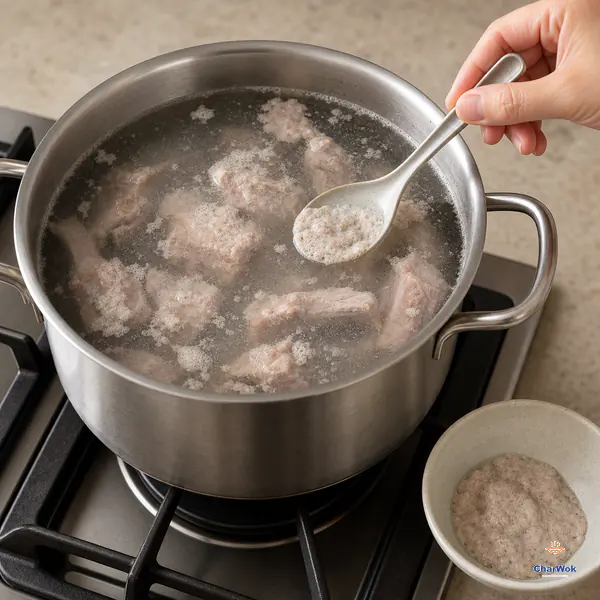
Cover the chopped ribs with cold water and heat them gradually so blood and albumin rise instead of sealing inside. Once the water boils, skim the grey foam, simmer for about three minutes and drain.
- Brown the ribs with the aromatics. In your braising pan, heat the oil over medium and add the drained ribs, the smashed garlic, the ginger slices, and the scallion pieces. Fry, stirring now and then, until the surface of the ribs takes on a light gold color, about 5 minutes. This is not for crunch. It is to develop Maillard flavors in the surface fat and to render a little of the pork fat into the pan, which the sauce will later use as flavor.
- Add everything but the last spoon of vinegar. Add the sugar, 3 tablespoons of the black rice vinegar, the light soy, the dark soy, and the salt. Pour in enough hot water to barely cover the ribs, roughly 400 ml. Stir to dissolve the sugar. Bring to a full boil, then cover and drop the heat to low.
- Braise covered for 50 minutes. Leave it alone. Check once at the halfway mark. If your lid is loose and the liquid has dropped below the ribs, top up with a splash of hot water. The goal at this stage is collagen breakdown, which is what turns tough intercostal meat tender. It needs time and gentle heat, not aggression.
- Remove the aromatics and turn up the heat. After 50 minutes, take the lid off and fish out the garlic, ginger, and scallion pieces. They have given up their flavor by now and leaving them in makes the final sauce look muddy. Add the last tablespoon of black rice vinegar here, not earlier. Most of the acidity from the first addition has cooked off over the hour. This fresh spoonful is what makes the dish taste bright instead of flat.
- Reduce on high, and watch it like a hawk. Turn the heat to high and let the liquid boil hard. Stir every 30 seconds or so, scraping the bottom and turning the ribs through the sauce. As the water leaves, the sugar concentrates and the sauce thickens and darkens. This is where the dish is won or lost. Pull the pan off the heat when the sauce is glossy and coats the back of a spoon but still flows freely. Aim to stop a touch early, while it still seems loose, since it tightens up considerably once it leaves the flame. On my gas ring this part runs close to 8 minutes, but expect anywhere from 6 to 12 depending on your pan width and burner.
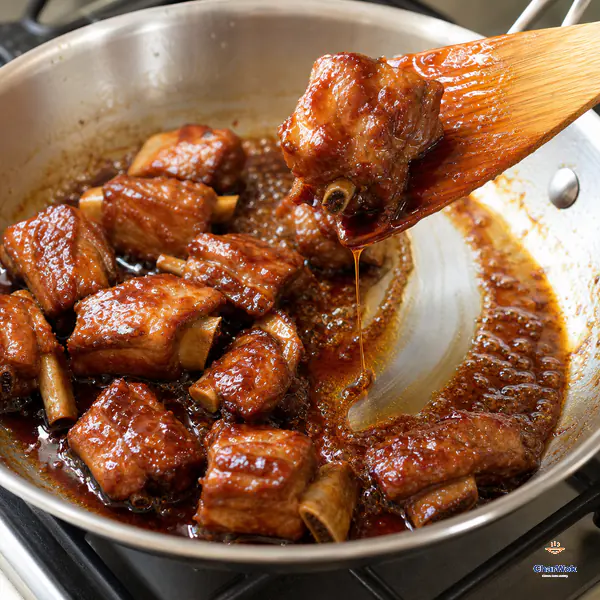
Reduce uncovered over high heat, turning the ribs and scraping the pan roughly every 30 seconds. Pull the pan off while the glossy sauce coats a spoon yet still flows in a short ribbon; it tightens further off the flame, so stopping early prevents a burnt candy glaze.
- Finish and serve. Tip the ribs onto a plate, scrape all the sauce over them, and shower with toasted sesame seeds and chopped scallion green. Eat them warm, or let them sit to room temperature, where the sauce sets into a tacky glaze that is arguably even better.
Where it goes wrong, and how to fix it
The sauce tastes burnt at the back of the throat. You reduced too far or too hot. The sugar crossed from caramel to carbon. There is no rescuing burnt sugar once it is in the pan. Next time, pull off the heat earlier and reduce on medium-high rather than a full blast, and stir more often near the end.
The sauce is thin and runs off the ribs. Either you did not reduce long enough, or you started with too much water. The liquid should barely cover the bones at the start, never drown them. If you are unsure, pour less. You can always add a splash, you cannot easily take it out. If you have already served and the sauce is loose, pour it back into a small pan and reduce it separately for two more minutes, then pour over.
The meat is tough and chewy. The braise was too short or too hot. Low and slow is the whole point. A hard boil for 50 minutes tightens the muscle fibers instead of relaxing them. If your ribs were particularly meaty or large, give them another 10 to 15 minutes covered before you start reducing.
The dish tastes flat, just sweet, no spark. You added all the vinegar at the start. The long simmer kills most of the volatile acidity. That final spoonful of vinegar, added after the braise and right before the reduction, is what wakes the dish up. Do not skip it, and do not add it earlier.
The color is pale. You skipped the dark soy sauce, or your light soy is very pale. Dark soy is mostly for color, not salt. A teaspoon makes a real difference to that deep amber brown. Rock sugar also gives a slightly deeper, clearer color than white sugar.
Can you use a pressure cooker
Yes, for the braise only. Pressure cook the ribs with the aromatics, sugar, 3 tablespoons of vinegar, soy sauces, salt, and water for about 20 minutes at high pressure, then let it release naturally. After that, transfer everything to a wide pan, add the final vinegar, and do the reduction step on the stove exactly as written. The reduction cannot happen under pressure. It needs an open pan and high heat. If you try to reduce inside the pressure cooker with the lid off it works, but most of them are too deep and narrow for good evaporation.
Variations and pairings
For a spicier, more Sichuan leaning version, tuck a couple of dried red chilies into the braise with the aromatics and add a pinch of Sichuan pepper with the final vinegar. It will not make the dish hot, just warmer and more complex. This is a common variation in Chengdu home cooking.
Lotus root chunks, parboiled and added for the last 20 minutes of the braise, are a classic pairing in some regions and turn the dish into more of a one-pan meal. Peeled chestnuts work the same way in autumn.
If you love this flavor profile, the same sugar and vinegar logic translates to other proteins. Sweet and sour whole fish uses a thinner, cornstarch-thickened version of the sauce over fried fish, and sweet and sour meatballs apply it to ground pork. For a pork route that skips the sweetness entirely, Hunan pork stir-fry or scallion pork chops lean savory and are good next-night alternatives.
What to serve with them
These ribs are rich and intense, so they want plain rice and something crisp and cold alongside. Steamed jasmine rice is non-negotiable in my house for this dish, because the sauce on rice is half the point. For vegetables, a smashed cucumber salad or a quick blanch of gai lan with oyster sauce cuts the sweetness perfectly. A bowl of plain egg drop soup to start turns the whole thing into a meal that feels composed rather than thrown together.
Storage and reheating
The ribs keep, covered, in the fridge for up to three days, and the flavor actually improves overnight as the sauce soaks into the meat. Reheat gently in a pan with a tablespoon of water over medium-low, stirring until the sauce loosens and the meat is warm through. Do not microwave them dry or reheat over high heat, because the concentrated sugar will scorch. They also freeze well for up to two months. Thaw overnight in the fridge, then reheat as above.
At room temperature, the sauce sets into a sticky glaze and the ribs make an excellent cold appetizer for a larger meal. This is how they are often served at banquets, alongside dishes like mei cai kou rou or a plate of char siu.
Questions I get asked
Do I have to blanch the ribs first
Yes. Blanching from cold water pulls blood and impurities out of the bones so the final sauce stays clean instead of cloudy and faintly gamey. Skipping it saves five minutes and costs you a layer of flavor.
Can I use baby back ribs instead of chopped ribs
You can, but the dish changes. Whole baby backs need a longer braise to get tender, and the sauce coats them less evenly. If that is all you have, cut the rack into individual bones and braise for an extra 10 minutes.
Why add the vinegar in two stages
The first batch of vinegar flavors the braise but loses most of its acidity over the long simmer. The second spoonful, added right before reducing, brings back the bright sour note the dish is named for. Add it all at once and the dish tastes flat.
Is there a cornstarch-free way to thicken it
That is exactly what is happening here. The sauce thickens from the sugar concentrating as the water boils off, not from starch. This is why the reduction step is so important and so easy to overshoot.
Can I make it ahead for a crowd
Yes, and you should. Braise the ribs a day ahead and stop there. The next day, do the reduction fresh, which takes under 10 minutes. The ribs actually taste better for the rest, and you are not tied to the stove while guests arrive. This is also how the dish earns a place in a roundup of pork favorites for a gathering.
If I had to name the one thing that separates a good version of this dish from a great one, it is restraint at the end. The temptation is to keep reducing, chasing a thicker sauce, until suddenly you have caramel and the pan is ruined. Pull it when it still looks a little loose. Let the cooling do the rest. The ribs will thank you.