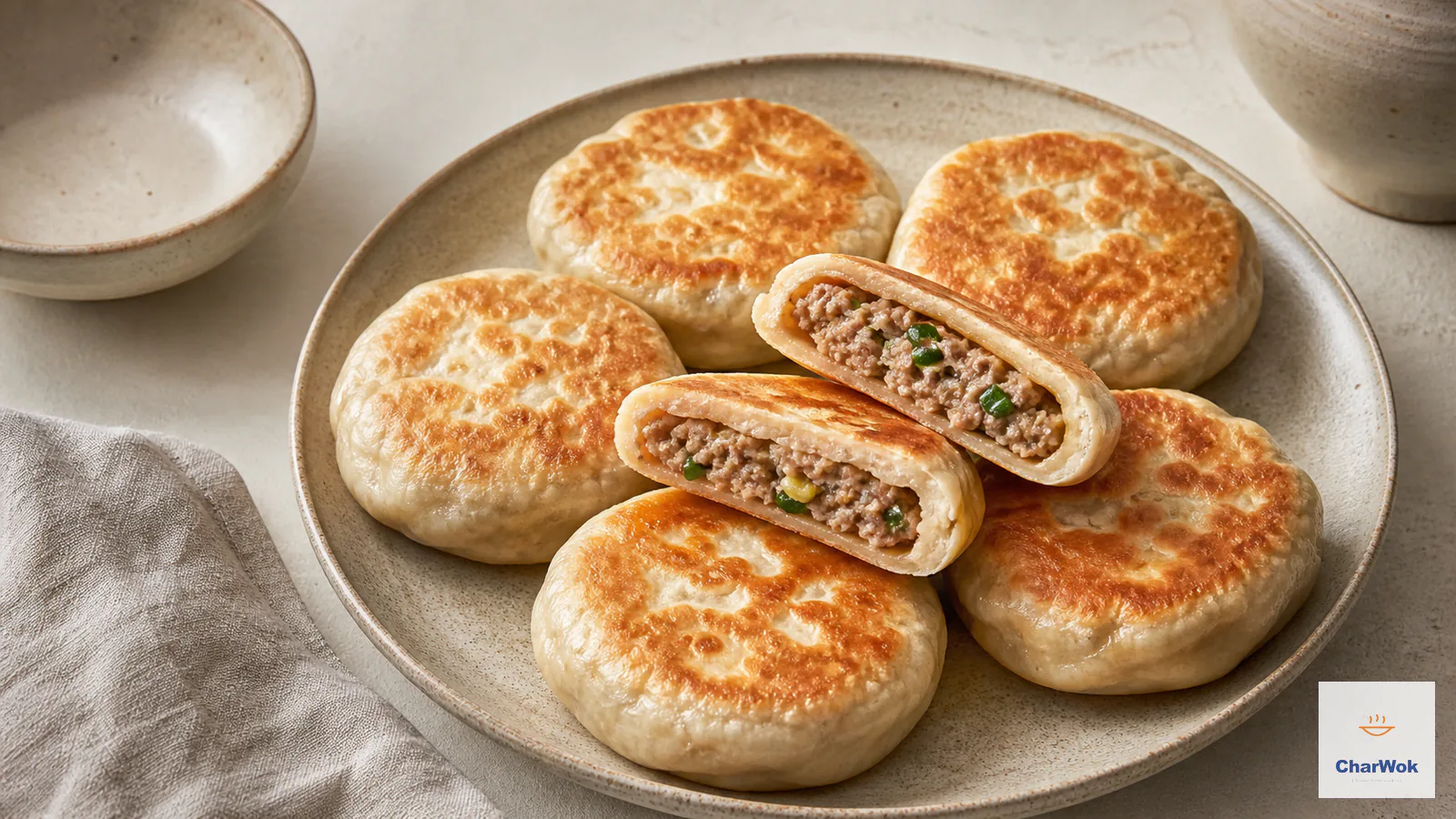
A good xian bing (馅饼, "filled flatbread") is not a dumpling that got pressed flat, and it is not a scallion pancake with meat sneaked inside. It is its own thing: a thin, almost custard-soft wrapper stretched around a puck of juicy, scallion-perfumed meat, seared until the bottom shatters when you bite it. The first time I made them I got two of those three things right. The crust was pale, the meat was dry, and the whole batch tasted like a missed opportunity. What I had missed was not a recipe detail. It was the dough.
Almost every problem people have with these pies, from torn wrappers to leathery crusts, traces back to one decision: how you hydrate the flour. Get that right and the rest of the recipe becomes forgiving in a way few Chinese breads are. The filling can be pork, beef, or lamb. The spice can be Sichuan pepper or five-spice or cumin. Even the shape can change. But the dough asks for the same treatment every time, and that is where we start.
The whole pie hinges on a half-hot-water dough: about 55% water to flour by weight, split roughly two-thirds hot and one-third cool, plus a spoon of oil. Rest it twice, flatten the pies in a covered pan on low heat, and you will not need a second chance.
What these pies actually are
Xian bing is northern home cooking, the kind of thing that shows up at breakfast stalls and family tables rather than banquet menus. You will meet it across Beijing, Tianjin, and the northeastern provinces, with regional variations in spice and filling. Cousins exist across the wider family of Chinese breads, from the crisp shelled Guo Kui stuffed flatbread to Rou Jia Mo, but xian bing is the soft, pan-fried branch. Think of it as the squat, juicy relative of a scallion pancake, with the tender chew of a wrapper rather than flaky layers.
Why hot water, and why oil in the dough
This is the part most recipes gloss over, and it is the part that decides whether your crust is tender or tough. When you pour near-boiling water onto flour and stir, you gelatinize some of the starch on the surface of the flour granules. That does two things at once. It stops the gluten from forming long, elastic strands the way cold water would, so the dough stays soft and relaxed instead of springing back at you. And it lets the dough hold more water than a standard dough ever could, which is what gives the cooked wrapper that slightly moist, almost stretchy bite.
You finish with a splash of cool water and a little neutral oil. The cool water builds just enough gluten back in so the dough can be stretched thin without tearing. The oil coats the flour particles and shortens the gluten further, the same way fat makes a pie crust flaky, and it keeps the cooked wrapper supple instead of turning cardboard-stiff as it cools. This is the same principle behind homemade dumpling wrappers, but pushed further: more water, more oil, a softer dough that you would never roll into a potsticker.
The payoff of all this is that you can stretch the dough paper-thin around a generous pile of filling. That is the ideal the northerners call pi bo xian da, thin skin and big filling. A thick wrapper tastes like bread with meat on it. A thin one tastes like meat with crust on it, and there is a real difference.
Ingredients
Ingredients at a glance
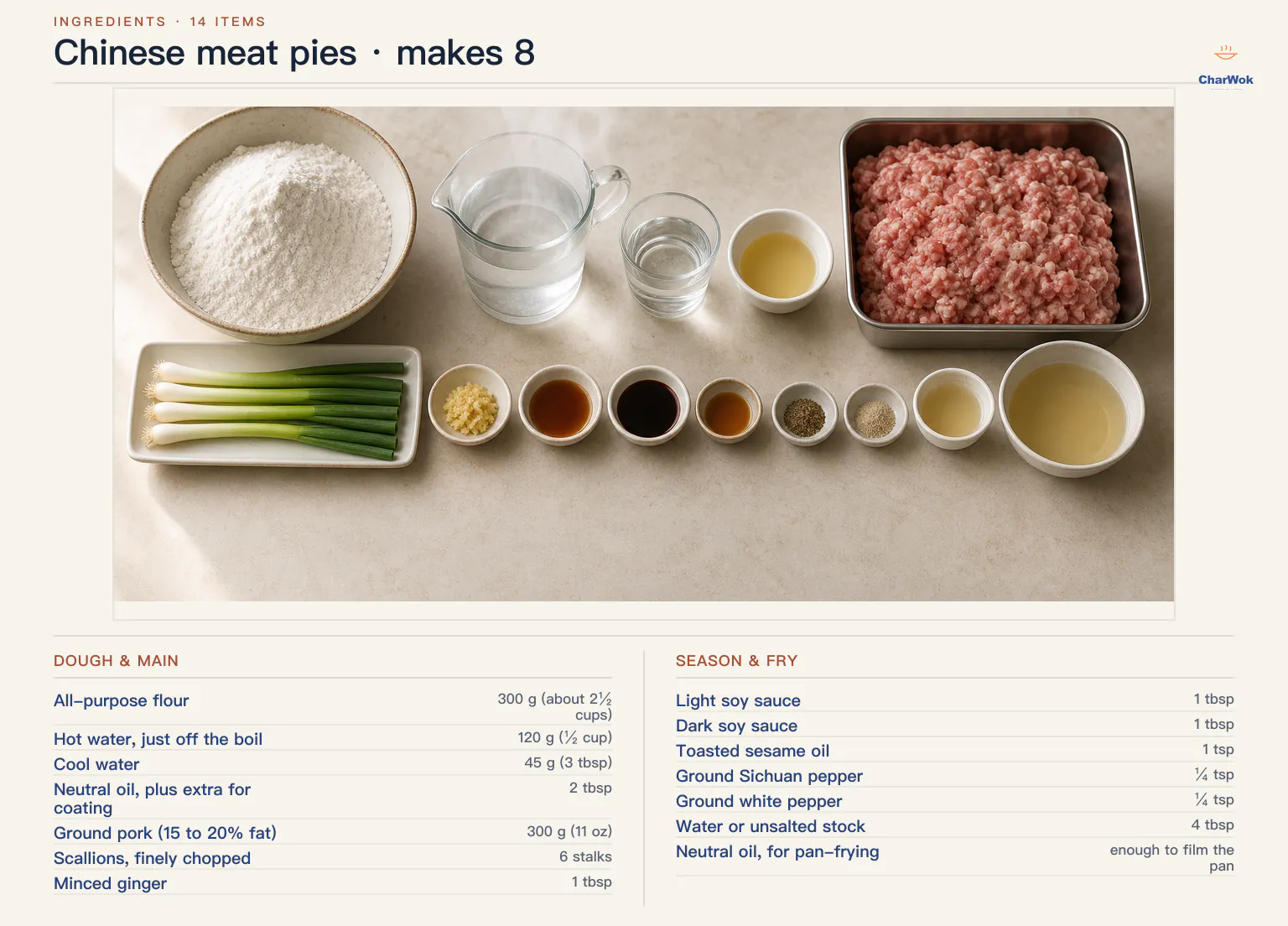
I use grams for the dough because the water ratio is the entire trick, and cups lie about water weight. The filling is forgiving enough to measure loosely. This makes 8 pies, enough for 3 to 4 people as a main or 6 as part of a spread.
| Ingredient | Amount | Notes / substitute |
|---|---|---|
| All-purpose flour | 300 g (about 2½ cups) | Plain flour. Do not use bread flour; the gluten is too strong. |
| Hot water, just off the boil | 120 g (½ cup) | Boiling is fine. This is the gelatinizing water. |
| Cool water | 45 g (3 tbsp) | Tap-cold or room temperature. |
| Neutral oil, plus extra for coating | 2 tbsp | Canola, grapeseed, or refined peanut. Avoid toasted oils. |
| Ground pork (15 to 20% fat) | 300 g (11 oz) | Beef or lamb work; see the variations. Do not use lean meat. |
| Scallions, finely chopped | 6 stalks | Chinese chives are an excellent swap. |
| Minced ginger | 1 tbsp | Fresh, grated fine. Ginger powder will not do the same job. |
| Light soy sauce | 1 tbsp | Salt and umami. See light vs. dark soy. |
| Dark soy sauce | 1 tbsp | Color and a round, slightly sweet depth. |
| Toasted sesame oil | 1 tsp | Aroma. A little more is fine, not a lot. |
| Ground Sichuan pepper | ¼ tsp | Or five-spice, or cumin for a northern lamb-style pie. |
| Ground white pepper | ¼ tsp | Sharper and cleaner than black pepper here. |
| Water or unsalted stock | 4 tbsp | This is what makes the filling juicy. Do not skip it. |
| Neutral oil, for pan-frying | enough to film the pan | About 2 to 3 tbsp total. |
Make the dough
- Hydrate in two stages. Put the flour in a wide bowl. Pour the hot water over it and immediately stir with chopsticks or a fork, fluffing the flour around so it turns into shaggy, partially cooked flakes. You are not trying to form dough yet, just kill the raw-starch stretchiness in some of the flour. Add the cool water and the 2 tbsp oil next and stir again.
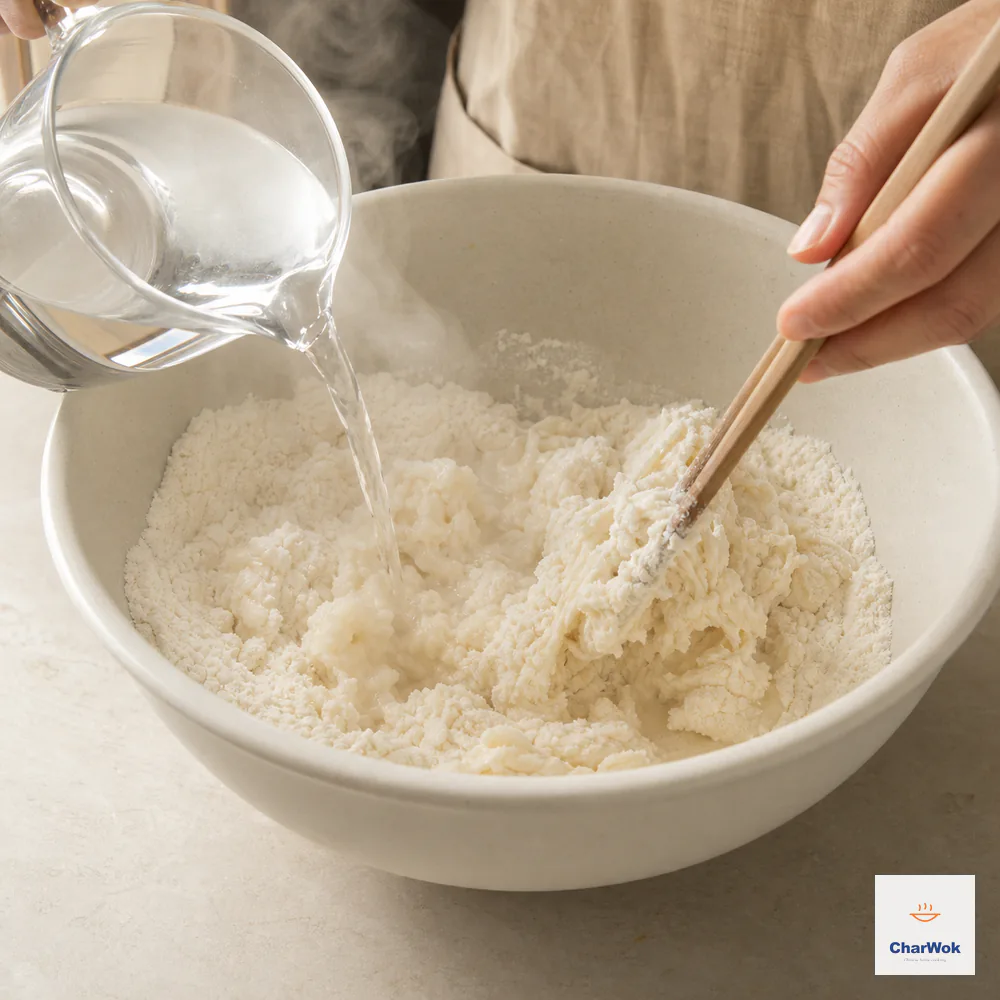
Pour the hot water over the flour and stir immediately with chopsticks; add the cool water and oil only after shaggy, partially cooked flakes form.
- Bring it together, then stop. As soon as the dough forms a single shaggy mass, stop kneading. It will look rough and a little ugly. Cover it with a damp cloth or plastic and rest it for 20 minutes. This rest is doing the work your hands cannot: the flour hydrates evenly and the gluten you did develop relaxes on its own. Skip it and you will fight the dough the whole way.
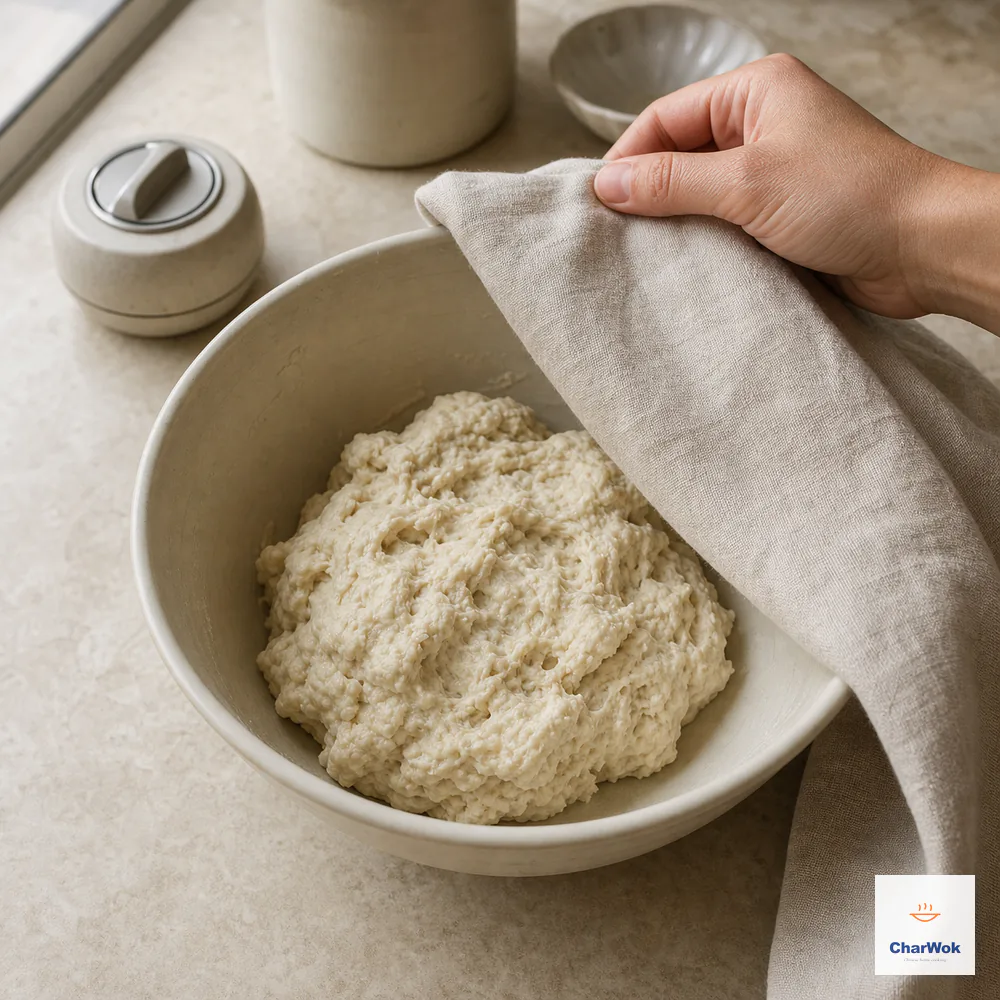
Stop as soon as one rough, soft mass forms, cover it, and let hydration and gluten relaxation do the work for 20 minutes.
- Knead it smooth. After the rest, knead for about a minute on a counter wiped with a little oil, not flour. The dough will transform into something smooth and quite soft. Roll it into a log and cut into 8 equal pieces.
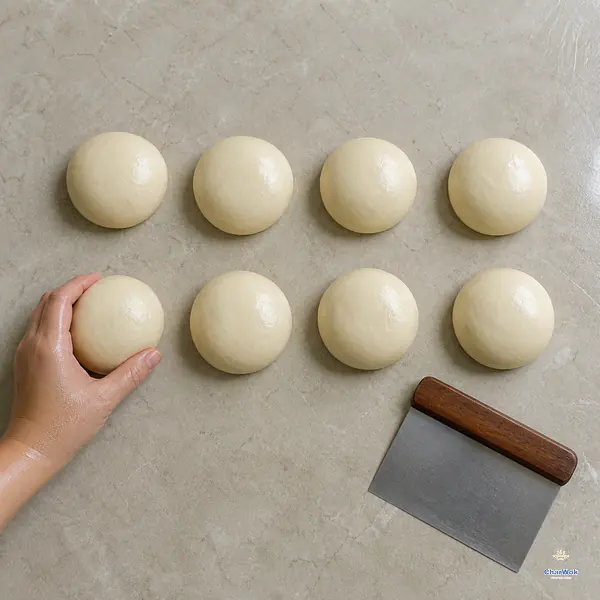
After the rest, knead gently for about one minute on a lightly oiled counter until smooth, then divide the entire dough into exactly eight equal portions.
- Shape and rest again. Roll each piece into a ball between oiled palms. Coat them lightly so they do not stick to each other, cover with plastic, and rest 10 more minutes. This second rest is the one that lets you stretch each ball into a thin disc without it springing back at you.
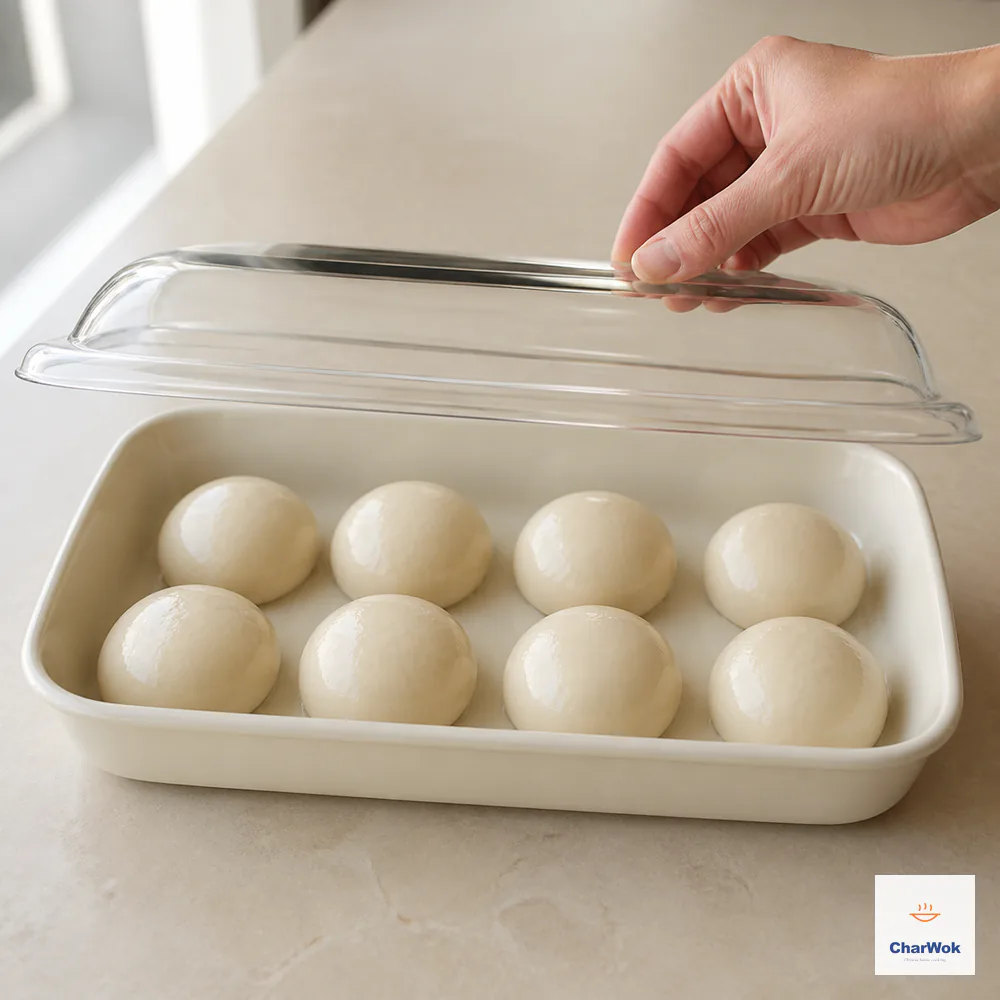
Round exactly eight equal portions with oiled hands, cover them without flour, and rest 10 minutes so each wrapper stretches without springing back.
One thing worth saying plainly: this dough is supposed to feel too soft and too sticky for a normal bread dough. That softness is the texture you are eating later. If it feels like pizza dough, you added too little water or too much flour while kneading. Resist the urge to dust flour; oil is what keeps it workable without toughening it.
Mix the filling
You can do this while the dough rests. The goal is a filling that holds together in a soft ball and releases juice when you bite into the finished pie, not a crumbly layer of cooked meat. Two things get you there, and they are the same two things that make great dumpling fillings.
- Start with fatty meat. Use ground pork in the 15 to 20% fat range. Lean meat turns grainy and dry inside a sealed wrapper because there is nowhere for the moisture to go. If you only have lean pork, add a tablespoon of oil or a little minced fatty bacon.
- Beat in liquid, in one direction. Put the meat, scallions, ginger, both soy sauces, sesame oil, Sichuan pepper, and white pepper in a bowl. Add the 4 tbsp of water or stock. Now stir with chopsticks, always in the same direction, for a good minute or two. The meat will go from loose to sticky and slightly lighter in color. That stickiness is the myosin proteins unraveling and binding the water into the meat, the same way a meatball holds together. Stop when the mixture looks glossy and pulls away from the bowl in one mass.
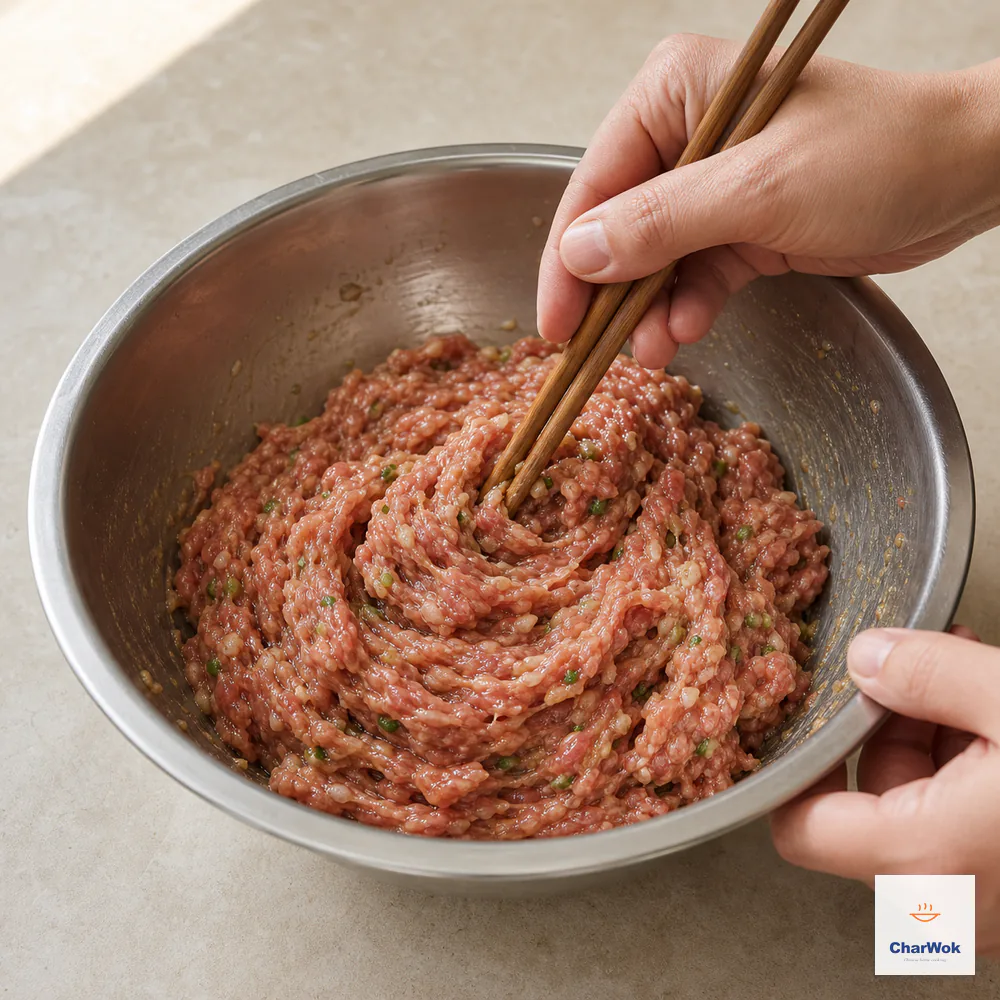
Beat the seasoned pork and 4 tablespoons water or stock in one direction until it turns cohesive, glossy, and sticky enough to pull from the bowl as one mass.
A note on the scallions: add them at the start here, not as a last-minute fold. They soften into the filling during cooking and their sharpness mellows, which is what you want. If you prefer a brighter scallion hit, hold back a third of them and fold them in right before assembling.
Assemble and shape the pies
The classic shape is a round, sealed dumpling that gets flattened in the pan. It is closer in spirit to wrapping a stuffed bao bun than to folding a flatbread. If the pleated round defeats you, a half-moon works perfectly well and looks like a chive pocket, so do not let the technique stop you from making these.
- Oil your surface, do not flour it. Flour will dry the dough and burn in the pan. A thin film of oil on the counter and on your fingers keeps the dough stretchy.
- Press a ball into a disc. Take one dough ball and press it with your fingertips into a round about 5 mm (just under ¼ inch) thick, with the edges a little thinner than the center. A thicker center holds the weight of the filling without tearing.
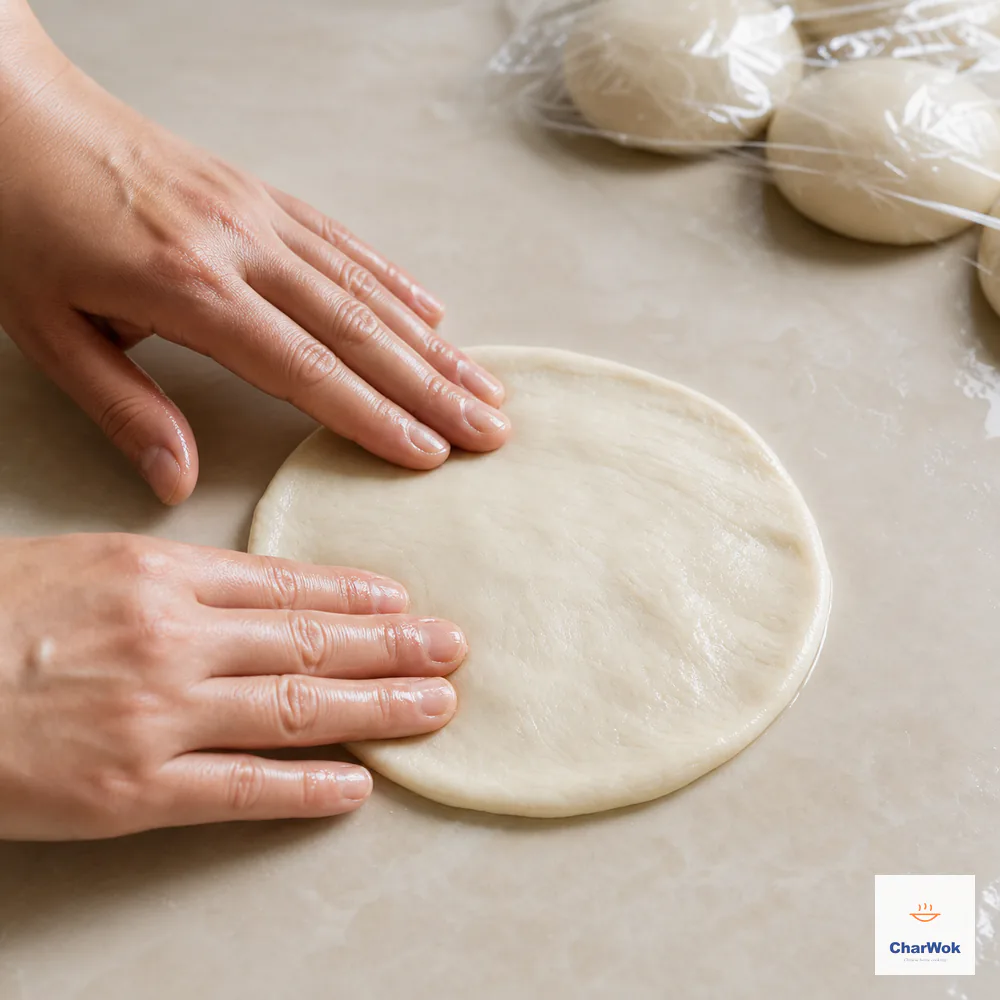
Use oil rather than flour and press each ball to about 5 millimetres thick, keeping the edge thinner and the center strong enough to hold the filling.
- Load and pleat. Set an eighth of the filling in the middle. Cup the wrapper in your non-dominant hand and use the thumb of that hand to press the filling down as you pleat the edge up and around it with the thumb and forefinger of your other hand. Pinch the top closed. The aim is a tight, sealed ball with the dough stretched thin against the meat, not a pouch of air.
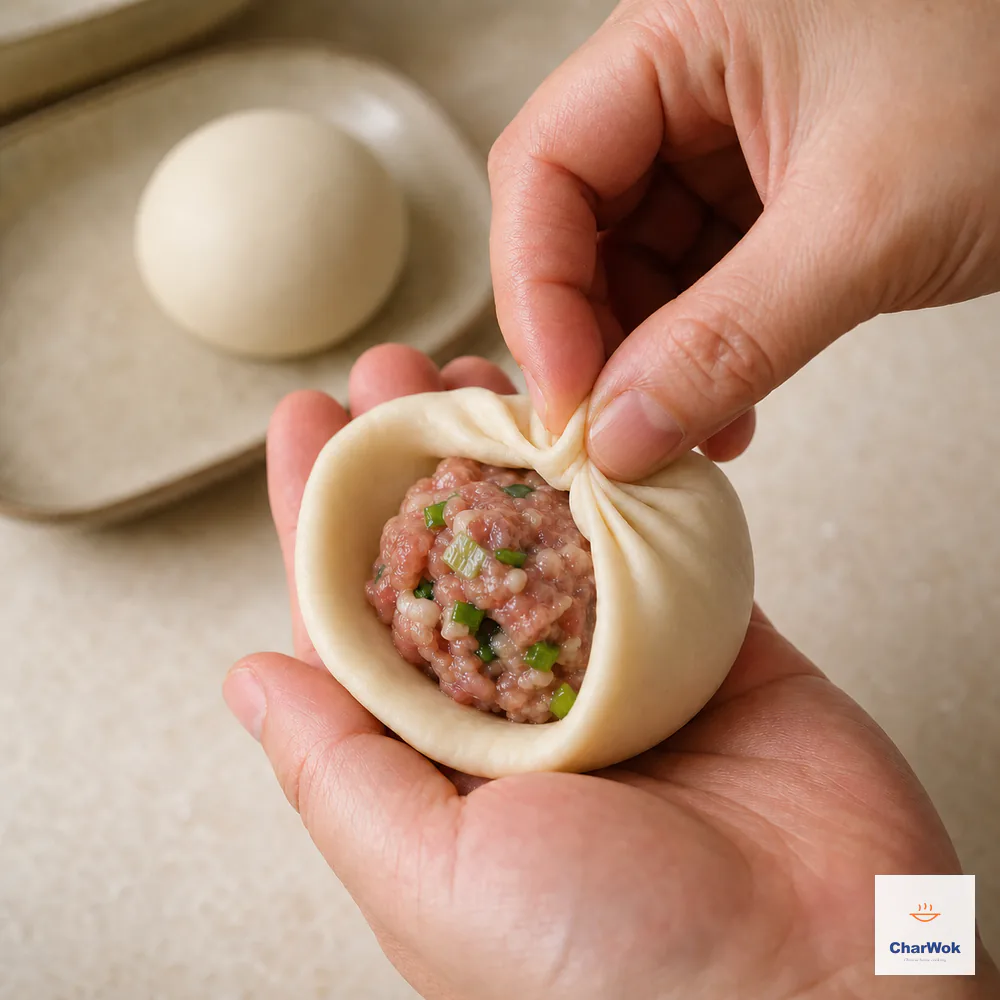
Set one-eighth of the filling in the center, push it inward while gathering the edge, pinch the seam completely shut, then set the pie seam-side down.
- Set it sealed-side down. Place each pie on an oiled tray with the seam facing down. The weight of the filling will start to flatten it gently. Do not flatten it fully yet; that happens in the pan.
Pan-fry them properly
This is the second place things go wrong, after the dough. The temptation is to crank the heat and get a fast crust. Do that and you get a black bottom and a raw, doughy center with cold meat inside. The correct move is low heat, patience, and a lid. It is the same logic as cooking sheng jian bao or pan-fried pork and chive dumplings: the lid traps steam so the top of the dough and the filling cook through while the bottom browns gently.
- Film a heavy pan with oil and heat it gently. A cast-iron or heavy-bottomed skillet holds heat evenly. Use about 2 to 3 tbsp of oil, enough to coat the bottom. Let it warm for half a minute over medium-low before the pies go in.
- Flatten the pies in the pan. Set the sealed balls in with room between them, then press each one down with a spatula or your fingers to about 2½ cm (1 inch) thick. Pressing them now, in the hot oil, sets the shape.
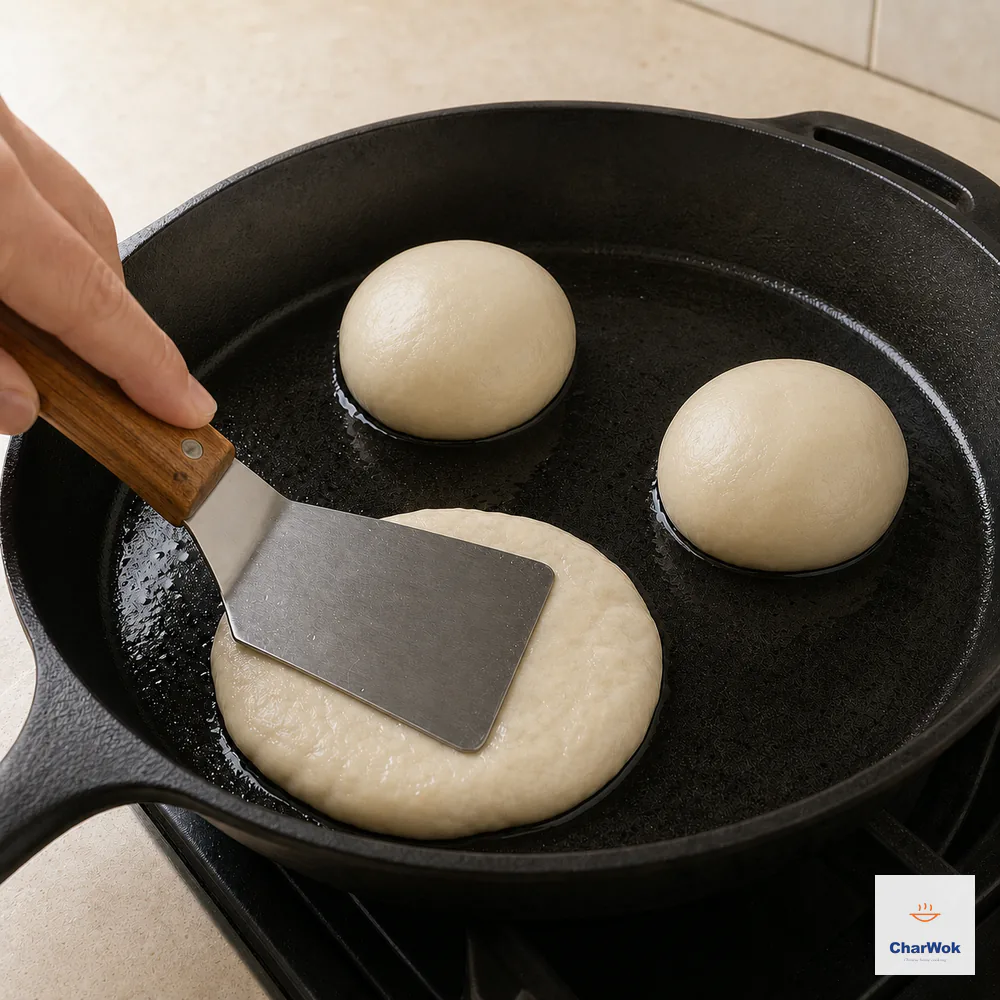
Place sealed balls seam-side down in a gently heated, oil-filmed heavy pan and press each to about 2.5 centimetres thick before browning.
- Fry the first side uncovered until golden. Keep the heat low. This takes 3 to 4 minutes. You want real color, not a blond blush, because that crust is the whole texture contrast.
- Flip, cover, and finish. Turn the pies, put the lid on, and cook another 3 to 4 minutes until the second side is golden and the filling is cooked through. The lid is non-negotiable; without it the tops stay pale and doughy.
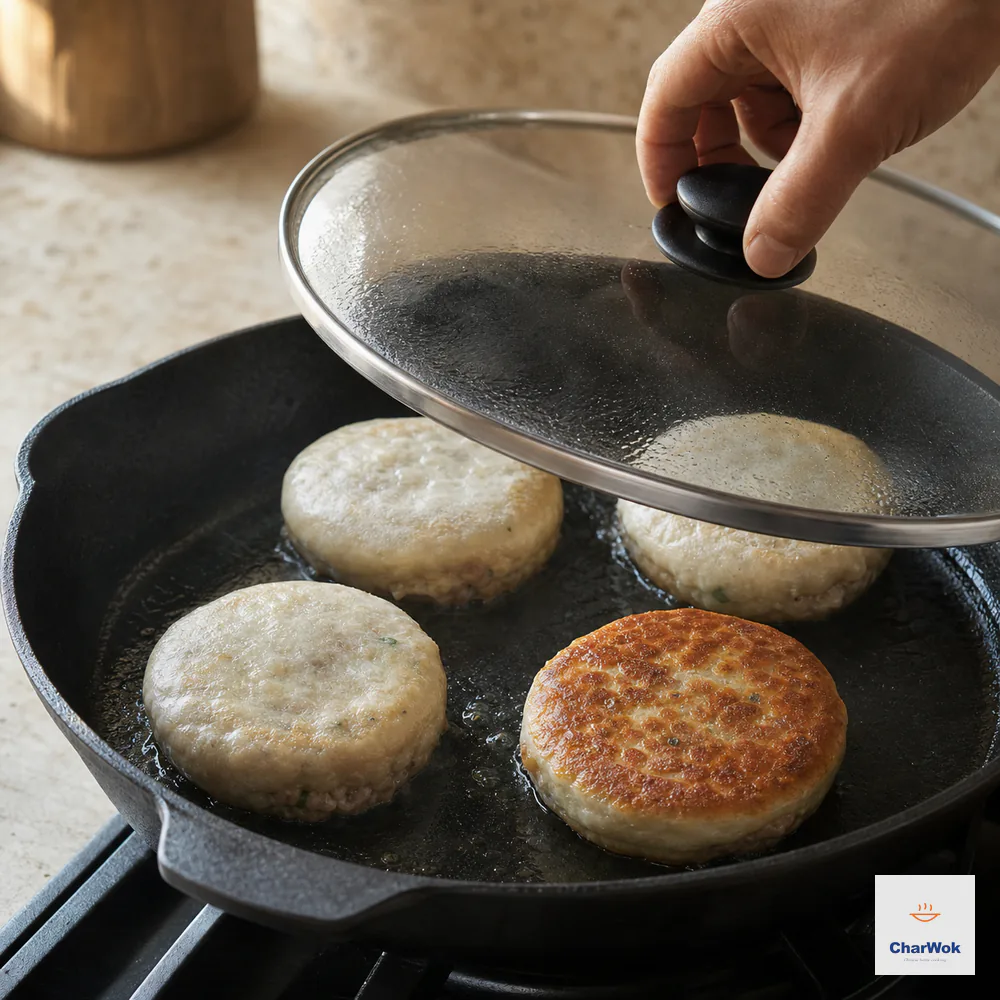
Brown the first side over low heat, flip, cover to steam the filling and second side through, then uncover and re-crisp the first side for about 20 seconds.
- One last flip to re-crisp. Flip back to the first side for about 20 seconds to wake up the crust before you take them out. Drain on paper towel for a moment.
Cut one open to test. The filling should be just cooked, still faintly pink turning gray-white at the center if you used pork, and a thin pool of juice should run out. If the center is still cold or raw-looking, the heat was too high or the pies too thick. Lower the heat next time and press them thinner.
When the pie fights back: troubleshooting
I keep this section close because these are the failures I have personally made, some of them more than once.
- The dough tears when you stretch it. It has not rested long enough, or you floured it and dried it out. Cover it and rest another 10 minutes, and switch to oiled hands.
- The wrappers puff up like balloons in the pan and the filling stays loose inside. You sealed in too much air. Press the filling firmly into the wrapper as you pleat, and squeeze the air out before the final pinch.
- The bottom burns before the meat cooks. Heat is too high. The pies are thick and the filling is dense; they need low heat and a lid, full stop. There is no high-heat shortcut.
- The crust turns hard and chewy as it cools. Either the dough was too low on hydration or you skipped the oil in it. Weigh the water next time and do not leave out the oil.
- The filling is dry and crumbly. The meat was too lean, or you did not beat in the added water. Use fattier meat and stir the filling until it is genuinely sticky and glossy.
- The pies leak oil and filling into the pan. The seal was not tight, or you pressed them too hard too fast. Seal firmly, press gently, and do not overcrowd the pan.
Variations and what to serve with them
The dough is a constant. The filling is where you get to play. A few directions I keep coming back to:
- Lamb and cumin. Swap pork for ground lamb, drop the Sichuan pepper, and use a half-teaspoon of cumin and a pinch of five-spice instead. This is the Uyghur-leaning northern profile and it is spectacular.
- Beef and Sichuan pepper. Ground beef with the full Sichuan pepper amount doubled, plus a spoon of freshly ground Sichuan pepper in the dip. Beef needs the full 4 tbsp of water more than pork does.
- Half-moon, easier shaping. Roll each ball into a thin round, fill one half, fold over, and crimp the edge. Same flavor, less pleating practice required.
For serving, these pies want something sharp or vegetal to cut the richness. A bowl of plain congee and a plate of cucumber salad is the classic northern breakfast answer. At dinner I like them alongside a plain greens dish and a dipping sauce of black vinegar, soy, and a spoon of chili oil. The vinegar is doing real work here; the acid balances the fat in a way hot sauce alone does not.
Make-ahead and freezing
These pies freeze beautifully raw, which makes them a weekday breakfast worth planning for. Shape and flatten them into discs, set them on a tray so they do not touch, and freeze until solid. Then drop them into an airtight bag; they keep for about two months.
Cook them straight from frozen, no thawing. Pan-fry over medium-low heat with the lid on the entire time, flipping once the first side is golden, until both sides are crisp and the center is hot through. Expect to add a couple of minutes to the covered cooking time. Thawing first is actually worse, because the dough weeps and the crust goes soggy.
Cooked leftovers reheat best in a dry skillet over low heat, covered, for a few minutes per side. A microwave will turn the crust to rubber, so avoid it unless you have given up on texture entirely.
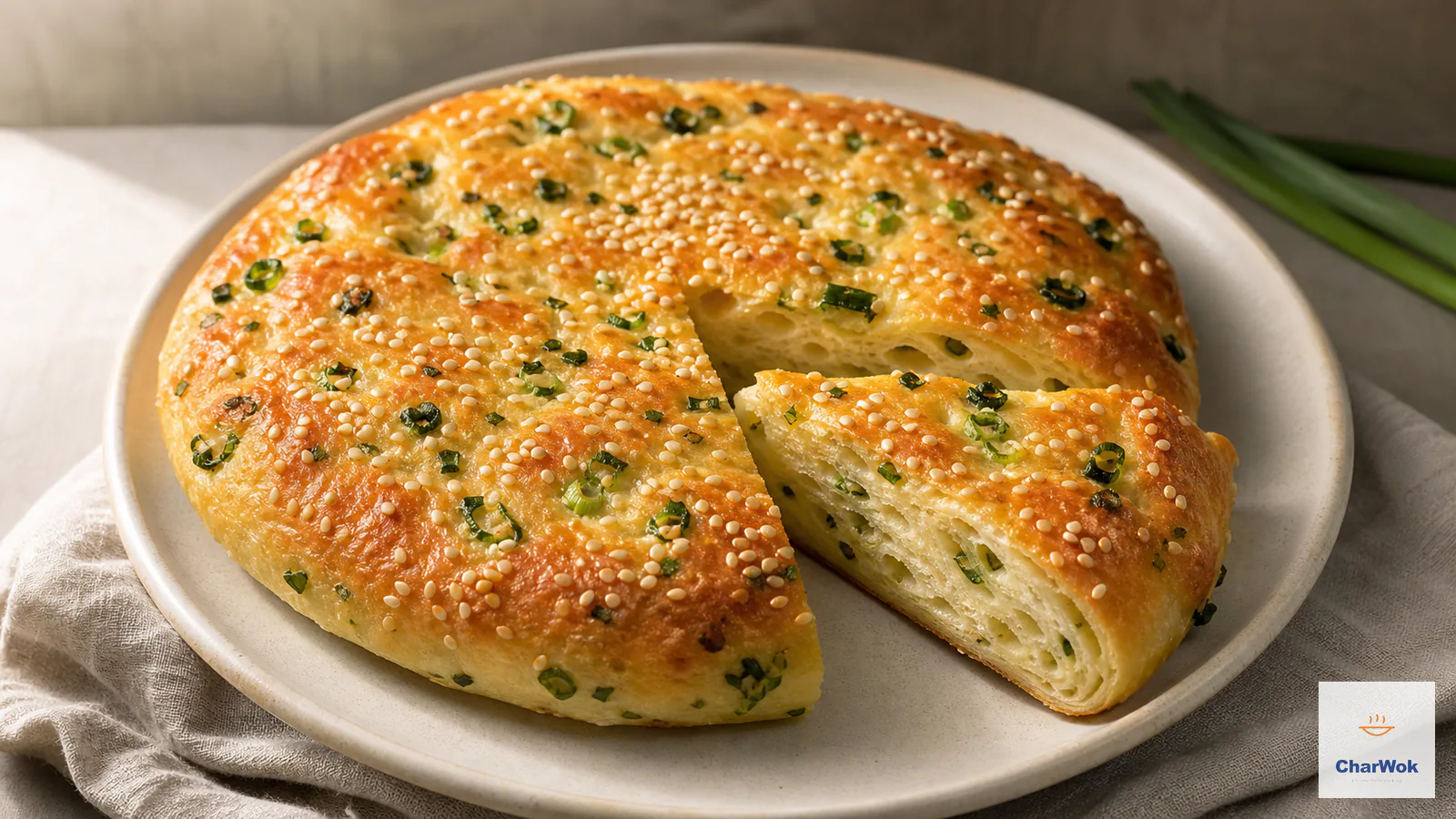
If you want a richer, breadier cousin in the same family, the leavened scallion flatbread uses a different dough but a similar pan-fried logic, and it is a good next step once this dough feels routine.
Frequently asked questions
Can I make the dough in a stand mixer? Yes. Use the paddle on low to combine with the hot water first, then the cool water and oil, until shaggy. Let it rest in the bowl, then switch to the dough hook briefly just to smooth it. Do not over-knead; the point is a soft dough, not a developed one.
Why is my dough so sticky when a normal bread dough is not? Because it is supposed to be. This is a high-hydration, partially cooked dough. Coat your hands and the counter with oil instead of flour and it becomes manageable; add flour and you lose the tender texture.
Can I bake or air-fry these instead of pan-frying? You can, but they are a different food. Baking at about 200°C (400°F) until golden works and uses less oil, though the crust dries out more and you lose the contrast between the crisp bottom and the steamed top. Pan-frying with a lid is the traditional method for a reason.
Do I have to rest the dough twice? The first 20-minute rest is essential; without it the dough will not knead smooth. The second 10-minute rest after portioning is what makes the balls stretchable. If you are truly pressed for time, you can shorten the second rest, but the wrappers will shrink back as you try to thin them.
Is beef or lamb as good as pork? Different, not better or worse. Pork is the most forgiving because of its fat. Beef and lamb both want the full amount of added water and a slightly heavier hand with the spice. The lamb-and-cumin version is, for my money, the best of the three.