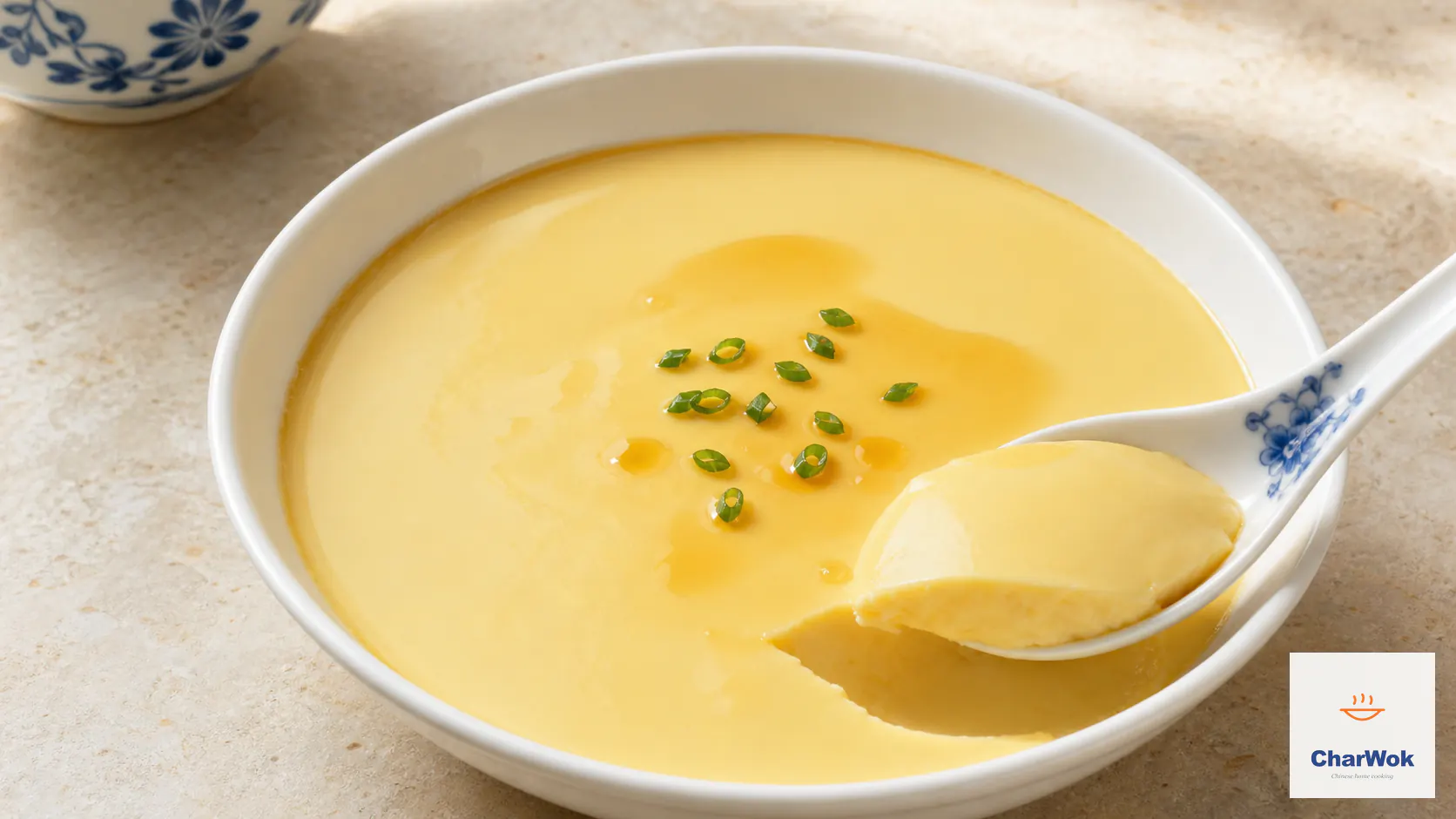
Three ingredients, one bowl, ten minutes of steam. And yet most home cooks open the lid to find a bowl of gray, cratered sponge floating in watery soup. That gap, between "just eggs and water" and a custard so silky it quivers when you tap the bowl, is the whole story of Chinese steamed eggs.
I ate this dish two or three times a week as a kid and ruined it for the first six months I tried to make it myself. The failure was always the same: I treated it like a recipe when it is really a temperature-control exercise. Once you understand what the heat is doing to the egg proteins, the rest falls into place. This guide is the version I wish someone had handed me back then.
Aim for an egg-to-liquid ratio of 1 to 1.5 by volume, water near 40°C/104°F (warm to the finger, not hot), a gentle simmer rather than a rolling boil, and a covered bowl. Steam a single serving about 10 minutes; pull it the instant the center wobbles like soft jelly rather than sloshes like liquid.
What this dish actually is
Known as zheng dan geng (蒸蛋羹, "steamed egg custard") across most of China, this is a savory water-bath custard, not the sweet baked kind. It is everyday home food, the thing a parent makes when there is nothing in the fridge and dinner is in fifteen minutes. Every region has its lean: the Cantonese version often uses stock and a slick of scallion oil; northern home cooks keep it austere with just water, salt, soy, and sesame; some Sichuan tables finish it with a spoon of chili oil. The technique is the same everywhere. Master the custard and you have a base for dozens of variations.
It is also one of the gentlest dishes you can serve, which is why it shows up in hospital food, toddler meals, and late-night snacks alike. If you already love silken tofu dressed with scallions and soy or a clean bowl of classic egg drop soup, steamed eggs sit in the same family: soft, savory, and built to soothe.
The ratio, and why most recipes lie to you about it
You will see "1 part egg to 2 parts water" repeated everywhere. I am going to tell you that is usually too much liquid for Western supermarket eggs, and it is the single most common reason readers end up with weeping, unset custard.
Here is the reasoning. An egg is roughly 74 percent water by weight. When a recipe says "add twice the egg's volume in water," you are not adding water to dry protein, you are adding water to something that is already mostly water. Push the dilution too far and the egg proteins can no longer form a continuous network that traps all that extra liquid. The curd sets on top, water pools underneath, and you get the exact failure one reader described to me: a clean-set top with a puddle seeping out when you spoon into it.
For US large eggs I land at 1 part egg to 1.5 parts liquid by volume. That gives a tender curd that still holds its shape. If you want it firmer, almost flan-like, drop to 1.25. I would not go above 1.75 unless you are using small eggs. Measure the beaten egg in a liquid measuring cup, then multiply.
What goes in the liquid matters too. Water gives the cleanest, most neutral result. Homemade chicken stock adds body and savory depth and is what I reach for when this is going to carry a meal instead of sit beside one. Stock gels when cold, which tells you it carries collagen; that collagen helps the custard set firmer, so if your stock is particularly gelatinous, nudge the ratio back toward 1.5 rather than 1.25.
Temperature, the variable nobody checks
The water you beat into the eggs should be warm, around 40°C (104°F). Not because of some folk rule about "warming the eggs," but for a mechanical reason: warm water dissolves the salt and disperses the proteins more evenly than cold, and it shortens the time the custard needs in the steamer. Shorter steam means less chance the proteins over-coagulate and squeeze out water.
You do not need a thermometer. Mix equal parts just-boiled water and room-temperature water, test it with a clean finger, and adjust. It should feel distinctly warm but not uncomfortable, the temperature of bathwater you would put a baby in. If it stings, it is too hot and you risk partly cooking the eggs before they reach the pot.
Ingredients
Ingredients at a glance
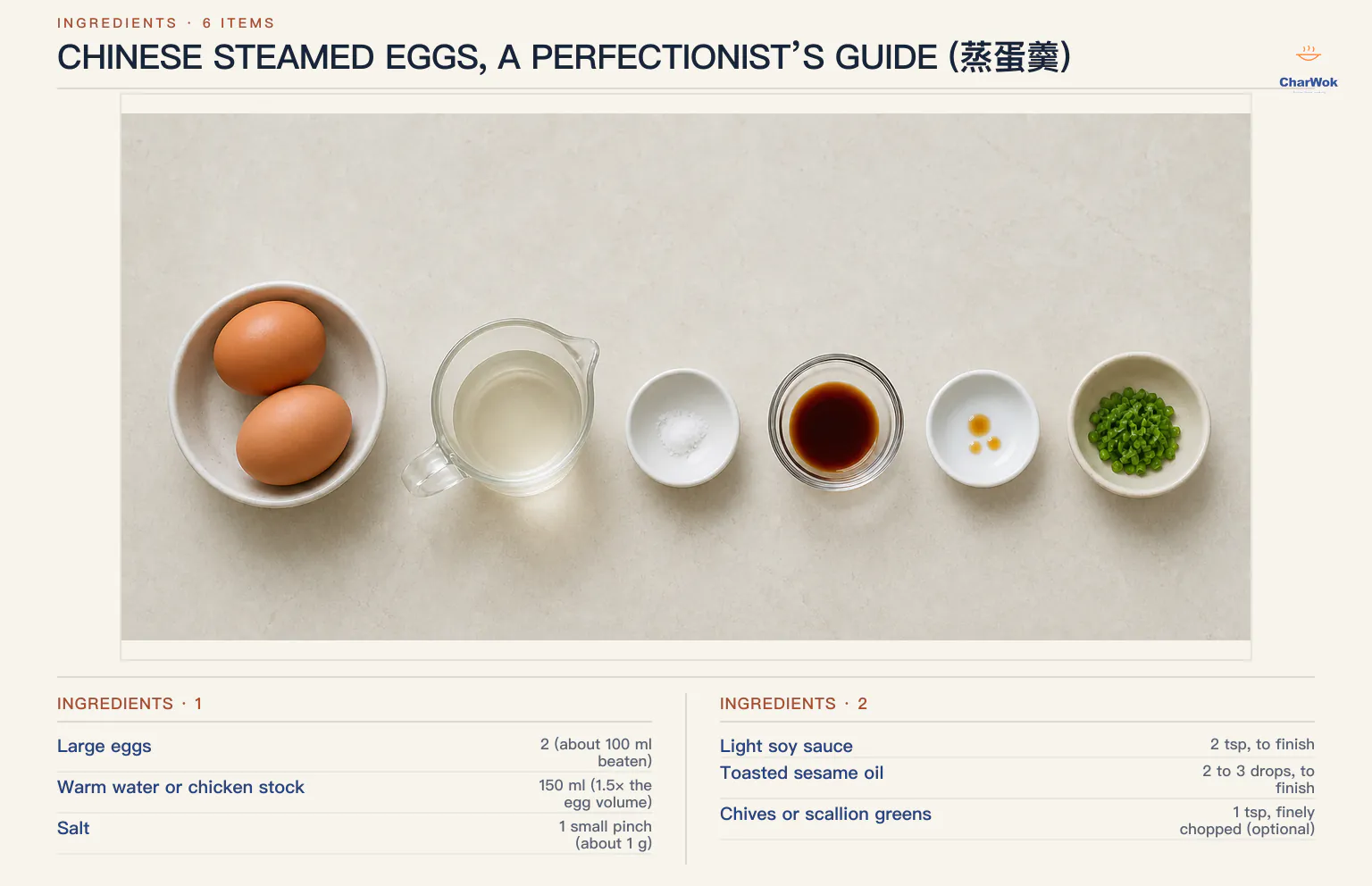
Serves 2 as a light dish. Nutrition per serving is roughly 76 kcal, 6 g protein, 5 g fat before the soy-sesame finish, which adds about 25 kcal and most of the sodium.
| Ingredient | Amount | Notes / substitute |
|---|---|---|
| Large eggs | 2 (about 100 ml beaten) | US large or medium; weigh or measure the beaten volume for accuracy |
| Warm water or chicken stock | 150 ml (1.5× the egg volume) | Stock for a richer base; water for a cleaner taste |
| Salt | 1 small pinch (about 1 g) | Fine sea salt; under-salt now, the soy sauce carries the rest |
| Light soy sauce | 2 tsp, to finish | See the light vs. dark soy sauce guide; dark soy will muddy the color |
| Toasted sesame oil | 2 to 3 drops, to finish | A little goes far; quality matters, see notes on Chinese sesame oil |
| Chives or scallion greens | 1 tsp, finely chopped (optional) | Garlic chives for a stronger allium note, scallion for milder |
Equipment that changes the outcome
You can make this in any pot wide enough to hold your bowl, but the setup matters more than people admit. A bamboo steamer is genuinely better here, not because of folklore but because bamboo breathes: steam condenses on the lid and wicks into the wood instead of raining back down onto your custard. That single property is why uncovered bowls turn out smoother in bamboo than in a metal steamer.
If you only have a metal pot or metal steamer insert, you must cover the bowl. Use a heatproof plate, a square of parchment, or plastic wrap pierced a few times. I avoid foil, it conducts heat and can overcook the top. Whatever cover you use, the goal is to stop condensation from the lid punching little craters into the surface.
Method, step by step
- Beat the eggs gently, do not whip. Combine the eggs and salt in a bowl and stir with chopsticks or a fork until just homogenous. You want the yolks and whites blended, not aerated. Whipping folds in air, and those bubbles become the pockmarks on the surface later.
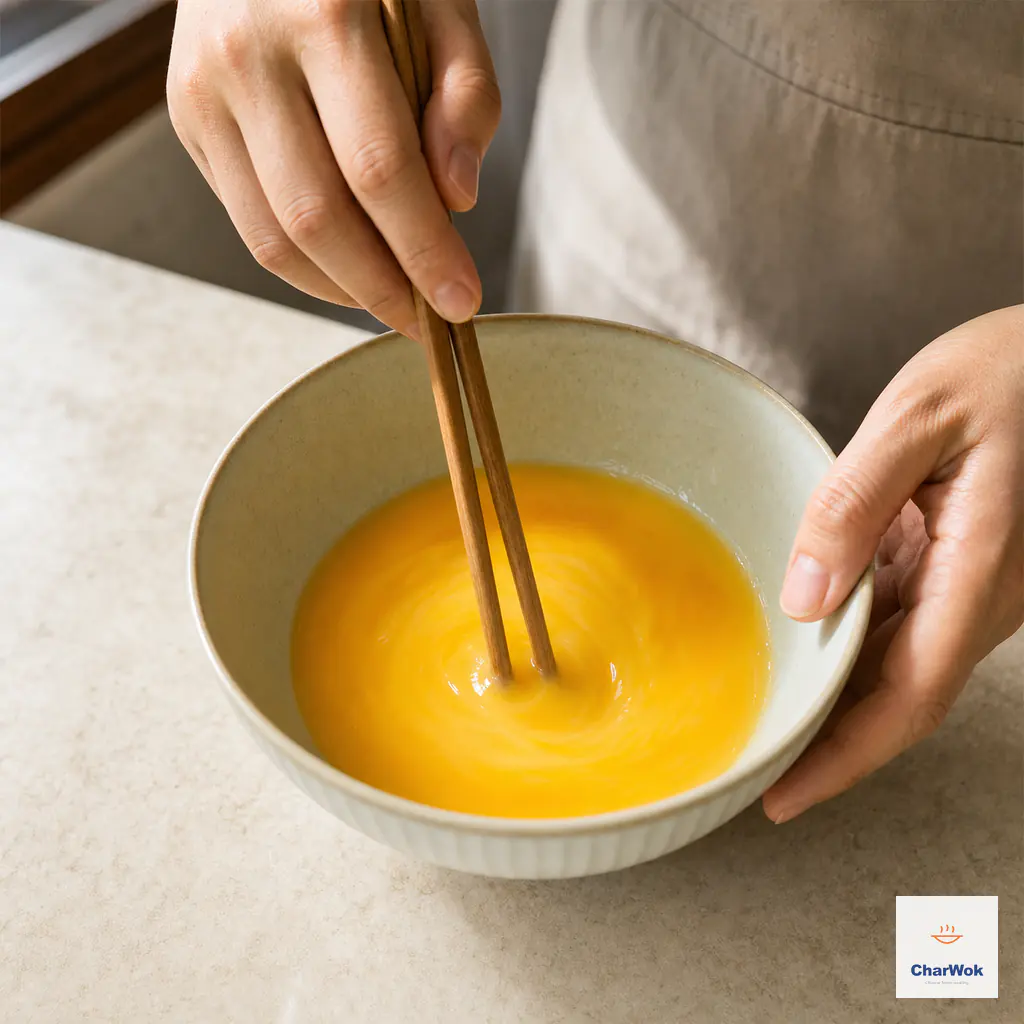
Stir only until the yolks and whites merge; do not whip air into the egg
- Add the warm liquid in a thin stream while stirring. Pour the 40°C water or stock in slowly, stirring the whole time so it tempers into the egg rather than shocking it. Stop the moment it is incorporated.
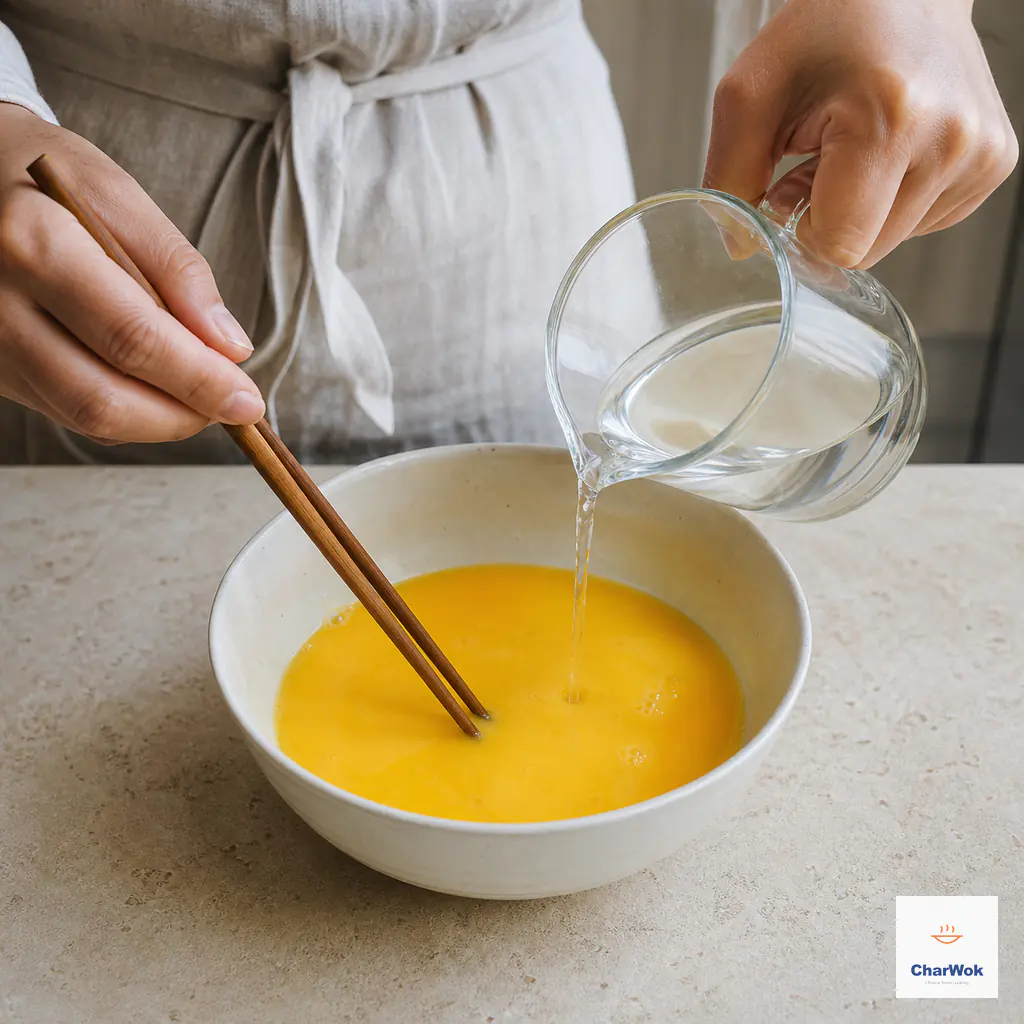
Pour the 40°C liquid in a thin stream while stirring, then stop as soon as it is incorporated
- Strain through a fine sieve, twice if you can. Pour the mixture through a fine-mesh strainer into your serving bowl(s). This removes the chalazae strands and any unbeaten bits of white that would show up as pale flecks. Straining is not optional if you want a flawless surface; it is the single most reliable fix for a "lumpy" result.
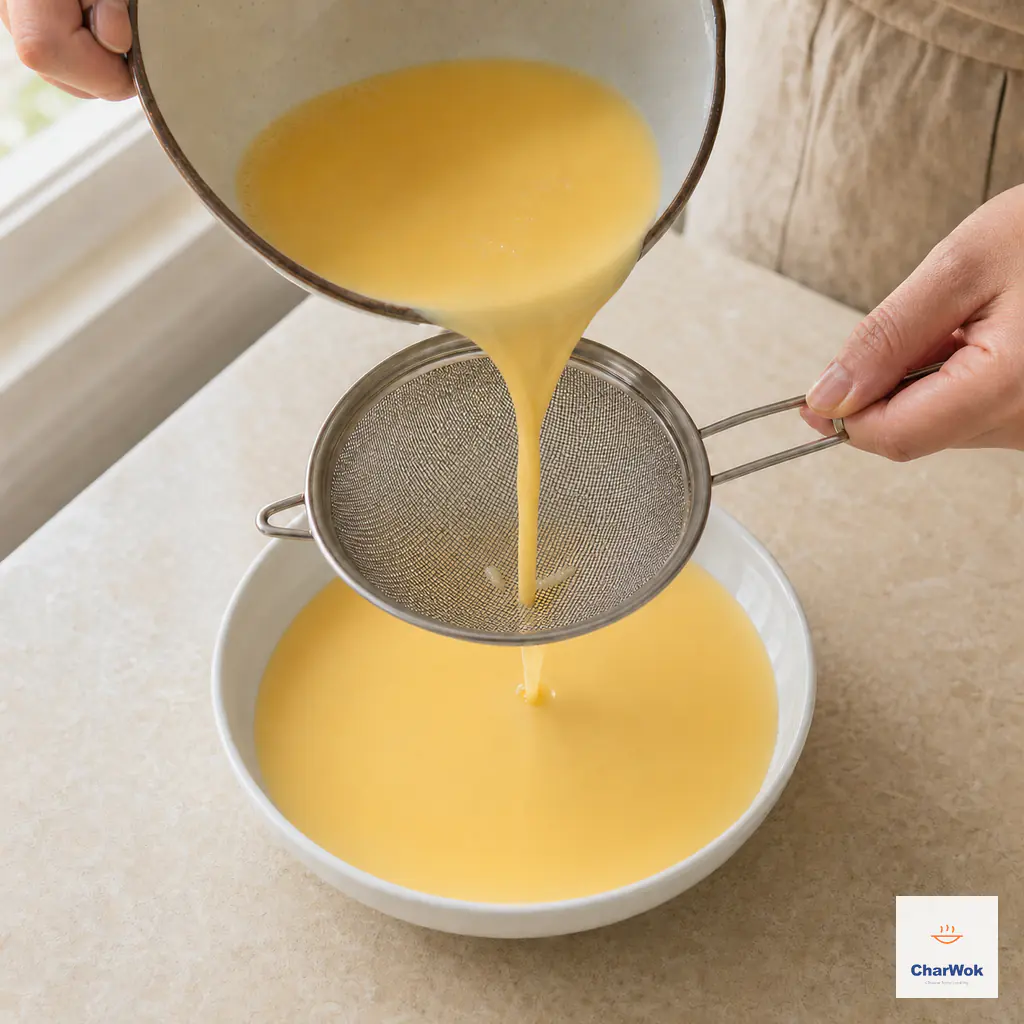
Strain into the serving bowl so chalazae and unbeaten white cannot mark the custard
- Skim any foam, then cover. A few bubbles will sit on top after straining. Lay a sheet of paper towel on the surface and lift it off, or skim with a spoon. Cover the bowl with a plate or pierced wrap. Skimming plus covering is the two-part defense against a cratered top.
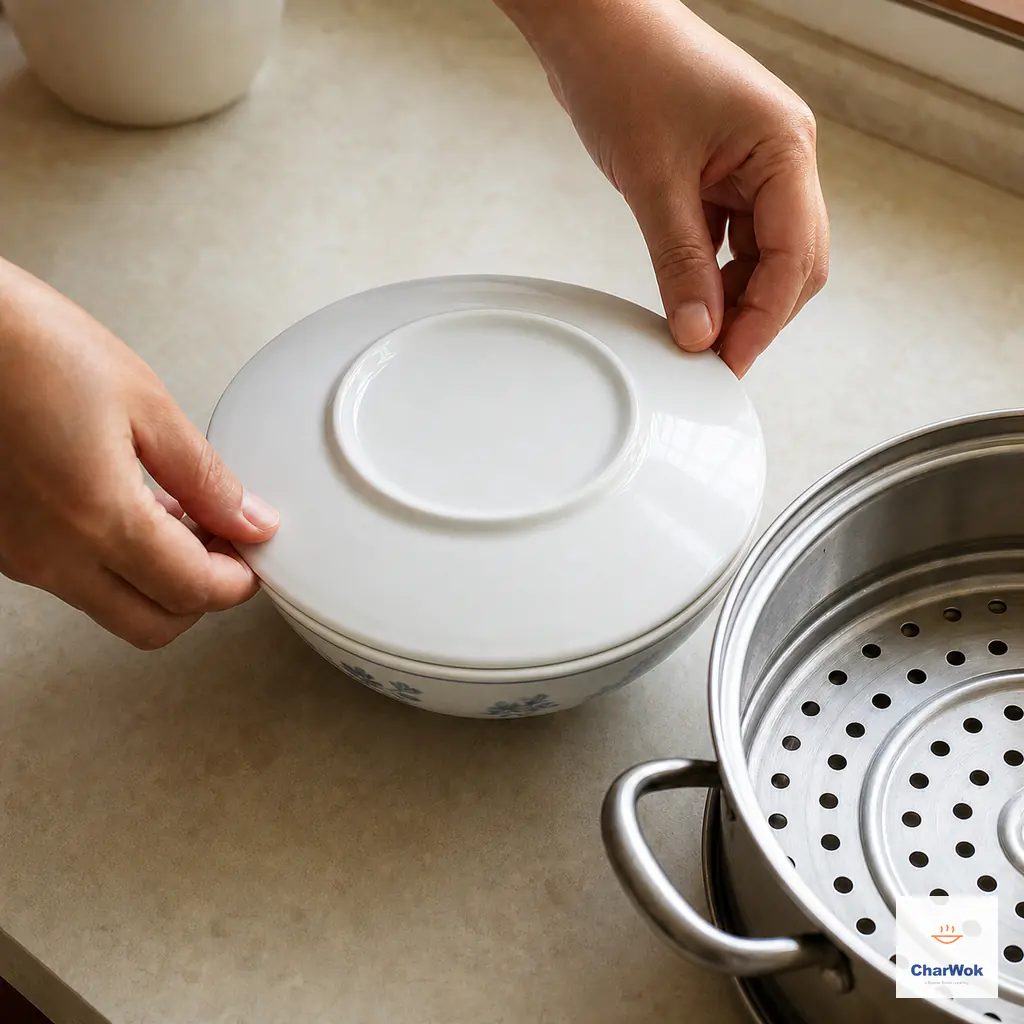
Skim the last bubbles, then cover loosely so condensation cannot crater the surface
- Start the custard in water that is already steaming, then drop the heat. Bring your steamer water to a boil, set the bowl in, and immediately reduce to a gentle simmer. You should see lazy steam, not a furious plume. Rolling steam overcooks the edges before the center sets, which is how you get a rubbery ring around a raw middle.
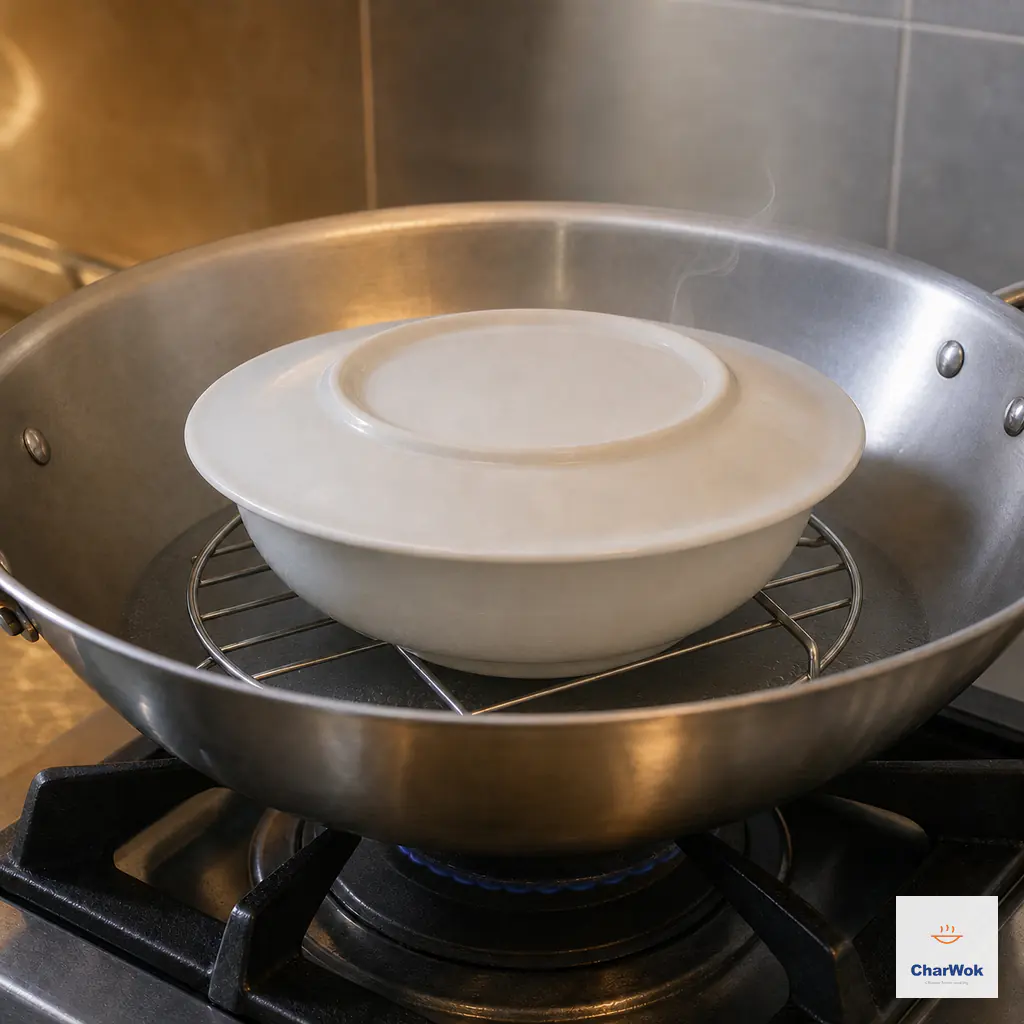
Start over steaming water, then reduce at once to a gentle simmer with lazy steam
- Steam about 10 minutes for one serving, 12 to 14 for a deep bowl. Timing depends on bowl depth, liquid temperature, and how gentle your simmer is, so judge by look, not by the clock. The custard is done when the edges are set and the center wobbles like soft jelly but no longer flows like liquid. Pull it then; carryover heat will finish the center as it rests.
- Rest one minute, then finish at the table. Take the bowl out, lift the cover to let the steam escape, and let it sit briefly so the surface firms up. Drizzle light soy and a few drops of sesame oil over the top, scatter chives if using, and run a spoon through the custard two or three times so the seasoning sinks in. Serve warm.
When things go wrong: troubleshooting
This is the section I had to write the hard way, from my own failures. Match your result to the symptom.
A puddle of water under a set curd. Too much liquid for the protein to hold. Drop the ratio from 2 to 1.5, and make sure you measured the beaten egg, not estimated. This is the fix for the weeping-curd problem.
A honeycomb of holes through the cross-section, even though the top looked fine. The heat was too high. Those tunnels are steam bubbles that formed inside the custard because the outside set first and trapped them. Use a gentler simmer and consider a cover, the trapped bubbles are usually condensation dripping and puncturing the gel.
A gray, dull surface. Overcooked. Egg proteins tighten and push out moisture, which makes the curd dense and slightly gray-green, the same reaction that turns overcooked hard-boiled yolks dark. Pull it earlier next time; the center should still wobble when you take it out.
Foam and flecks on top. You either whipped the eggs or skipped the strainer. Whip less next time, and always strain. The flecks are unbeaten strands of white and the chalazae.
Custard looks perfect but tastes bland. You under-salted to be safe, which is the right instinct, the soy sauce at the end is meant to carry the seasoning. Score the surface a few times so it penetrates instead of pooling on top.
Variations and add-ins
The plain custard is a blank canvas. These are the additions I come back to.
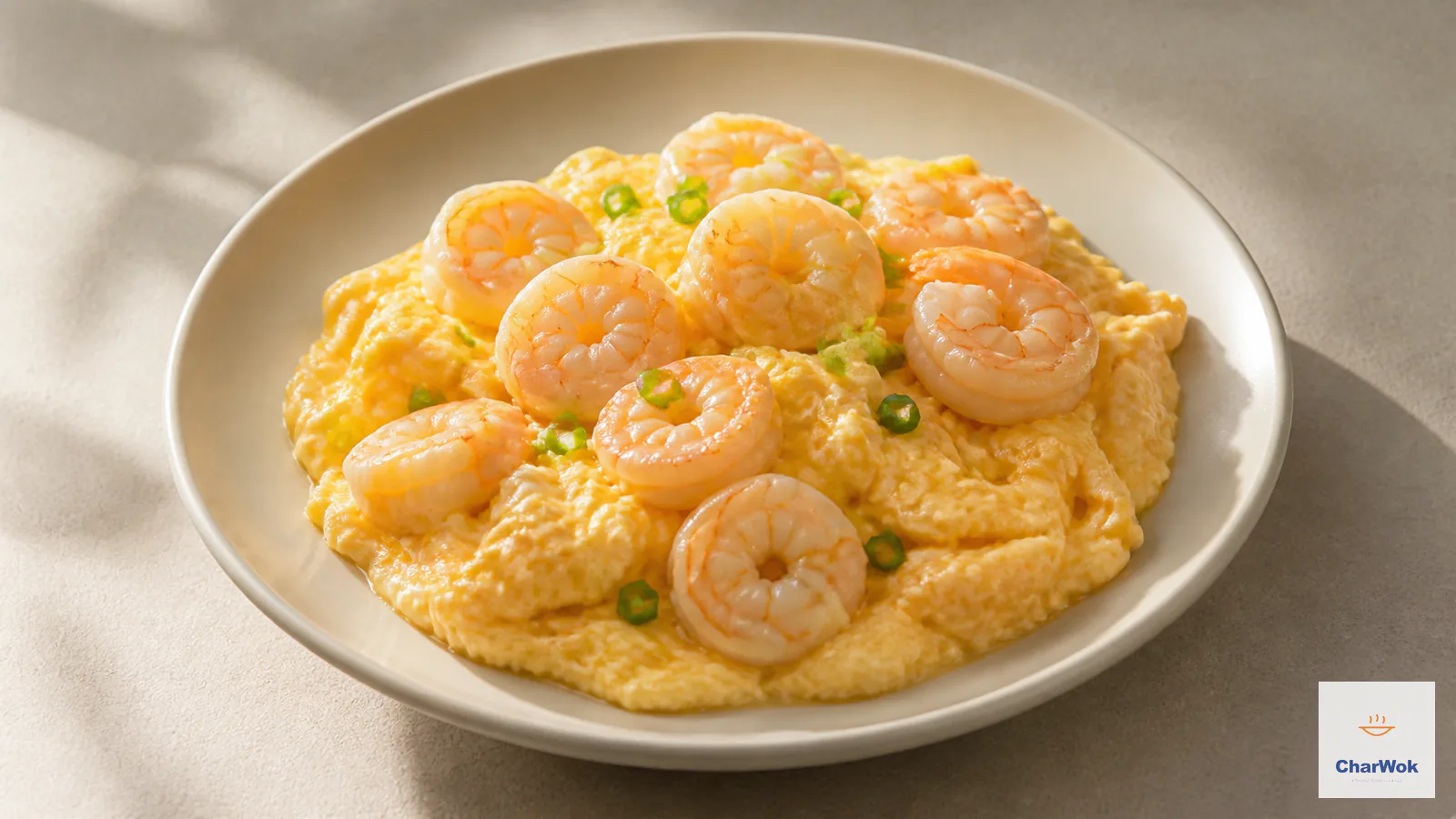
Shrimp and asparagus (the restaurant version). Peel and devein a few shrimp, cut asparagus into thin bias slices. Steam the custard for 7 minutes, then lay the shrimp and vegetables on top and steam another 3 minutes. The shrimp just cooks through as the custard finishes. This is close kin to steamed garlic shrimp with vermicelli in spirit, gentle steam letting a single ingredient shine.
Dried shrimp and mushroom for depth. Soak a few dried shrimp and thinly sliced dried shiitake mushrooms, mince them, and stir a spoonful into the raw mixture before straining. It turns the custard savory and faintly smoky, almost like a poor man's dashi. This is the version I make when there is no stock in the fridge.
Minced pork, scattered and steamed. Brown a little seasoned minced pork in oil first, then spoon it over the partly-set custard for the final three minutes. It echoes the logic of dishes like steamed ribs with black beans or steamed chicken with shiitake, where a savory topping melts its flavor into a steamed base.
Scallion oil finish instead of soy. Heat a tablespoon of oil until shimmering, pour it over a scatter of finely sliced scallion greens on the finished custard, then add a few drops of soy. The hot oil blooms the alliums the way it does in scallion tofu and many Cantonese steamed dishes. Use this when you want aroma more than salt.
What to serve it with
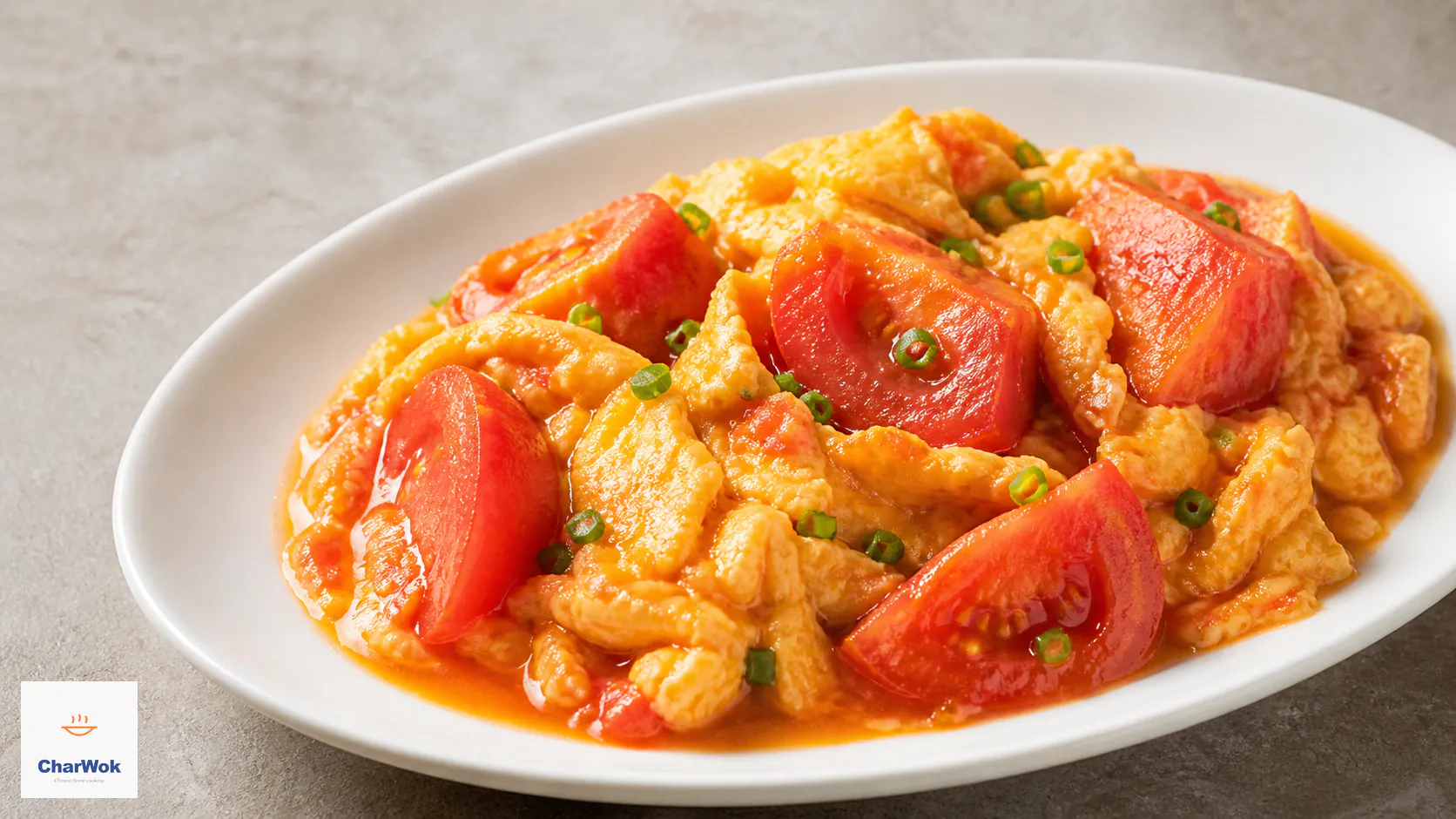
Steamed eggs are soft and low in texture, so they pair best with something that brings crunch or chew. A bowl of plain rice congee and this custard is a classic convalescent or breakfast combo. For a fuller meal, set it next to a stir-fry with bite: tomato egg stir-fry doubles down on egg in a completely different texture, while shrimp and egg stir-fry repeats the egg-and-shrimp pairing in a pan. If you want contrast rather than echo, anything from the chive and egg family or a quick vegetable stir-fry works.
For a Chinese-steamed-things theme night, you can run this alongside whole steamed fish or steamed enoki mushrooms; they share the same gentle-heat philosophy and you can keep one steamer going for all of them.
Storage and reheating
Steamed eggs are best eaten immediately, when the texture is at its most delicate. Leftovers keep, covered, in the fridge for up to 24 hours, but the custard will weep a little and tighten as it sits. Reheat gently in a steamer over low heat for 3 to 4 minutes, or in short bursts in the microwave at 50 percent power. The microwave will toughen it more than steam does; use it only if you must. I do not recommend freezing; the texture breaks and turns spongy on thaw.
More from the egg files
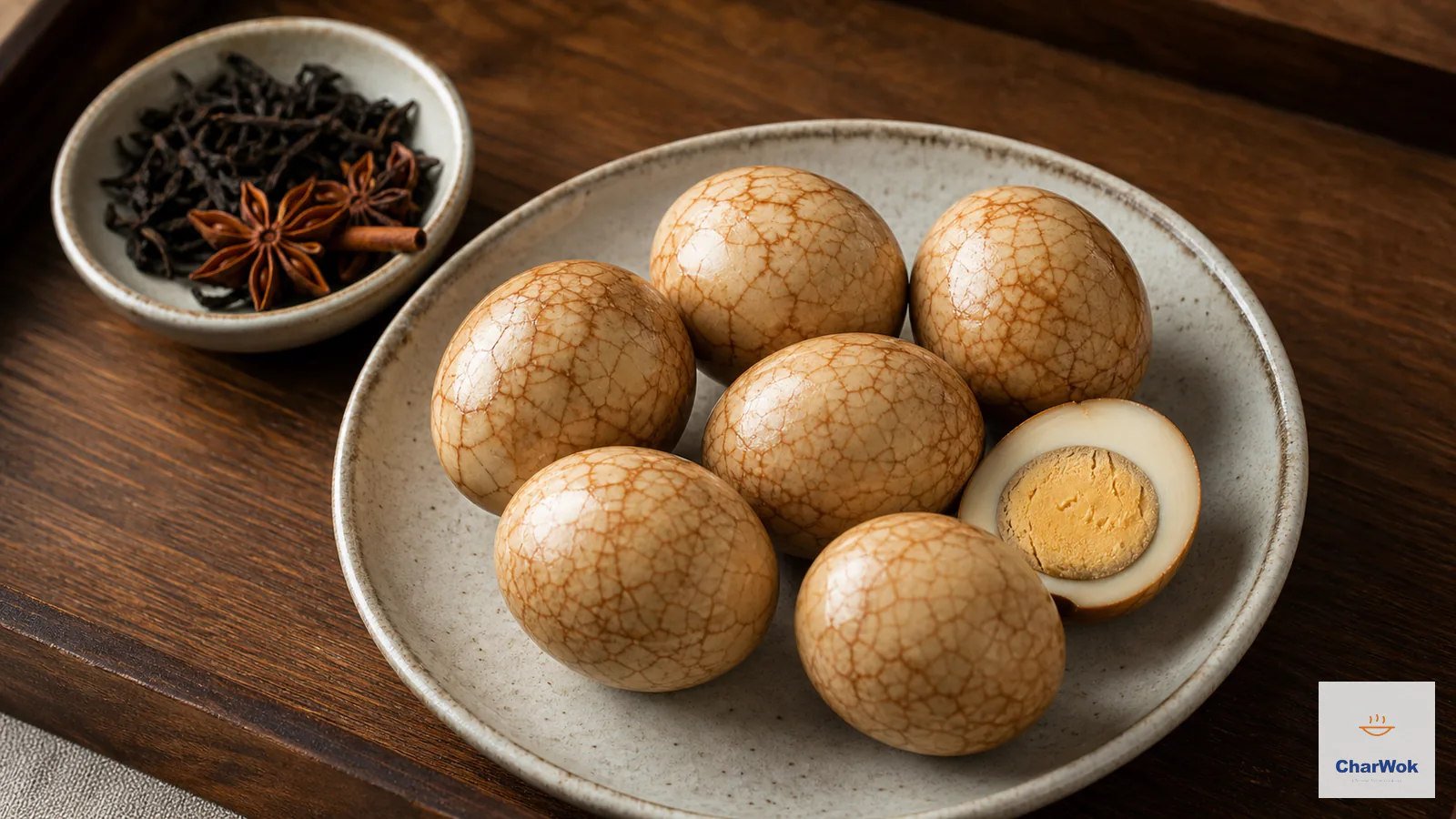
If you cook a lot of Chinese eggs, it helps to know the full range. Tea eggs are marbled and snacky, century eggs are preserved and pungent, egg foo young is the puffy omelette cousin, and egg stir-fried with pickled chili is the spicy shortcut when you want eggs with attitude. Steamed eggs are the quiet one of the family, the one that rewards restraint.
Frequently asked questions
Can I use cold water instead of warm? You can, and it will still set, but the custard tends to be slightly coarser and needs a minute or two longer in the steamer, which raises the risk of overcooking. Warm water around 40°C gives a smoother set for no extra effort.
Do I really need to strain the mixture? If a flawless, glass-smooth surface matters to you, yes. Straining removes the chalazae and unbeaten white bits that otherwise show up as flecks and strings. If you do not care about appearances, skip it; the taste is identical.
Why is my custard full of holes even though I covered it? The heat was too high. Those internal tunnels are steam bubbles trapped by a surface that set too fast. Drop to a gentle simmer and the holes disappear.
Can I make this without a steamer? Yes. Use any wide pot with a lid, set the bowl on a small heatproof stand or a folded cloth in shallow water, and keep the water at a gentle simmer. Treat it as a water bath and the results are nearly identical.
How do I know when it is done? The edges should be firmly set and the center should wobble like soft jelly, not flow like liquid. Pull it then; residual heat finishes the center as it rests. Better slightly under than over, since overcooking turns it gray and rubbery.