I have watched a lot of home cooks give up on Chinese food after their third sad plate of stir-fried whatever. Almost never is the wok to blame, or the heat, or their knife work. The problem is almost always the pantry. They bought one bottle of generic "soy sauce," a jar of chili flakes, and a tin of five spice that may predate the Obama administration, then tried to cook dishes whose entire personality comes from a half-dozen ferments they never bothered to stock.
Chinese cooking runs on a small library of condiments that do most of the seasoning for you. Get to know ten of them and your weeknight cooking changes overnight. Skip them and you are fighting the recipes every step of the way, substituting around a void you cannot quite name.
Here is the pantry I cook from, with the reasoning behind each bottle and what each one actually does in the pan. This is not a catalog of every condiment in China. It is the short list that earns its shelf space.
At a glance: Ten bottles cover roughly 90 percent of everyday Chinese home cooking. The two non-negotiables are light soy sauce (for salt and umami) and Shaoxing rice wine (to deglaze and deodorize meat). Add cornstarch and you can thicken, velvet, and crisp. The rest are dialect and accent. Buy them in small bottles first so nothing goes stale before you finish it.
What these bottles actually do
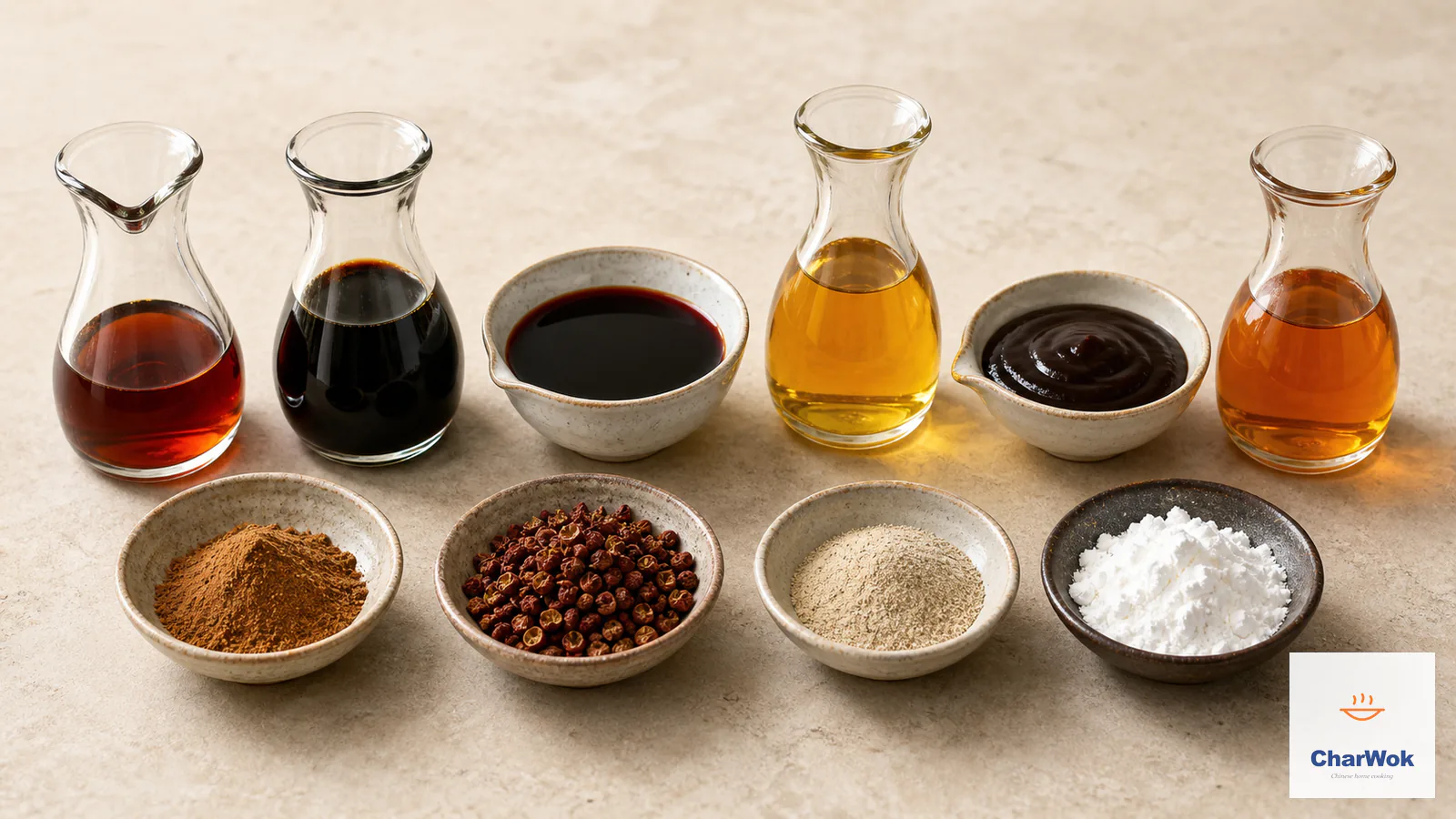
Think of the pantry in three layers. Salt and umami come from soy sauce and oyster sauce. Acid, aroma, and the removal of raw-meat smell come from black rice vinegar and Shaoxing rice wine. Texture and finish come from cornstarch, sesame oil, and the peppers. Five spice is a category of its own, a single seasoning that implies an entire braised dish.
Once those roles click, recipes stop feeling like incantations. You taste a sauce and notice it needs more acid, so you reach for the vinegar instead of dumping in more soy sauce. That instinct is the real payoff of building the pantry. The bottles are the price of admission.
The ten condiments
Ten Chinese pantry essentials at a glance
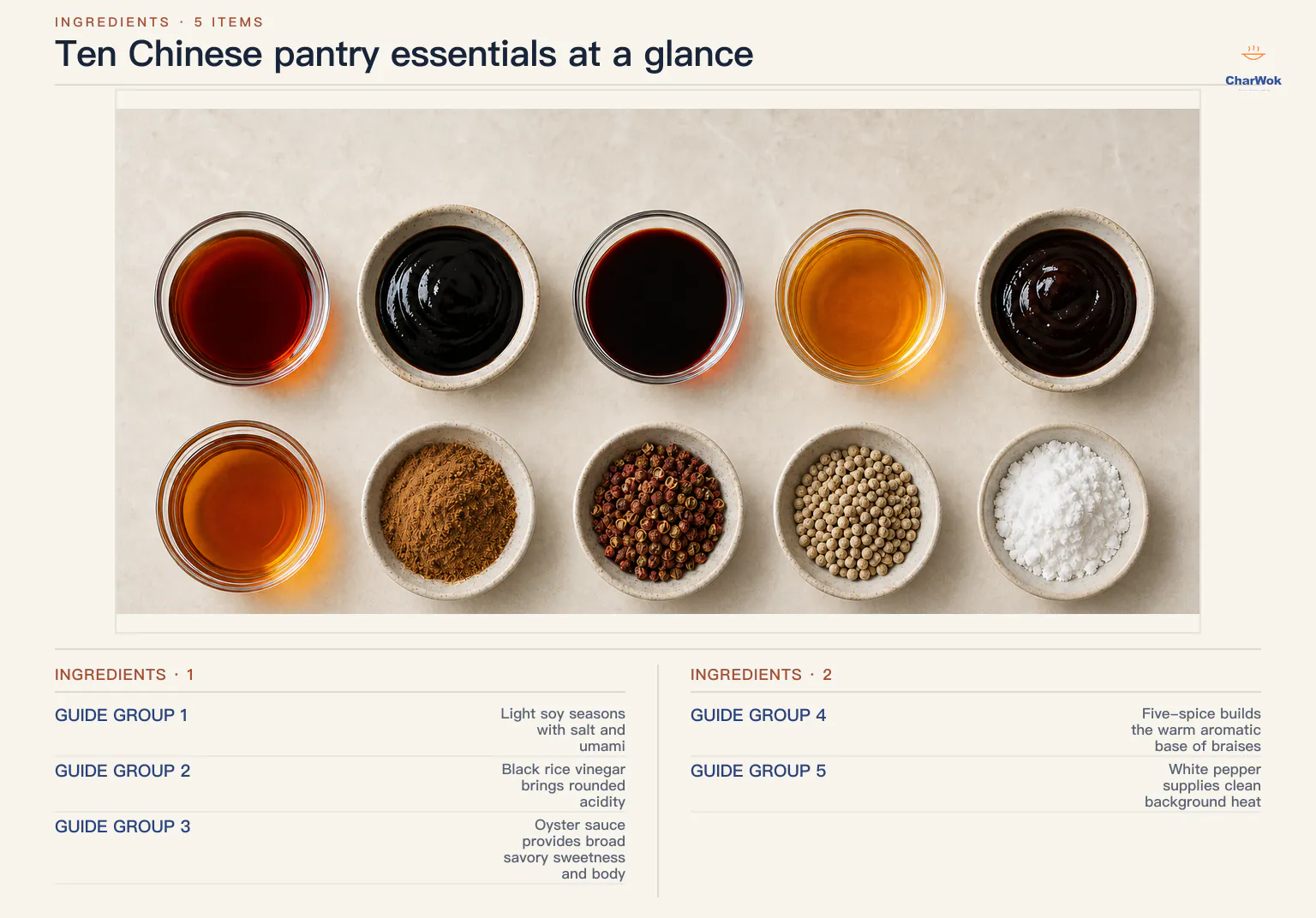
Quantities below are stocking suggestions, not recipe amounts. They are what I keep on hand and roughly how fast a home cook goes through them.
| Condiment | Keep on hand | What it does / substitute |
|---|---|---|
| Light soy sauce (生抽) | 500 ml, the workhorse | Salt plus umami for almost everything. The name tracks the pour's hue, not its saltiness; pour for pour it out-salts the dark bottle. Sub: tamari if you need gluten-free. |
| Dark soy sauce (老抽) | 250 ml | Color and a faint caramel sweetness for braises and noodle tosses. Thicker, less salty. Do not swap it in when a recipe just says "soy sauce." Sub: lighten regular soy with a smear of brown sugar to fake the molasses edge. |
| Black rice vinegar (镇江香醋) | 250 ml | Soft, smoky, slightly sweet acid for cold dishes, dumpling dips, and hot-and-sour anything. Nothing else tastes like it. The Zhenjiang-origin bottle is the one to seek out. |
| Shaoxing rice wine (绍兴酒) | 500 ml | Removes raw-meat smell, deglazes, deepens braises. Read the label: good bottles have under 0.1 g salt per 100 ml. Sub: dry sherry. |
| Oyster sauce (蚝油) | 250 ml | Syrupy umami that finishes stir-fries and seasons fillings. Foundational to Cantonese cooking. Vegetarian version (mushroom-based) is a fair stand-in. |
| Toasted sesame oil (香油) | 250 ml, dark amber | Nutty finishing drizzle for cold dishes, soups, and dumpling fillings. It is a finishing fat, not a pan oil. Reach for the toasted, amber pour, not the pale cold-pressed kind. |
| Five spice powder (五香粉) | 50 g, or make your own | A warm-aromatic blend whose core four (star anise, cassia, fennel, cloves) sit under a fifth spice that changes by region. Dry rubs, marinades, fillings, broths. Freshly ground beats the dusty tin. |
| Sichuan pepper (花椒) | 50 g whole | The numbing tingle (má) that defines Sichuan food. Whole keeps longer; grind what you need. Nothing else produces the effect, so it is worth its own shelf slot. |
| White pepper, ground | A small jar | A gentle, woody heat for soups, fried rice, and braises. Sharper and more aromatic than black pepper in this context. |
| Cornstarch | 250 g | Thickens sauces, velvets meat, builds crispy coatings for frying. Vegan and gluten-free. Sub: tapioca or potato starch; they pull the same three duties. |
Light soy sauce: the salt you forgot you needed
When a Chinese recipe says "soy sauce" with no other qualifier, it means light soy sauce. This is the first bottle you finish and the one you rebuy most often. It is fermented soybeans and wheat, thin and reddish-brown, and it carries salt and savory depth into marinades, dumpling dips, steamed dishes, and quick stir-fries.
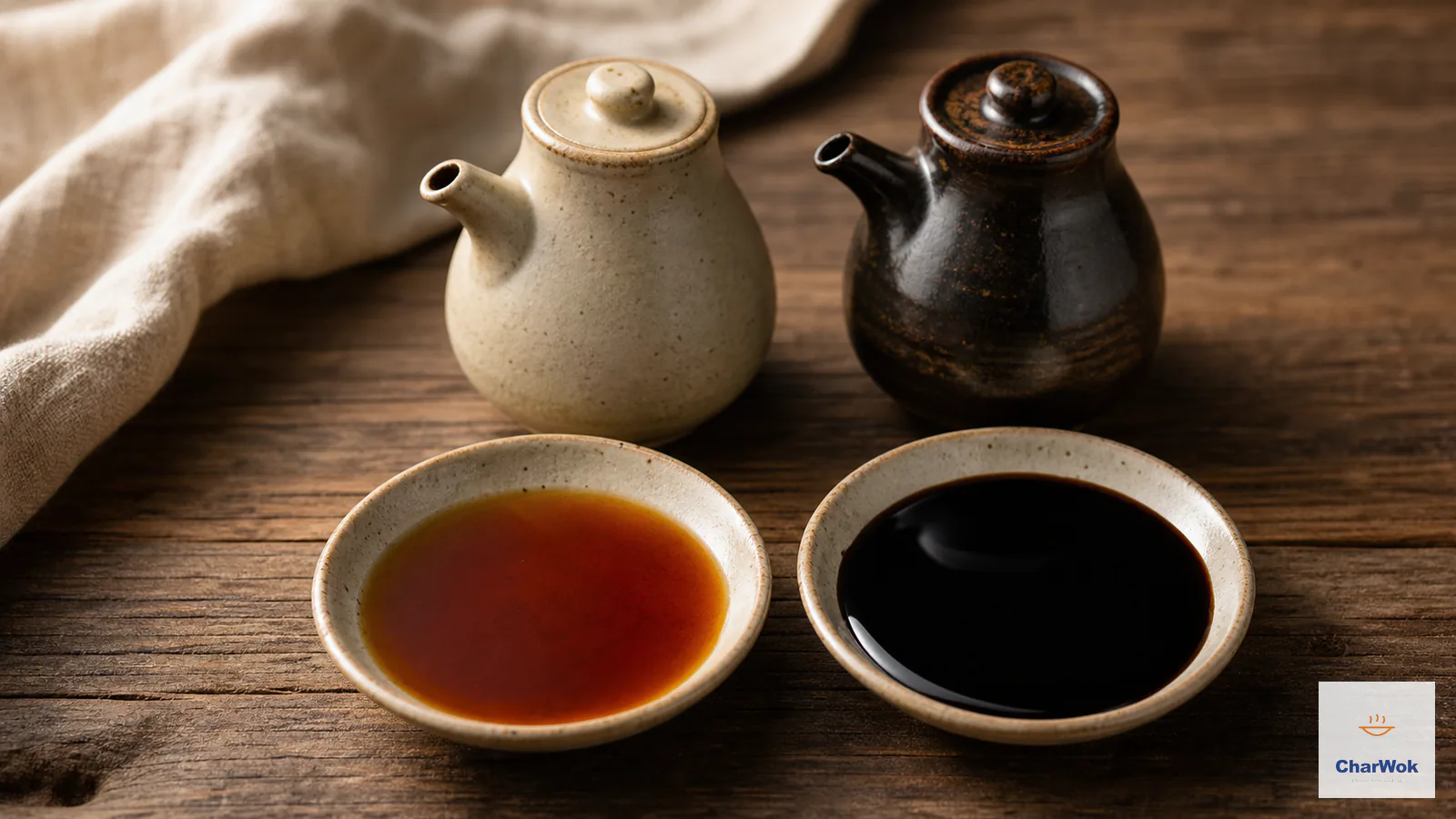
The naming trips people up, because the word "light" is doing two jobs at once in English. Here it describes the pour's reddish clarity, not a low-sodium claim. Measure against measure, this bottle hands you more salt than its dark counterpart, which is exactly why it does the seasoning in most dishes while the dark one hangs back to color. Watching your sodium? The reduced-salt line on the supermarket shelf behaves close enough for everyday cooking. One more label note: the wheat in a standard bottle rules it out for gluten-free cooks, but tamari steps in and behaves almost identically in the pan.
Dark soy sauce: color and a whisper of sweetness
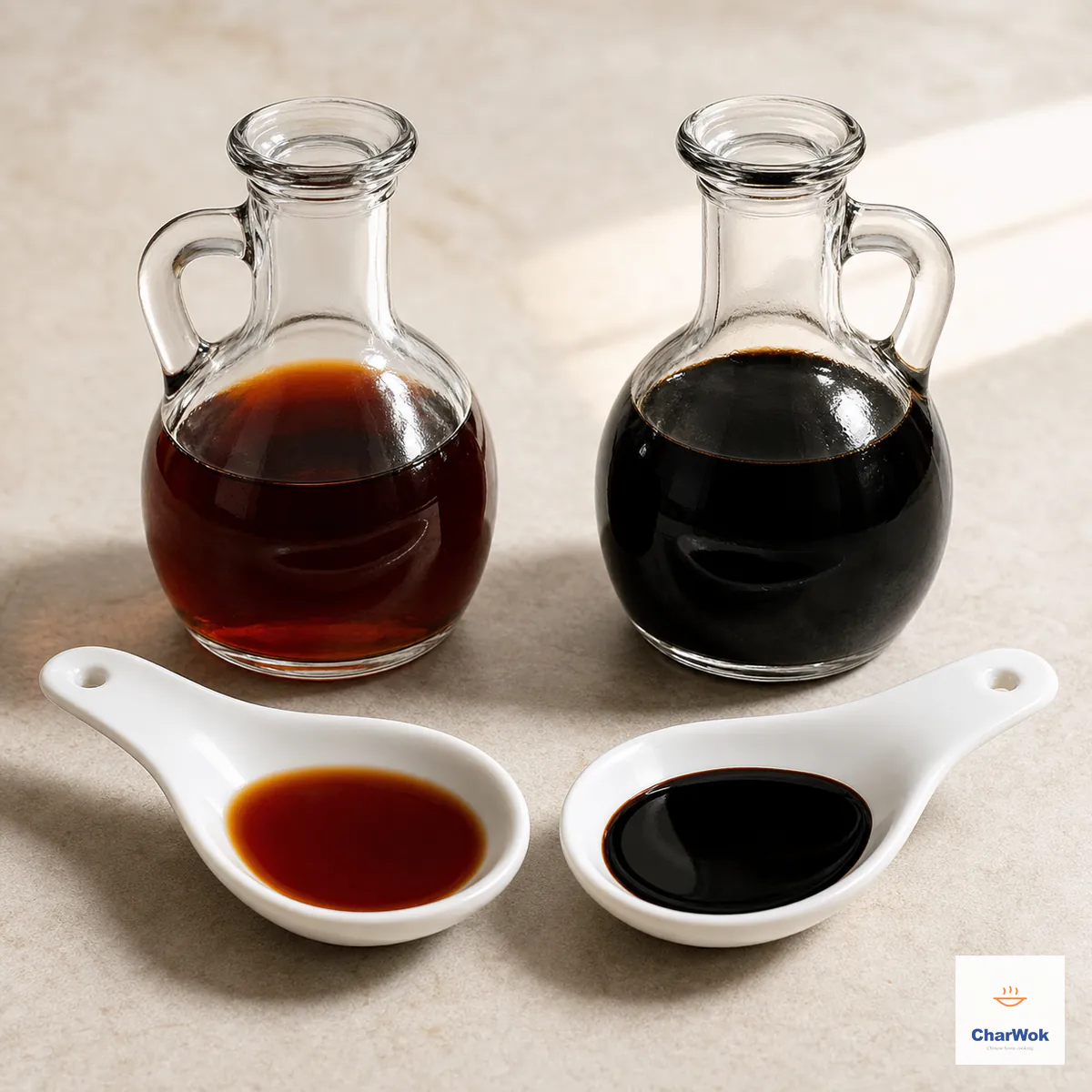
Light soy seasons with salt and umami; dark soy is thicker, less salty, and used mainly for mahogany color and gloss.
Dark soy sauce is aged longer and brewed with molasses or caramel, so it pours thicker and stains food a deep mahogany. It is less salty than the light version and brings a faintly sweet, slightly smoky note. Its real job is appearance: a spoonful in a braise gives meat that lacquered look, and a dash tossed through noodles leaves a glossy coating.
Do not treat dark and light as interchangeable. A dish built for light soy will come out muddy and overly sweet if you substitute dark. The reverse is more forgiving. If a braise calls for dark and you only have the light bottle, you can fake the molasses edge: pour the light, then melt in a small spoon of brown sugar until the glaze deepens and you are in the right neighborhood. Try it in red braised pork belly or a soy-glazed chicken to see what the color actually buys you.
Black rice vinegar: the one Western pantries miss
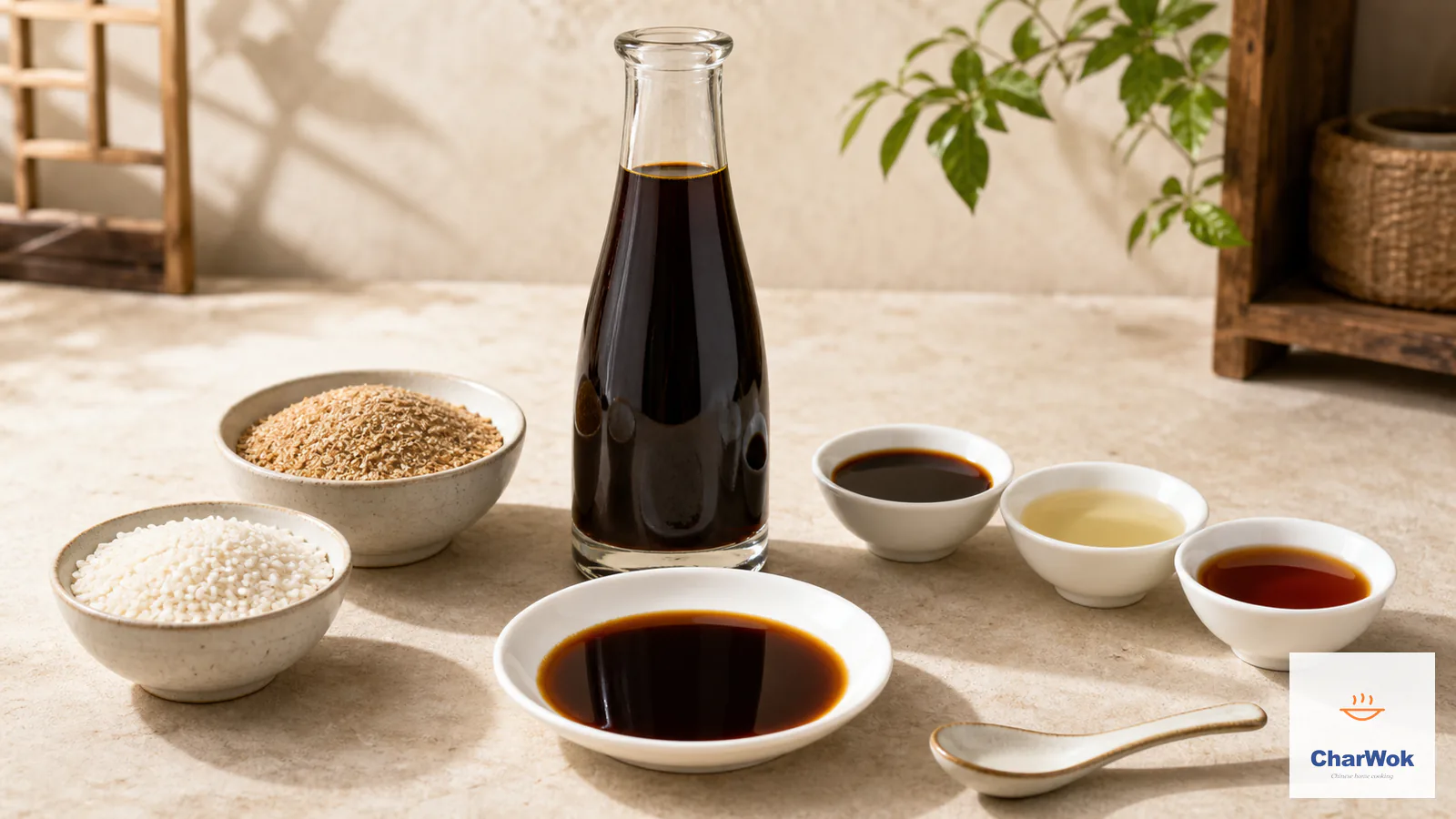
This is the condiment I push on everyone. It is fermented from black glutinous rice (sometimes millet or sorghum), darker than light soy, and its acidity is rounder and smokier than any wine or cider vinegar. What hits you is the balance: salt, tang, sweetness, and smoke folded into one rounded edge that white rice vinegar simply cannot imitate. If you have ever wondered why a restaurant cucumber salad tastes more interesting than yours, this is usually it.
The bottle to ask for is the one from Zhenjiang (镇江香醋), sold under several brand names. It is the easy-to-find entry point outside China, and once you taste it you stop looking for an imitation. It is the backbone of hot and sour noodles, the dipping sauce for mapo tofu-adjacent dishes, and the quiet acid in a good kung pao chicken. Check the label for barley if gluten is a concern.
Shaoxing rice wine: deglaze and deodorize
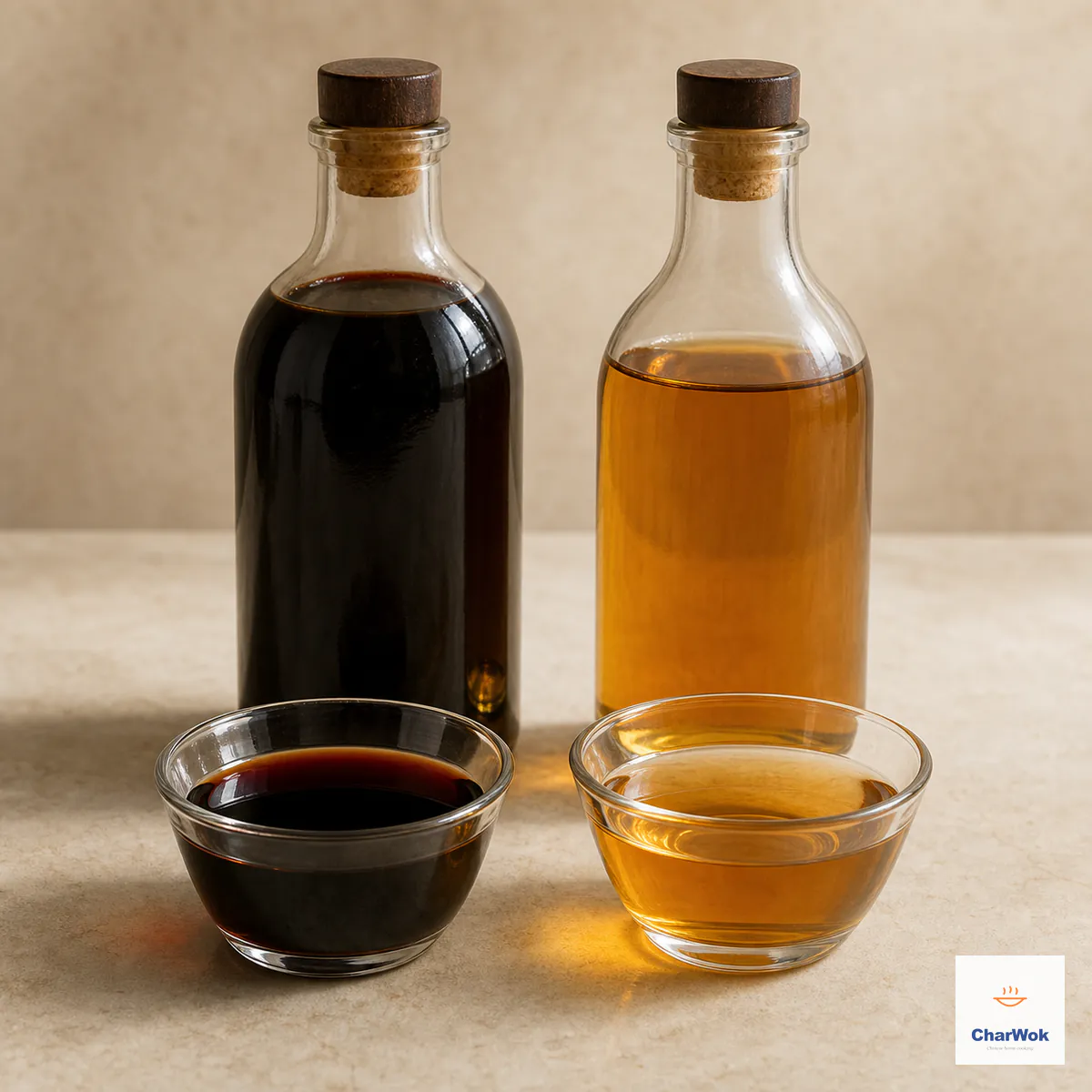
Black rice vinegar brings rounded acidity; Shaoxing wine is an aromatic rice wine used to deglaze, remove raw-meat odors, and deepen braises.
Shaoxing is a rice wine, around 14 percent alcohol, amber and aromatic. Cooks reach for it to strip the raw smell off pork, chicken, and fish before anything else hits the pan. Splash it onto hot meat and the alcohol flashes off, carrying the funky edge with it. It also builds depth in long braises like lu rou fan and red-cooked dishes.
Two labels matter. The first is grade: bottles marked Hua Diao (花雕) sit at the top of the Shaoxing ladder and repay the few extra dollars with cleaner aroma. The second is the sodium line. Some supermarkets stock a "cooking wine" version that is deliberately salted as a preservative (sometimes to 0.5 g per 100 ml), and that salt throws your seasoning off before you have seasoned anything. A drinking-grade bottle should read under 0.1 g. If you cannot source one, dry sherry is the swap that works. What will not work is rice vinegar: one is fermented to acidity, the other to alcohol, and they act on meat in completely different ways. Do not confuse them.
Oyster sauce: the shortcut to a Cantonese stir-fry
Oyster sauce is a dark, syrupy condiment built from caramelized oyster extract, salt, sugar, and a little starch for body. It delivers a broad, glossy umami with a sweet edge, and it is the reason a quick chicken-and-vegetable stir-fry can taste finished in five minutes. It is essential to Cantonese home cooking and shows up in fillings and braises across the rest of the country.
For a default brand, Lee Kum Kee is the safe hand and has the better origin story: the company's founder stumbled onto the recipe while boiling oysters overlong. Plant-based cooks are not shut out. Two credible mushroom routes exist: an oyster-mushroom "vegetarian oyster sauce" and a shiitake-based "vegetarian stir-fry sauce," and either one slides into a recipe with barely a seam. Gluten-free oyster sauce is on shelves too. See how it carries a dish in three cup chicken or a simple oyster-sauce braise.
Sesame oil: a finishing oil, not a frying oil
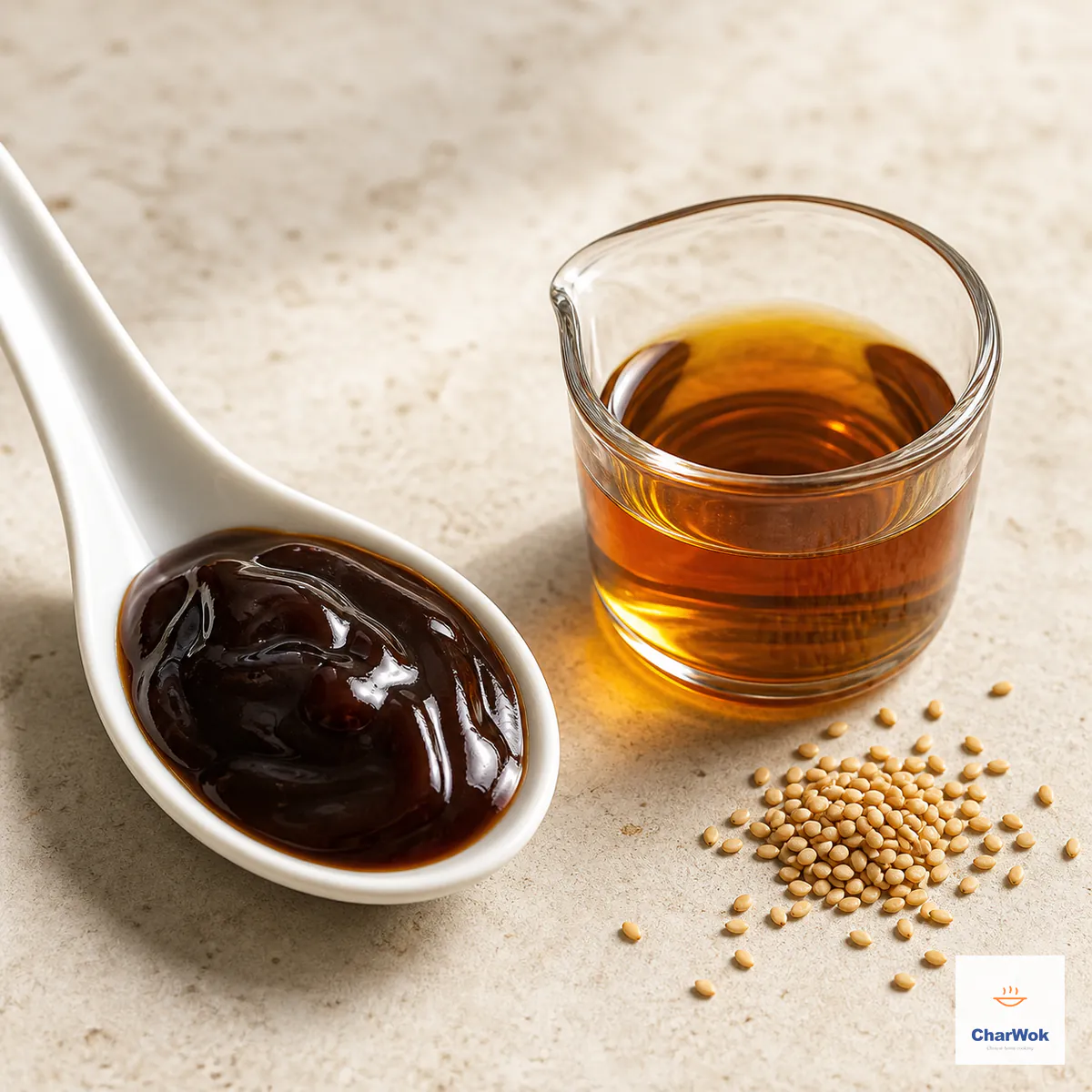
Oyster sauce provides broad savory sweetness and body; toasted sesame oil is a finishing aroma added sparingly after cooking.
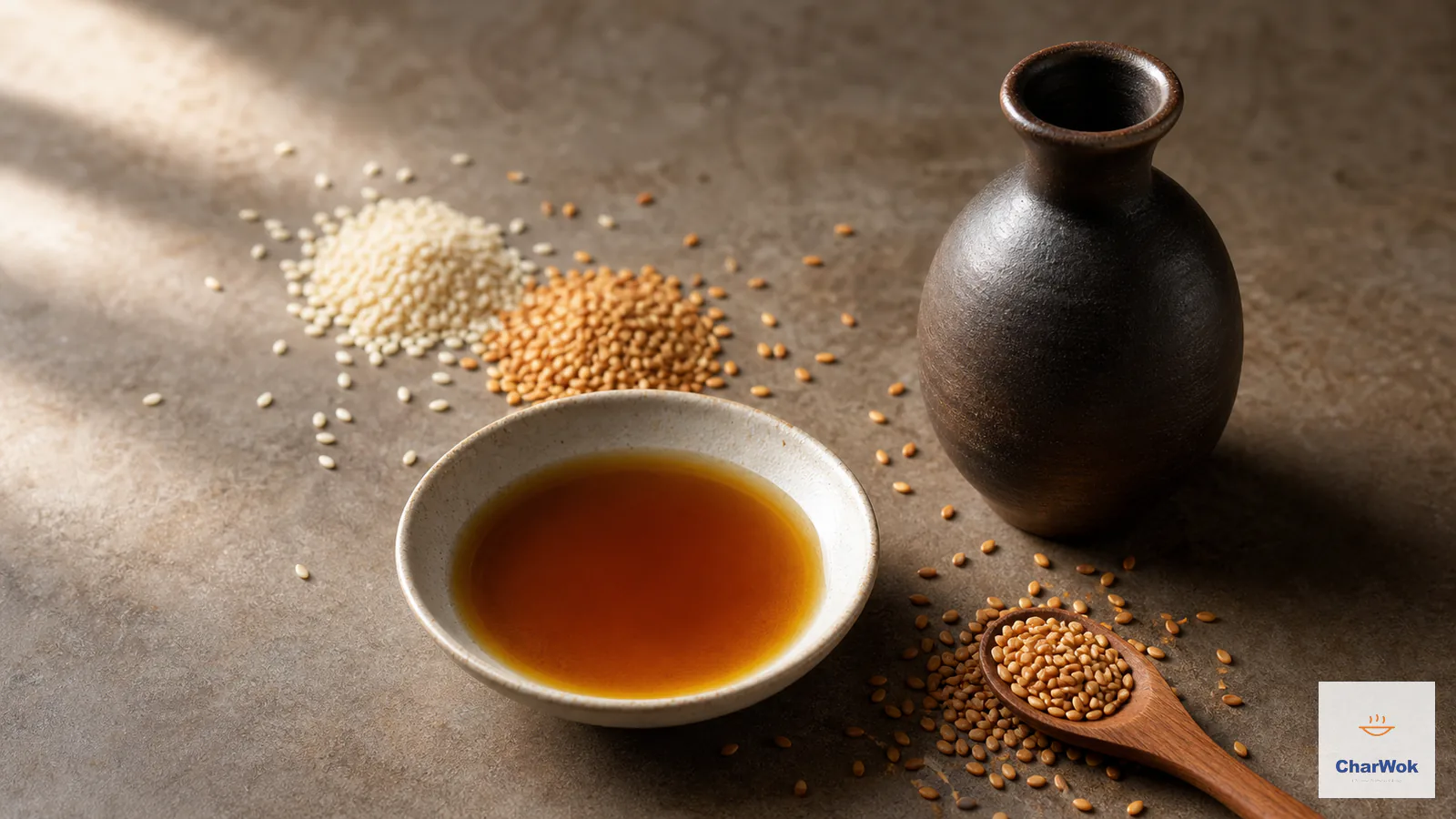
Chinese sesame oil starts from seeds that are toasted before pressing, which is why the pour runs dark amber and the lid comes off to a roasted, nutty hit. A few drops folded in at the end give soups, cold dishes, and dumpling fillings an aroma and a soft, round mouthfeel. I stir it in last, with the heat off, because a hot pan flattens the very fragrance you paid for.
Ignore the pale, cold-pressed sesame oil from the health-food aisle; it carries almost no aroma and reads as a neutral oil in Chinese food. What you want is the toasted, amber bottle from the Asian aisle. A dash lifts hot dry noodles and finishes egg drop soup. Treat it like a seasoning you stir in at the end, not like a fat you cook with.
Five spice: one powder, a whole braised dish
Five spice is a blend of warm aromatics. Four spices hold the floor (star anise, cassia, fennel, and cloves), and the "fifth" is less a fixed ingredient than a regional choice: Sichuan pepper in one town, white pepper in another, dried tangerine peel or licorice root somewhere else. It is the seasoning that makes a piece of pork taste like it has been slow-cooked for hours even when it has not. Use it as a dry rub, fold it into dumpling fillings, or drop a pinch into a braise.
Commercial blends are fine, but they go stale fast. I keep whole spices and grind small batches, which takes five minutes and smells dramatically better than the dusty tin in the back of the cupboard. A little goes far. Too much and everything tastes like a candle.
Sichuan pepper: the tingle nothing else gives you
A note on má
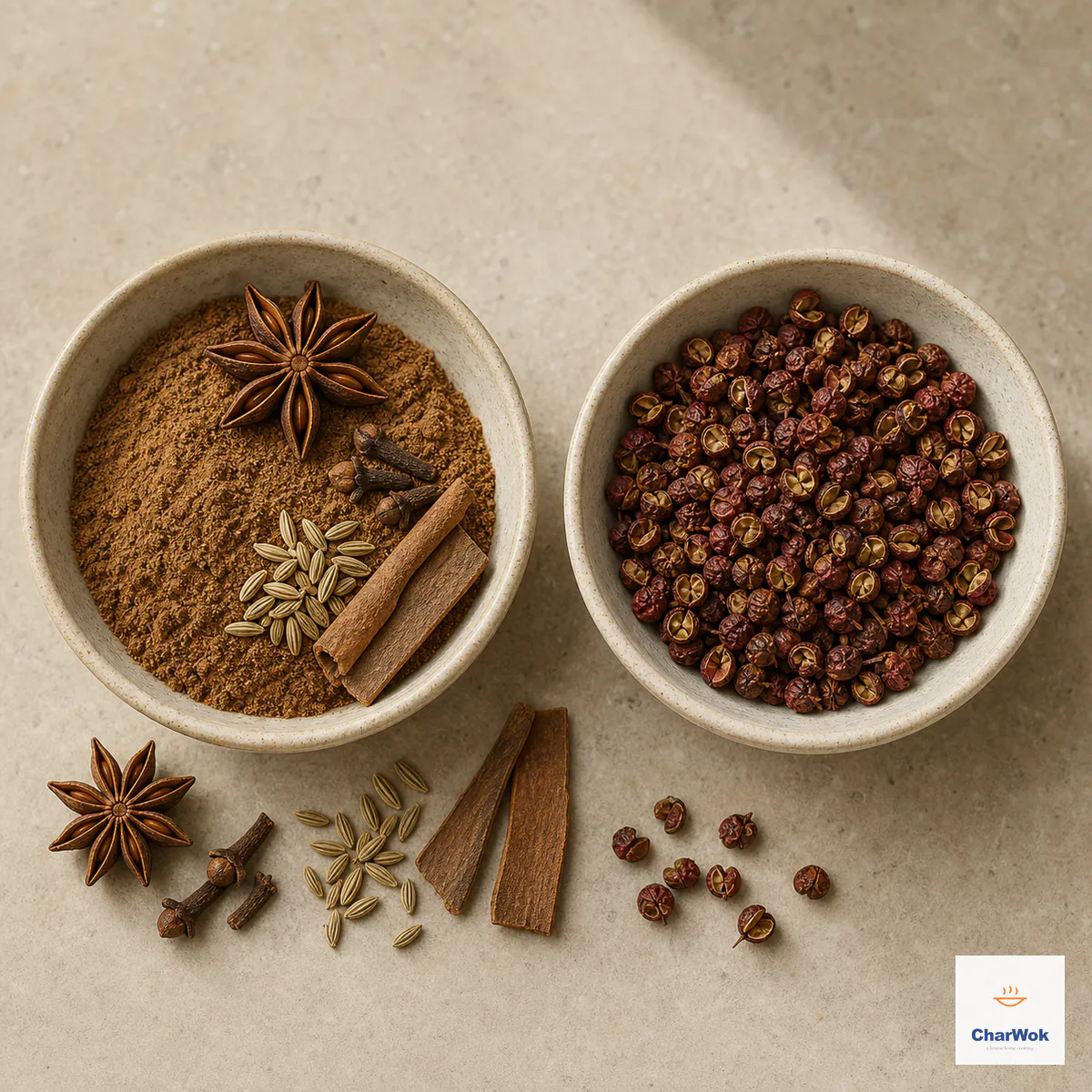
Five-spice builds the warm aromatic base of braises; Sichuan pepper contributes the distinctive citrusy tingling sensation called má.
Sichuan pepper is not a chili and not peppery in the black-pepper sense. Its signature is má (麻) — a current of tingling numbness that wakes the palate up and sets the stage for chili heat to land on. Paired with dried chilies it is the defining flavor of Sichuan cooking, and a few toasted peppercorns in oil will scent a whole dish. Nothing else on the shelf reproduces the effect, so it earns its own slot.
Keep it whole and grind only what you need; pre-ground loses its punch within weeks. Toast dry for thirty seconds before using to wake up the oils. It shows up far from Sichuan too, in the occasional northern dumpling filling or scallion pancake. For the long version, read the Sichuan pepper guide, and for technique see how to grind it correctly.
White pepper: heat without the chili
Where a Western kitchen reaches for black pepper, a Chinese one reaches for white. It carries a woody, slightly musty heat that sits behind soups, fried rice, and braised dishes without darkening them with flecks. The ground form is standard, but whole peppercorns toasted and ground fresh have noticeably more aroma. A pinch in hot and sour soup is what makes the heat linger in the throat.
Cornstarch: the one that is not a condiment
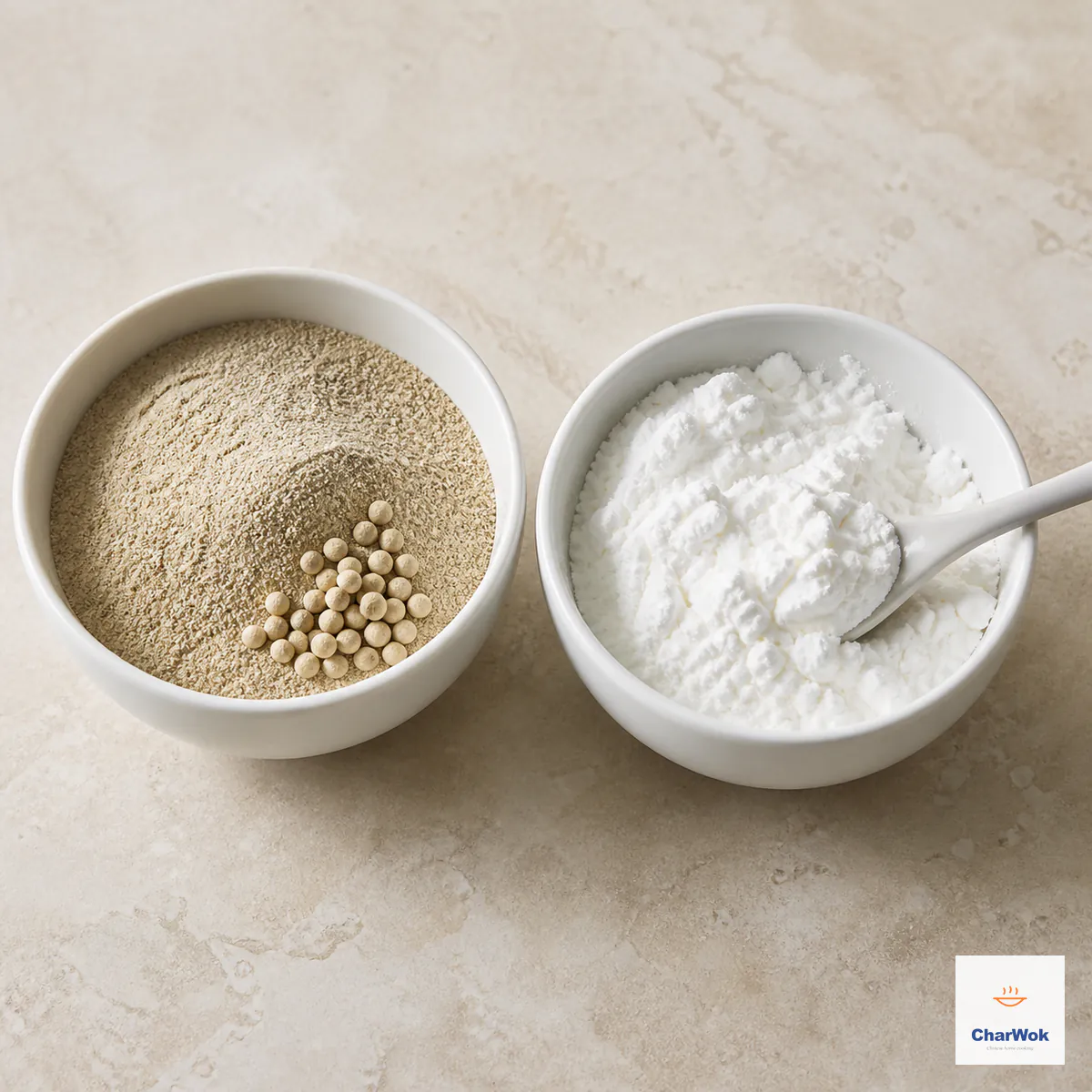
White pepper supplies clean background heat; flavorless cornstarch changes texture through thickening, coating, and velveting.
Cornstarch has no flavor, which is exactly why it matters. Its job is structural, and it works three angles at once. Whisked into cold water it becomes a slurry that pulls a thin sauce into a glossy coating. Dusted over meat or tofu it lays down the crisp shell a fryer needs. And massaged into sliced meat with a little water and oil it does the work cooks call velveting, the step that turns takeout chicken silky instead of stringy.
Pure cornstarch is vegan and gluten-free. If the jar runs empty, the other starches cover for it: tapioca for a clearer, more elastic set, potato starch as an all-rounder, sweet potato starch for the extra-crisp crust that Korean-Chinese frying is known for. You will see it in salt and pepper tofu and in nearly every meat stir-fry on this site.
Common pantry mistakes
A few failures show up again and again. Each one has a simple fix.
- One soy sauce for everything. Most beginner dishes turn out gray and dull because the cook used dark soy where light was meant. Keep both. If a recipe says "soy sauce" with no adjective, it is light.
- Buying salted "cooking wine." These bottles are loaded with salt and taste harsh. Use a drinking-grade Shaoxing or dry sherry. Check that sodium line.
- Pale sesame oil. Cold-pressed sesame oil looks pretty and tastes of nothing. You want the toasted, amber bottle from the Asian aisle.
- Stale five spice. Pre-ground blends lose their top notes within a couple of months. Grind your own in small batches, or at least date the tin and replace it yearly.
- Frying in sesame oil. High heat burns off the toasted aroma you paid for. Sesame oil is a finishing seasoning; cook in a neutral fat like peanut or canola.
- Reaching for rice vinegar when a recipe wants Shaoxing. One is fermented toward acid, the other toward alcohol, and they act on meat in unrelated ways. Keep them apart.
- Skipping the cornstarch slurry. Without it, stir-fry sauces stay watery and slide off the food. One teaspoon of starch in one tablespoon of cold water per dish is a reliable ratio.
Variations, pairings, and what to cook first
Once these ten are on the shelf, the obvious first dishes are the ones that show each condiment in isolation. A simple steamed fish lets the light soy and hot oil do the talking. A plate of dan-dan or hot-and-sour noodles introduces the Sichuan-and-vinegar axis. A braise like lu rou fan or red-cooked pork belly is where dark soy, Shaoxing, and five spice combine into something greater than the sum.
For a quick weeknight, build a master sauce: two parts light soy, one part oyster sauce, one part Shaoxing, a half part black rice vinegar, a pinch of sugar and white pepper, and a cornstarch slurry. That blend will carry chicken, pork, tofu, or whatever vegetables are in the fridge. Adjust the vinegar up for hot-and-sour, the sugar up for a glossier glaze, the five spice in for a deeper, braised note. This is the part where you stop following recipes and start cooking.
Storage and shelf life
Soy sauces, vinegar, Shaoxing, and oyster sauce keep fine at room temperature for many months once opened; oyster sauce will hold its texture longer in the fridge. Sesame oil goes rancid faster than people expect, so buy small bottles and keep it somewhere dark and cool. Whole Sichuan pepper and whole white pepper stay fragrant for a year in a sealed jar; ground versions, half that. Five spice is best ground on demand. Cornstarch lasts indefinitely if kept dry.
A practical rule: if you can no longer smell a condiment when you open the bottle, neither will your dinner. Replace it.
Related recipes & further reading
Once these ten bottles are on the shelf, the natural next step is to cook through them and to round out the pantry with the supporting ingredients they pair with. The recipes and pantry guides below each put a specific condiment front and center, so you can taste what one bottle is actually doing before you start combining them.
- See the full must-try authentic Chinese recipes list for dishes organized by how much pantry each one needs.
- Browse the core Chinese cooking skills guide to see where these condiments support braises, wok dishes, and fillings.
- Put your light soy and toasted sesame oil to work in a clean Chinese steamed fish that lets both bottles show through.
- A simple plate of soy sauce fried rice is the fastest way to taste the difference between light and dark soy.
- Let dark soy, Shaoxing, and five spice combine in a glossy spicy orange beef stir-fry.
- Round out the oil shelf with a guide to Chinese toasted sesame oil, the finishing fat this pantry leans on.
- For noodles with that springy, restaurant chew, lye water (kansui) explains the alkaline trick behind alkaline noodles.
- Dried shrimp adds a quick hit of umami to cold dishes and fillings when oyster sauce is too heavy.
- Fermented black beans (douchi) are the salty, savory punch behind many classic stir-fry sauces.
- A block of rock sugar is what gives braises their clear, glassy sweetness rather than a heavy sugar taste.
- Bring real Sichuan depth to mapo tofu and twice-cooked pork with a jar of Sichuan chili bean paste (doubanjiang).
- For the longer view of where these regional bottles come from, read the culinary tour of China notes on local pantries.
Frequently asked questions
Do I really need both light and dark soy sauce? Yes. They do different jobs. Light seasons; dark colors and rounds. Most recipes assume you have both.
Is "cooking Shaoxing wine" the same as drinking Shaoxing? No. Cooking versions are salted as a preservative and taste harsh. Buy a drinking-grade bottle with low sodium, or use dry sherry.
What can I use instead of black rice vinegar? Not much. A mix of balsamic and rice vinegar gets close in a pinch, but the smoky depth is the point, so try to find Chinkiang vinegar.
Can I make these gluten-free? Largely, yes. Tamari replaces light soy, gluten-free oyster sauce exists, and cornstarch is naturally gluten-free. Shaoxing wine and some black rice vinegars contain wheat or barley, so read the labels.
How long do these bottles last? Soy, vinegar, Shaoxing, and oyster sauce keep for many months at room temperature. Sesame oil and ground spices degrade faster; buy small and replace when the smell fades.