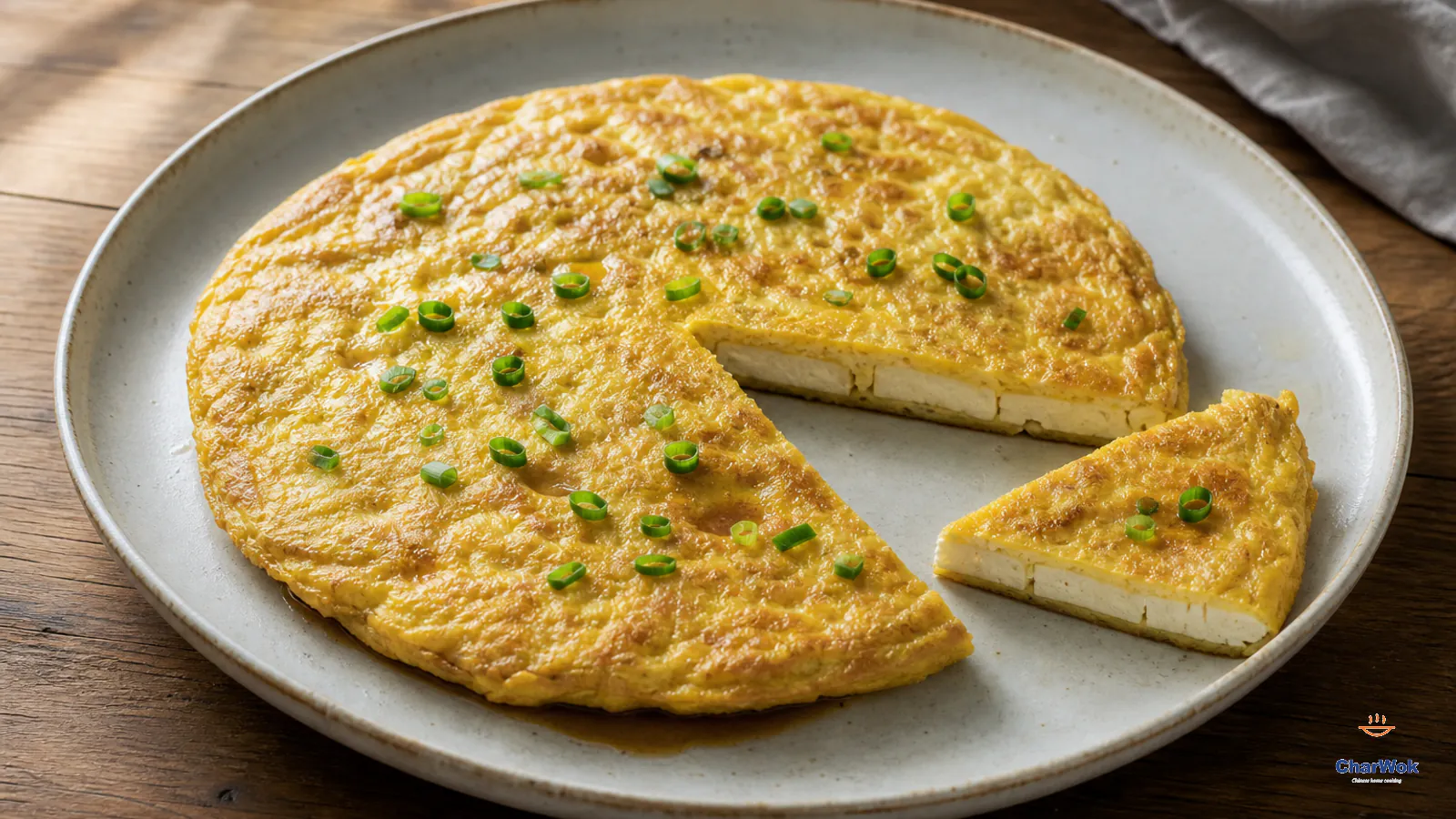
The first time I made a tofu omelet, I ended up with scrambled eggs studded with broken, weeping cubes. The pan was a mess, the eggs were gray from too much soy sauce dumped in too early, and the tofu had steam-boiled rather than browned. That failure taught me the whole dish in one go: this is not a "throw it together" recipe. It is two ingredients that each need one specific thing from the heat, then meet at the end. Get that sequence right and you have a ten-minute lunch with a crackly golden underside, a soft custardy middle, and tofu that tastes like something rather than nothing.
At a glance: Two ingredients, one pan, eight minutes. The whole dish turns on one judgment call: brown the tofu before the eggs go in, never together. Use 285 g (10 oz) tofu to 3 large eggs, a 25 cm / 10-inch non-stick skillet, and medium heat. The seasoning does not touch the eggs; it runs under the finished omelet for the last ten seconds.
What this dish actually is
In northern Chinese home cooking this is doufu danbing (豆腐蛋饼), literally "tofu egg pancake," part of a large family of danbing dishes that are shaped like a flat round but contain no flour. It is not a French omelet, because nothing is folded or rolled. It is closer in spirit to Egg Foo Young or the loose, pour-and-set shrimp and egg stir-fry, eggs used as a tender envelope for something savory, but where those dishes chop the filling small and fold it into the egg, here the tofu stays in slabs so it can develop its own crust.
Think of it as two textures sharing one pan: tofu that has been seared until its surface is golden and slightly chewy, and a thin sheet of egg that sets around it like a soft blanket. It is the kind of thing you make standing up at noon, eat with a bowl of steamed rice or congee, and feel fed. If you want a vegetarian main that pulls its weight, this is one of the better ones, and it sits comfortably alongside other quick easy Chinese recipes for beginners.
Choosing the tofu (and why firmness matters more than brand)
Use medium-firm or firm tofu. That is the only instruction that is non-negotiable here, and the reason is structural. Tofu is a protein-mineral curd held together by calcium sulfate or nigari; its firmness is a measure of how much whey has been pressed out. Silken tofu has almost no drained whey, so it is a fragile gel that will collapse the moment a spatula looks at it, save it for silken tofu salad or mapo tofu. Extra-firm tofu has been pressed so dry that by the time it sits in egg, it reads as rubbery and cottony, like eating packing peanuts.
Medium-firm to firm is the sweet spot. It has enough structure to brown and hold a slab shape, and enough internal moisture that the bite is still juicy. You do not press it. Pressing, wrapping the block in a towel and weighing it down, is what you do for stuffed tofu or salt and pepper tofu, where you want a dry surface to crisp. Here you want the moisture kept in, because it is what stops the dish from tasting like cardboard.
The ingredients
Ingredients at a glance
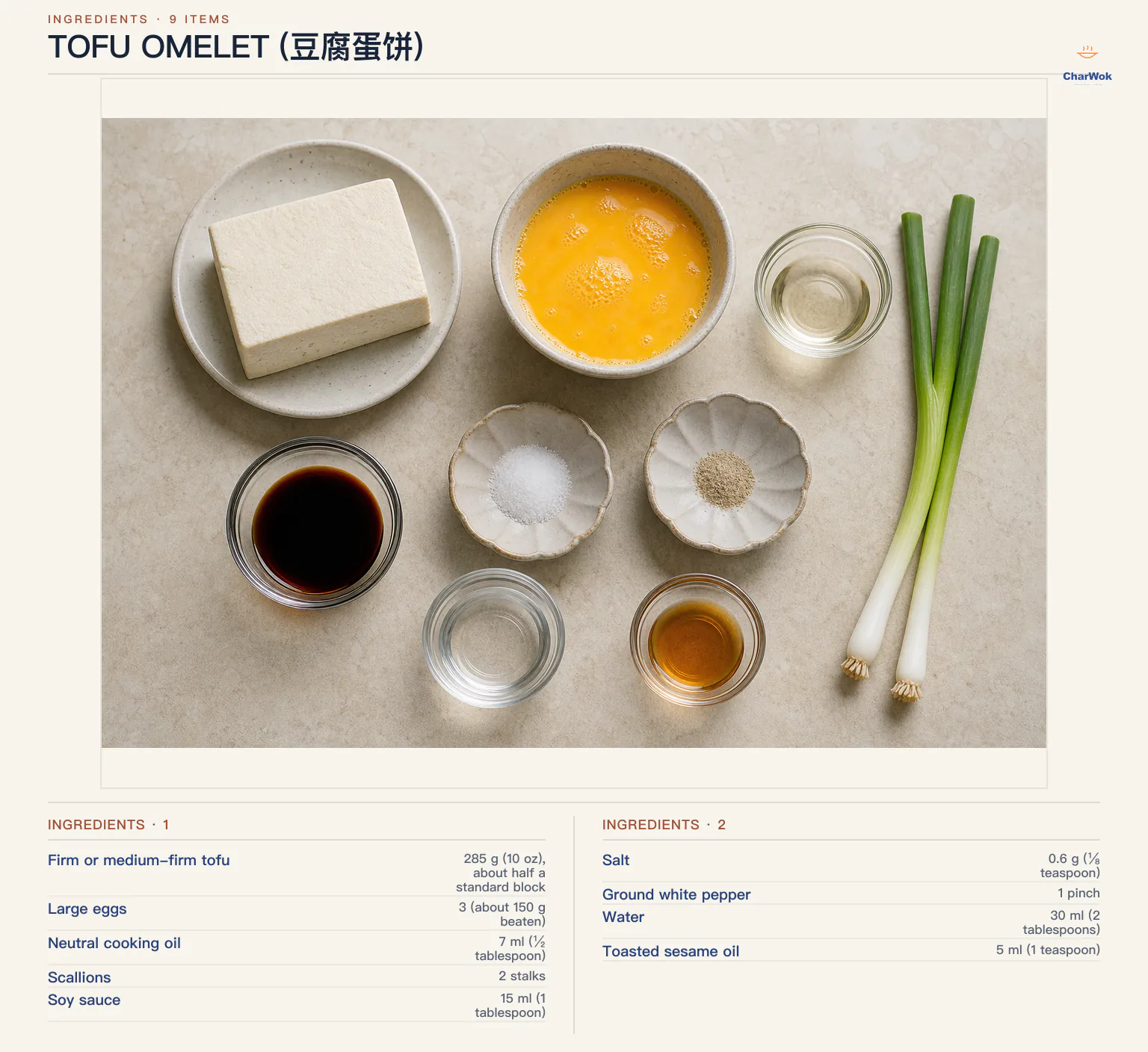
This serves two as a light main. The quantities are the part of the recipe that is fixed by the dish; everything else is method.
| Ingredient | Amount | Notes / substitute |
|---|---|---|
| Firm or medium-firm tofu | 285 g (10 oz), about half a standard block | Not silken, not extra-firm. Plain water-packed block tofu from any grocery works. |
| Large eggs | 3 (about 150 g beaten) | The ratio matters more than the count: roughly 50 g egg per 95 g tofu. |
| Neutral cooking oil | 7 ml (½ tablespoon) | Grapeseed, canola, or avocado. Avoid olive oil, its flavor fights the soy. |
| Scallions | 2 stalks | Split into white/light green (fried with the tofu) and dark green (garnish). |
| Soy sauce | 15 ml (1 tablespoon) | Light soy sauce. See light vs. dark soy sauce, dark will stain the eggs an unappetizing brown. |
| Salt | 0.6 g (⅛ teaspoon) | The soy sauce already carries sodium; this just seasons the egg wash underneath. |
| Ground white pepper | 1 pinch | White, not black, black specks look like dirt in pale eggs. |
| Water | 30 ml (2 tablespoons) | Thins the seasoning so it flows under the omelet rather than sitting on top. |
| Toasted sesame oil | 5 ml (1 teaspoon) | Or Chinese chili oil if you want heat. Added raw at the end, never cooked. |
Two pantry notes. First, the soy sauce is doing double duty as both salt and umami, which is why there is so little standalone salt, if you season the eggs with a full pinch of salt and add soy sauce to them, the dish tips over into too-salty and the eggs turn dark. Second, sesame oil is a finishing oil, not a cooking oil; heat destroys its aroma and turns it bitter. Drizzle it on after the pan comes off the stove.
The method
Read through before you turn on the stove. The whole cook is under five minutes and moves fast once it starts.
- Prep three things in parallel. Drain the tofu and pat the surface dry with a paper towel, you are not pressing, just removing the surface film so it can brown instead of stew. Cut it into slabs about 1.3 cm (½ inch) thick; aim for rectangles roughly the size of a domino so they fit in a single layer. In one bowl, beat the three eggs with the salt and white pepper until uniform but not frothy (over-beating incorporates air that makes tough, holey egg). In a second small bowl, stir together the soy sauce and water; this is the seasoning liquor, kept separate from the eggs on purpose.
- Brown the tofu first, on its own. Heat the oil in a 25 cm (10-inch) non-stick skillet over medium heat until it shimmers, then lay in the tofu slabs with space between them and scatter in the white and light-green scallion pieces. Do not crowd the pan, overlapping slabs will steam each other and stay pale. Leave them alone for about two minutes. You are looking for a real golden crust on the bottom before you flip, because that Maillard browning is the only thing standing between this tofu and the blandness it was born with. Flip each slab and give the second side about 90 seconds.
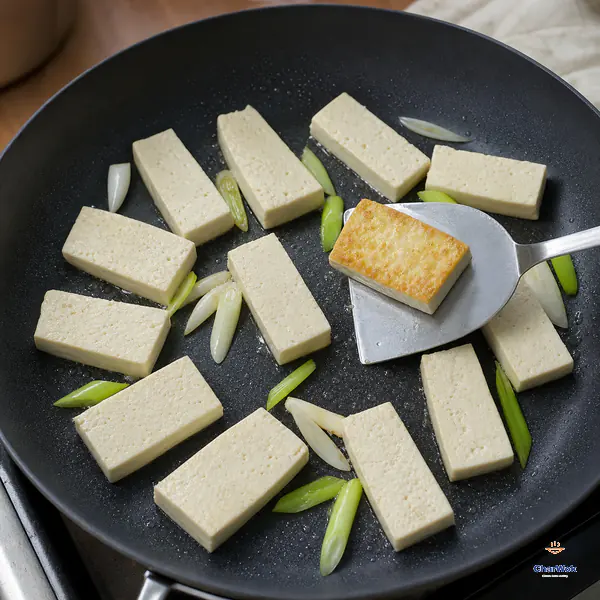
Lay the dried tofu slabs and scallion whites in one uncrowded layer over shimmering oil. Leave them alone for about two minutes, then turn only after the underside forms a real golden crust and releases cleanly from the pan.
- Pour the eggs over the browned tofu. Turn the heat down slightly, just below medium. Pour the beaten egg evenly across the pan so it flows around and between the tofu slabs. Now do the hardest thing in the recipe: nothing. Let it sit undisturbed until the underside sets and the whole round slides freely when you shake the pan handle. If you stir, poke, or try to lift edges early, you will tear the sheet and end up with my first failure, scrambled egg tofu. The top will still look wet; that is correct.
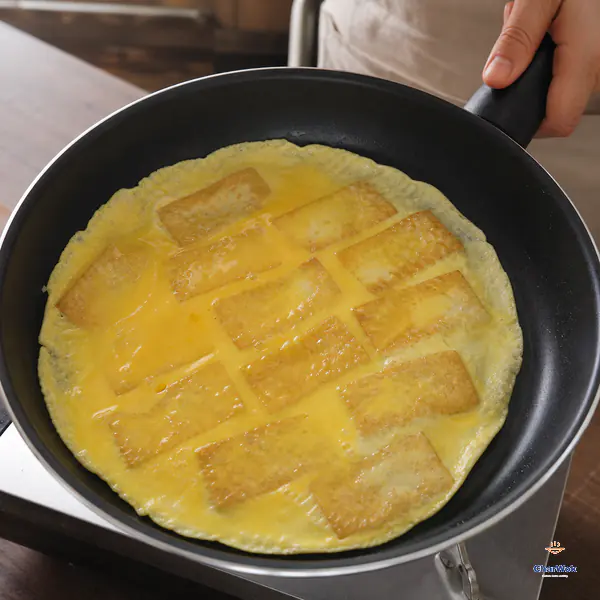
Pour the beaten egg evenly around the browned tofu, lower the heat slightly and do not stir. Wait until the edge and underside set and the complete round slides when the pan is shaken; the top should still look moist before the plate flip.
- Flip the whole round using a plate. Slide the half-set omelet onto a flat plate, then invert the empty skillet over the plate and flip the whole assembly so the wet side lands on the pan. This is the move that lets you flip an entire round without a spatula tearing it. Cook the second side for only 20 to 30 seconds, you want it just set, not browned, because overcooked egg goes rubbery and weepy.
- Season from underneath, in the last ten seconds. Take the pan off the heat. Pour the soy-water liquor around the rim of the omelet so it runs underneath and hits the hot pan surface, where it will flash into a thin glaze the tofu soaks up. Count to ten. Slide the omelet onto a serving plate, scatter the reserved dark green scallions on top, and drizzle with sesame oil or chili oil. Eat immediately, the texture is best in the first two minutes.
Why each step is the way it is
A quick map of the science, because once you see it you can stop needing a recipe. Browning the tofu alone, first, is the move that lets two incompatible cooking temperatures share one pan. Tofu wants a dry, hot surface (around 170°C / 340°F) to drive Maillard browning on its proteins and sugars; egg wants gentle heat so its proteins coagulate into a soft gel rather than a rubber mat. If you pour egg over raw tofu, the egg's water cools the pan, the tofu never browns, and you get pale cubes in a gray sheet. Cooking them in sequence gives each what it needs.
The plate-flip exists because a thin, wide egg round is structurally fragile and a spatula concentrates force on one edge. Inverting the whole pan distributes the flip evenly. And the under-pan seasoning trick is borrowed from egg and scallion crepe technique: pouring seasoned liquid under the cooked egg lets it reduce into a concentrated glaze on the tofu's hot surface instead of diluting into the egg, which is what happens if you add soy sauce to the beaten eggs, the color goes from gold to dun and the flavor reads flat.
When it goes wrong, and how to fix it
I have made every mistake below at least once. None of them ruins the food, they just change what you are eating.
- The tofu won't brown and just sits there steaming. The pan is too cool, there is too much tofu crowded in, or the tofu surface is still wet. Fix: fewer slabs at once, a hotter pan to start, and a firmer paper-towel pat. You can also leave it a full minute longer than feels comfortable before flipping.
- The egg tears when you try to flip. You flipped too early, or your non-stick coating is dead. Wait until the round slides on its own when you shake the pan, that is the only reliable signal. If the coating is gone, use a little more oil next time and accept that you may need to flip in halves.
- The omelet comes out dark gray. Soy sauce went into the beaten eggs instead of the separate seasoning bowl. It is still edible, just ugly. Next time keep the two bowls apart; this is the single most common reader error.
- The eggs are rubbery and weep water on the plate. Overcooked, or the heat was too high. Egg proteins squeeze out their trapped water when pushed past about 85°C / 185°F. Pull the pan off the heat the instant the top is just set; residual heat finishes it.
- It tastes bland despite all the seasoning. The liquor sat on top instead of running under. Pour it at the pan's edge so it hits hot metal and reduces. You can also let the tofu marinate in a teaspoon of the soy mixture for five minutes before cooking if you want deeper flavor.
Variations and what to serve with it
The base recipe is a template. A few directions worth taking it:
- Spicy. Swap the sesame oil for Chiu Chow chili oil, or scatter finely chopped fresh red chilies on top at the end. A spoonful of Chinese condiments like chili crisp turns it into something close to a quick Sichuan lunch plate.
- Garlicky scallion-tofu energy. Add a teaspoon of minced garlic to the pan with the tofu slabs. This nudges the dish toward scallion tofu or pan-fried tofu with garlic sauce territory, with the egg as a bonus layer.
- More vegetables. A handful of finely shredded napa cabbage or a few mung bean sprouts scattered over the tofu before the egg goes in adds crunch without disrupting the set.
- Chive version. Replace the scallions with Chinese chives for a more pungent, garlicky green, the same swap that powers Chinese chive and egg stir-fry.
For a meal, serve it over rice or alongside rice porridge for breakfast, or with a quick egg drop soup if you want a soup-and-main lunch. It also works cold, sliced into strips, over leftover rice with a drizzle of soy and sesame, a trick worth knowing if you cook for one.
Storage and reheating
This is a cook-and-eat dish. The egg is at its best in the first five minutes; refrigerated and reheated, it goes from custard to rubber. If you must store it, keep the cooked omelet in the fridge for up to one day and reheat gently in a covered skillet over low heat with a teaspoon of water to steam it back to life. Microwave reheating will toughen the egg and turn the tofu spongy, do not do it. Leftover pieces are better eaten cold, sliced into a noodle bowl, than reheated.
FAQ
A few questions that come up reliably when cooks try this for the first time.
Can I use silken tofu? No. Silken is too delicate to brown or flip and will collapse into the egg. Reach for medium-firm or firm block tofu; silken is better in a tofu soup or steamed eggs.
Do I have to press the tofu first? No, and you should not. A quick surface pat is enough. Pressing dries the block out, which is the opposite of what you want here, internal moisture is what keeps the tofu juicy inside its seared crust.
Why keep the soy sauce separate from the eggs? Because mixing it in stains the eggs gray and dilutes the seasoning into the whole round. Pouring it under the finished omelet lets it reduce into a concentrated glaze the tofu absorbs directly.
Can I make it without a non-stick pan? You can, but it is harder. A well-seasoned carbon-steel skillet works if you use a little more oil and wait until the egg fully releases before flipping. Stainless steel will fight you; use it only if you enjoy pain.
Is it vegetarian? Yes, it is naturally vegetarian and can be made vegan by substituting the eggs with a soft tofu-scramble layer, though the result is a different dish. For other plant-forward mains, browse the vegan dumplings and five spice potatoes recipes.