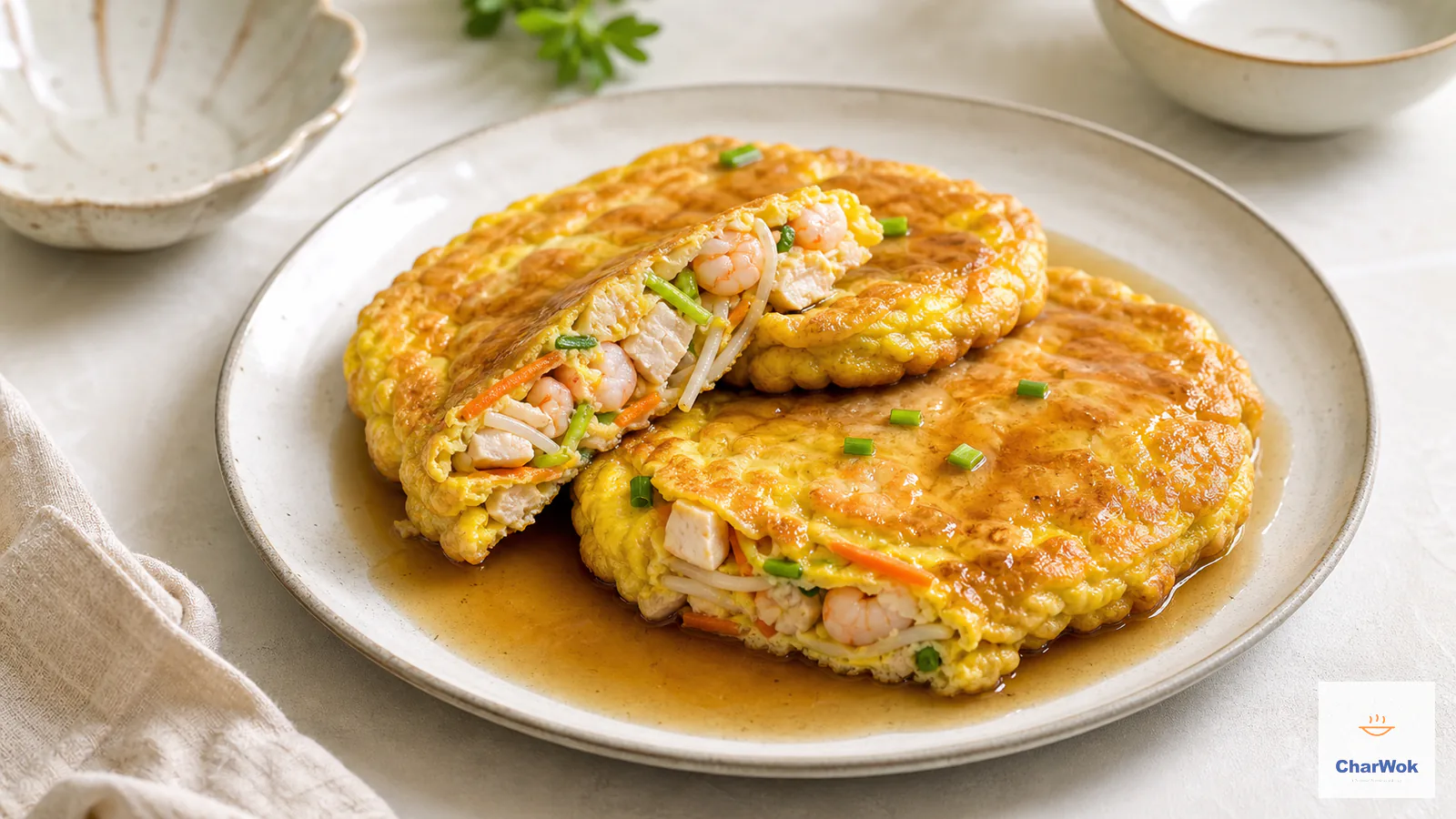
The soul of egg foo young is a thin, lacy omelette that's more vegetable and meat than it is egg, fried fast so the edges crisp while the middle stays soft, then drowned in a glossy brown gravy. The version most of us know is the one from the takeout box: a puffy disk, slightly greasy, sitting on a bed of rice. That dish is delicious, and it is also a recipe almost nobody makes at home, because the home version so often turns into a sad, weepy scramble.
I have made that sad scramble. I overloaded the eggs with raw mushrooms, dropped the heat too soon, and ended up with a heap of steamed curds that tasted fine but looked nothing like the thing. The fix turned out to be counterintuitive: less filling, not more, and a pan hot enough that you flinch a little when the mixture hits the oil.
Keep the filling under half the volume of the beaten eggs, get the oil shimmering before it goes in, then drop to medium-low to cook through. Six eggs makes four 13 cm (5-inch) omelettes in about ten minutes of frying. The brown gravy is just oyster sauce, soy sauce, cornstarch, and water, simmered until it coats a spoon.
What this dish actually is (and isn't)
Egg foo young (芙蓉蛋, "hibiscus egg") is a Chinese-American invention, built on a real Cantonese technique of folding vegetables and small bits of protein into beaten eggs and pan-frying them flat. You will not easily find it on a menu in mainland China. It belongs, along with chicken chop suey and the wave of dishes created by immigrant cooks feeding American diners in the early twentieth century, to that family of recipes born abroad and then carried home as "Chinese food." That lineage is worth knowing, because it explains two things: why the dish leans on a gravy instead of being eaten dry, and why it is engineered to sit on rice.
What separates it from a Western folded omelette is structural. There is no butter, no cheese, no fold. The add-ins are mixed into raw egg and cooked into a single round patty, the way you would a pancake. The filling is meant to dominate; the egg is the binder, not the star.
The ratio that decides everything
If you take one thing from this page, take the ratio: by volume, the beaten egg should be at least half of the total mix, and the chopped filling should never exceed the egg. Push past that line and the egg cannot form a continuous sheet around the filling. You get a frittata that crumbles when you try to flip it.
Six large eggs measure roughly 300 ml (about 1 ¼ cups). So your combined, chopped add-ins should sit somewhere under 300 ml. The recipe below uses about 250 ml of filling total and holds together cleanly every time. If you want to riff, measure your filling in the same measuring cup you used for the eggs and stop before you equal it.
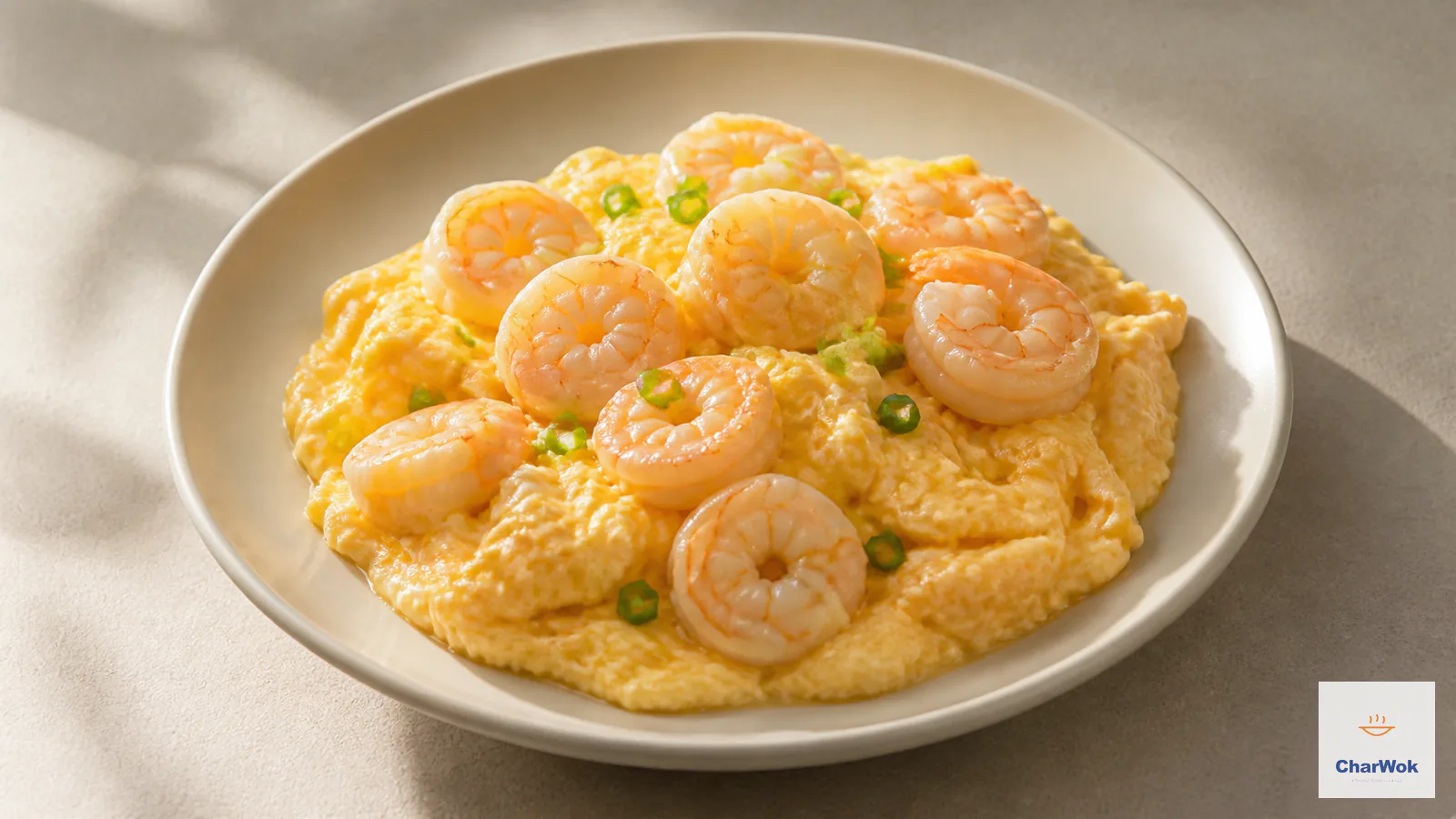
This is the same instinct behind other loose egg dishes on this site. Tomato egg stir-fry works because the egg is allowed to set in large, soft sheets; shrimp and egg stir-fry (hua dan xia ren) works because the eggs coat the shrimp in a silky layer rather than competing with it. Egg foo young is the patty version of that same logic.
Ingredients
Ingredients for four egg foo young patties
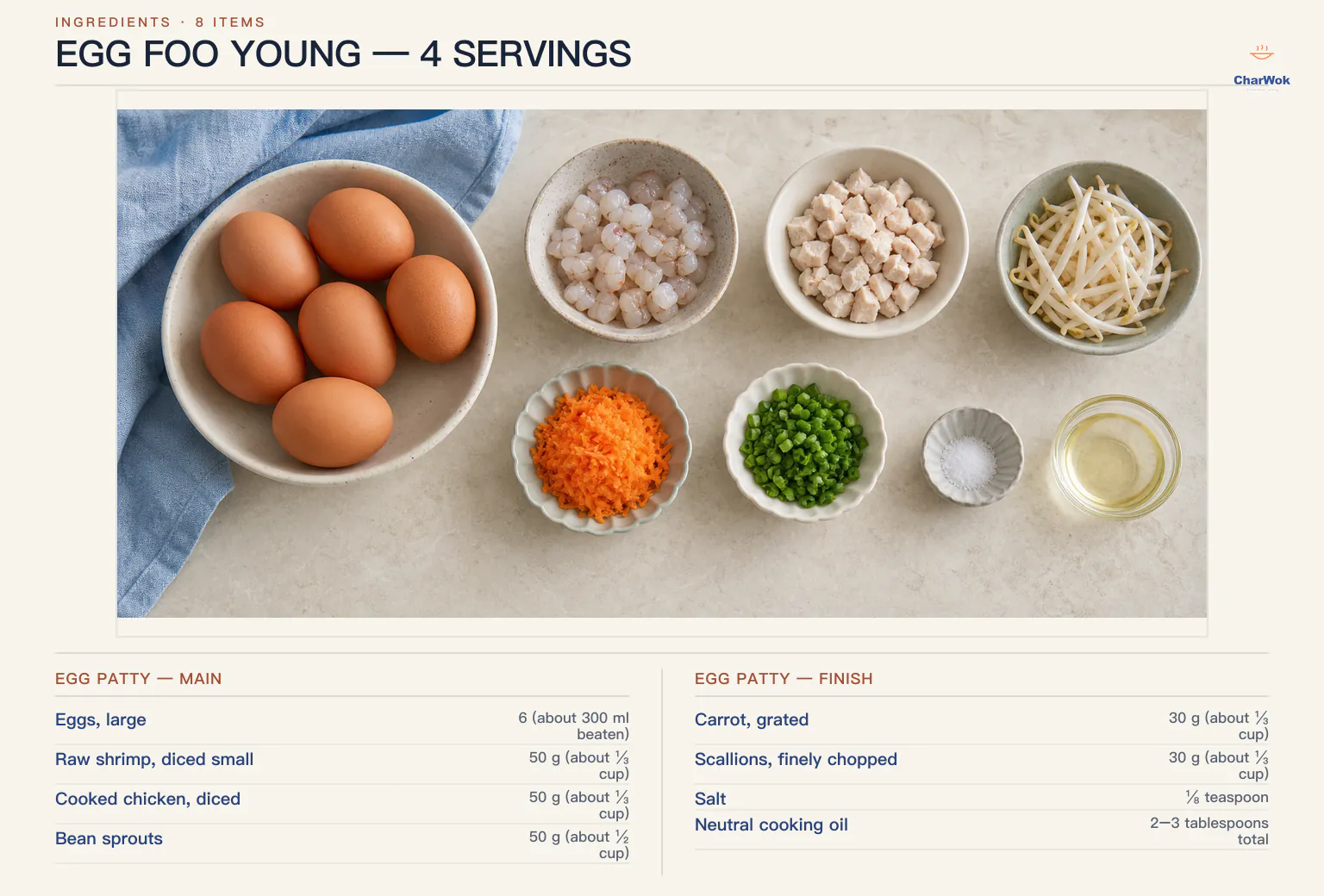
The filling below is a suggestion, not a rule. I have written it for shrimp and leftover chicken because they cook through in the time the egg needs, but the table lists the substitutes I reach for most. You can read it as a template: one quick-cooking protein, two or three crisp vegetables, scallions.
| Ingredient | Amount | Notes / substitute |
|---|---|---|
| Eggs, large | 6 (about 300 ml beaten) | The binder. Don't go below 5 eggs for this much filling. |
| Raw shrimp, diced small | 50 g (about ⅓ cup) | Swap for diced squid, firm tofu, or flaked cooked fish. |
| Cooked chicken, diced | 50 g (about ⅓ cup) | Use leftover roast bird. Char siu or ham also work. |
| Bean sprouts | 50 g (about ½ cup) | The classic crunch. Water chestnuts or bamboo shoots substitute. |
| Carrot, grated | 30 g (about ⅓ cup) | Grate fine so it softens in the short cook. Bell pepper, julienned thin. |
| Scallions, finely chopped | 30 g (about ⅓ cup) | Divided: most into the egg, the rest for garnish. |
| Salt | ⅛ teaspoon | The gravy is salty, so keep the egg lightly seasoned. |
| Neutral cooking oil | 2–3 tablespoons total | Peanut, canola, or grapeseed. Not olive oil. |
A note on the soy sauces, because they are doing different jobs here. Light soy sauce carries the salt and the savory depth; dark soy sauce is barely salty but adds the mahogany color that makes the gravy read as "takeout brown." If you only have one bottle, use all light and accept a paler sauce. The two are not interchangeable in role, and our guide to light vs. dark soy sauce breaks down why.
Why a smoking pan, then low heat
This is the part home cooks get backwards. The instinct is to cook eggs gently the whole way through. That gives you a tender, uniform omelette, which is exactly what you do not want here. Egg foo young needs contrast: a deeply browned, slightly crisp underside and a soft, barely-set top that finishes cooking off the direct flame.
You get that contrast by staging the heat. Start the empty pan ripping hot, hot enough that a drop of water dances and evaporates in a second. Add the oil, swirl it, and pour the egg in. The instant the egg hits, two things happen fast. The proteins on the bottom denature and seize, forming a solid sheet that the rest of the egg can sit on. The water in the egg flashes to steam, which is what lifts the edges into that lacy, frilly look. Maillard browning kicks in on the parts of the egg and filling in direct contact with the metal. None of this happens in a warm pan. Then you drop to medium-low, because from here you only need the egg to set, not to brown further.
If your pan is nonstick, the order flips: add the oil to the cold pan, then heat. A dry nonstick surface taken to smoking heat will off-gas and ruin the coating, and the coating itself can't give you the crust a steel wok or cast-iron skillet will. I use a flat-bottomed carbon-steel wok for this and recommend it if you have one.
Method
- Make the gravy first so it can rest off the heat. Whisk the oyster sauce, both soy sauces, sesame oil, cornstarch, white pepper, garlic powder, and sugar into the cold water in a small saucepan until no lumps remain. Cornstarch will not dissolve in hot liquid; it clumps. Cold water, stirred well, is the only reliable way.
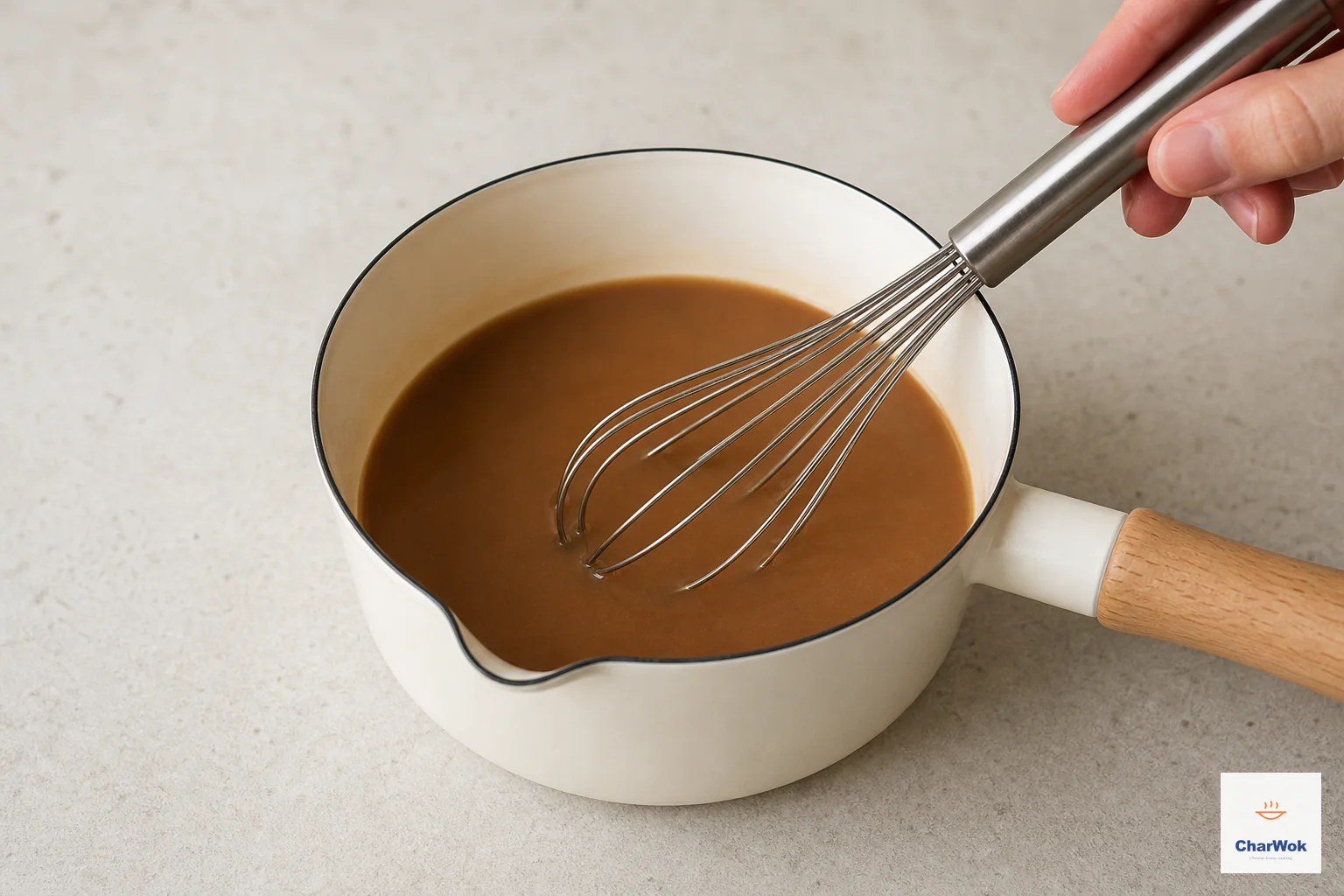
Whisk all gravy ingredients together while cold until the cornstarch is fully dispersed and no dry pockets remain.
- Cook the gravy. Set the pan over medium heat and stir constantly as it comes to a gentle boil. The moment it thickens enough to coat the back of a spoon, pull it off the burner. It keeps thickening as it cools, so stop a beat before you think it's ready. Cover and keep warm.
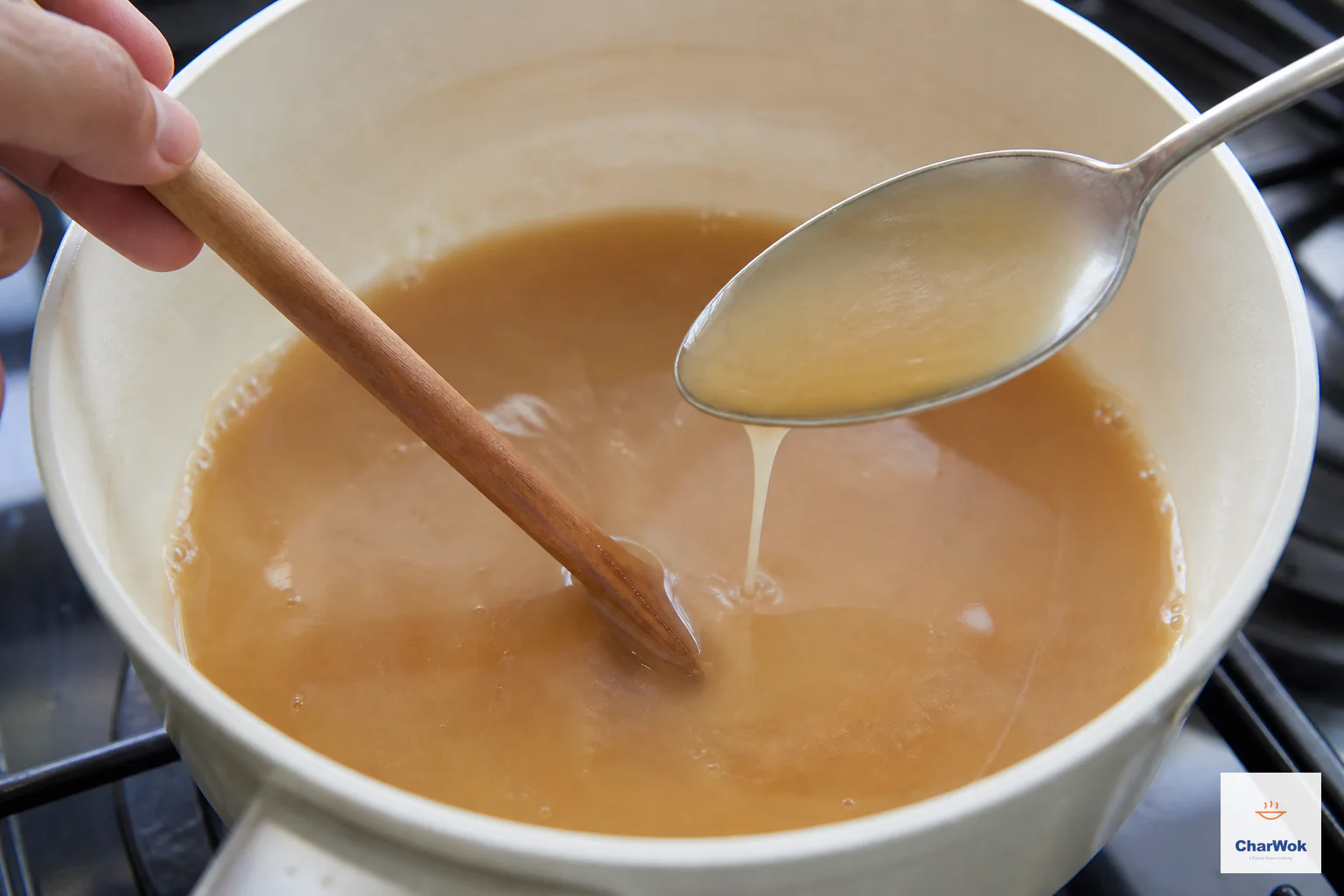
Stir over low heat just until the gravy gently boils and thinly coats a spoon; keep it flowing rather than gelled.
- Prep the filling. Dice the shrimp and chicken small, about the size of a pea, so they cook through in the short time the egg needs. Grate the carrot on the fine holes. Trim any long bean sprout tails; long tails poke through the egg and make flipping a mess. Chop the scallions.
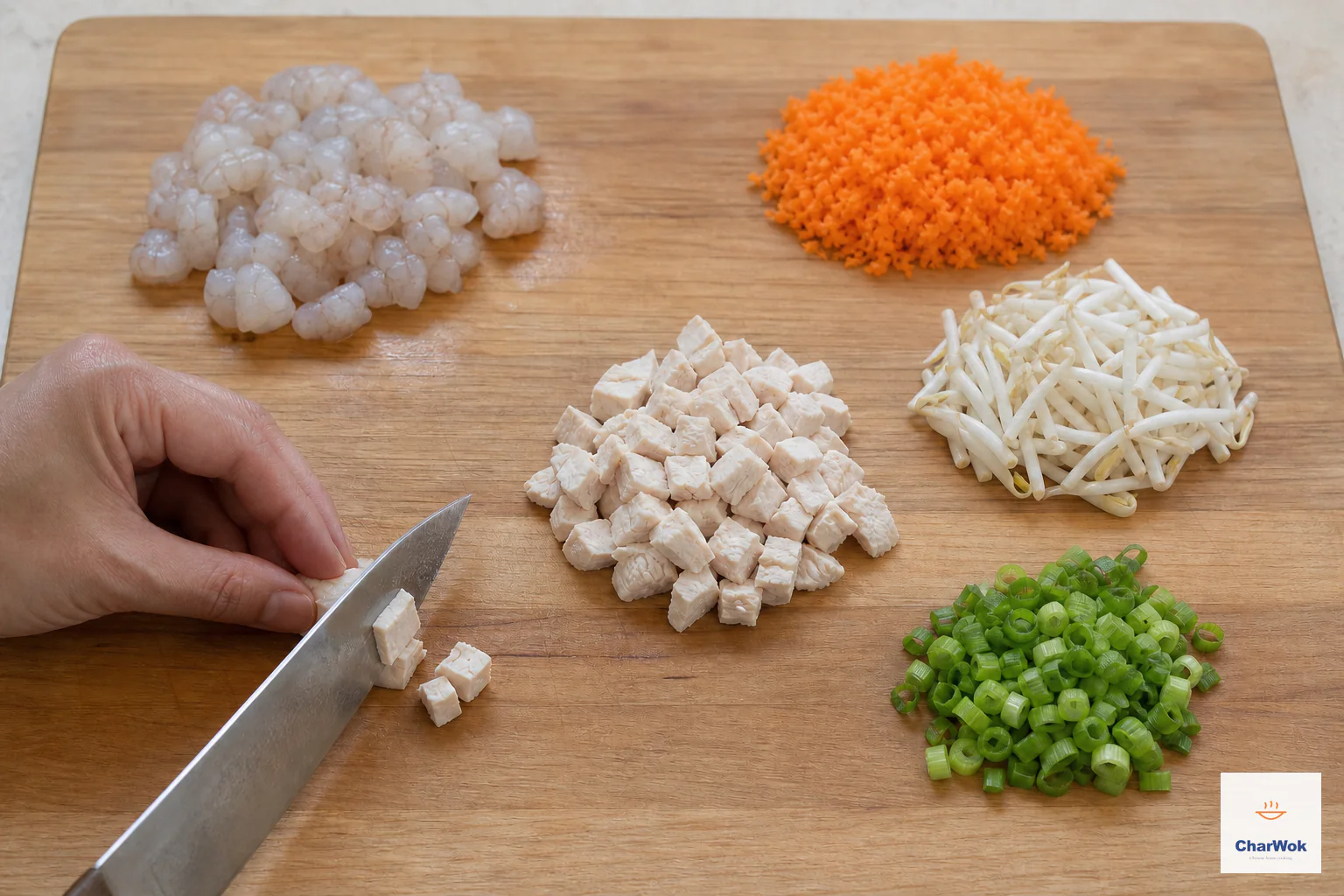
Cut the shrimp and cooked chicken to pea-size pieces, grate the carrot finely, trim the sprouts and chop the scallions before heating the wok.
- Combine egg and filling. Crack the eggs into a bowl and beat them only until the yolks and whites are blended. Over-beating whips in air, which makes the omelette puff and then collapse. Fold in the shrimp, chicken, bean sprouts, carrot, most of the scallions, and the salt. Stir just to distribute.
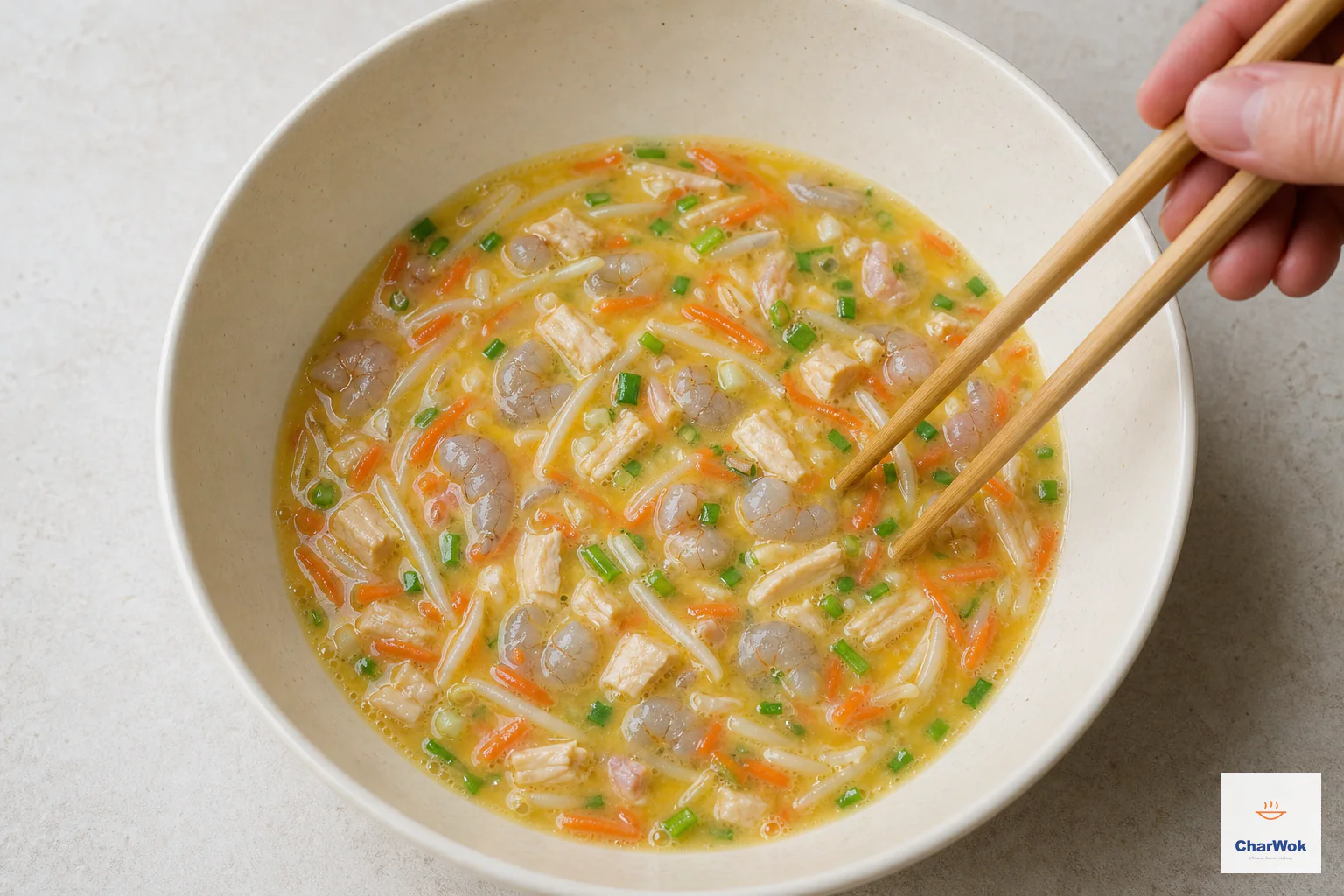
Lightly blend the eggs, then fold in the prepared fillings and salt without whipping air into the mixture.
- Heat the pan hard. Set a carbon-steel wok or skillet over high heat until it's just starting to smoke. Add about 2 tablespoons of oil and swirl to coat the bottom and an inch up the sides. The pool should shimmer and ripple, not sit flat.
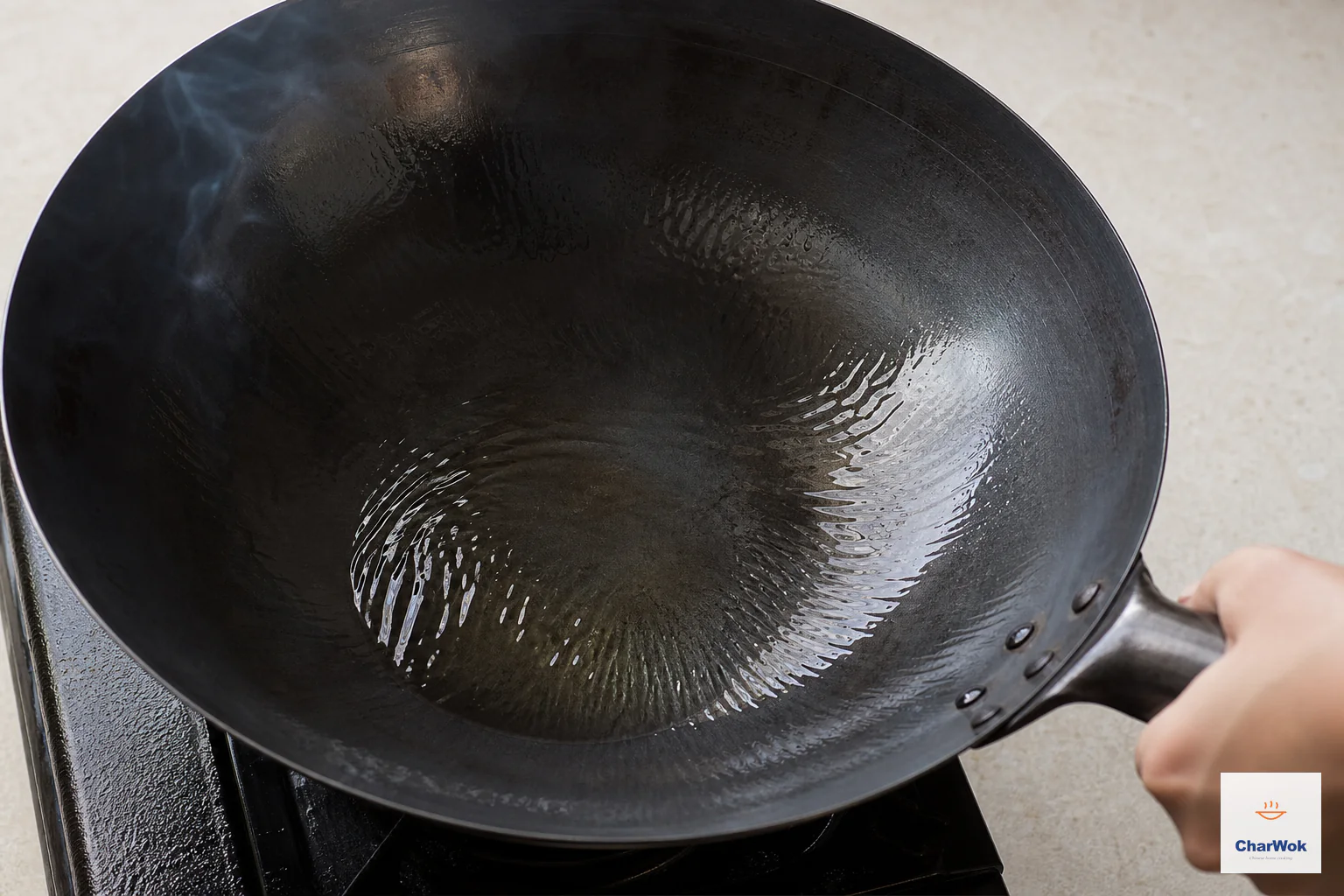
Heat the empty wok until it barely smokes, add about 2 tablespoons oil and tilt to coat the bottom and lower sides.
- Pour and listen. Add a quarter of the egg mixture, about 100 ml. It should sizzle loudly and the edges should frill within five seconds. Use a spatula to nudge the runny center toward the gaps so the egg spreads into an even round roughly 13 cm (5 inches) across.
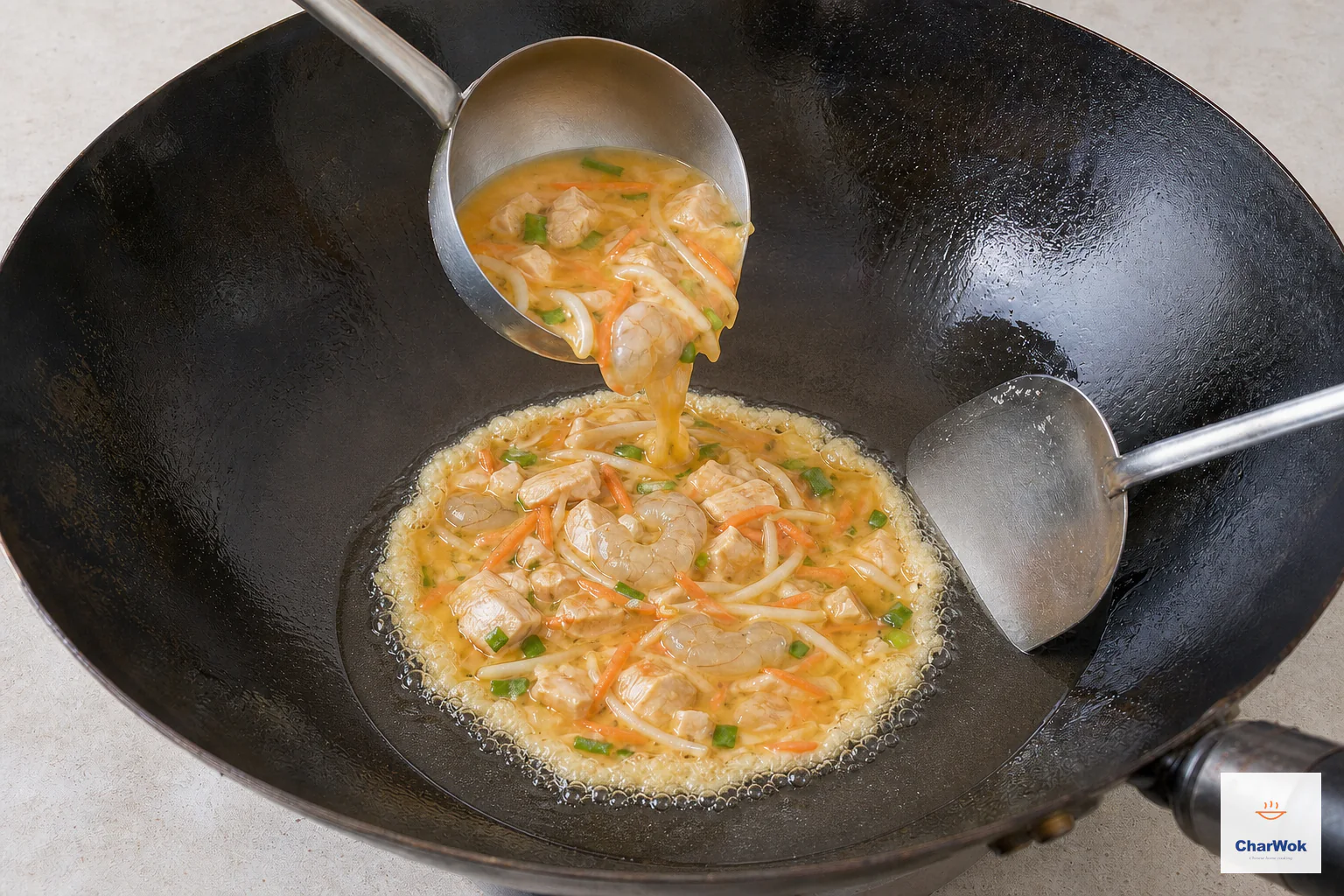
Add about one quarter of the mixture and nudge it into one 13-centimetre round while the edge sets and frills.
- Drop the heat and cook the bottom. Turn the burner down to medium-low. Let it fry undisturbed until the bottom is deep golden brown and the top is still wet but no longer liquid, about 90 seconds. The residual heat will finish the center.
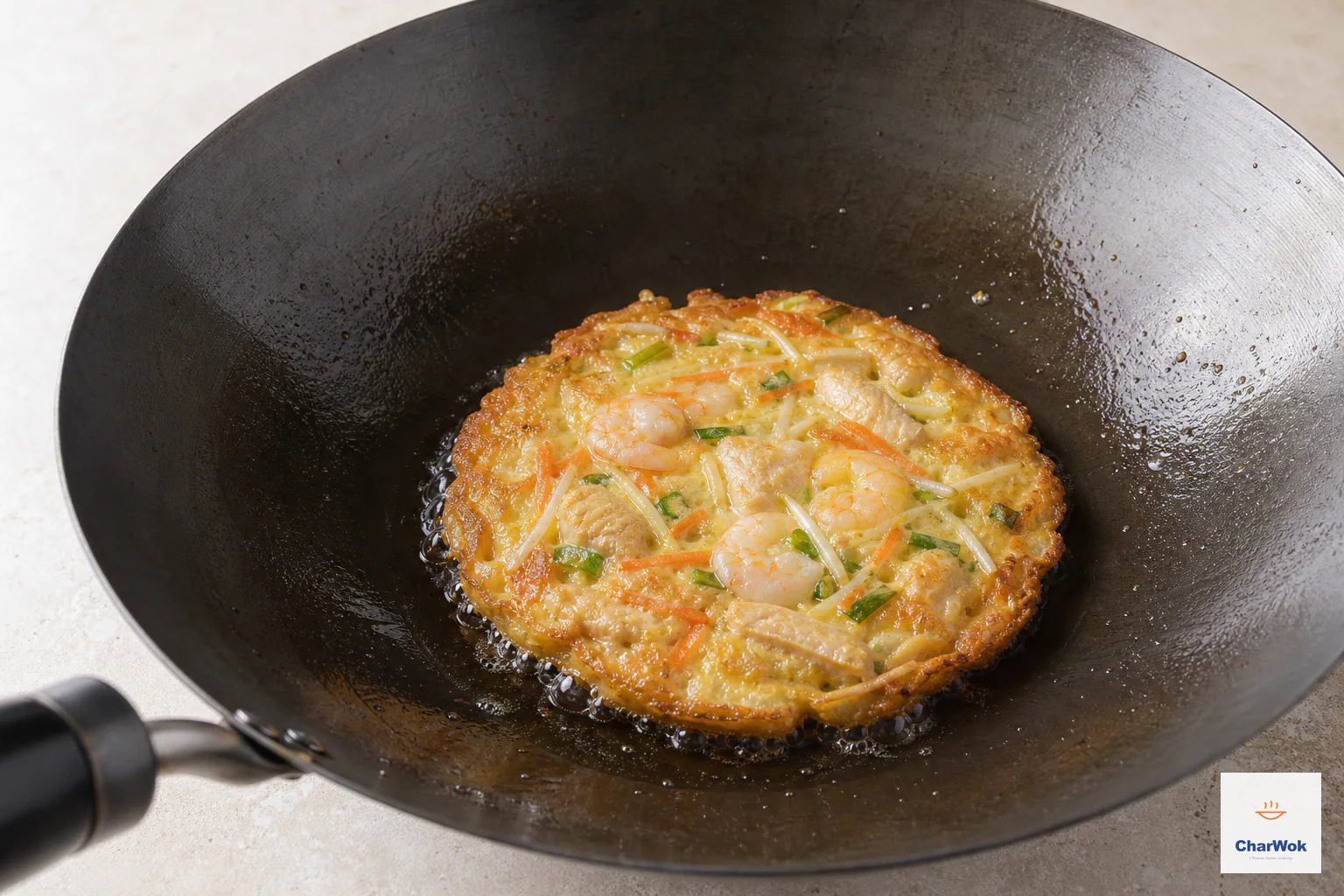
Lower to medium-low and leave the first side undisturbed until the edge is deep golden and the top is moist but no longer liquid.
- Flip and finish. Slide a wide spatula under the patty and turn it in one confident motion. Cook the second side until golden, another 60 to 90 seconds. Slide onto a plate and repeat with the remaining mixture, adding a splash more oil between batches.
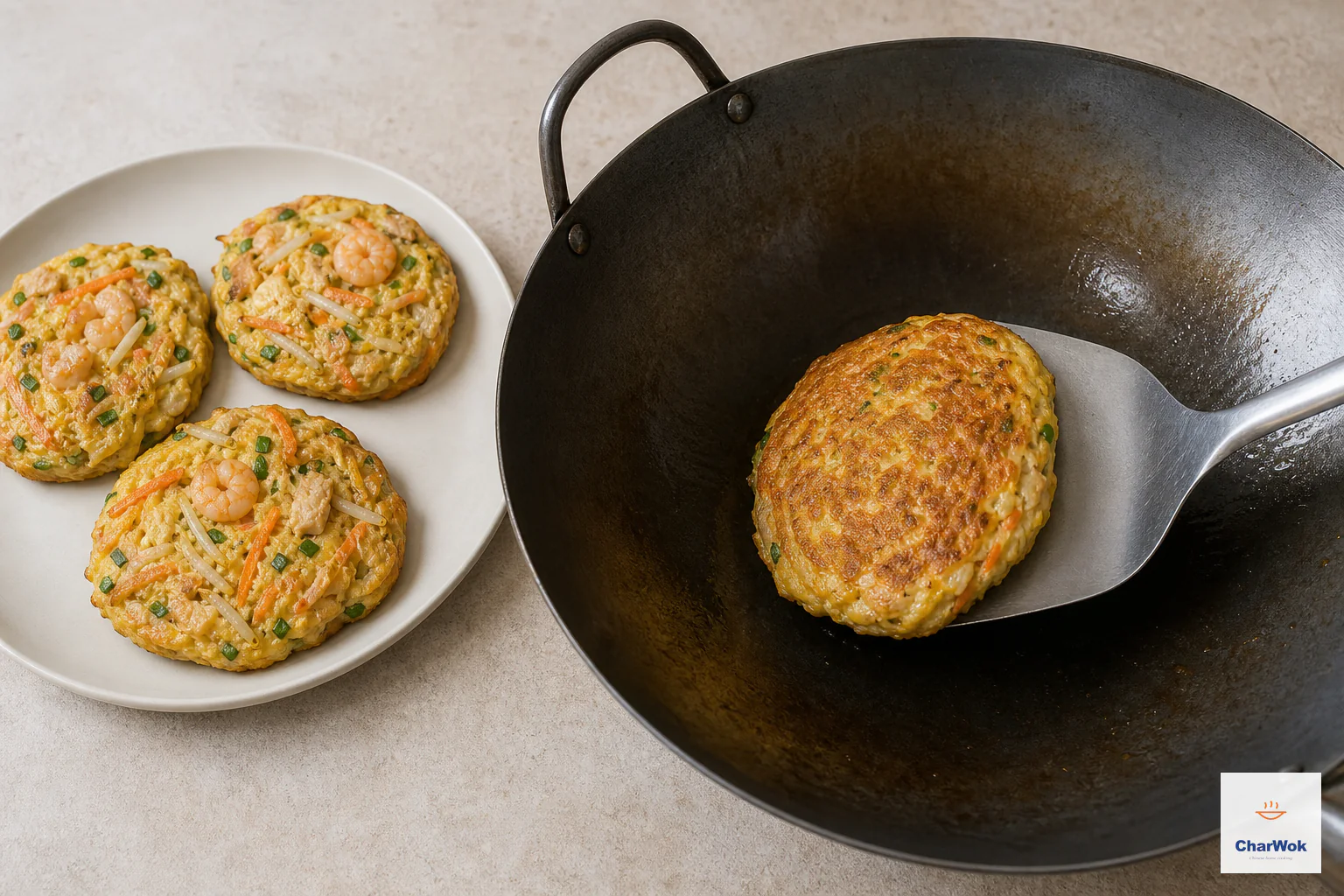
Flip in one confident motion, brown the second side, then repeat to make four matching patties in total.
- Plate. Set two patties over a bowl of freshly cooked jasmine rice, ladle the warm gravy generously over both the egg and the rice, and finish with the reserved scallions and a sprinkle of toasted sesame seeds. Serve at once.
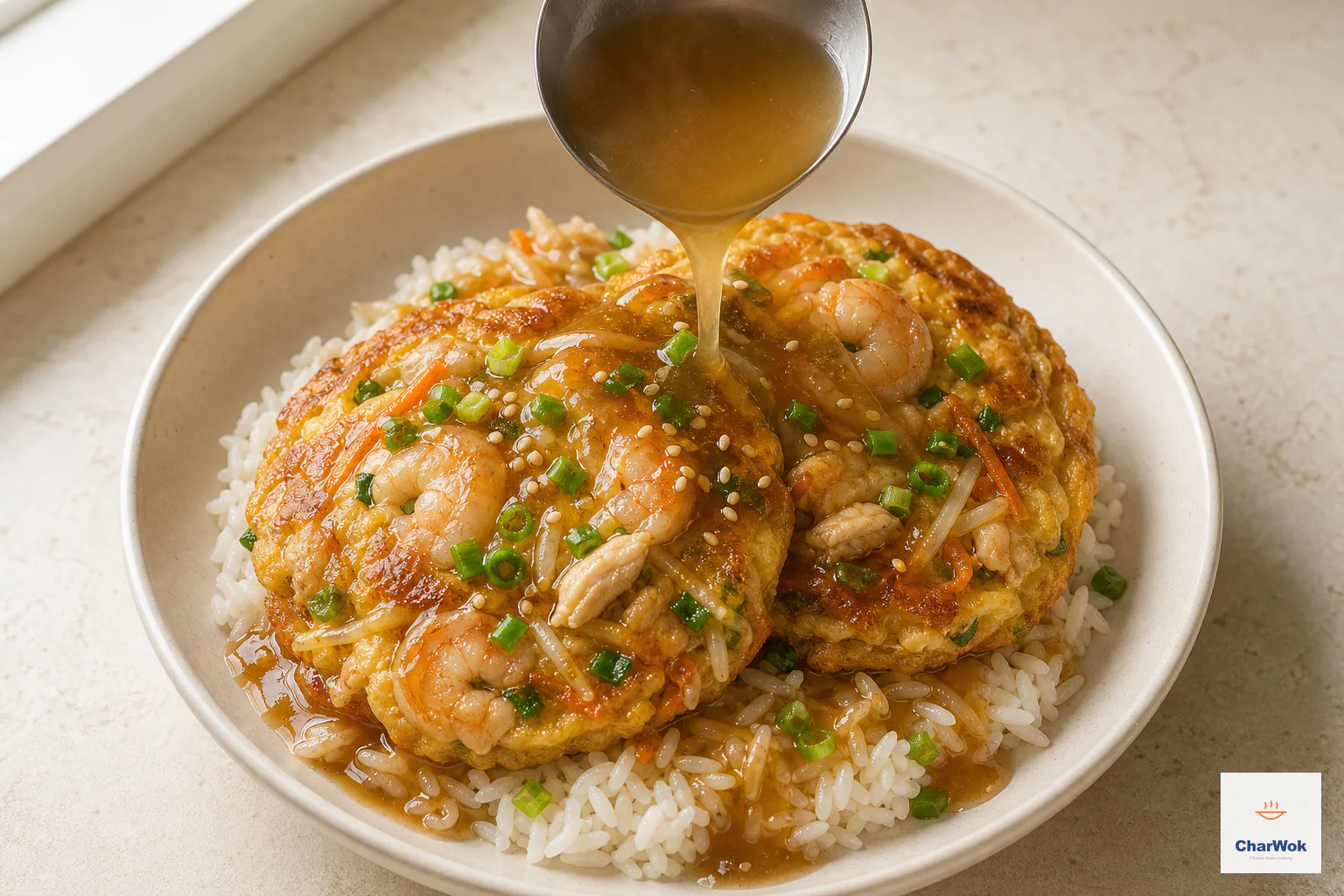
Set two patties over hot jasmine rice, spoon the warm thin gravy over both and finish with scallion and a restrained pinch of sesame.
When it goes wrong (and how to fix it)
The patty falls apart when you flip it. Two causes, almost always. Either you overloaded the egg with filling, or the pan wasn't hot enough when the egg went in, so a bottom skin never formed to hold everything together. Next time, measure the filling against the beaten egg and hold the line. This time, if it breaks, don't fight it. Let the pieces brown on both sides and serve it as a scramble over rice. It'll still taste right.
The shrimp are raw in the middle. The fix is in the cut. Dice the shrimp smaller than you think you need to. A chunk the size of a marble won't cook through in 90 seconds; a pea-sized piece will. The same applies to squid and fish.
The underside burns before the top sets. Your heat is too high after the initial pour, or the pan has a hot spot. Drop to true medium-low, and rotate the pan occasionally to even out the heat.
The gravy is lumpy or breaks. You added cornstarch to hot liquid, or you let it boil hard for too long after it thickened. Start over with cold water and whisk the starch in before any heat. Once it coats a spoon, it's done; prolonged boiling breaks the starch gel and turns it thin again.
The omelette is rubbery and pale. The pan was only warm, not hot, at the pour. You cooked it slowly the whole way through, which set the proteins tight without browning them. Crank the heat, get a shimmer on the oil, and pour.
Two ways to finish it that aren't the gravy
The brown gravy is the classic, and for most people it's the whole point. But the patty itself is a blank, and on nights when I don't want to dirty a saucepan I skip it entirely.
The first alternative is a no-cook drizzle of sweet soy sauce and chili oil. Sweet soy sauce (kecap manis, or the Chinese 甜酱油) is thicker and molasses-dark; it clings to the egg where regular soy sauce would run off. Spoon a little over each patty and add chili oil to taste. If you've never made your own, the chili oil guide on this site is worth the afternoon, and a jar of it lives in my fridge door for exactly this kind of meal.
The second is to season the egg itself and eat it dry. Stir a teaspoon of oyster sauce and a pinch of white pepper into the beaten egg along with the salt, then cook and serve with nothing on top. This is how I eat leftovers cold from the fridge, standing at the counter.
Variations and what to serve it with
Once you trust the ratio, the filling is whatever is in the fridge. A few combinations I keep returning to: char siu and scallion for a sweet, barbecue note; mushroom and water chestnut for a vegetarian version (use the tofu omelet technique if you want to skip egg entirely); leftover roast chicken and bamboo shoots; flaked salmon and scallion for a weekend brunch.
What you serve it on matters. Plain jasmine rice is the default, and the gravy is salty enough that it seasons the rice as it runs down. If rice feels heavy, the patties are good on their own with a bowl of soy sauce rice pilaf on the side, or folded into a multi-dish spread where they play the protein course. For a fully takeout-style night, I'll run egg foo young alongside egg fried rice and a quick stir-fried green, the kind of plate you'd get in a paper bag.
The brown gravy also does double duty. Thinned with a little more stock, it's the same sauce that ties together the classic takeout recipes most of us grew up ordering, and it's a good reason to keep the pantry stocked. If you're rebuilding a Chinese pantry from scratch, the ten condiments list is where I'd start; everything in this gravy is on it.
Storage and reheating
Cooked patties keep in the fridge for two days, layered between parchment in an airtight container. The gravy keeps separately for three days and actually improves overnight as the flavors settle. To reheat, warm the gravy gently in a pan with a splash of water to loosen it, and crisp the patties in a dry skillet over medium heat for a minute per side. The microwave works for the egg but kills the crust, so use it only if you don't care about texture.
I don't recommend freezing the cooked patties; the filling weeps on thaw and the egg goes spongy. The raw egg-and-filling mixture, however, freezes fine for up to a month. Thaw overnight in the fridge and cook as written.
Questions I get asked
A few things come up reliably when readers try this for the first time.
Can I bake these instead of frying? You can, in a 200°C (400°F) oven, spooning the mixture into a greased muffin tin for about 15 minutes. The result is closer to a crustless quiche than egg foo young, since you lose the browned bottom that defines the dish. Acceptable for a hands-off breakfast, not the same thing.
Why is restaurant egg foo young so much puffier than mine? Most takeout places deep-fry the patties in a basket, and some add a little baking powder or extra cornstarch to the egg to boost the lift. Deep-frying also gives the even, deep-gold shell that pan-frying can't fully match. Pan-frying is the practical home method; if you want the restaurant look, shallow-fry in a half-inch of oil.
Is there a gluten-free version? Yes. Swap the soy sauces for tamari (light tamari for light soy; for the dark soy, add a few drops of molasses to tamari for color), use a gluten-free oyster sauce, and confirm your cornstarch is processed away from wheat. The rest of the recipe is naturally gluten-free.
Can I make it ahead for a crowd? Cook the patties an hour ahead and hold them, uncovered, on a sheet pan at room temperature. Re-crisp under the broiler for 90 seconds per side just before serving, and warm the gravy on the stove. Don't hold them longer than two hours; the texture declines fast.
The one line to remember
Cook it hot, then cook it gentle, and keep the filling honest. Get those three things right and egg foo young stops being the takeout dish you never make and becomes the twenty-minute dinner you reach for whenever there are eggs in the fridge and a little leftover protein to use up.