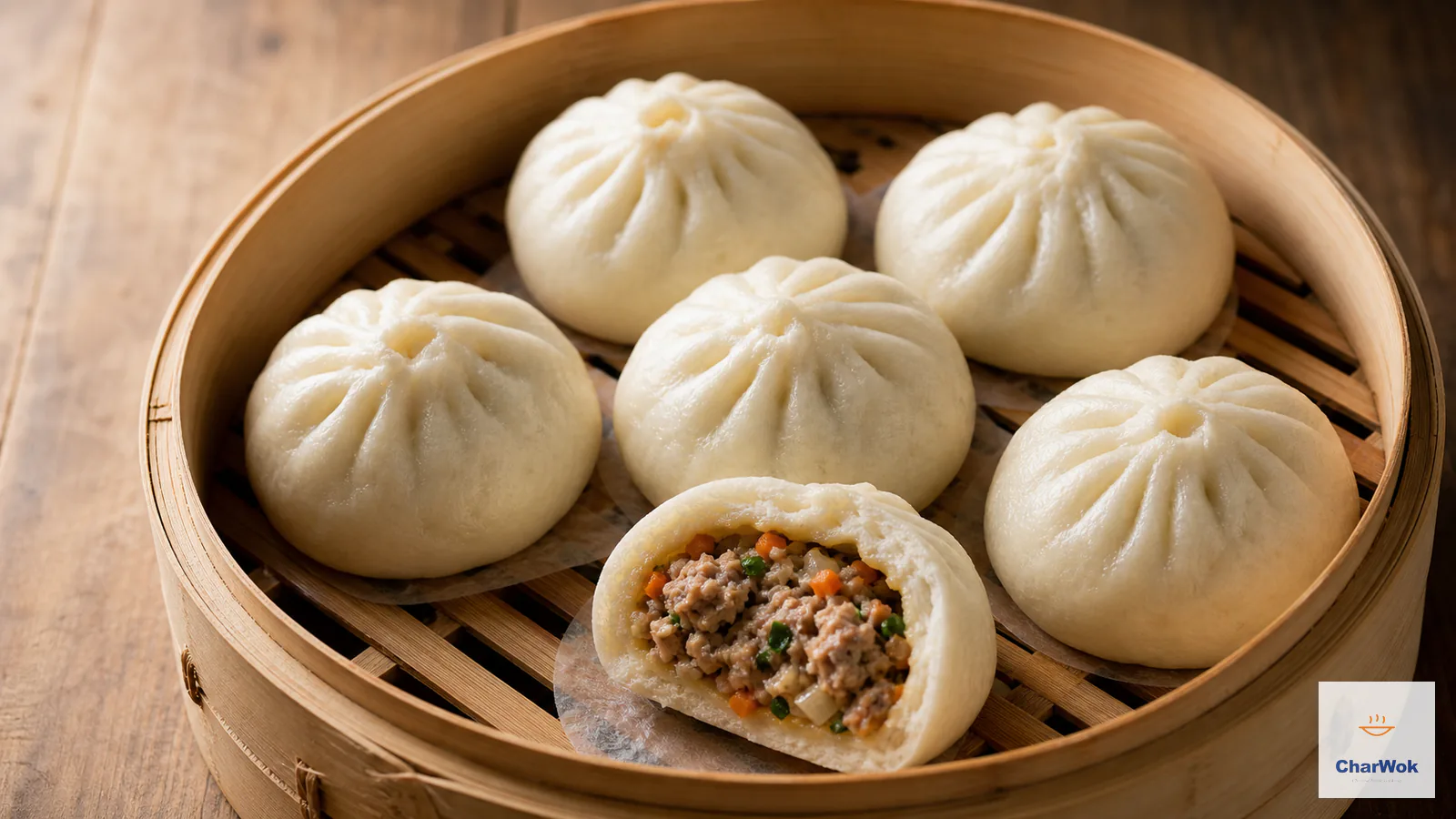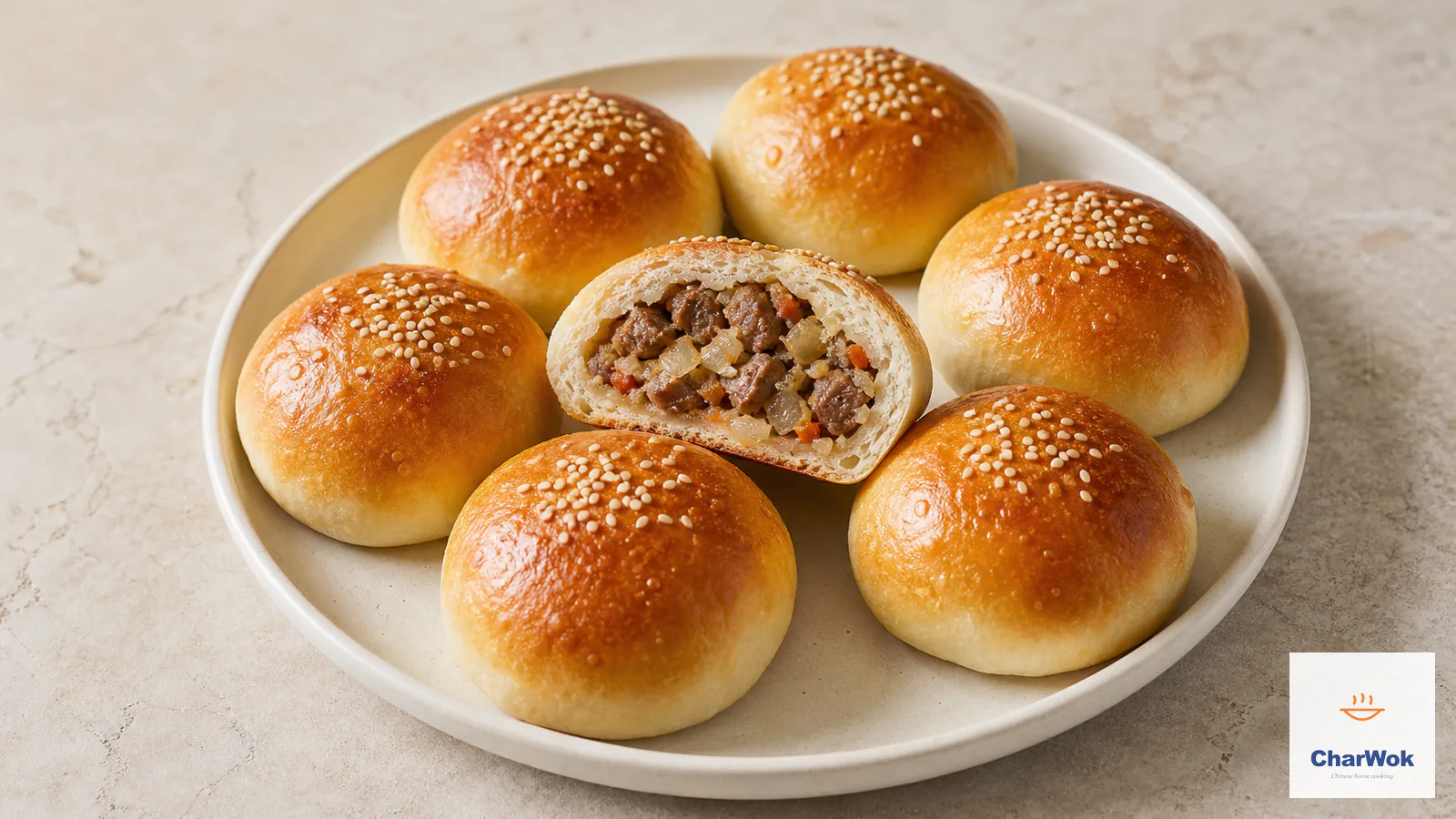
A baked lamb bun done right has a thin, crackling top and a juicy, cumin-scented core that runs down your wrist when you tear it open. The version most home cooks land on is sadder: a pale, doughy lid over a dry, gray lump of meat. The gap between those two outcomes is not about the recipe. It is about two decisions, dough hydration and oven temperature, that most recipes gloss over.
These buns sit at a crossroads of two northwestern Chinese traditions. There is the Xinjiang Kao Bao Zi (烤包子), a flat, pillow-shaped pie of unleavened dough sealed around fatty lamb and onion, then slapped against the wall of a tandoor to blister. And there is the Lanzhou baked baozi, a yeast-raised bun folded the usual way and finished in an oven. This recipe borrows the yeast dough and bao fold from the second and the raw-cube lamb, onion, and cumin soul from the first. The result is fluffy inside, crunchy outside, and far more forgiving than either parent dish cooked in its native equipment.
At a glance. Two-stage bake is the whole game: 18 minutes at 210°C (410°F) to cook the dough through, then 3 to 5 minutes at 250°C (480°F) to brown. Dice the lamb, never grind it, so it holds its juice. Rest the shaped buns a full 30 minutes before they go in, or the crust splits and the crumb stays dense.
What kind of dough, and why it is not a steamed bun dough
This is a lean yeast dough, closer to the dough behind mantou than to a rich brioche. Three things separate it from the dough you would use for steamed baozi. First, the hydration sits low, around 52 percent (130 ml water to 250 g flour). A wetter dough steams into a soft, pillowy crumb, which is what you want in a steamer. For baking you want something sturdy enough to hold a crisp skin, so hold back the water.
Second, a little baking powder goes in alongside the yeast. Baking powder is insurance: it gives a fast, even lift in the oven's dry heat where yeast alone can be sluggish. You will see the same trick in oven-baked scallion bread and leavened scallion flatbread. Without it, the buns dome unevenly and the bottoms stay gummy.
Third, a teaspoon of sugar feeds the yeast and, more importantly, browns the crust. Sugar participates in Maillard browning and caramelization, and that is what produces the mahogany top. Skip the sugar and you get a blond, pasty bun no matter how long you bake it.
The lamb: dice it, do not grind it
Most stuffed-bun recipes in the Chinese repertoire, from char siu bao to sheng jian bao, use minced or ground meat because it cooks fast and evenly in a gentle steam. Baking is different. The interior of a bao never gets hotter than about 100°C as long as moisture is present, and a ground filling squeezed of its juices by 18 minutes in the oven turns into a dry puck.
Diced lamb, cut to roughly the size of a green pea, survives that time inside the bun with its juice still trapped inside each cube. You also get real bite, the texture that makes the dish feel like a meal rather than a snack. If you have only a grinder, you can pulse the meat two or three times on pulse, stopping while distinct chunks remain, but the result will be drier.
Use lamb leg for the meat and ask the butcher for a piece of lamb fat, or save trimmings in the freezer. Lamb fat carries the characteristic flavor of the dish; without it the filling reads as beef-ish. If you cannot get lamb fat, a tablespoon of neutral cooking oil will carry the spices, but the finished filling will be flatter. I keep a bag of diced lamb in the freezer for this and for cumin lamb skewers; a quick partial freeze before cutting is the only trick to clean cubes.
Ingredients
The filling and dough are listed separately because they are built in different bowls. Salt is measured for the lamb only; the onion-carrot mix carries the spice layer and needs none.
For the filling
Ingredients at a glance
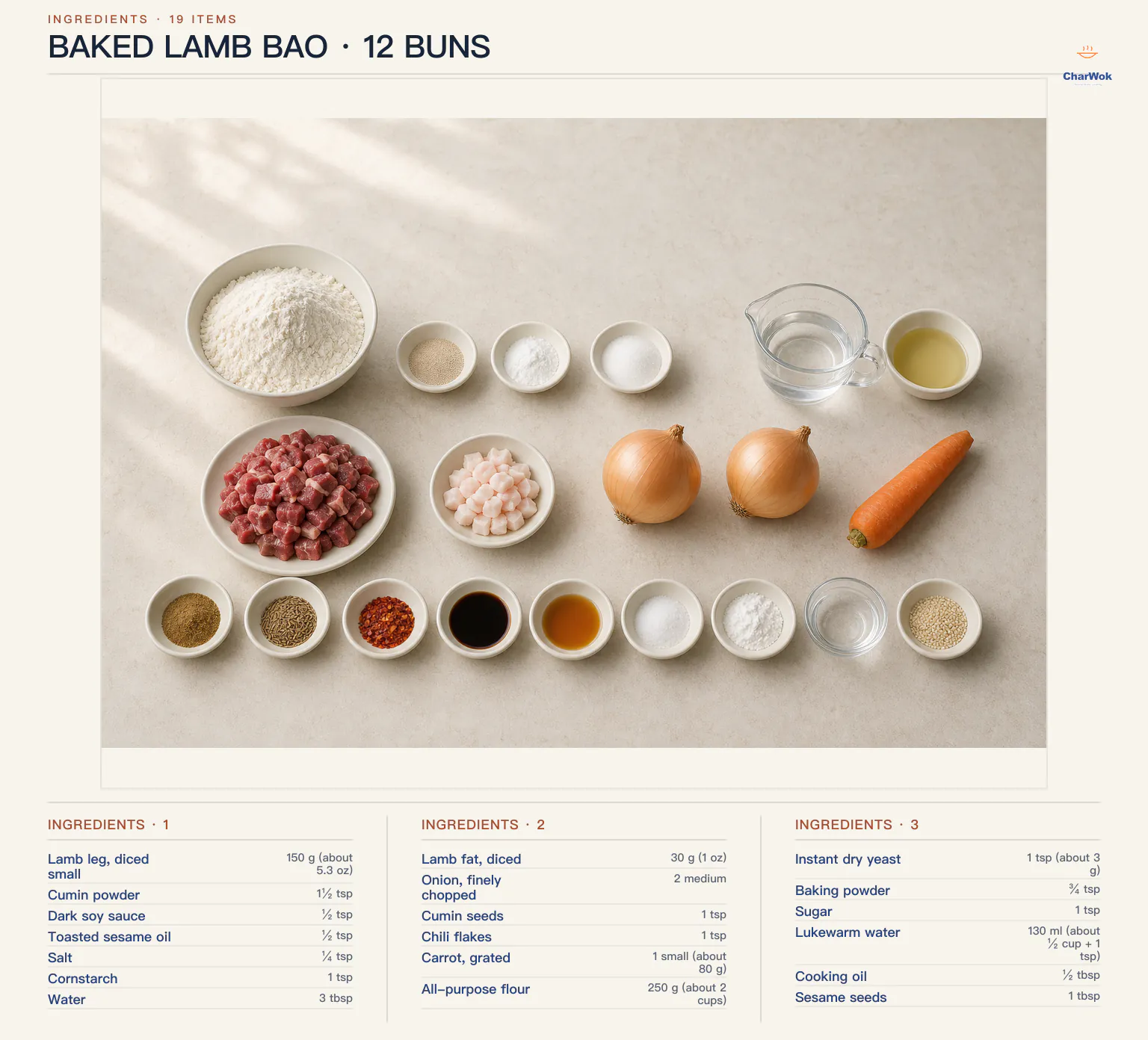
| Ingredient | Amount | Notes / substitute |
|---|---|---|
| Lamb leg, diced small | 150 g (about 5.3 oz) | Semi-freeze 1 hour first for clean cubes. Lamb shoulder works; add less water. |
| Cumin powder | 1½ tsp | Toast whole cumin and grind for the best aroma. |
| Dark soy sauce | ½ tsp | For color. See light vs dark soy for the difference. |
| Toasted sesame oil | ½ tsp | Read sesame oil basics if unsure which to buy. |
| Salt | ¼ tsp | Diamond Crystal; use a bit less for Morton. |
| Cornstarch | 1 tsp | Locks juice into the cubes during the bake. |
| Water | 3 tbsp | The hydrating liquid the cornstarch binds. |
| Lamb fat, diced | 30 g (1 oz) | Or 1 tbsp neutral oil, with some flavor loss. |
| Onion, finely chopped | 2 medium | Yellow or white. Red turns gray inside the bun. |
| Cumin seeds | 1 tsp | Whole seeds add pops of aroma the powder cannot. |
| Chili flakes | 1 tsp | Cut to ½ tsp for less heat; Aleppo or Korean flakes are milder substitutes. |
| Carrot, grated | 1 small (about 80 g) | Sweetness and moisture; grate on the large holes. |
For the dough
| Ingredient | Amount | Notes / substitute |
|---|---|---|
| All-purpose flour | 250 g (about 2 cups) | 11–12% protein is ideal. Bread flour works; add 1 tbsp more water. |
| Instant dry yeast | 1 tsp (about 3 g) | Active dry is fine; proof it in the water first. |
| Baking powder | ¾ tsp | The oven-heat insurance. Do not omit. |
| Sugar | 1 tsp | Feeds yeast and browns the crust. |
| Lukewarm water | 130 ml (about ½ cup + 1 tsp) | 35–40°C; warm to the finger, not hot. |
| Cooking oil | ½ tbsp | Neutral oil; keeps the dough supple. |
| Sesame seeds | 1 tbsp | To finish. Toasted white sesame is traditional. |
The method, step by step
- Marinate the lamb first. Combine the diced lamb, cumin powder, dark soy sauce, sesame oil, salt, cornstarch, and water in a bowl and mix until no pooled liquid remains. The cornstarch has a real job here: it gelatinizes during cooking and forms a film around each cube that slows juice loss. Let it sit while you do everything else; 30 minutes is plenty, overnight in the fridge is better.
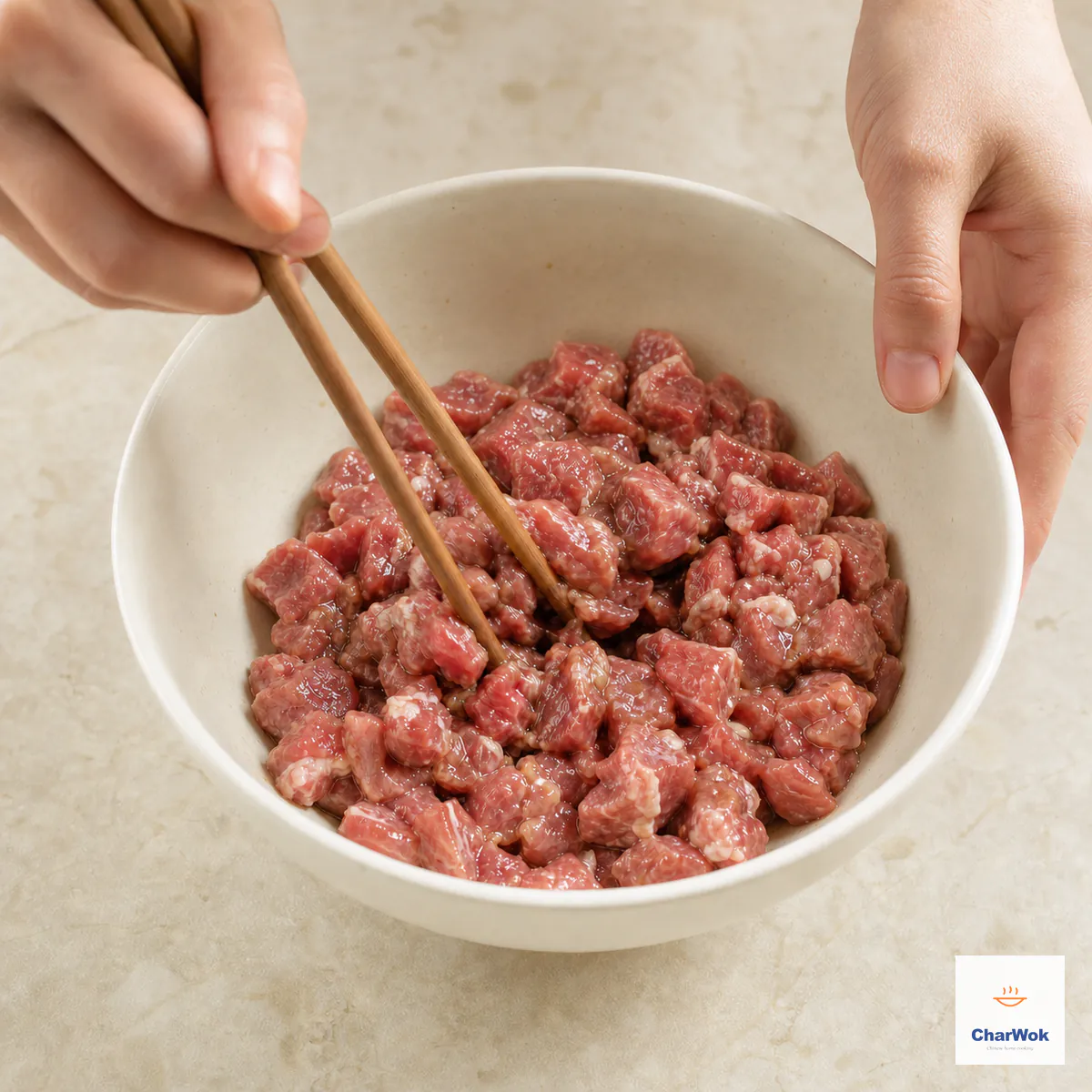
Mix in one direction until the lamb absorbs the water and no pooled liquid remains around the distinct cubes
- Render the lamb fat. Put the diced lamb fat in a dry wok or skillet over low heat. Patience matters here; high heat scorches the fat before it melts. Cook until the pieces are golden and crisp and the pan holds a shallow pool of clear oil, then lift out the solids and save them to snack on, salted. They are delicious.
- Sweat the onion, then add the seeds. Add the chopped onion to the lamb fat and fry until the edges take on a little color, about 4 minutes. Browning develops sweetness through Maillard reactions and drives off raw onion water that would otherwise sog the bun. Add the cumin seeds and chili flakes and fry for another minute; toasting whole spices in fat is what releases their aroma, the same principle behind cumin lamb stir-fry. Stir in the grated carrot and cook one minute more.
- Cool, then combine. Spread the vegetable-spice mix on a plate to cool to room temperature. Hot filling thrown onto raw dough will melt the fat in the dough and you will get a gummy, misshapen bun. Once cool, fold it into the marinated lamb. Do not overmix; you want chunks, not paste.
- Mix and knead the dough. In a stand mixer, combine flour, yeast, baking powder, sugar, and the lukewarm water and knead on low until the dough is smooth and springy, about 8 minutes. By hand, stir with chopsticks until the water is absorbed, rest the dough covered for 10 minutes so the gluten relaxes, then knead until smooth. That 10-minute rest is not optional; it is the difference between fighting a tight, ragged dough and an easy, silky one.
- Portion and roll. Divide the dough into 12 equal pieces (about 33 g each). Roll each into a disk about 10 cm across, slightly thicker in the center than at the edge, the same way you would for dumpling wrappers only larger. A thick center stops the filling from soaking through; a thin edge folds without a doughy seam.
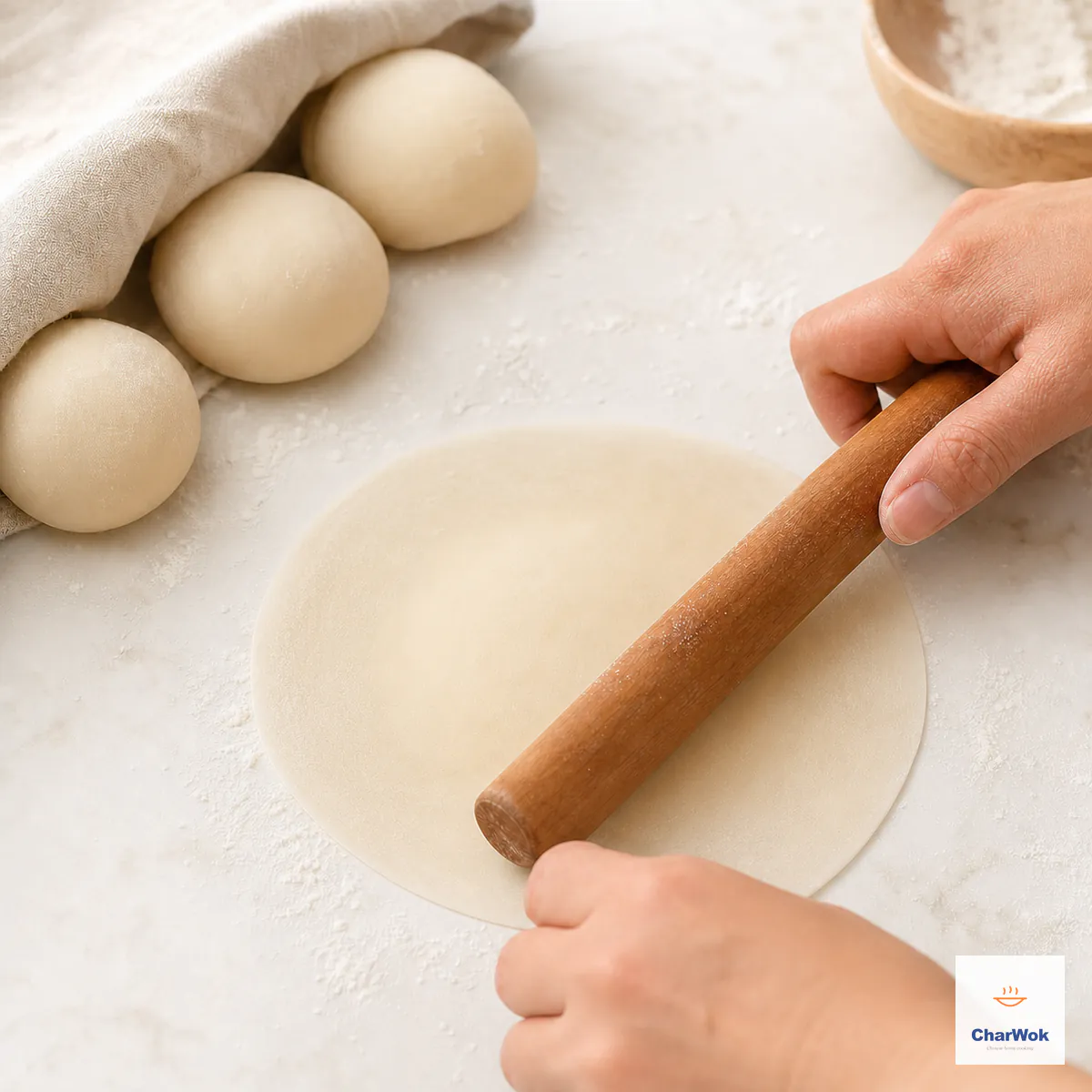
Roll each 10-centimetre wrapper with a slightly thicker center to support the filling and a thin flexible edge for pleating
- Fold into bao. Cup a wrapper in your palm, put a generous tablespoon of filling in the center, then pleat the edge shut, gathering the dough up and over the filling and twisting to seal. The seal must be tight; any gap leaks juice onto the tray and the bun dries out. Rest the buns, sealed side down, on an oiled or parchment-lined tray.
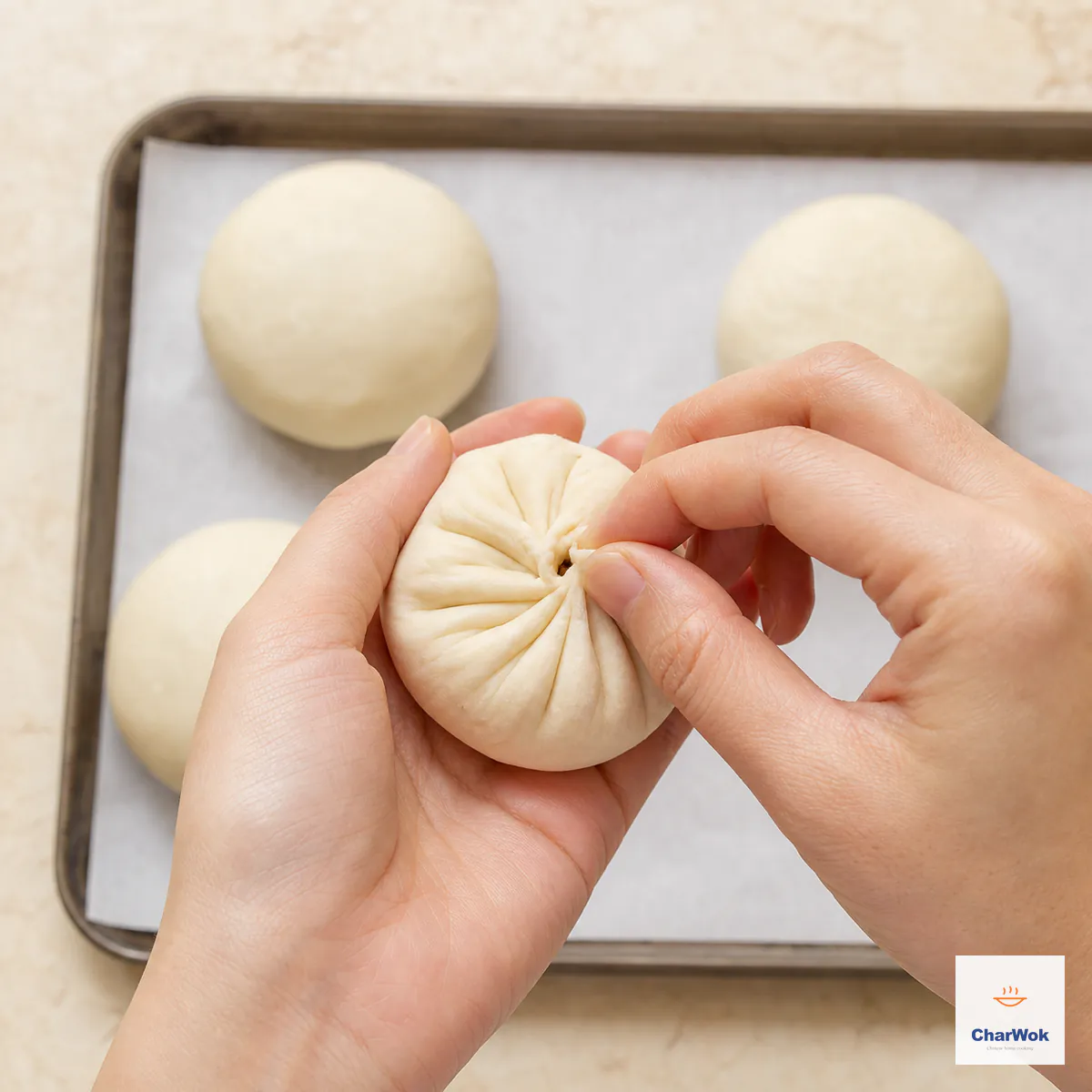
Gather the thin edge into fine pleats, pinch the center completely shut, then place each bun seam-side down
- Rest the shaped buns for 30 minutes. This proof lets the yeast produce gas that the bake will trap and expand. Underproof and the crumb is dense and the crust splits under pressure; overproof and the structure collapses. 30 minutes at warm room temperature is the sweet spot for this dough.
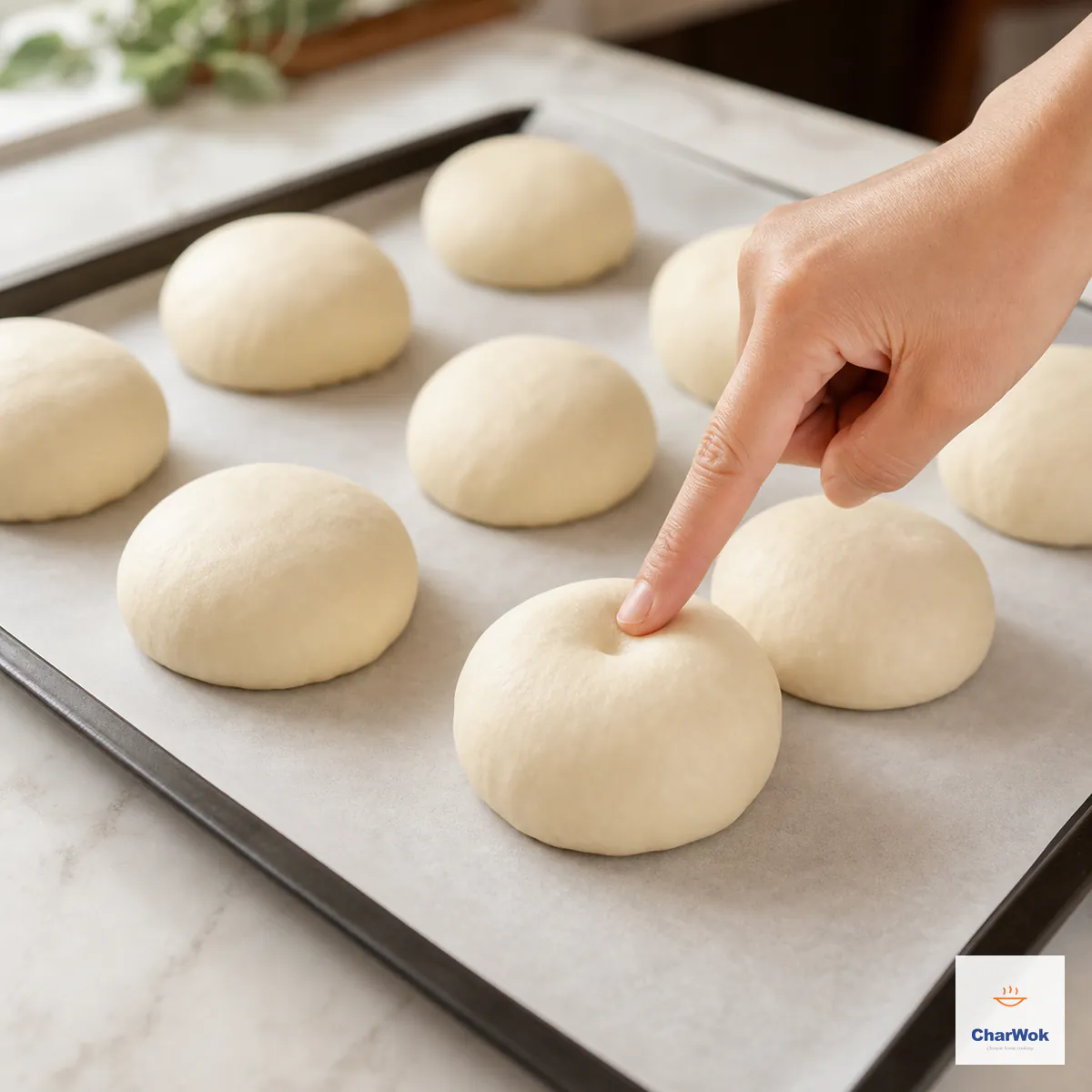
After about 30 minutes, the buns should look slightly fuller and a light fingertip press should return slowly
- Brush, seed, and bake at 210°C (410°F). Brush each bun with a thin film of oil and sprinkle with sesame seeds. Bake on the middle rack for 18 minutes. This stage sets the structure and cooks the dough through.
- Crank to 250°C (480°F) for the finish. Without opening the door, raise the heat and bake another 3 to 5 minutes, watching closely, until the tops are deep brown. This is the stage that creates the crunch. Watch the sesame seeds; once they darken past gold they burn in seconds. Cool 5 minutes before eating, the filling holds a lot of very hot juice.
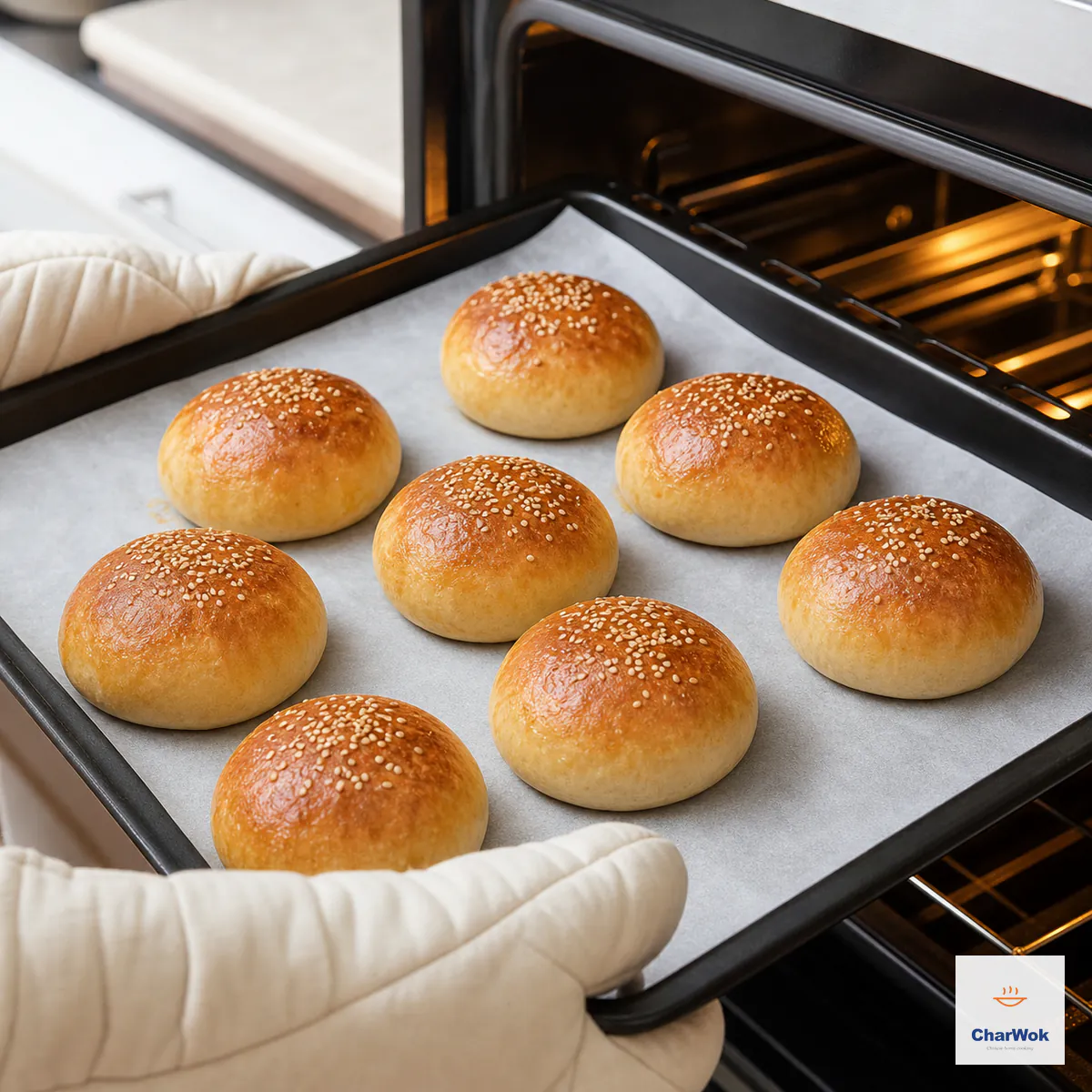
After the 210°C bake, raise the heat to 250°C and remove the tray as soon as the tops and edges turn deep golden
When things go wrong
I have made every mistake below at least once. Here is what each failure looks like and how to fix it the next time.
The dough is too sticky to knead
Two causes. Either you measured the flour by scooping and packed it down (which under-counts flour), or the water was warm enough to start cooking the starch. Weigh the flour if you can; if not, fluff, spoon, and level. If the dough is already sticky, knead in flour a tablespoon at a time rather than dumping more water back in to balance.
The buns split open at the seam
Almost always an underproofed dough or an overfilled bun. The shaped buns need the full 30-minute rest, and one tablespoon of filling per wrapper is the limit. A split also happens if the oven's first stage is too hot, which makes the crust set and crack before the interior has expanded; trust the 210°C setting.
The filling is dry
Either the lamb was ground instead of diced, the cornstarch-water mix was skipped, or the onion was not cooked long enough and wept its water into the tray during baking. The fix is upstream: dice, add the cornstarch slurry, and brown the onion properly.
The tops are pale even after the full bake
Check the sugar in the dough and the oil brush before baking. Both drive browning. A convection (fan) setting on the second stage also helps; if your oven has no fan, move the tray up one rack for the final minutes.
The bottoms are soggy
The tray was overcrowded or the buns sat in leaked juice. Give them room, seal the folds tightly, and bake on parchment rather than directly on a slick of oil, which can pool.
Variations and pairings
The dough is a reliable vehicle; the filling is where to play. Swap the lamb for beef chuck and you get a respectable beef version, though you lose the lamb-fat depth, so add a spoon of sesame paste to the filling to round it out. A pinch of five-spice powder alongside the cumin gives the filling a warmer, sweeter profile for anyone who finds straight cumin one-note.
For heat that builds rather than hits, swap the chili flakes for a spoonful of chili oil folded into the cooled vegetables. To turn the meal into a proper spread, serve the buns with a sharp, crunchy side that cuts the richness. A plate of Xinjiang tiger salad is the natural partner, or a simpler smashed cucumber dressed with black vinegar. These buns also belong on a holiday or gathering table alongside other filled breads; see Chinese New Year recipes and the festive-season collection for menu ideas that pair them with stews and noodles.
Storage and reheating
Cool leftover buns completely, then freeze them on a tray and transfer to a bag; they keep a month. To reheat from frozen, skip the microwave, which turns the crust to rubber. Put them on a rack in a 200°C (400°F) oven for about 12 minutes, then bump to 230°C (450°F) for 2 minutes to re-crisp the top. Refrigerated buns reheat the same way in 8 minutes plus 2.
You can also assemble and freeze the buns raw, before the final proof. Thaw them overnight in the fridge, let them sit at room temperature for 45 minutes to proof, then bake as written. This makes them a strong candidate for the make-ahead recipes approach to weeknight cooking.
A note on the bigger picture
These buns belong to the wider family of filled Chinese doughs that includes Xian Bing meat pies, the Rou Jia Mo pork burger, and the crisp Guo Kui flatbread. What they share is a belief that bread and filling are better as one object than as two. Once the two-stage bake clicks for you, the same dough logic carries over to gua bao territory and beyond. If you want to go deeper into the breads of the region, start with the introduction to Chinese bread and the breakfast table where many of these appear, in the classic Chinese breakfast lineup.
Frequently asked questions
Quick answers to the questions that come up most. The body above covers each in more depth.
- Can I use ground lamb instead of diced? You can, but expect a drier, softer filling. Pulse it coarsely and add the full cornstarch-water slurry to compensate.
- Do I need a stand mixer? No. A 10-minute rest before hand-kneading lets the gluten develop on its own and makes the dough easy to work by hand.
- Why two oven temperatures? The lower heat cooks the dough through without scorching; the higher heat dries and browns the surface for crunch. One temperature forces a compromise.
- Can I make them ahead? Yes. Freeze raw assembled buns, then thaw overnight and proof before baking, or freeze baked buns and re-crisp in a hot oven.