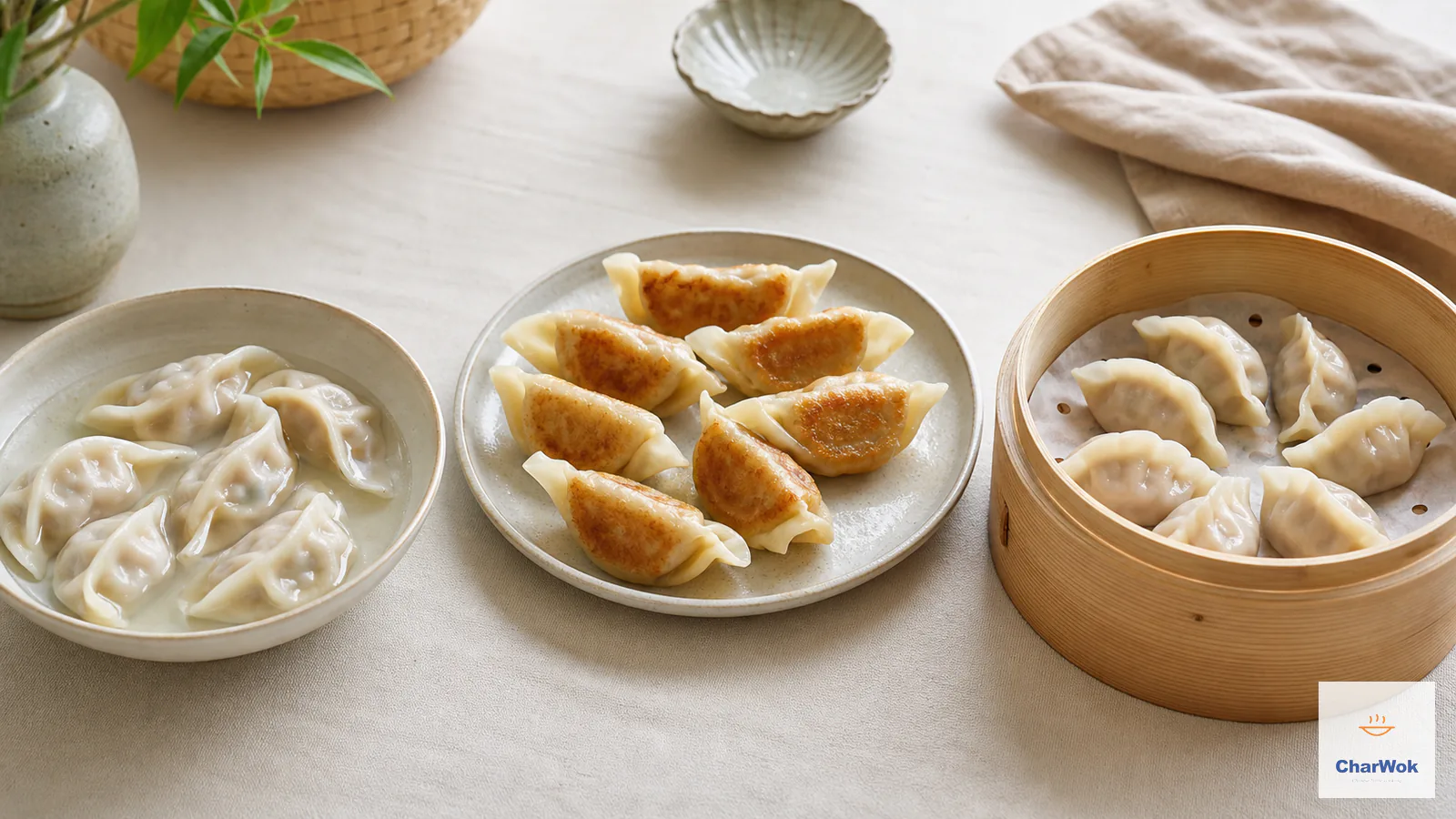
The difference between a memorable dumpling and a forgettable one is rarely the filling. It's the wrapper. A bag of store-bought rounds will get you through a Tuesday, and I keep some in my freezer for exactly that reason. But they have a flat, slightly gummy chew that no amount of well-seasoned filling can hide. Make the wrapper yourself, from two ingredients you already own, and the whole dumpling changes: the edges go tender-translucent, the bite has a real spring to it, and the dough tastes like wheat instead of nothing.
This is a technique guide, not a recipe in the usual sense. Once the dough logic clicks, you can scale it to six dumplings or sixty, adapt it for boiled or pan-fried, and stop reading wrapper recipes for good. I'll show you the hydration I trust, the rest that actually matters, and the rolling rhythm that turns a slow chore into something almost meditative.
Two ingredients, one ratio: 250 g all-purpose flour to about 130 ml water (roughly 2:1 by weight). Rest the dough twice, first 15 minutes, then at least 30, because gluten needs time to relax before it will roll thin. Aim for a disc about 1 mm thick in the center, thinner at the rim, and use the wrappers the day you roll them.
What you're actually building
A dumpling wrapper is a plain flour-and-water dough, kneaded, rested, portioned, and rolled into a thin disc. No yeast, no baking powder, no fat. Its entire personality comes from gluten, the network of proteins that forms when flour meets water and is worked. Too little gluten development and the wrapper tears when you fold. Too much, and it fights back, shrinking as you roll and turning leathery once cooked. The whole craft is about coaxing the gluten just enough, then letting it calm down.
This dough is the foundation of the northern Chinese boiled dumpling, or jiaozi, the dish families gather around on Lunar New Year's Eve in the wheat-farming north. The same logic underpins wonton wrappers (thinner, usually cut, often with egg or alkaline added) and the wrappers folded into chive pockets. If you understand this one dough, you understand most of the family.
Choosing the flour, and why it's less fussy than you think
You do not need flour labeled "dumpling flour," and you do not need to import anything. Plain American all-purpose flour is the right starting point. What you're checking is protein content, printed on the nutrition panel as grams of protein per serving adjusted to a 100 g basis (or do the math from a 30 g serving).
Here is how I read that number:
- 10–11 g protein per 100 g, the sweet spot. The dough is easy to roll, the cooked wrapper is tender with a clean chew. Most national-brand all-purpose flours in the US sit here.
- 12 g and up (bread flour territory), more elastic and resilient. The dough shrinks back when you roll it and needs a longer rest. Useful if you love a very chewy wrapper, but it makes the work harder.
- Under 10 g (some Southern US all-purpose, pastry flour), softer and easier to roll, but the wrapper loses its bounce and can turn pasty when boiled.
My firm recommendation: start with standard all-purpose. If your flour runs high in protein, rest the dough longer. If it runs low and the wrappers feel limp, add a pinch of salt to the next batch; salt tightens gluten and gives the dough a little more backbone. I learned that trick after a sack of soft pastry flour produced dumplings that sagged off the chopsticks.
The ingredient table
Ingredients at a glance
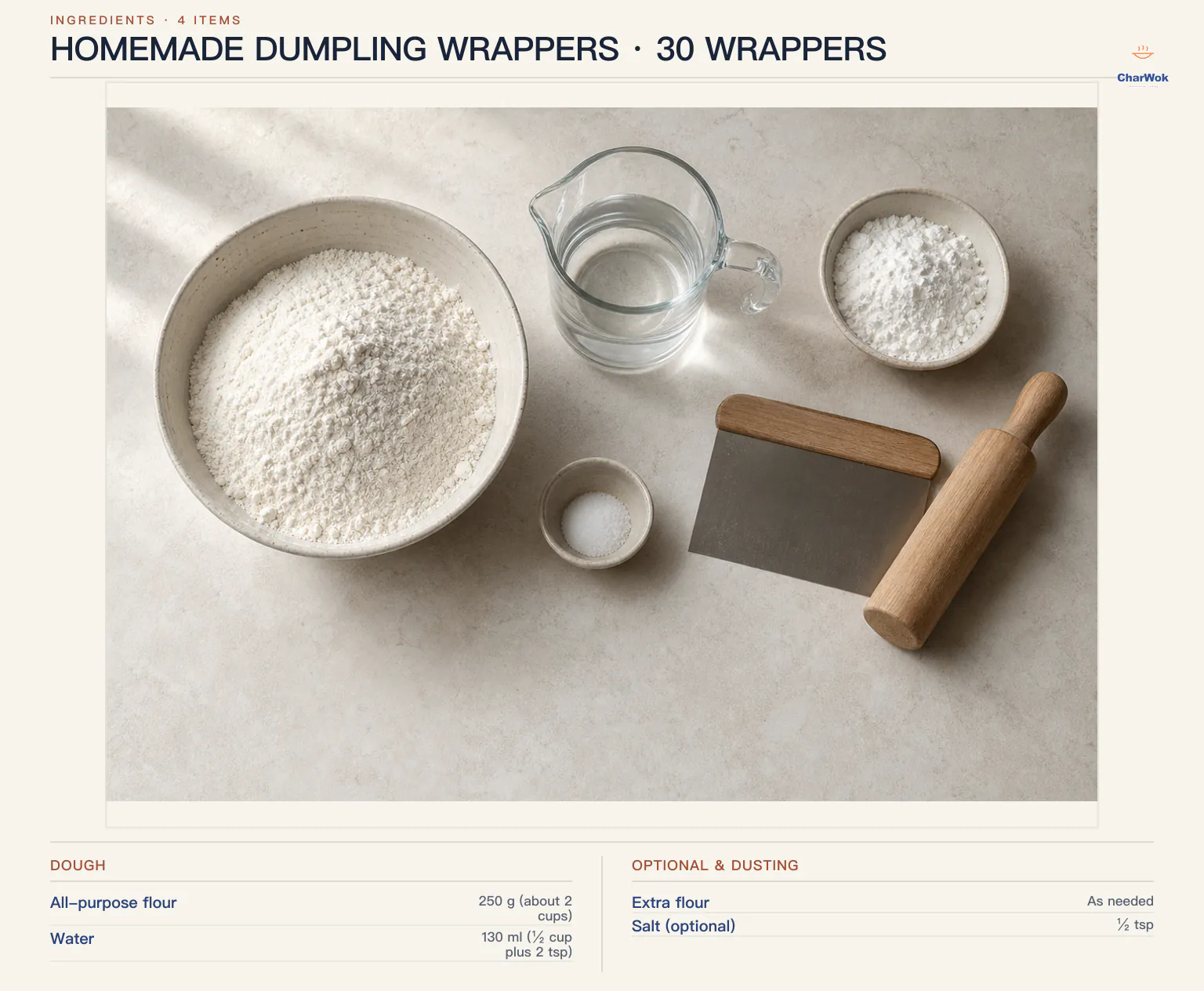
| Ingredient | Amount | Notes / substitute |
|---|---|---|
| All-purpose flour | 250 g (about 2 cups) | 10–11 g protein per 100 g is ideal. Bread flour works but needs a longer rest; pastry flour is too soft for boiled dumplings. |
| Water | 130 ml (½ cup plus 2 tsp) | Room temperature. See the hydration note below; your exact number depends on your flour. |
| Extra flour | As needed | For dusting the work surface and stacking the rolled wrappers. |
| Salt (optional) | ½ tsp | Add only if your flour is low-protein and the dough feels slack. Tightens gluten. |
Hydration, and why weighing beats cups
The dough you want is firm enough to hold a shape but soft enough that a fingertip leaves a slow impression. That falls around 50–52% hydration by weight: 130 ml water to 250 g flour. Higher-protein flour drinks more water, so if you're on bread flour you may need 135–140 ml. If you're on soft all-purpose, 125 ml might be plenty.
Please weigh the flour if you can. A cup scooped firmly can hold 140 g; a cup scooped loosely, 110 g. That 30-gram swing is the difference between a dough that cracks and one that sticks to everything. A cheap kitchen scale pays for itself on the first batch. The same hydration logic applies when you move on to handmade noodles: once your hands know the target feel, you stop measuring.
Mixing and the two-stage knead
This is where most people give up, and it's where the dough is actually won. Dump the flour into a wide bowl. Pour in the water in a thin stream while stirring with chopsticks or a stiff spatula. Stop the moment the loose flour is gone; you'll have a shaggy, unattractive lump. Press it together with your hand, then knead for about a minute, just until it forms a ball. It will look rough and feel stubborn. Cover it with a damp cloth or an overturned bowl and walk away for 10 to 15 minutes.
That short rest is not optional theater. While you're gone, the flour finishes absorbing the water and the gluten strands begin to align on their own. When you come back and knead again for two or three minutes, the same stubborn lump turns smooth and elastic under your hands almost as if by magic. This is the part that convinces people flour-and-water dough is alive.
Now cover the smooth ball and rest it a second time, at least 30 minutes and up to an hour. This is the rest that decides whether rolling is a pleasure or a struggle. Gluten that has relaxed rolls thin and stays put; gluten that is wound tight springs back like a rubber band. If you used high-protein flour, give it the full hour.
- Hydrate and gather. Stream water into the flour while stirring. Stop when the loose flour is absorbed. Press into a rough ball and knead just until it holds together, about one minute. It will look shaggy. Cover and rest 10–15 minutes so the gluten can develop on its own.
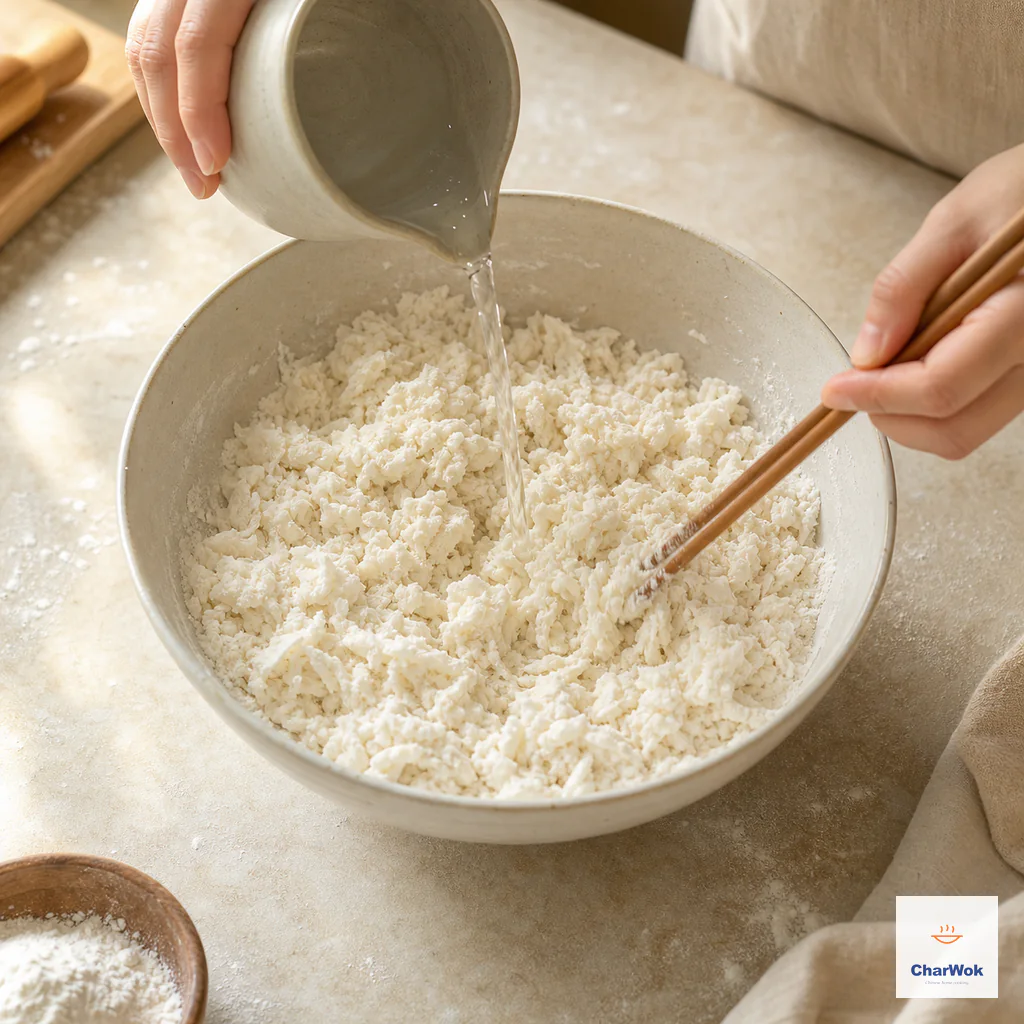
Add the water gradually while stirring, stopping as soon as the flour forms loose flakes and no dry flour remains at the bottom.
- Knead to smooth, then rest long. Knead the rested dough for 2–3 minutes until smooth and springy. Cover again and rest at least 30 minutes (up to 60 for high-protein flour). Press a finger in: the dent should fill back in slowly. If the dough springs back fast, it needs more time.
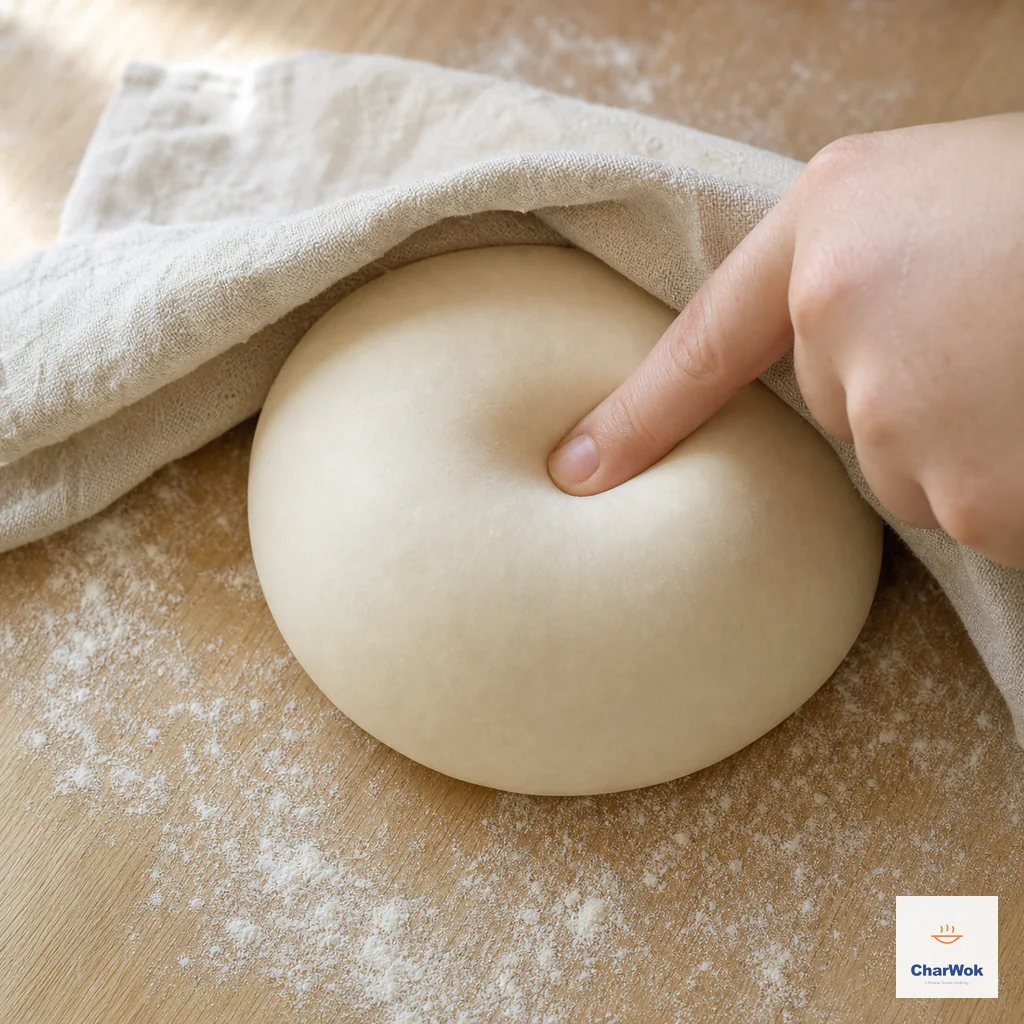
After the short first rest, knead until smooth, cover for 30 to 60 minutes and wait until a shallow dent returns slowly.
- Divide and rope. Roll the dough into a log, then cut into four equal pieces. Work with one piece at a time and keep the rest covered; exposed dough skins over in minutes. Roll that piece into a rope about 2.5 cm (1 in) thick, then cut it into 7 or 8 equal sections. A dough scraper gives cleaner cuts than a knife.
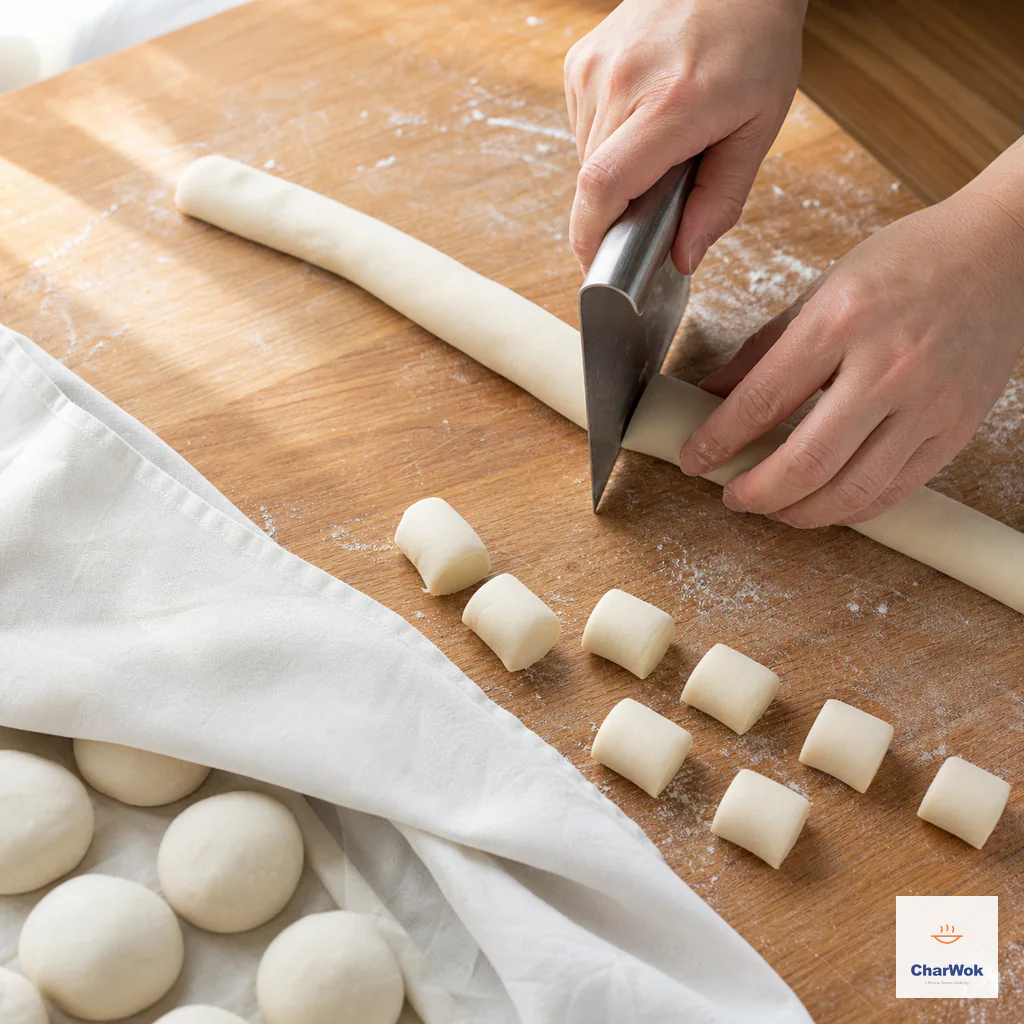
Divide the dough, roll one part into a rope about 2.5 centimetres thick and cut seven or eight equal sections, keeping the rest covered.
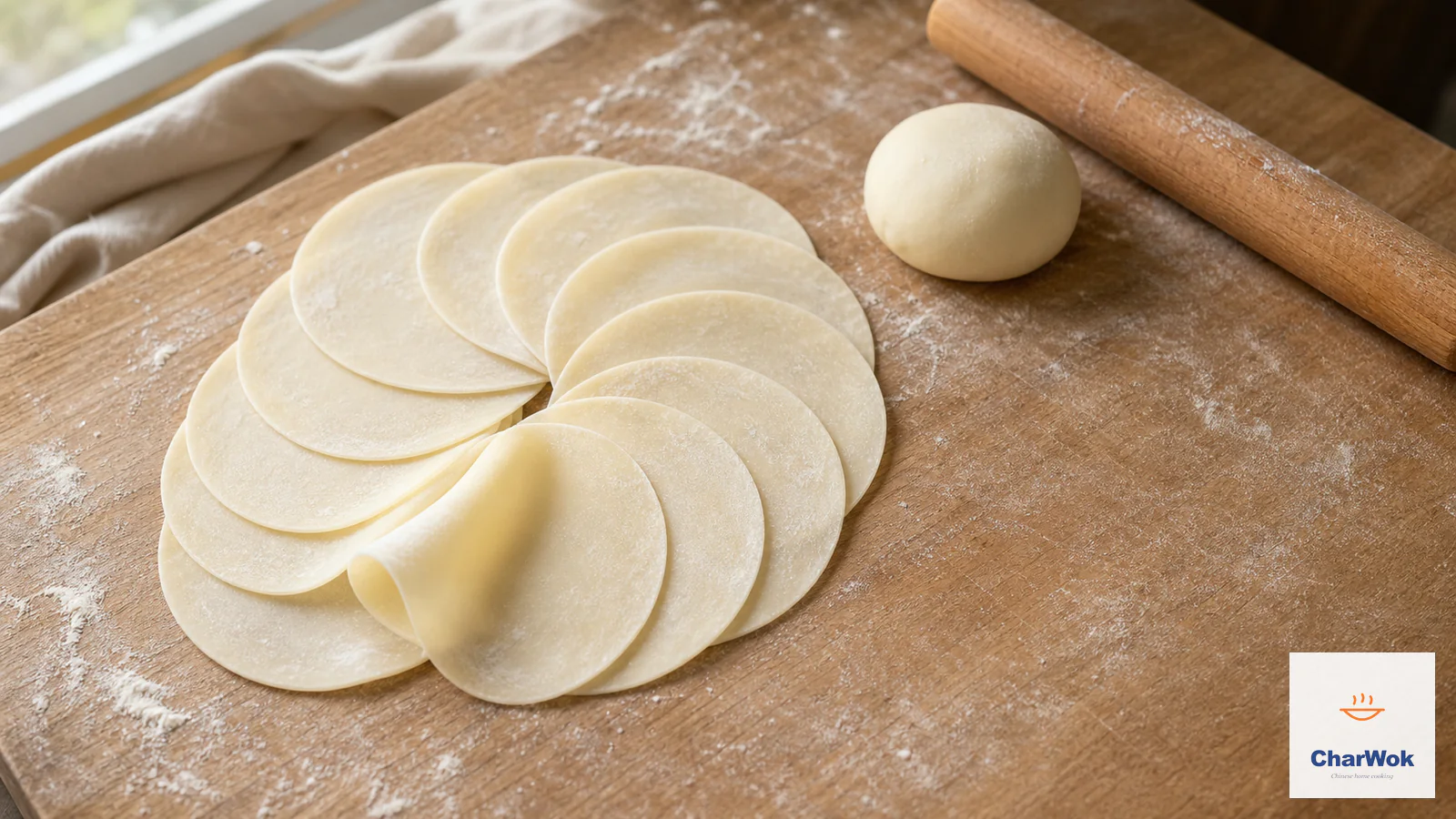
- Press, then roll. Stand each cut piece on a cut end and flatten it with your palm into a disc. Roll it out with a small rolling pin, rolling only halfway across the disc and turning it a little after each pass. This is what produces the slightly thicker center and thin rim: the center holds the filling without splitting, and the thin edge keeps a folded dumpling from becoming doughy at the seam. Dust with flour the instant anything sticks.
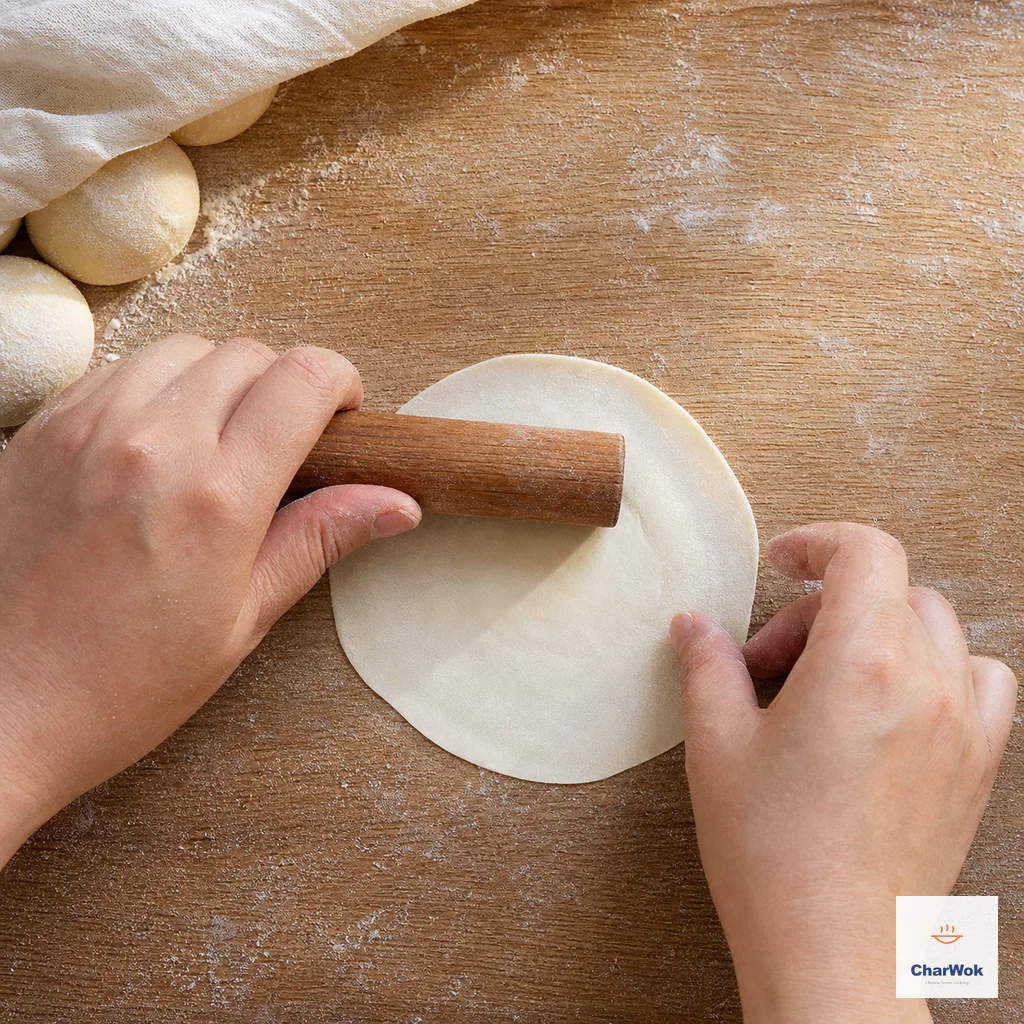
Roll only halfway across and rotate after every pass so the wrapper stays round with a sturdy centre and a thin folding edge.
- Use or freeze promptly. Roll a few wrappers, fill and fold them, then roll the next batch. Don't build a big pile, or the bottom ones will weld together. A generous dusting of flour (cornstarch is even better for freezing) between each wrapper lets you stack them. Freeze flat in a sealed bag with the air pressed out, then thaw overnight in the fridge and use straight away.
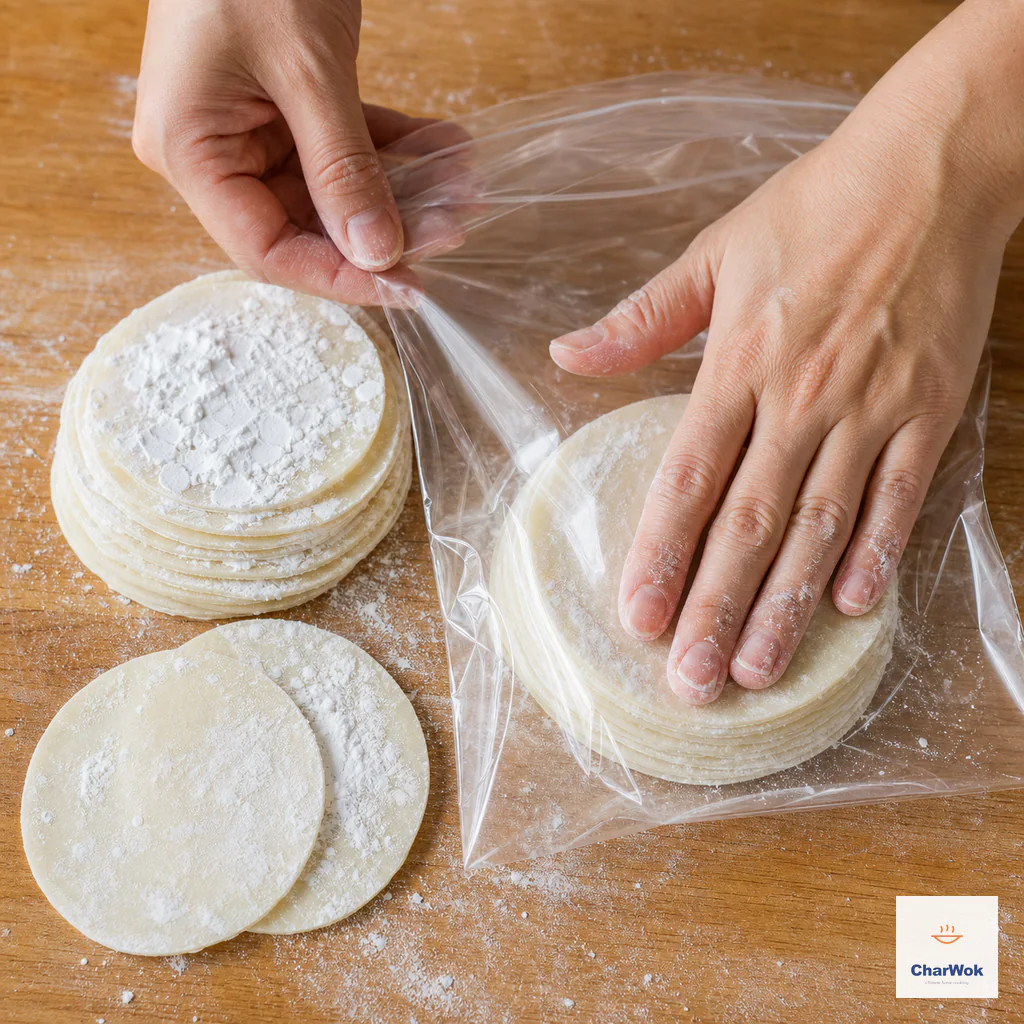
Use freshly rolled wrappers in small batches, or dust every layer well, seal the stack flat with the air pressed out and freeze.
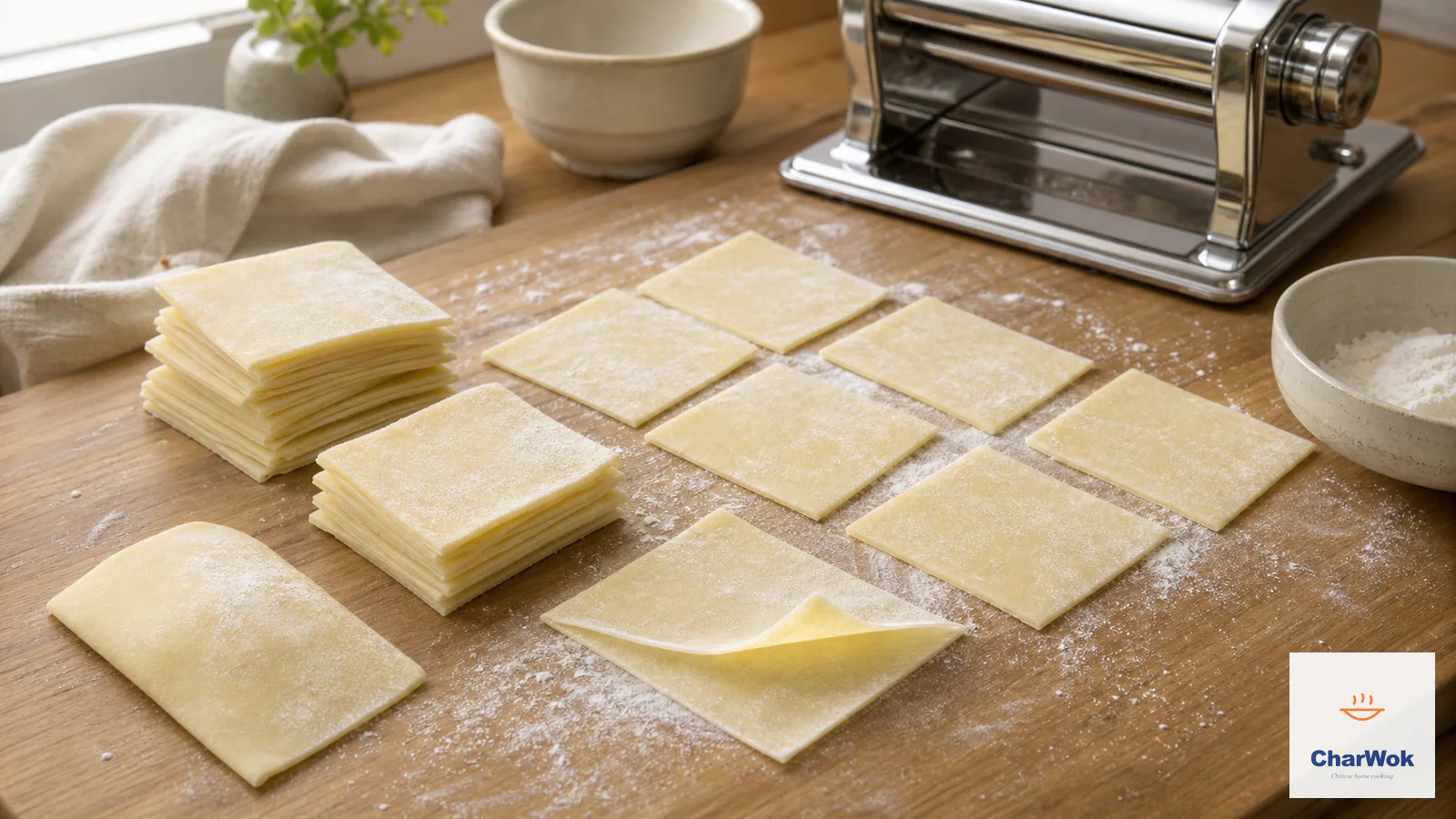
If rolling each disc feels punishing, there is a legitimate shortcut: run the dough through a pasta machine to a thin sheet, then cut circles with the rim of a glass or a cookie cutter. You lose the thicker-center-thinner-edge profile, so the folded edge can be a touch heavy, but the result is still leagues better than bought. This is also the standard route for soup dumplings and many wontons, where an even, paper-thin sheet is the goal.
When things go wrong
Almost every wrapper failure traces back to one of three causes: the wrong hydration, a skipped rest, or dough that dried out. Here is how I diagnose each.
- Dough cracks at the edges while rolling. It's too dry. Knead in water a teaspoon at a time, then rest 10 minutes. Next time, start with 5 ml more water.
- Dough sticks to the pin and the counter. Too wet, or the surface isn't floured. Dust generously. If it's truly slack, knead in flour a tablespoon at a time and rest before retrying.
- Dough fights you and shrinks back. The gluten is wound tight. It needs a longer rest, not more force. Cover it and walk away for 20 minutes. Forcing it just tears the strands.
- Wrappers tear while folding. Either you rolled them too thin at the center, or the dough dried out. Keep unused dough covered, and roll to about 1 mm in the middle, thin enough to see a shadow through but not so thin it rips.
- Cooked wrappers are tough and leathery. You kneaded a high-protein flour hard and didn't rest it. Or the dough was on the dry side. Both tighten gluten. Use all-purpose, rest long, and don't skimp on hydration.
- Cooked wrappers are mushy and slip off the filling. Dough too wet, or wrappers too thin, or overcooked. Boil in plenty of water and pull them the moment they float and turn translucent.
- Stacked wrappers fuse into a single sad brick. Not enough flour between them, or they sat too long before use. Cornstarch is the better separator if you're freezing.
Hot-water dough and the starch route
The cold-water dough above is the default and the one I'd learn first. Two variants are worth knowing, and both trade chew for softness.
Hot-water dough. Replace about two-thirds of the water with just-boiled water, pouring it onto the flour first and mixing to partially cook the starch, then add the remaining third at room temperature and knead as usual. The precooked starch makes the dough softer and more pliable, which is why it's the choice for steamed dumplings and many pan-fried ones. A cold-water wrapper can turn slightly stiff when it meets dry steam heat. The dough is easier to seal and stays tender, but it loses some of the resilient bite that makes a boiled jiaozi satisfying. Use cold-water dough for boiling, hot-water for steaming and pan-frying.
Semi-starchy dough. Swap about a quarter of the flour for cornstarch and sift them together before hydrating. The cooked wrappers take on a faint translucence and a silky, tender surface. It's a lovely texture for pan-fried dumplings where you want a delicate crust. Pure starch, taken all the way, is what produces the fully transparent skins of har gow, but that is a different technique and a different dough entirely.
Don't throw out the scraps
Rolling always leaves trimmings and odd offcuts. Gather them, knead briefly, rest five minutes, and roll them into a flat disc. Pan-fry it in a little oil with a sprinkle of salt and chopped scallion, and you have a rough scallion pancake for the cook to eat standing at the stove. No dough leaves my kitchen uneaten.
Variations and pairings
Once the basic dough is reliable, color and flavor are easy. Swap a few tablespoons of the water for spinach juice, carrot juice, or beet juice, and you get the jewel-toned wrappers that turn a dumpling platter into a centerpiece, the same idea behind naturally colored dumplings. A pinch of turmeric tints the dough gold without changing the texture.
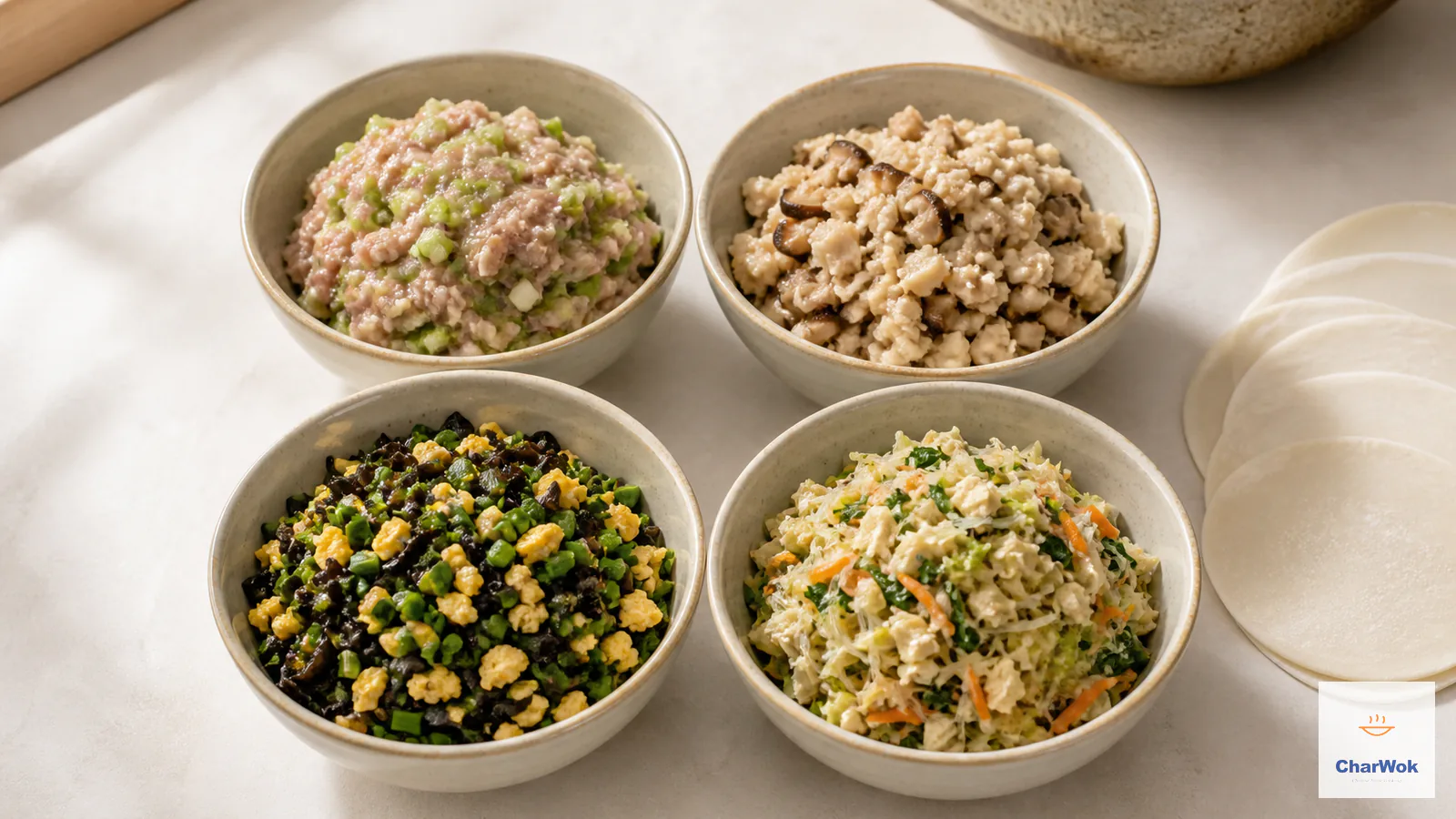
For fillings, the dough is neutral and forgiving. Pair it with a classic pork and napa cabbage filling, a fully plant-based one from the vegan dumplings recipe, or fold the scraps into chive pockets for a thicker, pan-fried treat. When you're ready to put it all together, the dumpling folding guide covers two core folds and their variations, while the cooking guide walks through boiling, steaming, and pan-frying. Round out the table with one of the six dumpling sauces. A sharp black vinegar and chili oil dip is the one I reach for most.
Storage
Fresh dough keeps in the fridge, tightly wrapped, for a day; any longer and it weeps moisture and turns sticky. Rolled wrappers are best used immediately, but they'll hold for a few hours under a barely damp cloth. For real keeping, roll, dust generously with cornstarch between each, stack, and freeze in a sealed bag with the air pressed out. They keep two to three months. Thaw overnight in the fridge and use straight away. Do not refreeze.
Filled and folded dumplings freeze beautifully on a tray, then go into a bag. Drop them straight from frozen into boiling water for a weeknight dinner that takes about as long as the pot takes to boil. For a broader set of make-ahead ideas around this kind of cooking, the best dumpling recipes collection and the full dumpling guide are good places to wander.
Frequently asked questions
Can I use a stand mixer? Yes. Combine flour and water with the dough hook on low until a smooth ball forms, about 5 minutes. You still need the two rests. The machine develops gluten faster than your hands, but gluten still has to relax before it will roll.
Do I need boiling water or cold water? Cold tap water for the standard boiled dumpling. Reserve the hot-water version for steamed or pan-fried dumplings, where the softer dough pays off. Cold-water dough keeps the chew that makes boiled jiaozi worth eating.
Why are my store-bought wrappers so different? They're made commercially with added salt and stabilizers and often a touch of oil, then dusted heavily. They're designed to last on a shelf, which is exactly why their texture is flatter. Fresh dough can't sit on a shelf, and that's the point.
How thin should I roll? About 1 mm at the center, thinner at the rim. You should see a faint shadow of your hand through it. Much thinner and it tears; much thicker and the folded seam turns doughy.
Can I add egg? You can — it enriches and tenderizes the dough, and many wonton skins include egg or alkaline water. For a northern boiled dumpling, I leave it out; the plain dough has the cleaner bite the dish is built on.