A good Gua Bao is a study in pressure and release: a soft, faintly sweet steamed bun folding around a slice of pork belly so tender it gives way without a fight, then a hit of acid, crunch, and heat to cut the fat. The dish is Taiwanese, and it shares a soul with the northern rou jia mo and the pulled-pork sandwich. Like those, it is bread cradling slow-cooked meat, but the flavor profile is its own. You eat it folded, with one hand, and the toppings run down your wrist. That is part of the point.
The home cook's pain point is rarely the recipe. It is the texture. Make the dough once wrong and you get a dense, chewy puck that fights the filling. Braise the belly too short and you slice into rubber. I have done both. This guide leans on two techniques that decide everything: a low-hydration mantou-style dough steamed from cold water, and a braise that borrows from red-cooked pork belly but goes lighter on the caramel so the bun and toppings stay in balance.
At a glance: 8 buns from 300 g flour and a 500 g slab of belly. Knead the dough smooth, fold the ovals over parchment, rest 30 minutes, then steam 10 minutes from a full boil. Braise the belly a full hour low and slow; anything less and the collagen does not melt. Make both parts a day ahead; the buns re-steam in 4 minutes.
What Gua Bao actually is
Gua Bao (刈包, sometimes written 割包) is a folded steamed bun, soft and slightly sweet, filled with braised pork belly and a clutch of contrasting garnishes. The classic Taiwanese version piles in sweetened and ground peanuts, pickled mustard greens (suān cài), cilantro, and sometimes sugar-dusted peanuts. The bun itself is a close cousin of mantou: same lean dough, same cold-water steaming logic, just shaped into a half-moon pocket instead of a plain round.
Culturally the dish has a foot in two camps. In Taiwan it is street food and night-market comfort, eaten year-round but with a ritual role near Lunar New Year, when the stuffed bun is said to resemble a wallet biting into money, a wish for prosperity. The folding technique also shows up across the Chinese steamed-bread family, from char siu bao to stuffed baozi; what sets Gua Bao apart is that the filling goes in after steaming, not before, so the bun stays clean and the toppings stay bright.
The two parts, and why each one fails
Think of this as a braise plus a bread, scheduled so they meet warm. The belly wants time and a gentle simmer so the connective tissue converts to gelatin; the bun wants a tender, even crumb that re-heats without going tough. Skimp on either and the dish collapses. I will not pretend the shortcuts work: a 30-minute braise is leathery, and a dough that hasn't rested is a brick. The good news is that both halves hold beautifully, so you can split the work across two days and assemble in minutes.
Ingredients
Ingredients at a glance
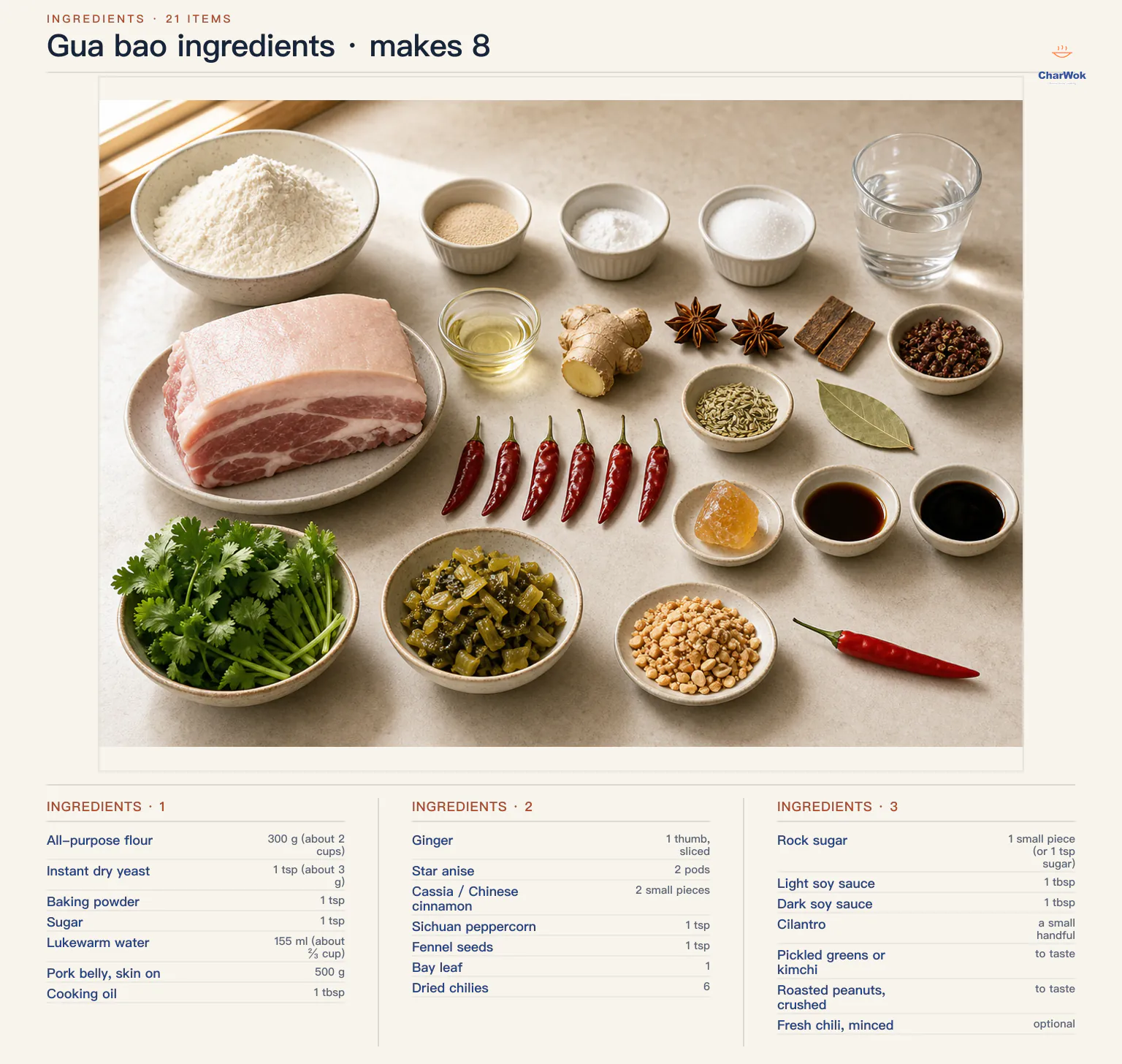
The buns are a lean dough: flour, water, yeast, a little sugar and baking powder. The baking powder is not traditional but it gives the steamed crumb a softer, slightly open texture that holds up to a wet filling; leave it out and the bun turns denser, closer to plain Chinese steamed bread. The braise uses a whole-spice aromatic base rather than a pre-mixed blend, because you can taste each layer; if you keep five-spice powder on hand it is a fine shortcut, but the spices below give a cleaner result.
| Ingredient | Amount | Notes / substitute |
|---|---|---|
| All-purpose flour | 300 g (about 2 cups) | Plain AP flour, 10–11% protein. Bread flour makes a tougher bun; do not swap. |
| Instant dry yeast | 1 tsp (about 3 g) | Active dry works; bloom in the water first if not instant. |
| Baking powder | 1 tsp | Aluminum-free. Omit for a denser, more traditional crumb. |
| Sugar | 1 tsp | Feeds the yeast and rounds the flavor; not for sweetness. |
| Lukewarm water | 155 ml (about ⅔ cup) | Body temperature, 35–38°C. Err slightly low, not high. |
| Pork belly, skin on | 500 g | One slab cut into 8 rectangles. Skinless works but slices drier. |
| Cooking oil | 1 tbsp | Neutral: canola, grapeseed, peanut. |
| Ginger | 1 thumb, sliced | Bruise it with the side of a knife to release more aroma. |
| Star anise | 2 pods | The backbone of the braise's warm note. |
| Cassia / Chinese cinnamon | 2 small pieces | Cinnamon stick works; cassia is more assertive. |
| Sichuan peppercorn | 1 tsp | For a faint numbing warmth. See the Sichuan pepper guide for sourcing. |
| Fennel seeds | 1 tsp | Adds a sweet, anise edge that rounds the soy. |
| Bay leaf | 1 | One only; more turns the broth medicinal. |
| Dried chilies | 6 | Mild heat. Cut in half and shake out the seeds to dial it back. |
| Rock sugar | 1 small piece (or 1 tsp sugar) | Gives a glossy sauce; rock sugar mellows better than white. |
| Light soy sauce | 1 tbsp | Salt and umami. See light vs dark soy. |
| Dark soy sauce | 1 tbsp | Color and body. Skip if you only have light; add ½ tsp more light. |
| Cilantro | a small handful | Torn at the last second, never chopped ahead. |
| Pickled greens or kimchi | to taste | Traditional is sweet pickled mustard greens; good kimchi is the easiest stand-in. |
| Roasted peanuts, crushed | to taste | Coarse, not powdered. Spicy Sichuan peanuts are excellent here. |
| Fresh chili, minced | optional | For heat on the plate, not in the braise. |
Step 1: Sear and braise the pork belly
Cut the slab into 8 even rectangles so they cook at the same rate. Uneven pieces mean one slice melts while another stays tough. Pat them dry.
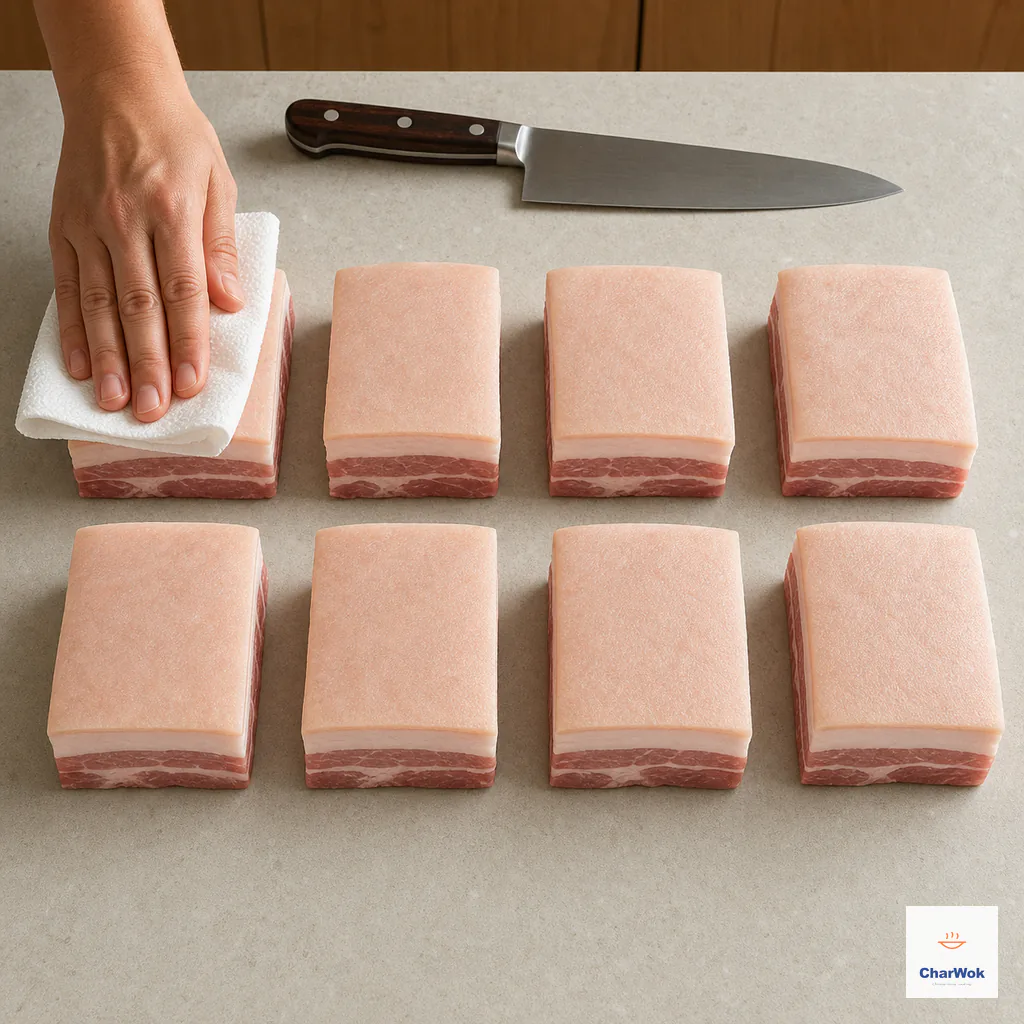
Cut the pork belly into eight equal rectangles and pat every surface dry so it can brown instead of steam.
- Heat the oil in a heavy pan or wok over high heat and sear the belly until both sides are deep golden, about 2 minutes a side. This is not for a crust (the meat will be braised soft) but for the Maillard flavors that color the broth. Skip it and the sauce tastes flat and boiled.
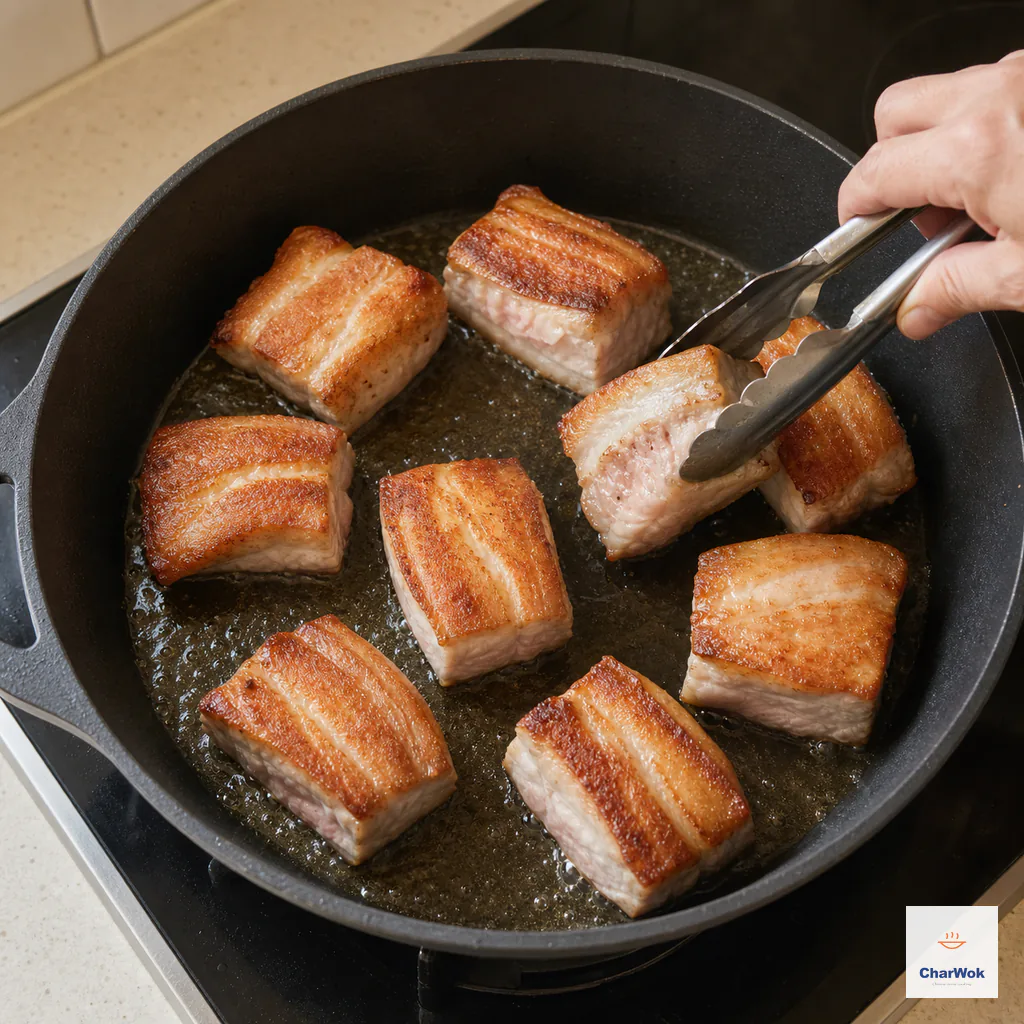
Sear every broad face over high heat until deeply golden; keep the pieces in one layer and leave the rendered fat in the pan.
- Add the ginger, all the whole spices, the rock sugar, and both soy sauces. Stir for 30 seconds until the spices bloom and you can smell the star anise. Toasting the spices in the rendered fat is what separates a layered braise from soy-flavored water.
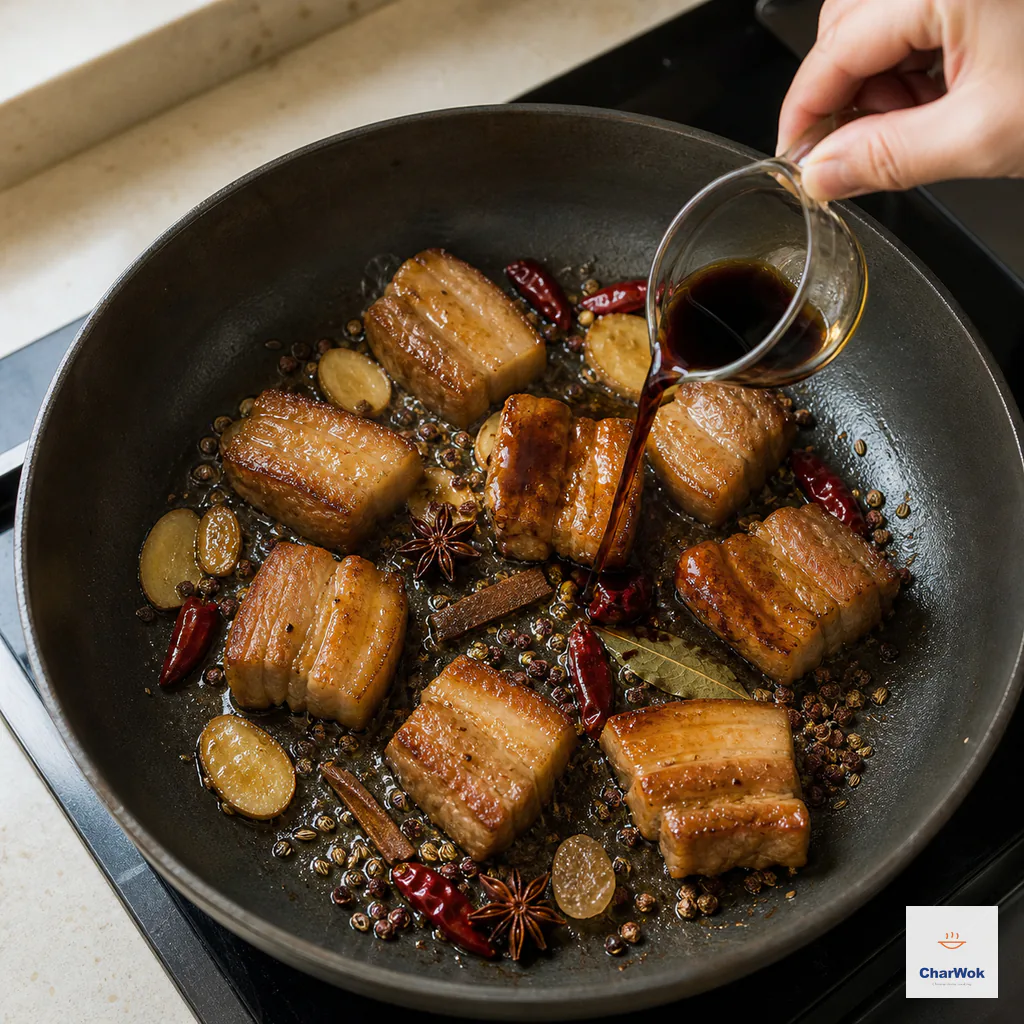
Bloom the ginger and whole spices around the pork, then add rock sugar and both soy sauces before any water.
- Pour in just enough boiling water to cover the meat, not more. Too much liquid and the sauce never concentrates; you want it to reduce into something that clings.
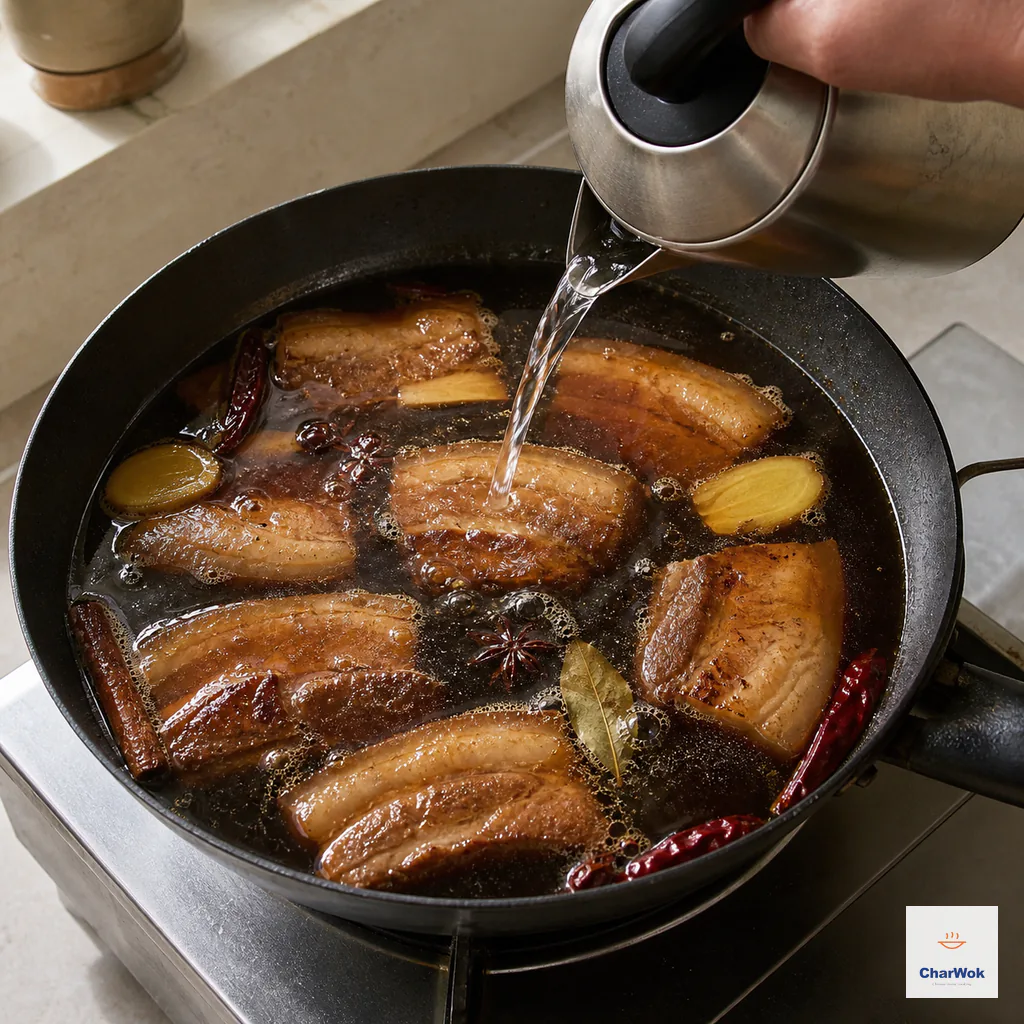
Add boiling water only until it just covers the pork; too much water dilutes the braise and slows reduction.
- Drop the heat to the lowest setting that still holds a gentle simmer, cover, and leave it alone for about an hour. The test is not time but texture: a skewer should slide through the thickest piece with almost no resistance. If it catches, give it another 15 minutes. This is the same low-and-slow principle behind lu rou fan: collagen needs time, not heat.
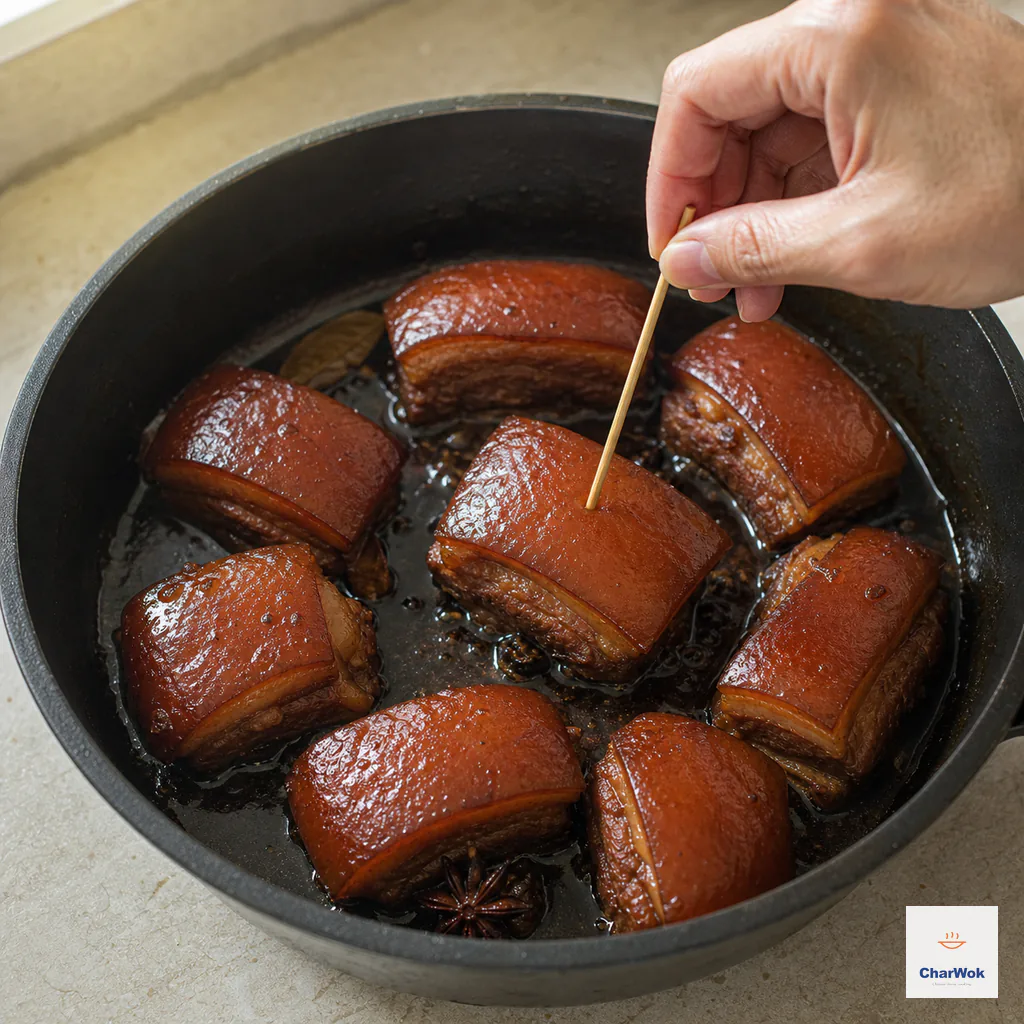
Cover and simmer gently until a skewer slides through the thickest piece without resistance and the sauce clings.
Step 2: Make the bun dough
While the belly simmers, build the dough. Whisk the flour, yeast, baking powder, and sugar together in a bowl. Add the water in a thin stream, stirring with chopsticks or a spatula until no dry flour remains, then bring it together into a rough ball.
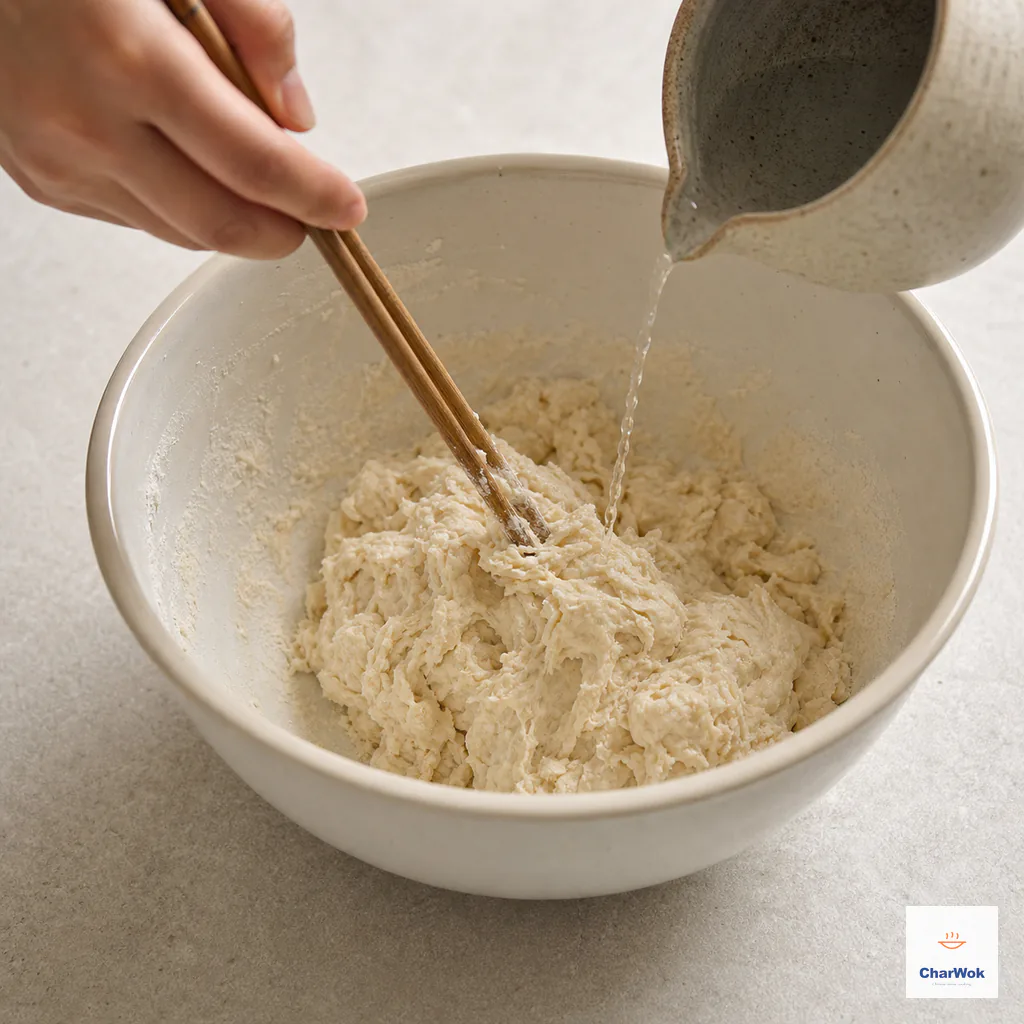
Mix the dry ingredients first, then add the lukewarm water gradually until no dry flour remains.
- Knead briefly just until the dough holds together, then cover and rest it 10 minutes. This short autolyse lets the flour hydrate and the gluten relax, so the second knead is short and the final dough is smooth rather than overworked.
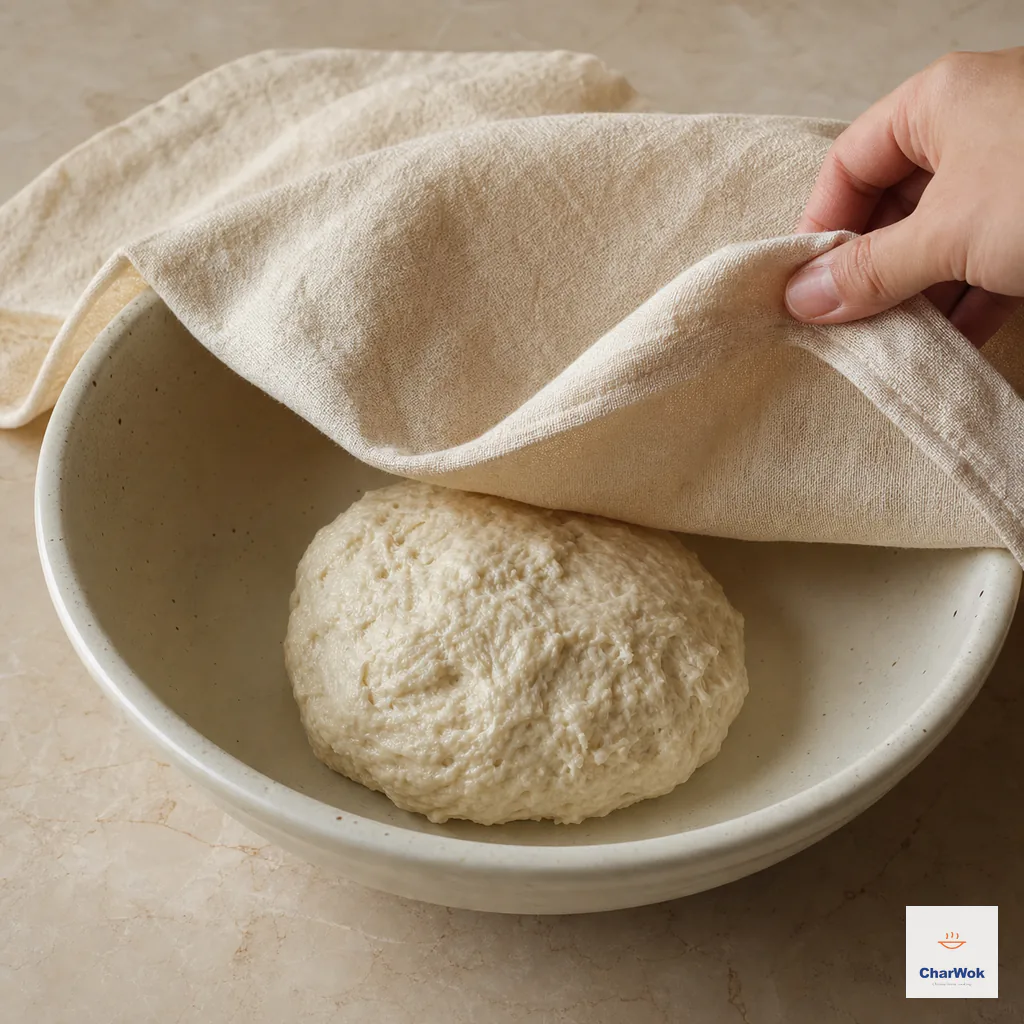
After a brief knead, cover the rough dough for 10 minutes so hydration makes the next knead smoother.
- Knead again for 4–5 minutes until the surface is smooth and springs back when you press it. Under-kneading is the hidden cause of buns that collapse or feel doughy inside. A stand mixer on low for about 8 minutes total does the same job; the dough is ready when it passes the windowpane test: stretch a small piece thin enough to see light through without tearing.
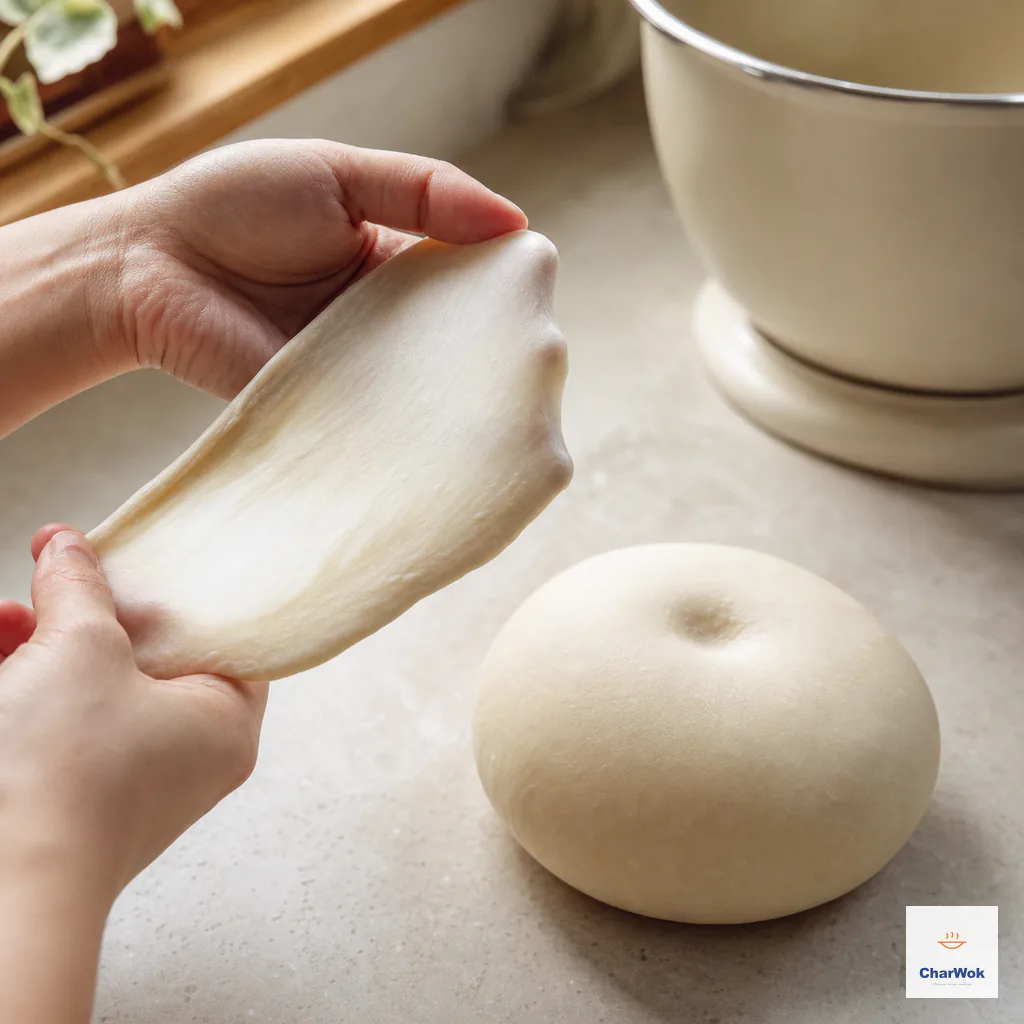
Knead until smooth and firm; a thin piece should transmit light without tearing and a fingertip dent should spring back.
Step 3: Shape the folded buns
- Divide the dough into 8 equal pieces and roll each into a ball. Even portions matter; eyeball it and one bun will be a coin and another a balloon.
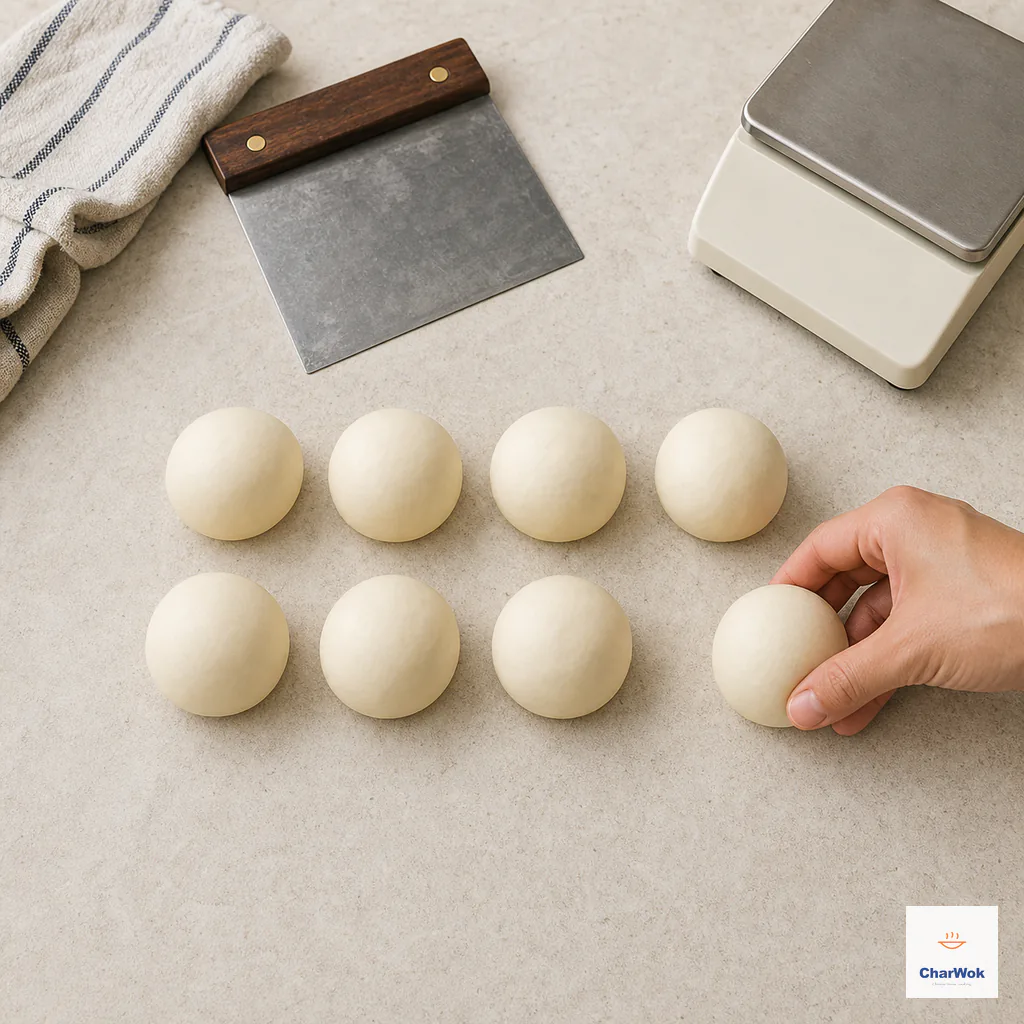
Divide the dough into eight equal portions and round each one smooth so every bun steams at the same rate.
- Flatten a ball with your palm, then roll it into an oval about 3 mm thick, roughly the size of your hand. Roll from the center outward and rotate 90 degrees between passes so the oval stays even rather than going lopsided.
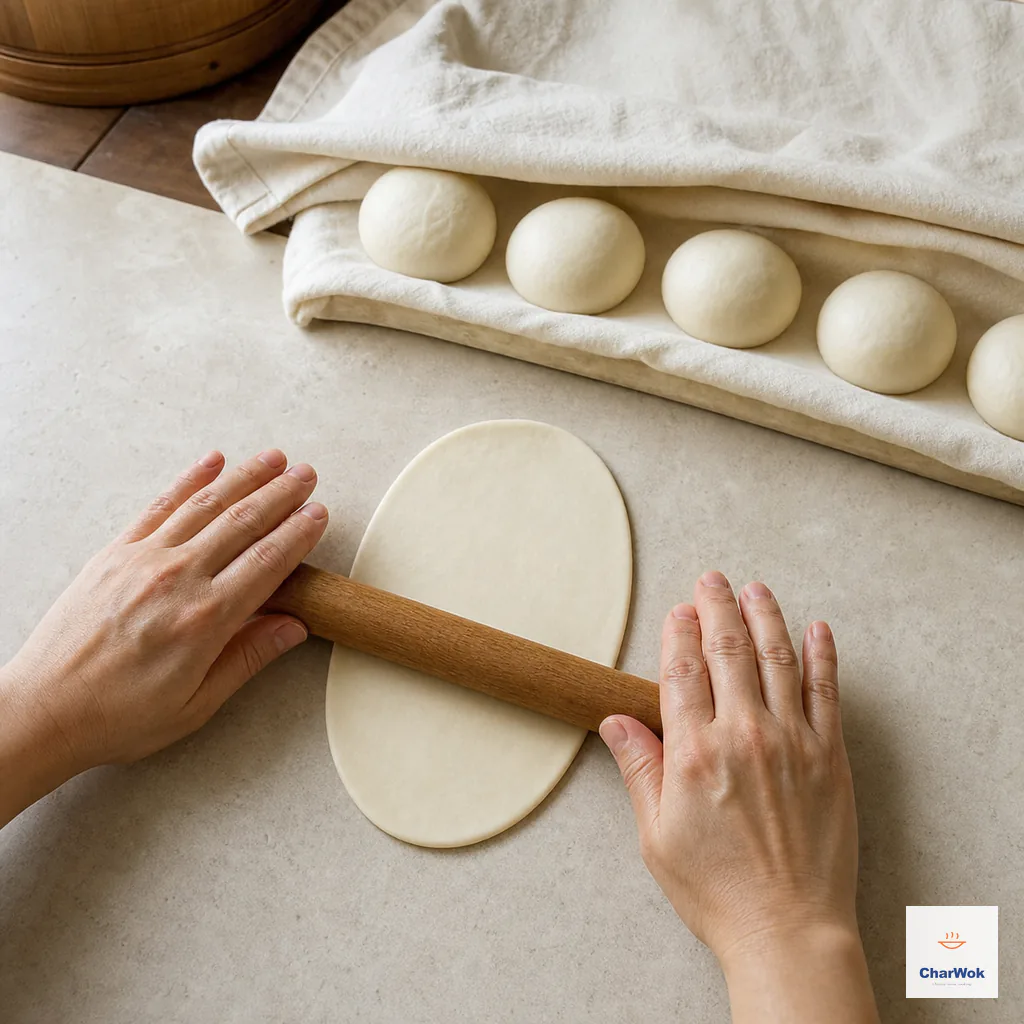
Roll from the centre outward to a hand-sized oval about 3 millimetres thick, keeping the centre from becoming paper-thin.
- Brush the surface lightly with oil (this is the release layer), then fold the oval in half lengthwise. Slip a small square of parchment paper between the halves so they don't fuse during steaming. The oil alone is not enough; the paper guarantees a clean open pocket.
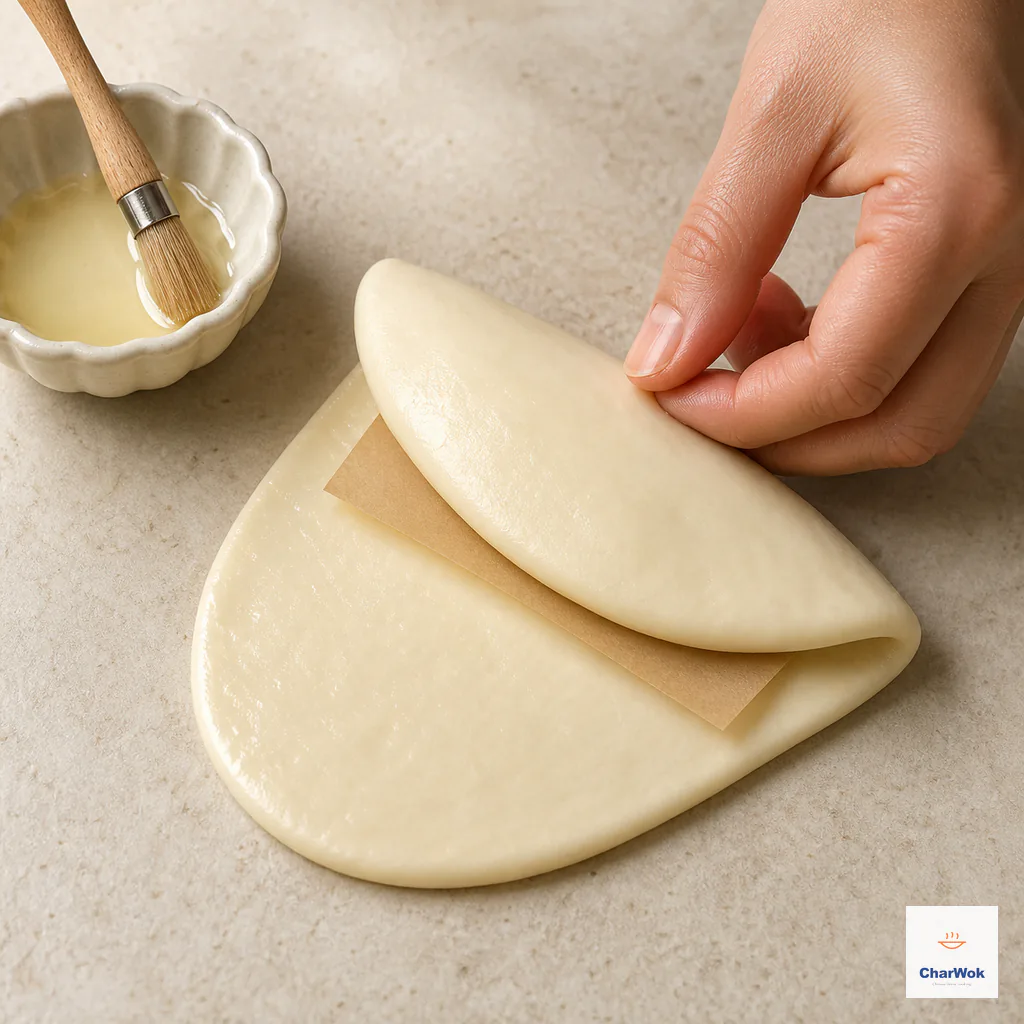
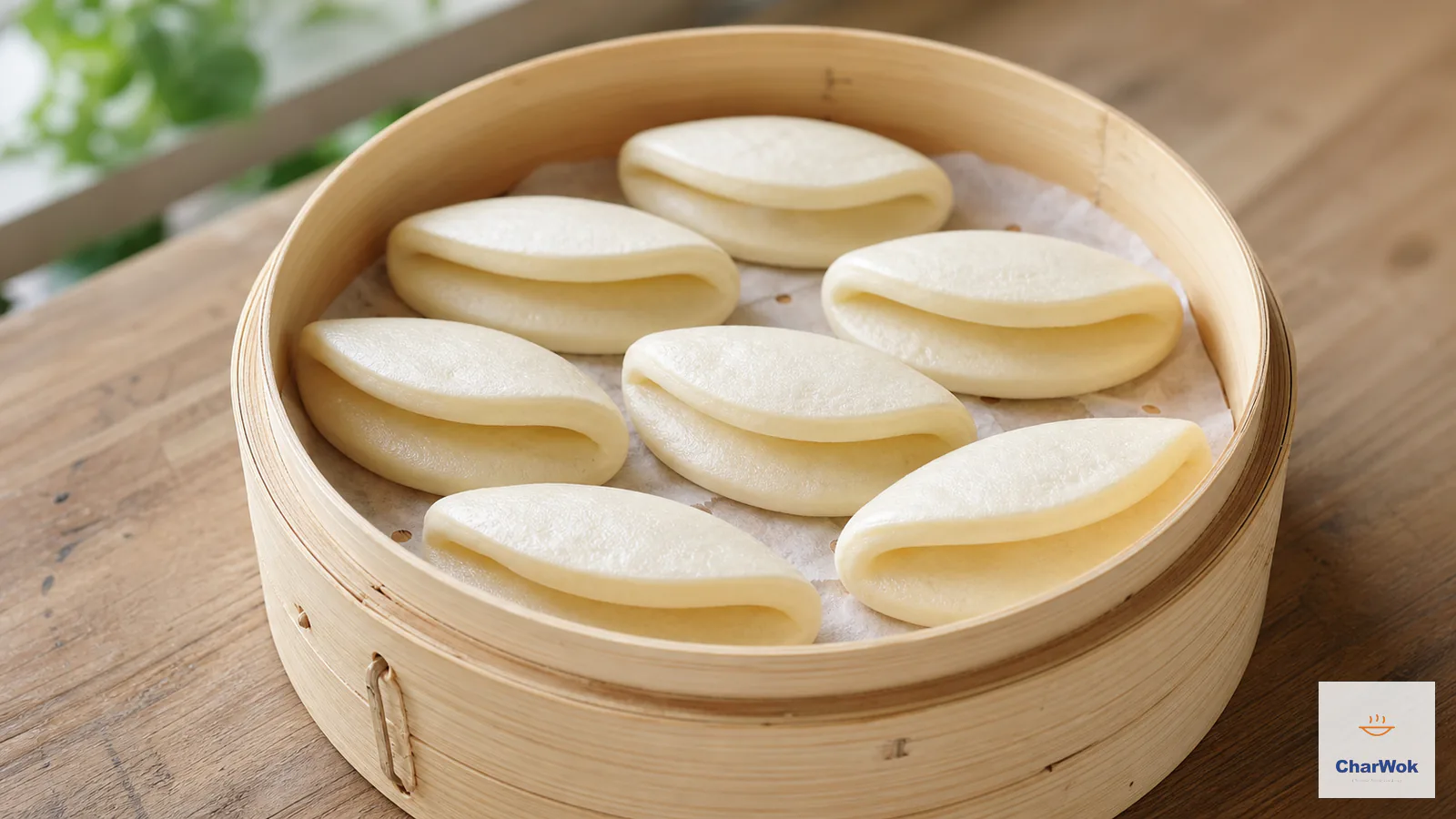
Brush on only a thin film of oil, place one parchment rectangle across the centre and fold the oval without pressing it shut.
Step 4: Rest, then steam from cold water
Arrange the folded buns in a bamboo steamer lined with parchment or brushed with oil, leaving generous gaps; they will spread and rise, and crowding welds them together. Rest them 30 minutes uncovered at room temperature. You are looking for a visible puff, maybe 50% larger, not a doubling; over-proof and the structure weakens and they wrinkle on top.
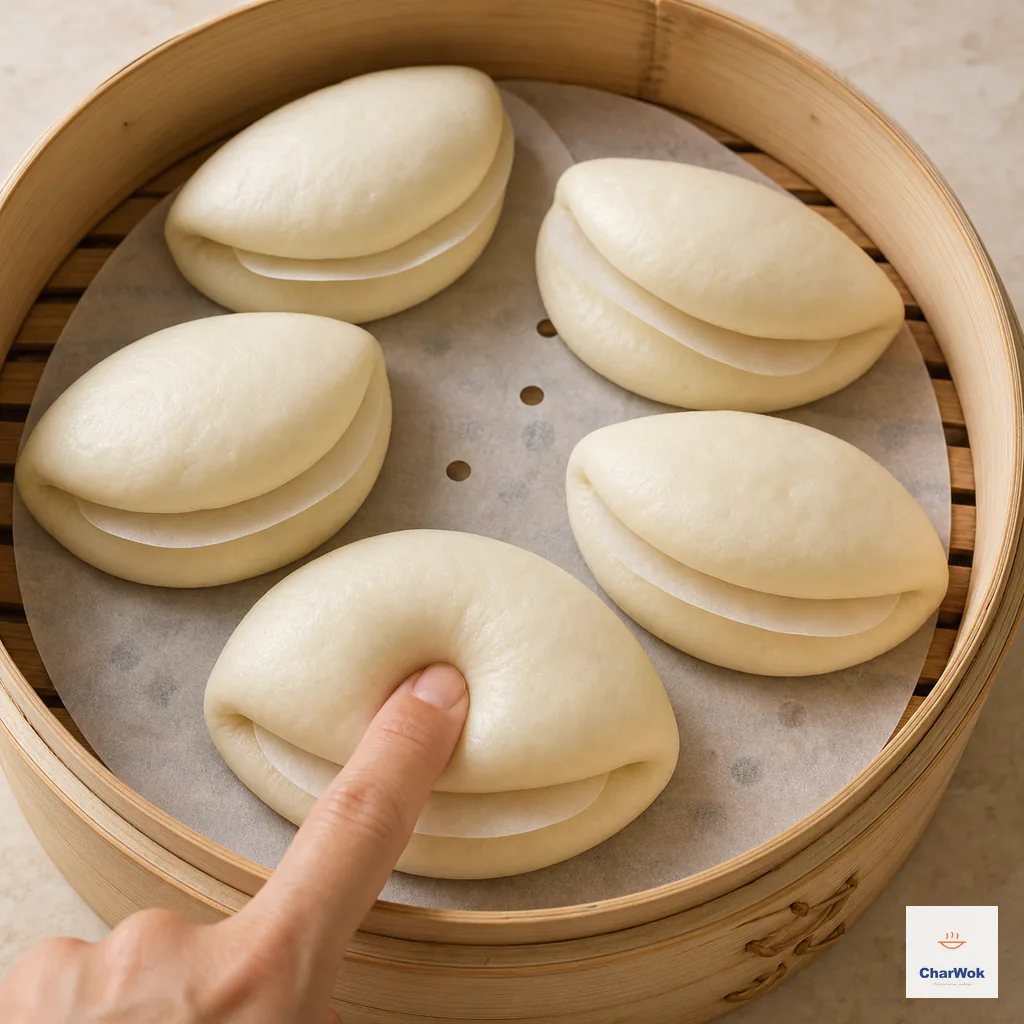
Arrange with space and rest about 30 minutes; the buns are ready when slightly puffed and a shallow dent returns slowly.
- Set the steamer over a pot or wok of cold water and turn the heat to high. Starting cold gives the dough a slow, even rise as the water warms, which is the same reason it works for flower rolls and other steamed breads. Beginning with boiling water shocks the surface and sets it before the inside expands.
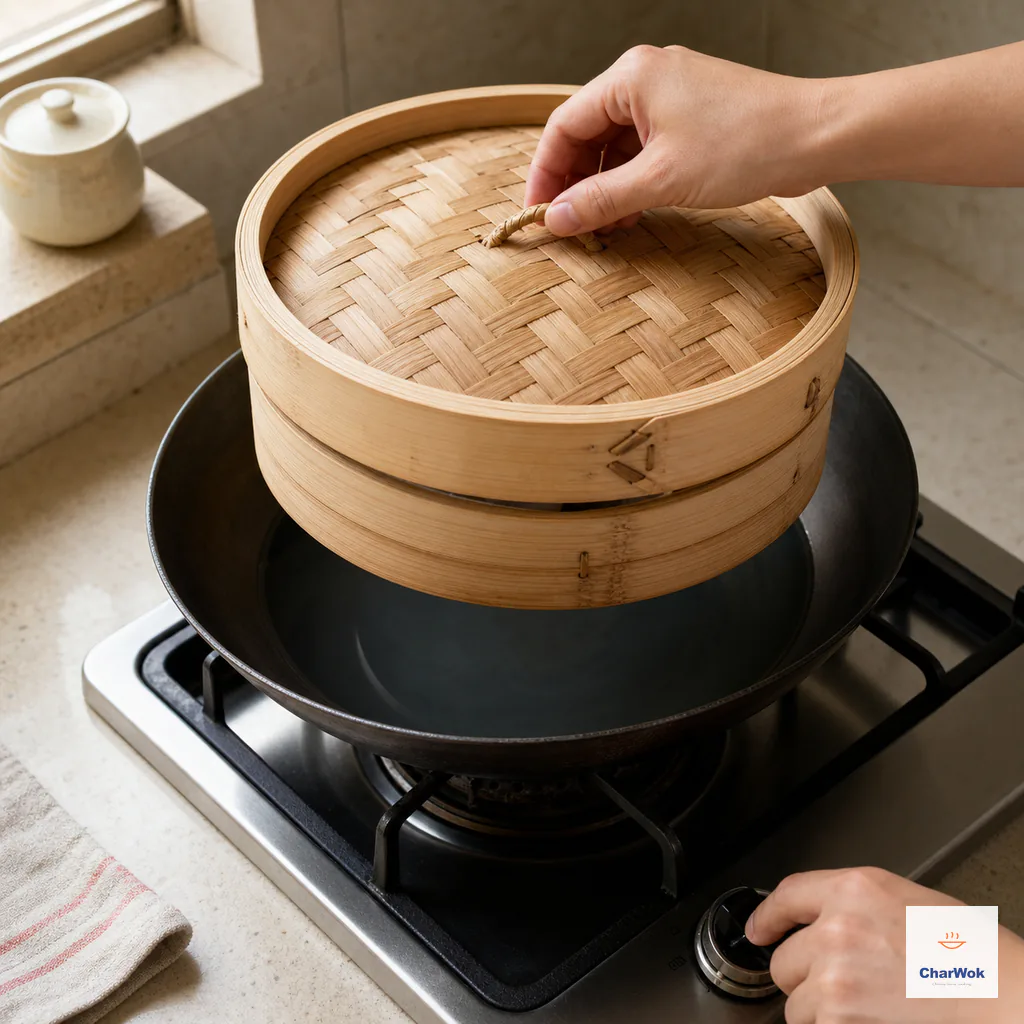
Start with cold water under the loaded steamer and keep the lid closed from the moment the heat is switched on.
- Once the water hits a full rolling boil, drop to medium-low and set a timer for 10 minutes. Resist opening the lid to check; the temperature crash collapses the buns.
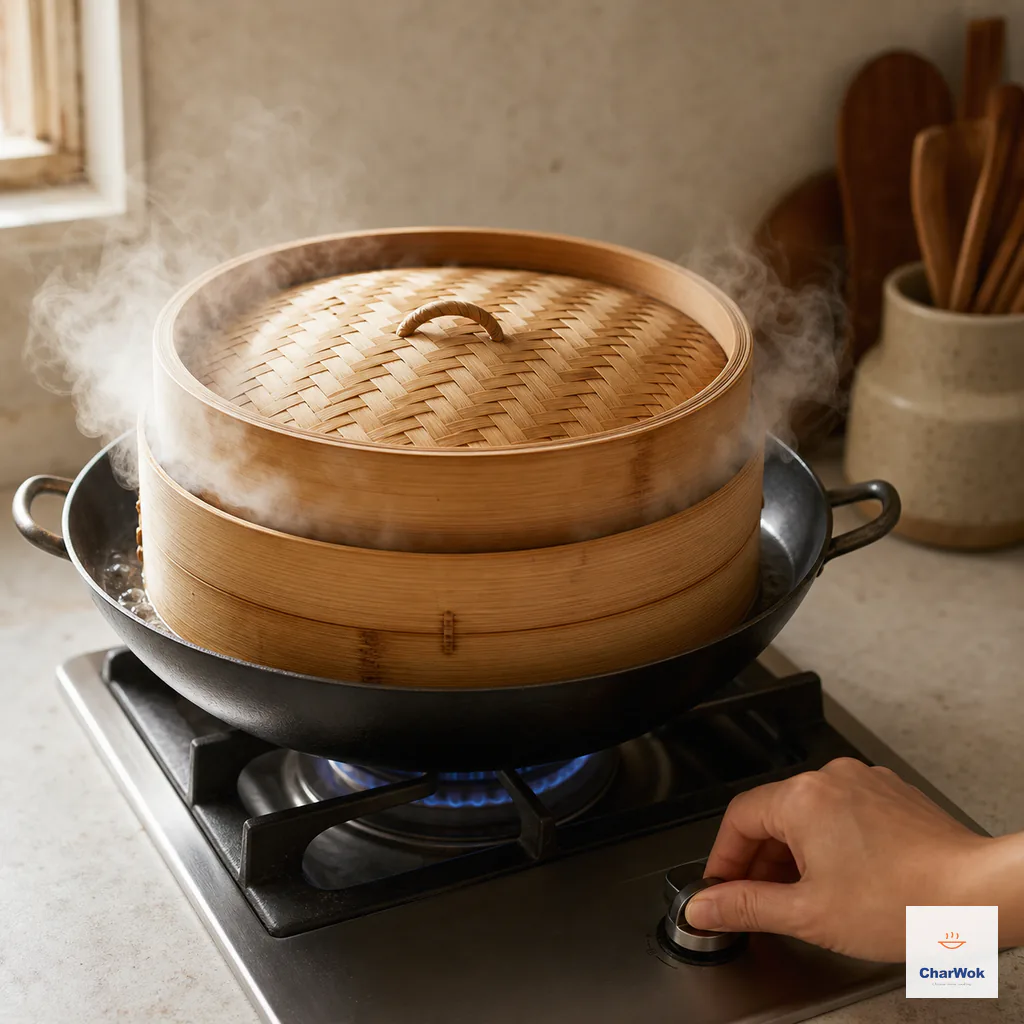
Once the water boils, reduce to medium-low and steam for 10 minutes without lifting the lid.
- After 10 minutes, turn off the heat and let the steamer sit 2 minutes with the lid cracked before you lift it fully. This gradual cool-down stops the surface from wrinkling as the steam condenses.
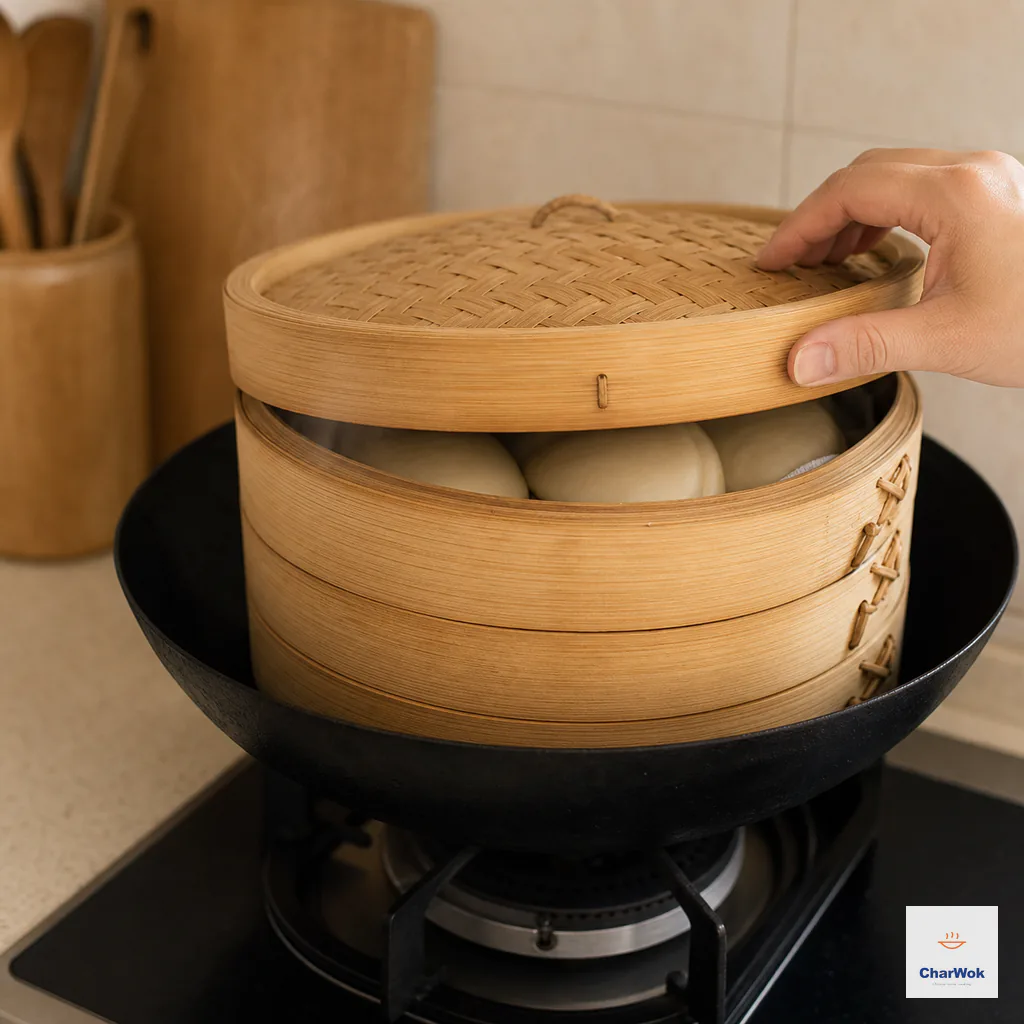
Turn off the heat and crack the lid only slightly for 2 minutes so the buns settle without a sudden temperature drop.
Step 5: Assemble
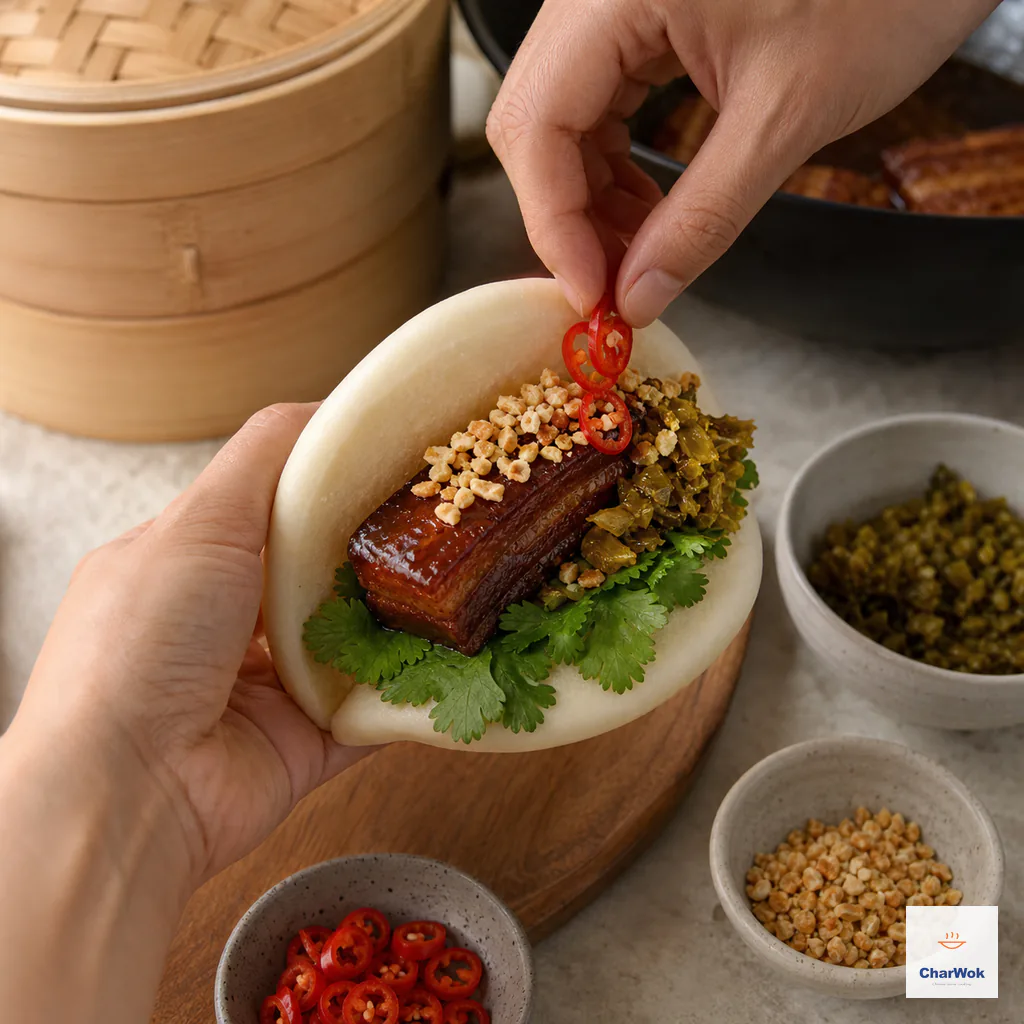
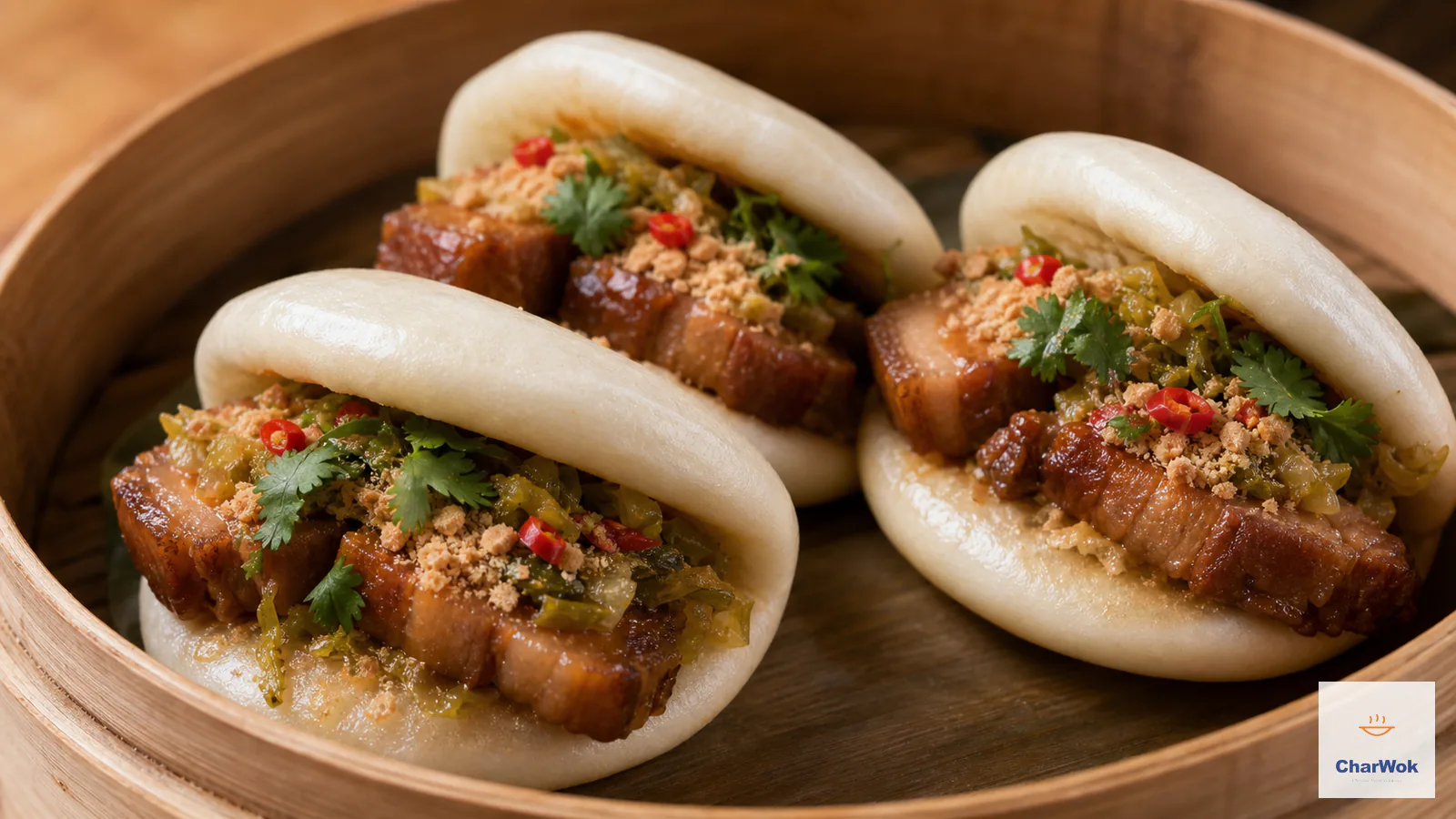
Remove the parchment and fill each warm bun with cilantro, one piece of pork, pickled greens, coarse peanuts and optional chili.
Open a warm bun. Lay down cilantro, set a slice of belly on top, then pile on the pickled greens or kimchi, crushed peanuts, and minced fresh chili if you want the heat. Eat immediately, while the bun is steam-soft and the fat is still glossy. This is hand food — assembled, not plated.
When things go wrong
This is the section that earns its keep. Most Gua Bao failures fall into a handful of recognizable faults, and each has a fix.
- Dense, heavy buns. Under-kneaded dough or skipped rest. Knead until smooth and springy, and do not skip the 10-minute autolyse. A too-warm kitchen can also over-proof and then collapse the structure; if your kitchen is hot, cut the final rest to 20 minutes.
- Buns wrinkled or shriveled on top. Sudden temperature drop. Always let the steamer cool 2 minutes with the lid cracked before fully opening, and never lift the lid mid-steam.
- Belly is chewy or rubbery. Under-braised. Collagen melts slowly; add 15-minute increments until a skewer glides through. Boiling hard rather than simmering also tightens the muscle fibers; keep it at the barest tremble.
- Sauce is thin and greasy. Too much water at the start, or no final reduction. Lift the meat out and boil the liquid down until it coats a spoon, then return the meat. Skim the surface fat first if it bothers you.
- Buns stick together or to the paper. Crowding in the steamer, or not enough oil on the fold. Give each bun at least 3 cm of space and use the parchment square.
- Folded buns won't open cleanly. The oil layer was thin or skipped. Brush generously and keep the parchment in until serving.
Variations and what to serve alongside
The filling is forgiving. Swap the belly for char siu slices for a sweeter, quicker version, or for crispy fried chicken for a night-market twist. Vegetarian? Braise cubes of pressed tofu or mushrooms in the same spice blend and load the bun with those plus extra peanuts. The pickled greens are where most cooks improvise: traditional sweetened mustard greens are ideal, but good kimchi, quick-pled cucumber, or even the kimchi you'd put in dumplings all work because the dish needs acid and crunch more than any specific pickle.
For a spread, pair the buns with a simple soup. A clear pork rib soup or a light vegetable broth balances the richness, alongside a crunchy vegetable side. If you are leaning into the street-food angle, they sit happily next to pan-fried sheng jian bao or on a dim-sum-style table; dim sum recipes and a Chinese breakfast spread both make natural company.
Storage and reheating
Both parts are natural make-aheads. Cooked buns keep in the fridge up to 4 days or frozen 2 months; re-steam refrigerated ones about 4 minutes and frozen about 6 minutes straight from cold, no thawing needed. The braised belly keeps in its liquid in the fridge 4 days or frozen 2 months, and it is honestly better the next day once the flavors settle; reheat in a pan until bubbling. Do not freeze the uncooked folded buns; the yeast dies and the texture suffers.
Frequently asked questions
Can I use a stand mixer? Yes, knead on low about 8 minutes until the dough passes the windowpane test. Hand kneading with the 10-minute rest works just as well and takes little longer.
Why cold water for steaming? A cold start warms the dough gradually, giving an even rise. Boiling water from the beginning sets the outside too fast and the buns end up smaller and tighter.
What can I use instead of pickled mustard greens? Kimchi is the easiest swap. Any tart, crunchy pickle works, because the bun needs acidity to balance the rich pork more than it needs a specific ingredient.
Can I make the dough without baking powder? You can. The buns turn out denser and chewier, closer to plain steamed bread. The baking powder only softens the crumb; it is not essential.