Ask an American home cook to name Chinese staples and you will hear rice, noodles, and dumplings long before anyone mentions bread. That order is backwards. North of the Yangtze, where the climate favors wheat over rice, bread is the daily grain and the cook's most varied craft. Steamed buns for breakfast, pan-fried flatbread with lunch, a stuffed pocket grabbed from a street cart for dinner. The home oven barely figures into it.
This is a guide to that world: what the breads are, why they are made the way they are, and how to think about them when you start cooking. I have made every type below dozens of times, and I have botched most of them at least once, so I will be direct about where things go wrong and which flour you should actually buy.
At a glance: Chinese bread is defined less by ingredients than by two cooking methods: steam and dry heat in a pan. Most doughs are just flour, water, and sometimes yeast. What separates a great mantou from a leaden one is gluten development and resting time, not a secret recipe. Master the dough, and the whole category opens up.
Why China is bread country, not just rice country
The wheat line runs roughly along the Qinling-Huaihe boundary, splitting the country into a rice-eating south and a wheat-eating north. In the north and northwest, wheat gets worked into noodles and an enormous family of breads because that is what the land grows. A household there might go through a 25 kg sack of flour in weeks, not months. My own memory of this is mundane and specific: the smell of toasted wheat when a flatbread hits a hot pan, and the dull ache of waiting for bread that was too hot to bite and too good to set down.
Once you see the regionality, the category stops feeling random. Crisp, layered Cong You Bing belongs to the north. The dense, chewy "bun" of a Rou Jia Mo from Shaanxi reflects the dry, wheat-heavy loess plateau. The fat, fragrant flatbreads of Xinjiang come from a different grain tradition entirely, the tandoor-baked flatbread of Central Asia. Even the soft, pillowy buns of Shanghai dim sum have their own logic: a tender dough that holds a soupy filling without tearing.
Steam, pan, and the flour underneath
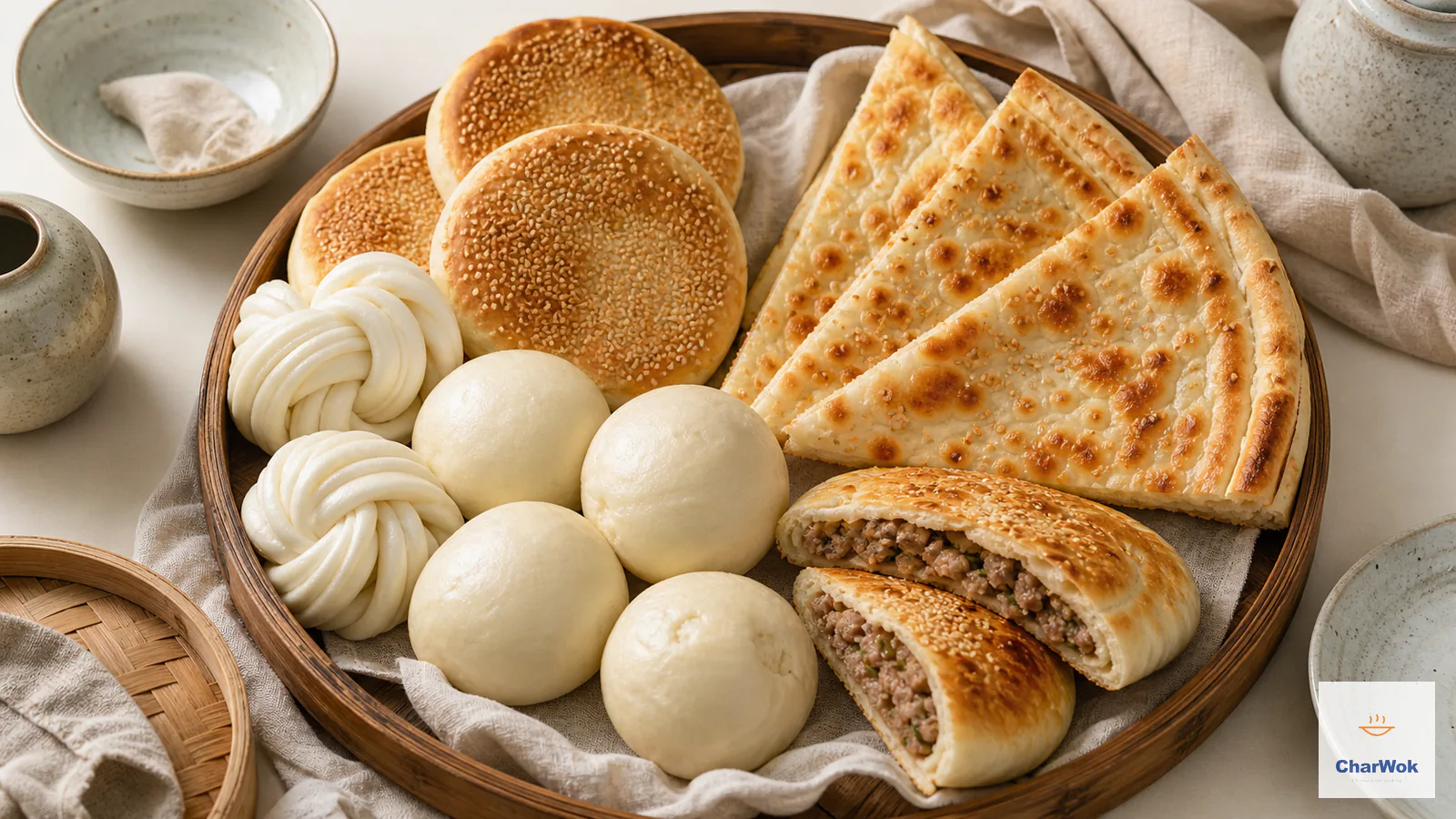
Chinese bread foundations and cooking paths at a glance
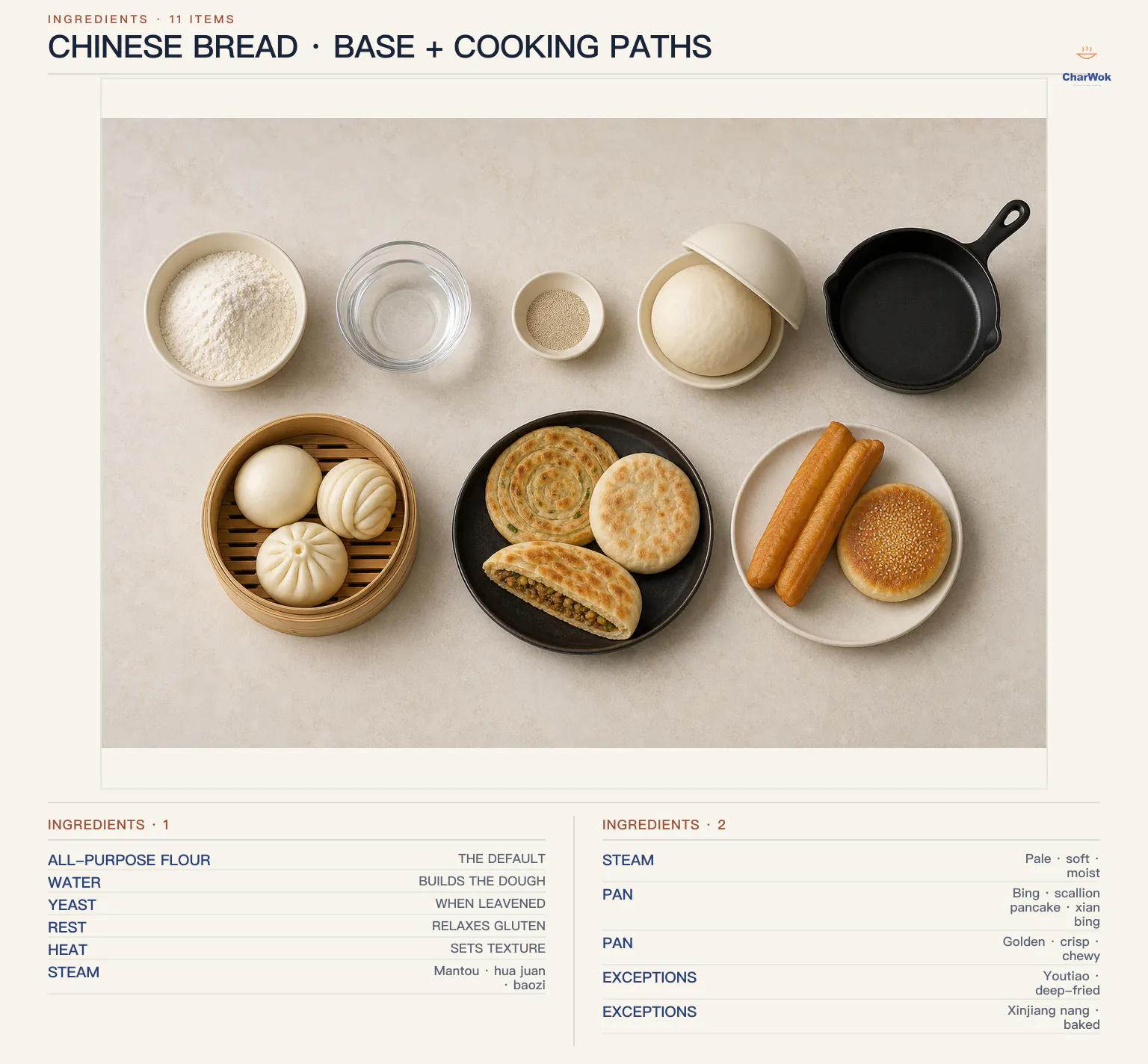
Two cooking methods cover most of the territory. The first is steaming, which cooks dough gently in moist heat so it stays pale, tender, and a little chewy. The second is dry-pan cooking in a skillet or flat griddle, which crisps the surface through Maillard browning and drives off moisture. A home oven is rarely the tool, because traditional northern kitchens were not built around one and because the two methods above already produce the textures people want.
Underneath both is the same unbleached all-purpose wheat flour you already own. You do not need a specialty product. What you do need is to understand how water, kneading, and time build gluten, and how a small amount of leavening, or none at all, changes the result. If a recipe calls for bread flour or a low-protein alternative I will say so; otherwise assume all-purpose.
The buns you steam: mantou and its cousins
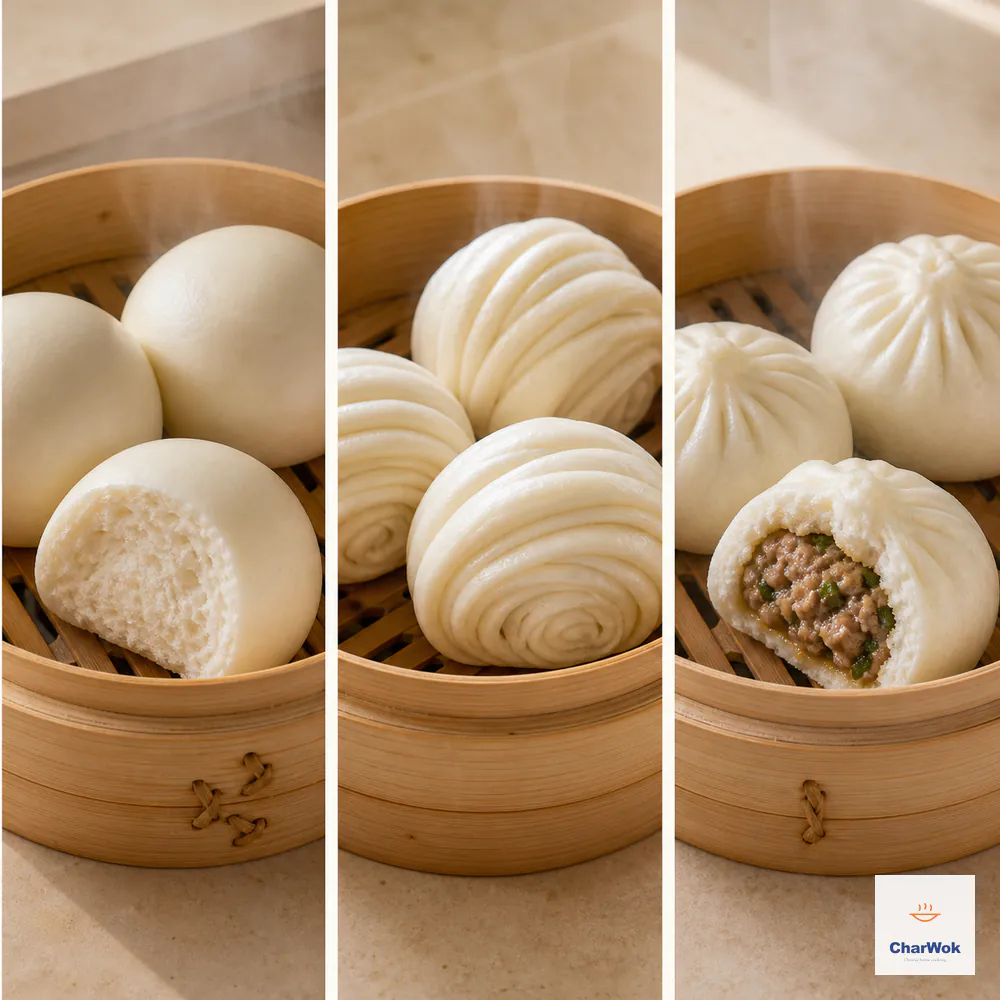
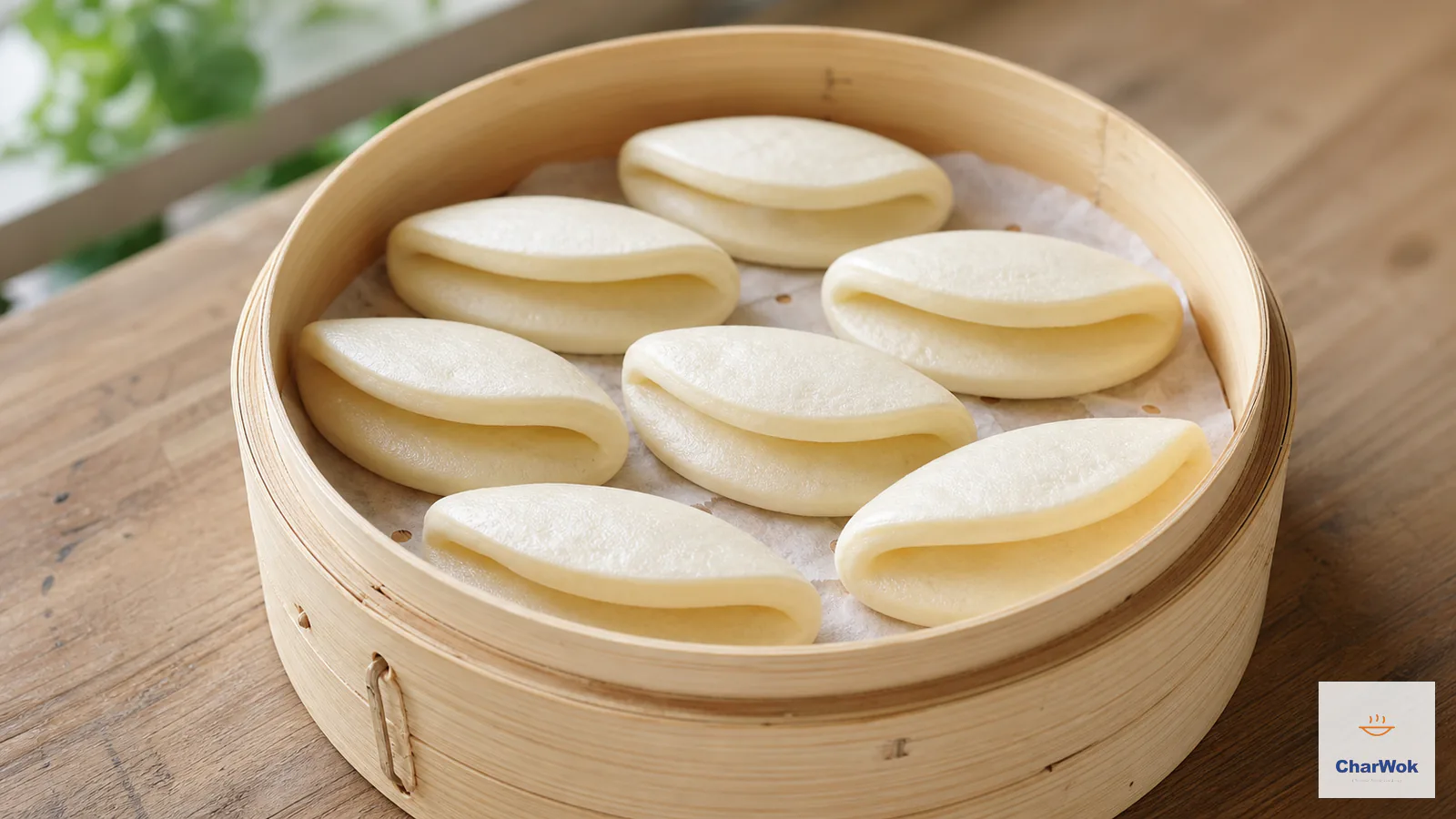
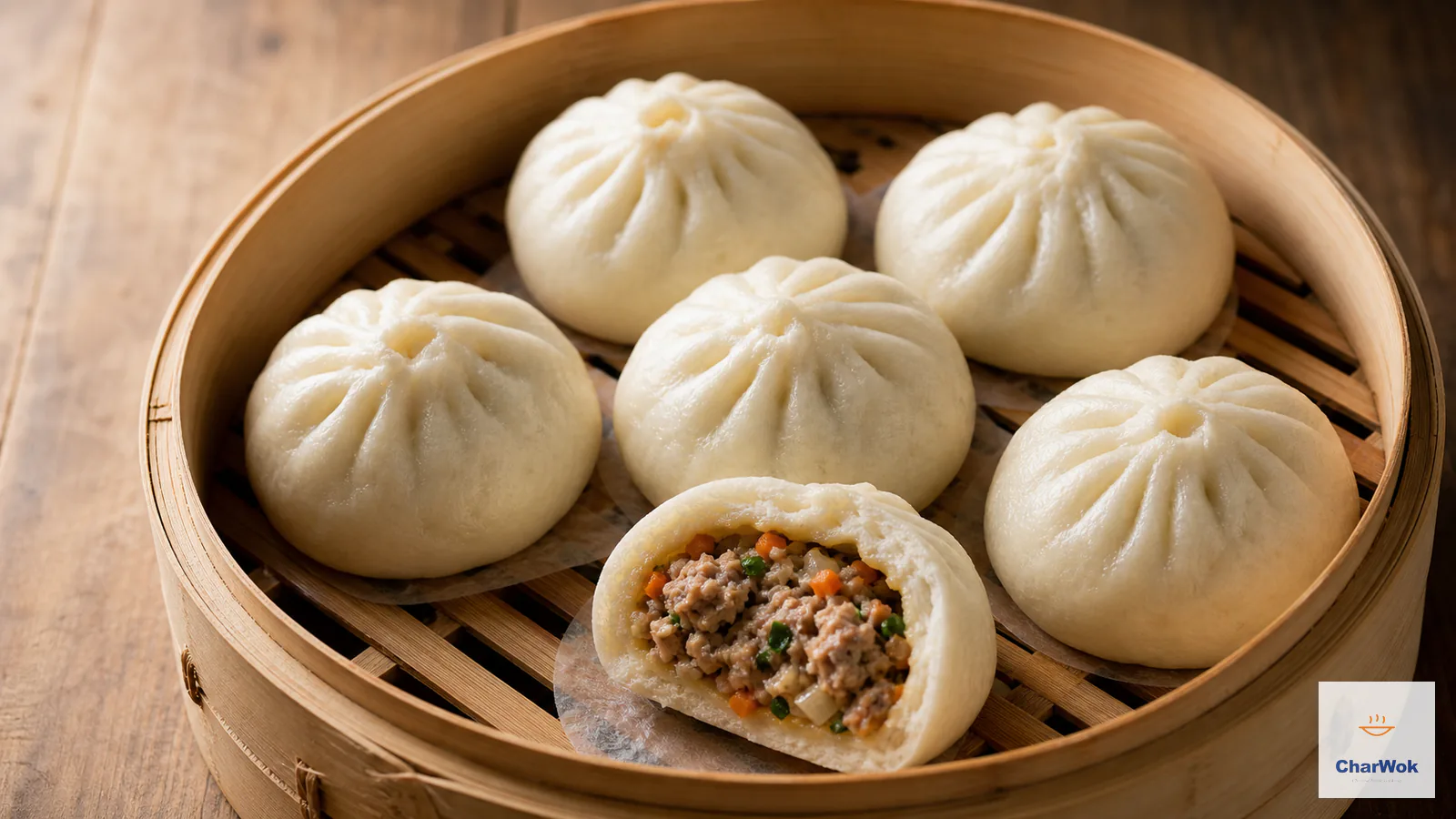
Steamed wheat dough becomes distinct families through shaping and filling: plain mantou, layered hua juan, and sealed baozi should all stay pale, moist, and fully cooked.
Mantou is the foundational steamed bun: flour, water, yeast, nothing more. Eaten plain, it is the northern equivalent of a dinner roll or a slice of bread, served across the day. A split bun with a smear of fermented bean curd and a fried egg is a real breakfast, not a gimmick. The thing that ruins home mantou is impatience, not technique: under-kneaded, under-rested dough turns dense and wrinkled instead of springy and smooth.
Once you have mantou dough, you have the base for nearly every other steamed item. Shape it into the twisted, layered flower roll (Hua Juan) brushed with scallion oil and salt, and you have bread that carries its own seasoning. Wrap the same dough around a filling and you get baozi, the stuffed steamed bun that turns up everywhere from breakfast trays to dim sum carts. Add a sweet red bean filling and it becomes Dou Sha Bao; add a barbecued pork filling and it becomes Char Siu Bao, the Cantonese dim sum classic with its own slightly sweet, open crumb.
The fold-and-pleat work on a filled bun looks fussy but has a function: a tight seal keeps steam from leaking into the filling and watering it down. If you want a softer, slightly sweeter bun with a clean flat surface, the folded bao bun (gua bao style) uses a richer, milk-and-sugar dough that is worth the extra ingredients.
The flatbreads you cook in a pan
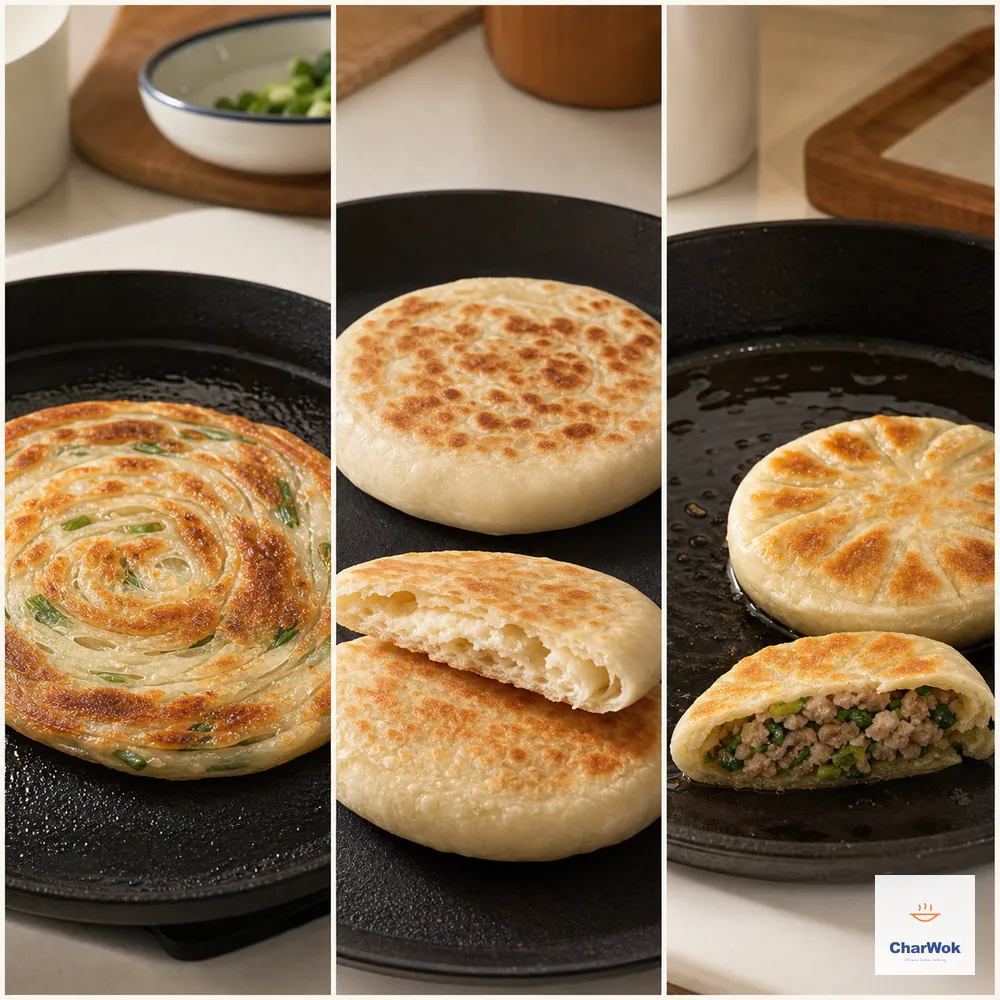
Pan breads range from flaky and lightly oiled to thick and dry-cooked or thin and stuffed; the pan controls browning while the rested dough keeps the interior tender rather than tough.
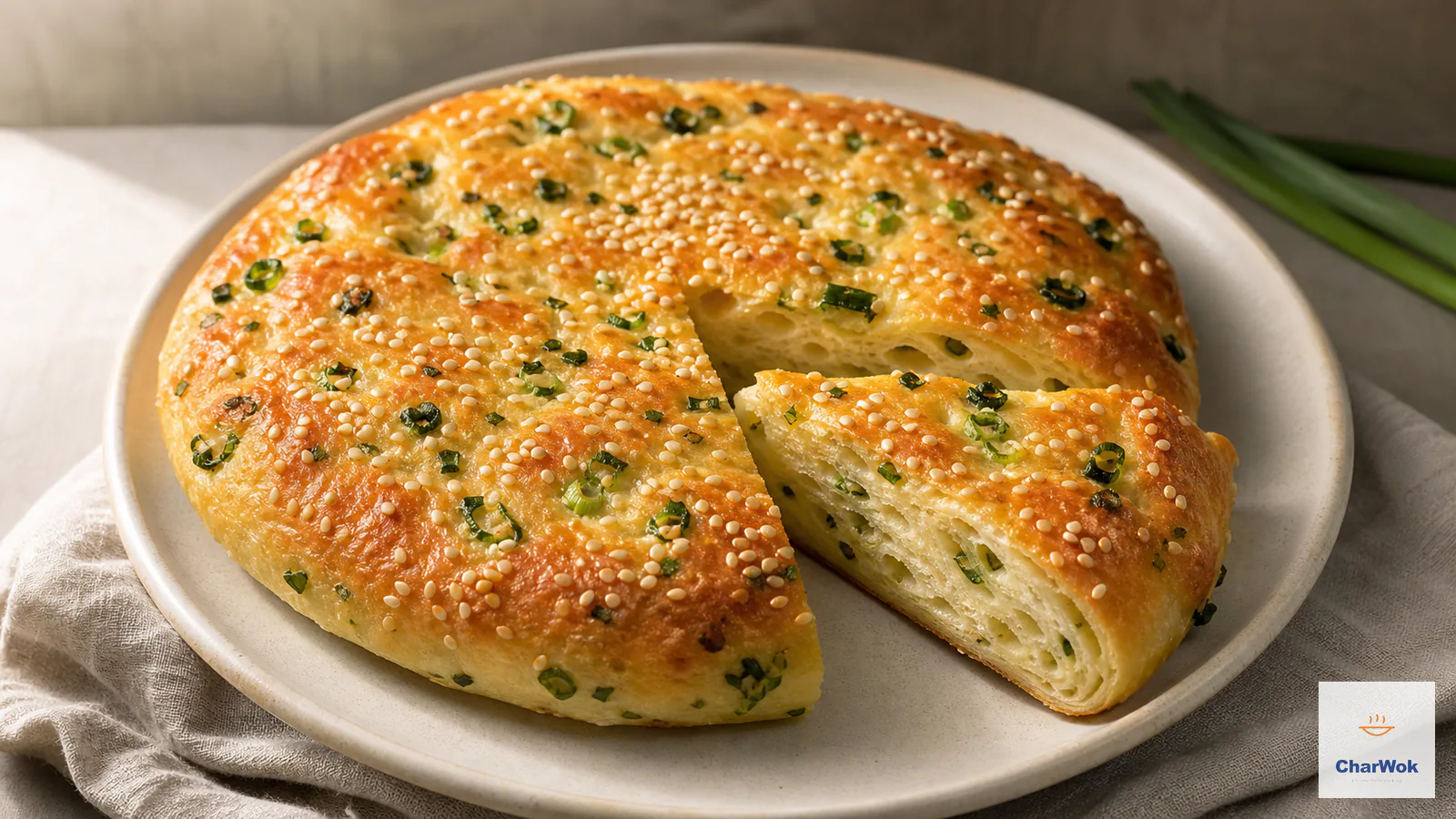
Pan-cooked breads are where Chinese wheat cooking gets rowdy. The simplest is a yeasted flatbread cooked dry in a cast-iron pan until the surface chars lightly, the kind of thing you tear and eat with a bowl of congee. A leavened scallion flatbread sits in this family: the dough rises, the scallions perfume it, and a hot pan with minimal oil gives you a blistered crust with a soft, bready interior. I cook mine in a dry-ish cast-iron skillet exactly because that faintly burnt, nutty edge is the point.
Unleavened dough takes you in a different direction. Roll it thin, brush with oil and scallions, coil it, and re-roll, and you build the layers that make Cong You Bing shatter at the edges. The same oil-layering principle, pressed into a denser disk and cooked until it cracks like a cracker, produces the crispy stuffed flatbread known as Guo Kui, which keeps for days on the road and was invented for exactly that reason.
Stuffed breads: pockets, burgers, and the meat pie
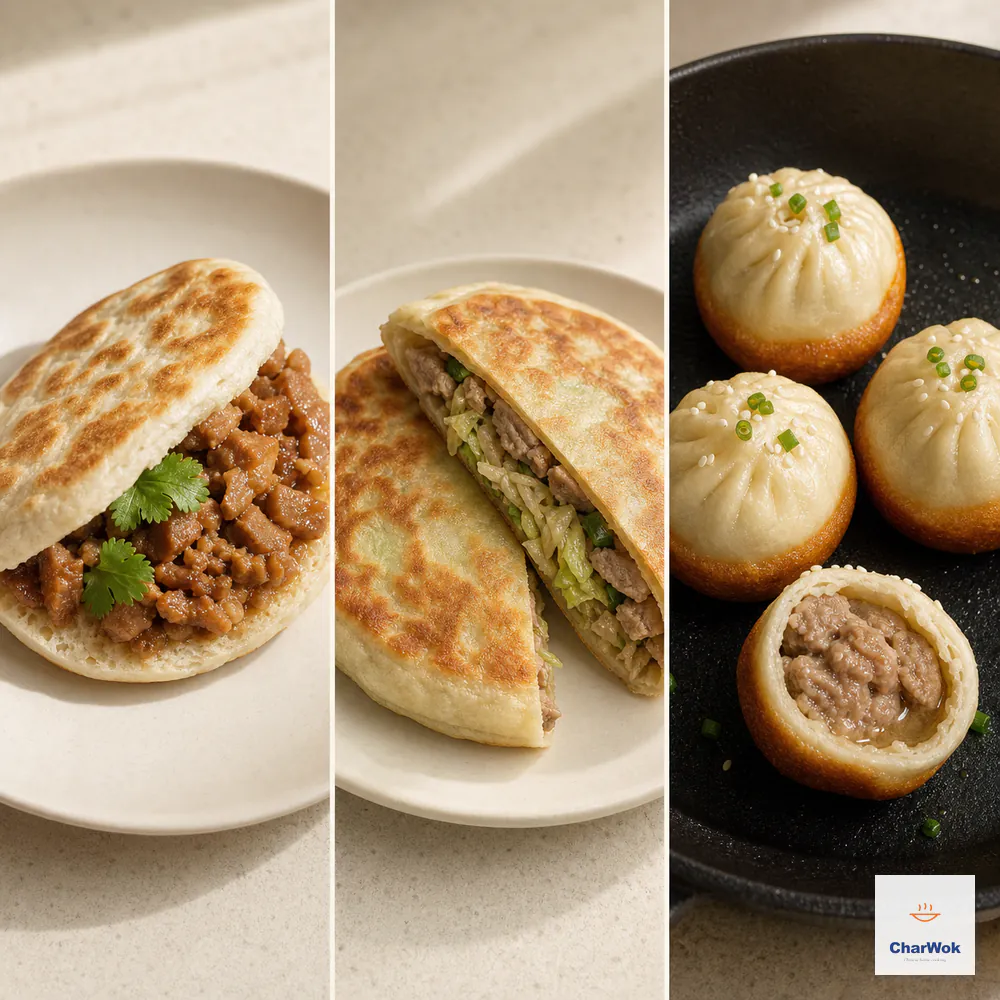
Stuffed Chinese breads can be split after cooking, sealed before pan-frying, or proofed and crisped in the pan; the shell and filling method define the final structure.
Once bread meets filling, the line between "bread" and "dumpling" blurs, but a few stuffed breads are clearly their own thing. The Rou Jia Mo uses a dense, slightly yeasted flatbread split open and crammed with chopped, spiced braised pork; the bread is meant to be sturdy enough to hold a juicy filling without collapsing. The Xian Bing meat pie seals raw filling inside dough and pan-fries it so the dough fries in its own steam and the meat cooks in its rendered fat, a technique that rewards a heavy pan and a patient, moderate flame.
The pan-fried buns of Shanghai, Sheng Jian Bao, sit halfway between a steamed bun and a meat pie: a tight lid of dough, a soupy pork filling, and a crispy bottom crisped in oil while the tops cook under a splash of water and a lid. This is one of the most demanding breads in the whole category, because the dough has to be tender enough to bite but strong enough not to leak broth onto the pan. I have ruined more of these than I care to admit by lifting the lid too early.
Breakfast breads and the street cart
The breakfast table has its own breads, most of them fried. Youtiao, the long, deep-fried, lightly salted dough stick, is engineered to dunk into hot soy milk until it softens. The dough is leavened with a combination of yeast and an alkaline lift that gives it that hollow, stretchy interior and a thin, greasy-crisp skin. It is the most common breakfast bread in the country, eaten from Harbin to Guangzhou.
Layer an egg and scallions into a thin, crepelike dough and you get Ji Dan Bing, the egg-and-scallion crepe cooked fast on a griddle. Roll a thin batter with savory fillings and you get Jian Bing, the street-cart wrap that is closer to a French crepe than to any yeast bread. None of these need an oven. A flat pan and a hot stove are the whole workshop, which is why street vendors turn them out so fast.
Thin pancakes and the duck wrapper
Some Chinese breads are not bread in the leavened sense at all but thin wheat pancakes cooked to be folded around something else. Chun Bing, the spring pancake, is steamed or pan-cooked until it is nearly translucent, then used to wrap Peking duck, sliced braised meats, or a pile of stir-fried vegetables. The goal is tenderness: the pancake must bend without cracking and disappear behind the filling it carries. If yours tears, the dough was either too dry or not rested long enough for the gluten to relax.
The Xinjiang flatbread and the oven question
The one major exception to the no-oven rule is Nang, the flatbread of Xinjiang, baked on the wall of a tandoor-style clay oven. Slapped onto the hot clay, the dough puffs, blisters, and dries into a bread low enough in moisture to keep for weeks. This is Central Asian flatbread tradition working its way into China's far west, and it is the reason you will sometimes see oven-baked scallion breads on a Chinese table. If you want a home-oven version of that crackly, layered style, an oven-baked scallion bread is a fair translation of the idea for a Western kitchen.
Where stuffed flatbreads blur into dim sum
Push the filled-bread idea toward richness and you cross into territory that dim sum claims. The baked bao bun with lamb is a Xinjiang-style filled bread baked rather than steamed, with a lamb-and-onion filling that leans on cumin. Shrimp toast is a Cantonese-British invention, a slice of bread topped with shrimp paste and deep-fried, which sits at the far edge of the bread category and shows how flexibly the word gets used.
The flour, the water, the rest
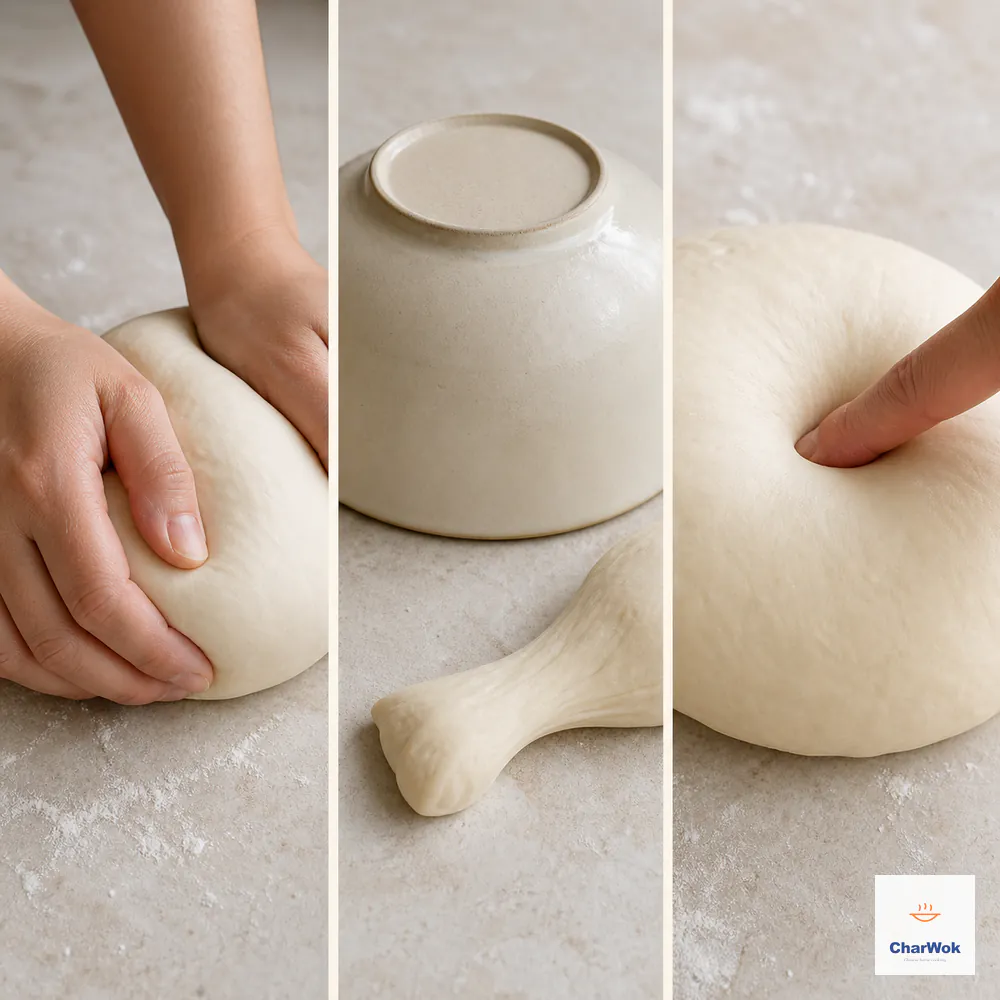
Judge dough by feel as well as time: knead until smooth, keep it covered while resting, and for leavened breads look for a press that returns slowly without the dough collapsing.
Because most Chinese breads share a dough family, the variables that matter are few, and they are worth naming once so you can apply them across the category.
| Element | What it does | The home-cook call |
|---|---|---|
| Flour | All-purpose (10-12% protein) gives enough gluten for chew without turning tough. Bread flour is overkill for most steamed breads. | Stick with unbleached all-purpose. Only reach for bread flour for youtiao or very chewy flatbreads. |
| Water ratio | More water means a softer, more open crumb; less water means a denser, sturdier bread. | Steamed buns: roughly 48-50% hydration by weight. Pan breads and wrappers: 45-48%. |
| Kneading | Aligns and develops gluten for structure and chew. | Knead until the dough is smooth and springs back when pressed, 8-10 minutes by hand. |
| Resting | Lets gluten relax so the dough rolls thin without snapping back; lets yeast work if used. | Always rest at least 20-30 minutes before shaping, even for unleavened doughs. |
| Yeast | Leavens and lightens; most northern breads use very little. | Active dry or instant, about 1% of flour weight. Skip it entirely for Cong You Bing and wrappers. |
The single biggest mistake I see in new bakers is treating the rest as optional. A dough you fight to roll thin is a dough that needed twenty more minutes under a damp cloth. The second-biggest mistake is using hot water straight from the tap, which can partially cook the flour and kill the yeast. Lukewarm, around body temperature, is right.
Equipment that actually matters
You can make nearly all of these breads with a bowl, a rolling pin, and a heavy pan. Two extras are worth owning. A bamboo steamer is the right tool for mantou, bao, and flower rolls because it diffuses steam gently and absorbs condensation so it does not drip onto the buns and pit the surface. A well-seasoned cast-iron skillet or a carbon-steel flat pan holds heat evenly for pan breads in a way thin stainless skillets cannot. If you only have a thin pan, accept that your flatbreads will brown unevenly and adjust by rotating them often.
What goes wrong, and how to fix it
I keep a short list of the failures I have earned, because they repeat and they are diagnosable.
- Dense, heavy steamed buns. Almost always under-kneaded or under-proofed dough, or dough that got hit by a draft while rising. Knead longer, proof in a warm spot, and do not rush the final rise before steaming.
- Bumpy, wrinkled bun surface. Cold dough meeting hot steam, or a steamer lid that drips. Use warm dough, bring the water to a full boil before the buns go in, and wrap the lid in a cloth to catch drips.
- Flatbread that will not roll thin and snaps back. The gluten has not relaxed. Cover and rest another 15-20 minutes. Do not force it; you will tear the layers.
- Soggy Cong You Bing. Too much oil, or the scallions were wet when folded in. Pat scallions dry and use less oil than feels right; you can always add more.
- Steamed buns that collapse after cooking. The lid was lifted too fast and the temperature dropped. Leave the lid on with the heat off for 2-3 minutes at the end so the buns ease down to room pressure.
- Stuffed buns leaking filling. The seal was loose, or the filling was too wet. Drain wet fillings, and pleat tightly with no gap at the top.
How a table is built around bread
In a northern meal, bread does not sit at the center; it sits beside the savory dishes as the grain that rounds out the plate. A typical arrangement is plain mantou or flatbread with two or three vegetable and meat dishes and a bowl of congee or soup. The bread soaks up sauce, balances salt, and gives the meal body without competing with the main dishes. The lightest pairing is mantou with a simple stir-fry and a clear soup; the heaviest is a stuffed bread like Rou Jia Mo eaten on its own with nothing but a cup of tea. If you want to see the full spread of what a bread-and-dishes table looks like, the classic fare of Xi'an is a good reference, since the city's wheat tradition runs deeper than almost anywhere.
Where to start
If you have never made a Chinese bread, start with plain mantou. It is the simplest dough in the category, it teaches you kneading and proofing, and a successful batch is genuinely thrilling. From there, flower rolls are one small step, filled bao another, and the flatbreads a parallel track that rewards a hot pan. The one honest limit: some breads, like youtiao and the most delicate Xiao Long Bao wrappers, take real practice and a few failed batches before they click. That is not a reason to avoid them. It is a reason to start with the forgiving ones and earn your way up.
Keeping and reheating
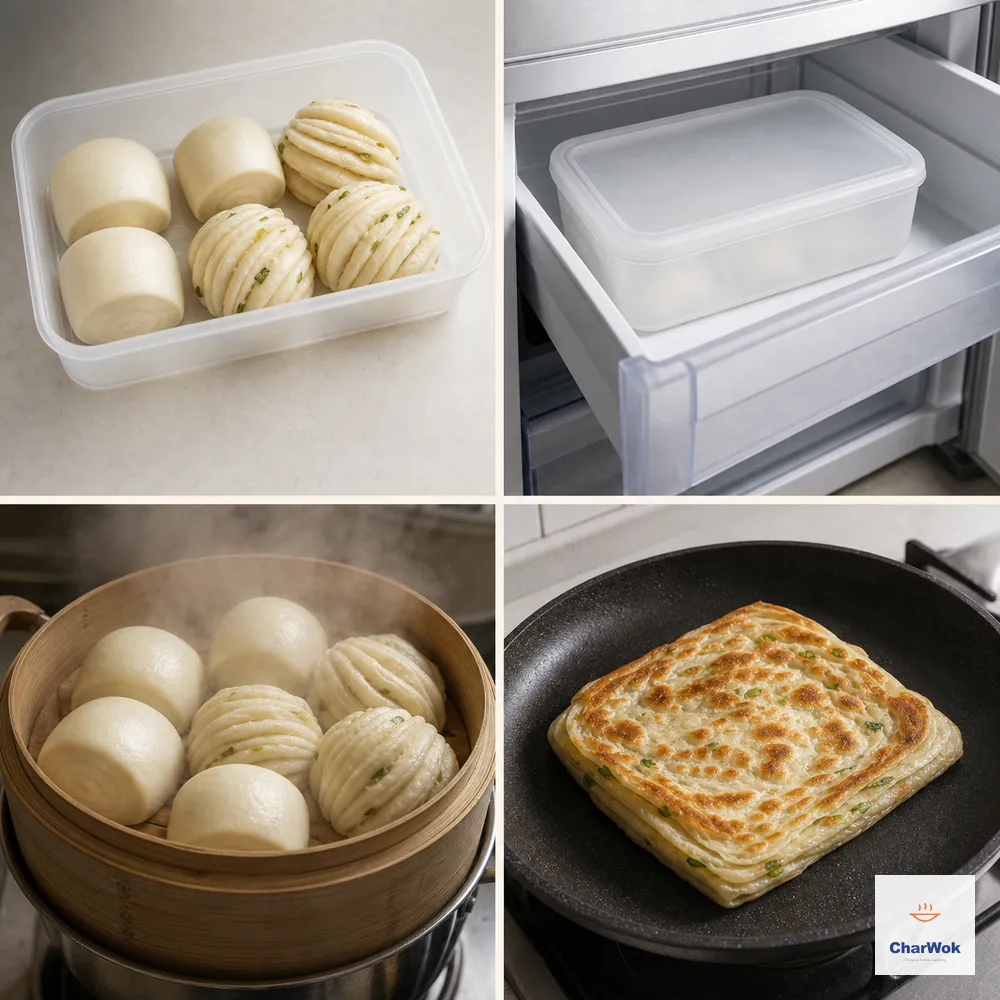
Cool steamed breads before freezing, re-steam them from frozen for moisture, and bring pan breads back in a dry skillet so the exterior turns crisp again.
Steamed breads keep well and reheat badly if you let them dry out. Cool them fully, then store in a sealed bag in the refrigerator for up to three days or the freezer for a month. Reheat by steaming for a few minutes until soft and hot through. A microwave will turn a mantou into a rubbery puck as it cools; if you must use one, wrap the bun in a damp paper towel and eat it immediately. Pan breads reheat best back in a dry pan for a minute per side, which revives the crispness the oven or microwave destroys.
For more dishes that round out a bread-led meal, browse the full Chinese breakfast collection, where most of these breads first appear in the day.
Frequently asked questions
Is Chinese bread the same as Western bread? No. Chinese bread is rarely oven-baked and rarely uses butter, milk, or sugar in the base dough. It leans on steam and pan cooking, and the texture runs from soft and chewy (steamed) to crisp and layered (pan-fried), rather than crusty and open like a Western loaf.
Do I need a special flour? No. Plain unbleached all-purpose flour handles most Chinese breads. Reach for bread flour only when you want extra chew, like in youtiao. Specialty low-protein flours help with translucent wrappers but are not needed for buns and flatbreads.
Can I skip the resting time? Not if you want good results. Resting relaxes the gluten so dough rolls thin and shapes evenly, and for yeasted doughs it gives the leavening time to work. Cutting it short is the most common reason homemade Chinese bread turns out dense.
What should I make first? Plain mantou. It uses the fewest ingredients, teaches the core skills of kneading and proofing, and reheats easily so nothing is wasted while you practice.
Are these breads vegetarian? Plain mantou, flower rolls, Cong You Bing, and most flatbreads are vegetarian or vegan as long as the fat used is oil. Stuffed breads depend on the filling; meat-free versions exist for nearly every shape.