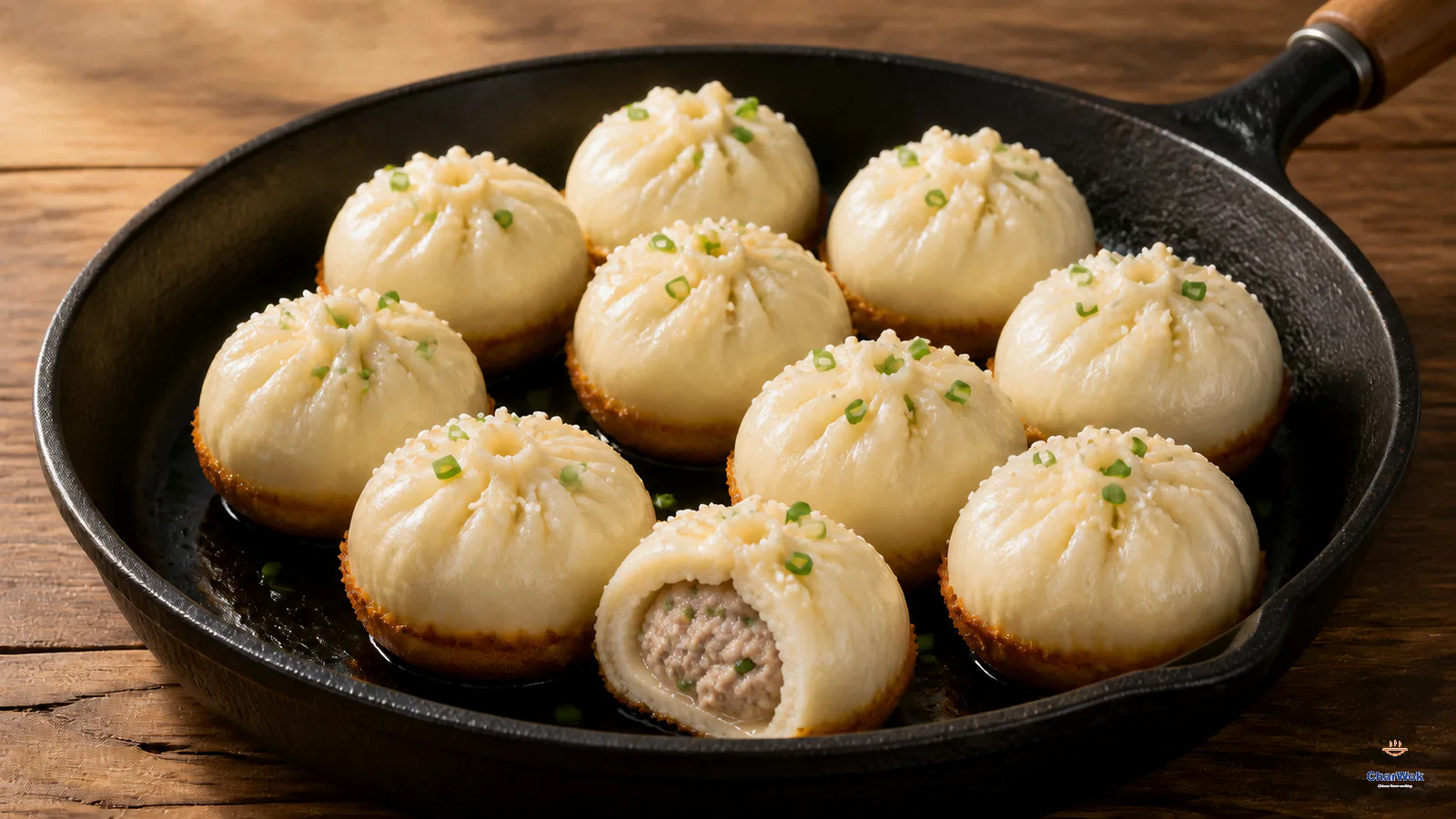
A good Sheng Jian Bao is two buns in one. The bottom is a deep amber disc, shatteringly crisp, almost like a savory cookie. The top stays soft and pale, a yeasty pillow. Crack the crust and a rush of pork broth floods out, hot enough to scald the roof of your mouth if you bite in too eagerly — which, of course, you will.
That broth is the whole point. These Shanghai pan-fried pork buns, a street breakfast that vendors sell straight from cast-iron pans, hide a savory liquid inside the wrapper, just like their steamed soup-dumpling cousins. People get the dish wrong at home for one of two reasons: the bottom never crisps because the pan wasn't hot enough, or the crust burns while the dough stays raw in the middle. Both are fixable, and the fixes come down to a single idea, which is that you are steaming the buns in their own crust.
At a glance: Yeasted dough, pan-fried in oil, then drowned in water and lidded so the tops steam while the bottoms fry. The ratio that matters is the water: about 240 ml (1 cup) to a single layer of 20 buns, and the pan needs 8–10 minutes covered before the liquid is gone. Undercook the steam and the dough is gummy; overcook and the broth boils away dry.
What these buns are, and where they come from
Sheng Jian Bao (生煎包, literally "raw-fried buns") is a Shanghai specialty, younger than most people assume. The style emerged in the early 1900s at teahouses in the old city, sold as a cheap, filling breakfast. Two schools grew up around it. The "clear water" style (Qing Shui) keeps the filling plain, the dough slightly sweet, and lets pork and scallion do the talking. The "thick skin" Shanghai-style shops add more filling and a heavier hand with seasonings. I lean toward the restrained Qing Shui version at home because the broth stays clean and the crust gets more attention.
They sit squarely in the Chinese bao family alongside steamed baozi, char siu bao, and the soft mantou rolls. What sets them apart is the cooking method: raw buns go into a hot oiled pan, fry on the bottom, then get steamed. It is the same instinct behind a Chinese breakfast table that pairs fried and steamed textures side by side, and contrast is the goal.
The ingredients, with the choices that matter
Use all-purpose flour for the dough. Bread flour makes the wrappers too chewy and they will not seal cleanly; cake flour and they tear. The dough here is a fairly lean yeasted dough, closer to a soft bread than a dumpling skin, so a moderate protein level (around 10–11%) is exactly right.
For the pork, ask for a grind that is roughly 70 to 80 percent lean. Too lean and the filling turns out dry; too fatty and the broth greases your lips in an unpleasant way. If your butcher only has very lean ground pork, grate in a little extra fat or add a tablespoon of neutral oil to the filling to compensate.
Filling components and why each one is there
Pan-fried pork bun ingredients at a glance
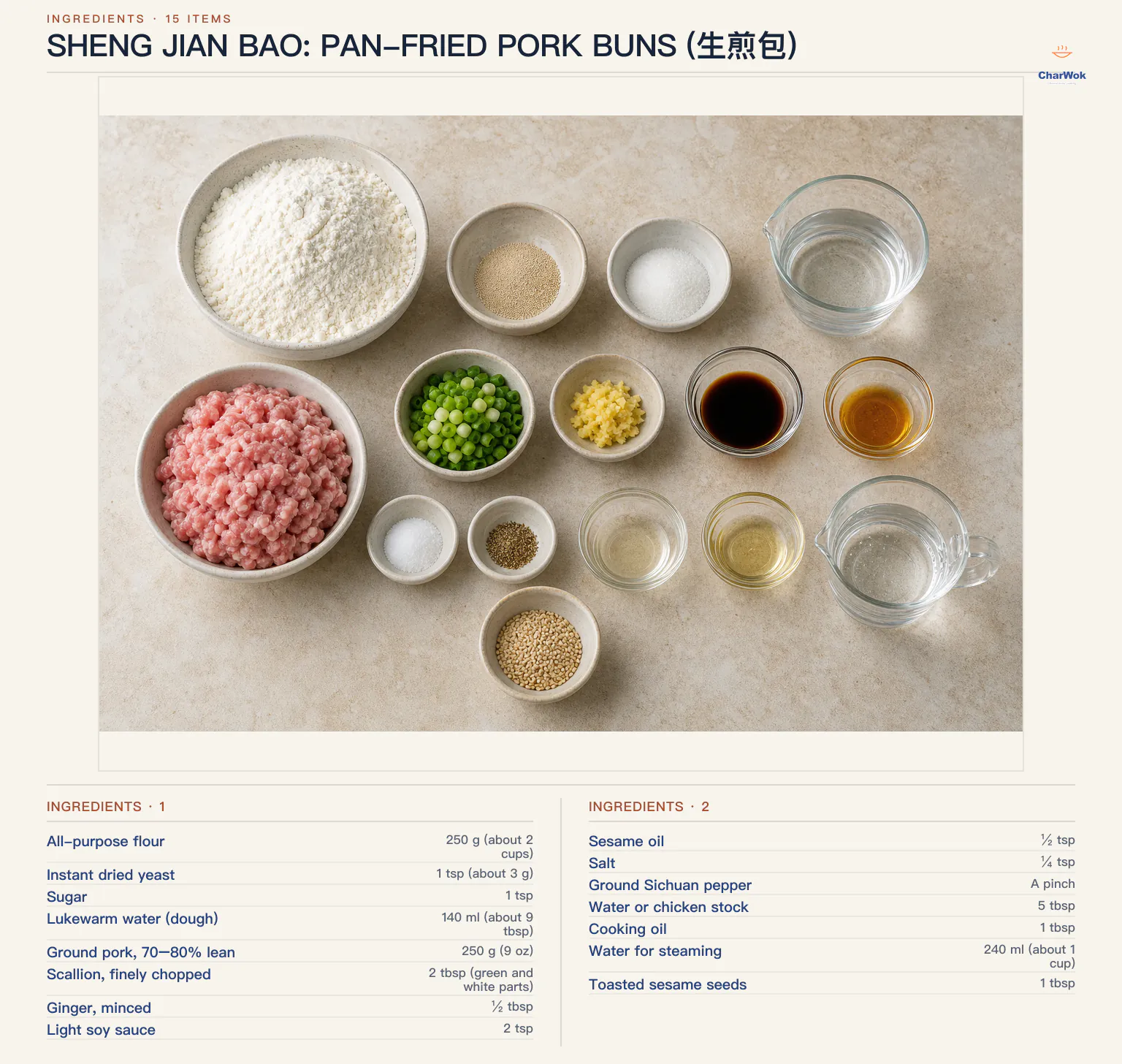
| Ingredient | Amount | Notes / substitute |
|---|---|---|
| All-purpose flour | 250 g (about 2 cups) | 10–11% protein. Do not swap for bread or cake flour. |
| Instant dried yeast | 1 tsp (about 3 g) | Active dry works if dissolved in the lukewarm water first with a 5-min proof. |
| Sugar | 1 tsp | Feeds the yeast and rounds out the dough. |
| Lukewarm water (dough) | 140 ml (about 9 tbsp) | Body temperature: pleasant on the wrist, not hot. |
| Ground pork, 70–80% lean | 250 g (9 oz) | Higher fat = juicier broth. See note above. |
| Scallion, finely chopped | 2 tbsp (green and white parts) | Reserve a little extra raw for the top. |
| Ginger, minced | ½ tbsp | Fresh only; powder tastes flat here. |
| Light soy sauce | 2 tsp | See the light vs. dark soy sauce guide; do not use dark. |
| Sesame oil | ½ tsp | Toasted sesame oil. A little goes far. |
| Salt | ¼ tsp | Adjusts with how salty your soy sauce is. |
| Ground Sichuan pepper | A pinch | Or a pinch of five-spice. Read the Sichuan pepper notes to grind your own. |
| Water or chicken stock | 5 tbsp | The broth that becomes soup inside the bun. Stock is better. |
| Cooking oil | 1 tbsp | Neutral oil for the pan. |
| Water for steaming | 240 ml (about 1 cup) | Hot from the kettle so the pan does not lose heat. |
| Toasted sesame seeds | 1 tbsp | For the top. |
How the filling becomes soup
The broth inside a Sheng Jian Bao does not come from pork rind jelly or gelatin, the way it does in some soup dumpling traditions. It comes from beating water into the raw pork. This is the same principle behind a well-made dumpling filling or a pork and napa cabbage dumpling: you stir the meat in one direction while you trickle in liquid, and the proteins unravel and bind the water so it does not leak out during wrapping. Heat the meat later and that bound water releases as soup.
Two rules make this work. Stir in one direction only, the whole time. Reversing breaks the protein network you are trying to build. And add the liquid a spoonful at a time, waiting for each addition to be absorbed before the next. The mixture should look glossy and slightly sticky, almost like a soft paste, never soupy. If it goes too far and weeps, you have either added too much or stirred too little; fold in a teaspoon of extra pork to rescue it.
Making the dough, and why you must let it rest twice
Mix the flour, yeast, and sugar in a bowl. Pour in the lukewarm water in a thin stream, stirring with chopsticks or a fork until shaggy clumps form, then turn it out and knead. You are after a smooth, springy ball, about 6 to 8 minutes by hand. The dough is a little stiff on purpose; if it feels slack you added too much water and the wrappers will be hard to fold. Cover with a damp towel and let it rise in a warm spot until doubled, 40 minutes in a warm kitchen, up to 90 minutes in a cool one.
This first rise builds flavor and stretches the gluten so the wrappers roll thin without tearing. The second rest, after shaping, is the one people skip and should not. Once the buns are folded, a 15-minute rest lets the gluten relax so the dough does not snap back and split open in the hot pan. Skip it and you will see raw seams pop along the bottom where the crust needs to be intact.
Shaping, in plain steps
Punch the dough down and knead it briefly on a floured counter to push the air out. Divide into 20 equal pieces (a kitchen scale helps; each piece is about 18 g). Roll each into a ball, then flatten and roll into a disk roughly 8 cm (3 inches) across, with thinner edges and a slightly thicker center. The thicker center holds the weight of the filling; the thin edges fold without becoming a doughy lump at the top.
Cup a wrapper in your palm, spoon about a tablespoon of filling into the middle, and pleat the edge with your thumb and index finger, working around in one direction, until the bun is sealed. Give the top a gentle twist to lock it. Stand the buns sealed-side up on a lightly oiled plate, cover loosely, and rest 15 minutes before frying.
The fry: where most attempts go wrong
Use a heavy skillet. Cast iron is ideal because it holds heat when you add the water. A thin pan drops in temperature the moment the liquid hits it, and the crust never recovers. From here the fry runs in five moves.
- Heat and arrange. Warm the pan with the tablespoon of oil over medium-high until the oil shimmers. Set the buns in a single layer with a little space between them; they will expand, and a crowded pan means the crusts steam each other soft.
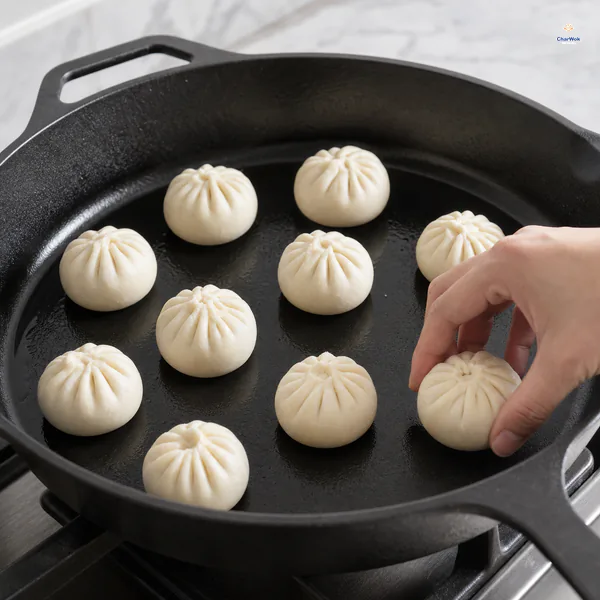
Coat the pan with one tablespoon of neutral oil and arrange the rested buns pleat-side up with room to expand; cook in batches rather than crowding the pan.
- Brown the bottoms by color. Let them fry undisturbed until the bottoms are a deep golden brown, about 2 minutes. This is the only browning the buns will ever get, so judge by color, not the clock. Pale now means a pale crust at the end.
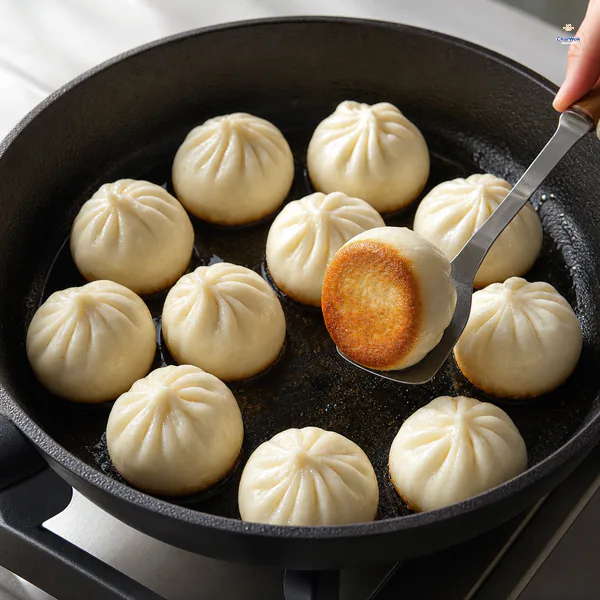
Cook uncovered for about two minutes, then lift one bun to check: add water only after the underside has formed a thin, even deep-golden crust.
- Deglaze with hot water and lid it. Pour in the hot water; it will hiss violently, and that is the correct reaction. The water must be hot from the kettle so the pan temperature does not crash. Clamp on a tight lid and drop the heat to medium.
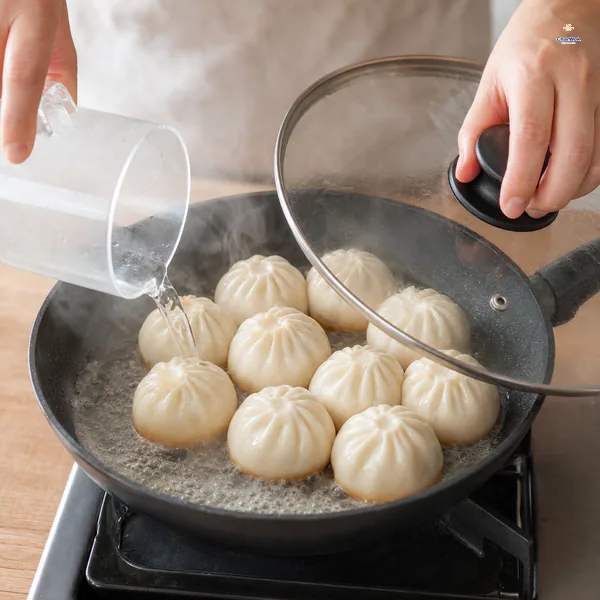
Pour 240 milliliters of hot water around, not over, the buns and cover immediately to trap the steam.
- Steam until the water is gone. Wait 8 to 10 minutes and listen to the pan. While water remains you hear lively bubbling; as it disappears the sound shifts to a faint sizzle and then near silence. Lift the lid only when that sizzle sharpens.
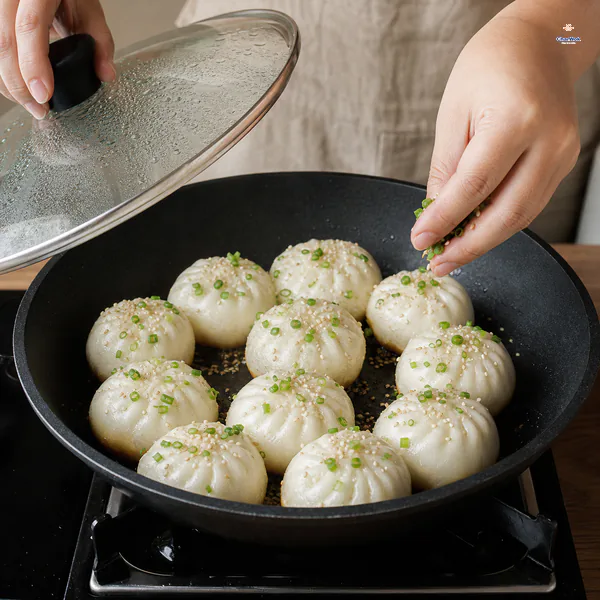
Steam for 8 to 10 minutes until the water is gone, uncover, and sprinkle with white toasted sesame and scallion only after no liquid remains in the pan.
- Finish and serve. Sprinkle sesame seeds and the reserved scallion over the top and cook another 30 seconds uncovered to re-crisp the crust. Slide them out with a spatula, bottoms up, so the crust does not steam soft on the plate.
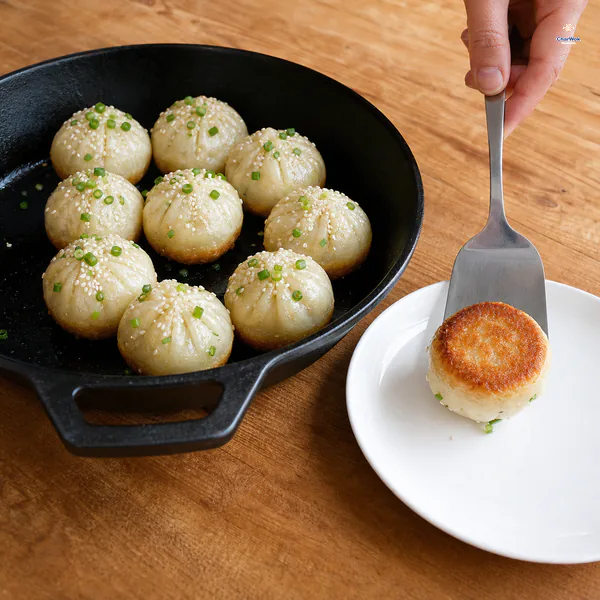
Cook uncovered for another 30 seconds to re-crisp the bottoms, then plate the buns bottom-side up so trapped steam cannot soften the crust.
When things go wrong, here is the fix
The bottom is pale or soggy
The pan was not hot enough when the buns went in, or you added the water before the crust browned. Next time, brown by color, not the clock. To rescue a finished pale batch, pour off any remaining water, add a teaspoon of oil, and crisp the bottoms for another minute over medium-high heat.
The dough is raw and gummy inside
The steam ran out before the dough cooked through, usually because the lid was loose or you lifted it too often. Keep the lid on until the water is gone, and use hot water from the kettle so the pan temperature does not crash. If the water evaporates early, add a couple more tablespoons and cover again for 2 minutes.
The buns split open during cooking
Either the seal was weak or you skipped the post-shaping rest and the gluten snapped back under heat. Pleat firmly and twist the top to lock it, and always rest the shaped buns 15 minutes. A thick, doughy seam at the top also splits more easily, so roll the wrapper edges genuinely thin.
The crust burned but the top is still pale
Heat too high. Drop to medium the moment the water goes in. The steam does the work of cooking the top; high heat just scorches the bottom and drives the water off before the dough sets.
The filling is dry, no broth
The meat was too lean, or you did not beat enough water in. Go back to the one-direction stir and add the stock a spoonful at a time until the filling is glossy. A pinch of sugar in the filling also helps it hold moisture.
Variations and what to serve them with
The classic filling is pork and scallion, but the dough tolerates anything. Fold in a tablespoon of Chinese sesame paste for a nutty Shanghai-style filling, or swap the pork for a chicken-and-mushroom mixture. A spoonful of finely chopped cooked napa cabbage, squeezed bone-dry, stretches the filling and adds sweetness without watering it down.
Dip them in black rice vinegar with a few slivers of fresh ginger, or reach for one of the dumpling sauces if you want something spicier. A drizzle of sesame oil over the vinegar is traditional and worth it. For a fuller meal, serve the buns alongside a simple soup, like a clear egg drop or a mild broth, and a quick stir-fried green. They are naturals for a gathering; more pork recipes on the site give you a full spread if you want to build a table around them.
Storage and reheating
Cooked buns keep in the fridge for 2 days and freeze well for a month. The trick to reheating is recreating the fry-then-steam, not microwaving, which turns the crust to rubber. From the fridge, put the buns in a cold dry pan, add a tablespoon of water, cover, and heat over medium until the water sizzles away, then uncover and crisp 1 minute. From frozen, do the same but add 2 tablespoons of water and a few extra minutes covered.
Questions I get asked
A few things come up often, so here they are directly.
Can I make the dough the night before? Yes. Let it rise at room temperature until just puffy, about 30 minutes, then refrigerate overnight. The cold slows the yeast and develops flavor. Bring it back to room temperature before shaping, roughly an hour on the counter.
Do the buns go in seam-up or seam-down? Seam-up. The folded side faces the steam, and the smooth round bottom fries against the pan. This is what gives Sheng Jian Bao their signature look: pale pleated top, golden flat bottom.
Why is there broth inside at all? Because you beat water into the raw pork during mixing. The proteins bind the liquid, and when the filling heats through, that liquid releases as soup inside the sealed bun.
Can I bake these instead of pan-frying? You can, but you lose the defining crust and the broth tends to leak out in a dry oven. Pan-frying is the method; baking makes a different, softer thing.
What pan should I use? Cast iron or carbon steel. Both hold enough heat to recover when the cold water hits. Nonstick works but rarely gets the crust dark enough.
The dish comes down to two moments: brown the bottom before the water goes in, and trust the steam after. Get those right and the rest, from the broth to the soft top to the sesame and scallion, falls into place on its own.