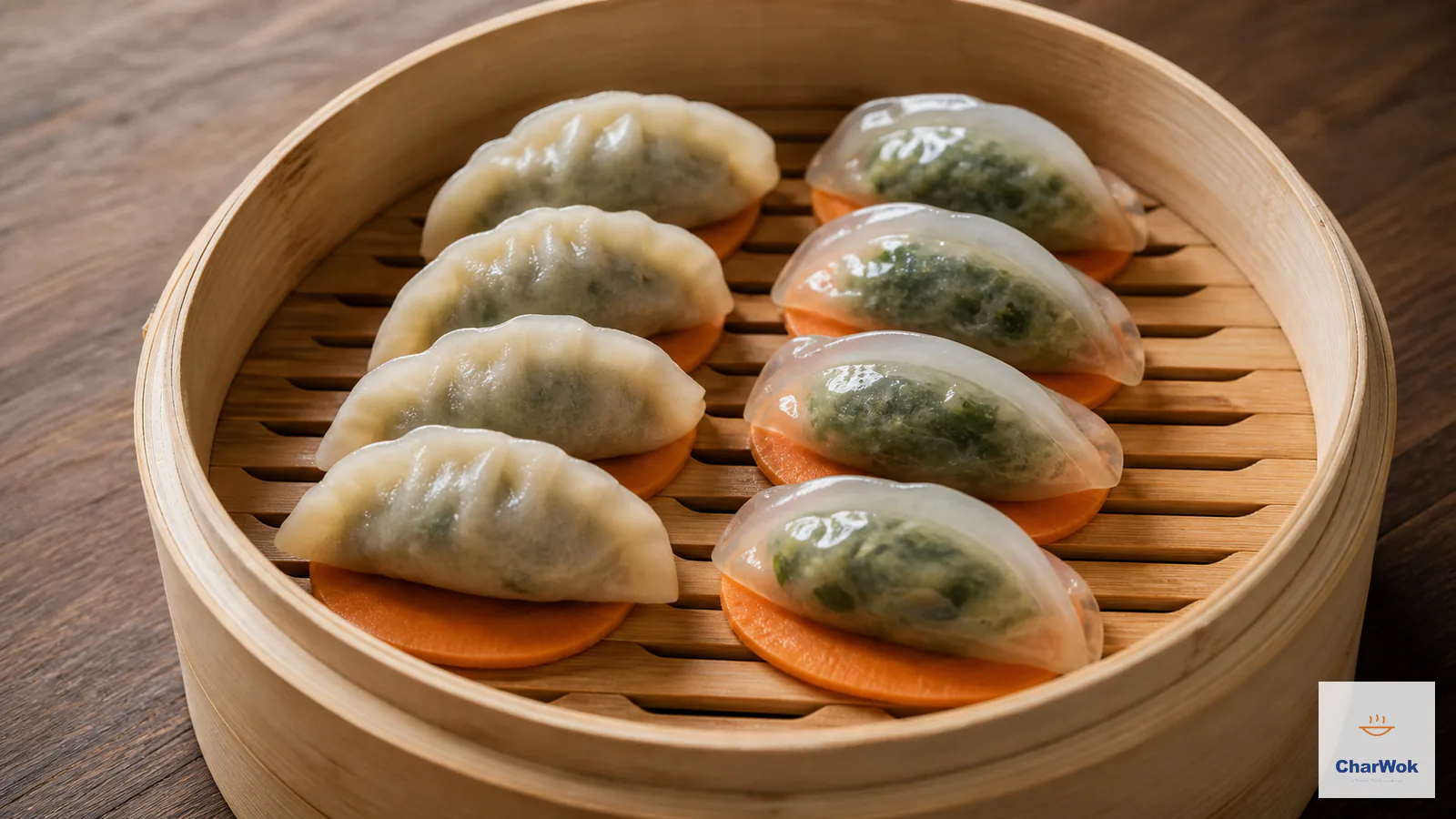
There is a quiet kind of confidence in a basket of steamed dumplings that have not split open. The wrappers sit smooth and slightly translucent, the filling inside still glossy with its own juice, the carrot slice underneath stained with a little oil. Boiled dumplings forgive you. Steamed ones do not. A torn wrapper in a steamer is a small public failure, and most home cooks blame themselves instead of the dough.
This guide covers the two wrappers that matter for steamed dumplings: a hot-water flour dough that turns soft and chewy, and a boiling-water starch dough that goes glassy and translucent. The filling is the same pork-and-chive base for both, because once you can season one filling well you can season a dozen. If you have never made a dumpling from scratch, this is a forgiving place to start, since steaming does not punish a clumsy pleat the way frying does.
At a glance: Two doughs, one filling, 24 dumplings. Hot-water flour dough rests 30 minutes; starch dough works immediately. Steam flour dumplings 10 minutes over medium heat, crystal dumplings 6 minutes. The single most common failure is a starch dough mixed with water that was not truly boiling — it will never go translucent, no matter how long you steam it.
What these dumplings are, and where they come from
Steamed dumplings, zheng jiao (蒸饺), are a northern-Chinese table tradition that crosses into dim sum territory in the south. The flour-dough version is the everyday home-style one: soft, slightly resilient, the kind of wrapper you eat hot off the steamer with nothing but black vinegar. The translucent crystal version, shui jiao made from wheat starch and tapioca, is closer in spirit to Cantonese tea-house dumplings like har gow and the broader family of starch-based steamed dim sum. Both belong on any serious list of dim sum dishes to cook at home, even though the flour version is more weeknight than weekend.
The reason there are two doughs at all comes down to what you want the wrapper to do. Flour dough develops gluten, so it has bite and can hold a heavy filling. Starch dough has no gluten. When boiling water hits it the starch granules gelatinize into a stretchy, glassy paste that turns see-through as it cooks. You cannot swap one for the other, and you should not try.
The ingredients
Ingredients at a glance
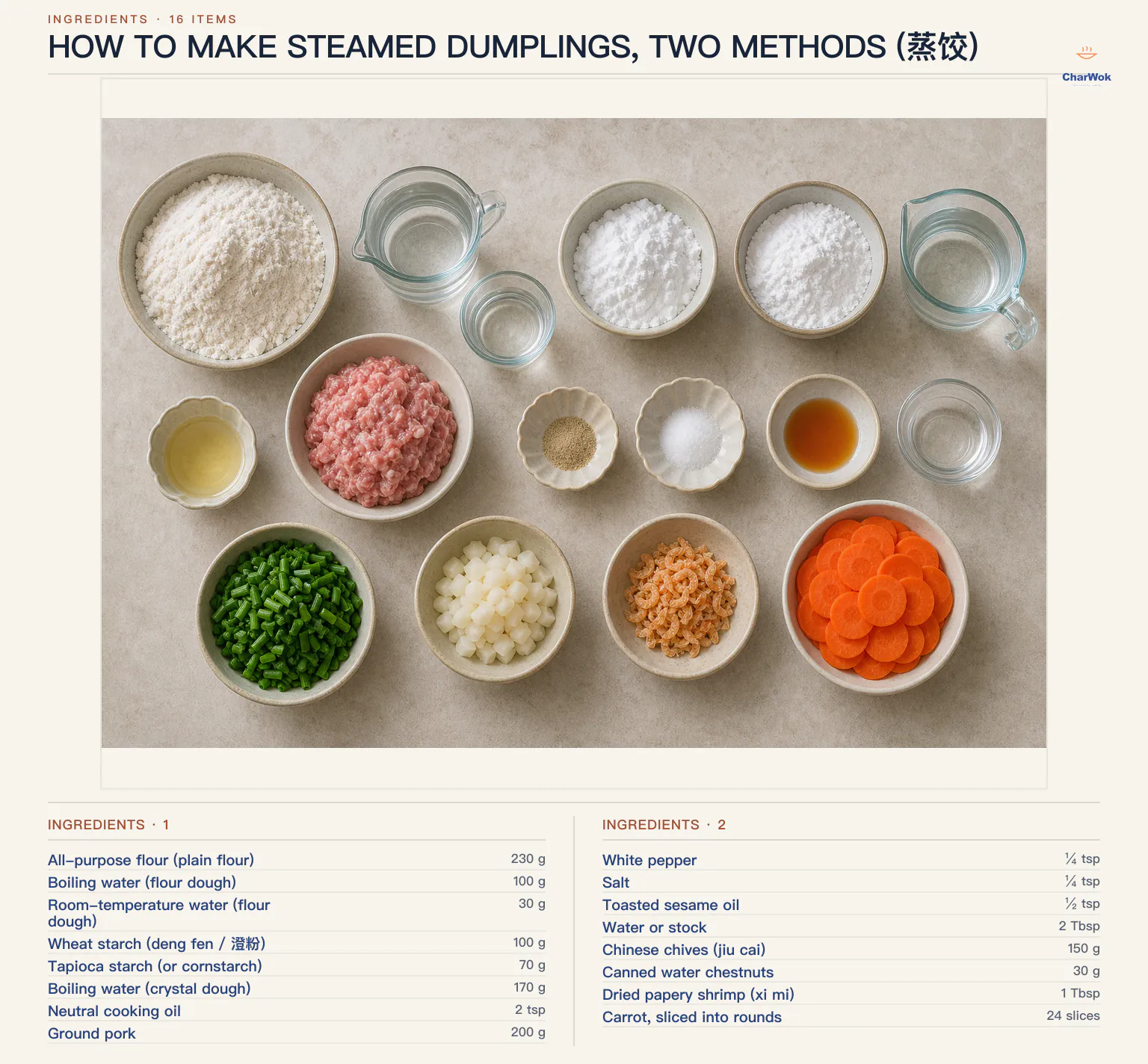
| Ingredient | Amount | Notes / substitute |
|---|---|---|
| All-purpose flour (plain flour) | 230 g | For the soft flour dough. US all-purpose works well; do not use bread flour, the dough gets too tough to pleat thinly. |
| Boiling water (flour dough) | 100 g | Must be a rolling boil. This is hot-water dough (tang mian), which partially gelatinizes the starch and softens the gluten. |
| Room-temperature water (flour dough) | 30 g | Added after the boiling water so the dough isn't fully cooked. Adjust by a teaspoon if your flour is dry. |
| Wheat starch (deng fen / 澄粉) | 100 g | For the crystal dough. Not the same as flour; find it at Asian grocers. No real substitute. |
| Tapioca starch (or cornstarch) | 70 g | Tapioca gives a more elastic, glossy wrapper. Cornstarch works but tears more easily; handle gently. |
| Boiling water (crystal dough) | 170 g | Truly boiling, off the heat for ten seconds at most. If it is merely hot, the dough will stay cloudy. |
| Neutral cooking oil | 2 tsp | Any neutral oil. Added to the crystal dough to keep it pliable and stop it cracking as it cools. |
| Ground pork | 200 g | Ask for 70–80% lean. Too lean and the filling is dry; too fatty and it weeps oil into the wrapper. |
| White pepper | ¼ tsp | Prefer white over black; black specks show through the crystal wrapper. |
| Salt | ¼ tsp | Seasons the meat and draws out the myosin. |
| Toasted sesame oil | ½ tsp | Toasted, not raw. This is your aroma layer. |
| Water or stock | 2 Tbsp | The liquid that makes the filling juicy. Stock adds more flavor than water. |
| Chinese chives (jiu cai) | 150 g | Garlic chives, flat and green, not the flowering ones. Substitute napa cabbage (see variations) if you can't find them. |
| Canned water chestnuts | 30 g | For crunch. Finely diced. Optional but worth it. |
| Dried papery shrimp (xi mi) | 1 Tbsp | Optional umami boost. Minced. Skip or sub a few drops of fish sauce if unavailable. |
| Carrot, sliced into rounds | 24 slices | Used as a nonstick bed in the steamer. Cabbage leaves or parchment work too. |
Mixing the two doughs
Flour dough (soft, chewy wrapper)
- Pour the 100 g of boiling water into the flour in a steady stream while stirring with chopsticks. The flour will look shaggy and partly cooked. This partial cooking is what gives steamed wrappers their tenderness; you are deliberately weakening the gluten rather than building it.
- Add the 30 g of room-temperature water and stir until no dry flour remains. The contrast of hot then cool water leaves some gluten intact for stretch while keeping the dough soft.
- Tip onto a counter and knead for about 3 minutes, until smooth. Cover and rest 30 minutes. Resting is not optional here: the gluten relaxes so you can roll the wrappers thin without them springing back. This is the same principle behind well-rested dumpling-wrapper dough.
Crystal dough (translucent wrapper)
- Whisk the wheat starch and tapioca starch together in a heatproof bowl. Have your boiling water ready, genuinely boiling, fresh from the kettle.
- Pour the 170 g boiling water over the starch and stir immediately and fast with chopsticks. You are cooking the starch on contact; slow stirring leaves dry lumps that will never hydrate. Keep going until the mass looks like a lumpy wet paste.
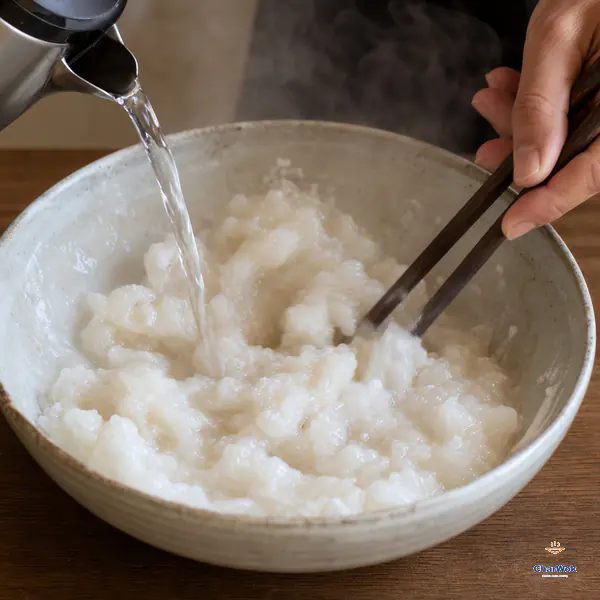
Pour all 170 g of genuinely boiling water over the combined starches and stir immediately and quickly. Stop only when every dry pocket has become a cohesive, lumpy wet paste, then add the oil and knead once safe to touch.
- Add the oil, then knead by hand once it is cool enough to touch. Knead until very smooth and no longer sticky, about 2 minutes. If the dough feels dry and cracks at the edges, knead in water a teaspoon at a time; if wet and sticking, dust with wheat starch.
- Wrap the dough tightly in plastic or cover with a damp cloth. Unlike flour dough, this one does not need to rest, but it must not dry out. A skin on the surface means cracked wrappers later.
The filling, and why you stir it the way you do
Put the pork in a bowl with the white pepper, salt, sesame oil, and the 2 tablespoons of water or stock. Stir in one direction only, and keep stirring for a full minute. This is not superstition. The sustained one-way stirring aligns the myosin in the meat into a sticky network that traps the liquid, so the cooked filling is springy and holds its juice rather than leaking it into the wrapper. It is the same trick that gives a good dumpling filling its bounce.
Only after the meat has absorbed the liquid do you fold in the chives, water chestnuts, and dried shrimp. The reason for the order: salt draws water out of raw chives, and if the chives sit against the meat they will weep and make the filling wet. Fold them in last, loosely, and chill the bowl until you are ready to fill. A cold filling is firmer and easier to portion.
Rolling and folding
- Divide each dough in half, then roll each half into a rope about 2 cm thick. Cut each rope into 12 even pieces, 24 total per dough. Cover the pieces you are not working on; crystal dough especially will crack if left exposed.
- Flatten a piece with your palm, then roll it into a thin disc about 9–10 cm across, rolling from the edges and leaving the center slightly thicker than the rim. A thicker center stops the wrapper tearing under the weight of the filling; a thinner rim makes a neat pleat. Dust the flour dough with flour and the crystal dough with wheat starch. Never flour on crystal, or it shows as white spots.
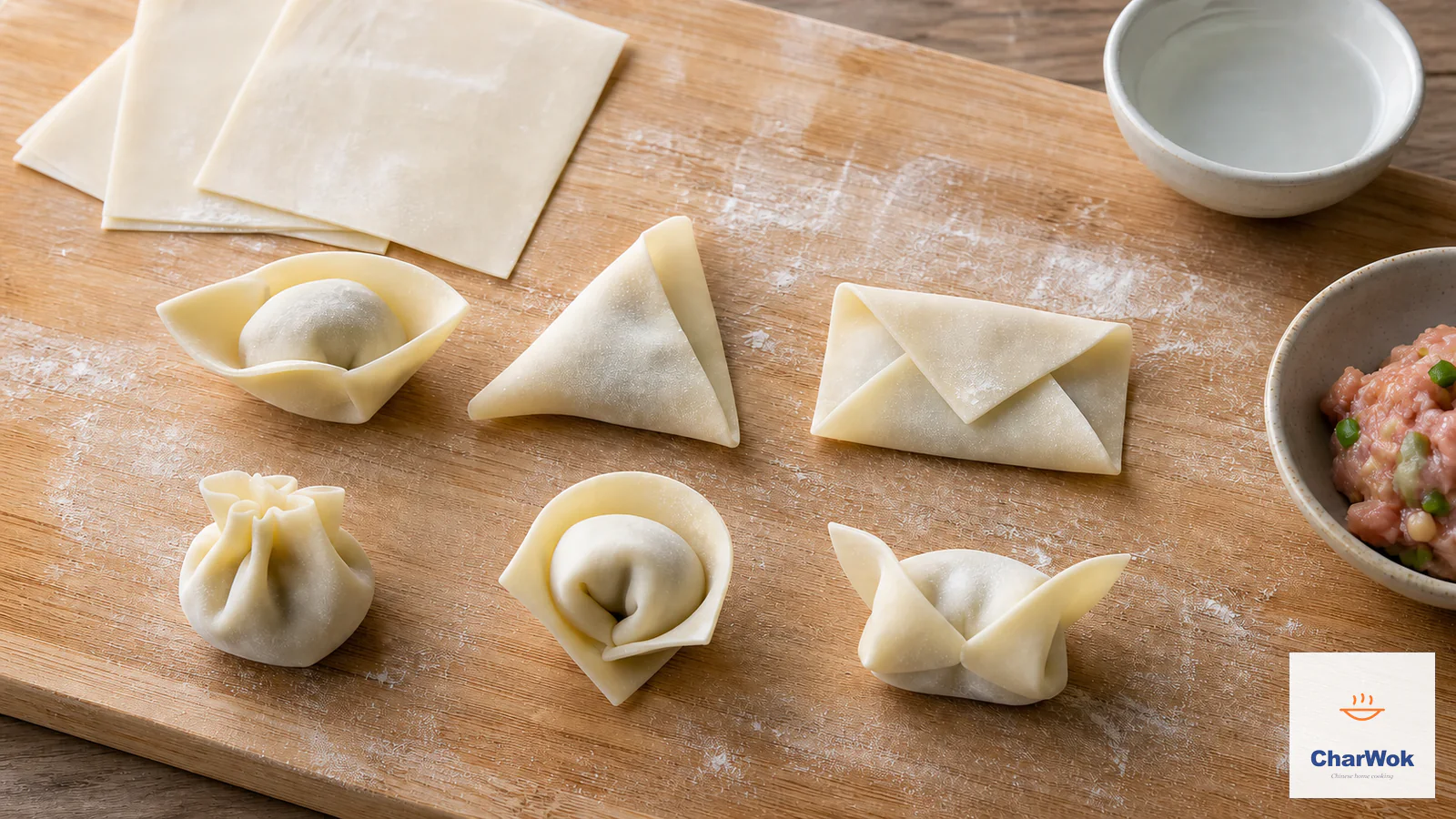
- Place a rounded tablespoon of filling in the center and fold in half. For a simple half-moon, press the edges flat. For a pleated crescent, start at one end and fold small pleats along the top edge toward the center, pressing each one closed. Crystal wrappers are tear-prone, so keep your pleats shallow. The core techniques in the dumpling folding guide work, but pleated crescents and simple triangles are the most reliable here.
- Set each finished dumpling on a tray dusted with starch and keep them covered with a damp cloth. Do not let them touch each other: wet crystal wrappers will weld together on contact.
Steaming
- Line a bamboo or metal steamer with the carrot slices (or parchment, or a cabbage leaf brushed with oil). Arrange the dumplings on top with a finger-width of space between them, since both doughs expand as they cook.
- Bring the steamer water to a full, rolling boil before the basket goes in. Putting dumplings over warm water is how you get gummy, stuck wrappers; the dough needs the shock of live steam to set its surface quickly.
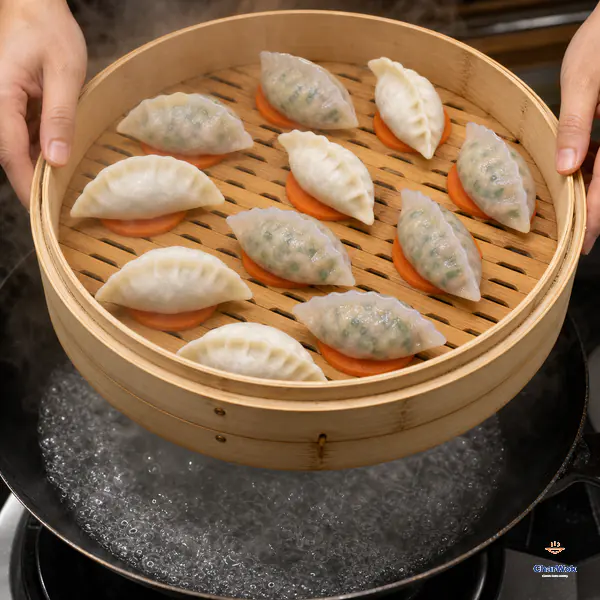
Keep each dumpling on a carrot slice with a finger-width gap, bring the water to a full rolling boil, then set on the basket and cover. Steam flour wrappers for 10 minutes and crystal wrappers for 6 minutes.
- Cover and steam over medium heat: 10 minutes for the flour dumplings, 6 minutes for the crystal ones. The shorter time for crystal is deliberate; over-steaming a starch wrapper makes it collapse and turn opaque again. If you want to compare methods side by side, this is the same basket-and-lid discipline described for cooking dumplings three ways.
- Lift the lid away from you so the condensation does not drip back onto the dumplings, and let them sit 30 seconds before lifting out with a spatula. They are at their most fragile the instant the steam stops.
When things go wrong
Most failures fall into a small number of causes, and they are nearly all fixable before you steam.
- The crystal dough won't go translucent. The water was not hot enough. Tapioca and wheat starch need true gelatinization, which starts around 70 °C but needs near-boiling water to happen evenly. There is no rescue for an undercooked dough; remake it with water straight off a rolling boil. I have done this twice with water I let sit for a minute; both times the wrappers stayed cloudy and torn-looking.
- The flour dough shrinks back when you roll it. It has not rested long enough. Cover it and wait another 15 minutes. The gluten is still contracting; fighting it just makes the wrappers thick.
- The wrappers split open in the steamer. Either you overfilled (a flat tablespoon is the max for an 8 cm wrapper), or the dough dried out while you worked. Cover unused dough and fillings, and brush a little water on the seal if it won't close cleanly.
- The dumplings stick to the steamer. Your barrier failed. Carrot slices and cabbage leaves work; bare bamboo does not. A light oil on parchment is the most reliable for crystal dumplings, which are stickier than flour ones.
- The filling is bland or dry. Bland usually means under-salted or missing the dried shrimp; dry means the pork was too lean or you skipped the 2 tablespoons of liquid. The liquid is the whole point: it is what turns into the pocket of juice inside.
- Crystal wrappers crack as they cool. The dough lost moisture. Next time add the oil, knead in a touch more water, and keep the dough wrapped the entire time you fold.
Variations and what to serve alongside
The chive-and-pork filling is the classic, but the wrapper techniques are what you are really learning, and they carry other fillings well. Swap chives for finely diced napa cabbage (salted, squeezed dry first) and you have a pork-and-cabbage version. Shrimp folded into the same seasoned pork makes a brighter, sweeter filling, closer to siu mai in spirit. A fully vegetable version using mushrooms and carrot works in either wrapper; the vegetarian dumpling fillings are a good starting point.
For the table, I keep the side dishes light. A simple chive pocket feels redundant on a chive-forward day, so I usually go the other direction: a clean green vegetable like blanched broccoli or a cucumber salad, and a bowl of soup. Steamed dumplings also sit happily next to soup dumplings if you are building a dim sum spread, or alongside pan-fried ones for a mix of textures, the way you would mix and match from a wider collection of dumpling recipes.
The dipping sauce matters more than people admit. Plain black rice vinegar with a sliver of ginger is the traditional match for flour dumplings. For crystal dumplings I prefer a sharper soy-and-vinegar mix, and a spoonful of homemade chili oil on the side for anyone who wants heat. If you want to go further, the six dumpling sauces are worth knowing by heart.
Make-ahead, storage, and reheating
Both the flour and crystal doughs freeze well raw. Arrange the shaped dumplings on a tray so they don't touch, freeze until solid, then transfer to a bag. Steam from frozen: add 3 minutes to the time and do not thaw, since thawing crystal dough makes it weep and stick. The flour dough also pan-fries well from frozen if you'd rather not steam; the same technique works as for potstickers.
Cooked leftovers keep two days in the fridge. Reheat them in a steamer for 4 minutes, not the microwave. Microwaved crystal wrappers turn rubbery and opaque, which is exactly the texture you worked to avoid. The filling also keeps a day in the fridge on its own, which is handy if you want to shape dumplings across two evenings.
Frequently asked questions
Can I make just one kind of dough? Yes. The recipe scales fine as a single batch. If you only want crystal dumplings, double the starch dough and freeze half for later; the flour dough does not double-freeze as gracefully.
Why is my crystal dough still cloudy after steaming? The mixing water wasn't hot enough, or the steam was too gentle. Use water straight off a rolling boil to mix, and steam over steady medium heat, not a whisper of a simmer.
Do I have to rest the flour dough? Yes. Thirty minutes lets the gluten relax so the wrappers roll thin. Skip it and the dough fights you, leaving you with thick, doughy edges.
Can I use a metal steamer instead of bamboo? Either works. Bamboo absorbs some moisture and gives a slightly softer surface; metal is fine but watch for condensation dripping off the lid, which can puddle on the dumplings.
Is cornstarch really interchangeable with tapioca here? Mostly. Tapioca gives a stretchier, glossier wrapper; cornstarch makes a dough that tears more readily and is less elastic. If you use cornstarch, roll a little thicker and handle gently.
Both of these dumplings come down to two judgments. For the flour dough, rest it properly and roll the edges thin. For the crystal dough, use water that is genuinely boiling and don't let the dough dry out. Get those right and the rest is assembly — and once you can make these, the same starch technique opens up har gow and the same filling carries you through potstickers, boiled dumplings, and soup dumplings without a second thought.