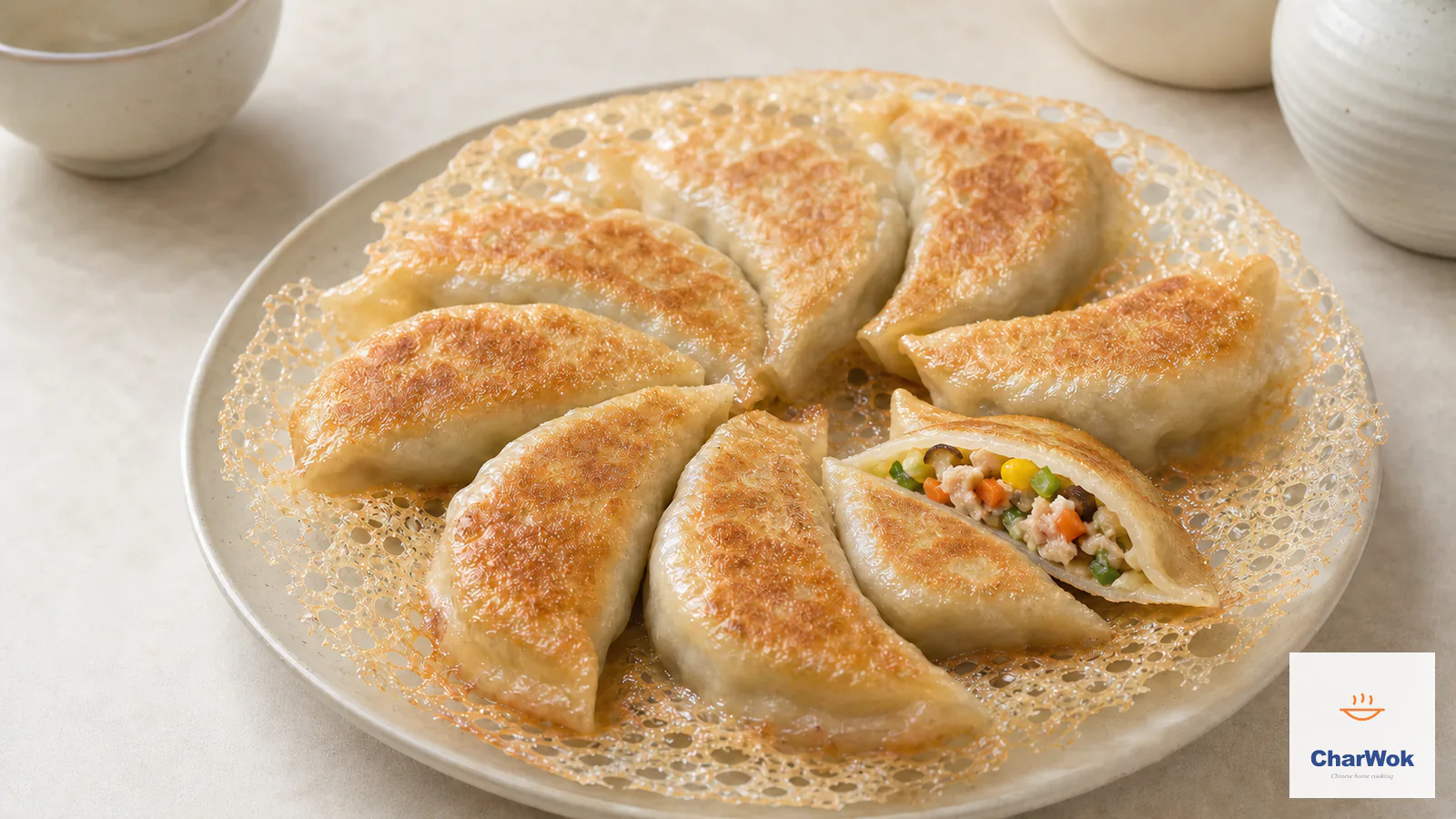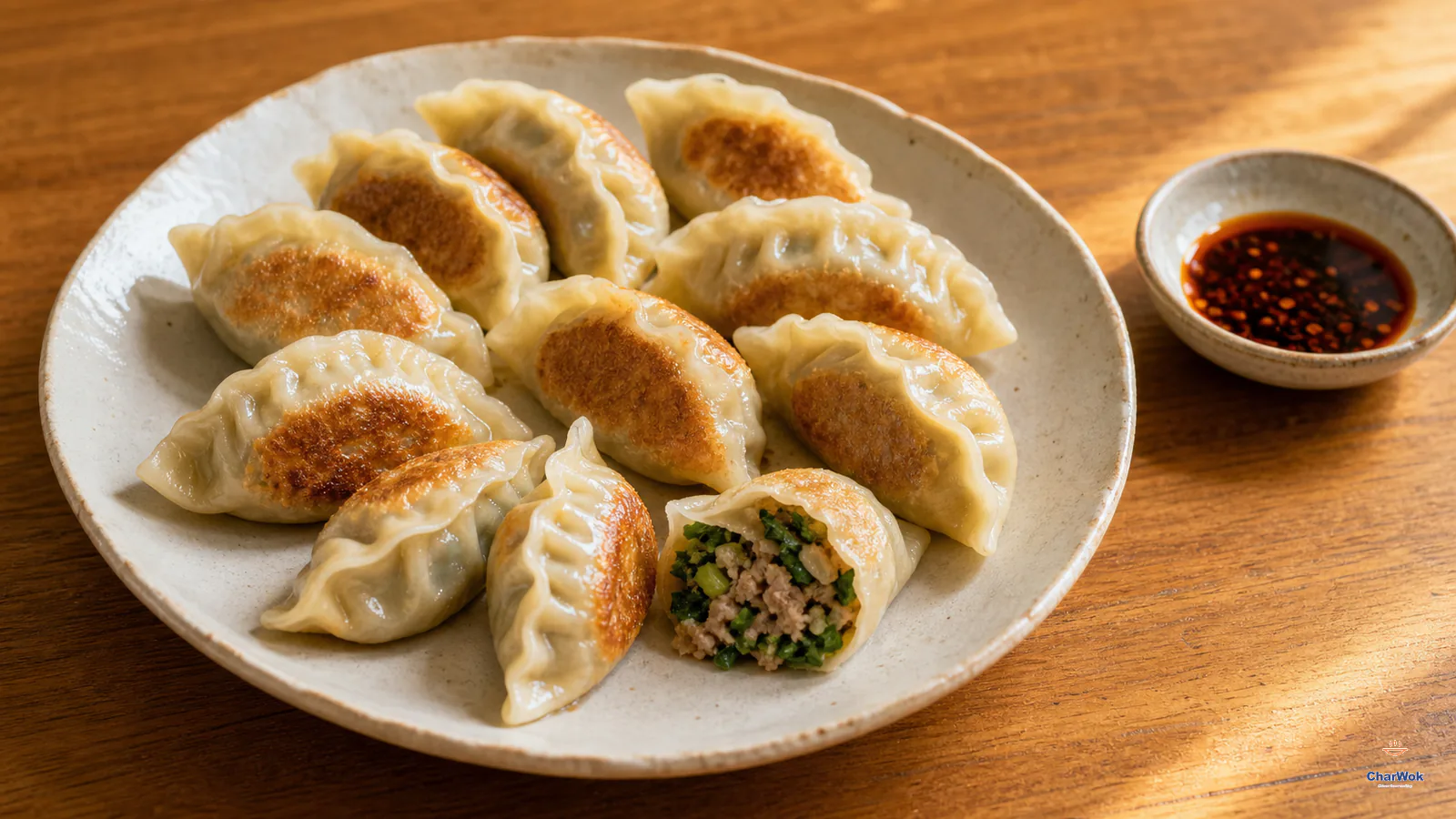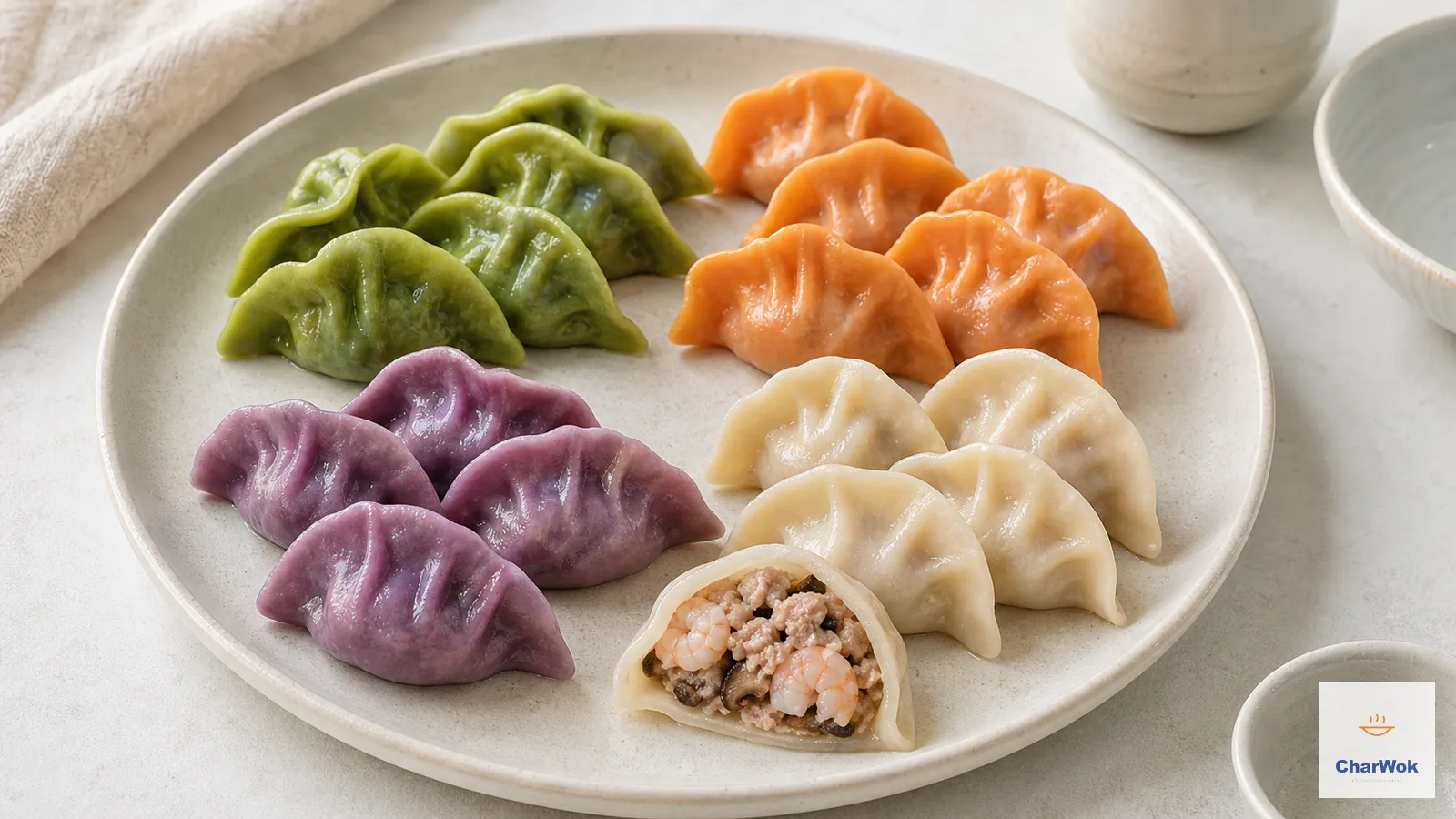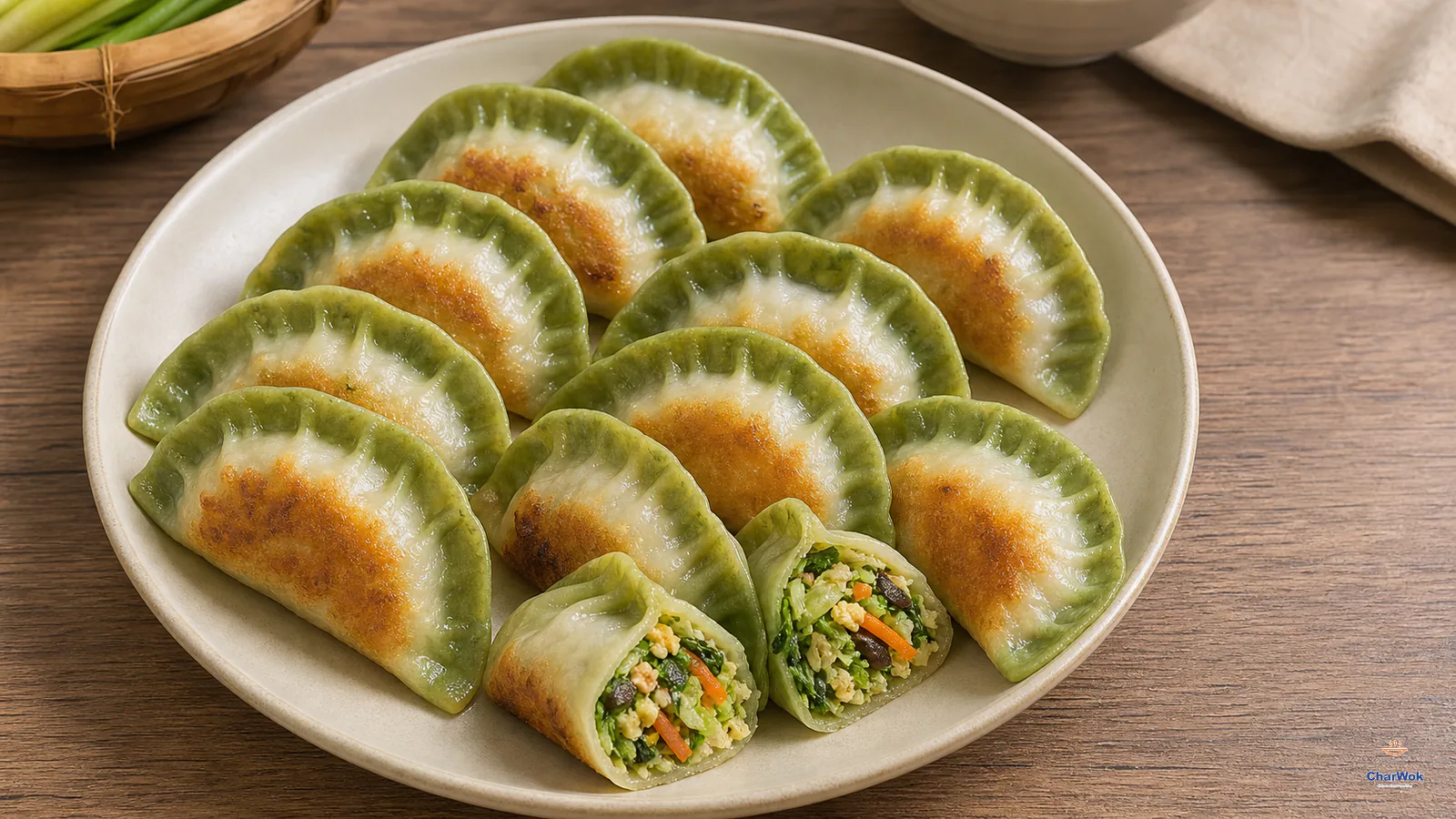
The best thing about a potsticker is the crust. That lace of caramelized dough across the bottom, golden and shattering, is the whole reason the shape exists. The second best thing, in my house at least, is making vegetarian dumplings look like the very vegetable they're stuffed with: white stems fanning out, a green rim of wrapper above, the silhouette of a baby bok choy. It is a small, showy trick that costs you about ten extra minutes and almost no skill.
I'll be honest about where this recipe can frustrate you. Vegetable fillings leak. Wet dough tears. The two-tone wrapper looks clever right up until the green dough slides off the white as you roll. Every one of those failures has a fix, and the fix is rarely more flour. It is patience, salt timing, and a habit I picked up after ruining too many batches: squeeze the greens until you think they're dry, then squeeze again. If you want the full background on the dish family first, my dumpling guide walks through the shapes and cooking methods in one place.
At a glance. Two doughs, one white and one spinach-green, wrapped green-around-white to mimic bok choy. Plan on a 30-minute rest before rolling, water at roughly 50% of the flour weight, and never salt the filling until the wrappers are cut. Pan-fry the bottoms hard, then steam in shallow water until it vanishes. Serves four as a main, makes about 40 dumplings.
What these dumplings are, and where they come from
Potstickers are jianjiao, the pan-fried branch of the jiaozi family that northern China turns to for almost any gathering that matters. Boiled dumplings feed the everyday table; pan-fried ones show up when you want a crisp edge and a slightly richer bite, the kind of thing you set out for Lunar New Year or a Sunday when people linger. The vegetarian version here leans on a long-standing Buddhist-table tradition of meatless jiaozi built from mushrooms, root vegetables, and tender greens, the same sensibility behind many of the best-loved dumpling recipes across regions.
The two-tone wrapper is a festive flourish, not a regional classic. You dye half the dough with blanched-spinach juice so a thin green sheath sits outside a white core. When you roll and fold, the green stays at the rim and the white peeks through the center, and a simple pleat reads as the leaves of a baby bok choy. It is pure theater, the good kind.
The ingredients, with my preferences
Pan-fried vegetarian dumpling ingredients at a glance
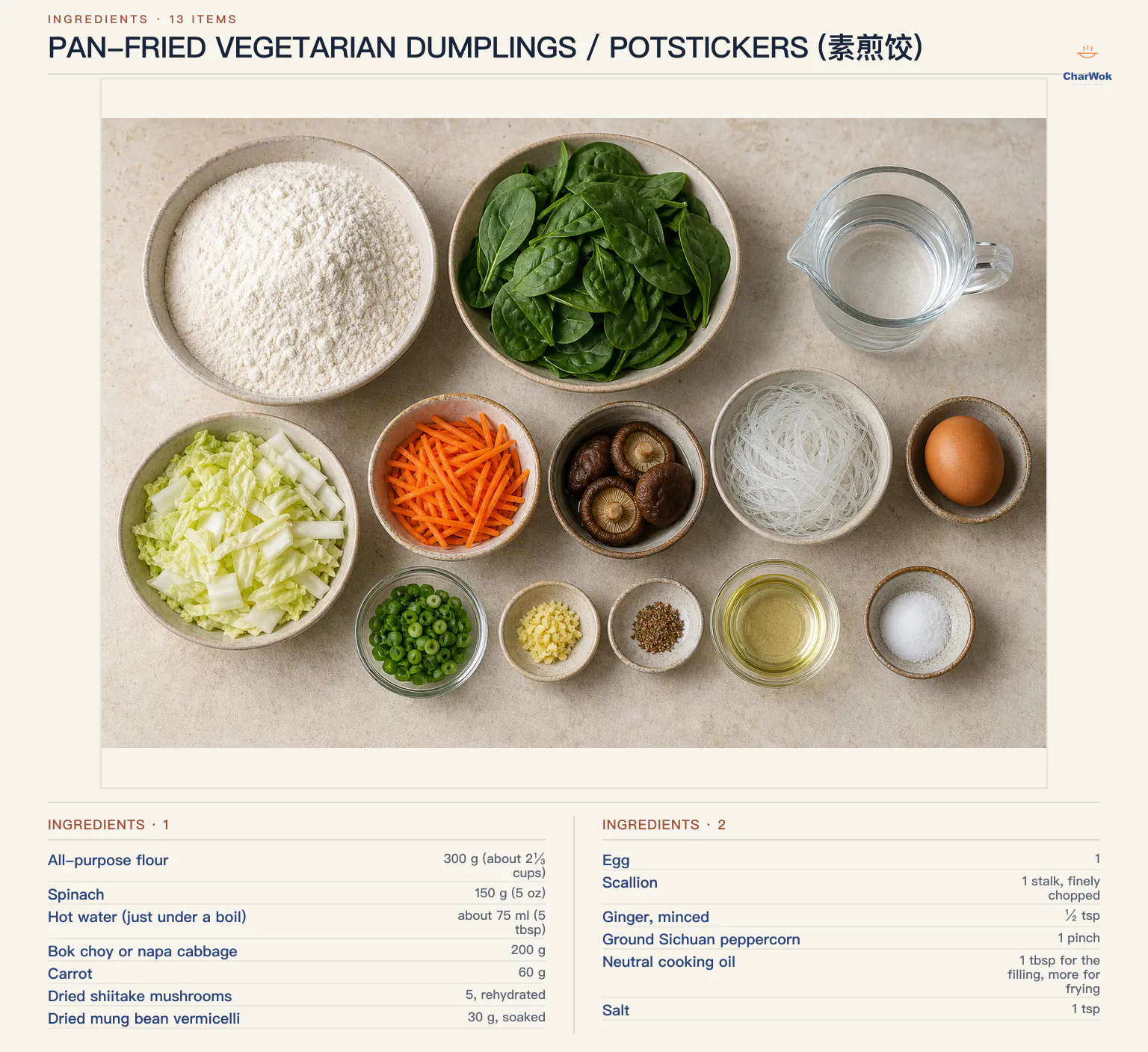
| Ingredient | Amount | Notes / substitute |
|---|---|---|
| All-purpose flour | 300 g (about 2⅓ cups) | Standard AP is ideal. Bread flour makes a tougher skin you'll fight while pleating; don't reach for it. |
| Spinach | 150 g (5 oz) | Any flat-leaf or baby spinach. This is your dye plus a flavor boost for the filling. |
| Hot water (just under a boil) | about 75 ml (5 tbsp) | For the white dough. Hot water partially gelatinizes the starch, giving a softer, more pliable skin that seals cleanly. |
| Bok choy or napa cabbage | 200 g | Baby bok choy gives a cleaner flavor; napa is sweeter and wetter. Either works, but napa needs more squeezing. |
| Carrot | 60 g | For color and a little sweetness. Grate fine so it folds in without tearing the wrapper. |
| Dried shiitake mushrooms | 5, rehydrated | The dried ones carry far more flavor than fresh. See the FAQ for how I soak them. Don't have time? Use the guide to dried shiitake shortcuts. |
| Dried mung bean vermicelli | 30 g, soaked | The quiet workhorse: it drinks up the liquid the greens give off and adds a bouncy bite. Cellophane/glass noodles are the same thing. |
| Egg | 1 | Lightly beaten, it binds and enriches. For a vegan version, swap in crumbled firm tofu and skip ahead to the vegan dumplings method. |
| Scallion | 1 stalk, finely chopped | Green and white parts together. |
| Ginger, minced | ½ tsp | Keep it modest; raw ginger easily dominates a delicate filling. |
| Ground Sichuan peppercorn | 1 pinch | A faint tingle, not heat. Toast and grind your own using the Sichuan peppercorn notes for the brightest aroma. |
| Neutral cooking oil | 1 tbsp for the filling, more for frying | Grapeseed, canola, or peanut. A tablespoon of hot oil poured over the aromatics blooms their flavor before mixing. |
| Salt | 1 tsp | Add last, right before filling. Salt too early and you'll have a puddle. |
Why the dough behaves the way it does
Two things decide whether your wrapper rolls thin without snapping back or tearing. The first is hydration. At around 50% water-to-flour by weight, you get a dough that's firm enough to handle but soft enough to roll to the thinness a potsticker needs. The second is the rest. Kneading aligns the gluten into elastic sheets, and that aligned gluten fights you on the rolling pin. Thirty minutes covered, at room temperature, lets those protein strands relax. Skip the rest and every wrapper shrinks back the instant you stop rolling.
Hot water in the white dough isn't traditional for every jiaozi, but it helps here. It swells and gelatinizes a fraction of the surface starch, which makes the dough more extensible and less prone to tearing at the pleat. The green dough uses spinach juice at the same volume as the water in the white dough, so both halves share a hydration level and roll out at the same speed. Mismatched hydration is why one color always feels tougher than the other.
Making the spinach dye
Blanch the spinach for about twenty seconds in boiling water, just until it collapses. The brief heat sets the green by driving out trapped air and breaking down the cell walls that hold the chlorophyll; longer than thirty seconds and the color starts drifting toward gray-green. Shock it under cold water so it doesn't keep cooking from residual heat. Puree it smooth in a food processor, then press it through a fine sieve to extract roughly 75 ml of vivid green liquid. Save every bit of the leftover puree, because it goes straight into the filling. This same dyeing move works beautifully for homemade dumpling wrappers of any style.
The method, step by step
- Build two doughs. Split the flour into two bowls of 150 g each. Stir about 75 ml of hot water into one and the 75 ml of spinach juice into the other, mixing with chopsticks first so the heat doesn't hit your hands. When each shaggy mass is cool enough, knead briefly until smooth. Cover both tightly and rest at least 30 minutes, up to an hour.
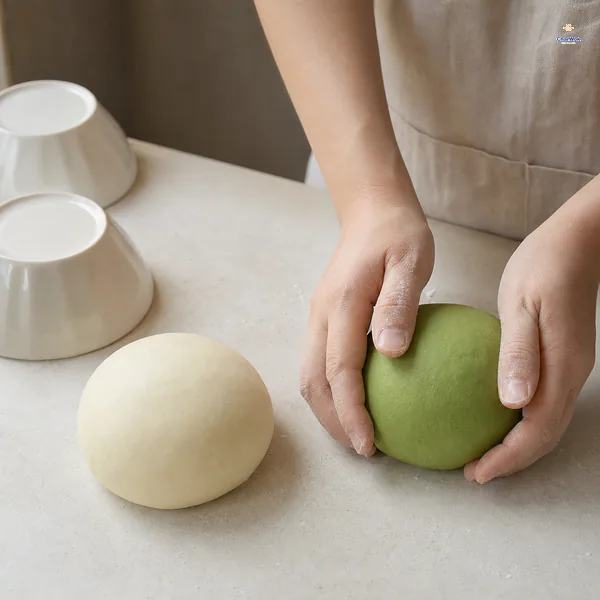
Divide the flour equally: mix one half with about 75 milliliters hot water and the other with 75 milliliters spinach juice, knead both smooth, then cover for 30 to 60 minutes.
- Prep and squeeze the filling vegetables. While the dough rests, mince the bok choy, carrot, rehydrated shiitake, and soaked vermicelli. Take the bok choy and the mushrooms in fistfuls and squeeze hard over the sink. You are not trying to crush them to nothing; you want them damp, not dripping. This single step is the difference between a filling you can fold and a filling that floods the wrapper.
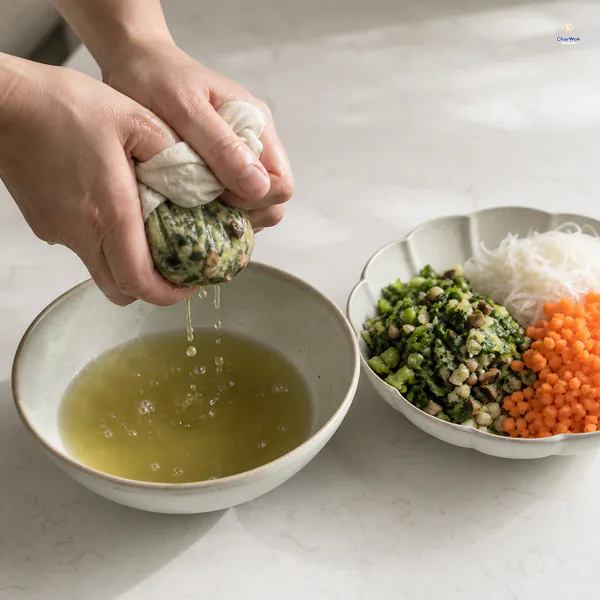
Mince the bok choy, carrot, rehydrated shiitake and soaked vermicelli, then squeeze the greens and mushrooms hard so the filling stays damp but never drips.
- Bloom the aromatics. Pile the filling into a bowl and make a well in the center. Put the scallion, ginger, and Sichuan pepper in the well, then heat a tablespoon of oil in a small pan until it just shimmers. Pour the hot oil directly onto the aromatics. You'll hear them sizzle and smell the change instantly; that heat releases the fat-soluble flavor compounds raw stirring never will. Stir in the beaten egg and the reserved spinach puree.
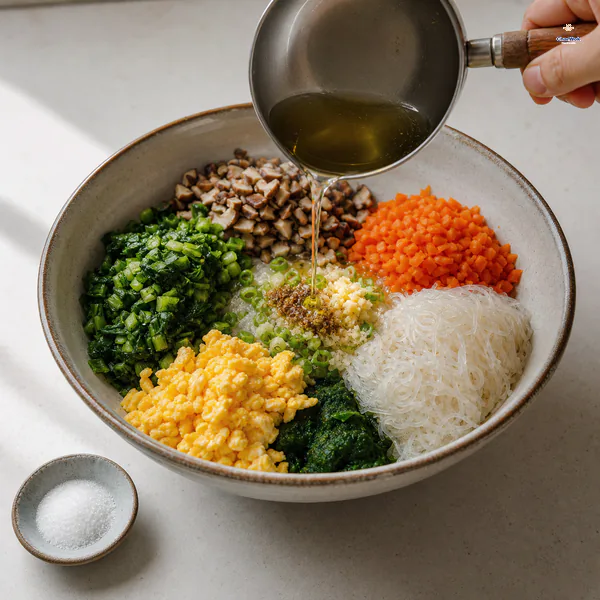
Stir in the beaten egg and reserved spinach puree, make a well for scallion, ginger and Sichuan pepper, then pour over 1 tablespoon shimmering-hot oil and mix thoroughly.
- Hold the salt. Do not salt yet. Salt pulls water from the cut vegetables through osmosis, and once that water is loose it never goes back. Leave the salt in a small dish next to your workstation.
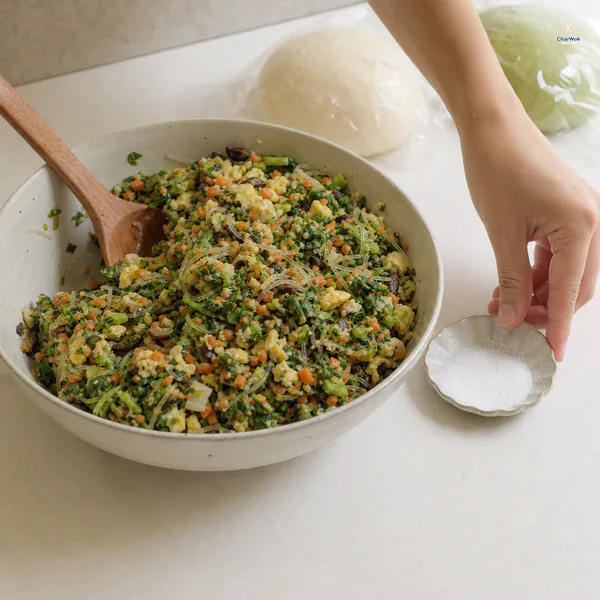
Keep the salt beside the station but out of the filling until the wrappers are ready; salting early draws out water and loosens the filling.
- Build the two-tone log. On a lightly floured surface, roll each dough into a rope about 2 cm thick. Roll the white dough into two even ropes. Flatten the green dough into two thin rectangles the same length as the white ropes, then wrap a green sheet around each white rope and pinch the seam closed. You now have a green cylinder with a white core.
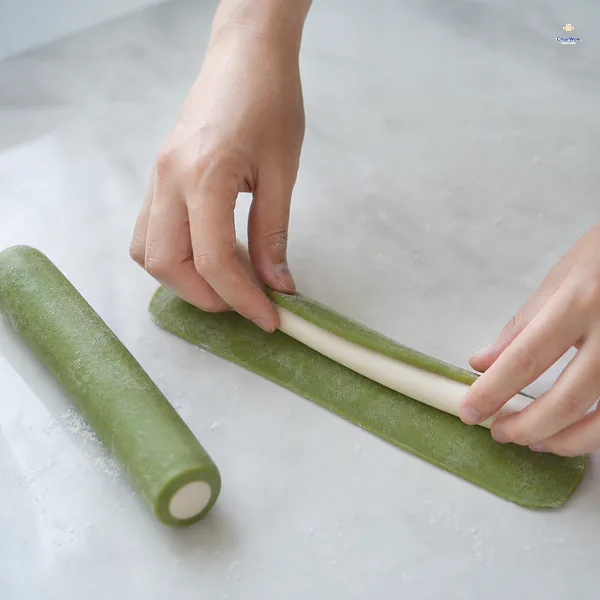
Roll the white dough into two ropes about 2 centimeters thick, roll the green dough into two thin rectangles of equal length, wrap each around a white rope and seal the green seam.
- Cut and press. Cut each log into about 20 equal slices. Stand a slice cut-side up so you can see the white circle inside the green ring, then press it flat with your palm. That cut face becomes the top of your wrapper, and it's what carries the bok-choy pattern.
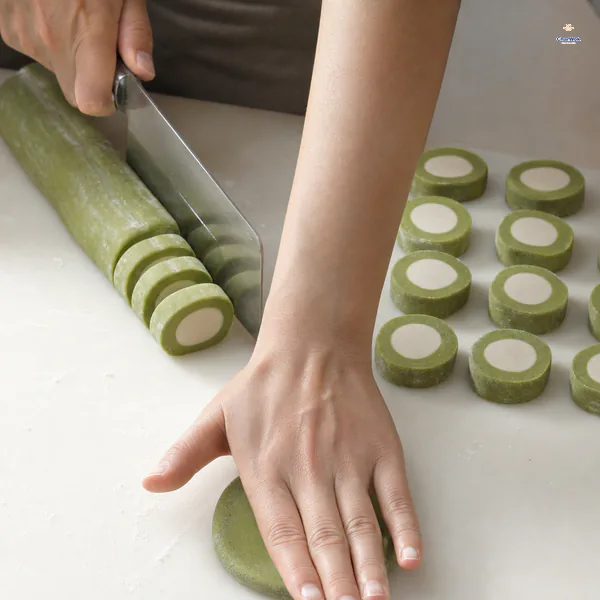
Cut each two-tone log into about 20 pieces, turn every cut face upward so the white center sits inside the green ring, then press each piece flat.
- Roll, edge-thin. Roll each disc into a thin round, working the rolling pin mostly at the rim and leaving the center a touch thicker. A thinner edge pleats neatly; a thicker center holds the filling without blowouts. If you want the precise hand technique, the folding guide breaks down the pleats in detail.
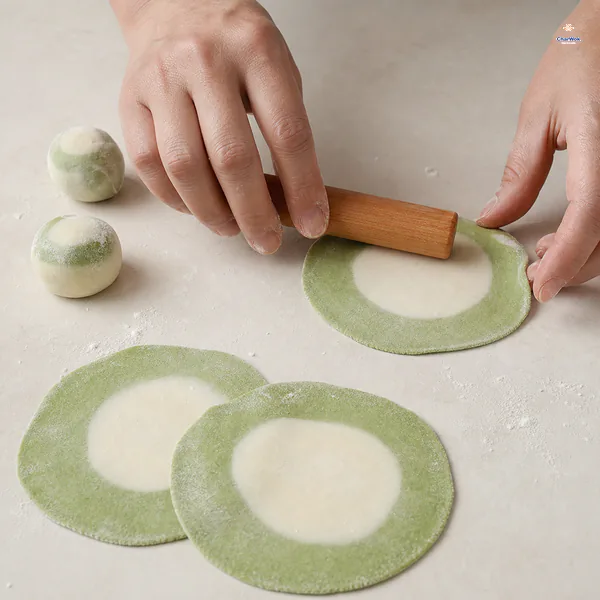
Rotate each piece as you roll only the outer edge, making a thin round wrapper with a continuous green rim and a slightly thicker white center.
- Salt, then fill. Only now, stir the teaspoon of salt into the filling and mix well. Spoon about a tablespoon into the center of a wrapper, fold in half, and pleat or simply press to seal, squeezing air out the top as you close. Work in small batches so the salted filling never sits long.
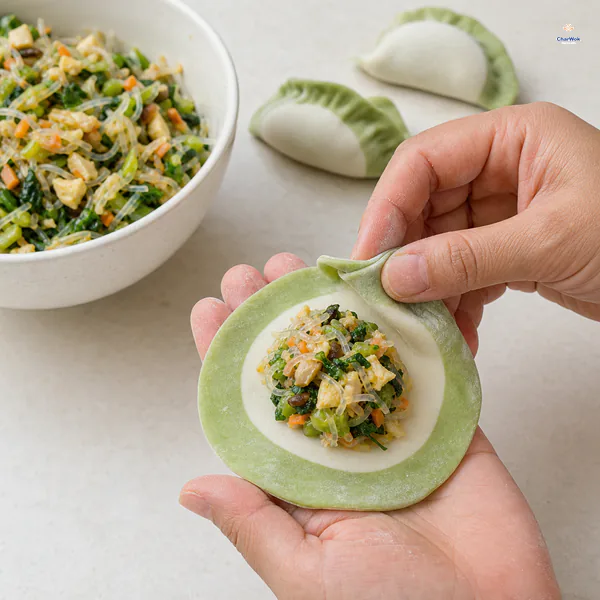
Mix in the salt only now, place about 1 tablespoon filling on each wrapper, expel trapped air and pinch or pleat the seam completely closed; work in small batches.
- Sear hard, then steam. Set a heavy skillet over medium-high heat with enough oil to film the bottom. When the oil shimmers, stand the dumplings in the pan, flat side down and slightly crowded. Let them fry undisturbed until the bottoms are a deep gold, about two minutes; you want genuine color, which is where the flavor lives.
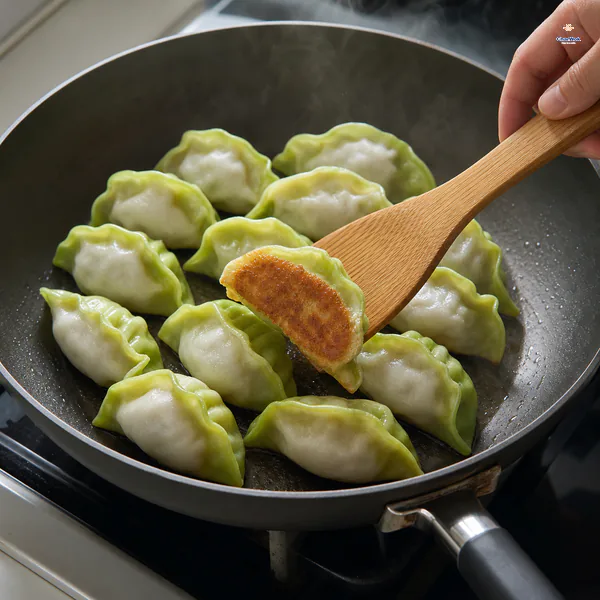
Heat a thin film of oil in a heavy skillet over medium-high heat, set the dumplings flat-side down slightly crowded and sear about 2 minutes until the bottoms are deeply golden.
- Steam it off. Pour in water to come about a third of the way up the dumplings and clap on a lid. The water-then-steam combo sets the wrapper and cooks the filling through. When the water has fully evaporated, about five minutes, lift the lid and let any residual moisture fry off for another 30 seconds so the crust crisps back up. Slide them onto a plate crust-side up.
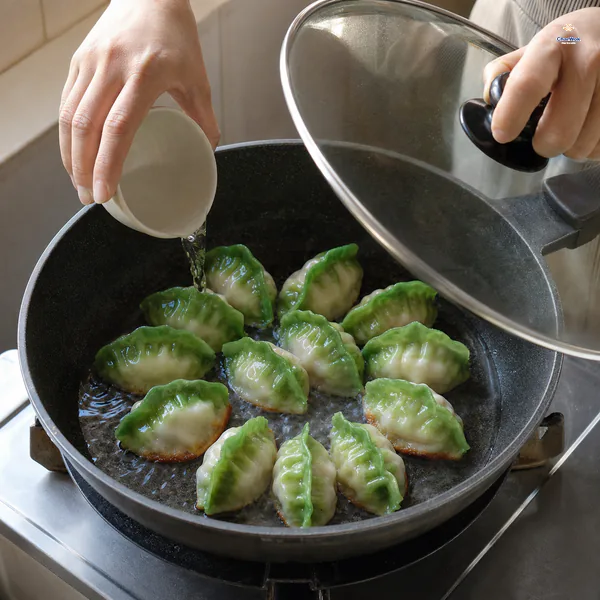
Pour in water to one-third of the dumplings' height and cover for about 5 minutes; when the water evaporates, uncover for 30 seconds to re-crisp and plate crust-side up.
For the wider context on how pan-frying compares to boiling and steaming, the three-method how to cook dumplings rundown lays out the timing for each so you can convert this filling into any style.
When things go wrong
This is the section I wish someone had handed me the first time I tried these. The failures are predictable, and so are the fixes.
- The green dough slides off the white as you roll. The two haven't bonded. Pinch the seam shut again, then let the log rest five minutes before cutting; relaxed dough clings to itself better than tense dough. Dusting the joining surfaces with flour makes it worse, not better.
- The wrapper tears at the pleat. Either it's too thin at the edge or the dough hasn't rested. Re-cover the unused dough and give it ten more minutes. Roll with the pin moving outward from the center, not straight across.
- The filling weeps into a puddle. You salted too early or didn't squeeze the greens enough. Tilt the bowl, let the liquid pool in one corner, and scoop filling from the higher side. Next time, salt only at the moment of filling.
- The bottoms are pale and the tops are overcooked. Your pan isn't hot enough when the dumplings go in, or the lid is leaking steam. Preheat until the oil shimmers, and use a lid that actually fits. A glass lid lets you watch the water line disappear.
- The dumplings stick and tear when you try to lift them. Two causes: not enough oil at the start, or you're trying to move them before the crust has set. Wait until the sear releases them on its own; a properly formed crust will let go of the pan when it's ready.
- The crust is leathery, not crisp. You left the lid on after the water evaporated. That last 30 seconds uncovered is what turns steamed dough into glass; don't skip it.
Variations and what to serve alongside
Once the technique is in your hands, the filling is a template. Swap the bok choy for finely chopped chives and you're halfway to a classic pork and cabbage dumpling in spirit, minus the meat. Add a spoon of chili oil to the filling for a warm, slow background heat. Fold in a handful of crumbled pressed tofu for more protein, or lean on the chicken potsticker idea and replace the egg with ground poultry if you'd rather not keep this vegetarian.
For dipping, these are gentle enough to take a bold sauce. Black rice vinegar with a sliver of ginger is my default; a mix of soy sauce, vinegar, chili oil, and a few sesame seeds is the crowd-pleaser. If you want a ready-made lineup, the dumpling dipping sauce collection has six to choose from. On the side, a crunchy smashed cucumber salad or a quick bowl of steamed dumplings done a second way turns the plate into a full spread.
Storing and reheating
Freeze them the instant they're folded if you're not cooking right away; an assembled dumpling left on the counter is a slow-motion disaster as the filling weeps into the skin. Lay them on a flour-dusted or parchment-lined tray, freeze solid, then bag airtight. They keep a month and cook straight from frozen with no thawing, just add a splash more water and a minute to the steam. Cooked leftovers reheat best in a dry skillet over medium heat to bring the crust back, or under a broiler for ninety seconds. The microwave will turn the crisp bottom to rubber, and I say that as someone who has tried to make it work.
Frequently asked questions
These come up every time I teach this recipe.
Can I make the dough the day before?
Yes. Wrap each dough tightly and refrigerate overnight; let it sit at room temperature for 20 minutes before rolling so it loosens up.
How do I rehydrate dried shiitake quickly?
Cold water for 8 to 12 hours gives the best texture. In a hurry, soak them in just-boiled water for 30 minutes; they'll soften, though the flavor is slightly thinner. Trim and discard the tough stems either way.
Do I need a stand mixer or food processor?
No. Hand-mixing is enough. A processor helps only for pureeing the spinach; for the dough, your hands read the hydration far better than a machine does.
Can I boil or steam these instead of pan-frying?
Absolutely. Steam for 10 minutes over high heat for the prettiest result, since the two-tone wrapper shows best without browning. Boiling works too, but seal the pleats firmly or they'll open in the water.
Why is my spinach dough dull gray-green?
You blanched too long or didn't shock it in cold water. Keep the blanch under 30 seconds and cool it fast to lock in the bright chlorophyll.
One last thing
If you remember nothing else, remember the salt. Salt last, squeeze the greens until they're almost dry, and let the dough rest. Get those three right and the rest of the recipe forgives a lot of fumbling, including the messy pleats on your first dozen. The crisp bottom will cover for all of it.