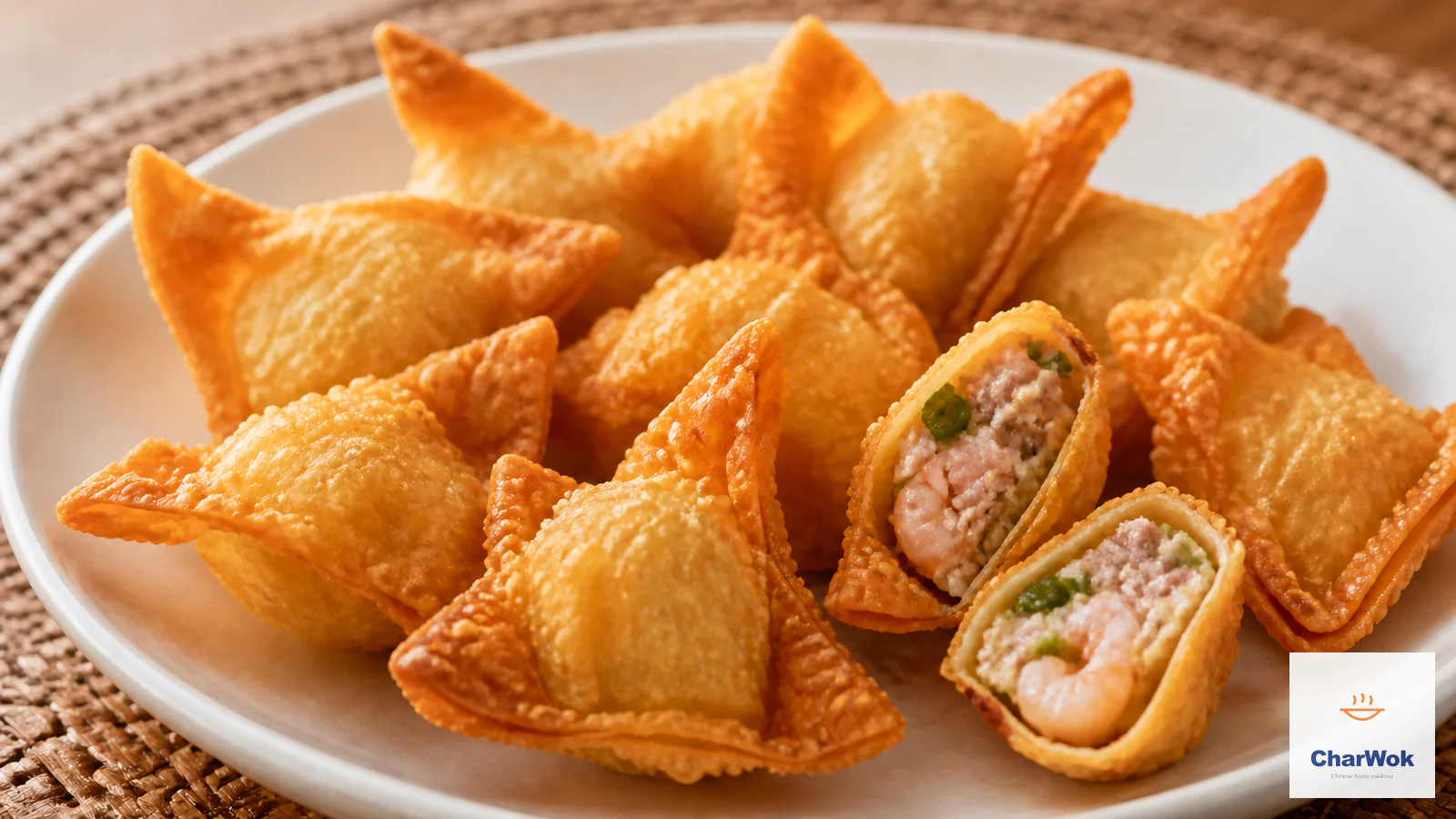
A good fried wonton needs a crisp wrapper and a juicy pork-and-shrimp filling. The filling stays moist when the pork absorbs the cold water before the shrimp is folded in; the parcel is safe to serve only after the centre reaches 160°F / 71°C.
Beat the water into the ground pork until it turns sticky and almost paste-like, then fold in the shrimp without crushing the pieces. The same filling works for deep-frying or air-frying, but colour and a fixed number of minutes are not reliable doneness tests.
At a glance. Beat 3 tablespoons of cold water into 8 oz / 225 g pork, keep the raw filling at 40°F / 4°C or below, and cook in small batches. Remove 2 to 3 of the largest wontons from different positions, insert a thin thermometer sideways into the filling, and require 160°F / 71°C in every sample before serving.
What a fried wonton is, and where the crisp comes from
Wontons appear in several regional Chinese styles. Cantonese wontons commonly use thin wrappers and may be served with egg noodles in wonton noodle soup; Sichuan red-oil wontons use a chile-and-soy dressing. This version uses a sealed pork-and-shrimp parcel cooked until crisp.
What separates a fried wonton from a boiled one is mostly the wrapper. Store-bought wonton skins are made from flour, water, and a little salt, sometimes with egg, and they are rolled extremely thin. Thin is what you want for soup, but for frying it is a double-edged sword: thin skins go brittle and glassy and shatter beautifully, but they also blister and split if the oil is too hot or the wonton has trapped air inside. The whole technique, from fold to fry, is about managing that tension.
The ingredients, and what you can swap
Ingredients at a glance
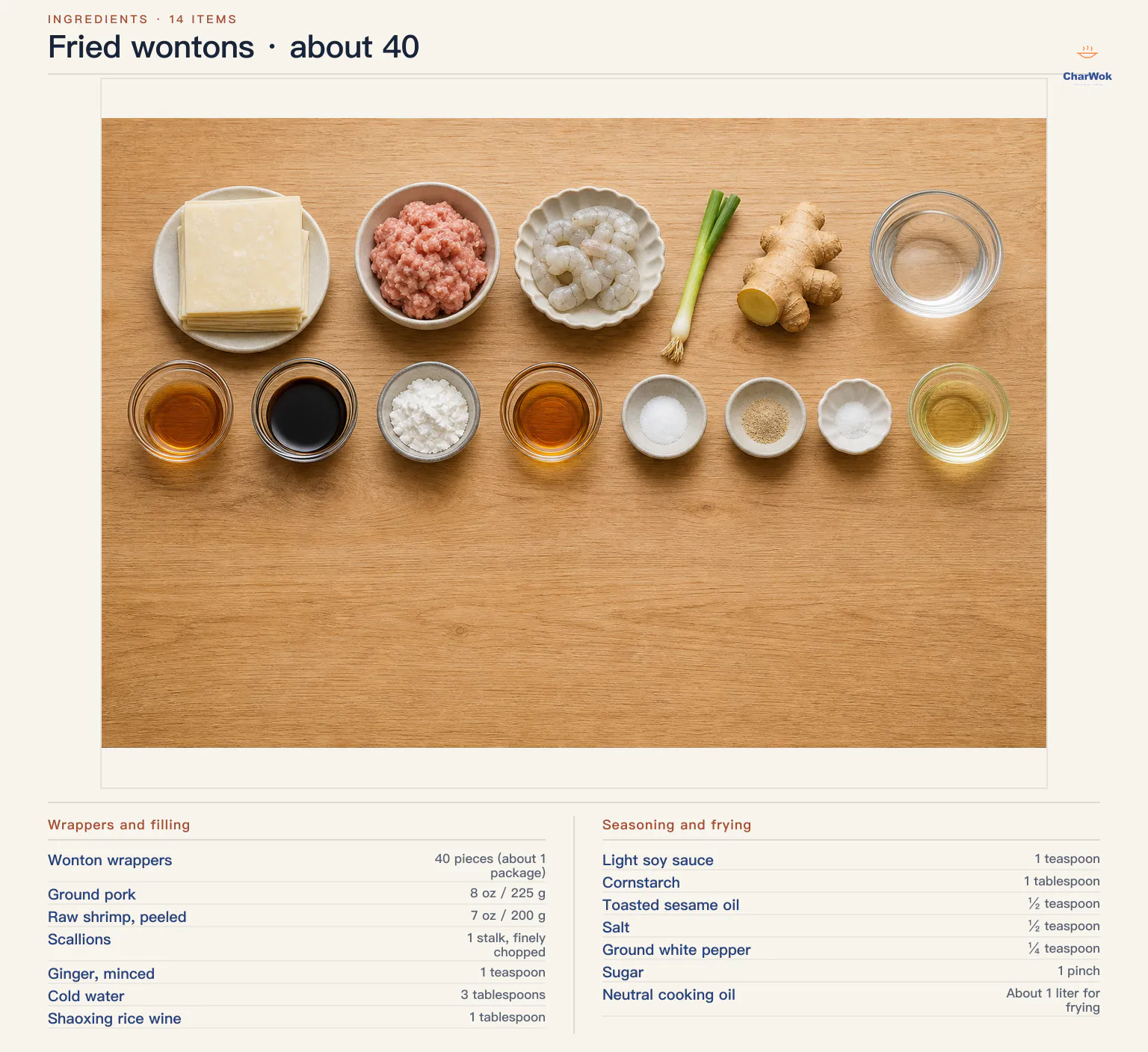
This recipe makes about 40 wontons with roughly equal weights of shrimp and pork. The filling method is similar to a dumpling filling: add cold liquid gradually and mix until the pork is cohesive before folding in the shrimp.
| Ingredient | Amount | Notes / substitute |
|---|---|---|
| Wonton wrappers | 40 pieces (about 1 package) | Find them frozen at Asian markets. Thaw overnight in the fridge. Or make homemade wonton wrappers if you want them slightly thicker for extra crunch. |
| Ground pork | 8 oz / 225 g | Use pork with some visible fat. This recipe does not treat poultry as a one-to-one substitute because ground poultry requires 165°F / 74°C. |
| Raw shrimp, peeled | 7 oz / 200 g | Cut into small cubes, do not mince. You want texture. For guidance on shrimp prep see the section below. |
| Scallions | 1 stalk, finely chopped | Green and white parts. Chives are a fine substitute. |
| Ginger, minced | 1 teaspoon | Fresh only. Powdered will not work here. |
| Cold water | 3 tablespoons | The hydration that makes the filling juicy. Do not skip. |
| Shaoxing rice wine | 1 tablespoon | Substitute dry sherry. Avoid cooking wine with added salt. |
| Light soy sauce | 1 teaspoon | Learn the difference between light and dark soy sauce before substituting; dark will stain the filling. |
| Cornstarch | 1 tablespoon | Helps the filling hold together. Potato starch works too. |
| Toasted sesame oil | ½ teaspoon | A little goes far. Read up on Chinese sesame oil if you are unsure which bottle to buy. |
| Salt | ½ teaspoon | Adjust if your soy sauce is very salty. |
| Ground white pepper | ¼ teaspoon | White pepper keeps the seasoning profile mild; black pepper tastes different but is safe to use. |
| Sugar | 1 pinch | Rounds the salt; you should not taste sweetness. |
| Neutral cooking oil | About 1 liter for frying | Choose an oil whose label supports frying above 180°C, such as peanut, canola, sunflower, or refined olive oil. |
The filling, step by step, and why each move matters
- Prep the shrimp the right way. Peel, devein, and pat the shrimp dry, then cut each one into 4 to 6 small pieces. Resist the urge to mince them into a paste. Whole chunks of shrimp give the filling little bursts of sweetness and a satisfying chew, which is exactly what you taste in a good pork-and-shrimp siu mai or har gow. Minced shrimp turns into anonymous protein.
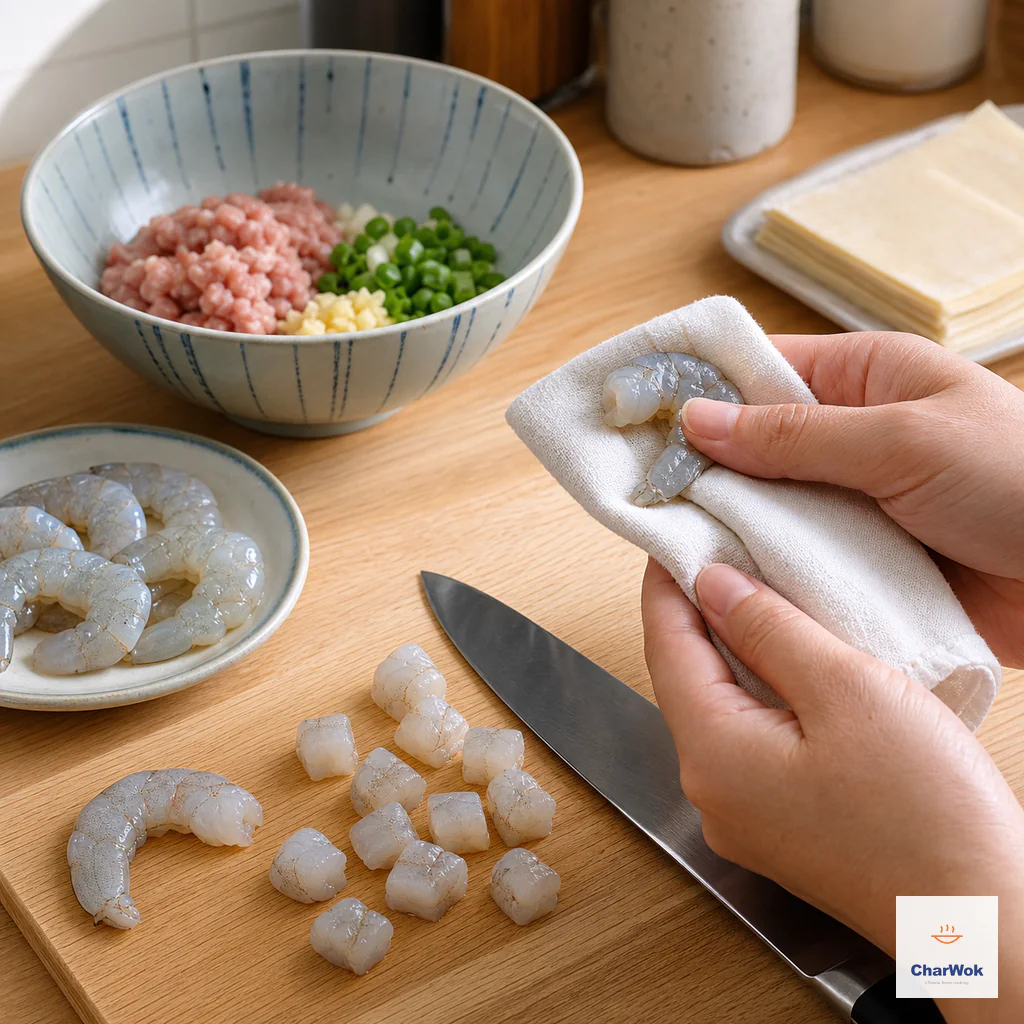
Pat the shrimp dry and cut each one into four to six pieces so every bite keeps its texture.
- Hydrate the pork first. Put the ground pork in a bowl and add the cold water in two or three doses. Mix continuously until each dose is absorbed and the pork looks sticky, slightly lighter in colour, and cohesive. A consistent direction makes the texture change easier to judge, but changing direction does not undo the mixture.
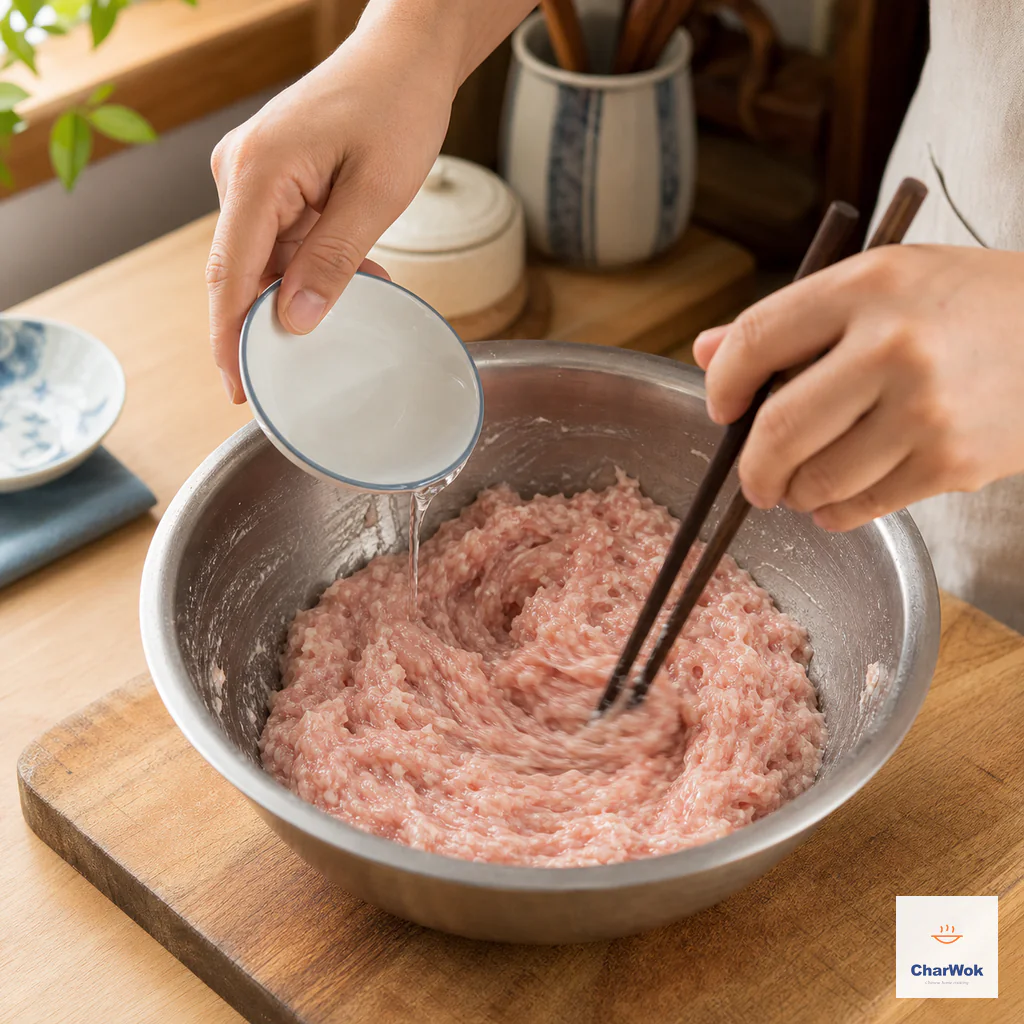
Beat in the water before anything else until the pork turns sticky, lighter and fully hydrated.
- Add the seasonings, then the aromatics. Once the pork is sticky, add the wine, soy sauce, cornstarch, sesame oil, salt, white pepper, and sugar. Mix until no free liquid remains, then fold in the ginger and scallions.
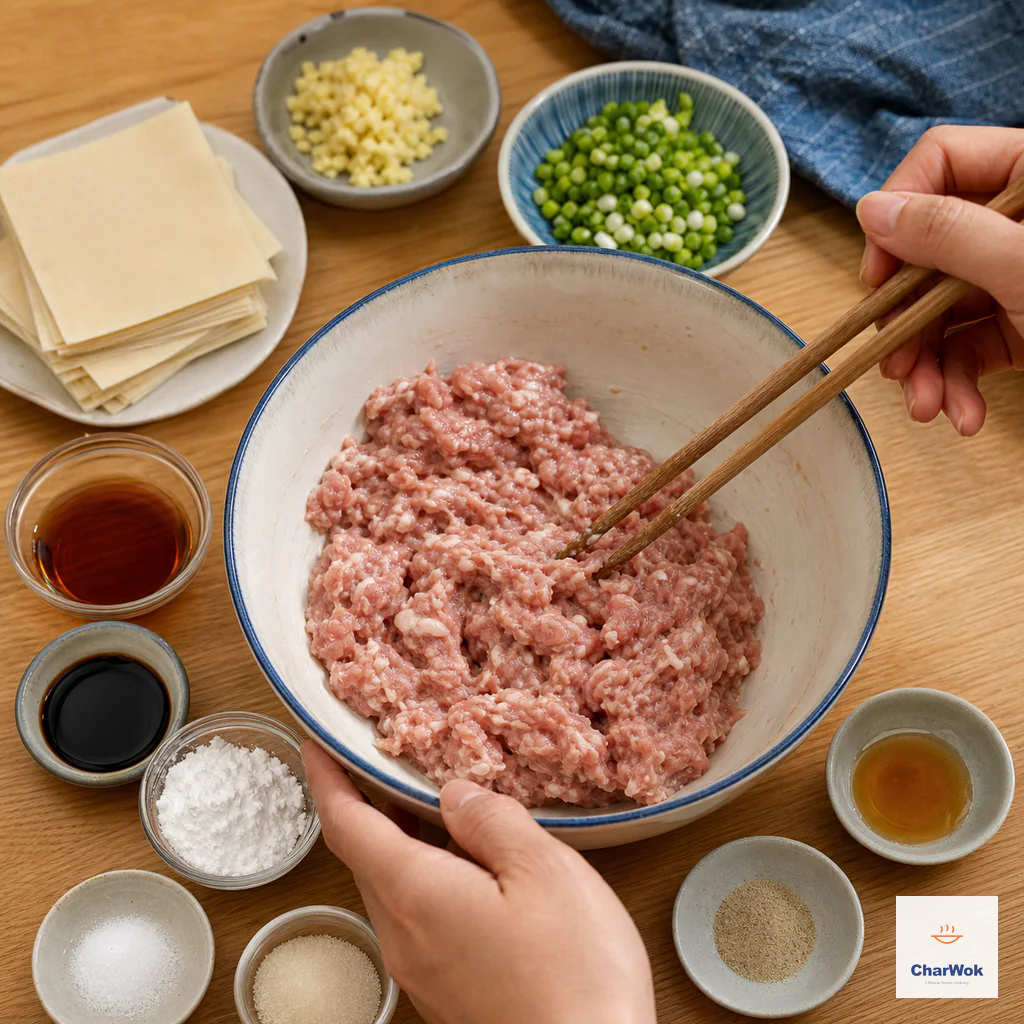
Mix the liquid and dry seasonings into the sticky pork, then fold in ginger and scallion.
- Fold in the shrimp gently. Add the shrimp cubes and fold just until distributed. Overmixing here breaks the chunks you worked to create. The filling is done when it looks glossy and holds a soft peak on a spoon.
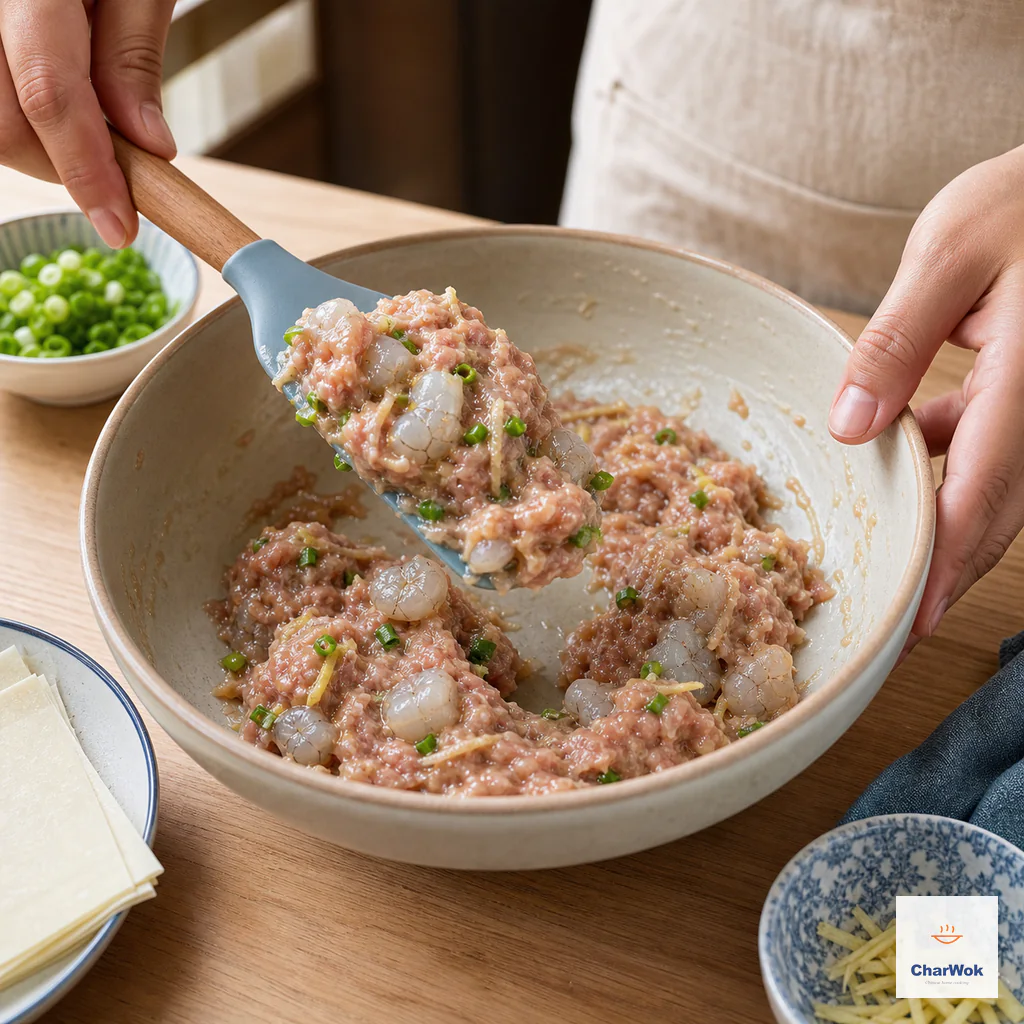
Fold just until the shrimp is distributed and the glossy filling holds a soft peak.
- Keep the filling cold. Cover and refrigerate it at 40°F / 4°C or below while setting up the wrappers. Cook or freeze the filling within one day, and wash hands, the bowl, and utensils before they touch cooked wontons, dips, or garnishes.
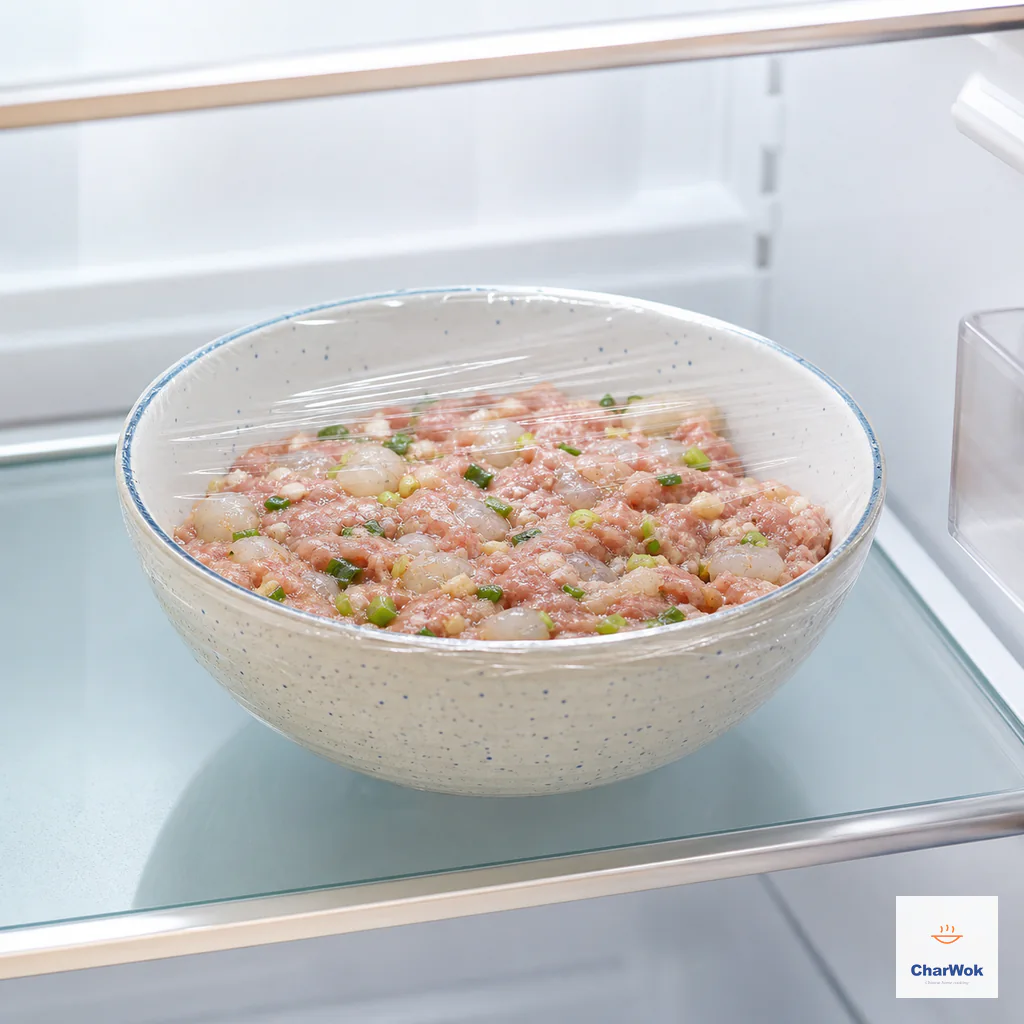
Keep the covered raw filling at 40°F / 4°C or below and cook or freeze it within one day.
Folding: the shape that fries best
There are several ways to fold a wonton; the wonton-folding guide shows six. For frying, use a compact parcel with no trapped air because expanding air can split the wrapper in hot oil.
- Lay a wrapper as a diamond in front of you. Keep the rest under a damp towel so they do not dry out. Dry wrappers crack instead of sealing.
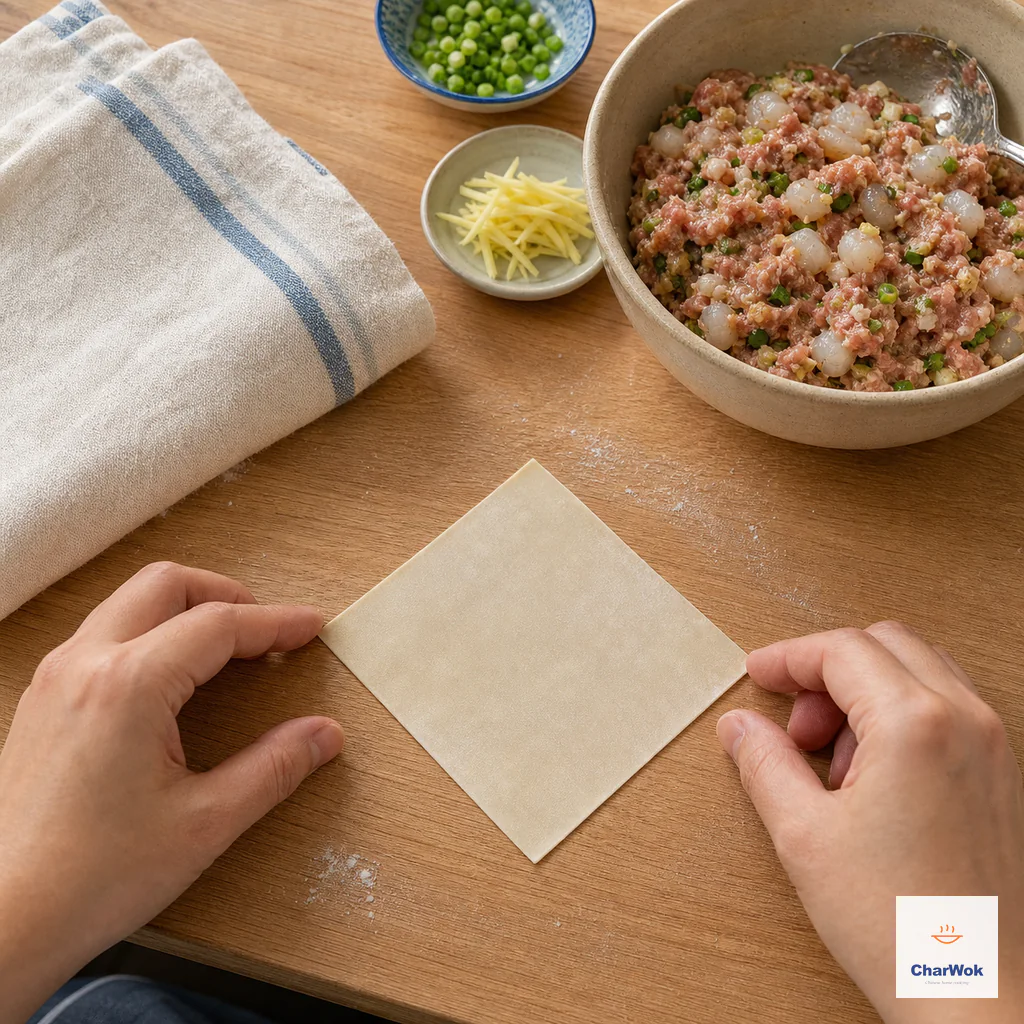
Work with one wrapper at a time and keep the rest covered so the edges stay pliable.
- Wet two adjacent edges with water. Use your finger or a small brush. Just the two edges that will meet, not the whole wrapper.
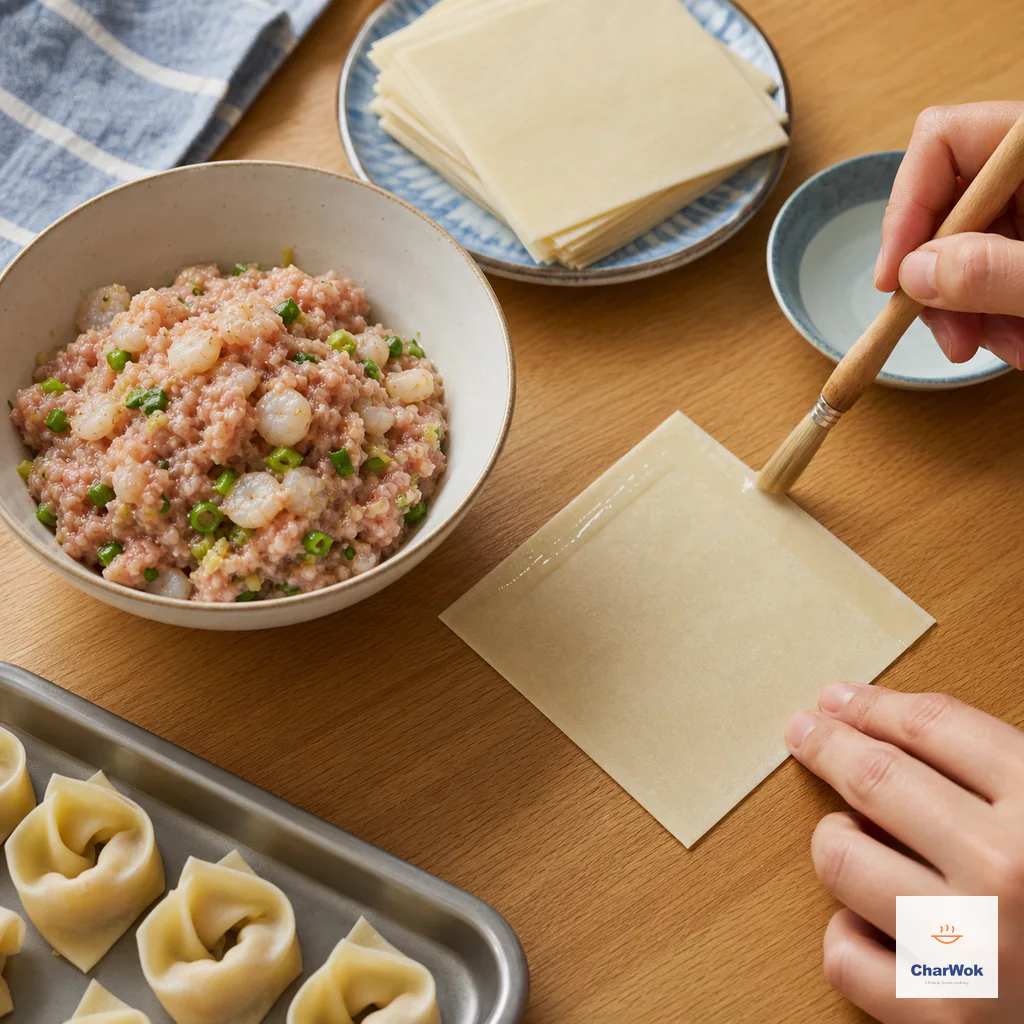
Moisten only the two edges that will meet; leave the center and other edges dry.
- Place a scant teaspoon of filling in the center. Overfilling is the number one cause of blowouts. Less is more here.
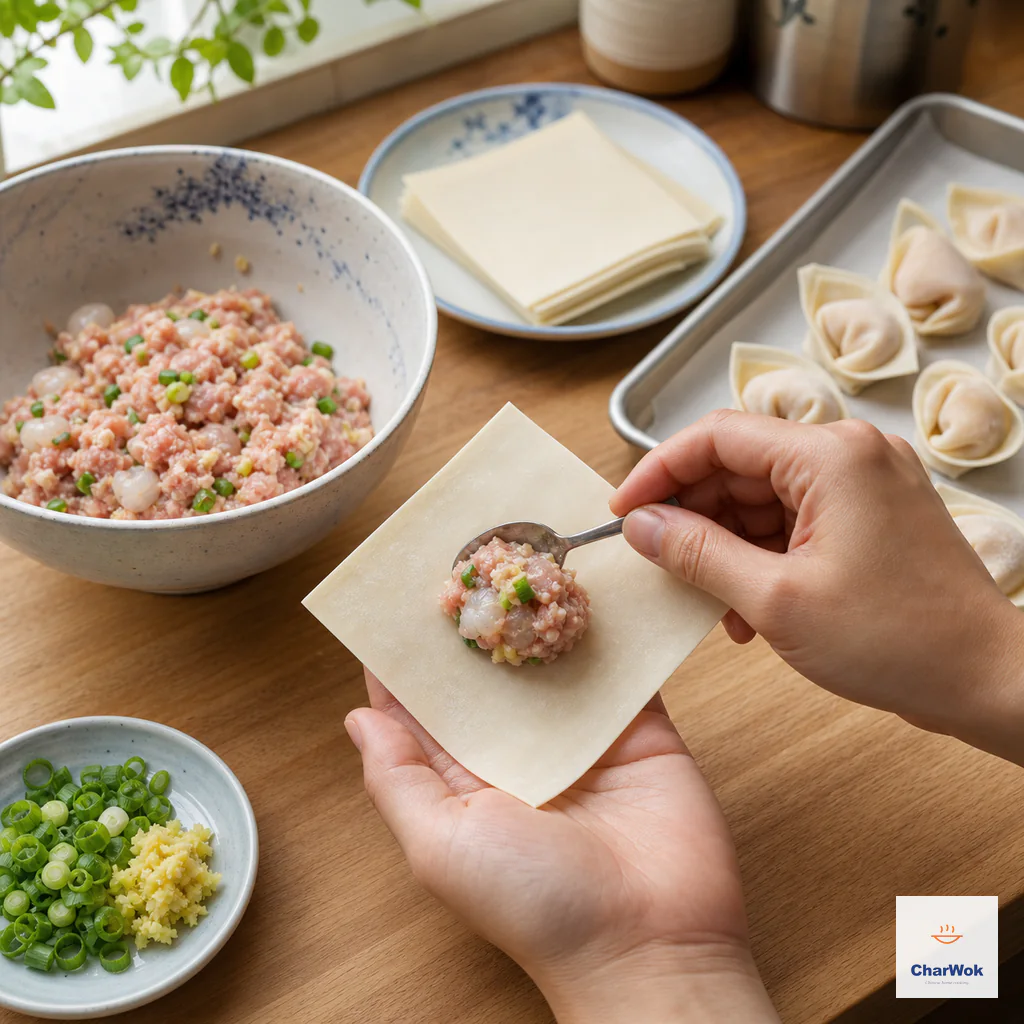
Keep the portion level and the sealing rim clean to prevent blowouts in hot oil.
- Fold into a triangle and press the air out. Bring the bottom corner up to the top corner, forming a triangle. Start sealing from the filling outward toward the edges, pushing air out ahead of the seal as you go. Press firmly along the two wet edges.
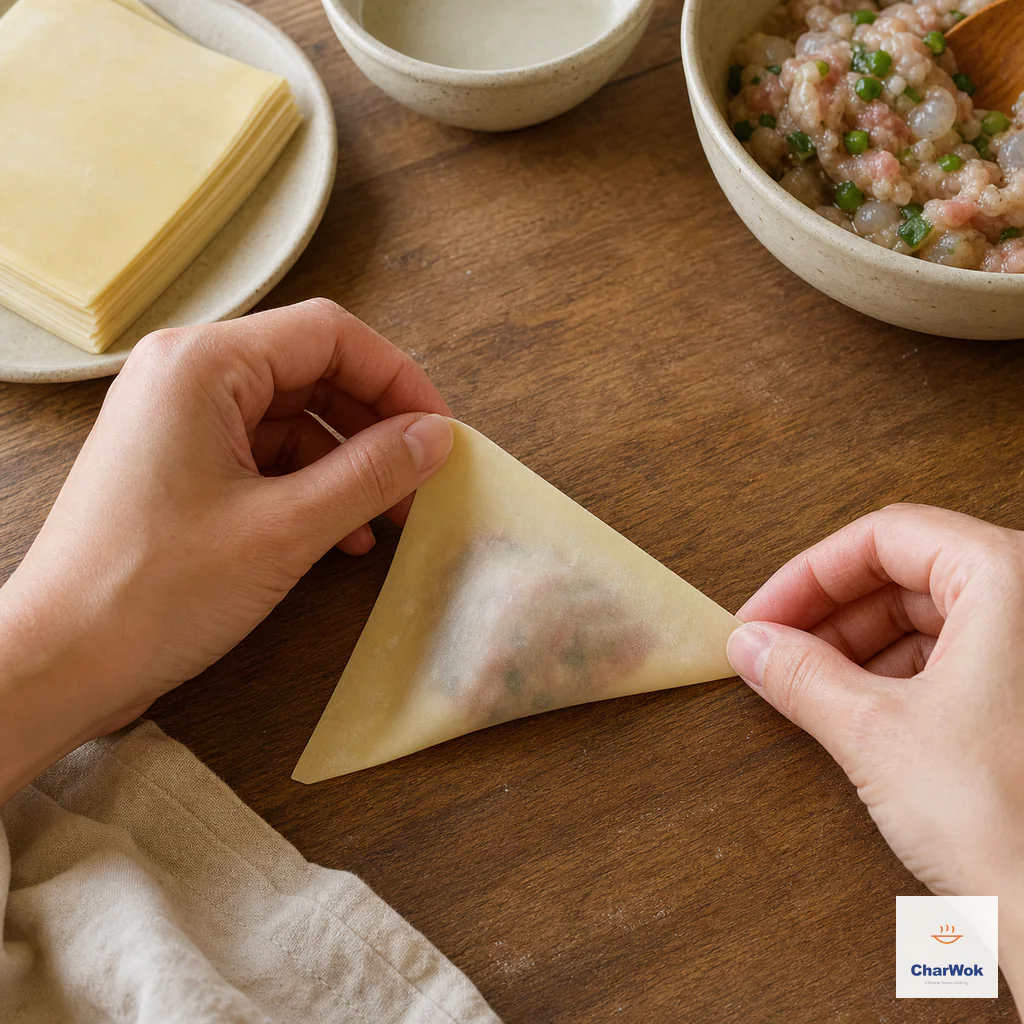
Bring the corners together, press outward around the filling and seal both wet edges firmly.
- Bring the two side corners together. Dab a little water on one of the two bottom corners of the triangle, then curl both side corners forward and overlap them, pressing to stick. You now have the classic ingot shape, compact and with minimal internal air.
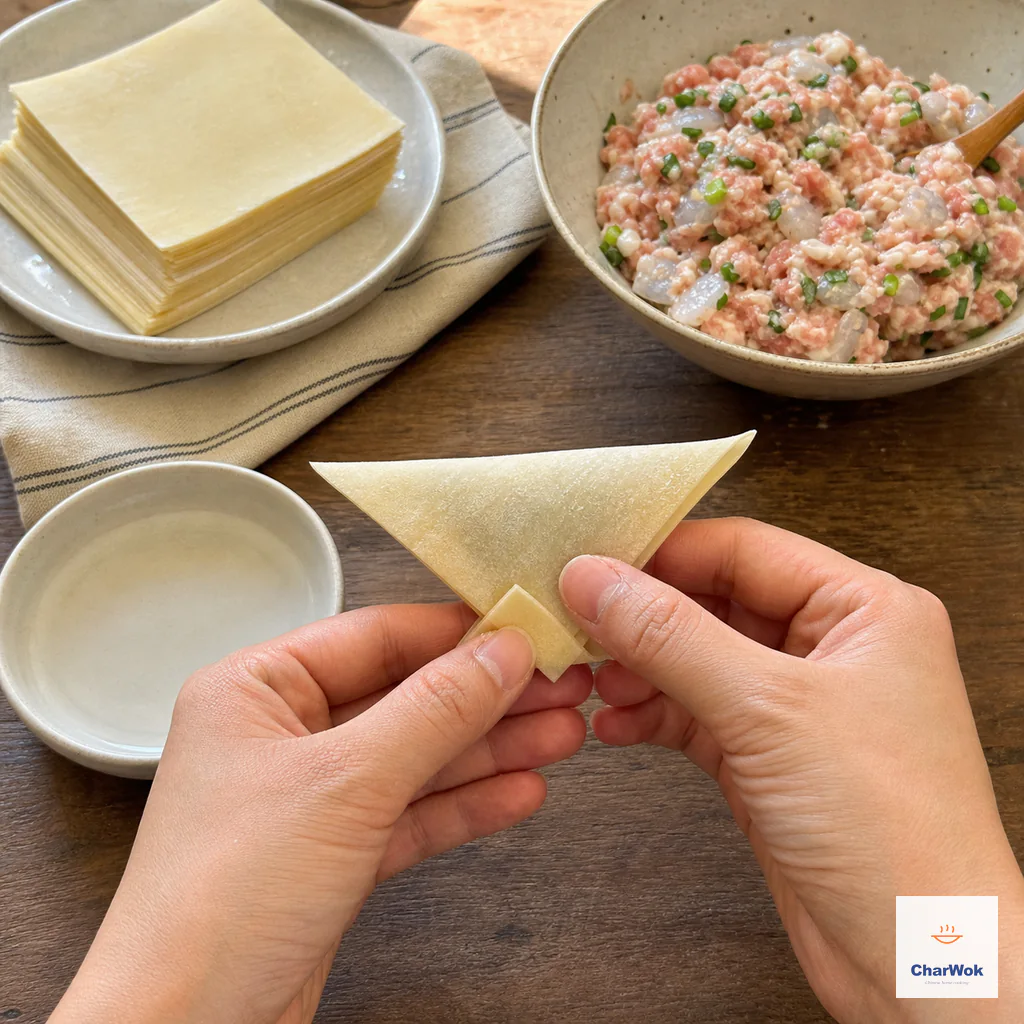
Wet one corner, overlap the pair and pinch until the compact parcel stays closed.
That curled ingot is what you see on restaurant platters, and it fries evenly because there are no tall air pockets. If you are new to this and the curl feels fiddly, a flat sealed triangle fries just fine, it just looks plainer. The same compact-no-air principle applies whether you are making these or a pan-fried chive pocket; the shape changes, the physics does not.
Deep-frying safely and checking the filling
Use a deep, heavy pot with about 5 cm / 2 inches of oil and plenty of empty space above it; the oil should fill no more than one-third of the pot. Keep the wontons dry, keep a lid nearby, and stay beside the stove. If the oil catches fire, turn off the heat if safe, cover the pot, and never use water. A thermometer is needed because wrapper colour cannot confirm that the pork filling is safe.
- Bring the oil to 180°C / 350°F. Adjust the burner as each batch cooks to keep the oil roughly between 170 and 180°C / 340 and 350°F instead of automatically turning it to low.
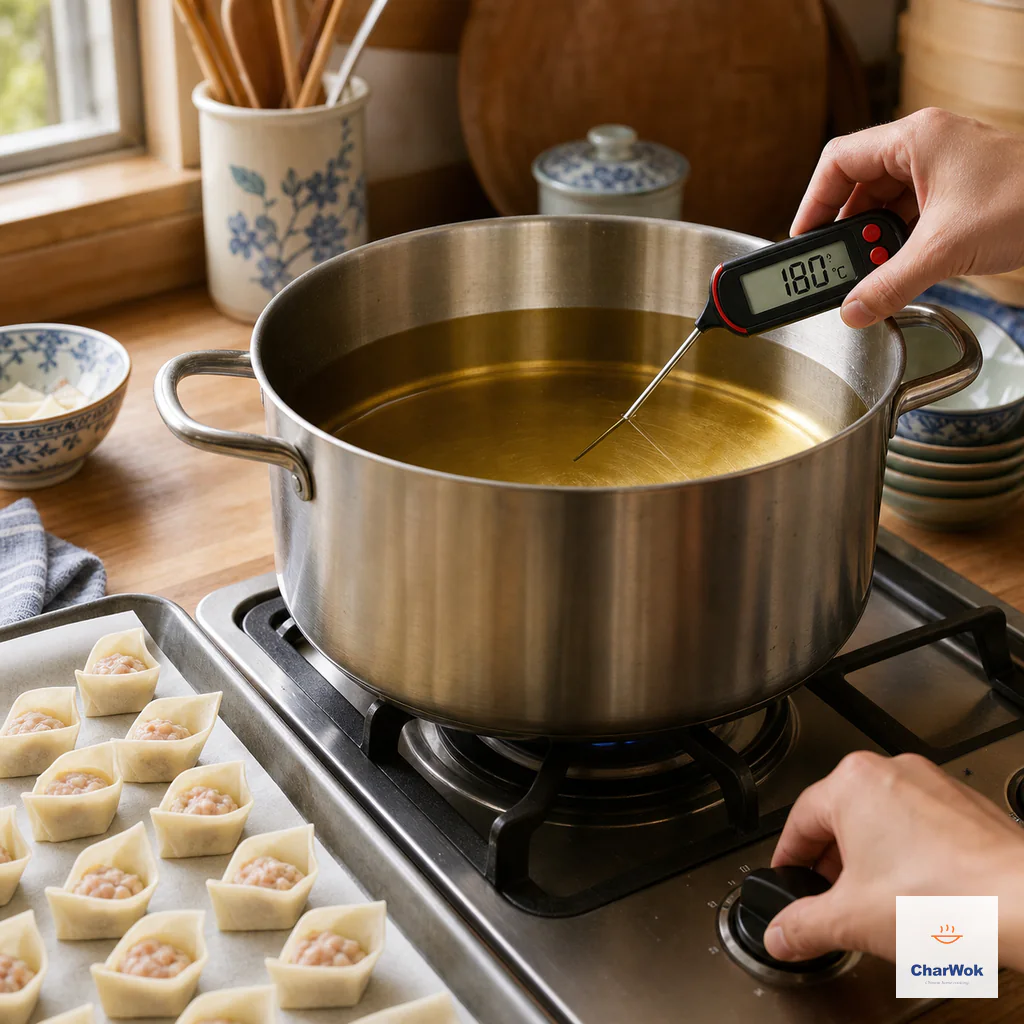
Reach 180°C, then adjust the burner throughout the batch to keep the oil between 170 and 180°C.
- Slide in six to eight wontons at a time. Use a slotted spoon or spider. Never drop them, or the oil splashes and the wontons stick to each other. Do not crowd the pot; each batch needs room to float freely so the oil temperature does not crash.
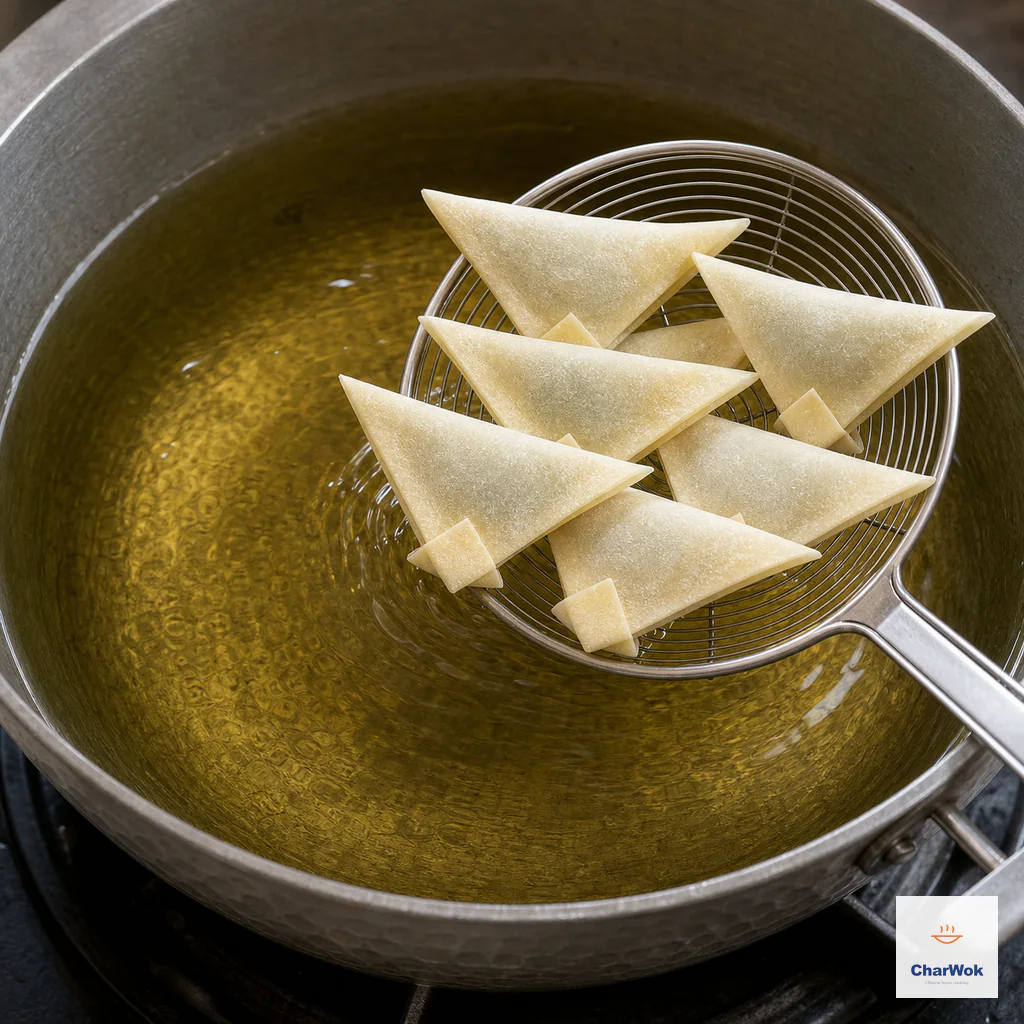
Slide in only six to eight at a time so every parcel has room and the temperature stays stable.
- Fry, nudging gently, then measure. Turn the wontons once or twice for even colour. Remove 2 to 3 of the largest from different pot positions to a clean plate; never measure while food is submerged. Insert a clean thin thermometer sideways into the filling. Every sample must reach 160°F / 71°C. If one is cooler, return the whole batch to the oil and recheck with a cleaned probe.
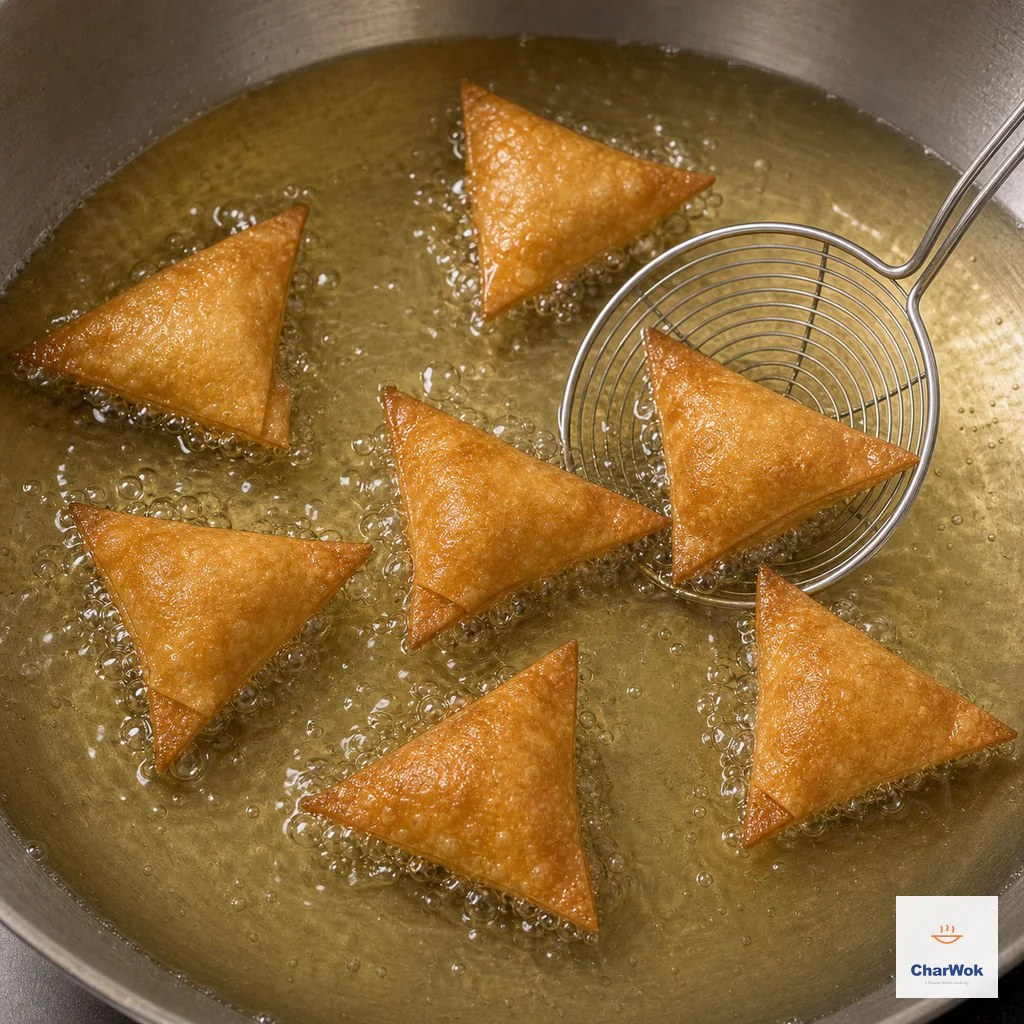
After even browning, remove 2 to 3 large wontons from different pot positions and require 160°F / 71°C in every filling centre.
- Drain on a rack, not paper. A wire rack lets air circulate underneath and keeps the bottom crisp. Paper towels steam the side they touch and soften it.
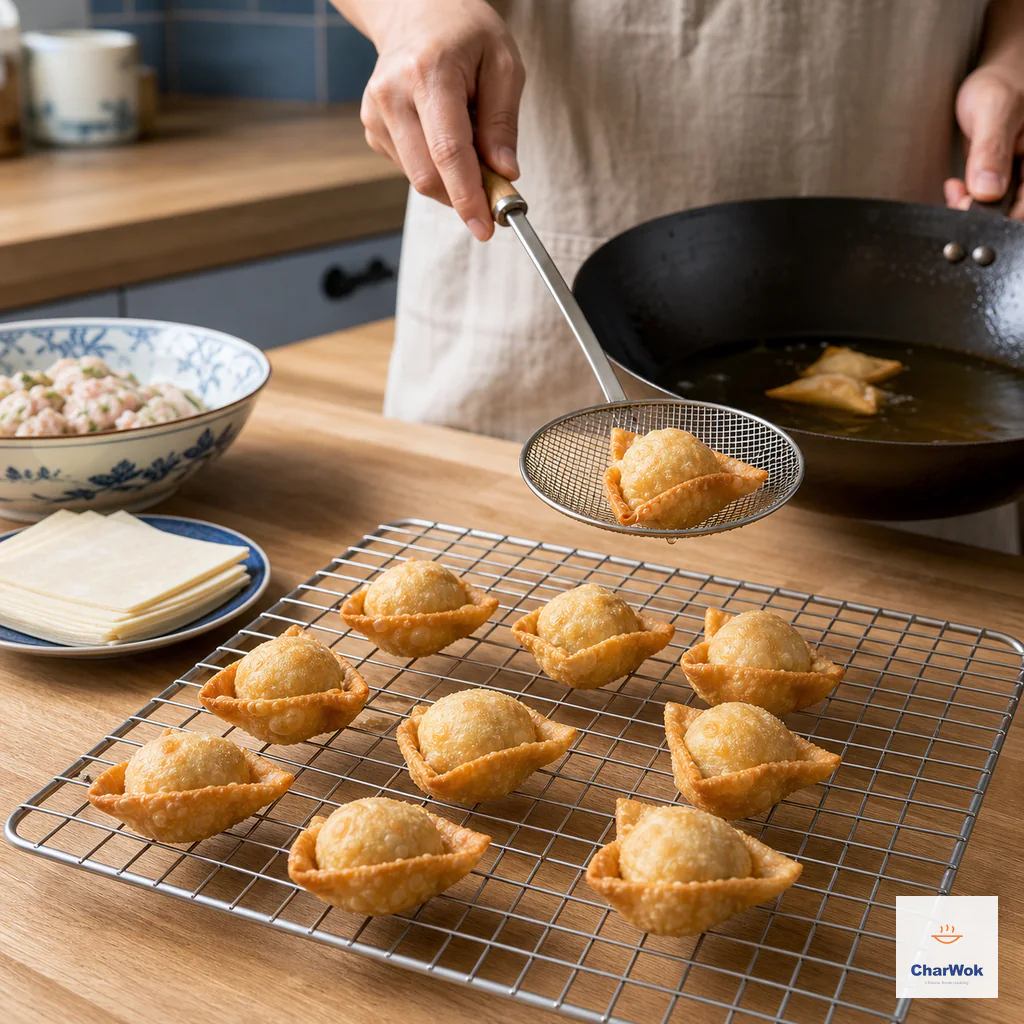
Let air circulate underneath; paper towels would trap steam and soften the bottom.
Let the oil return to 180°C before each batch. Keep raw wontons and their tray separate from the clean rack and utensils used for cooked wontons.
The air fryer shortcut, and when it actually wins
An air fryer produces a drier, less blistered wrapper than deep-frying. A thin coat of oil improves browning, but the pork-and-shrimp filling still needs the same measured 160°F / 71°C endpoint.
- Preheat to 190°C / 375°F. A hot cavity from the start is non-negotiable; cold-start air frying steams the wrappers limp.
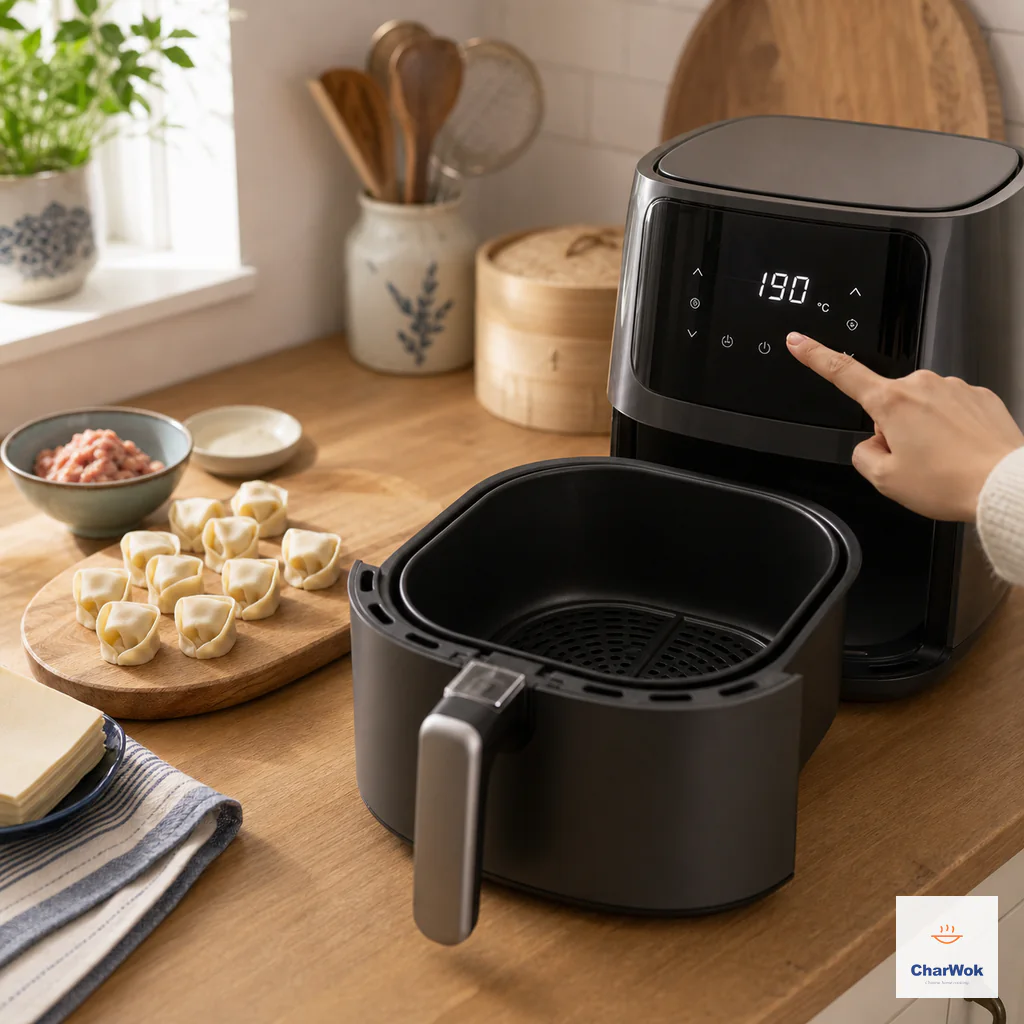
Preheat the empty air fryer completely before loading the first batch.
- Brush each wonton lightly with oil. Neutral oil, all sides, thin coat. This is the step that turns air frying from a disappointment into something close to deep-fried. Do not skip it.
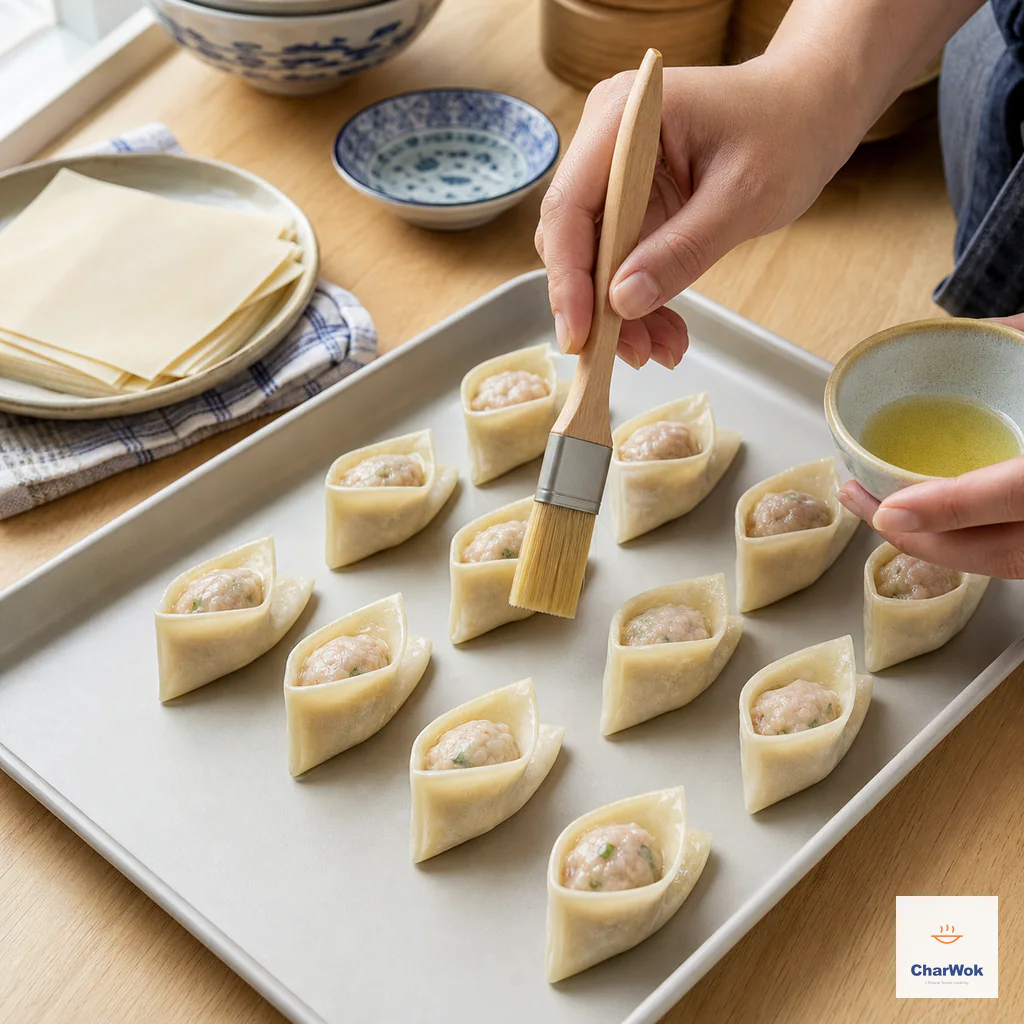
Brush every surface lightly; the thin oil film carries heat and promotes even browning.
- Lay them in a single layer, not touching. Overlap and you get pale, stuck-together patches.
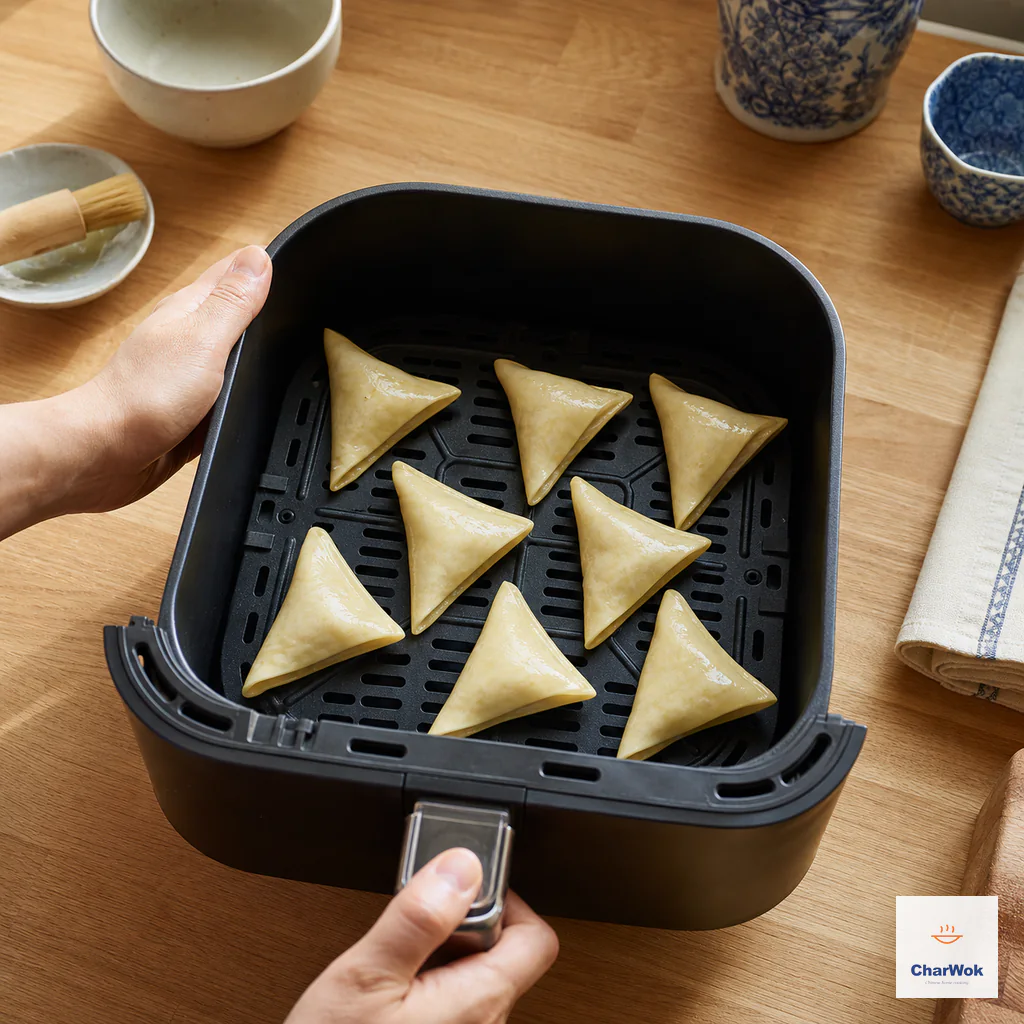
Leave visible gaps between parcels and never overlap them in the basket.
- Cook, flip, rotate, and measure. Five minutes before flipping and roughly two minutes after it are only first-check cues. Remove 2 to 3 of the largest wontons from different basket positions and check the filling sideways; every sample must reach 160°F / 71°C. Continue cooking and recheck if any one is cooler.
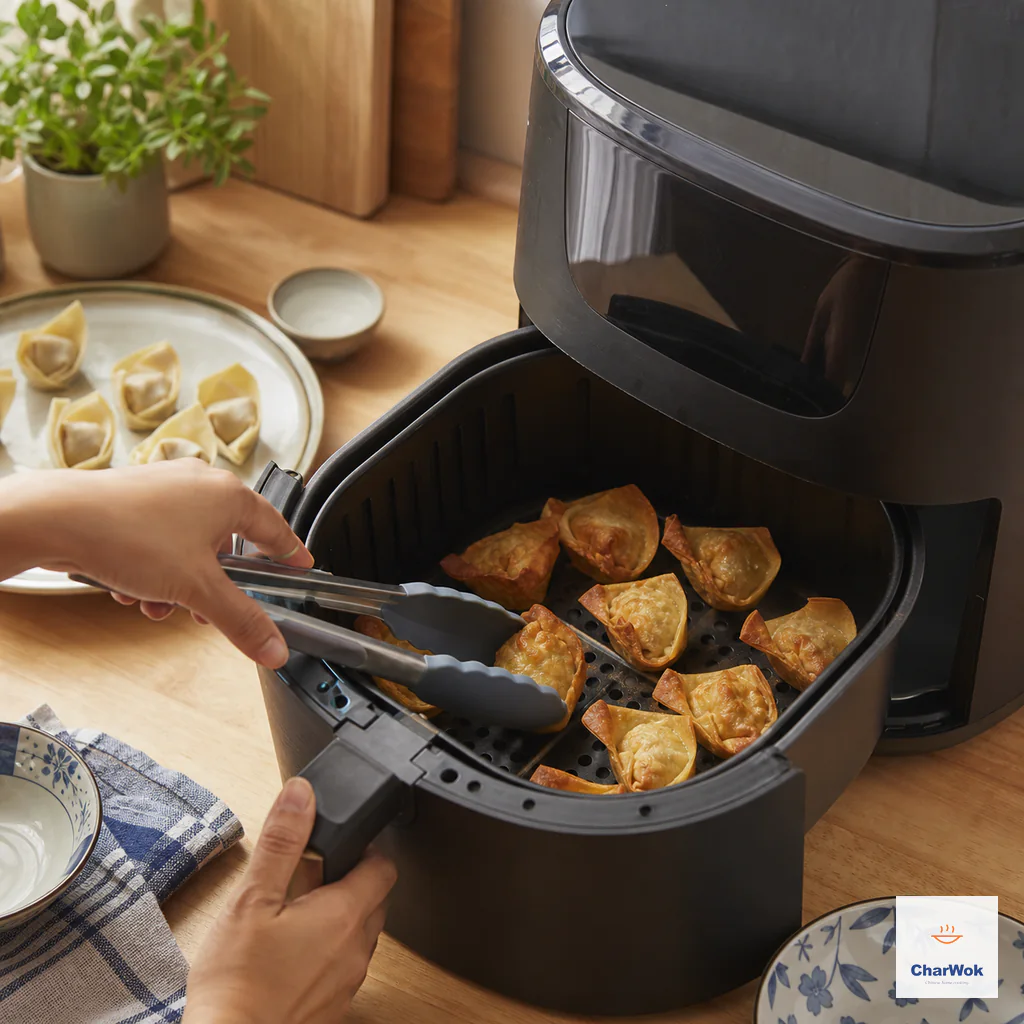
Flip and rotate, then check 2 to 3 large wontons from different basket positions and require 160°F / 71°C in every filling centre.
Choose the air fryer when easier oil handling matters more than a blistered shell. Deep-frying gives a more evenly puffed wrapper; air-frying uses less oil but needs enough spacing and rotation for even cooking. The shrimp toast guide uses another shallow-fried pork-free appetizer technique.
When things go wrong: troubleshooting
Most failures come from trapped air, filling that was not mixed until cohesive, or oil that drifted outside the target range.
- Wrappers split open in the oil. Two causes: trapped air, or overfilling. Next time, press the air out toward the edges as you seal, and use less filling per wonton, a level teaspoon is plenty.
- Filling is dry and dense. You skipped the water-beating step, or you used very lean pork. Re-read step 2 of the filling. The meat must look sticky and glossy before the shrimp goes in.
- Wontons are greasy and pale. The oil dropped too low, usually because you added too many at once or did not reheat between batches. Fry fewer per batch and wait for the thermometer to climb back to 180°C.
- Color is uneven, with dark blotches. Your oil is too hot, or the wontons are touching each other or the pot bottom. Lower the heat and give them room to float.
- Wrappers tear while folding. They dried out. Keep the stack under a damp towel, and work with one wrapper at a time. Frozen wrappers that were thawed and refrozen also turn brittle, so thaw once and use them.
- The seal pops open during frying. Not enough water on the edges, or grease on your fingers transferred to the wrapper. Wash and dry your hands between every few wontons.
Fried wontons soften as moisture moves from the filling into the wrapper. Fry them near serving time and leave them in one layer on a rack instead of stacking them.
Variations and what to serve them with
The pork-and-shrimp filling can be adjusted, but a change of protein may also change the safe temperature.
- Pork only. Drop the shrimp and use 15 oz / 425 g pork. Add a tablespoon of finely diced water chestnut for crunch. This is closer to the filling in lion's head meatballs and makes a very forgiving, cheap wonton.
- Shrimp-forward. Flip the ratio to two parts shrimp, one part pork. The texture is more delicate and the flavor cleaner; this is the spirit of a salt and pepper shrimp dish wrapped up.
- Ground poultry. Chicken or turkey is not a one-to-one safety substitution. Keep it at 40°F / 4°C or below and require 165°F / 74°C in every sampled filling centre.
- Spicy dipping duo. Serve with a Chiu Chow chili oil for the adults and sweet chili sauce for anyone who wants milder heat. The garlic-chili version cuts through the richness of fried dough better than a soy-based dip.
- Build a platter. Fried wontons are a natural opener for a noodle night. Pair them with a bowl of wonton soup for the boiled-versus-fried contrast, or set them alongside a stir-fried main.
Storing and reheating
Freeze uncooked wontons in a single layer, then transfer them to a sealed bag once solid and use within one month for the best wrapper quality. Before frying, thaw them overnight in the refrigerator and blot away exterior moisture; never thaw raw pork-and-shrimp wontons at room temperature. Cook by measured centre temperature rather than adding a fixed minute.
Refrigerate fried leftovers in a shallow container within 2 hours, or within 1 hour above 90°F / 32°C, and use within 3 to 4 days. Reheat in an air fryer or oven until the filling reaches 165°F / 74°C; fixed reheating minutes vary by appliance and batch size. See the USDA leftovers guidance.
Frequently asked questions
These answers cover the most common cooking and make-ahead decisions.
Can I bake these instead of deep-frying or air-frying? Yes. Brush them with oil and bake at 200°C / 400°F in a single layer. Start checking around 10 minutes, then measure 2 to 3 of the largest wontons from different tray positions; every pork-and-shrimp filling centre must reach 160°F / 71°C.
Do I have to stir the filling in one direction? No. Continuous mixing helps salted pork absorb the cold water and become cohesive. One direction makes the texture change easier to judge, but the useful finish line is no free liquid and a sticky filling that holds together.
Can I use store-bought dumpling wrappers instead of wonton wrappers? Not ideally. Dumpling wrappers are thicker and doughier, built for boiling or pan-frying. Fried, they turn hard instead of shattery. Wonton wrappers are worth seeking out; the thinness is the whole point.
How do I know the oil is ready without a thermometer? Bubbles around a wooden chopstick cannot verify an exact oil temperature. Use a thermometer to reach 180°C / 350°F, then adjust the burner to stay near 170 to 180°C / 340 to 350°F.
Can I make the filling ahead? Yes. Keep it covered at 40°F / 4°C or below and cook or freeze it within one day. Keep raw filling, hands, tools, and trays away from cooked wontons and ready-to-eat dips.
How do I know fried wontons are cooked? Golden colour is only a texture cue. Remove 2 to 3 of the largest wontons from different cooking positions, set them on a clean plate, and insert a thin thermometer sideways into the filling. Every pork-and-shrimp centre must reach 160°F / 71°C; if any one is cooler, continue cooking the whole batch and recheck.
Serve the wontons only after every sampled filling centre reaches 160°F / 71°C. Keep them in one layer on a rack so the wrappers stay crisp, then add a dipping sauce at the table.