You folded a beautiful tray of dumplings. Now comes the part that wrecks more batches than folding ever did: the cooking. The wrapper splits in the pot. The bottoms burn while the tops stay raw. The pleats collapse into a soggy crease. Almost none of these failures are about your filling or your pleating. They are about heat, water, and timing, and once you can read what the pot and the pan are telling you, the same dumplings cook perfectly every time.
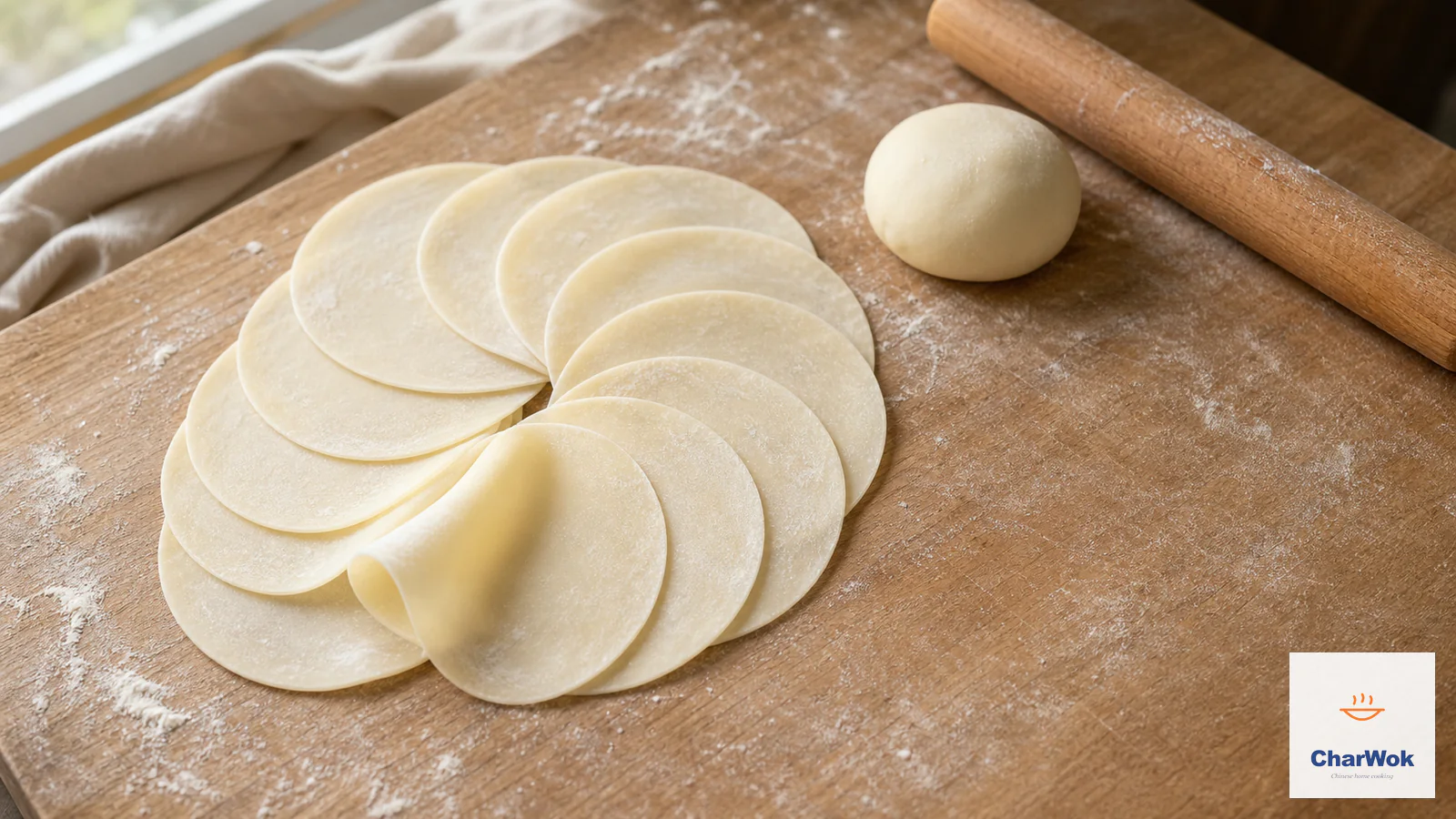
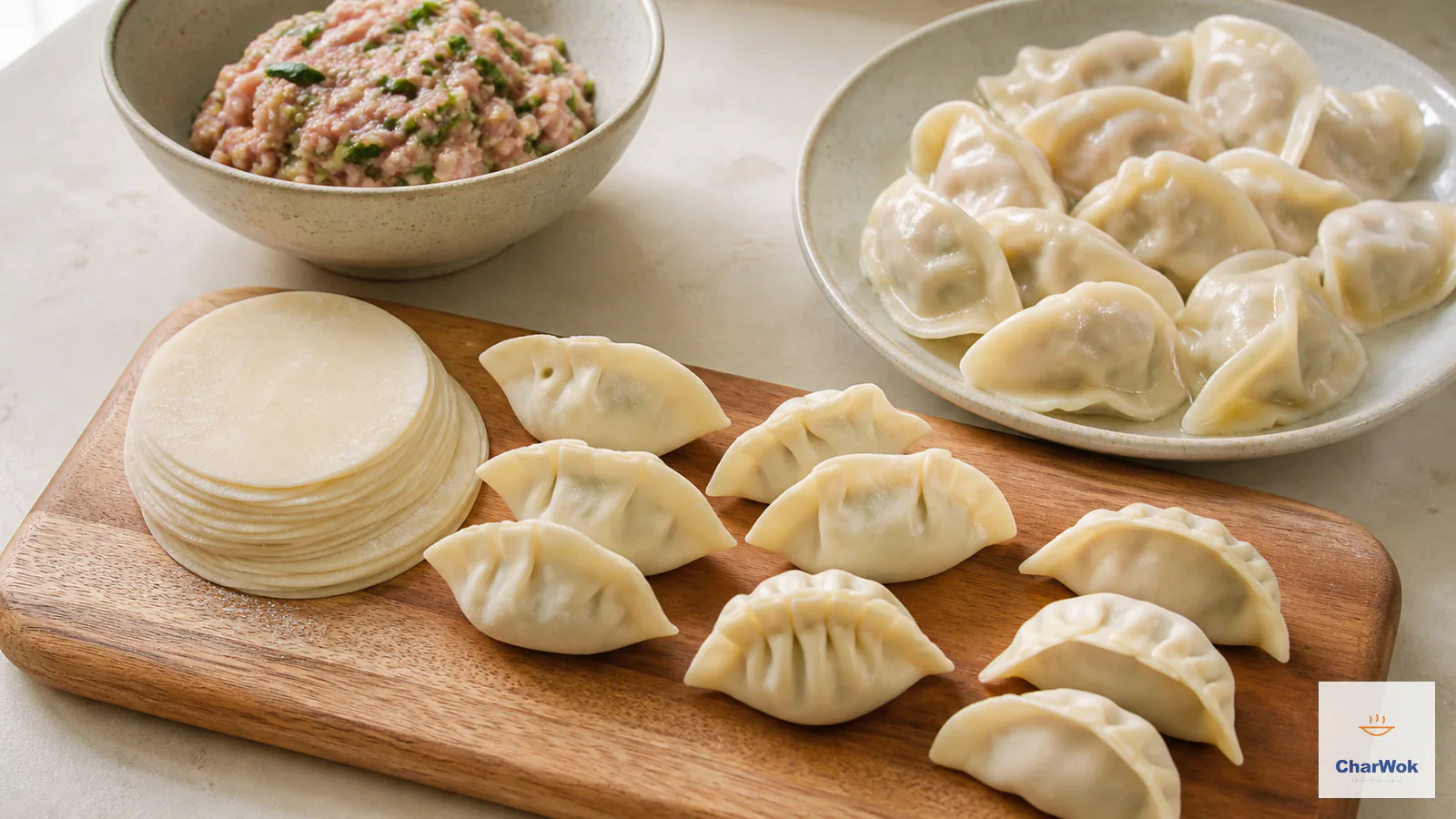
This is the last piece of the dumpling-making process. If you arrived here with a tray you already filled, you can skip straight to the three methods below. If you are still building the tray, the parts that decide how the dumpling survives cooking are the wrapper and the dough hydration: read up on how to make dumpling wrappers and how to season a juicy filling that won't soak the dough before you commit to a method.
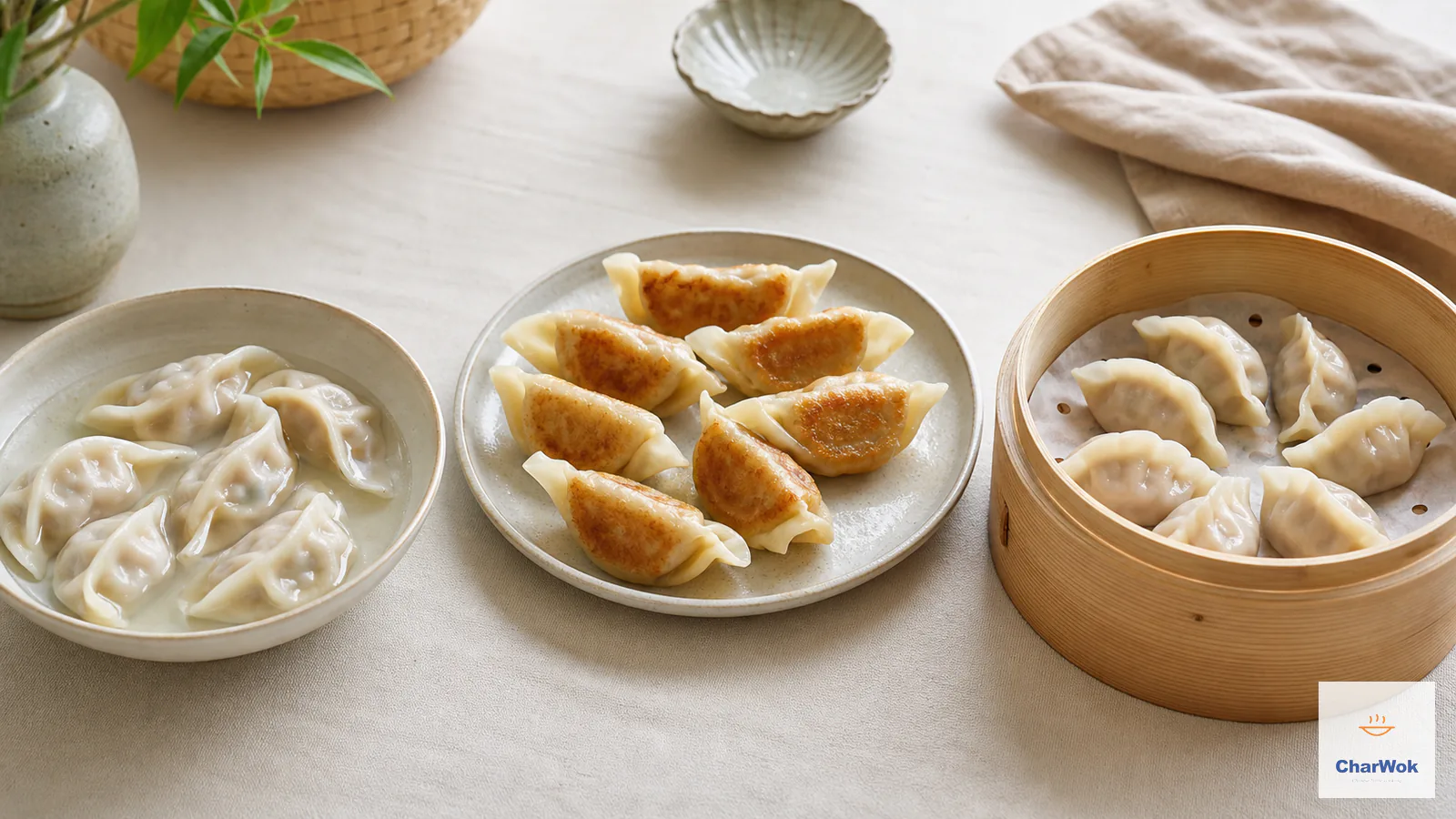
Three methods, one finish line: cook the centre of the filling to the temperature required for what is inside. The cold-water cycles, covered steam and wrapper appearance tell you when to start checking; they do not prove a raw meat filling is safe.
What each method is actually doing
Every method has to solve the same physics problem. The filling is dense and wet; the wrapper is thin starch. If you blast both with dry heat, the wrapper desiccates and splits long before the centre of a raw filling is safe to eat. So Chinese cooking uses water. Boiling carries heat in by convection. Pan-frying sears the bottom in oil for flavor, then adds water and a lid so trapped steam finishes the top and filling. Steaming skips the oil and uses water vapor. In all three, moisture keeps the wrapper supple while heat moves into the centre.
That is also why you add cold water during boiling rather than turning the heat down. Dropping the boil stops the violent convection that bashes dumplings against each other and tears wrappers, but the pot is still hot enough to climb back to a boil and push heat into the center. You get the gentleness of a simmer with the throughput of a boil.
What you need
Ingredients at a glance
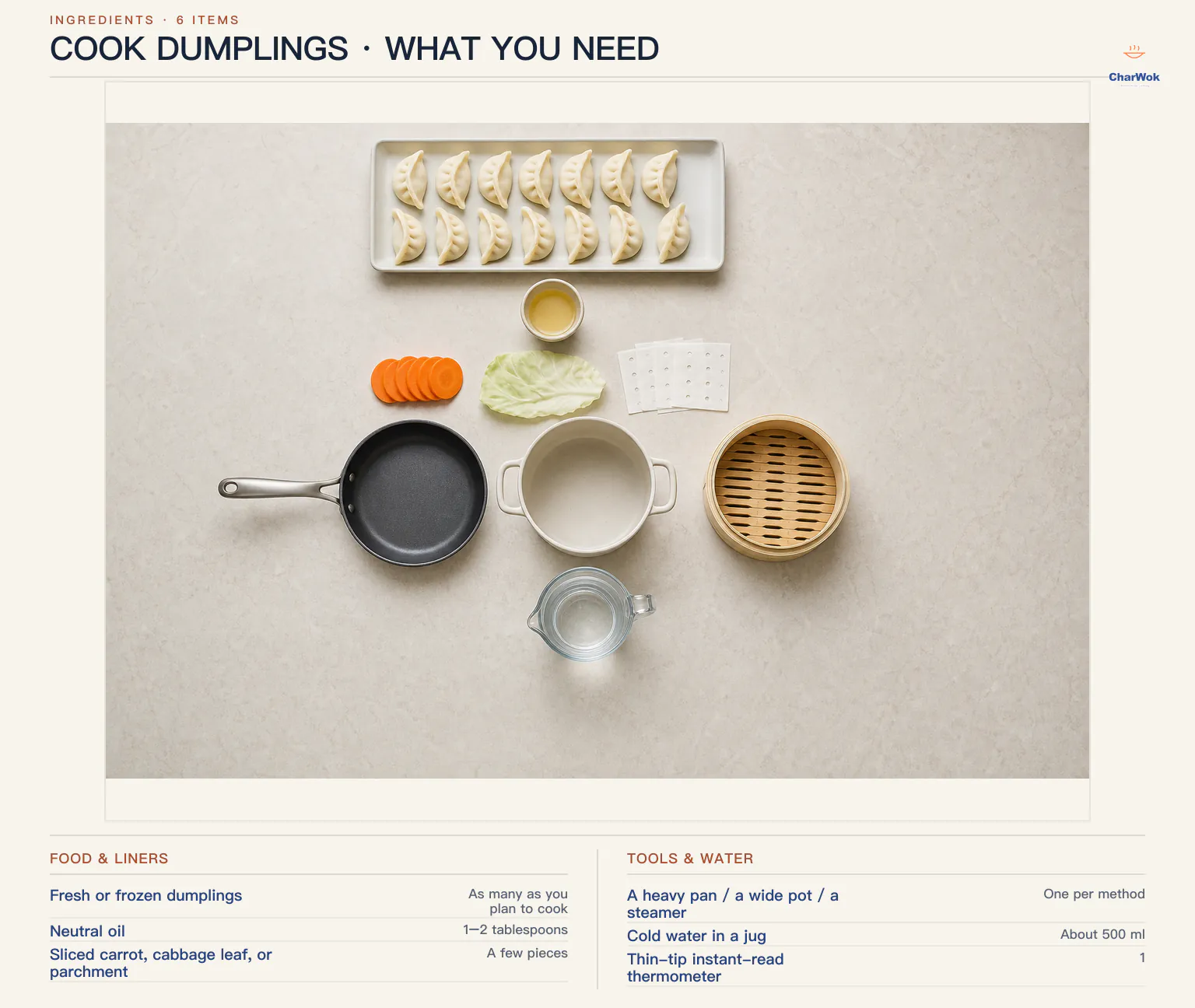
| Item | Amount / spec | Notes |
|---|---|---|
| Fresh or frozen dumplings | As many as you plan to cook | Any wheat-flour wrapper works. Starch-based wrappers (har gow style) steam only; don't boil or pan-fry them. |
| Neutral oil | 1–2 tablespoons | For pan-frying only. Canola, vegetable or peanut oil keeps the flavour neutral. If any oil smokes, turn off the burner and let the pan cool. |
| Sliced carrot, cabbage leaf, or parchment | A few pieces | For steaming only. Keeps the dumplings from welding themselves to the basket. |
| A heavy pan / a wide pot / a steamer | One per method | Heavy-bottomed and nonstick are the two features that save pan-fried dumplings. See the steamer guide for setup. |
| Cold water in a jug | About 500 ml | For the boiling and pan-frying methods. Tap water is fine if it's drinkable. |
| Thin-tip instant-read thermometer | 1 | Insert it through the side of a large dumpling into the centre of the filling. Clean the probe before and after every check. |
Safe internal temperature by filling
Use the wrapper and the clock to protect texture, then use a clean thermometer to confirm the filling. Check two or three of the largest dumplings from different parts of the pot, pan or steamer. Insert a thin probe through the side into the centre without pushing it through the far side. For a mixed filling, use the highest temperature that applies; if a package gives a higher target, follow the package.
| Filling | Minimum centre temperature |
|---|---|
| Chicken, turkey or any filling containing poultry | 74°C / 165°F |
| Ground pork, beef, lamb or a mixture of these | 71°C / 160°F |
| Egg-based filling without poultry | 71°C / 160°F |
| Fish or shellfish without poultry or ground meat | 63°C / 145°F |
| Plant-only or already fully cooked filling | Follow the recipe or package and heat the centre thoroughly |
Method one: boiling (the everyday one)
Boiled dumplings, shui jiao, are what most northern Chinese households actually eat on a weeknight. The wrapper is soft with a slight chew, and there is no oil to muddy the flavor of the filling. This is also the method that punishes a thin or under-rested wrapper most harshly, so it is not the place to show off gossamer dough. If you folded pork and napa cabbage dumplings for boiling, roll them a touch thicker than you would for steaming.
- Fill a large pot and bring it to a rolling boil. Use more water than feels reasonable, at least 2 liters for one tray. A big volume of water barely drops in temperature when the dumplings go in, which keeps the boil alive and the wrappers moving.
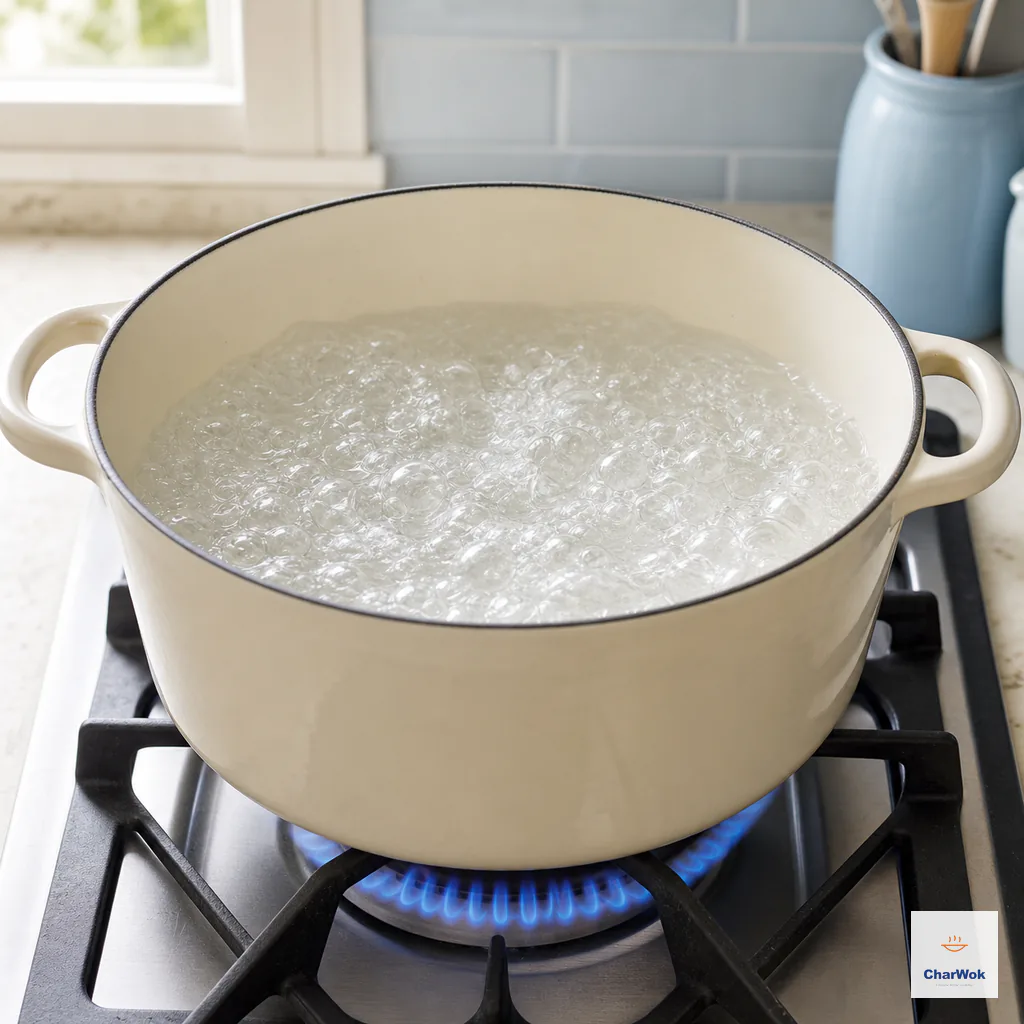
Bring at least 2 litres of water to a true rolling boil so one tray of dumplings has room to move and the temperature stays high when they enter.
- Slide the dumplings in one at a time along the edge. Do not drop them from a height. Stir immediately and gently with the back of a ladle, pushing along the bottom, so nothing glues itself to the pot before the starch gelatinizes.
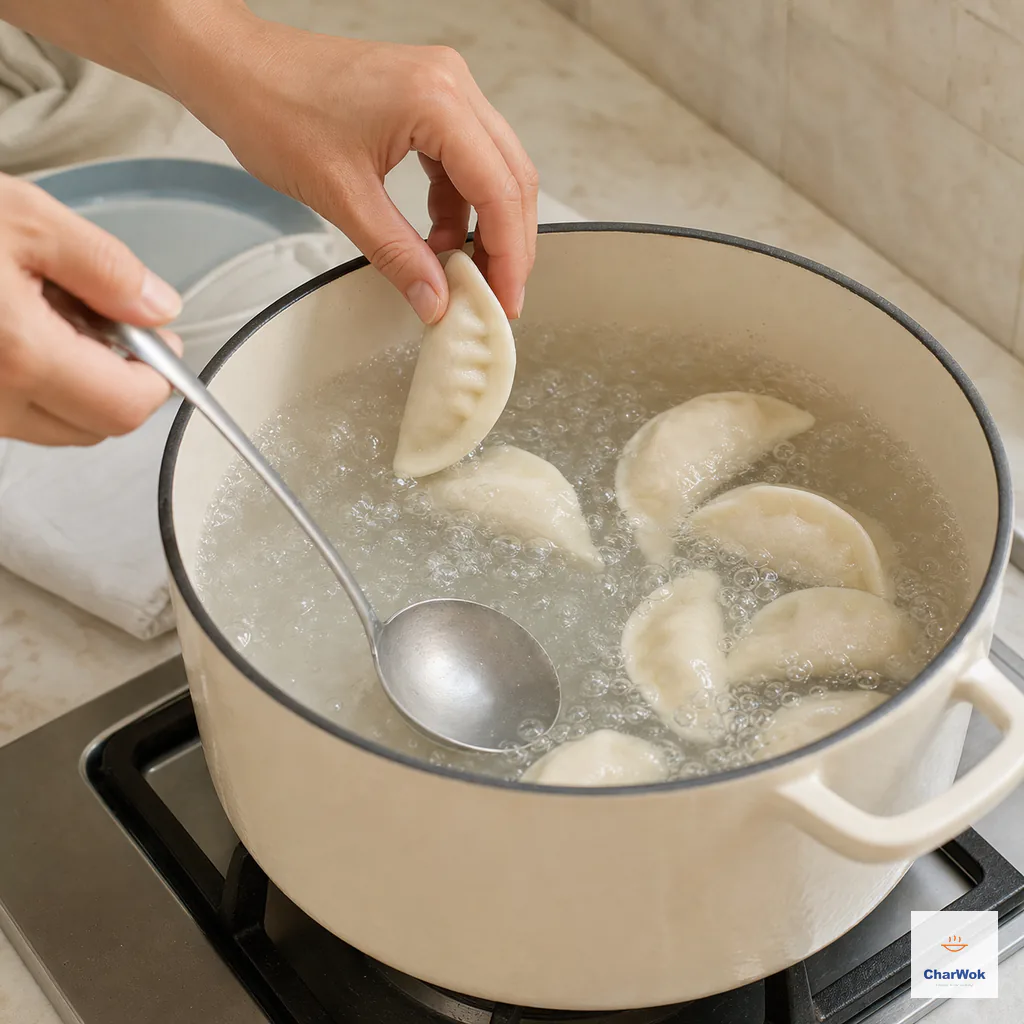
Slide each dumpling in close to the inner edge, then make one gentle sweep along the bottom with the back of a ladle before the starch can stick.
- Cover and wait for a full boil to return. The dumplings will rise partway. Tilt the lid away from you, slowly pour about 120 ml (½ cup) of cold water down the inside wall of the pot, then cover again.
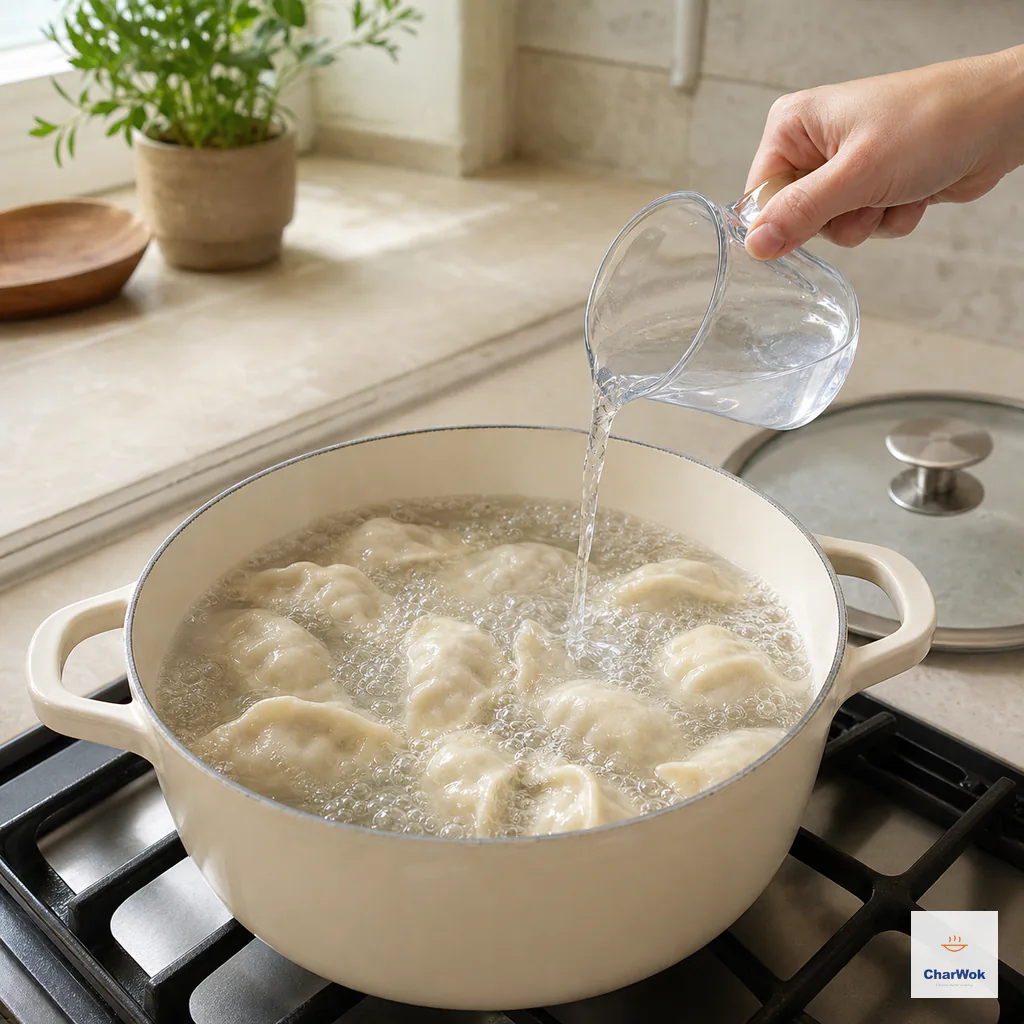
When the covered pot returns to a hard boil, add about 120 millilitres or half a cup cold water to calm the convection, then cover again.
- Repeat the cold-water addition twice more, then measure. Three additions total, each when the pot returns to a hard boil. Floating, swelling and translucent pleats mean the wrapper is ready and it is time to check—not that a raw filling is done. Test two or three large dumplings against the filling table above. If one is below its target, simmer for another minute and check again with a cleaned probe.
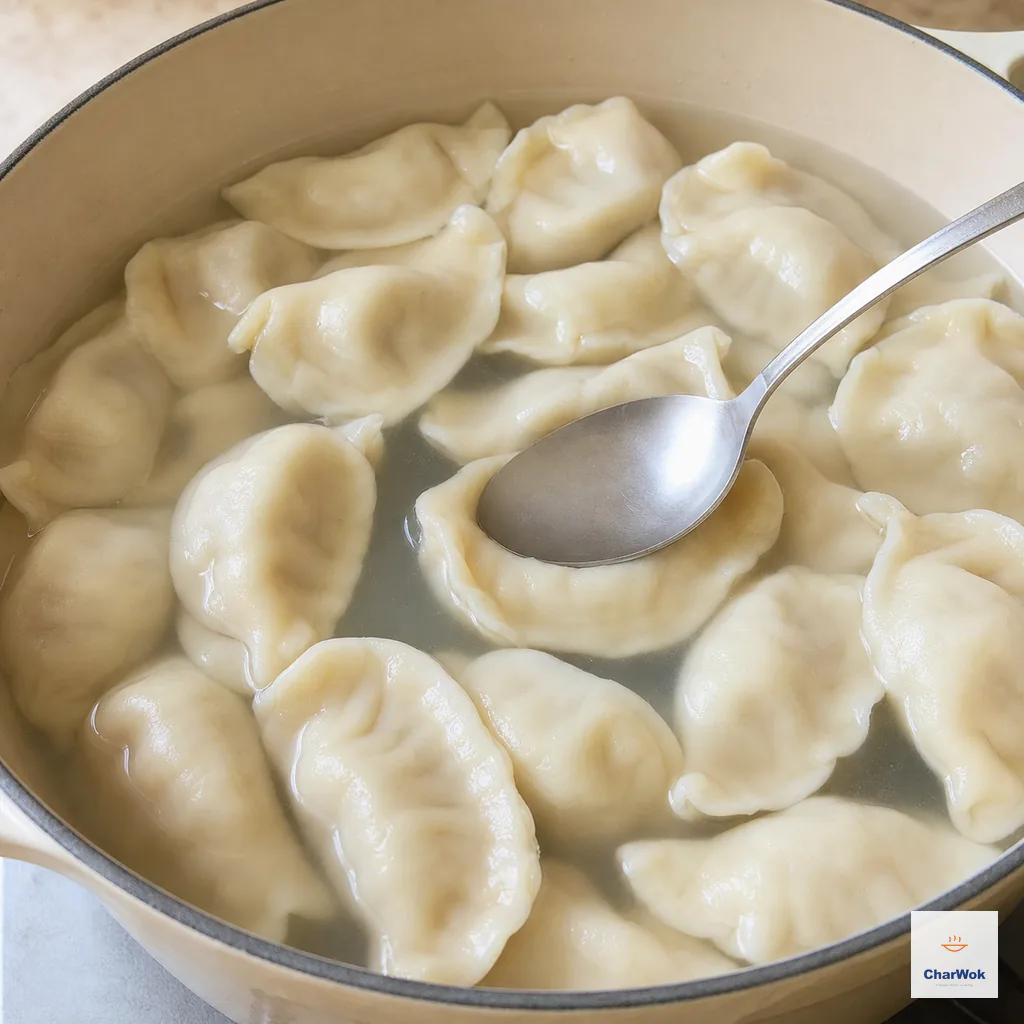
After three cycles, floating and translucent pleats mean the wrapper is ready to check. Test 2–3 large dumplings: poultry filling needs 74°C, ground meat or egg 71°C, and seafood-only filling 63°C.
- Lift them out and rinse briefly under running water. A few seconds under the tap washes surface starch so they don't clump on the plate. Skip the rinse only if you are serving them in soup, as with beef dumplings in hot and sour soup.
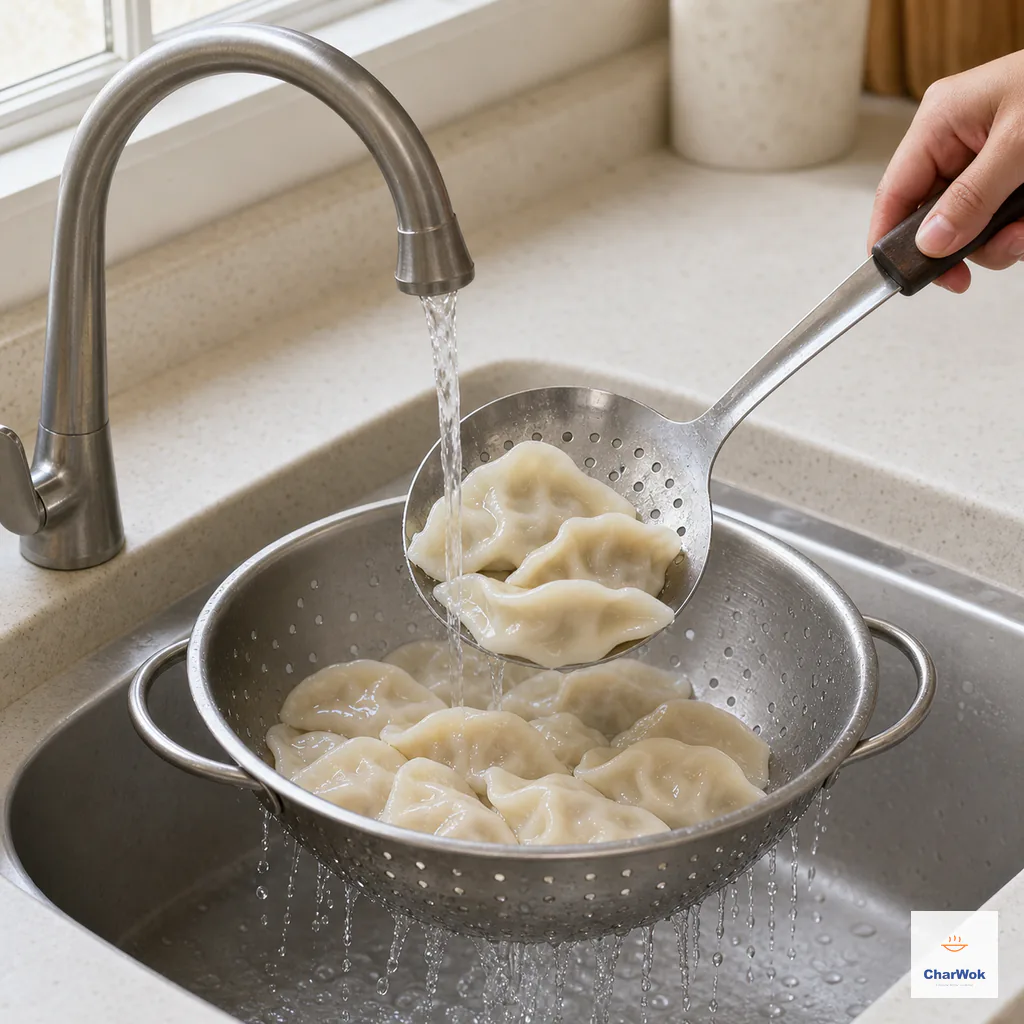
Rinse only for a few seconds and drain immediately to remove surface starch; skip this step when the dumplings will be served in soup.
Why three additions rather than a hard uninterrupted boil? Each addition calms the convection that can batter a tender wrapper. Three cycles are a useful starting rhythm for many fresh wheat dumplings, but size, filling, starting temperature and pot load all change the cook. Treat the rhythm as wrapper control, not a replacement for a thermometer.
Method two: pan-frying, for the golden bottom
Pan-fried dumplings go by two names: jian jiao as a general term, and guo tie, the potsticker, when they are shaped and arranged to stand upright. The whole maneuver is sear, steam, crisp. Get the sequence right and you get a crust that shatters and a top that stays tender. This is the method to reach for with chicken potstickers or vegetarian potstickers, and it is the only method that forgives a slightly thicker wrapper.
- Heat a thin film of oil over medium-high. Just enough to slick the whole surface, not a shallow fry. Use a heavy, preferably nonstick pan; thin pans throw hotspots and you will get one burnt dumpling and three pale ones.
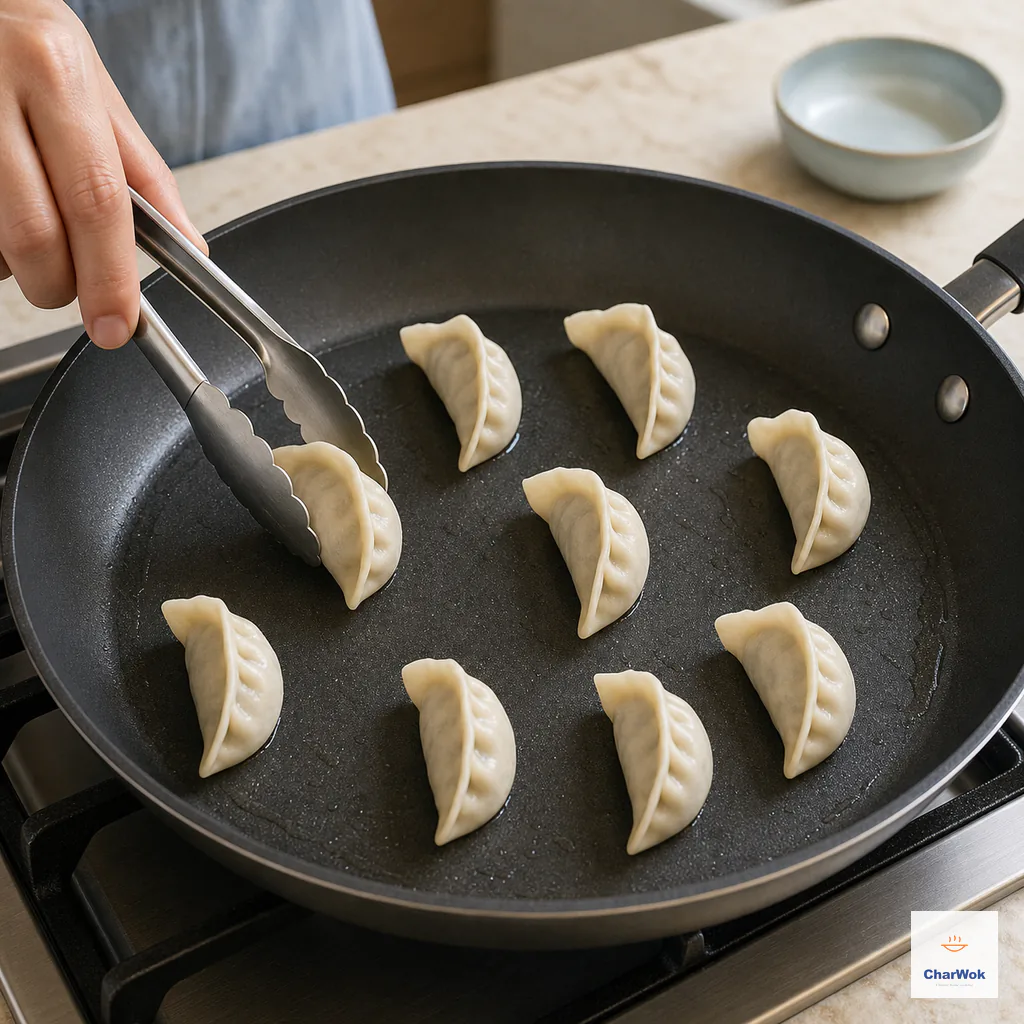
Heat just enough neutral oil to slick the pan, then arrange the dumplings upright with room to expand; this is a sear, not a shallow fry.
- Place the dumplings in and leave them alone. Arrange them with a little space, then do not touch. If you nudge them before the bottom sets, you will tear the skin and leak filling into the oil. Wait until you can lift one and see a pale gold underside.
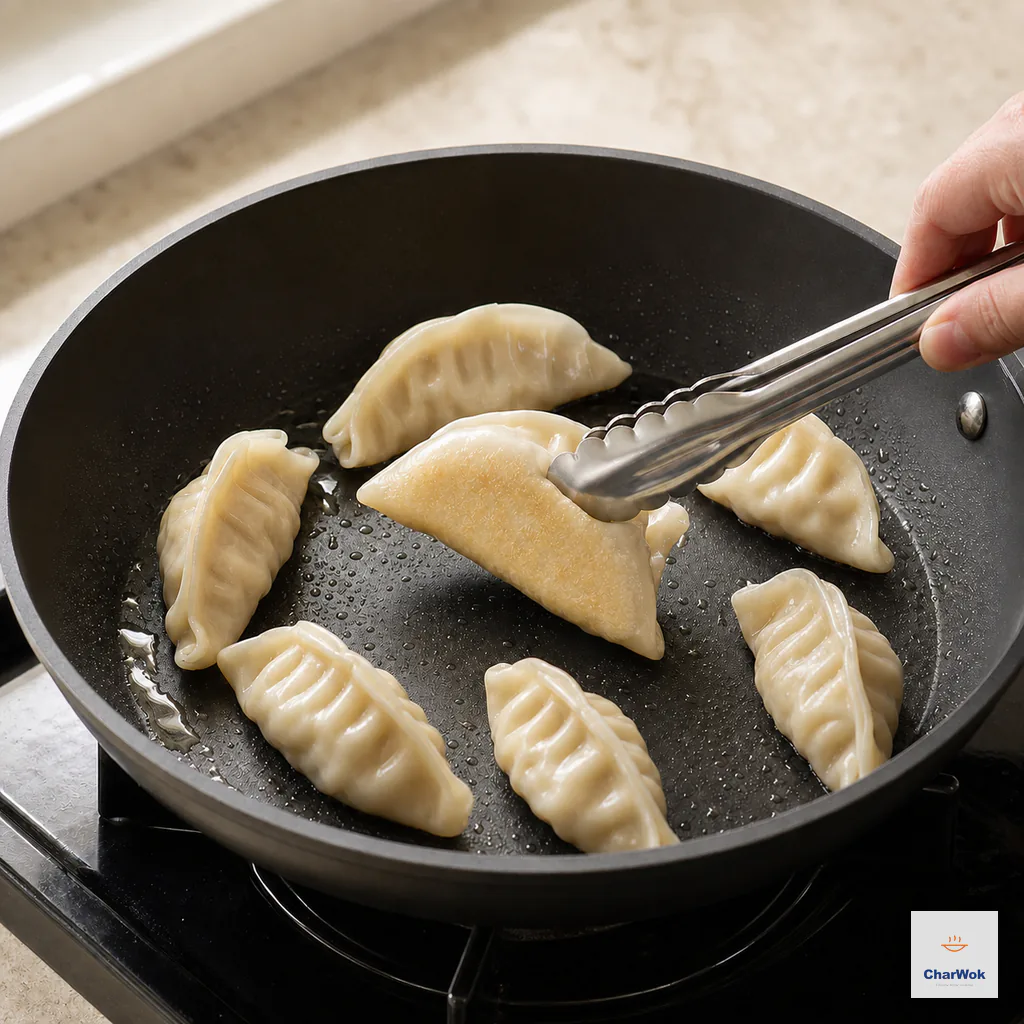
Leave the dumplings alone until one lifts cleanly and shows an evenly pale-gold base; moving them sooner can tear the still-soft wrapper.
- Pour in cold water to come one-third up the sides. Move the pan off the burner if needed, stand back and pour slowly down the side before clamping on the lid. The water turns to steam and cooks the top and filling.
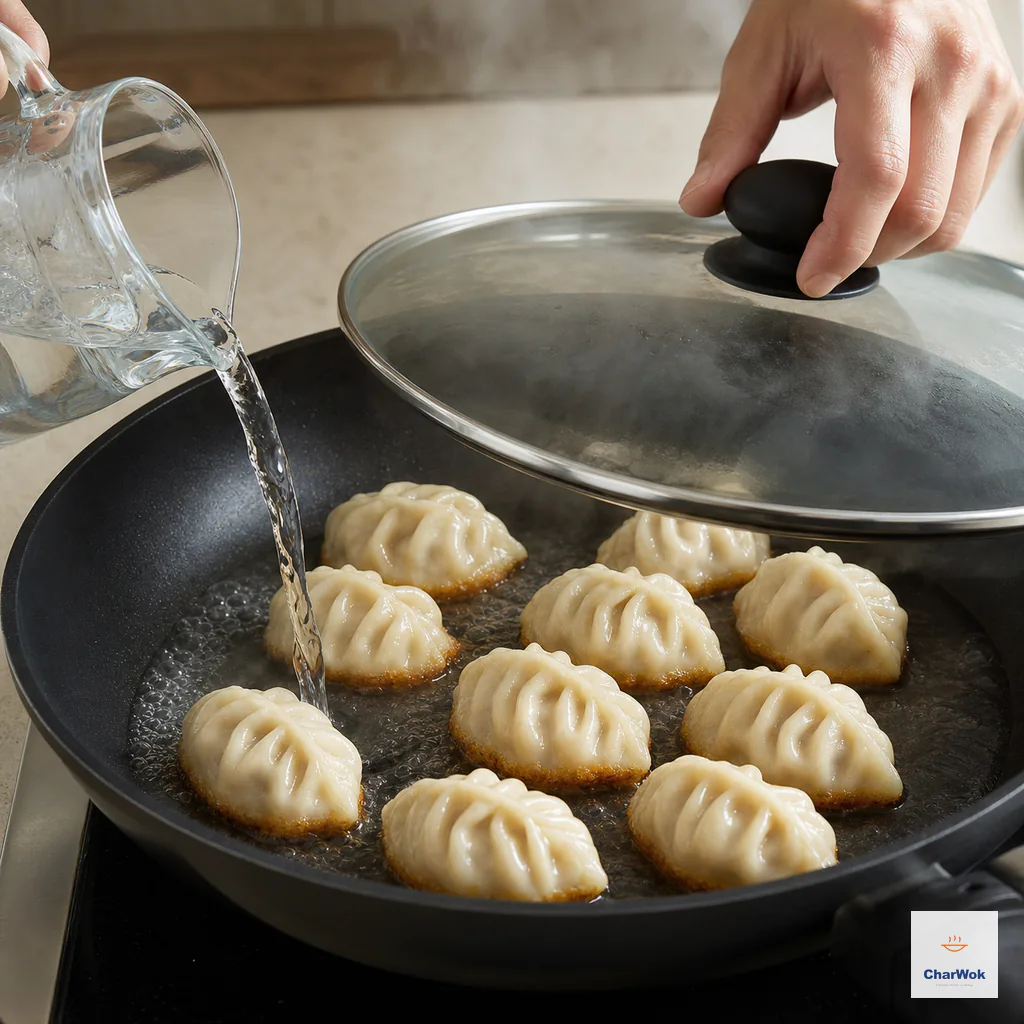
Pour cold water to one-third of the dumplings’ height, stand clear of the first steam burst, and clamp the lid on immediately.
- Steam until the hiss fades, then measure. Open the lid away from you and test two or three large dumplings. If any is below the target for its filling, add 1–2 tablespoons water, cover for another minute and check again with a cleaned probe.
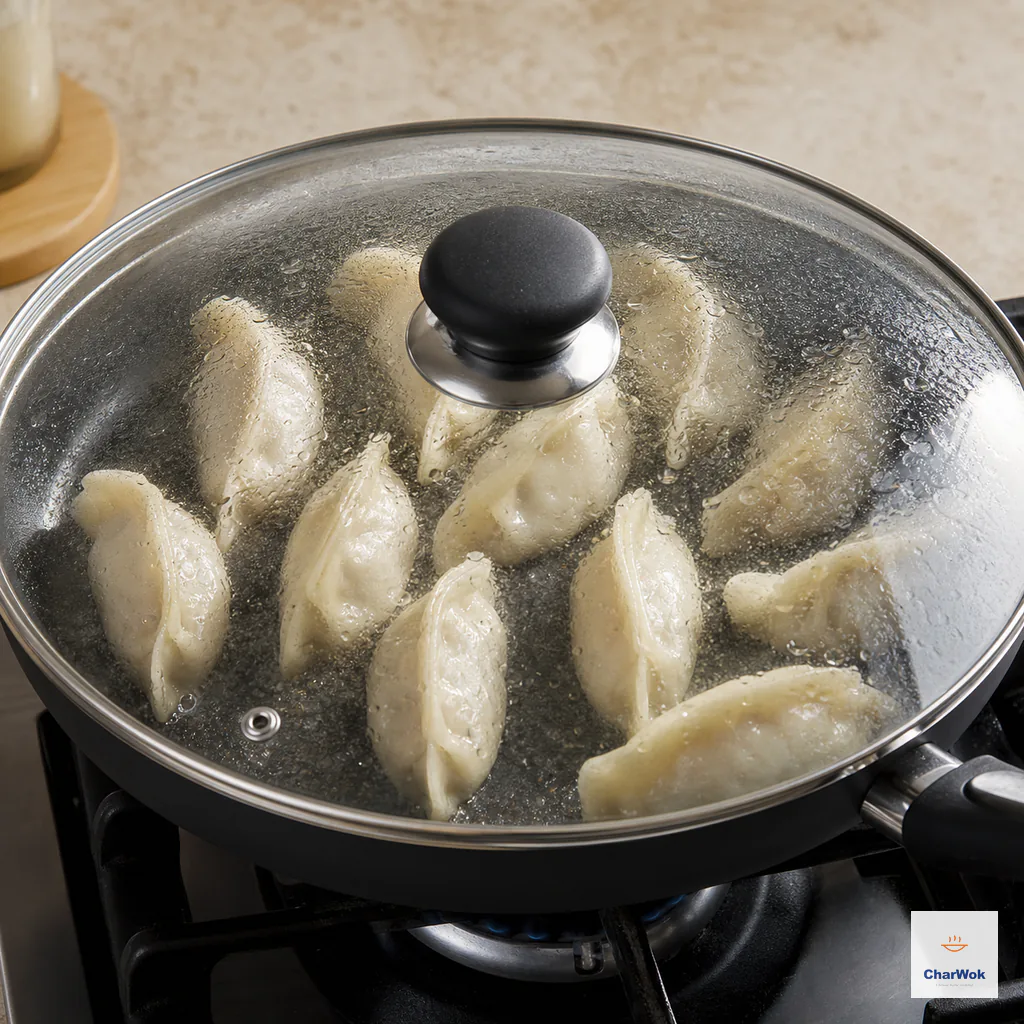
When the hiss fades, open the lid away from you and temperature-check 2–3 large dumplings. If one is low, add a little water, cover for another minute and recheck.
- Only after the filling passes, crisp for 30 to 60 seconds uncovered. Let the remaining water evaporate; stop if the oil smokes. Slide the dumplings onto a plate bottom-up so the crust does not steam soft on the way to the table.
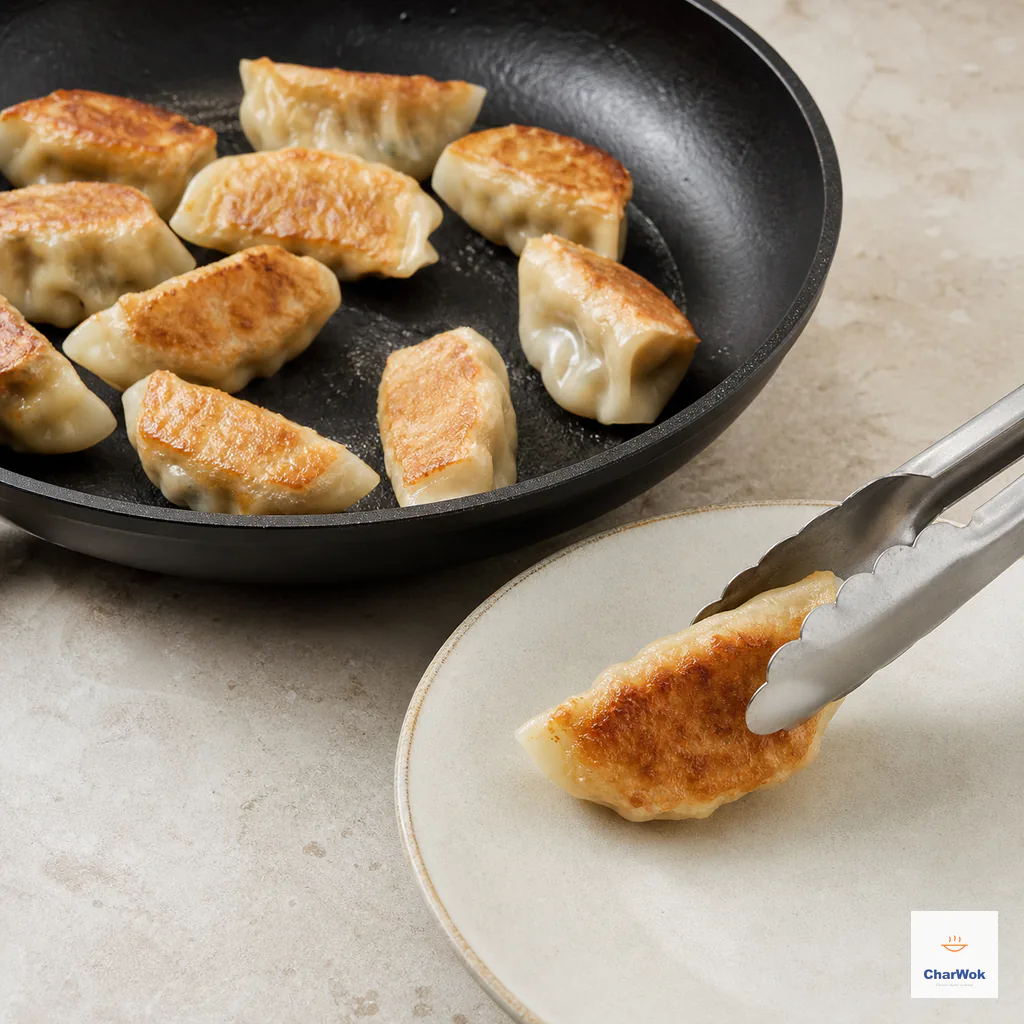
Only after every checked filling reaches its target, evaporate the water and crisp 30–60 seconds. Stop if the oil smokes, then plate bottom-up.
If you want the lacy "skirt" that holds the dumplings together in one dramatic pancake, whisk a teaspoon of flour into the water before you pour it in. The starch gelatinizes and fries into a glassy, crunchy web. It looks impressive and it is genuinely easy; the only failure mode is pouring the water too deep, which makes the skirt climb too far up the wrapper.
Method three: steaming, the gentle one
Steaming is the laziest method and the one that flatters your folding. Because nothing agitates the dumpling, the pleats hold their shape, which is why this is the default for the dainty baskets of har gow and other Cantonese dim sum. It is also the right call when your wrappers are delicate or starch-based and would fall apart in a rolling boil.
- Line the steamer basket. Scatter carrot slices, lay down cabbage or lettuce leaves, or cut small squares of parchment with a hole punched in each. The barrier matters: wheat dough on bare bamboo is glue.
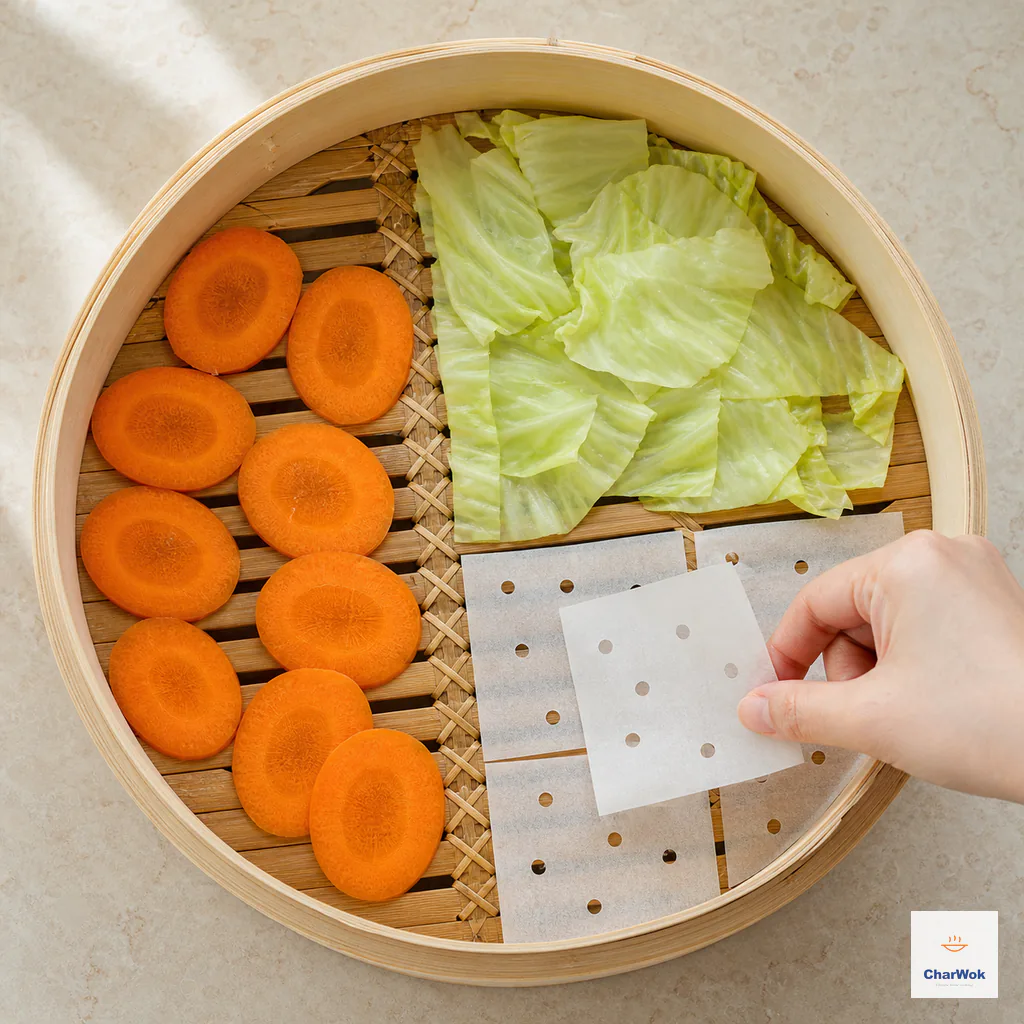
Line the basket with one barrier per dumpling—carrot, cabbage or perforated parchment—because wet wheat dough sticks firmly to bare bamboo.
- Arrange the dumplings with a gap between them. They swell slightly and will stick to each other if they touch. Pleat them as nicely as you can; the work shows. The folding techniques are worth revisiting here because steaming preserves them where boiling erases them.
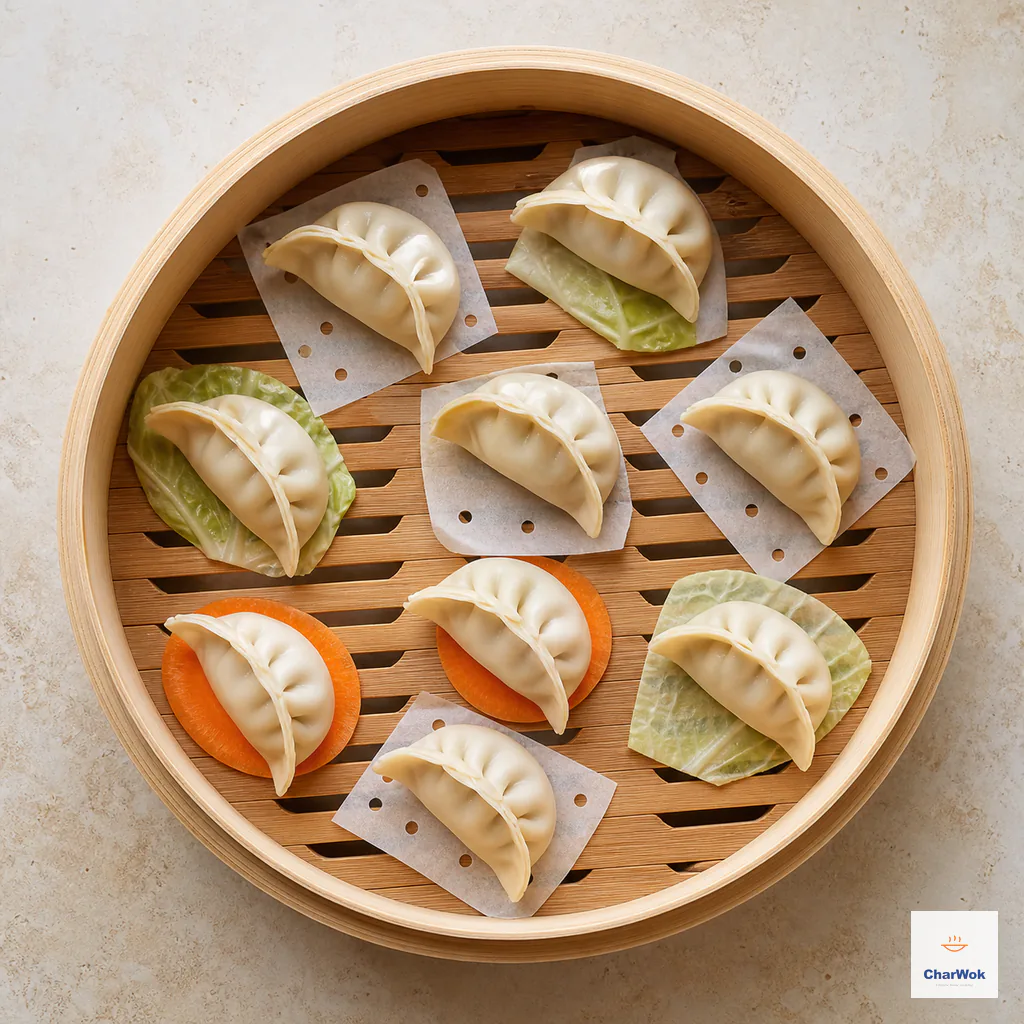
Arrange the dumplings on individual liners with visible gaps so their swelling wrappers neither touch one another nor the bare basket.
- Get the water to a full boil before the basket goes on. Starting over cold water means a long, sweaty warm-up that cooks the dough unevenly and leaves it tacky. You want steam hitting the dumplings immediately.
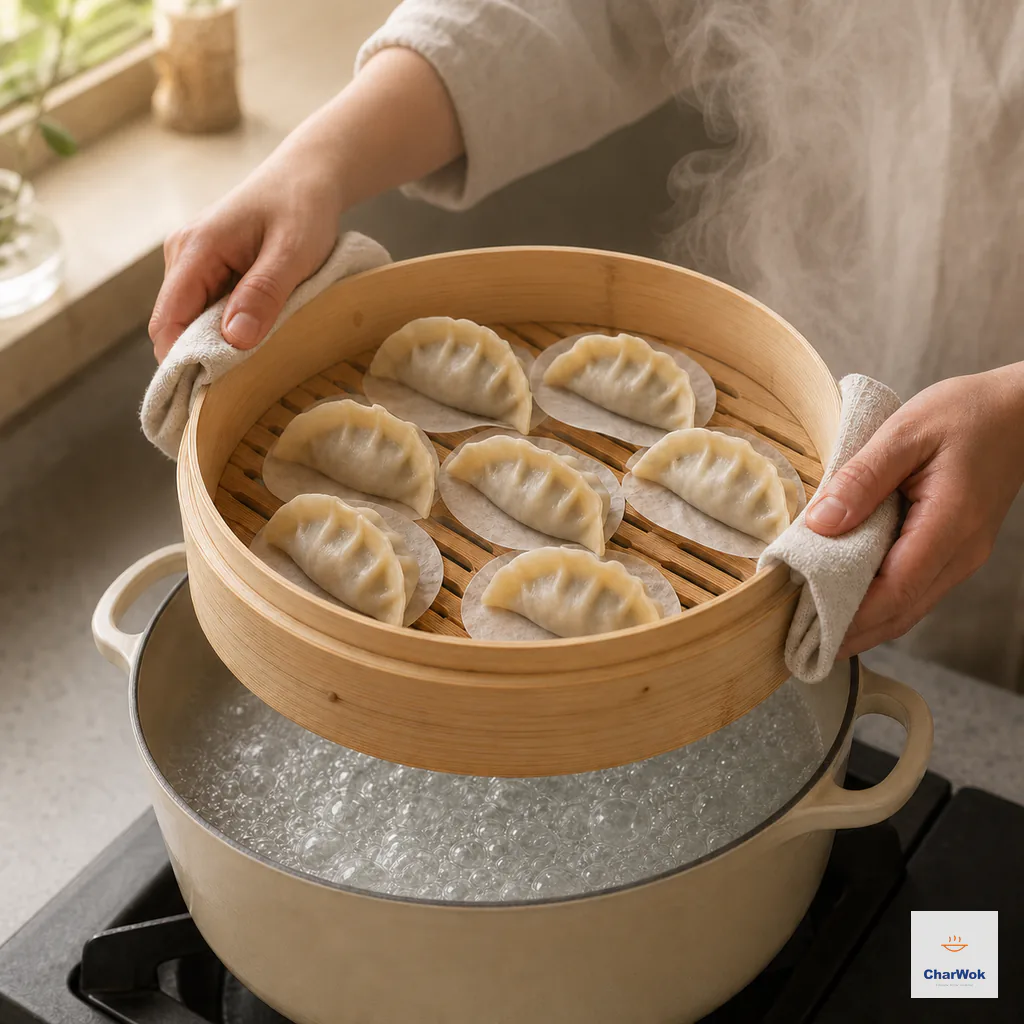
Wait for a full rolling boil before lowering the basket from the side with protected hands, keeping every hand and forearm away from the steam plume.
- Cover and use time as the first check. Start checking wheat-flour wrappers at about 10 minutes and starch-based wrappers such as har gow at about 6 minutes. Open the lid away from you and measure two or three large dumplings. If one is below the filling target, cover, steam another minute and recheck with a cleaned probe.
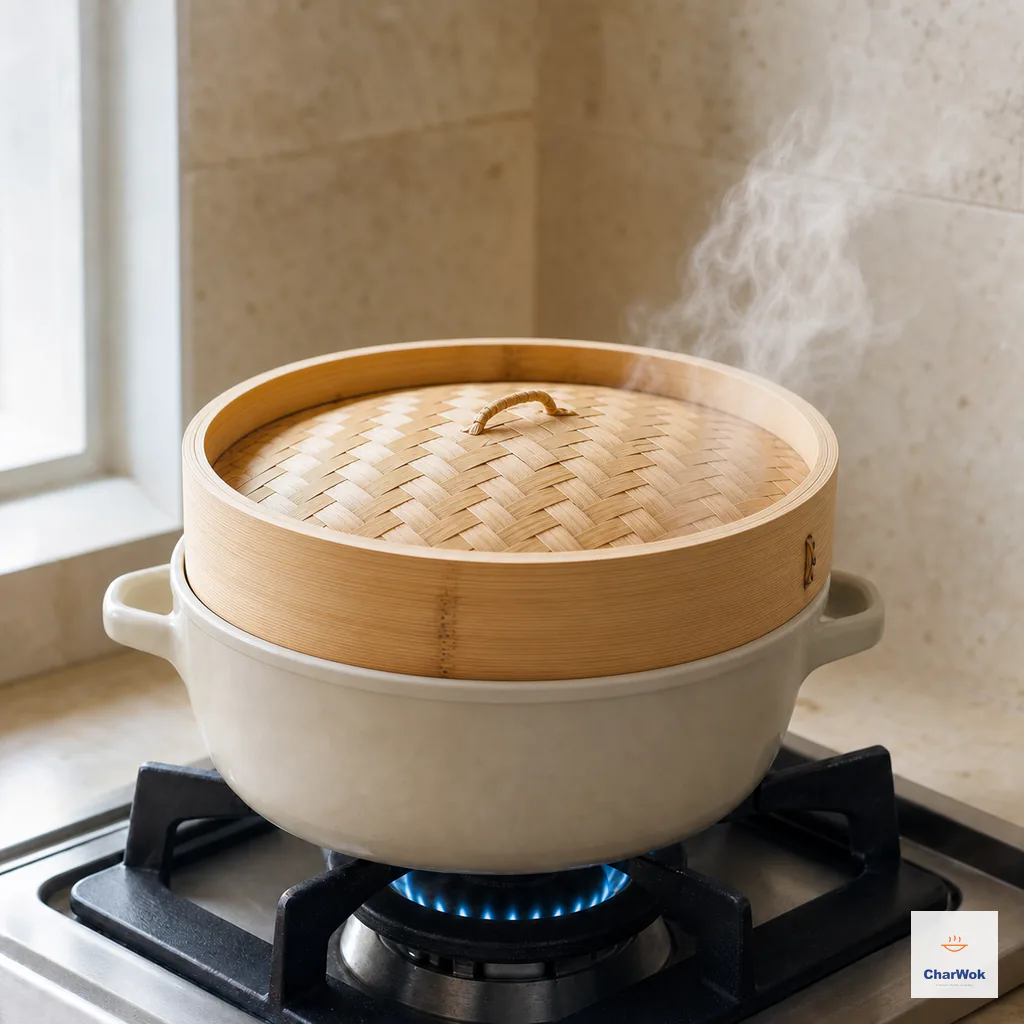
Use about 10 minutes for wheat wrappers or 6 minutes for starch wrappers as the first temperature-check point, not a universal doneness guarantee.
- Once the filling passes, lift the basket off the heat with dry mitts. Open the lid away from your face and let the dumplings settle for a minute before plating so the skin firms up and releases cleanly from the liner.
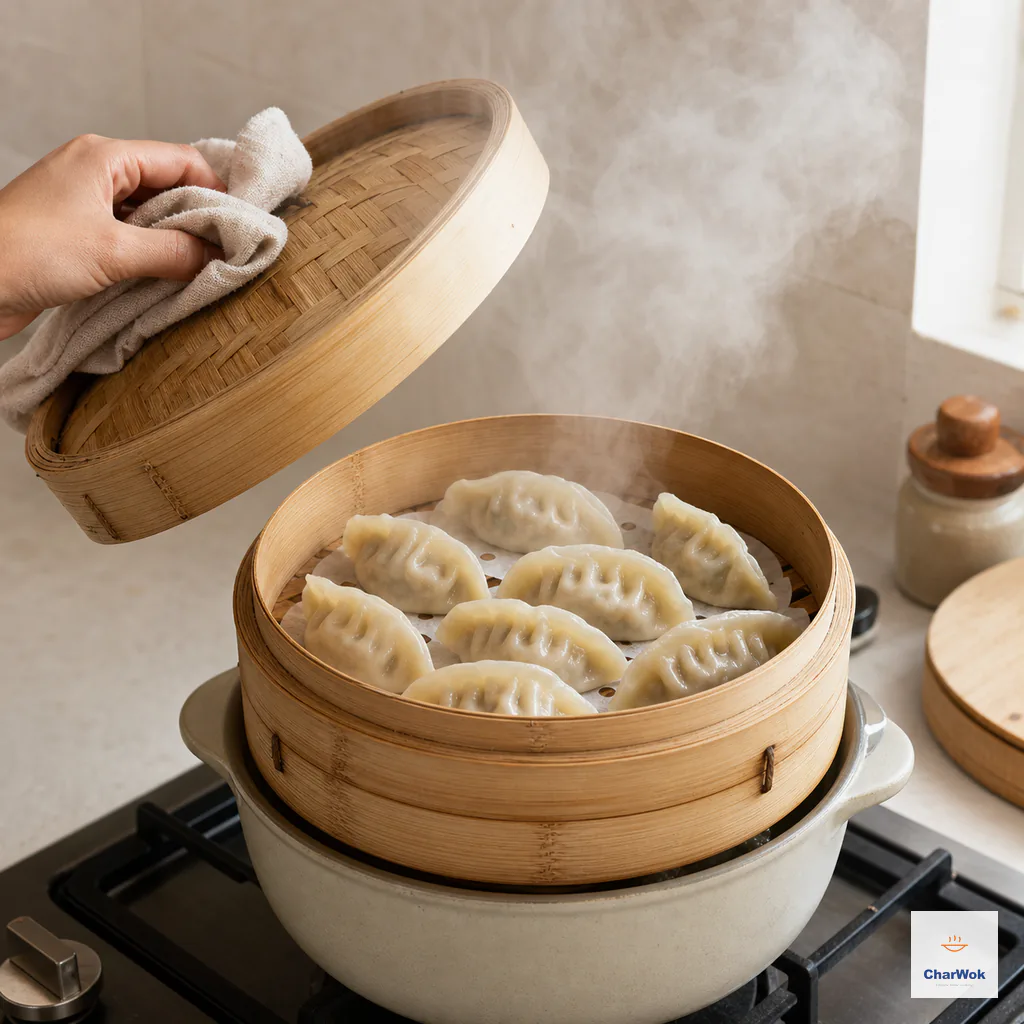
Open the lid away from you, check 2–3 large dumplings, and steam another minute if one is below its filling target. Remove with dry mitts once all checks pass.
When things go wrong
The same handful of failures account for almost every bad batch. Here is what to look for and how to course-correct mid-cook or next time.
- Wrappers split open in the boiling pot. The dough was either rolled too thin, under-rested so the gluten was tight, or the boil was too violent. Next batch, rest the dough 30 minutes longer and roll a hair thicker. Mid-cook, you cannot save the split ones; fish them out, eat them first, and turn the heat down for the rest.
- Dumplings stick to each other in a single mass. Surface starch is the culprit. You either skipped the post-boil rinse or crowded the pan. Rinse immediately after draining, and don't let them touch on the plate. A brush of sesame oil on the plate buys you time.
- Pan-fried bottoms are burnt on one side and pale on the other. Your pan has hotspots, or the heat is too high. A heavy pan fixes the first; medium-high instead of high fixes the second. Rotate the pan a quarter turn halfway through the steam phase.
- The potsticker won't release from the pan. It isn't ready. The crust has to fully set before it lets go; forcing it tears the wrapper. Add a teaspoon of water around the edge, cover for 30 seconds, and try again with a thin spatula.
- Steamed dumplings are gummy and wet on the bottom. You started over cold water or the lid was dripping condensation back onto them. Boil first, and if your lid drips, wrap it in a kitchen towel.
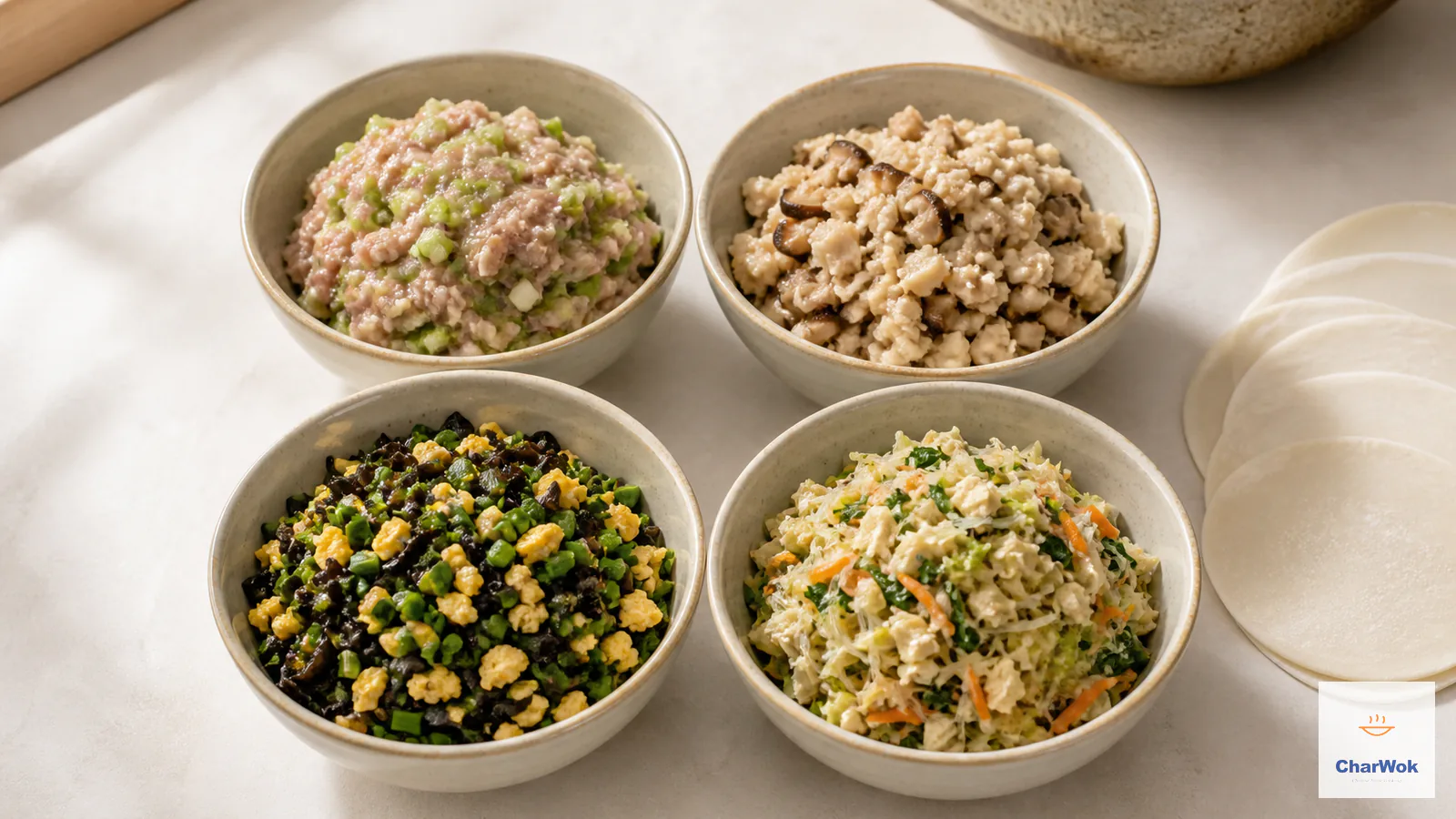
- The filling is dry and crumbly after cooking. This is a filling problem, not a cooking one, and it usually means the mixture was under-seasoned with water or oil. Check the ratios in the filling guide; a properly juicy filling stays juicy through any of these methods.
From frozen, and the day after
You do not need to thaw most frozen dumplings for boiling, pan-frying or steaming, but a commercial package takes priority if it says otherwise. Frozen centres take longer, so the extra cold-water cycle or extra covered minutes are only estimates: measure two or three large dumplings and meet the same filling target as fresh ones. Do not crowd the pan, and keep raw frozen dumplings and their utensils away from the serving plate.
Refrigerate cooked dumplings in shallow containers within 2 hours, or within 1 hour when the room is hotter than 32°C / 90°F. Eat them within 3–4 days. Reheat in a lightly oiled covered pan with a splash of water, then uncover to crisp, and verify 74°C / 165°F in the centre. These storage and reheating limits follow USDA leftovers guidance.
Variations and what to serve alongside
The cooking method is independent of the filling, which is why this guide pairs with almost any dumpling you make. Pork and chive works well boiled; leaner fillings gain richness from pan-frying; delicate shapes such as siu mai or steamed dumplings two ways keep their pleats in the steamer. The same filling-temperature rule still applies to every method.
For dipping, don't default to soy and vinegar every time. The six dumpling sauces run from a simple black vinegar dip to a numing Sichuan oil, and matching the sauce to the method is half the fun. Pan-fried dumplings take a heavier, oilier sauce; boiled ones want something sharp and thin that cuts the starch. A bowl of stir-fried napa cabbage or a plate of cold napa cabbage salad alongside keeps the meal from feeling like a wall of dough.
Try cooking the same dumpling two ways in one meal: boil half and pan-fry half. The comparison makes it easy to learn how the wrapper and filling respond to moist heat and browning without changing the recipe.
Frequently asked questions
How can I tell when dumplings are safely cooked? Floating, swelling and translucent pleats show that the wrapper is ready, not that a raw filling is safe. Check two or three large dumplings with a clean thin-tip thermometer: poultry fillings need 74°C / 165°F, ground meat and egg-based fillings need 71°C / 160°F, and seafood-only fillings need 63°C / 145°F. Mixed fillings use the highest applicable target.
Can I boil starch-based wrappers like har gow? No. Starch dough has almost no gluten and can fall apart in a rolling boil. Steam those instead; begin checking around 6 minutes and verify the filling temperature before serving.
Why are my potstickers sticking to the pan? Either the heat is too high, the pan is thin, or you tried to move them before the crust set. Wait until they release on their own, and use a heavy nonstick pan.
How do I cook dumplings from frozen? Follow the package when available; most can cook from frozen. Extra cycles or minutes are only estimates, so check two or three large dumplings and meet the same filling temperature required for fresh ones.
What is the best way to reheat leftover cooked dumplings? Reheat them in a lightly oiled covered pan with a splash of water, then uncover to crisp. Verify 74°C / 165°F in the centre; discard leftovers kept more than 3–4 days.