Most handmade Chinese noodles demand something the home cook usually lacks: technique built over years. You need the wrist for knife-cut noodles, the patience and alkaline dough for hand-pulled lamian, or a pasta machine for the rolled-and-cut version. Scissor-cut noodles throw all of that out. You mix a stiff dough, snip it straight into boiling water with kitchen shears, and you have a bowl of fat, chewy ribbons in about thirty minutes. The catch is that "easy" and "foolproof" are not the same word, and most first-timers end up with noodles that are either gummy in the middle or stuck to the scissors in one useless lump.
This guide fixes that. I will walk through the dough science behind the chew, the exact hydration that makes the shears glide instead of drag, and the one steam-burn mistake I made the first time I cut noodles over a rolling boil. We finish with a you po (hot oil) dressing borrowed from Biang Biang noodles, because these thick ribbons were built to carry chili, garlic, and vinegar.
At a glance: Use a 2:1 flour-to-water ratio by weight (250 g flour to 125 g water for two bowls). Rest the rough dough 15 minutes so the gluten relaxes, then knead it smooth. Cut the ribbons straight into the pot and watch for the curl that says they are done, about 2 minutes. The make-or-break detail is hydration: this dough should feel firm and almost dry, softer than pasta, similar in feel to the cold-water dough used for dumpling wrappers.
What these noodles are, and where they come from
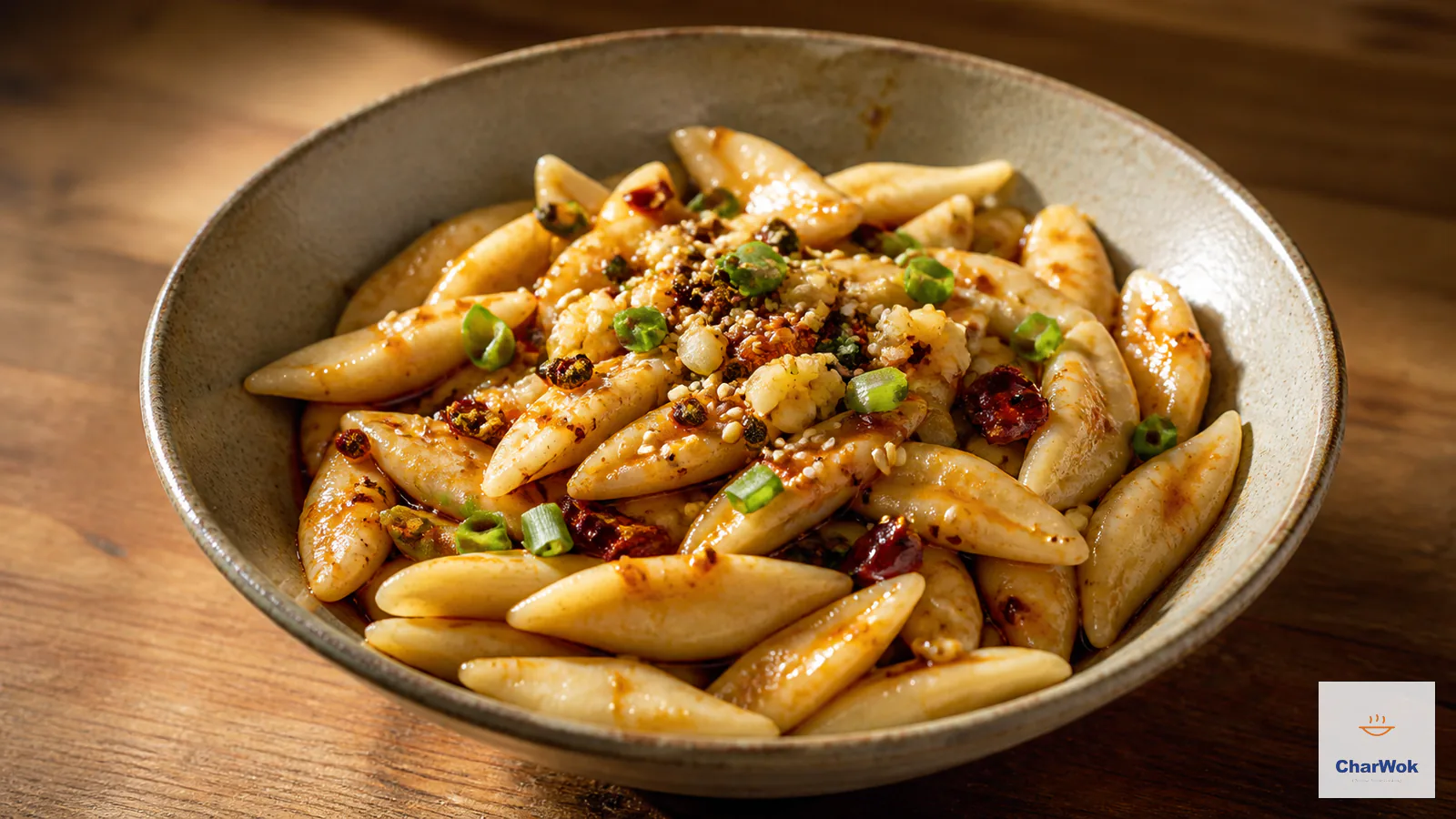
Scissor-cut noodles, jian dao mian (剪刀面), are a Shanxi folk noodle. Shanxi province is the wheat belt of north China and the spiritual home of knife-cut (dao xiao mian) and hand-torn (mian pian) noodles, so it makes sense that someone there reached for a pair of scissors as the lowest-skill shaping tool. The result is a noodle with deliberately uneven, rustic edges. Those rough surfaces grab sauce in a way a smooth extruded noodle never will, which is why the you po dressing clings instead of pooling at the bottom.
You will sometimes see the dish written as you po jian dao mian, the "you po" meaning hot oil poured over the top, the same technique behind a bowl of Sichuan cold noodles or a jar of homemade chili oil. Same principle: oil heated to about 180°C / 355°F releases the aromatics in seconds without needing to smoke. Different assembly.
Why this dough behaves the way it does
The chew you want comes from gluten, and gluten only forms well under two conditions: enough water to hydrate the flour proteins, and enough time for them to link up. This recipe sits at about 50% hydration by weight, which is low. Low hydration means a firm dough, less stickiness on the scissors, and a tight gluten network that resists tearing when you snip it. It also means the dough feels unpleasant and shaggy when you first mix it. That is correct. Do not add water to fix it.
The rest period does the real work. When flour meets water, the glutenin and gliadin proteins begin to bond, but the bonds need time to align. Kneading forces them together faster, yet a 15-minute covered rest gives them time to organize with almost no effort from you. What was a gritty, resistant lump comes back softer and stretchier, ready to knead smooth in under a minute. Skip the rest and you will fight the dough the whole way. (Bread bakers know a similar but salt-free pause as the autolyse; here, with salt already in the mix, it is simply a rest, and it does the job perfectly.)
The pinch of salt is not for flavor. Salt tightens the gluten strands, raising the temperature at which they relax and giving the cooked noodle a touch more bounce. It works through a different mechanism than the kansui (alkaline water) that gives ramen noodles their yellow color and distinctive spring, so do not expect the same result, just a slightly firmer bite. A quarter teaspoon is enough; more and the dough turns brittle.
Ingredients
Ingredients at a glance
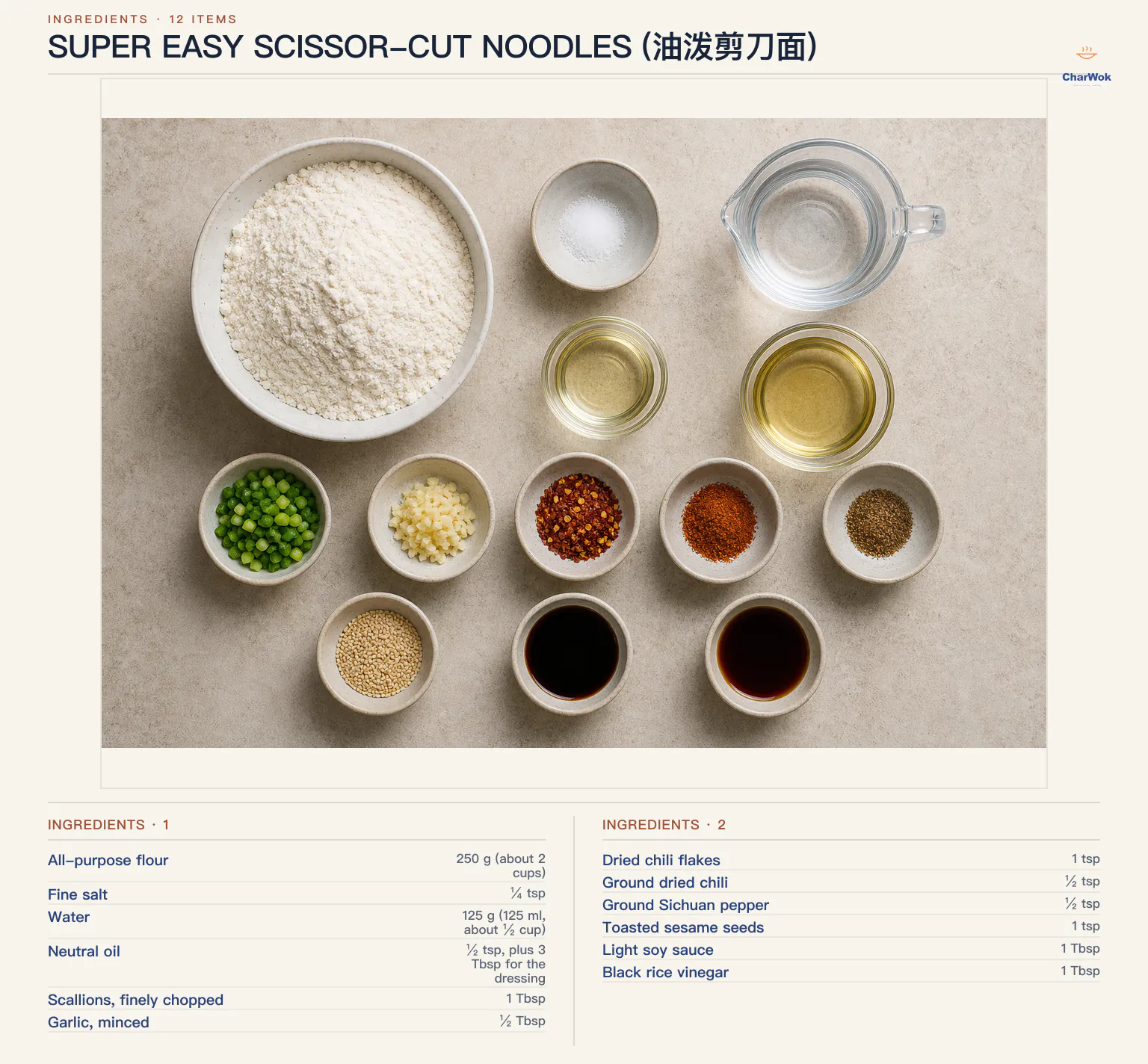
For two bowls. Scale up directly; the dough holds for a few hours if you keep it covered and oiled.
| Ingredient | Amount | Notes / substitute |
|---|---|---|
| All-purpose flour | 250 g (about 2 cups) | Bread flour works and gives a firmer bite; add 5 to 10 g extra water. Whole wheat only as a 25% blend. Gluten-free flour will not work, there is no gluten to develop. |
| Fine salt | ¼ tsp | Kosher or table salt, either is fine. |
| Water | 125 g (125 ml, about ½ cup) | Cool tap water, not warm. Adjust by a teaspoon either way depending on your flour brand. |
| Neutral oil | ½ tsp, plus 3 Tbsp for the dressing | The ½ tsp coats dough and scissors. Use canola, grapeseed, or peanut for the hot pour. |
| Scallions, finely chopped | 1 Tbsp | Green and pale green parts. Substitute chives. |
| Garlic, minced | ½ Tbsp | About 2 medium cloves. |
| Dried chili flakes | 1 tsp | To taste. Any style you like; see the heat note below. |
| Ground dried chili | ½ tsp | Fine powder deepens color and heat. Use only the flakes if you prefer. |
| Ground Sichuan pepper | ½ tsp | For the tingling ma note. Substitute five-spice powder or cumin for a different, non-numbing direction. |
| Toasted sesame seeds | 1 tsp | White or black, either is fine. |
| Light soy sauce | 1 Tbsp | Light, not dark. Dark soy will muddy the bowl. |
| Black rice vinegar | 1 Tbsp | Chinkiang style. Balsamic, cut with a splash of water, is a workable substitute. |
Choosing your flour and your chili
Use all-purpose flour and you cannot go wrong. If you want a more aggressive bite, swap in bread flour and add a touch more water; the higher protein builds a tighter network. I would not go all whole wheat. Bran cuts gluten strands, and at this low hydration the dough turns gritty and the noodles tear on the shears.
On heat: I call for both chili flakes and ground chili because they do different jobs. Flakes give little pockets of warmth and visual flecks; the fine powder infuses the oil so every strand carries heat evenly. If you only stock one, use the flakes and lean on freshly ground Sichuan pepper for complexity. For the numbing, citrusy character that defines the dressing, freshly ground Sichuan peppercorn matters, pre-ground loses its punch fast. If you have never worked with it, the Sichuan pepper guide walks through sourcing and grinding.
The method
- Mix to a shaggy dough. Combine the flour and salt in a bowl. Pour in the water a little at a time, stirring with chopsticks or a fork so the water distributes before gluten forms. When it looks like wet flakes, switch to your hands and press it into one rough ball. There should be no dry flour and no loose water. A stand mixer with a dough hook on low works too; run it just until the mass comes together.
- Rest 15 minutes, covered. This is the step that makes the whole recipe work. Cover with a damp cloth or plate so the surface does not skin over. Walk away. The gluten relaxes and reorganizes while you do something else.
- Knead until smooth. After the rest the dough will feel transformed. Knead on a barely floured surface for about a minute, until it is smooth and springs back lightly when pressed. You are not building more gluten here, you are just aligning what the rest already created.
- Film the dough and the shears with oil. Work the ½ tsp of neutral oil between your fingers until the whole dough ball has a satin sheen, then wipe that same oily film down both blades of the scissors. The goal is a slippery boundary on every surface the dough will touch, so each snip releases a clean strand instead of dragging. Do not skip it.
- Fill a wide pot and bring it to a low simmer. Use plenty of water in a wide pot and keep the surface just trembling, not erupting. A rolling cauldron sends a steady plume of steam straight at your cutting hand, which is the burn I mentioned earlier. You can turn the heat up only after every noodle is in the water.
- Snip the ribbons straight into the pot. Sit the dough ball in your nondominant palm and let the shears do the work, cutting short ribbons about 5 to 8 cm long so each one curls as it hits the water and sinks. The moment the dough sheen dulls or your hand feels too warm, set the ball down. You can also snip onto an oiled tray and slide the whole batch in at once. Thin snips cook fast and turn soft; thick ones keep their chew, so vary the width and pick your favorite later.
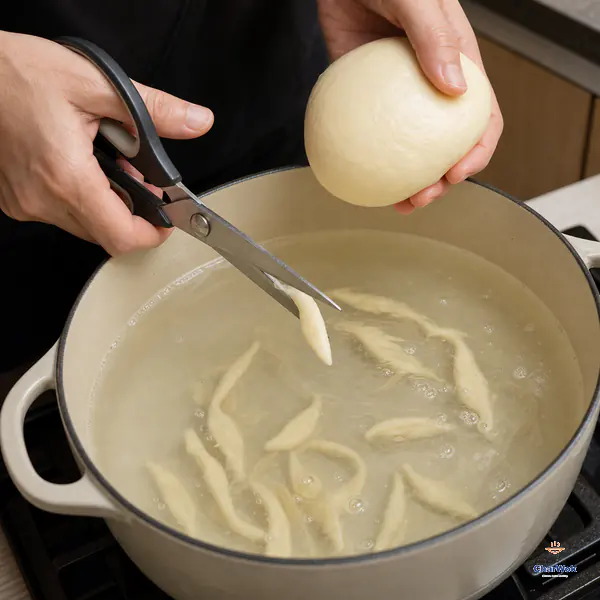
Hold the oiled dough over a low simmer and snip short tapered ribbons directly into the water; turn the heat up only after the whole ball is cut.
- Watch the curl, then add greens. Fresh noodles sink, then float and curl at the edges when they are close to done. From the moment the last ribbon drops, that takes about 2 minutes for an average thickness. Drop in baby bok choy, spinach, or choy sum and give them another 20 seconds to wilt. Pull one noodle and bite through it: the center should be cooked through but still push back against your tooth, with real chew rather than mush. Thicker ribbons may need another minute.
- Lift everything into two dry heatproof bowls on stable trivets. Use a spider or slotted spoon so most of the water drains off. A wet bowl both dilutes the dressing and increases splatter when the oil lands.
- Top with the aromatics. Pile scallions, garlic, chili flakes, ground chili, Sichuan pepper, and sesame seeds in the center of each bowl. Keep them heaped, not scattered, so the oil lands on a concentrated mound.
- Heat the oil until shimmering, then bloom the aromatics. Warm 3 Tbsp neutral oil gradually in a small pan to about 180°C / 355°F. The oil should move freely and shimmer, but it should not smoke. Stay beside the pan; if smoke appears, turn off the burner and let the oil cool before pouring. Pour the oil once in a controlled pass over the aromatic mounds. A strong crackle means the aromatics are blooming on contact. If it barely sizzles, do not collect and reheat the poured oil or make a second pour over the same bowls; adjust the temperature next time.
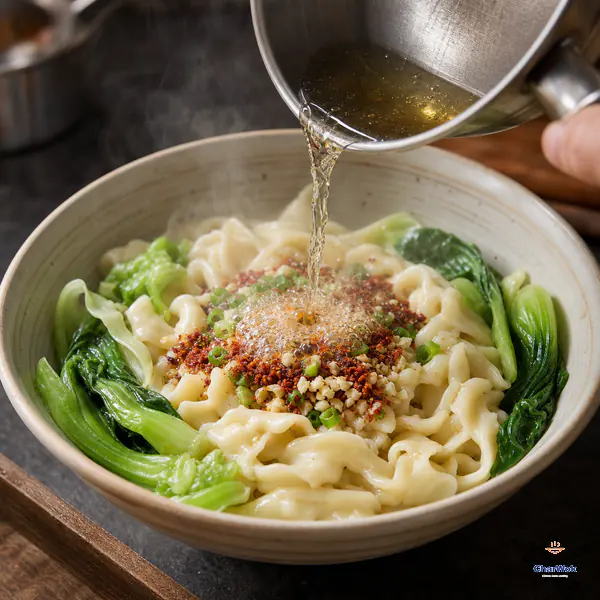
Heat fresh oil gradually to about 180°C / 355°F without smoking, then pour it once over the concentrated aromatic mound so it crackles immediately.
- Finish and toss. Splash the soy sauce and black rice vinegar down the side of the bowl only after the oil pour, then mix while the fat is still loose enough to cling to every strand. Eat straight away, while the bowl is loud and hot.
Hot-oil safety follows the U.S. Fire Administration cooking guidance: stay beside the pan, turn off the burner if the oil smokes, and never add water to burning oil.
When things go wrong
Here is where this guide earns its keep. These are the failures I see most often, with the fix for each.
The dough is too sticky to knead. You added water too fast or used a soft flour. Dust with a teaspoon of flour and knead it in; if still sticky, rest 5 more minutes before adding more flour. Most sticky doughs fix themselves during the rest.
The noodles stick to the scissors and come off in one clump. Either the dough was not oiled, the shears were not oiled, or the dough is too wet. Re-oil both surfaces. If the dough itself is soft, dust it lightly and knead in a teaspoon of flour, then rest again.
The noodles are gummy in the center. Undercooked, or cut too thick. Pull one out and bite it. If the core is still opaque and dense, give the pot another 30 to 60 seconds. Thickness matters more than the clock.
The noodles are mushy. Overcooked, or the dough was too wet to begin with. There is no rescue once they are mush. Next time tighten the dough and start tasting at 90 seconds.
The hot-oil pour did not sizzle. The oil was probably below about 180°C / 355°F. Do not collect and reheat oil that has already touched the aromatics, and do not make a second pour over the same bowl. Eat this batch as it is; next time use a thermometer and heat fresh oil gradually until shimmering but not smoking.
Steam burns your cutting hand. Lower the heat so the water is just bubbling, not rolling. Wear a dishwashing glove on the cutting hand, or cut onto a tray as described above. I learned this the hard way; rolling boils and bare hands do not mix.
Variations and what to serve alongside
The dough is a blank canvas. A few directions worth cooking:
- Soup version. Skip the oil pour and serve the noodles in a clear broth with greens, a soft-boiled egg, and a drizzle of sesame oil. A tomato-and-egg soup base, the kind behind tomato egg noodle soup, is excellent here.
- Chongqing-style xiao mian. Dress the bowl with the spicy, numbing seasoning that powers Chongqing noodles: chili oil, Sichuan pepper oil, soy, vinegar, and a little sesame paste.
- Dan dan treatment. Top with a spoonful of cooked pork and the sesame-chili sauce from Dan Dan noodles for a richer meal.
- Cold bowl. Shock the cooked noodles in ice water, then dress with sesame paste, soy, and vinegar, the way you would build sesame noodles or Tian Shui Mian.
- Leafy-green swaps. Replace baby bok choy with spinach, choy sum, or sliced napa cabbage, the kind you would stir-fry for hot-and-sour napa.
For a full meal, pair the bowl with a simple vegetable side. Garlic bok choy feels redundant since greens are already in the bowl, so go the other direction: a cool smashed cucumber salad to balance the heat, or a plate of pan-fried pork and chive dumplings if you want a dumpling-and-noodle spread, the classic northern combination.
Storing and reheating
The uncut dough keeps, covered and oiled, in the fridge for up to a day. Bring it back to room temperature before cutting or it will be too stiff to snip cleanly. Cooked noodles do not hold well in the dressing; the oil pools and the noodles turn soft. If you must make ahead, cook and shock the noodles in cold water, drain, toss with a few drops of oil, and refrigerate up to two days. To serve, drop them in boiling water for 20 seconds to refresh, then dress fresh. You can also drop raw cut noodles straight into a spicy beef noodle soup or chicken noodle soup if you have leftover dough.
A note on the "easy" label
Calling scissor-cut noodles foolproof oversells them. The technique is simple to describe and forgiving of rough shaping, but the dough hydration and the cutting-over-water steps each have a learning curve. Expect your first bowl to be uneven in size, and a few noodles thicker than the rest. That is fine, even desirable, those fat ribbons are the best bites. Once you have the feel of the dough, this becomes the fastest from-scratch noodle in the repertoire, faster than hand-rolled noodles and far less demanding than the hand-torn mian pian in the cumin lamb bowl.
Frequently asked questions
Can I use a stand mixer for the dough? Yes. Run the dough hook on low for about 8 minutes until smooth, then rest 15 minutes. Hand-mixing is faster for this small batch.
Do I have to cut over the boiling water? No. Snip onto an oiled tray, then slide the noodles in all at once and stir immediately. Safer for beginners and easier on your hands.
Can I make the dough ahead? Yes. Oil it, wrap tightly, and refrigerate up to 24 hours. Let it warm to room temperature so it cuts cleanly.
Is there a gluten-free version? Not really. The chew depends entirely on wheat gluten, so gluten-free flour will not produce the right texture. Rice noodles are a different dish.
What is the difference from knife-cut noodles? Knife-cut (dao xiao mian) shaves strips off a block of dough with a special blade and yields thinner, more uniform noodles. Scissor-cut is thicker, more rustic, and needs no special tool.