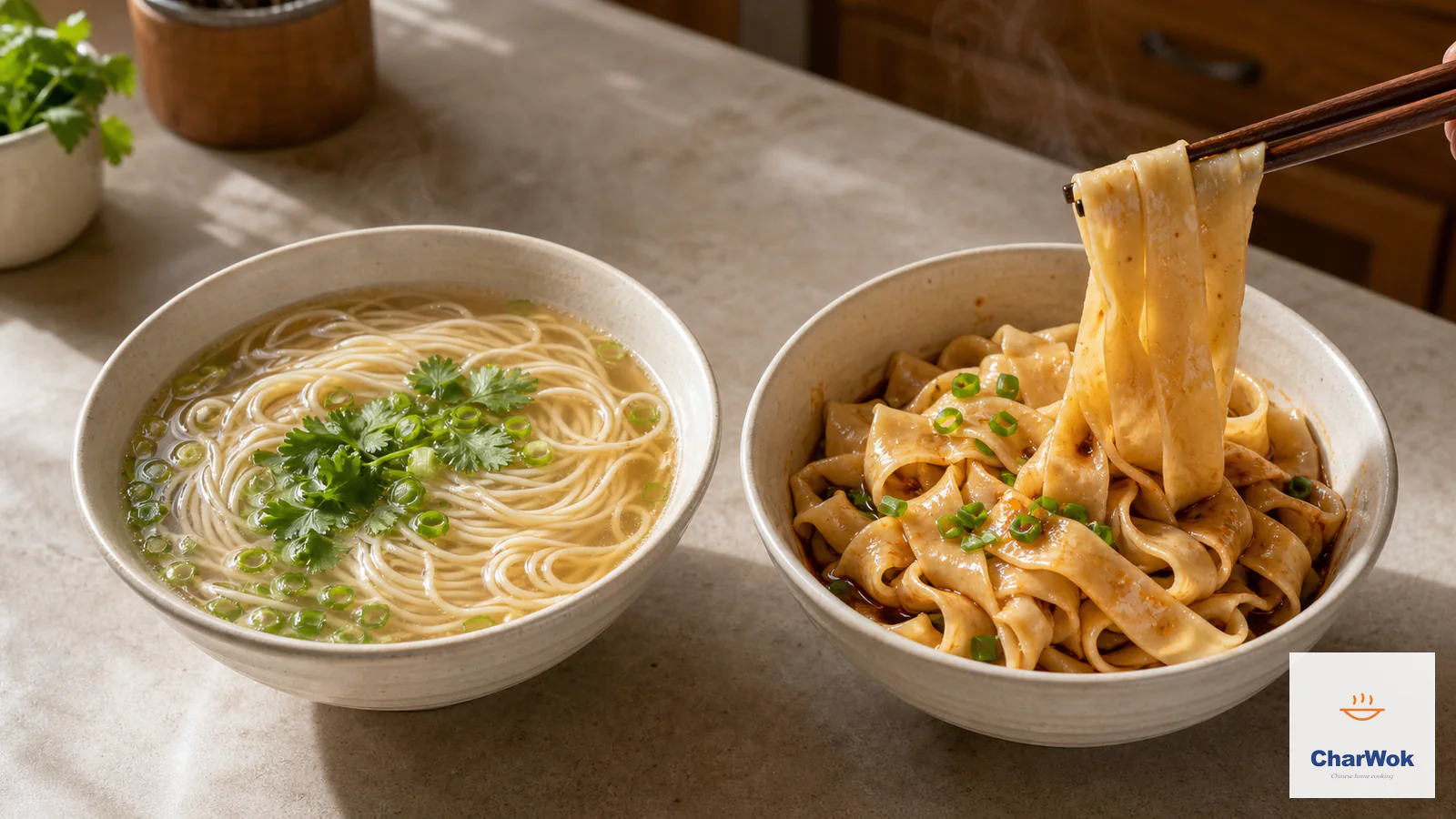
Biang biang noodles are the antidote to noodle anxiety. If you've ever been intimidated by La Mian, the pulled-and-flung wheat noodles that demand years of practice to throw without snapping, these broad, belt-like ribbons from Shaanxi province are the forgiving cousin. You don't need to swing dough over your head. You press a dent down the middle with a chopstick, grab both ends, stretch gently along the counter, and tear it open. The sound a stall cook makes slamming the dough against the board is the "biang biang" of the name. At home, the slam is optional. The chew is not.
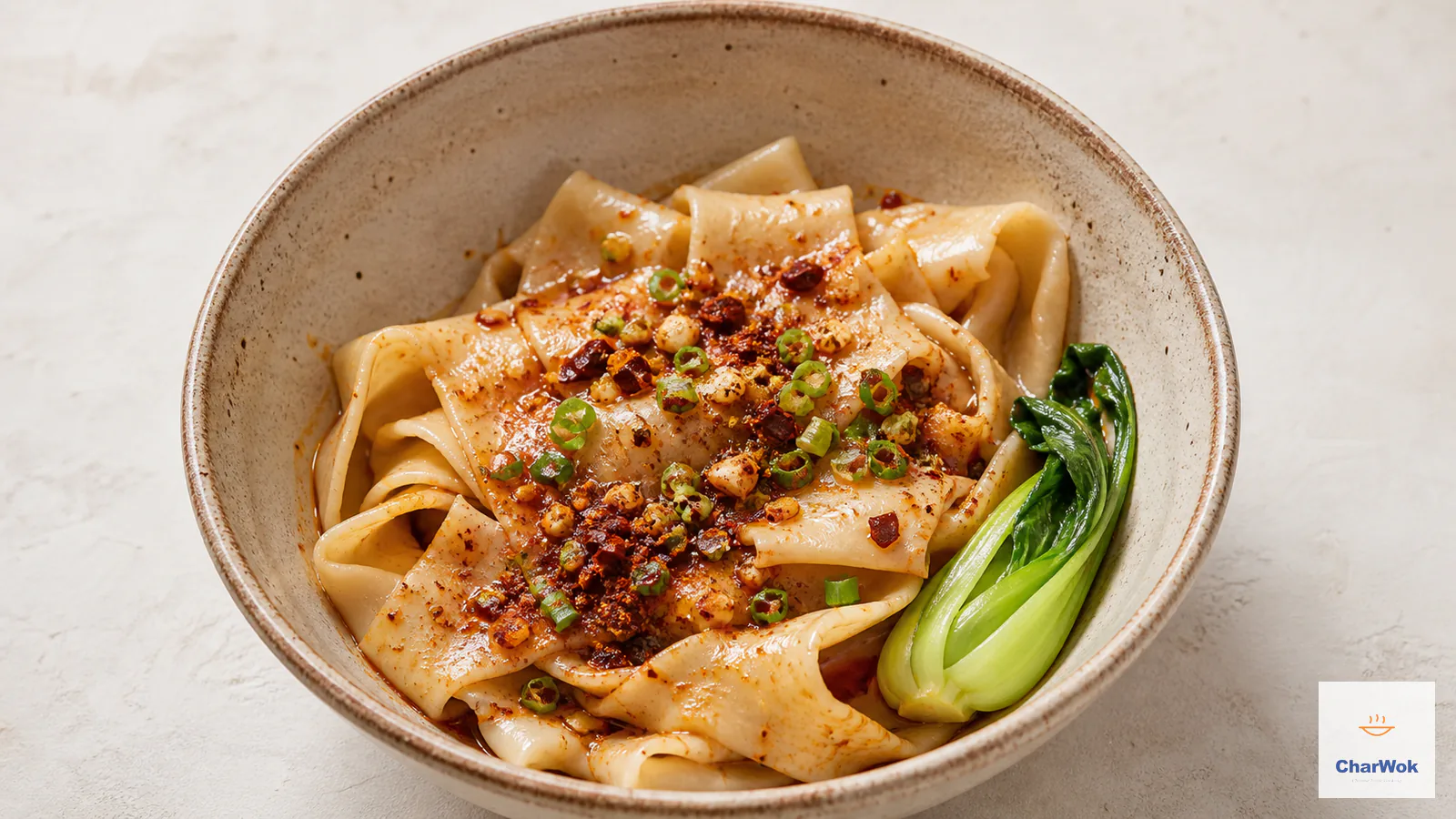
What makes these noodles worth the hour of waiting is texture. They're thick enough to fight back a little when you bite, glossy from the oil coating, and broad enough to carry a heavy chili-and-vinegar dressing without collapsing. They're the noodle equivalent of a good crusty bread: plain on their own, transformed by what you pour on top. The Xi'an-style finish uses hot, shimmering oil over raw garlic, scallion, chili flakes, and ground Sichuan peppercorn, followed by black rice vinegar.
At a glance: a stiff dough of 250 g all-purpose flour and 125 ml water (a 2:1 ratio by weight, with ¼ tsp salt), rested under oil for a full hour so the gluten relaxes. You don't pull these in the air; you stretch each oiled rectangle along the counter and tear it open down the center. The hour-long rest is not negotiable; it's the whole trick.
What biang biang noodles are, and where they come from
Biang biang is a Shaanxi specialty, most closely associated with Xi'an, the old imperial capital in northwest China. Shaanxi is wheat country, and the local noodle vocabulary is enormous: hand-pulled, knife-cut, scissor-cut, torn, and belt-wide all live side by side. If you've tried scissor-cut noodles or the cold-skin liang pi that Xi'an is famous for, you've already tasted the regional style: assertive wheat flavor, bouncy chew, and dressings built on chili, vinegar, and garlic rather than subtle broth.
The character "biang" is one of the most complex in Chinese writing, with fifty-plus strokes, and there's a rhyming mnemonic schoolchildren learn to recite it. The dish itself is humble. It started as cheap street food for laborers: more dough per gram of flour than thin noodles, filling, and dressed with whatever oil and spice were on hand. The "oil-splash" finish (you po, 潑), pouring hot oil over raw aromatics, is shared across northwest China. You'll see the same technique on the cumin-lamb version at spicy cumin lamb hand-torn noodles and in the Sichuan-style red-oil wontons.
The ingredients, and what you can swap
Ingredients at a glance
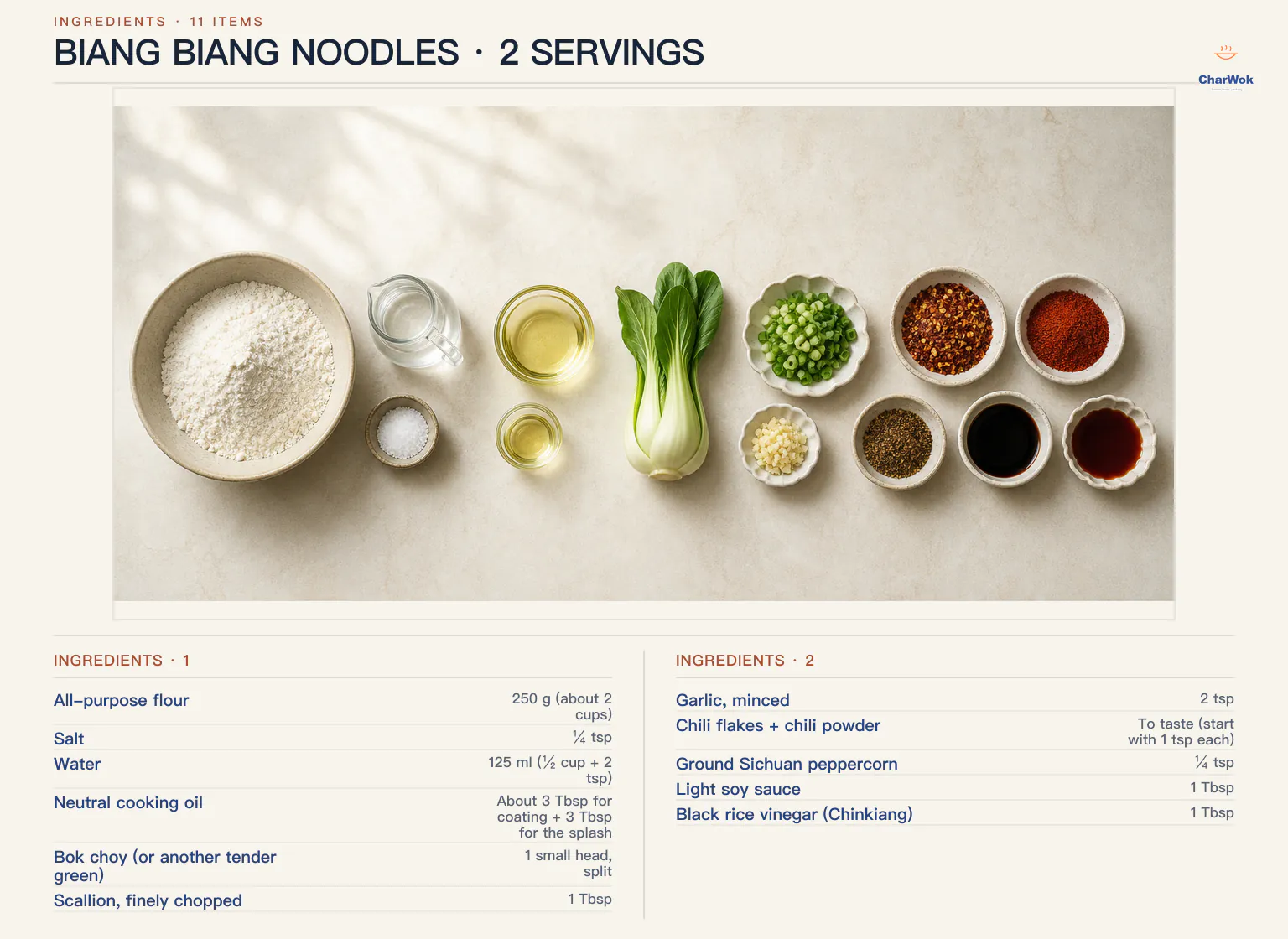
| Ingredient | Amount | Notes / substitute |
|---|---|---|
| All-purpose flour | 250 g (about 2 cups) | US AP flour (11% protein) is ideal. Bread flour works and gives more chew; do not use cake or pastry flour, which is too weak to stretch. |
| Salt | ¼ tsp | Tightens the gluten slightly so the dough stretches instead of tearing. Don't omit. |
| Water | 125 ml (½ cup + 2 tsp) | Room temperature is fine. This is a low-hydration dough (50%); it will feel stiff at first. |
| Neutral cooking oil | About 3 Tbsp for coating + 3 Tbsp for the splash | Avocado, canola, or grapeseed. Avoid olive oil (low smoke point, wrong flavor). |
| Bok choy (or another tender green) | 1 small head, split | Spinach, baby bok choy, or chrysanthemum greens all work. Blanching greens in the noodle pot is the traditional move. |
| Scallion, finely chopped | 1 Tbsp | Green and white parts. |
| Garlic, minced | 2 tsp | Fresh only. Pre-minced jar garlic tastes flat here because it's eaten raw. |
| Chili flakes + chili powder | To taste (start with 1 tsp each) | Use a coarse flake (Korean or Chinese er jin tao) for texture and a finer powder for color and heat. Korean gochugaru is a fine, milder stand-in. |
| Ground Sichuan peppercorn | ¼ tsp | Grind whole peppercorns fresh; the pre-ground jars lose their citrusy numbing buzz within weeks. |
| Light soy sauce | 1 Tbsp | Regular Chinese light soy. Tamari works for gluten-free cooks; the flavor is deeper but fine. |
| Black rice vinegar (Chinkiang) | 1 Tbsp | The dark, malty vinegar is non-negotiable for the right sour note. Balsamic is a distant substitute; rice vinegar is too sharp on its own. |
Mixing and resting the dough
This is a stiff, low-water dough on purpose. A softer dough would be easier to knead, but it would also stretch too thin and cook up soft. The 50% hydration here, plus a short rest, builds gluten that snaps back when you pull it, which is exactly what gives the cooked noodle its bouncy resistance. The same logic underlies basic homemade noodles: a firm dough is the foundation of a chewy noodle.
- Combine flour, salt, and water. Stir with chopsticks or a wooden spoon as you pour the water in a thin stream. It will look shaggy and dry and you'll think something is wrong. It isn't. Keep mixing until no loose flour remains.
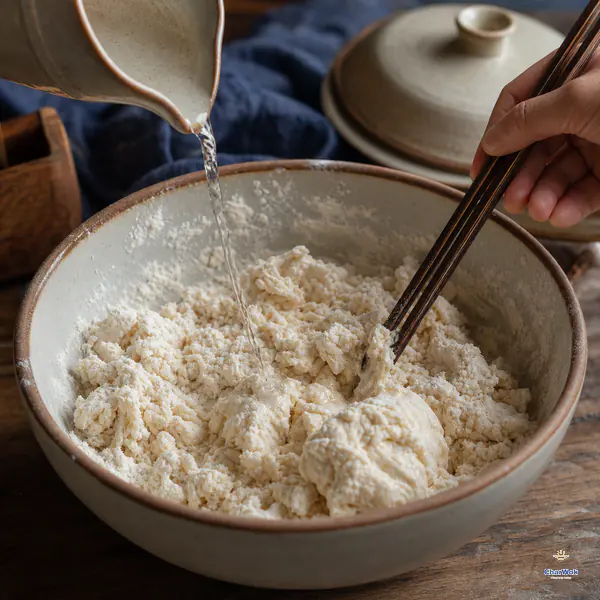
Pour the water in gradually while stirring until the flour forms a shaggy mass with no dry flour remaining, then cover and rest for 10 minutes
- Rest 10 minutes, then knead. Cover the rough dough loosely and walk away. This short rest lets the flour hydrate fully (gluten can't form until water reaches every particle). When you come back, the same stiff dough will knead into a smooth, medium-firm ball in 3–4 minutes. If you're using a stand mixer with a dough hook, run it on low for about 8 minutes total and skip the rest.
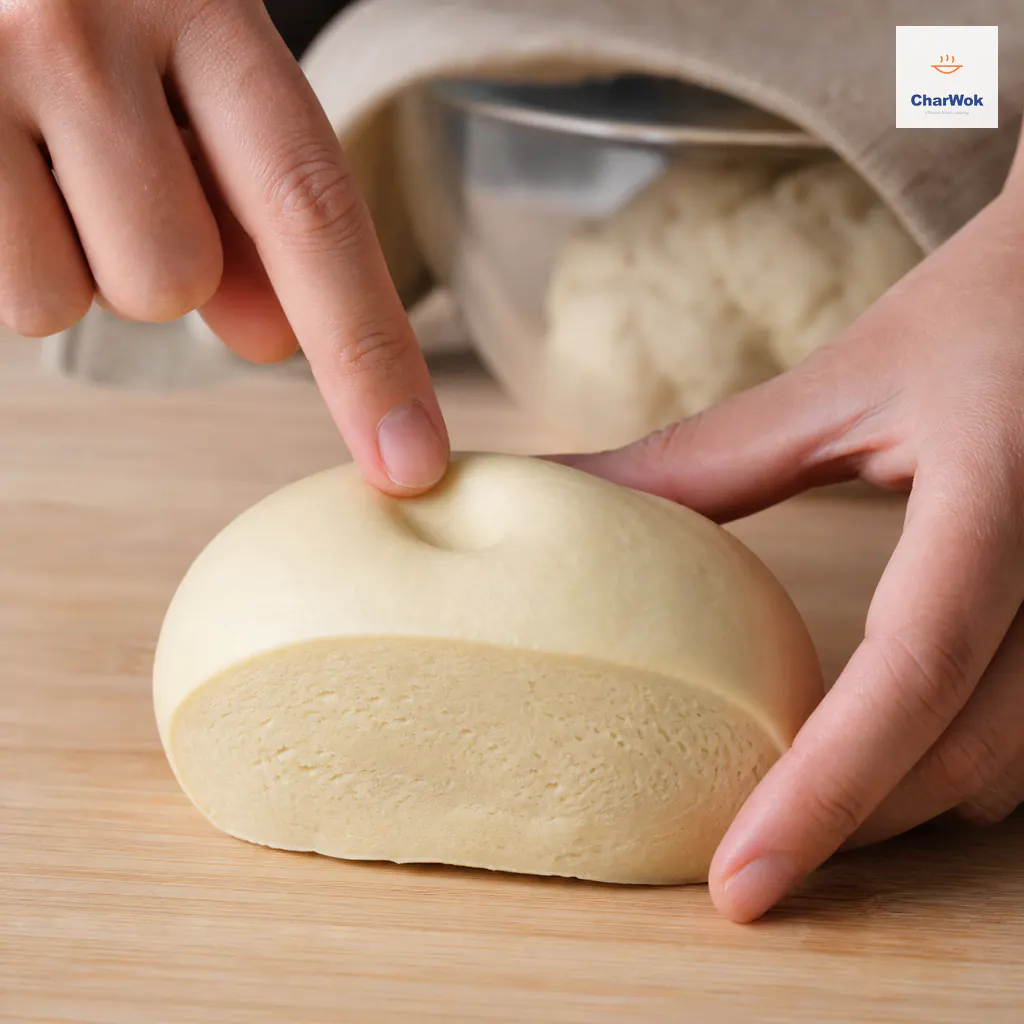
After the 10-minute rest, knead by hand for 3 to 4 minutes until the dough is smooth and medium-firm, with a slow rebound and a dense even cut face
- Divide into 8 pieces and shape into stubby cylinders. Portion the dough into 8 equal pieces (about 40 g each). Roll each into a short cigar shape, like a gherkin. This shape matters: you're going to flatten it into a long rectangle, and a cylinder rolls out more evenly than a round ball.
- Coat generously with oil and rest 1 hour. This is the step that makes biang biang possible. Stand the oiled cylinders on a plate, cover tightly with plastic, and rest at room temperature for a full hour. The oil does two things: it keeps the surface from drying out, and it lubricates the gluten so the dough stretches instead of snapping back. An under-rested dough will fight you; a properly rested one will almost stretch itself.
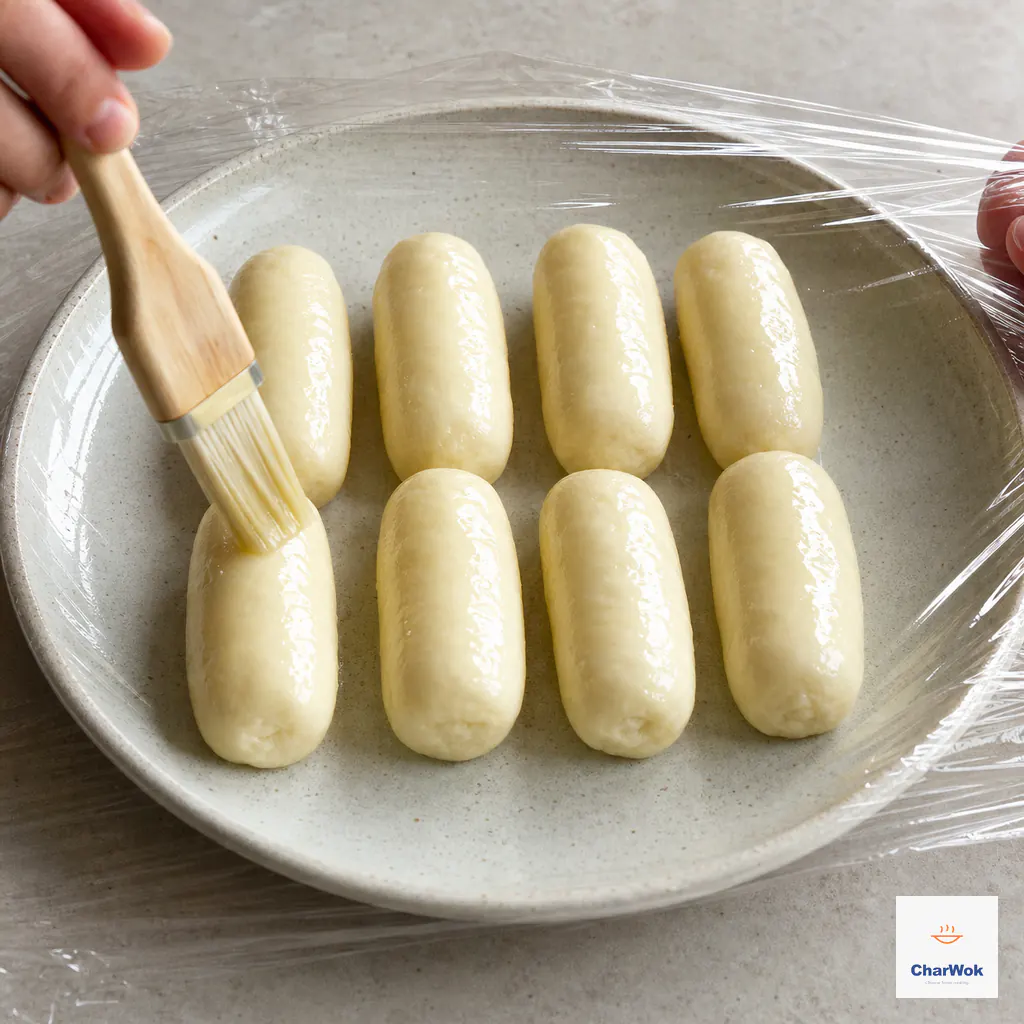
Shape 8 pieces of about 40 g into short cylinders, coat every surface generously with oil, cover tightly, and rest at room temperature for a full hour
Pulling the noodles
Bring a large pot of water to a boil while the dough finishes resting. You want to pull and cook in one continuous motion, because the pulled noodle is coated in oil and will weld itself to the counter if it sits. Have the water already boiling before you flatten the first piece.
- Flatten each cylinder into a rectangle. On a clean, un-oiled surface, use a rolling pin to roll each piece into a rectangle roughly 10 × 3 cm (4 × 1¼ in) and 3 mm thick. Don't flour the counter; you need the dough to grip the surface so you can stretch it. If it sticks, a tiny smear of oil on the counter is better than flour.
- Press a center groove with a chopstick. Lay a chopstick or the thin end of a rolling pin lengthwise down the middle of each rectangle and press firmly to make a shallow channel. Don't cut through; you're scoring about two-thirds of the way down. This groove is where you'll tear the noodle open after stretching; it weakens the gluten along that line so the tear runs straight instead of wandering.
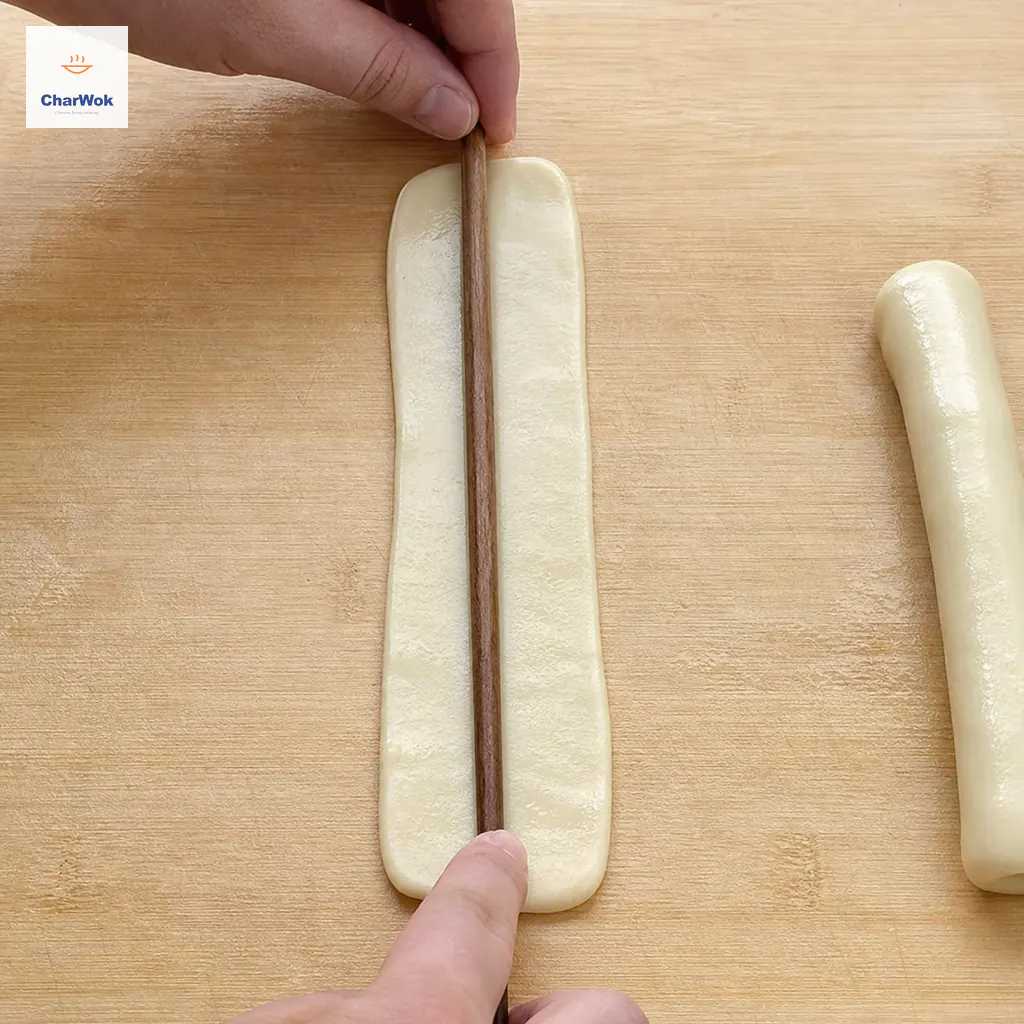
Roll each cylinder to a thin rectangle, then press a straight lengthwise groove about two-thirds through the center without tearing the dough
- Stretch along the counter and tear open. Pick the rectangle up by the two short ends. With the back (groove side) facing you, slap it gently against the counter a few times while pulling your hands apart, letting the dough's own weight help it lengthen. Stretch to your preferred thickness, somewhere between a fettuccine and a pappardelle, about 30–40 cm (12–16 in) long. Lay it down, then pinch along the groove with your fingers and pull apart to open it into one long loop. This loop-with-a-slit shape is traditional; it doubles the noodle length and gives more surface for the dressing to cling to.
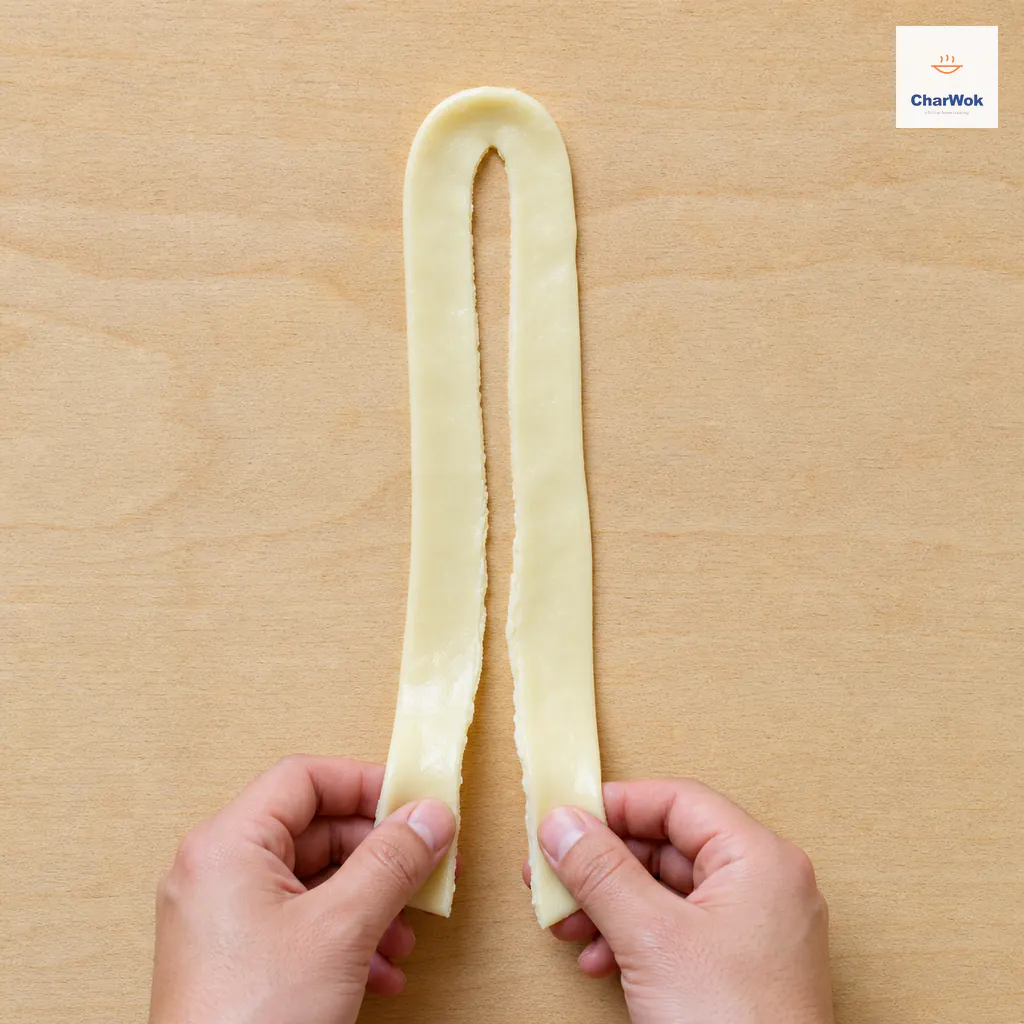
Stretch and slap gently, then tear along the groove while leaving the far end joined so one piece becomes one continuous broad noodle loop
- Drop straight into the boiling water. Don't queue them up on a board. Drop each noodle into the pot the instant it's torn. Cook four noodles per portion at a time so they have room to move, then repeat for the second portion.
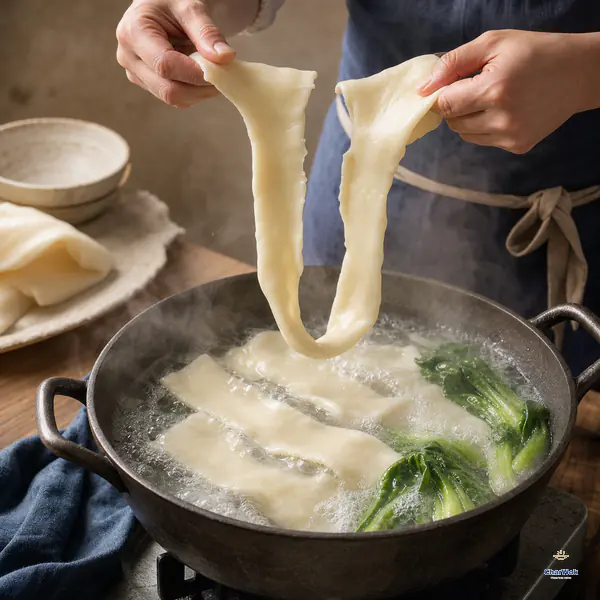
Drop each noodle into a full boil immediately after tearing; cook four per portion and add the bok choy for the final 20 seconds
Cooking and finishing the bowl
- Boil until they float and turn glossy, about 2 minutes. These are thick noodles, and they need a real boil, not a simmer. When they rise to the surface and look slightly translucent at the edges, they're close. In the last 20 seconds, drop in the split bok choy to blanch it in the same water. Drain everything together.
- Pile into bowls and top with the aromatics. Divide the noodles and greens between two bowls. Mound the minced garlic, chopped scallion, chili flakes, chili powder, ground Sichuan peppercorn, and a pinch of salt on top. Keep each pile loosely separate so the hot oil can hit it directly.
- Splash with hot oil. Heat 3 Tbsp neutral oil gradually in a small pan until it shimmers, around 180°C / 350°F. Stay beside the stove; if the oil smokes, turn off the burner and let it cool briefly. Pour it directly onto the dry aromatics; you want a sharp sizzle and a puff of chili-scented steam. This is the same oil-splash technique that powers the dressing on Chongqing xiao mian and cold Sichuan noodles: the heat toasts the chili flakes, blooms the Sichuan peppercorn, and takes the raw edge off the garlic in one move.
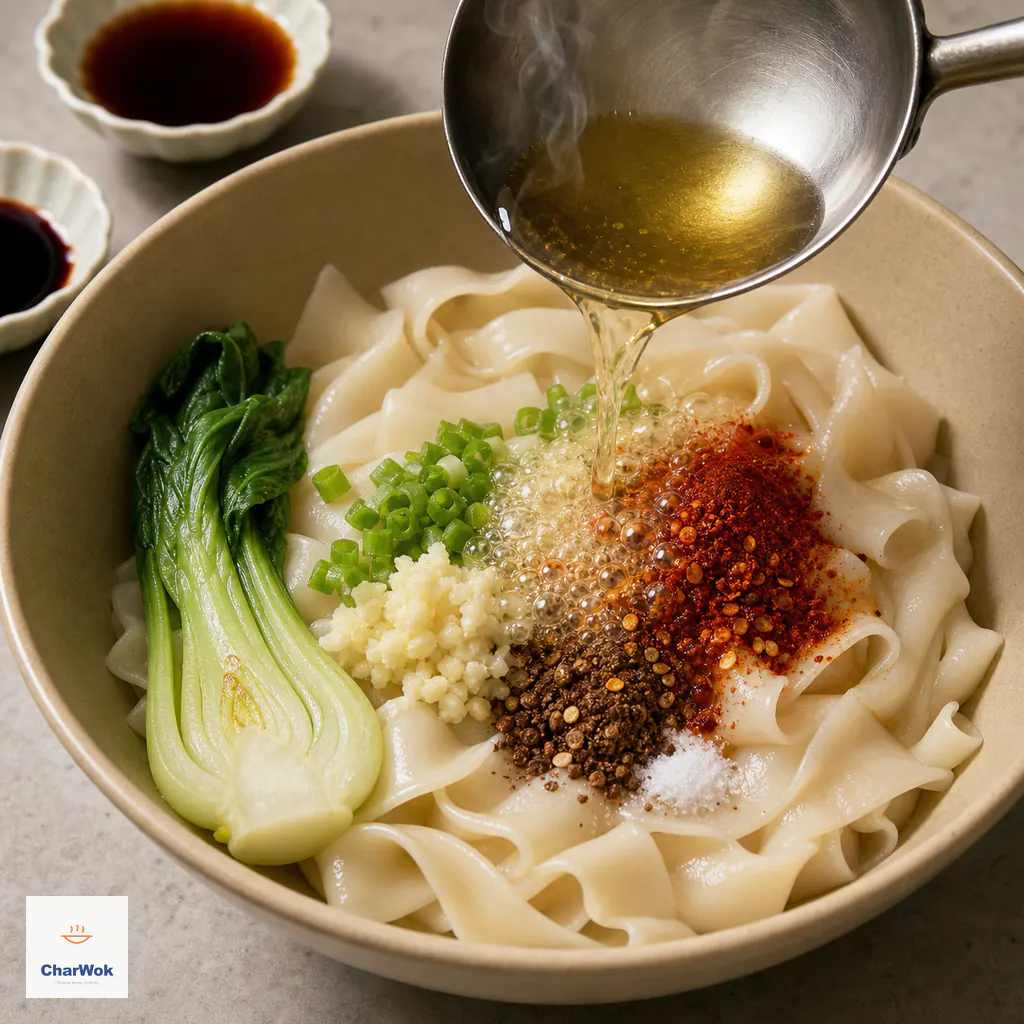
Pour about 3 tablespoons of oil heated to roughly 200°C over the aromatics, then add 1 tablespoon each light soy and black vinegar and toss while hot
- Add soy and vinegar, then toss. Pour 1 Tbsp light soy sauce and 1 Tbsp black rice vinegar over each bowl and stir vigorously with chopsticks to coat every strand. Eat immediately; these noodles are at their best in the first two minutes.
When things go wrong
Most biang biang failures trace back to one of four points. Here's what to check.
- The dough snaps back and won't stretch. It hasn't rested long enough under the oil, or your kitchen is cold. Give it another 20 minutes. If it still fights you, your flour may be unusually strong; knead in a few drops of water next time, or switch to a softer all-purpose.
- The noodle tears down the middle instead of the sides. The center groove was pressed too deep. Score only about two-thirds of the way through, and stretch gently; let gravity and the dough's weight do most of the work, not your arms.
- The noodles clump into a single mass. Either you didn't drop them in one at a time, or the water wasn't at a full boil when they went in. A rolling boil keeps them moving; a lazy boil lets them settle and stick.
- The cooked noodle is gummy, not chewy. Overcooked, or the dough was too wet. Biang biang should be boiled just until it floats plus a short beat, not until it's soft. Pull them when they still look a touch underdone at the very center; residual heat finishes them in the bowl.
- The oil splash didn't sizzle. The oil may not have been hot enough, or the aromatics were wet. Pat the aromatics dry and heat fresh oil gradually until the surface shimmers. Do not keep heating once it smokes; turn off the burner and let it cool briefly.
Variations and what to serve alongside
The bare oil-splash bowl is the canonical version, but biang biang is a canvas. Once the noodles are made, the toppings are wide open:
- With a stir-fried topping. Spoon cumin lamb or a quick tomato-and-egg mixture over the noodles in place of (or in addition to) the oil splash. The noodles carry a saucy topping beautifully because of their width.
- Cold, sesame style. Rinse the cooked noodles under cold water, then dress with sesame paste, soy, and chili oil, a cross between biang biang and sesame noodles. Excellent in summer.
- Swap the greens. Baby spinach, snow pea shoots, or blanched broccoli florets all stand in for bok choy. Add whatever is in the fridge.
- Heat it down with vinegar. Black rice vinegar is the traditional sour note, but a spoon of suan la mian-style hot-and-sour dressing works if you want more punch.
For dipping sauces on the side, the six dumpling sauces translate directly: a black-vinegar-and-ginger dip or a soy-chili-oil dip both play well alongside a bowl of these. And if you're building a noodle-focused meal, biang biang pairs naturally with Dan Dan noodles or a bowl of scallion oil noodles for contrasting textures. The broad noodle canon is big enough to hold all of them.
Storage and reheating
The dough is the part worth making ahead. Once the oiled cylinders have rested, you can refrigerate them covered for up to a day; bring them back to room temperature before pulling, or they'll be too tight to stretch. Cooked biang biang does not reheat well; the dressing soaks in and the noodles lose their snap within an hour. If you must, slightly undercook them, shock in cold water, toss with a little oil, and refrigerate; then drop them back into boiling water for 30 seconds to revive. It's a decent workaround, but it won't match fresh. My honest advice: pull only as much as you'll eat, and leave the rest of the dough for tomorrow.
Frequently asked questions
A few questions that come up every time someone makes these for the first time.
Can I use bread flour for more chew? Yes. Bread flour (12–13% protein) gives a noticeably springier noodle. The trade-off is the dough feels even stiffer at the mixing stage, so don't panic; it smooths out during the rest.
Why rest the dough for a whole hour? Gluten needs time to relax after kneading, and the oil needs time to penetrate the surface. Skip the long rest and the dough will shrink back the moment you pull it. This is the one step you cannot shortcut.
Do I really need black rice vinegar? For the authentic flavor, yes. Black rice vinegar (Chinkiang) is malty and mellow where regular rice vinegar is sharp and bright. If you can't find it, balsamic thinned with a little rice vinegar is the closest common substitute, though the result is recognizably different.
Why tear the noodle open into a loop? It doubles the strand length and creates ragged internal edges that grip the dressing. If a loop feels fussy, skip the tear and leave each noodle as a single wide ribbon; it's still biang biang.
Can I make the dough without a stand mixer? Absolutely. Hand-mixing is the traditional method and works perfectly. The 10-minute rest halfway through is what makes the stiff dough kneadable by hand.