Crunch is the whole point of a Chinese cucumber salad. Once you lose that snap, you've made pickle soup. The first time I served a beautifully dressed bowl of cucumber to friends, by the time we sat down it had wept a cup of water and the garlic dressing tasted like nothing. The dish was technically "correct" and quietly ruined.
What follows is the way I now make it at home, built around three knife approaches and three dressings that each solve a different problem. The trick isn't a secret ingredient. It's understanding that cucumber is about 95 percent water, and that every step here, the smashing, the salting, the hot-oil pour, exists to manage that water and the surface that holds the seasoning.
Whole dish in under 15 minutes of active work, plus a 10-minute salt rest before dressing. The decision that matters most: pull the dressing back until the moment you serve. Salt the cut cucumber, dump the wept liquid, dress last. Cut for surface area; season at the table.
Where these salads come from
Cold vegetable plates (liang ban cai, or "tossed cold dishes") are the quiet engine of a Chinese meal. They arrive first, they cost little, and they wake up the appetite without weighing it down. Cucumber leads the category because it is cheap, year-round, and almost impossible to hate. For a sense of how wide the family runs, compare the gentle ginger-soy version here to the sharp, chili-driven Northeast tiger salad, the earthy wood ear mushroom salad, or a clean napa cabbage salad. Same logic, different vegetables.
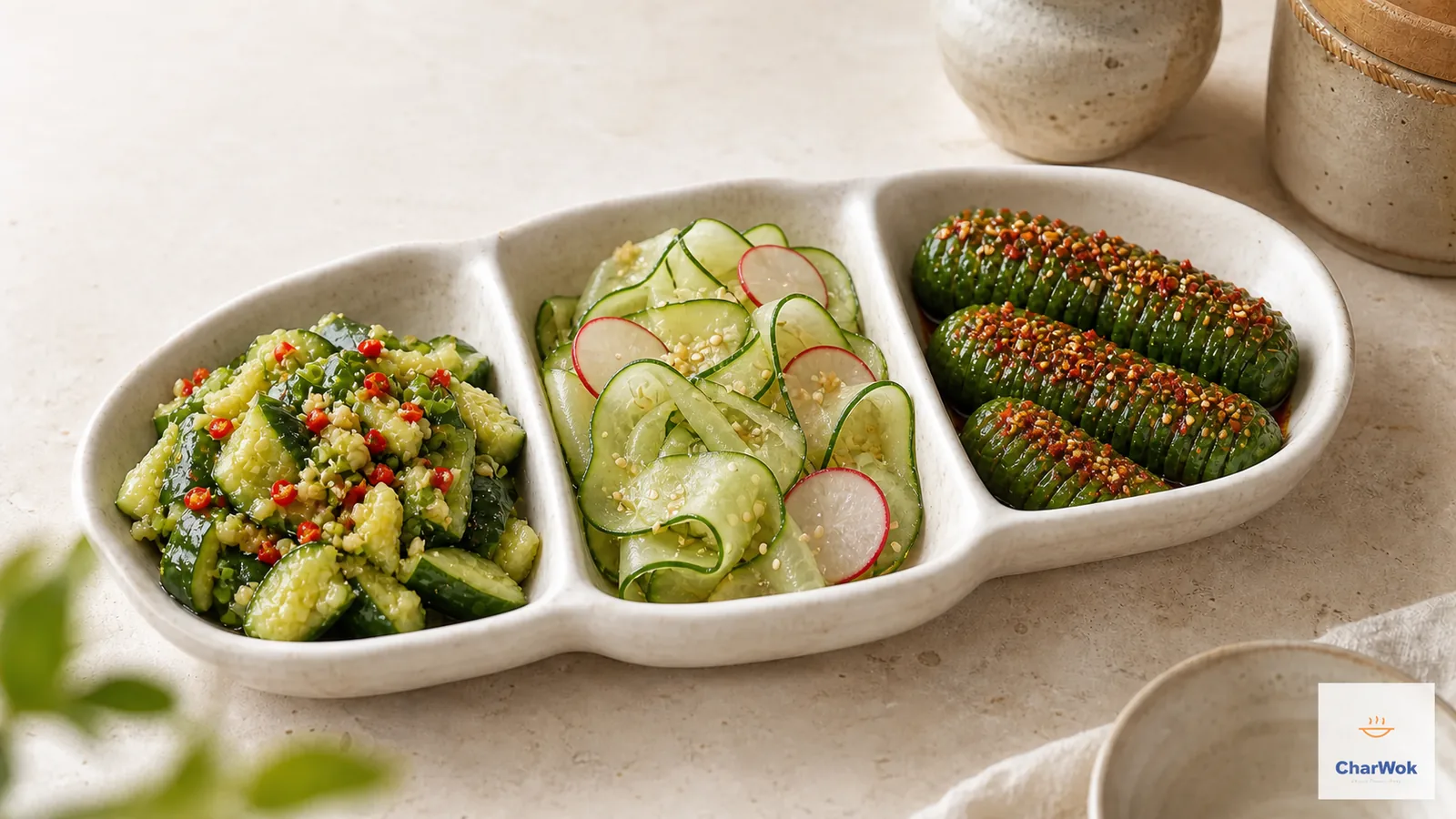
Of the three styles below, the smashed version is the everyday one, eaten across northern and central China all summer. The thin-sliced version is more recent and a little restaurant-fancy. The accordion-cut "coir raincoat" cucumber is a Shandong tradition, a knife-skill showpiece named after the layered straw raincoats old farmers wore. I'll be honest: I save that one for when people are watching.
Why the cut changes everything
A cucumber dressed as smooth rounds and the same cucumber dressed as smashed shards taste different, and the reason is physics. Seasoning clings to surface area and to rough, broken cell walls. A clean knife slice leaves a smooth face that repels sauce. A smash ruptures the flesh into a jagged landscape of cracks that drink the dressing. So the question isn't really "which cut is best." It's "how much dressing do I want this cucumber to hold, and how fast?"
If you've only ever made the classic smashed cucumber salad, the two other cuts here give you two new tools. The peeler-ribbon cut turns a thick-skinned supermarket cucumber into something elegant and quick. The accordion cut turns a plain vegetable into a conversation piece that soaks up a bold mala dressing from the inside out.
Ingredients for all three versions
Ingredients at a glance
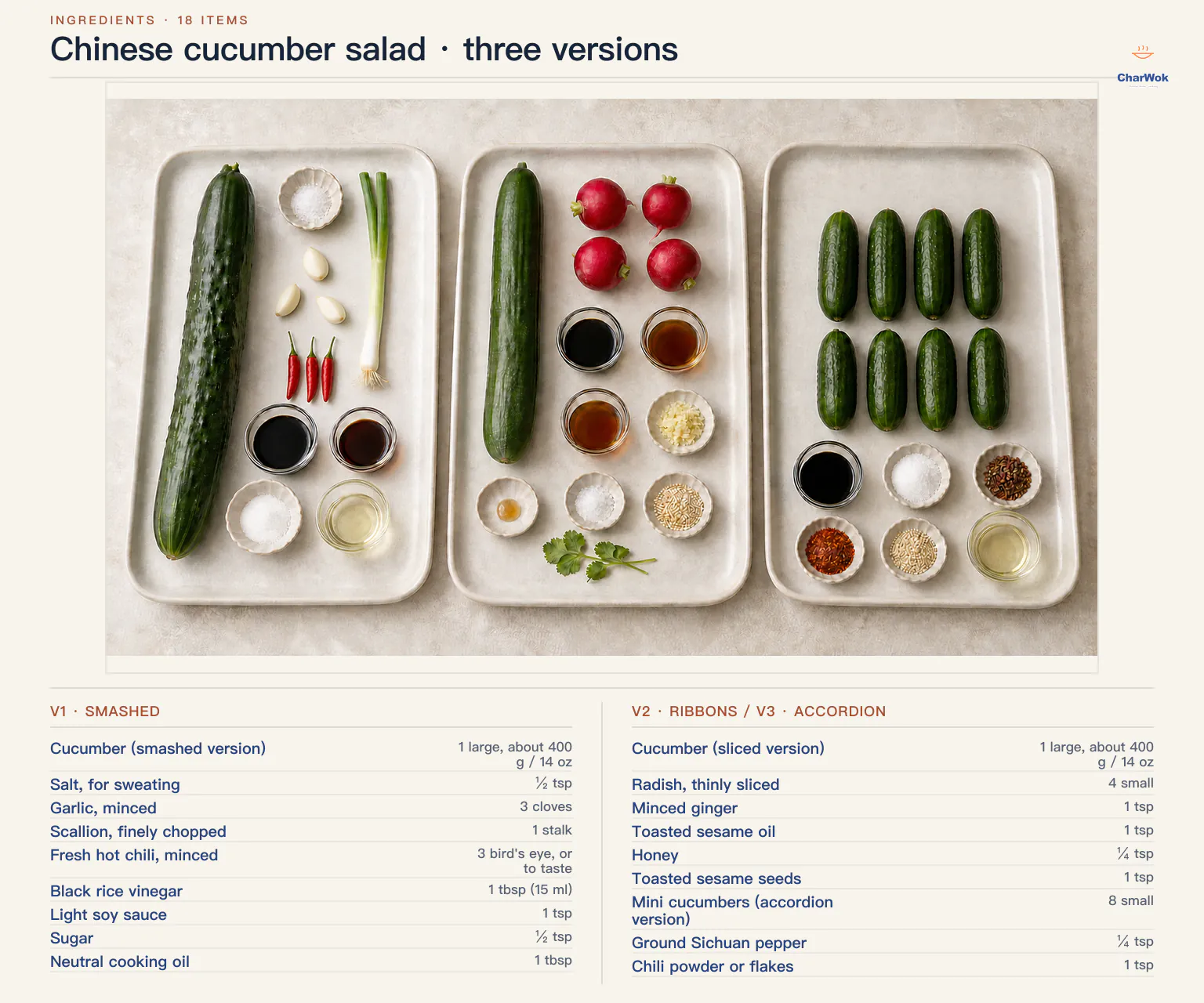
Each version serves 2 as a side. Use Persian, Kirby, or English cucumbers. I reach for Persian first: thin skin, small seed cavity, real crunch. English cucumbers are fine but softer and wetter; if that's what you have, peel them in stripes so the flesh cracks more easily when smashed.
| Ingredient | Amount | Notes / substitute |
|---|---|---|
| Cucumber (smashed version) | 1 large, about 400 g / 14 oz | Persian or Kirby preferred; English works, peel in stripes |
| Salt, for sweating | ½ tsp | Kosher or fine sea salt |
| Garlic, minced | 3 cloves | Smash with the flat of a knife, then chop |
| Scallion, finely chopped | 1 stalk | Cilantro works if you prefer it |
| Fresh hot chili, minced | 3 bird's eye, or to taste | Thai chili, serrano, or jalapeño by heat preference |
| Black rice vinegar | 1 tbsp (15 ml) | Chinkiang/Zhenjiang vinegar; see black rice vinegar |
| Light soy sauce | 1 tsp | Regular soy sauce is fine |
| Sugar | ½ tsp | Balances the vinegar's sharp edge |
| Neutral cooking oil | 1 tbsp | Peanut, canola, or grapeseed |
| Cucumber (sliced version) | 1 large, about 400 g / 14 oz | English cucumbers excel here |
| Radish, thinly sliced | 4 small | Red radish for color; daikon for a milder bite |
| Minced ginger | 1 tsp | Scrape the skin off first; don't grate it to a paste |
| Toasted sesame oil | 1 tsp | Use toasted, not pale raw; see sesame oil |
| Honey | ¼ tsp | Sugar works; honey pairs better with ginger |
| Toasted sesame seeds | 1 tsp | For garnish and nutty flavor |
| Mini cucumbers (accordion version) | 8 small | Start on a large cucumber while you learn |
| Ground Sichuan pepper | ¼ tsp | Freshly ground; see Sichuan pepper guide |
| Chili powder or flakes | 1 tsp | Pure chili, not a blend; heat to taste |
Version 1: Smashed cucumber with a garlic-chili dressing
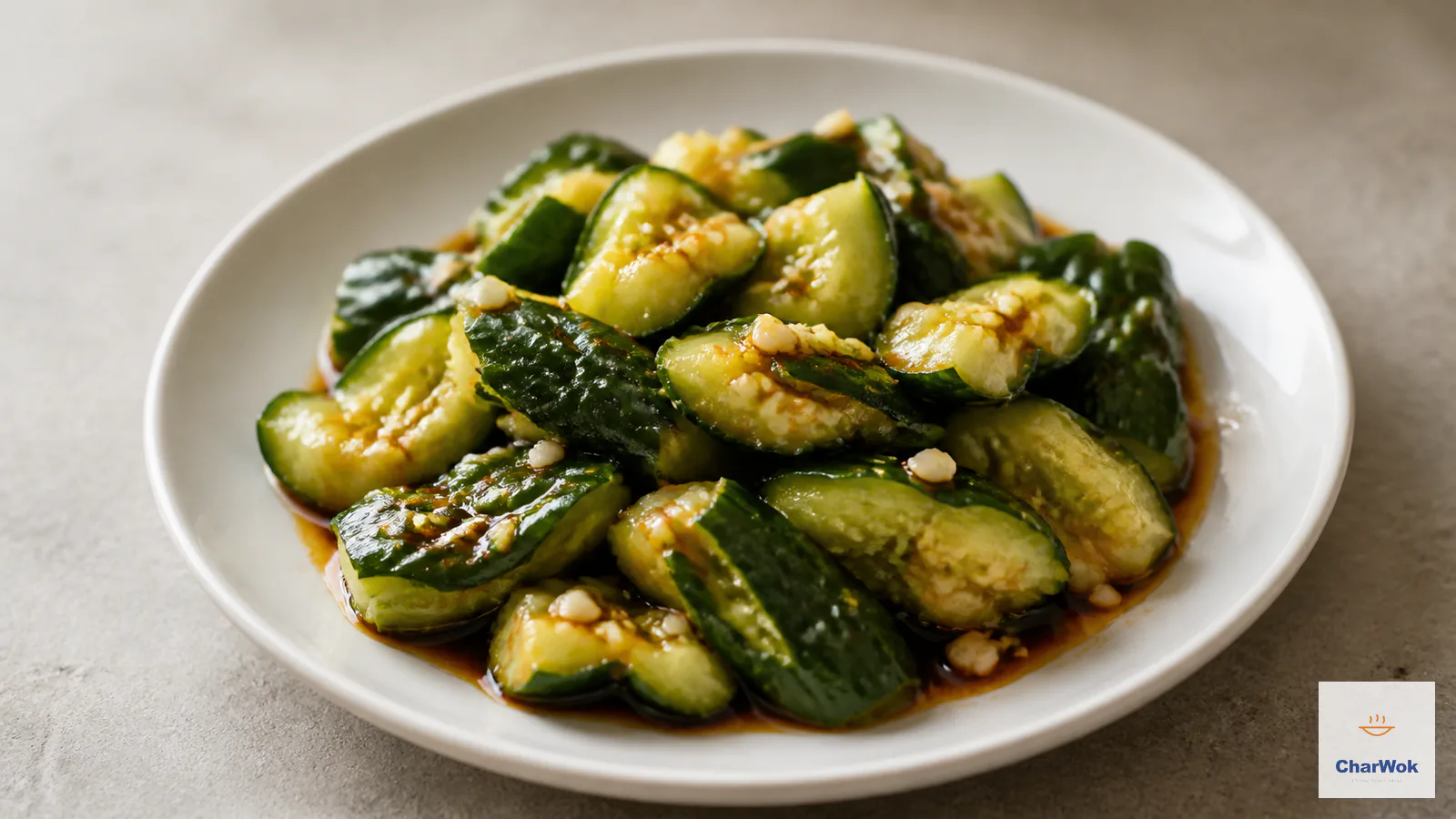
This is the one you'll make most often. The smash is the whole technique. It opens the flesh so the dressing can travel inside the pieces rather than sitting on top.
- Stripe-peel the cucumber. Run a peeler down it three or four times, leaving green stripes. This thins the skin where you'll smash and stops the pieces from being all rind.
- Smash it flat. Lay the whole cucumber on the board and bring the side of a cleaver, a rolling pin, or an empty bottle down its length until the flesh cracks open along the seed line. You want it shattered, not pulverized. The cracks are what hold the dressing.
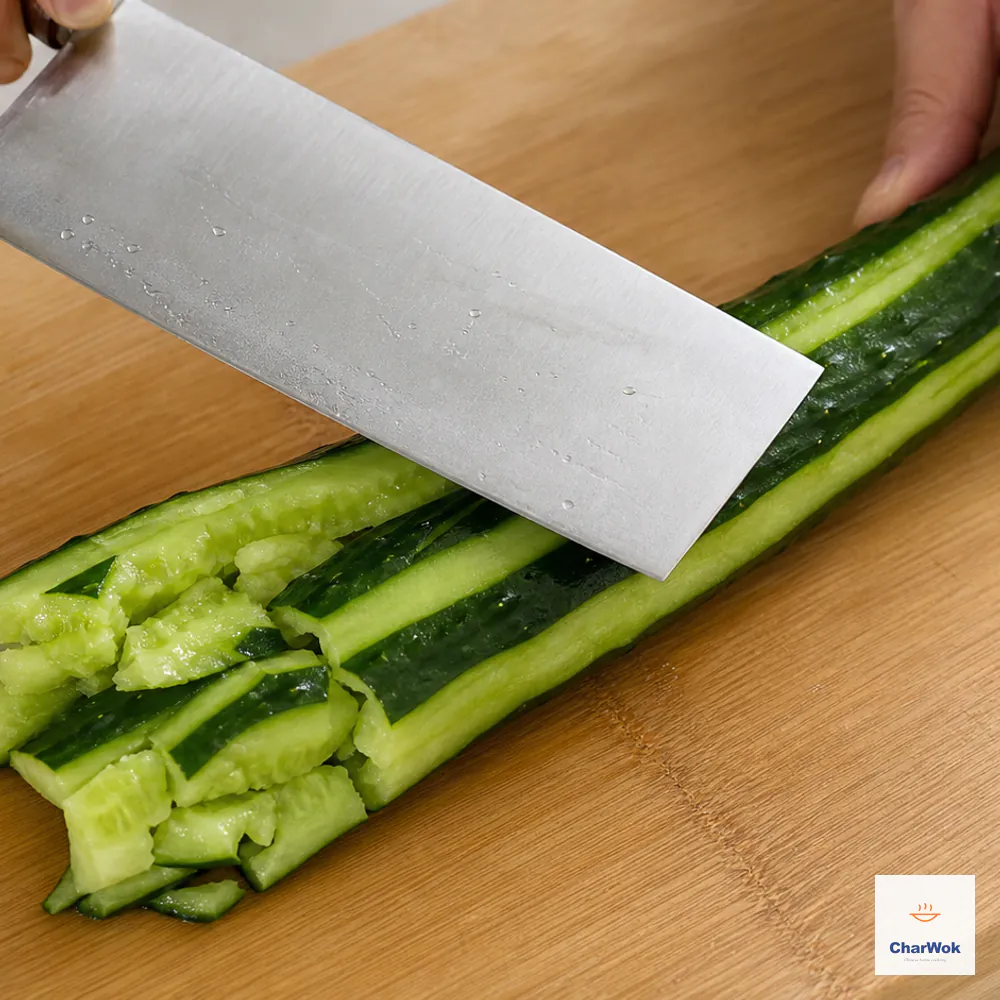
Peel alternating stripes, split the cucumber lengthwise, then smash firmly before breaking it into rough bite-size pieces
- Cut into rough bite-size pieces. Irregular is good. Even factory cuts repel sauce; jagged ones drink it.
- Salt and sweat for 10 minutes, then pour off the liquid. Toss with ½ tsp salt, wait, then drain every drop. This is the step that saves the crunch. Skip it and the bowl floods on the table.
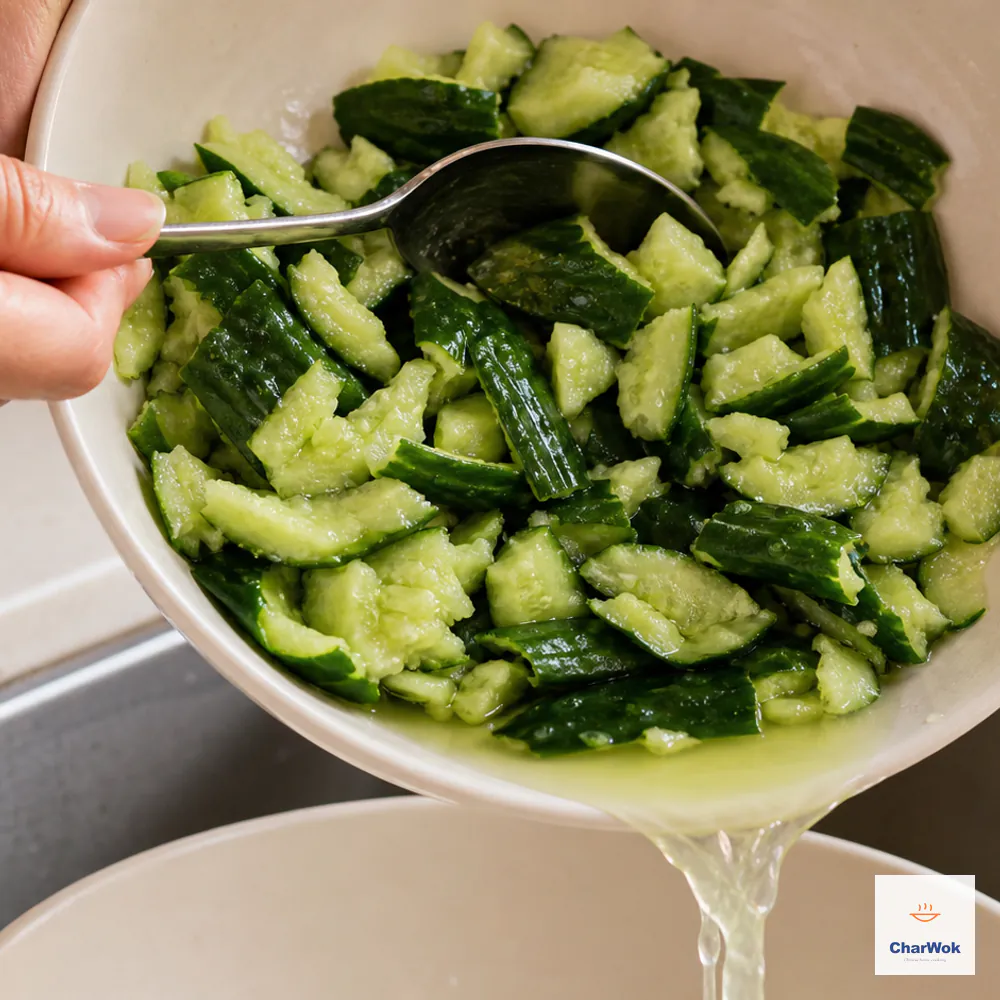
Salt the smashed cucumber, leave it for 10 minutes, then drain the released water thoroughly so the dressing stays punchy
- Mound the aromatics in the center. Pile the garlic, scallion, and chili on top of the drained cucumber.
- Heat 1 tbsp oil until it shimmers, then pour it over the aromatics. You should hear a sizzle and smell the garlic bloom instantly. This is a mini hot-oil "bloom," and it transforms raw, harsh garlic into something fragrant. If the oil isn't hot enough, the garlic stays sharp.
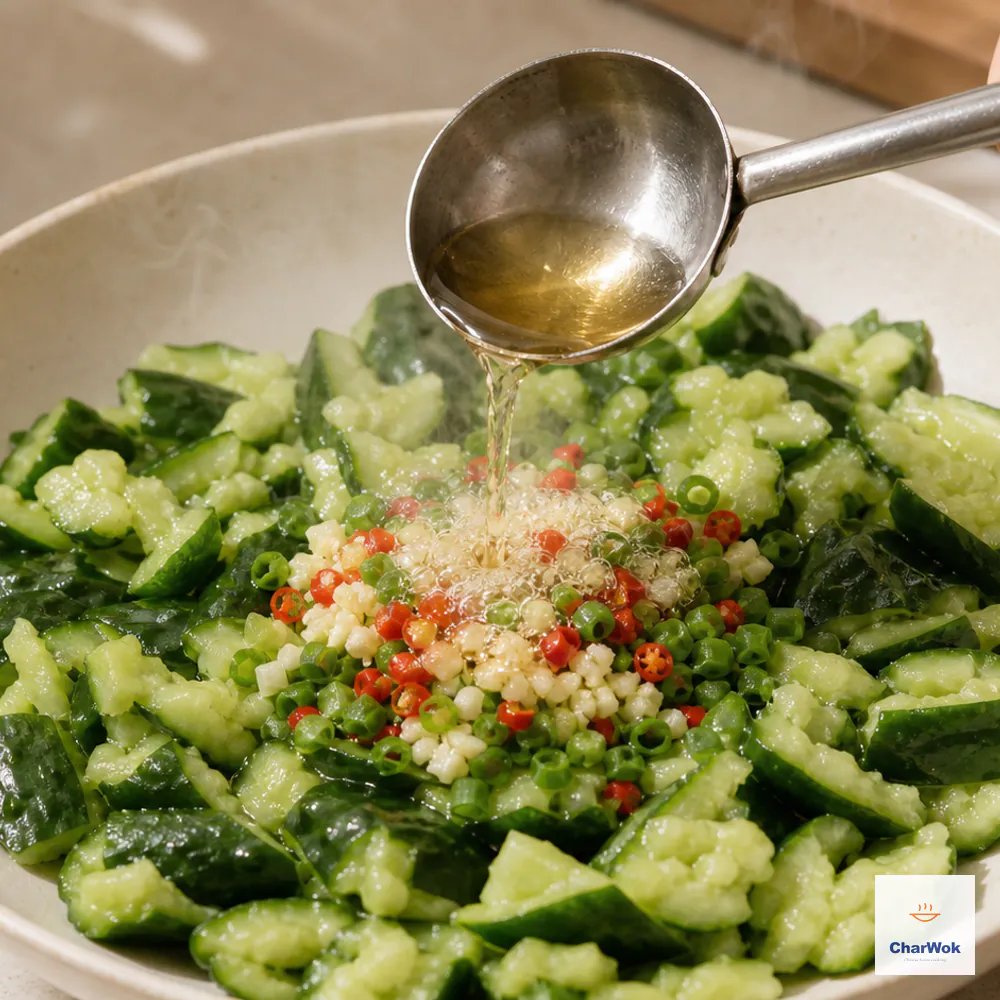
Heat the oil gradually to 170–180°C, shimmering but not smoking, then pour it over the garlic, scallion, and chilli; if it smokes, turn off the burner and let it cool
- Add soy sauce, vinegar, and sugar, then toss. For a cleaner mix, cover the bowl with a plate and shake it for ten seconds instead of stirring.
- Serve right now. This version does not wait.
The garlic dressing here pulls double duty. It's the same family of flavors I use as a quick dumpling dipping sauce, thinned out a touch. Make extra and keep it in the fridge.
Version 2: Peeler-ribbon cucumber with ginger dressing
This is the gentlest of the three, and the one that rescues a thick, watery supermarket cucumber. Instead of fighting the vegetable, you shave it into long translucent ribbons that pick up a light ginger-honey dressing without ever going near a knife edge.
- Shave lengthwise with a vegetable peeler. Run the peeler down the cucumber from end to end. Stop the moment you see the wet, seedy core. The seed cavity is where most of the water lives, so leaving it out keeps the salad from flooding.
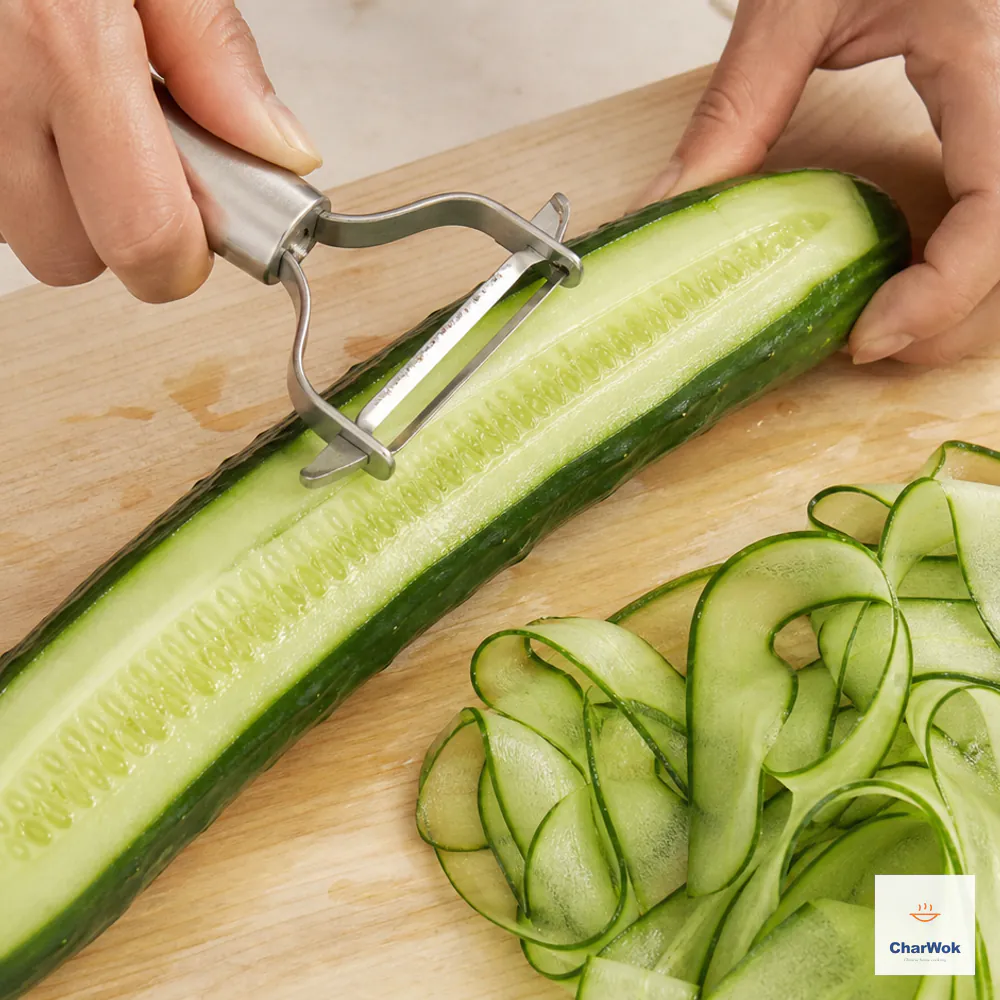
Shave long ribbons from one side and rotate the cucumber, stopping as soon as the watery seed core is exposed
- Rotate a quarter turn and keep shaving. Repeat on all four sides. You'll be left with a seedy core; eat it as a cook's treat or save it for a smoothie. Don't try to shave it.
- Combine the ribbons with thin radish slices. The radish adds color and a peppery note that the cucumber lacks on its own.
- Mix the dressing in a small bowl and let it sit. Black rice vinegar and soy sauce at a 3:2 ratio, plus minced ginger, sesame oil, a drop of honey, a pinch of salt, and sesame seeds. Five minutes of sitting lets the ginger infuse the liquid, which is the whole point of using ginger instead of garlic.
- Dress at the very last second. Pour, toss with chopsticks, and walk it to the table. The ribbons are delicate; left in the dressing they collapse within ten minutes.
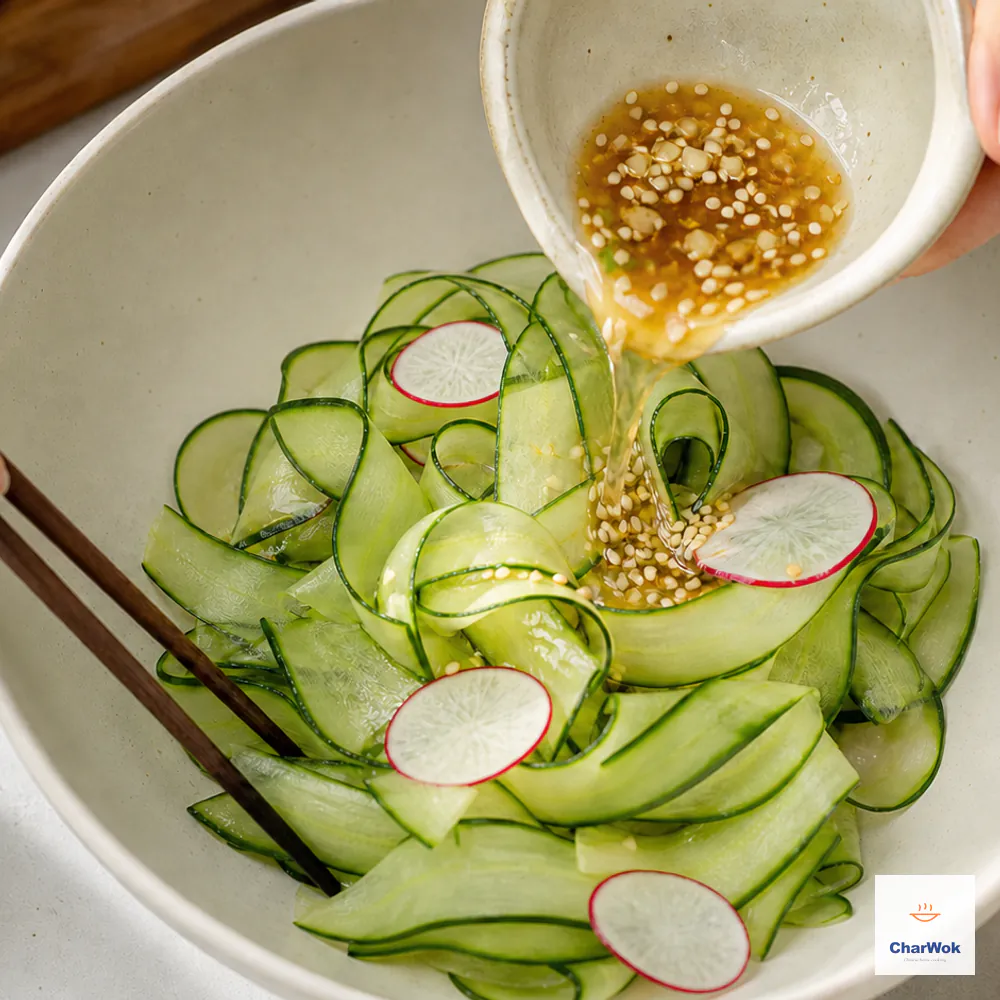
Combine the dressing first, then toss the cucumber ribbons and four radish slices only at the last second to keep them crisp
This ginger dressing is the same one I use on a spinach and soybean salad, and it's the most forgiving of the three. The smashed dressing has attitude; this one has poise.
Version 3: Accordion (coir raincoat) cucumber with mala dressing
Here's the showpiece. The cucumber is cut in a connected accordion that stretches like a slinky and soaks a chili-Sichuan-pepper dressing from the inside. Shandong in origin, named after layered straw raincoats, and worth the patience on the rare evening you want to impress somebody.
- Rest a chopstick alongside the cucumber as a depth stop. Lay the cucumber on the board with a chopstick flush against its far side. The stick stops your blade at roughly halfway through, which is what keeps the slices connected rather than severed.
- Slice diagonally, thin and even, from one end to the other. Angle the knife about 30 degrees to the board and use just the tip. The chopstick guarantees you never cut all the way through.
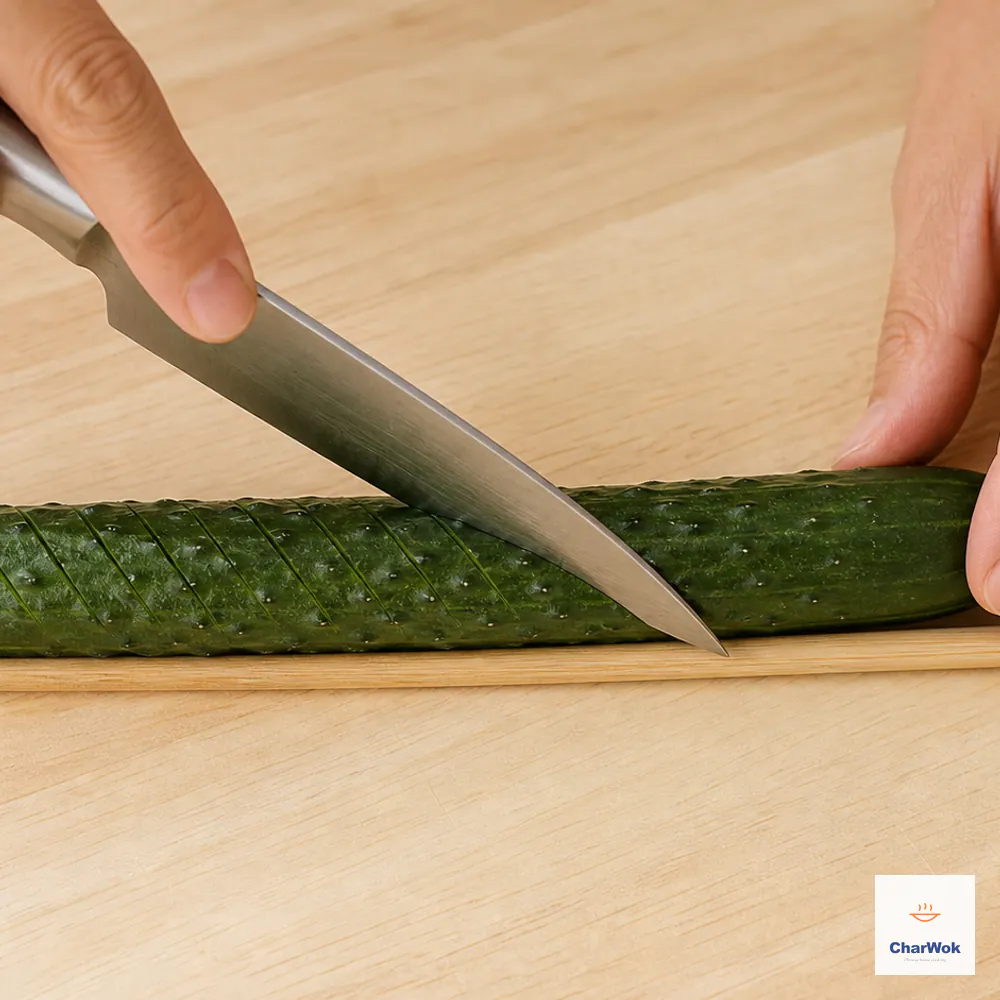
Place each mini cucumber between chopsticks and make close diagonal cuts; the chopsticks prevent the blade from cutting all the way through
- Flip the cucumber and slice the other side at right angles. Same depth stop, perpendicular cuts. When you lift it, the cucumber should stretch open in a continuous zigzag.
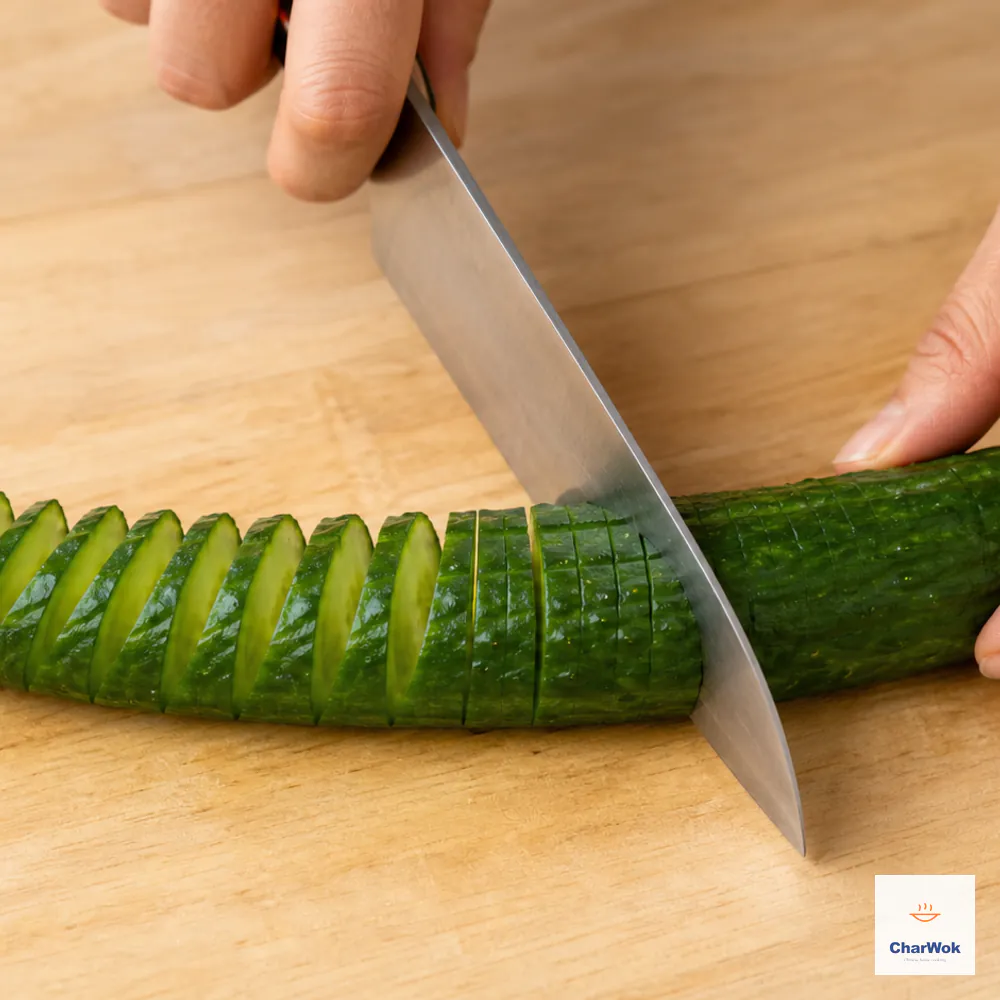
Flip the cucumber over and cut straight across at right angles to the first cuts so it stretches into an even accordion
- Sweat the accordions in soy sauce and sugar for 10 minutes, then drain. The salty-sweet soy draws out water and seasons the flesh at once. Toss once halfway, then discard every drop of liquid.
- Pile the spices on top. Ground Sichuan pepper, chili powder or flakes, and toasted sesame seeds, mounded in the center.
- Pour hot oil over the spices to bloom them. Heat the oil gradually to 170 to 180°C / 340 to 356°F, when it shimmers but does not smoke, then pour it over the chili and Sichuan pepper for an immediate crackle. If it smokes, turn off the burner and let it cool before continuing.
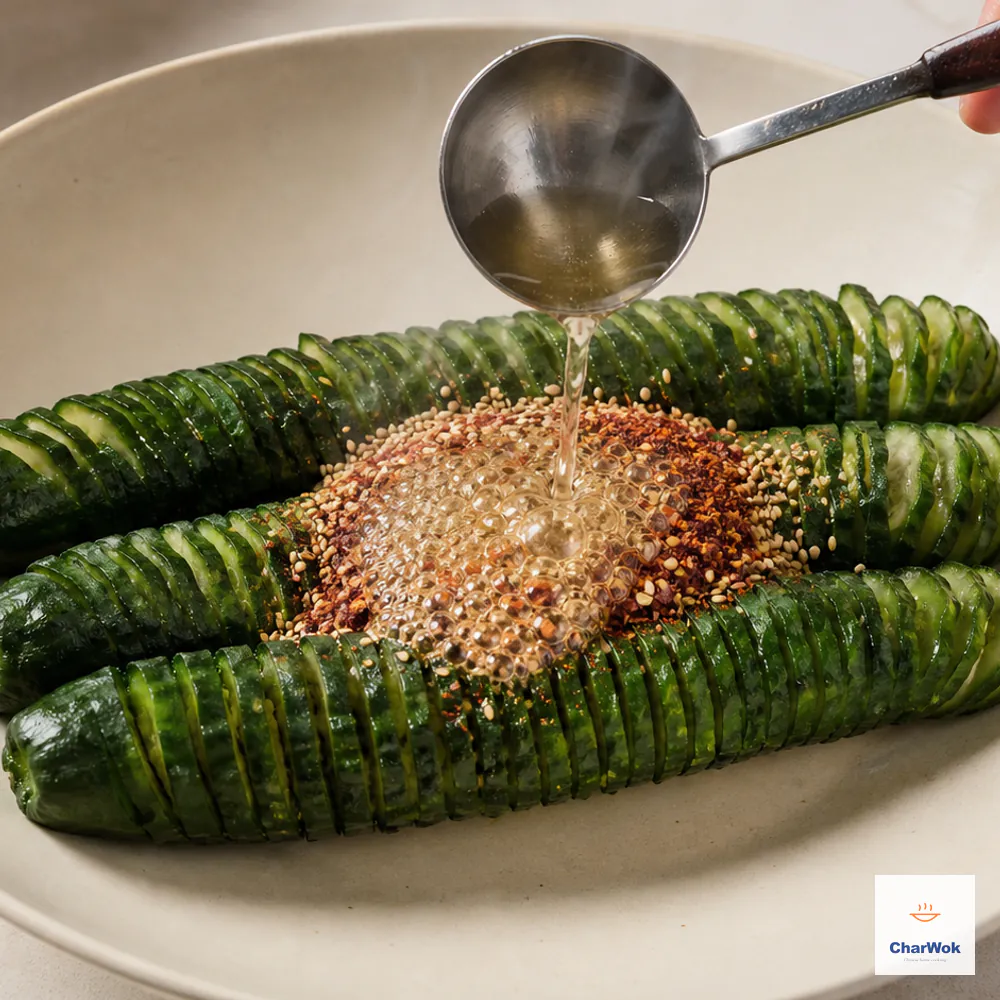
Heat the oil gradually to 170–180°C, shimmering but not smoking, and pour it over Sichuan pepper, chilli, and sesame; if it smokes, turn off the burner and let it cool
- Toss gently and serve immediately. The accordion shape is fragile; rough handling snaps it apart.
Hot-oil safety: Stay beside the pan and use a dry, stable, heatproof bowl. The U.S. Fire Administration advises turning off the burner if cooking oil starts to smoke.
For the spice layer, freshly toasted and ground Sichuan pepper beats anything from a jar by a wide margin. If you've never done it, the technique for grinding Sichuan pepper is worth learning once. And if you keep a jar of homemade chili oil on hand, a generous spoonful stands in for the pepper, flakes, sesame, and oil in one move, which is how I make this on a weeknight.
When it goes wrong, and how to fix it
These salads are simple, which means the failures are obvious and almost always come down to water or oil temperature.
- The bowl floods and the dressing tastes weak. You skipped the salt-sweat, or you dressed too early. Next time, salt the cut cucumber, wait 10 minutes, drain fully, and dress only at the table. To rescue the current bowl, pour off the pooled liquid and add a small extra splash of vinegar and soy to re-sharpen.
- The cucumber is limp instead of crunchy. It sat in salt too long (more than 20 minutes), or it was dressed and left standing. Salt weakens the cell walls over time; ten minutes firms them by drawing water out, thirty minutes collapses them.
- The hot-oil pour didn't do anything. The oil may have been too cool. Heat fresh oil gradually until it visibly shimmers, about 170 to 180°C / 340 to 356°F, then pour it while staying beside the pan. Do not keep heating until it smokes; if smoke appears, turn off the burner and let the oil cool.
- The garlic tastes harsh and raw. Either the oil wasn't hot enough to bloom it, or it sat minced for a long time before use. Mince garlic close to serving, and always pour hot oil over it rather than stirring raw garlic into a cold dressing.
- The accordion cut fell apart. Your blade went past the halfway line. Use the chopstick depth stop, slow down, and practice first on a fat cucumber before attempting the mini ones.
- The Sichuan pepper tastes dusty, not tingly. It's stale. Buy whole peppercorns, toast them dry in a pan until fragrant, grind fresh, and use within a couple of weeks.
Variations and what to serve alongside
The three dressings are interchangeable with the three cuts. Put the mala dressing on smashed cucumber for a louder weeknight version, or dress the accordion cut with the gentle ginger sauce for something subtler. A few directions I like:
- Swap the dressing entirely. A spoonful of homemade chili oil turns any of these into a five-minute spicy side; a sesame-paste dressing makes them richer and more northern.
- Bulk it up. Toss the smashed version with rehydrated wood ear mushrooms or torn century egg for a fuller cold plate. A cold glass noodle salad on the same table turns a side into a light meal.
- Pair it. These salads are built to cut through richness. Serve the garlic version alongside dumplings, the ginger version with steamed eggplant with chili garlic dressing, and the mala version with cold Sichuan-dressed noodles on a hot night. If you want a contrasting crunch, a small bowl of quick overnight pickled vegetables alongside repeats the cold-and-crunchy theme without repeating flavors.
Storage and leftovers
My firm recommendation: don't store these dressed. Cucumber salads are a now food. If you must plan ahead, do all the cutting and the salt-sweat, drain the cucumber, and keep it undressed in the fridge for up to a day. Make the dressing separately and combine at the table. Once dressed, you have maybe 30 minutes of good texture before the water wins. Leftovers are still edible as a sort of cucumber pickle, but they aren't the dish anymore, and I won't pretend they are.
Frequently asked questions
A quick rundown of the questions I get most often, answered in short form.
- Can I use regular cucumbers from the supermarket? Yes. English cucumbers are best for the ribbon version; for the smashed version, stripe-peel them so the flesh cracks open.
- Do I really need to salt and drain first? If you want real crunch and a dressing that tastes like itself, yes. It's the single step that separates a good version from a watery one.
- Is there a substitute for black rice vinegar? A mix of balsamic and rice vinegar gets close in a pinch. The flavor won't be identical, but the sweet-sour balance will be in the right zone.
- How spicy is the mala version? As spicy as you make it. The heat comes from the chili you choose; the numbing tingle comes from the Sichuan pepper, which is a sensation, not a burn.
- Can I make the accordion cut without a cleaver? You don't need a cleaver for any of these. A sharp chef's knife and a chopstick for a depth stop are all the accordion version requires.
Make the smashed version first. It's the one that teaches the whole principle, that texture is seasoning, and that a bowl of cucumber can hold its own against anything else on the table if you respect the water inside it.