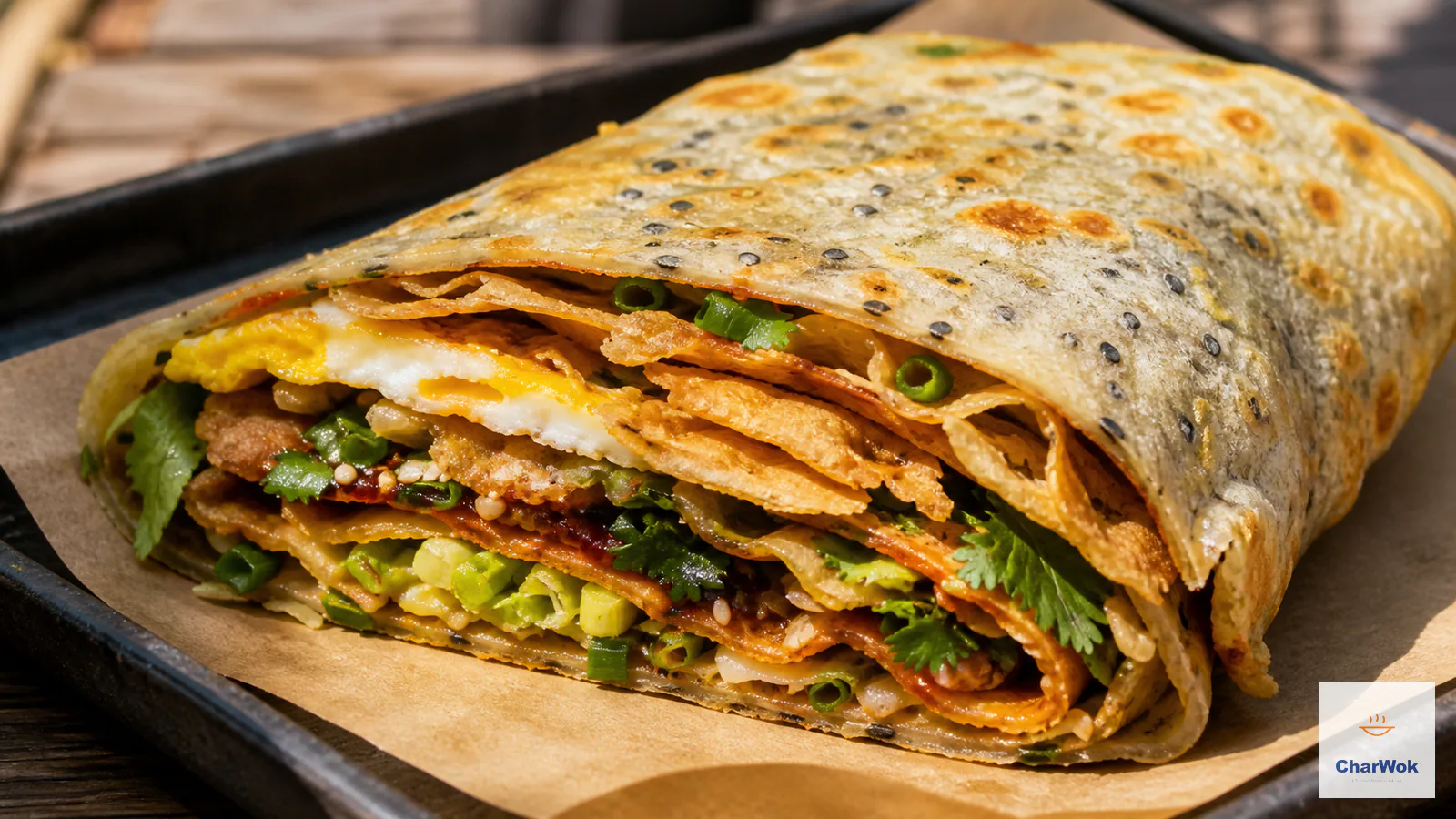
Jian Bing is a thin wheat-and-grain crepe cooked to order on a hot round griddle, painted with two or three savory sauces, scattered with scallion and cilantro, hit with an egg, then folded around something crunchy. That is the whole idea. The thing that haunts anyone who has eaten one at a Beijing or Tianjin bus stop at 7 a.m. is the contrast: a soft, almost custardy wrapper shattering against a fried cracker in the same bite.
Recreating it at home trips people up for two reasons. They make the batter too thick, so it turns into a pancake you have to spread with a tool instead of a crepe that flows on its own. And they treat the cracker as optional, which leaves you with an egg wrap that is fine but not really Jian Bing. This recipe fixes both, and it does it with a regular non-stick skillet, no flat cast-iron griddle, no wooden batter spreader.
Thin batter, warm-not-hot pan, fry the cracker until just golden. A working ratio is 2 parts all-purpose flour to 1 part whole-wheat flour to 5 parts water by volume (70 g AP flour + 40 g whole wheat + 300 ml water makes 4 crepes). The single most common failure is a pan that is too hot when the batter goes in, which sets the crepe into a lumpy disc before it can spread.
What Jian Bing actually is, and where it comes from
Jian Bing (煎饼) means "pan-fried flatbread," and the stuffed version sold as commuter food is properly called Jian Bing Guo Zi (煎饼果子), a name that belongs to Tianjin, where it is close to a religion. The Guo Zi is the crisp; in Tianjin that crisp is always a freshly fried rectangle of dough, never the soft youtiao doughnut stick you see standing in for it elsewhere. Other northern cities took the idea and ran with it, and today the dish travels under one umbrella across most of China.
What makes it work as street food is that it is built in front of you in under a minute. The vendor pours batter onto a large flat griddle, spreads it thin with a wooden paddle in one motion, cracks an egg on top, scatters scallion and sesame, flips it, brushes the sauces, lays in the crisp, folds the whole thing into a paper-wrapped parcel, and hands it over steaming. The traditional batter is mung bean flour cut with wheat flour and water; that gives the crepe its slightly beany, savory edge. Mung bean flour is hard to find in a standard American grocery, so this home version leans on whole-wheat flour to add back the flavor and color the mung bean would have supplied. It is a substitution, not the canonical thing, and I will be honest about that below.
If you want to spend a Saturday morning making a bigger spread, Jian Bing sits well next to the classic Chinese breakfast lineup and to softer items like steamed mantou buns or a bowl of quick chicken and mushroom congee.
The components you are about to build
There are three pieces, and it helps to think of them separately: a thin savory crepe (the wrapper and the egg that goes on it), a crisp (the crunch inside), and the sauces (the salty-spicy backbone). Each one is simple on its own. The reason this dish feels hard is sequencing, so I fry the crisps first, mix the batter second, and only then start cooking crepes to order.
Ingredients
Ingredients at a glance
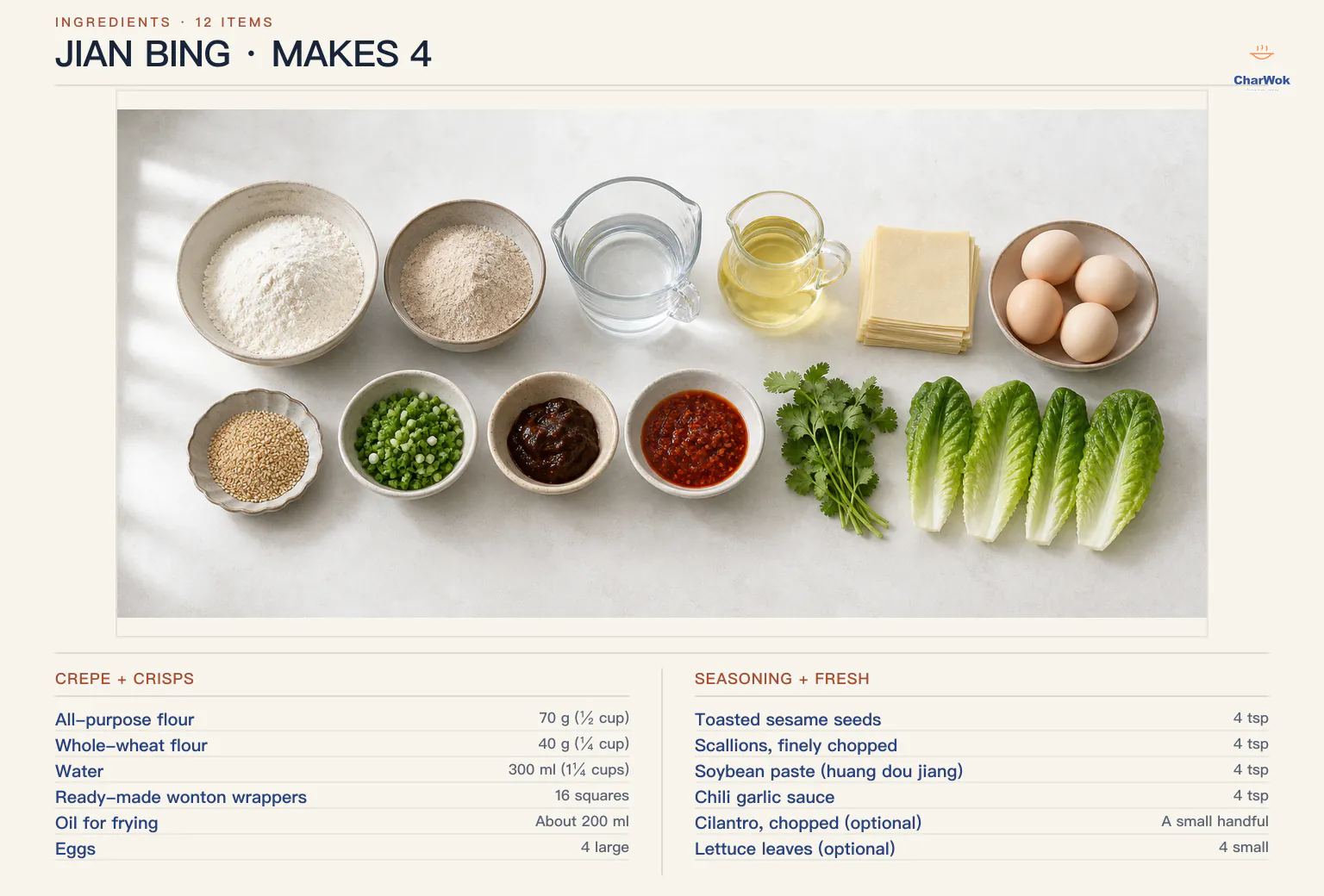
Quantities below make 4 crepes. The batter ratio is the part worth memorizing; everything else scales from there.
| Ingredient | Amount | Notes / substitute |
|---|---|---|
| All-purpose flour | 70 g (½ cup) | The structure of the crepe. Do not swap bread flour; too much gluten makes it rubbery. |
| Whole-wheat flour | 40 g (¼ cup) | Stands in for traditional mung bean flour. Mung bean flour (not starch), millet flour, soybean flour, or cornmeal all work in equal weight if you can find them. |
| Water | 300 ml (1¼ cups) | Room temperature. The batter must look like thin cream. |
| Ready-made wonton wrappers | 16 squares | Frozen section of Chinese markets. Yellow alkaline ones fry up the crispest; plain white are fine. See how to make wonton wrappers from scratch if you cannot buy them. |
| Oil for frying | About 200 ml | Use a small saucepan so you do not need much. Peanut, canola, or neutral oil; reuse once for stir-frying. |
| Eggs | 4 large | One per crepe. |
| Toasted sesame seeds | 4 tsp | For the egg side. White or mixed; toast briefly if yours are raw. |
| Scallions, finely chopped | 4 tsp | Green and pale parts, not the tough dark-green tips. |
| Soybean paste (huang dou jiang) | 4 tsp | The main salty sauce. Sweet bean paste (tian mian jiang), hoisin, or a mild chili bean paste thinned with water are reasonable substitutes. |
| Chili garlic sauce | 4 tsp | Store-bought chili garlic sauce, or my homemade duo jiao for more punch. |
| Cilantro, chopped (optional) | A small handful | Skipped in some regions, mandatory in others. I always add it. |
| Lettuce leaves (optional) | 4 small | Adds a cool, watery crunch. Romaine heart leaves are the right size. |
Step 1: Fry the crisps (do this first)
The crisps hold for days at room temperature, so get them out of the way before the pan gets crowded. Take two wonton wrappers, dab a little water on one, press the second on top, and roll once with a rolling pin to seal. Cut two slits through the middle so the cracker does not puff into a balloon when it hits the oil. Repeat until you have 8 doubled crackers.
Step 2: Mix a batter that pours like cream
Whisk the two flours, then stream in the water while whisking. Keep going until there are no lumps and the batter runs off the whisk in a thin ribbon, like crepe batter or light cream. If it falls in heavy dollops, add water a tablespoon at a time. Let it sit ten minutes if you have the time; the flour hydrates evenly and the crepes tear less.
Step 3: Cook the crepes to order
- Warm the pan, do not blast it. Set a 28 cm (11-inch) non-stick skillet over medium-low and let it come up slowly. Test by flicking a drop of water; it should sizzle and vanish in a second, not dance and spit. Too hot and the batter seizes into a thick puck before it can spread. This is the step everyone gets wrong.
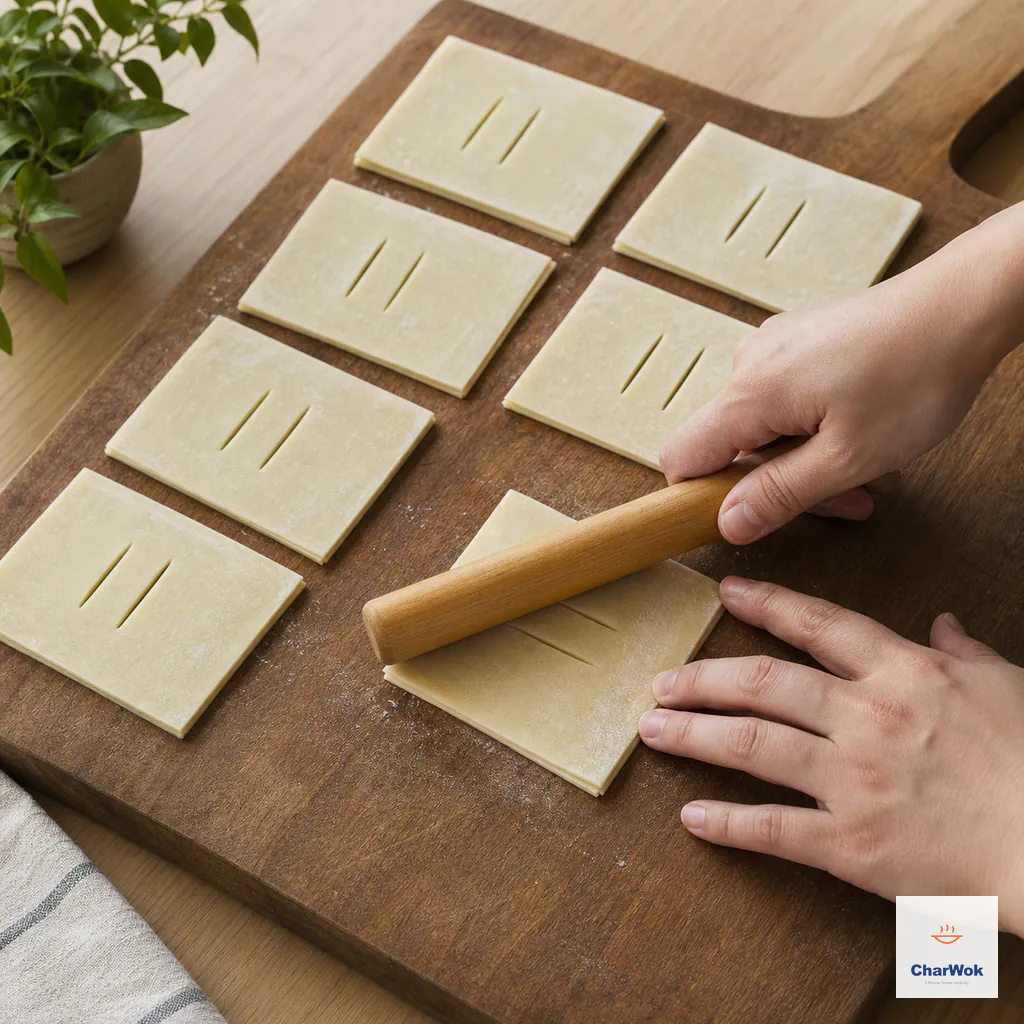
Brush two wrappers with a trace of water, press them into one layer and cut two center slits so each cracker fries flat and crisp
- Pour and swirl. Give the batter a stir (it settles fast), then pour a quarter of it into the center. Immediately tilt and rotate the pan so the batter runs out to the edges under its own weight. You are not spreading it; you are letting it find its own circle.
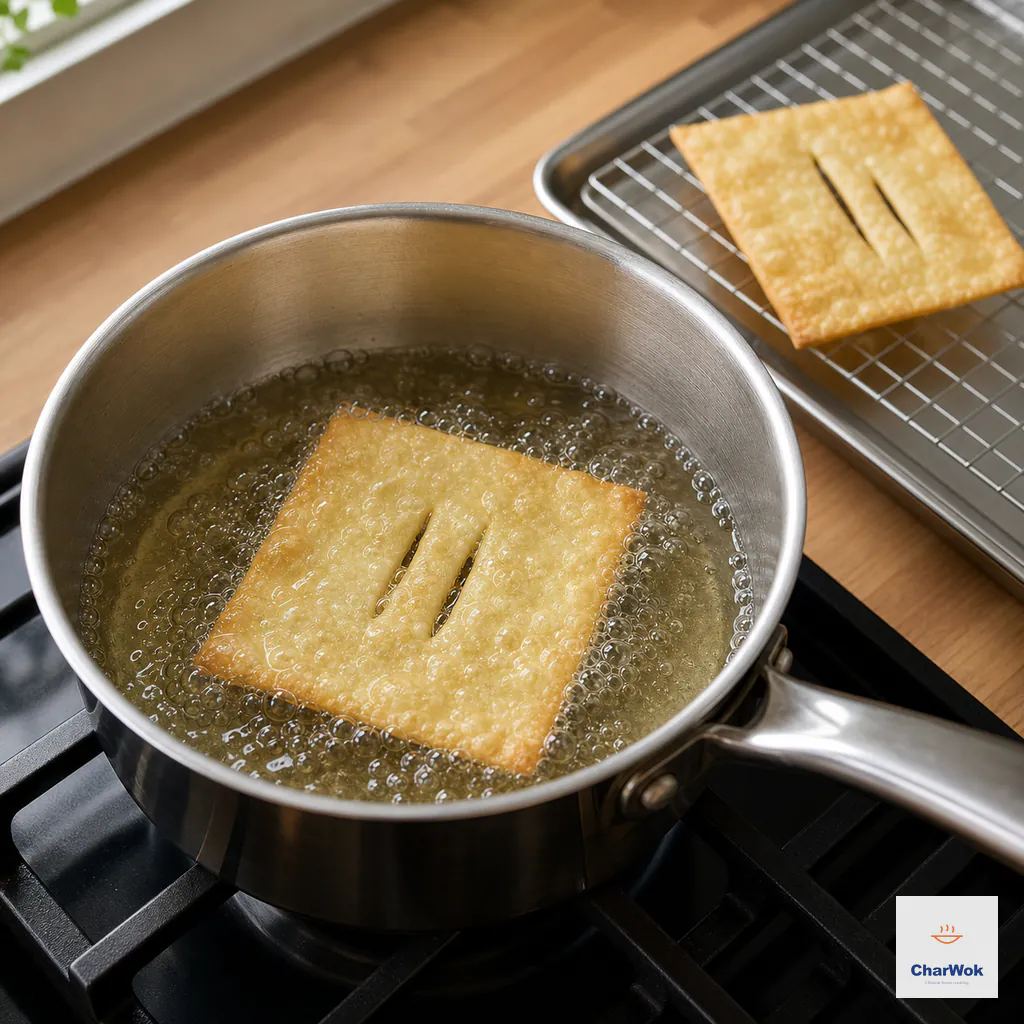
Fry at 180°C only until pale gold, then drain flat; the cracker keeps coloring and crisps as it cools
- Wait for the surface to lose its shine. When no wet batter is visible and the top looks set, crack an egg onto the center. Use the back of a spoon to break the yolk and smear it outward in a rough spiral, almost to the rim. The egg should land on a set crepe, not a wet one, or you will tear through to the pan.
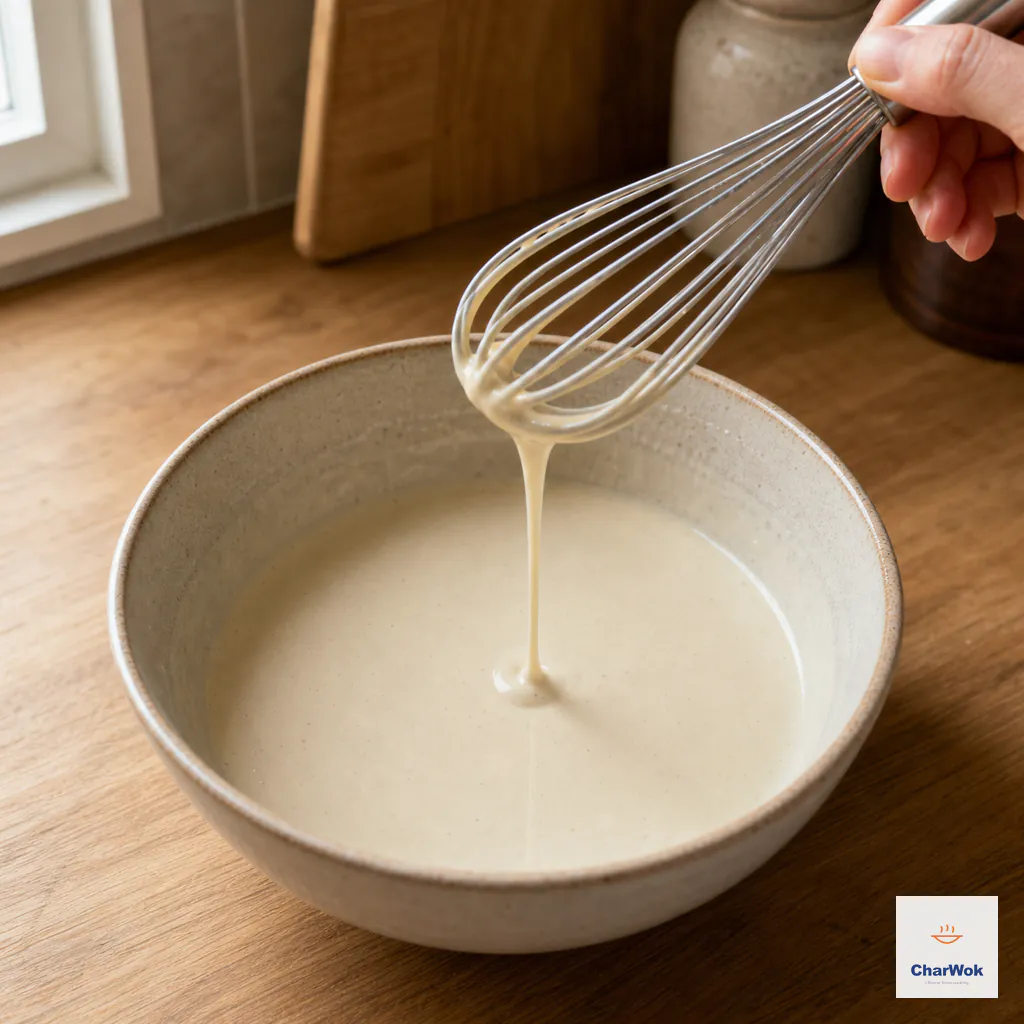
Whisk both flours with water until lump-free and fluid like light cream rather than falling in heavy dollops
- Scatter and season. Sprinkle sesame and scallion over the wet egg so they stick. A pinch of salt on the egg is not traditional but I like it.
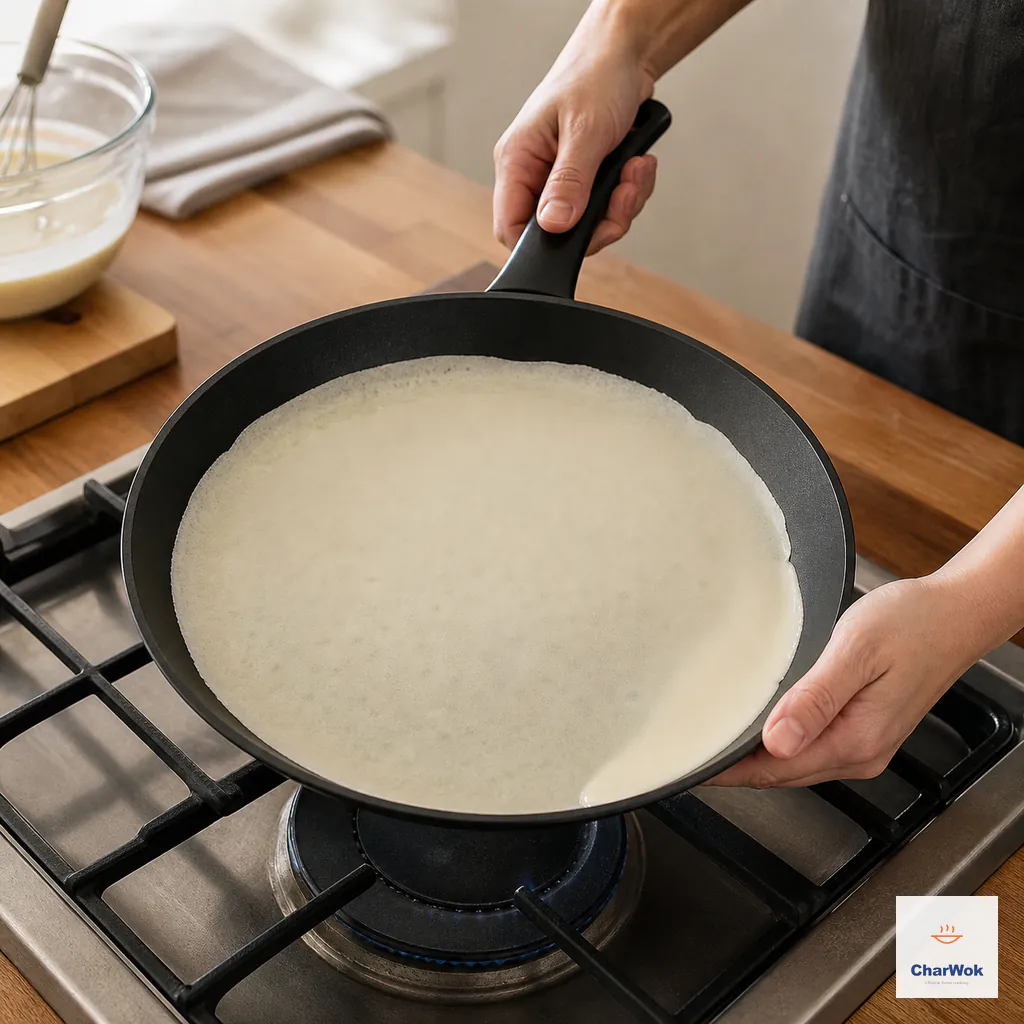
Use medium-low heat and rotate the skillet immediately; the thin batter should find its own circle without a scraper
- Flip with a lid, not a spatula. The crepe is ready to flip when it slides freely when you shake the pan. The cleanest method for a home cook is to slide the whole crepe onto the inside of a large pot lid, then invert the lid back over the pan. A spatula flip works too but cracks the surface.
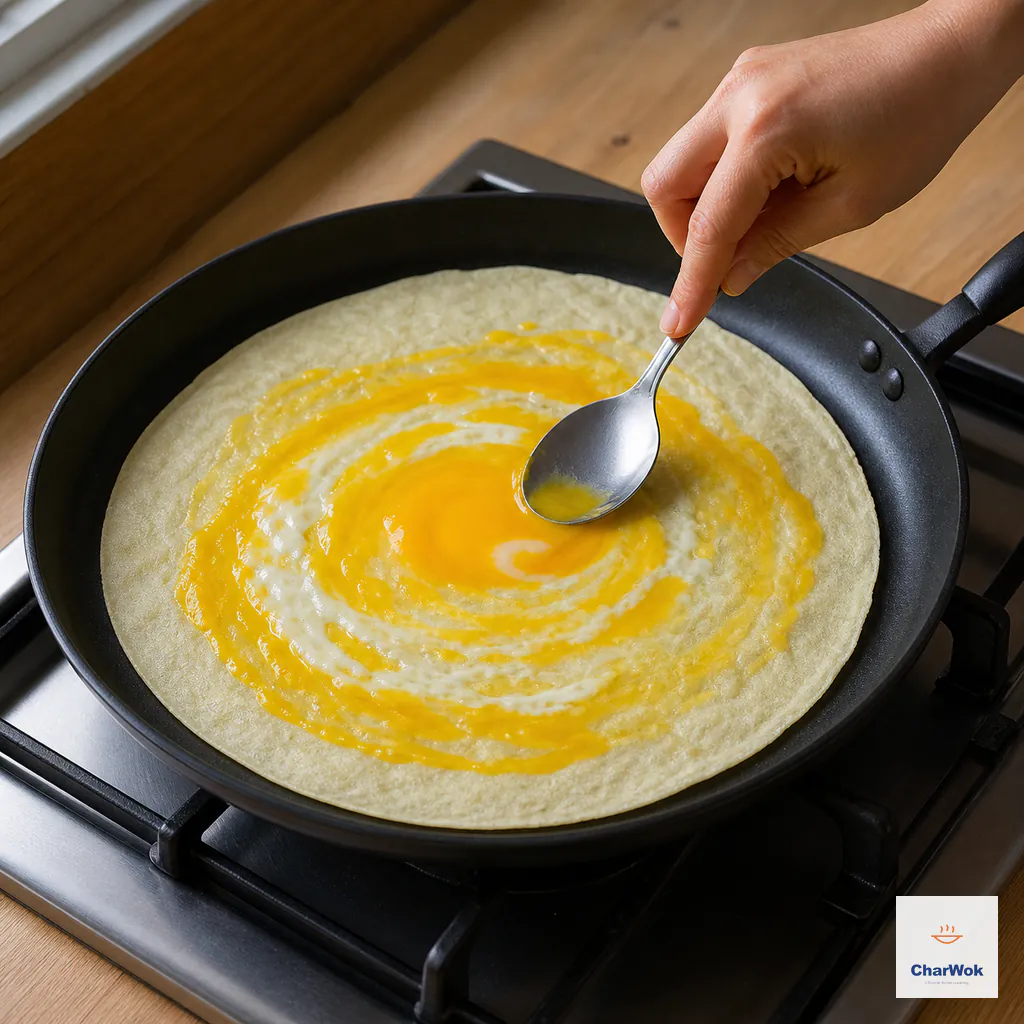
Wait until no wet batter shine remains, then break the yolk and spread the egg almost to the rim
- Kill the heat and dress it. The moment the egg side hits the pan, turn the burner off. Residual heat finishes the egg without overcooking it. Brush soybean paste and chili garlic sauce across the surface, scatter cilantro, lay down a lettuce leaf if using, and set two crisps end to end across the middle.
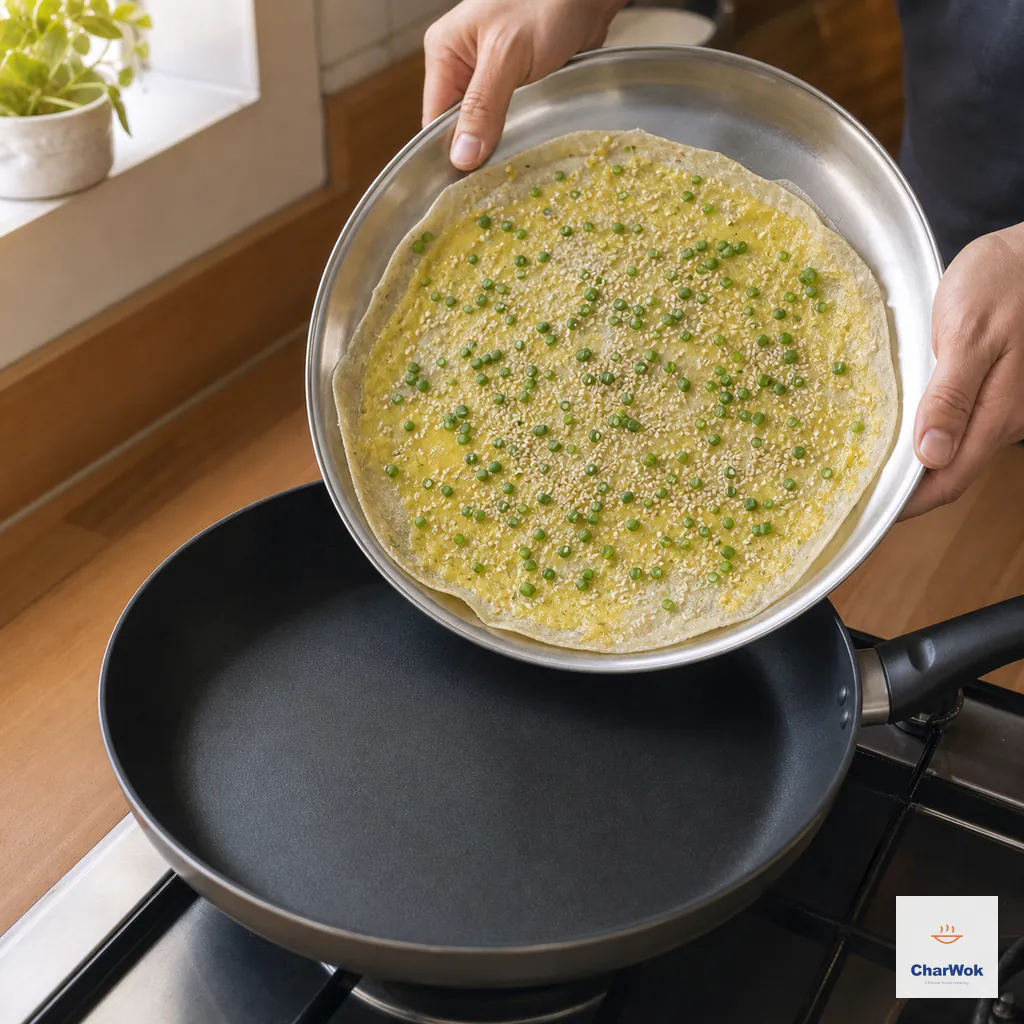
Once the crepe slides freely, move it onto the inside of a lid and invert it back over the pan for a clean, unbroken flip
- Fold and eat now. Fold the near third up over the filling, then fold in the sides, then roll once more into a parcel. Eat immediately; a Jian Bing waits for nobody, and the crisp softens within minutes.
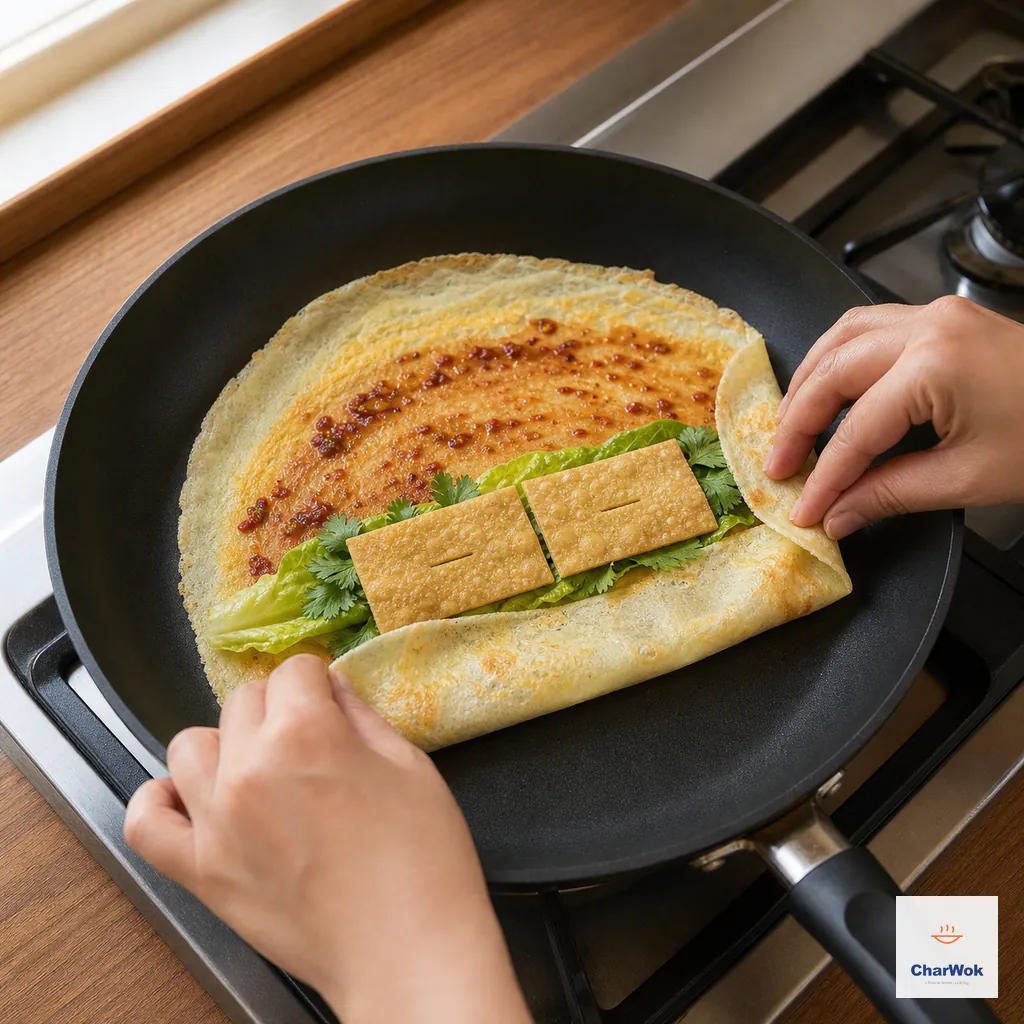
Turn off the heat, brush the sauces thinly, add two crackers and fresh herbs, then fold and serve before the crunch softens
Why each step works the way it does
The thin batter matters because a Jian Bing crepe has to set in seconds and stay flexible enough to fold around a rigid cracker without splitting. A higher flour-to-water ratio gives you a sturdier disc, but it also gives you something cakey that fights the filling. Five parts water to three parts flour (by volume) is the sweet spot where starch gelatinizes into a tender skin rather than a pancake.
The warm-not-hot pour matters because of how starch gels. Pour onto a screaming pan and the batter in contact with the metal sets instantly, while the batter on top is still liquid, so it cannot flow outward; you get a thick lump with lacy edges. Pour onto a warm pan and the whole layer gels at roughly the same rate, leveling itself into a circle.
The egg goes on after the surface sets because raw egg on wet batter is a soup. Waiting until the crepe has a skin means the egg sits on top, cooks into a thin omelet layer, and becomes the surface that holds the sesame and scallion.
The cracker is fried twice-folded (two wrappers stuck together) because a single wonton wrapper puffs and shatters into shards the moment you bite; a doubled one stays in one piece and gives a single clean snap through the whole crepe.
When it goes wrong
| Problem | What happened | The fix |
|---|---|---|
| Batter sets into a thick, lumpy disc the second it hits the pan | Pan too hot, or you tried to spread it instead of letting it flow. | Drop the heat to low, let the pan cool a minute, pour the next one and only tilt the pan. |
| Crepe tears when you crack the egg on top | Egg went on while the batter was still wet, or the batter is too thin. | Wait until no wet shine remains on top. If the batter is at fault, whisk in another teaspoon of flour. |
| Crepe sticks and will not slide for the flip | Not a true non-stick pan, or you rushed before the bottom released. | Brush a thin film of oil before the first crepe. The crepe releases on its own when the starch has fully set; if you have to force it, it is not ready. |
| Crisp comes out pale and chewy, not crunchy | Oil under 175°C (350°F), or it sat in the oil too long at a low temp and soaked up grease. | Bring oil to 180°C (360°F) and fry each cracker about 30 to 40 seconds, pulling it the instant it is light golden. It darkens after it leaves the oil. |
| Crisp burns before the crepe is done | You fried the crisps too dark. | Pull them one shade paler than you think. They keep cooking on the paper towel. |
| Finished crepe is soggy by the time you sit down | Sauce was too wet, or the crisp sat against hot steam. | Brush sauces thin, not pooled. Assemble one, eat one; do not stack. |
Sauces: the part worth getting opinionated about
The two sauce minimum at most stalls is a salty brown paste plus a spicy red one. Soybean paste (huang dou jiang) is the salty one, and chili garlic sauce is the spicy one. That pairing is hard to beat and is what the ingredient table assumes.
If you want to push closer to a Tianjin-style flavor, add a thin smear of mashed fermented bean curd (fu ru) for its cheesy funk, and finish with a spoon of Lao Gan Ma chili oil with black beans. A brush of dark soy sauce adds color more than salt. Sweet bean paste (tian mian jiang) is the sweet-savory note you taste in northern versions; if you have leftover sweet bean paste from making Peking shredded pork, this is a fine place to use it. Do not pile on more than two or three sauces at once or they cancel each other out.
Variations and pairings
Swap the crisp. Outside Tianjin, vendors fold the crepe around a whole fresh youtiao instead of a fried cracker. The youtiao version is softer and more filling; try it if you find frying the crackers fussy. Either crisp also makes a good snack on its own, the way fried wontons do.
Add a protein. A thin layer of seasoned ground pork, a slice of ham, or a few shreds of char siu turns Jian Bing into more of a meal. Lay it down before the crisps so the sauce glues it in place.
Go vegetarian. Skip the protein and load in extra scallion, cilantro, and a smear of fermented bean curd. A few mung bean sprouts add a fresh crunch that plays well with the chili garlic sauce.
Related crepes worth trying. Once the pour-and-swirl motion clicks, the same instinct carries over to the thinner egg and scallion crepe (ji dan bing), to the doughier layered scallion pancake, and to the unleavened wrappers used for Peking duck pancakes. For a fuller survey of the family, start with an introduction to Chinese breads and buns.
What to serve alongside. Jian Bing is rich and salty, so a light soup balances it. A bowl of hot and sour soup or classic egg drop soup echoes the morning-stall meal; a thinner chicken and mushroom congee works if you want something gentler. For a vegetarian-leaning spread, fan tuan stuffed rice rolls make a nice grain-and-crepe pairing.
Make-ahead and storage
This is a cook-to-order dish, but you can front-load the slow parts. The crisps keep for up to four days in an airtight container at room temperature, so fry them whenever you have the oil out. The batter holds overnight in the fridge; stir it well before pouring, because the flour settles into a hard layer. Wash and chop the scallions, cilantro, and lettuce and keep them in containers. With those three prepped, a Jian Bing is five minutes from fridge to hand.
Assembled Jian Bing do not reheat well; the crisp collapses. If you must, reheat the crepe and egg in a dry skillet to crisp the bottom, then add a fresh cracker at the end.
A note on what this recipe is, and is not
This is a home-cook's Jian Bing built from grocery-store flour and frozen wonton wrappers, cooked in a skillet. It is not a Tianjin street vendor's Jian Bing, which uses a mung bean batter on a dedicated cast-iron griddle and a freshly fried sheet of dough. The home version is, in my experience, the closest you can get without buying specialty flour and a flat crepe maker, and it scratches the itch reliably on a Tuesday morning. If you ever find yourself near a real Tianjin stall, eat three.
Frequently asked questions
Can I make the batter with only all-purpose flour? Yes, but the crepe will be blander and paler. Whole-wheat flour (or mung bean flour, if you have it) supplies the toasty, slightly bitter note that makes Jian Bing taste like Jian Bing. At minimum, keep the 2:1 white-to-whole ratio.
Why double up the wonton wrappers for the crisp? A single wrapper puffs and shatters into fragments the instant you bite. Two pressed together fry into one rigid sheet that snaps cleanly through the whole folded crepe. It is worth the extra wrapper.
Can I bake or air-fry the crisps instead of deep-frying? You can air-fry doubled wrappers at 190°C (375°F) for about 4 minutes, flipping once. They are crunchier when deep-fried and slightly more brittle when air-fried, but the air-fryer version avoids heating a pot of oil on a weekday morning.
Do I need a round griddle or special tools? No. A 28 cm (11-inch) non-stick skillet, a spoon for the egg, and a pot lid for flipping cover everything. The traditional flat griddle and wooden spreader exist because vendors cook dozens an hour; at home they are unnecessary.
Is there a gluten-free version? You can replace the wheat flour with a gluten-free blend plus 1 teaspoon of xanthan gum, and use rice-paper or chickpea-flour wrappers for the crisp. The texture drifts, but the structure holds. I have not found a gluten-free version that fully matches the original's snap.