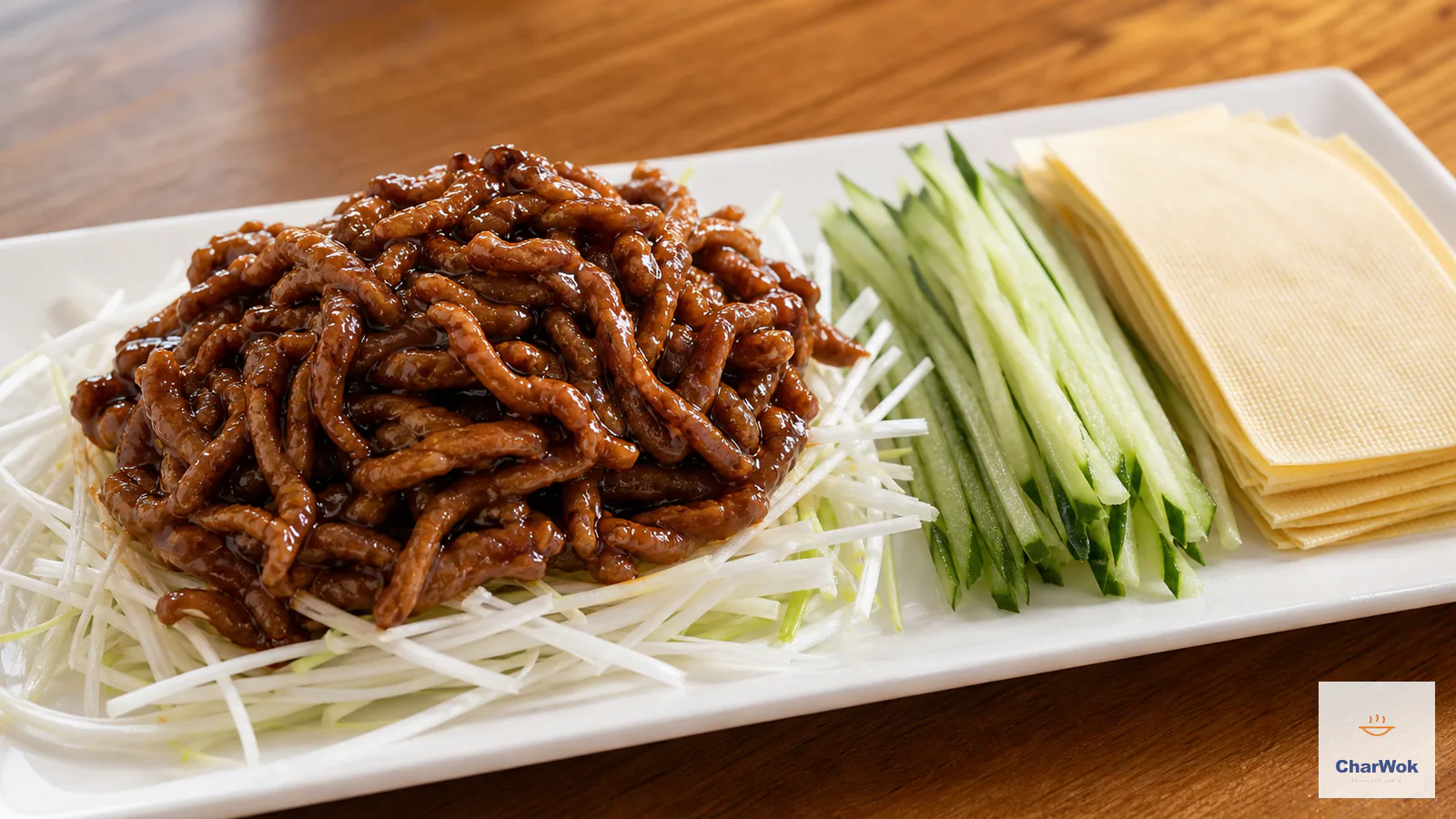
The dish lives or dies on one thing: pork so tender it gives way without resistance, glazed in a salty-sweet brown sauce that smells like toasted wheat. That is Jing Jiang Rou Si, or Peking shredded pork. The first time I cooked it, I overworked the strips in the wok and the meat turned into gray, chewy threads. The sauce was correct. The texture was a lesson.
What I learned is that this is a velveting dish pretending to be a stir-fry. The 26 minutes of active work matters far less than the 10 minutes you let the pork sit with cornstarch and water. Skip that, and no amount of heat will save you. Get it right, and you have one of the most forgiving, crowd-pleasing plates in the northern Chinese repertoire, ready to be wrapped in a soft tofu sheet with raw scallion and cucumber the way it is served in Beijing.
At a glance. Four hundred grams of pork tenderloin cut across the grain into chopstick-thin strips, velveted for 10 minutes with cornstarch and water, then flash-fried and folded into a reduced sweet bean sauce. Cook the meat in one pan, build the sauce in the same pan, finish in under a minute. The single biggest mistake is overcooking the pork after it is already pale.
What this dish is, and where it comes from
Beijing cooking runs on fermented sauces. The dark, wheat-heavy pastes that define the capital show up in Zha Jiang Mian, in the dipping sauce for Peking duck, and here, where a glossy sweet bean sauce (Tian Mian Jiang) coats lean pork. The Chinese name translates plainly: capital-sauce meat shreds. There is no secret ingredient, no regional chili, no complex stock. The prestige comes from technique and from the theatrical way it is eaten, rolled into a wrapper at the table.
Two things separate a home version from a restaurant one. First, restaurants deep-fry the velveted pork in a pool of oil to set the coating instantly. At home I pan-fry in roughly three tablespoons of oil instead, which is enough if your pan is hot and your strips are loose. Second, restaurants often skip the wrappers and pile the pork over shredded scallion. The wrapper version is the one worth making for guests.
The pork: tenderloin, and only tenderloin
Use pork tenderloin, the long thin fillet that runs along the backbone. This is a quick-cooking dish, and tenderloin is the one lean cut that stays soft at a fast sear. Do not substitute pork loin. Loin looks similar in the package but is a denser, drier muscle that turns stringy under high heat and only becomes tender through long, slow braising. If you have cooked red braised pork belly or twice-cooked pork, you already know how forgiving fatty cuts are. Tenderloin is the opposite. It punishes overcooking and rewards speed.
Cutting strips that stay tender
Cut across the grain, never along it. The reason is mechanical: slicing perpendicular to the fibers chops them into short segments your teeth can shear apart. Cut parallel and you leave long, unbroken fibers running the length of the strip, which no amount of marinade will rescue. Width matters as much as direction. Aim for slivers no wider than the tip of a pencil, about 5 mm (1/4 inch). At that gauge the pork flash-cooks in seconds, which is exactly what tenderloin needs. Wider pieces stall in the pan and dry out before they brown. If the raw fillet is too floppy to hold a clean line, give it 1 to 2 hours in the freezer so it firms up partway through but never freezes solid. This is the same trick I use for the sister dish Sichuan shredded pork with garlic sauce, and it makes a noticeable difference. A damp blade helps too: dip the knife in water between cuts so each strip drops cleanly instead of dragging and tearing.
Velveting: the step you cannot skip
Velveting is a brief marinade built around cornstarch and water. The starch forms a thin gel on the surface of each strip. When the meat hits hot oil, that gel sets into a protective layer that holds in moisture and gives the finished pork a faintly slippery, smooth bite. Without it, lean tenderloin seizes and turns dry the instant it touches the pan.
Combine the strips with light soy sauce, Shaoxing rice wine, salt, white pepper, cornstarch, and water, then work the mixture in by hand until the bowl is dry and the pork has taken on a paste-like cling. What you are watching for is hydration, not seasoning: the starch needs to pull all the liquid into itself so it can later form that gel layer. If a puddle remains at the bottom, keep mixing. Once the cornstarch has bound everything, drizzle in a teaspoon of neutral oil and fold it through. That thin oil film is a physical barrier that stops the strips fusing together in the wok. Let the bowl sit for 10 minutes minimum; half an hour is fine, but beyond that the texture stops improving.
Sweet bean sauce, and what to do if you cannot find it
Tian Mian Jiang is, despite its name, a fermented wheat-flour paste carrying only a small soybean fraction. The wheat is what you are tasting: dark, malty, with a flat sourness underneath that has nothing to do with sweetness. That sour note is why the sauce recipe carries a tablespoon of sugar. Leave the sugar out and the finished dish reads as unfinished, almost metallic. Think of the sweetener as rounding the sauce rather than sweetening it.
If you cannot lay hands on the real thing, two stand-ins work, and they behave differently enough that you should choose on purpose. Hoisin, the easiest supermarket option, is built on sugar and fermented soybeans and is already quite sweet, so swap it in one-for-one but cut the added sugar entirely or the dish tips cloying. Yellow soybean paste, the closer cousin in spirit, is saltier and beanier and can stand in at the same measure, though you lose the toasted-wheat character that gives the original its depth. Either way, taste the diluted sauce before it goes near the heat. Diluting exposes flaws that concentrate again on reduction, so if the bowl tastes harsh now, a half-teaspoon more sugar or a splash of wine fixes it before the mistake becomes permanent. A jar of Tian Mian Jiang keeps for months in the fridge and earns its shelf space across a wide range of northern recipes.
Ingredients
15 ingredients for Peking shredded pork
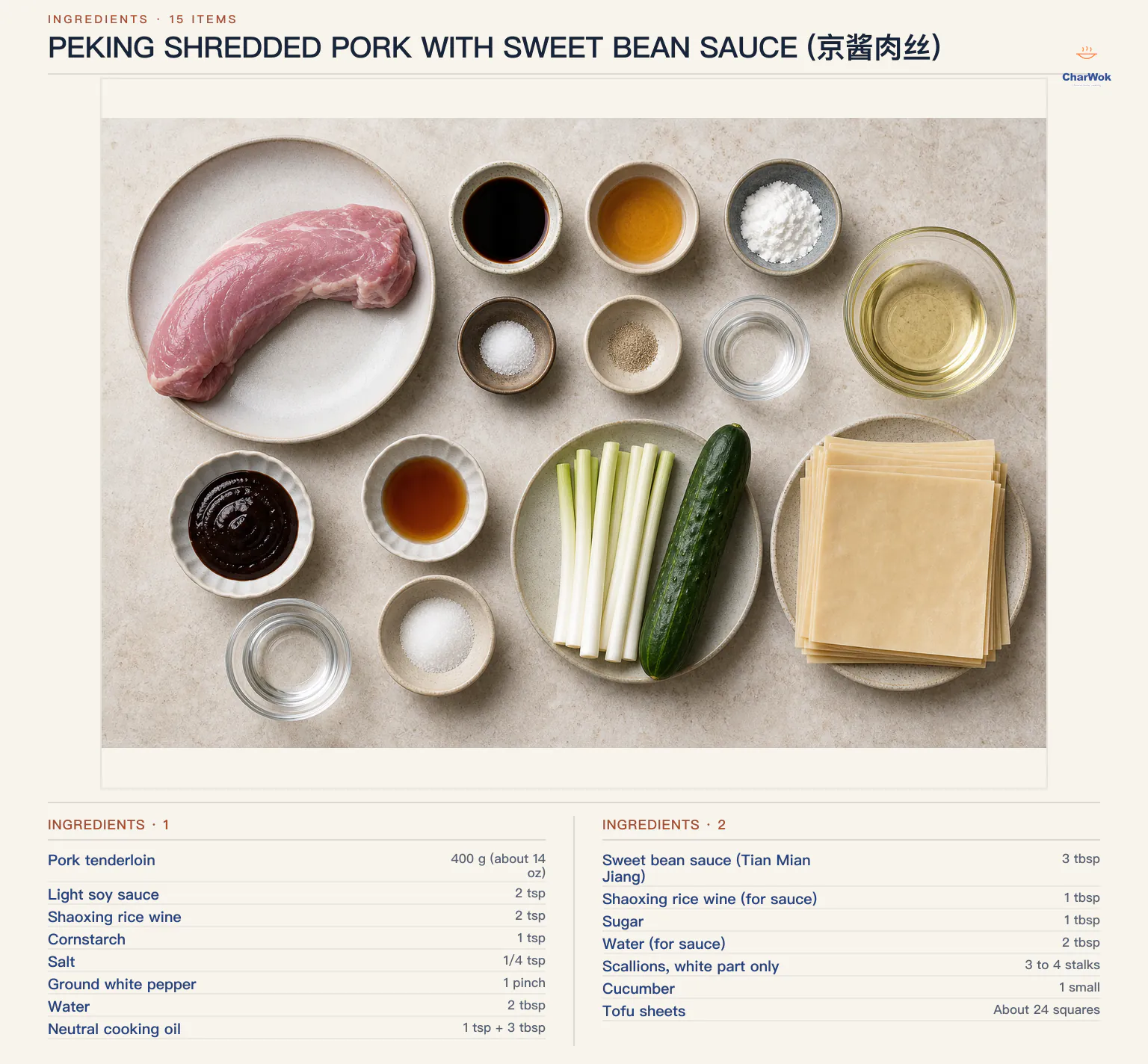
| Ingredient | Amount | Notes / substitute |
|---|---|---|
| Pork tenderloin | 400 g (about 14 oz) | Not pork loin. One small fillet. |
| Light soy sauce | 2 tsp | For the marinade. |
| Shaoxing rice wine | 2 tsp | Dry sherry works in a pinch. |
| Cornstarch | 1 tsp | The velveting agent; do not omit. |
| Salt | 1/4 tsp | |
| Ground white pepper | 1 pinch | Milder and cleaner than black. |
| Water | 2 tbsp | Or unsalted stock. |
| Neutral cooking oil | 1 tsp + 3 tbsp | Peanut, canola, or grapeseed. |
| Sweet bean sauce (Tian Mian Jiang) | 3 tbsp | Hoisin (skip sugar) or yellow soybean paste. |
| Shaoxing rice wine (for sauce) | 1 tbsp | |
| Sugar | 1 tbsp | Omit if using hoisin. |
| Water (for sauce) | 2 tbsp | |
| Scallions, white part only | 3 to 4 stalks | Julienned for serving. |
| Cucumber | 1 small | Peeled, seeded, julienned. |
| Tofu sheets | About 24 squares | Or duck pancakes, or steamed bao buns. |
Method
- Cut and velvet the pork. Carve the tenderloin across the grain into pencil-tip-thin slivers, roughly 5 mm wide. Tip them into a bowl with the soy sauce, wine, cornstarch, salt, white pepper, and 2 tbsp water, then knead by hand until the bowl reads completely dry and the pork wears a milky, clinging film. Fold in 1 tsp oil as a separator and let everything rest for 10 minutes. The paste-like coating is what shields the lean meat from the heat later, so do not rush this step.
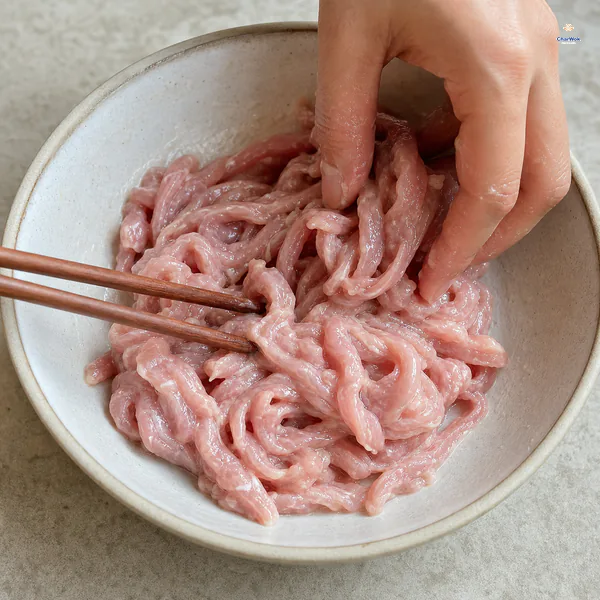
Knead until the bowl looks dry and the pork turns sticky, fold in the final teaspoon of oil, then rest for 10 minutes.
- Prep the accompaniments. Cut the scallion whites and the seeded cucumber into slivers that match the pork in shape. Square the tofu sheets to roughly wonton-wrapper proportions, then run them through a kettle of boiling water for 2 minutes. The brief blanch does two jobs the dry sheets cannot do on their own: it softens the tough skin so it folds without cracking, and it rinses off the chalky, raw-bean taste that would otherwise cut through the sauce. Lift them out and spread them on a plate to shed their water.
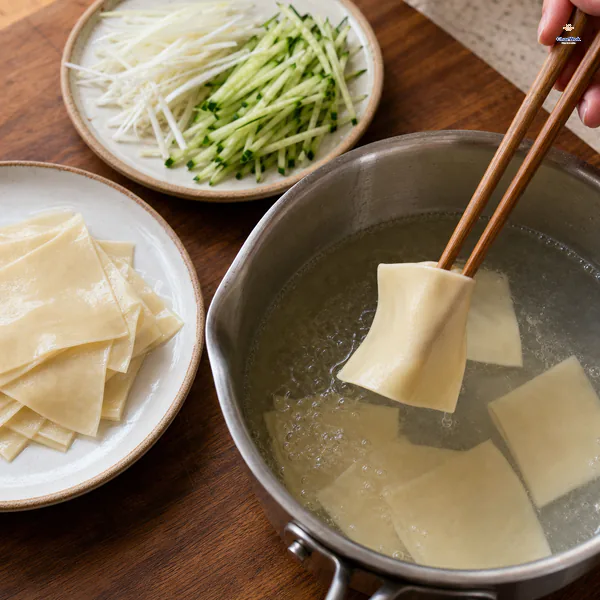
Cut the tofu sheets into small squares, blanch for 2 minutes and drain well; cut the scallion whites and seeded cucumber into matching slivers.
- Mix the sauce. In a small bowl, loosen the sweet bean sauce with 1 tbsp wine, the sugar, and 2 tbsp water and whisk smooth. You want the consistency of heavy cream, thin enough to flow but with body. Stage it within arm's reach of the stove. The whole stir-fry is a one-minute sequence, so the moment the pork leaves the wok the sauce has to go in without a pause to chase lumps.
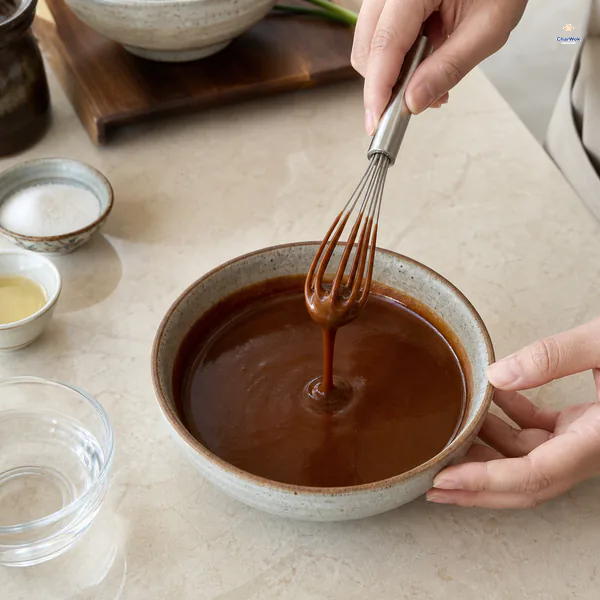
Whisk the sweet bean sauce, 1 tablespoon wine, sugar and 2 tablespoons water until completely smooth and about as fluid as heavy cream.
- Sear the pork fast. Get a wok or deep skillet ripping hot, hot enough that a drop of water dances and vanishes, then swirl in 3 tbsp oil. The non-stick exception applies in reverse here: coated pans cannot take dry high heat, so in that case put the oil in cold and let it warm up with the pan. Scatter the pork in a loose ring around the sloping sides rather than dumping it in the center. This spreads the strips out for even contact instead of stacking them into a steaming pile. The instant the pork hits the metal, drag the strips apart with your wok spatula or chopsticks so no two fuse. Keep the whole mass moving. The target is opaque and pale, not golden, and it arrives quickly, often inside a minute. The second the last trace of pink is gone, lift the pork out to a plate and leave every drop of oil in the wok. Pulling it even 30 seconds late is the difference between silky and leathery.
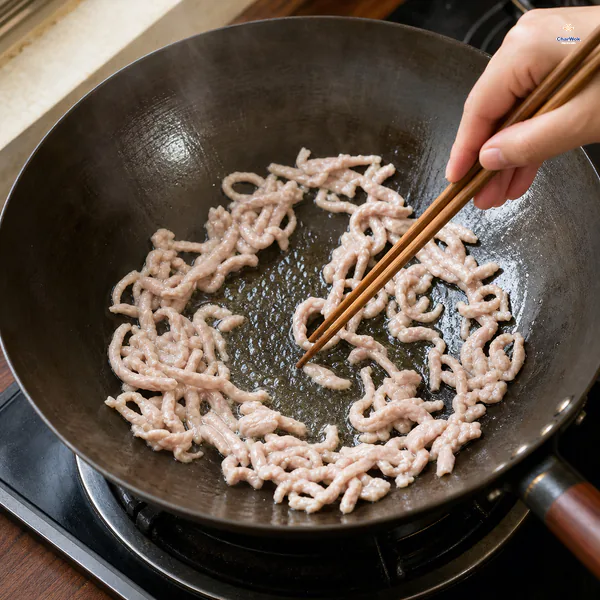
Separate the strips immediately in the very hot oiled wok and remove them as soon as the last pink disappears, before any browning.
- Reduce the sauce. With the wok now off high heat, drop to a low flame and pour in the sauce. Let it burr and concentrate, scraping up the fond from the pan, for about half a minute to a minute. Watch the bubbles, not the clock: as water leaves the sauce, the bubbles grow larger and slower and the color deepens. Tian Mian Jiang carries so much dissolved starch from the fermented wheat that it sets its own glaze as it cools, so there is no slurry to add and nothing to stir in.
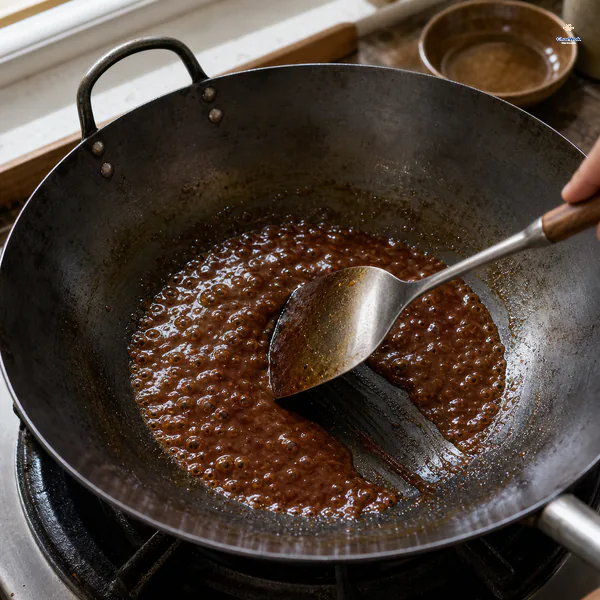
Lower the heat, add the sauce and stir until its bubbles grow slower, the colour deepens and a spatula briefly exposes the wok surface.
- Return the pork and finish. Tip the pork back into the pan and turn it through the sauce for 10 to 15 seconds, just long enough for the glaze to paint every strip. Take the wok off the burner the moment the coating looks uniform. The metal retains enough heat to keep cooking the meat, so pulling early always beats pulling late.
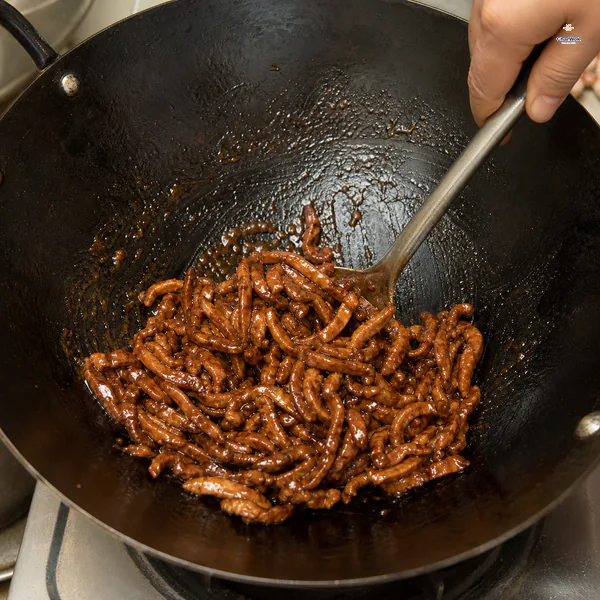
Return the pork and toss for only 10 to 15 seconds, stopping as soon as the glaze looks uniform on every strip.
- Serve. Heap the pork in the center of a plate and fan the tofu sheets, scallion, and cucumber around it. To eat, lay a strip or two of pork, some scallion, and some cucumber on a tofu sheet and roll it up.
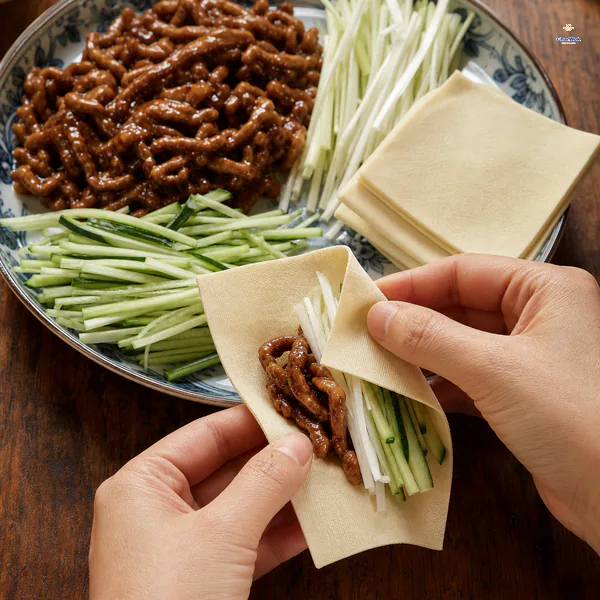
Place a little pork, scallion and cucumber on one tofu sheet, then fold it around the filling and eat immediately.
When it goes wrong, and how to fix it
The pork is tough and chewy
Two causes, both fixable next time. Either you sliced with the grain instead of across it, or you cooked the meat past pale. Recheck your knife angle: the lines in the raw meat should run across the strip, not down its length. On the heat, set a bowl next to the stove before you start and commit to scooping the pork the second no pink remains. Undercooking slightly is recoverable in the final toss. Overcooking is not.
The strips stick together in a clump
You forgot the teaspoon of oil in the marinade, or the pan was not hot enough when the pork went in. That finishing oil is a physical separator between strips. Preheat the wok until smoking before adding the oil and meat, and use chopsticks to break the pile apart in the first five seconds.
The sauce is runny and will not coat
Either the pan was too cool to drive off water, or you rushed the reduction. Keep the sauce at a low bubble and wait for it to darken and thicken before the pork goes back. If it is still thin, give it another 30 seconds. Resist adding a cornstarch slurry; the sauce should be glossy and clinging, not gelatinous.
The sauce tastes flat or harsh
That is the sour edge of under-sugared Tian Mian Jiang. Add sugar in half-teaspoon increments and taste. If you used hoisin and it now reads as too sweet, a few drops of black vinegar or a pinch of salt will pull it back. The finished sauce should taste rounded and savory, with sweetness in the background rather than up front.
Variations and pairings
The classic roll-up is not the only way to serve this. For a faster weeknight version, skip the wrappers and spoon the pork and sauce over a bed of thin scallion shreds on plain rice. The sharp raw allium cuts the rich sauce cleanly.
You can swap the protein. Chicken breast, cut and velveted the same way, works almost as well, though it is even less forgiving of overcooking. Beef sirloin is a common variation in northern home cooking and pairs surprisingly well with the sweet sauce. Shiitake mushrooms, torn and velveted, make a vegetarian version that keeps the same saucy bite.
For a full northern meal, serve this alongside something fresh and something starchy. A simple cucumber salad or a plate of plain greens balances the richness, and the same tofu sheets you are using as wrappers turn up in everything from stir-fries to hot pot. If you want to lean into the wrapping format, moo shu pork is the obvious cousin. For the other end of the pork spectrum, rich and fatty, lu rou fan or lion's head meatballs make a satisfying contrast if you are cooking for a crowd.
Storage and reheating
Leftover pork keeps in the fridge for up to two days, sauce and all. The texture will soften overnight, which is fine but not identical to fresh. Reheat gently in a covered pan over low heat with a splash of water to loosen the sauce. Do not microwave at full power; the tenderloin will seize and turn rubbery. The tofu sheets and raw vegetables do not store well once assembled, so wrap only what you will eat at the table.
Frequently asked questions
Can I use pork loin instead of tenderloin? No, not for this method. Loin needs long cooking to become tender and will dry out under a quick sear. Stick with tenderloin, or switch to a slow-braised cut like belly for a different dish.
Is deep-frying required? No. Pan-frying in three tablespoons of oil gives you close to the same result at home. Deep-frying sets the coating faster and is the restaurant standard, but it is not necessary for a good version.
What if I cannot find tofu sheets? Use Peking duck pancakes or soft steamed bao buns instead, or simply serve the pork over rice with the scallion and cucumber on top.
Do I need to add cornstarch to thicken the sauce? No. Tian Mian Jiang thickens on its own as the water cooks off. A slurry will make it gloppy rather than glossy.
Want more pork ideas? Browse the full collection of must-try Chinese pork recipes, or try sweet and sour ribs and scallion pork chops for two more home-cook-friendly favorites.