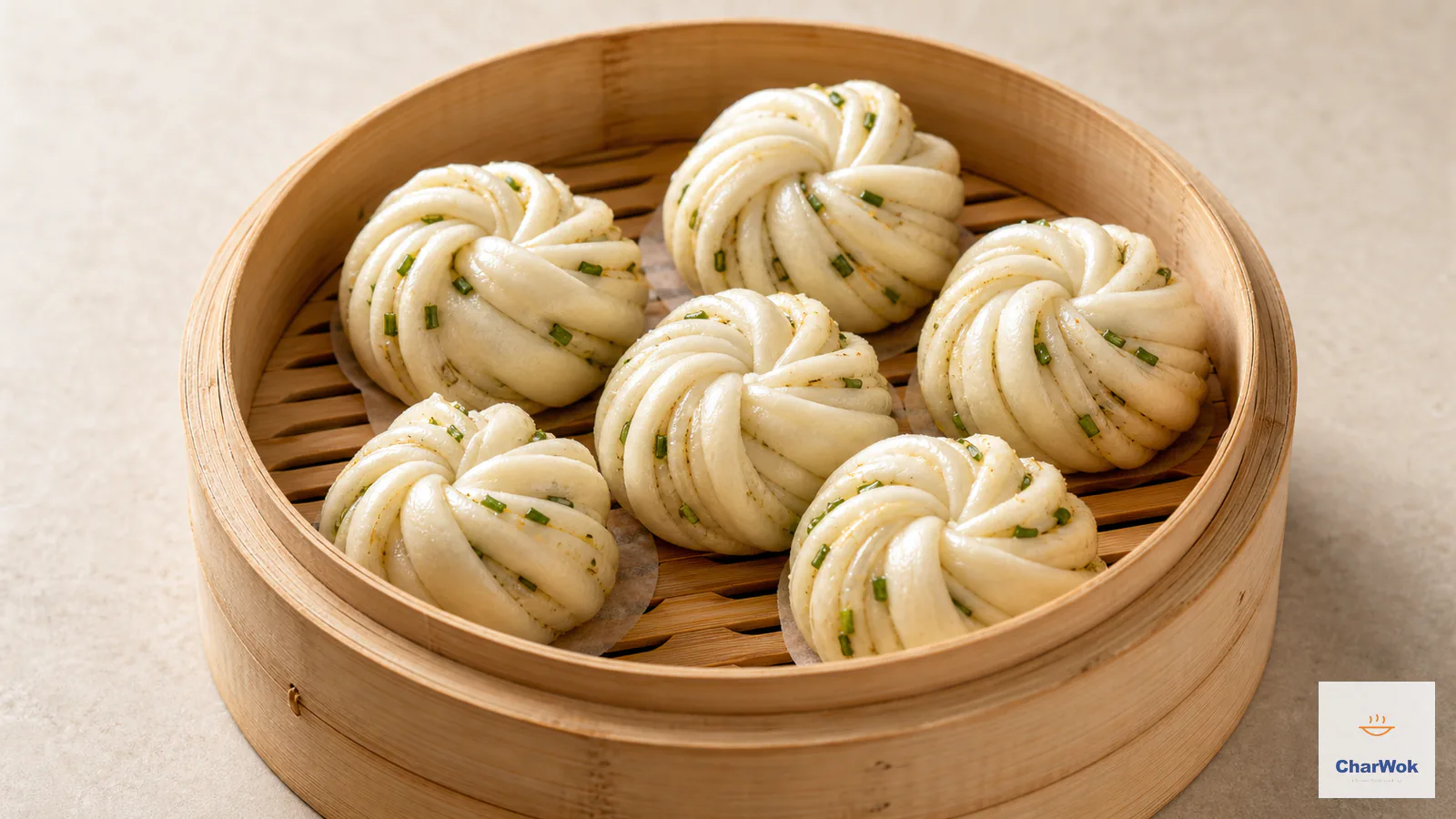
The best thing in a Chinese breakfast steam basket is rarely the showiest dish. It is the plain-looking swirled roll, layered with scallions and a thread of oil, that everyone reaches for first. That is the flower roll, or Hua Juan (花卷). The pain point I hear most from home cooks is that theirs come out dense, pale, and stuck together in one sad lump. The fix is almost never the recipe. It is the dough temperature, the length of the final proof, and how much space you leave in the steamer.
Flower rolls succeed or fail on three numbers: dough at 28-32°C (82-90°F) for the yeast to wake; a 30-minute final proof until the rolls are visibly puffy but not doubled; and 2.5 cm (1 inch) of space between each roll so they can expand without welding together. The filling is flexible. Those three numbers are not.
What a flower roll actually is
A flower roll belongs to the same family as mantou, the plain Chinese steamed buns. The dough is nearly identical: wheat flour, water, yeast, a touch of sugar. What changes is the shaping. Instead of leaving the dough as a smooth bun, you roll it thin, paint it with seasoned oil and scallions, fold it into layers, and twist. Wherever two layers of dough meet a pocket of oil, they cannot weld shut. Steam forces those layers apart as the dough rises, and the roll blooms into its namesake flower.
It is a northern staple, eaten across Beijing, Shandong, and the wheat belt of the Yellow River plain. If you want to understand where it sits in the broader world of Chinese breads and buns, think of it as the savory, layered cousin of the white steamed bun. It shows up at breakfast alongside congee, at the dim sum table, and on the everyday family dinner table in place of rice.
Why this dough behaves the way it does
Three things are happening in the dough, and understanding them is what separates a roll that tears open in fluffy sheets from one that crumbles like cake.
Gluten development. Wheat flour forms an elastic network of gluten proteins when hydrated and worked. That network traps the carbon dioxide the yeast produces, so the dough can inflate instead of leaking gas. An under-kneaded dough never builds enough structure, and the rolls stay flat. I knead until the surface looks smooth and feels like an earlobe when pressed, not like a rough ball.
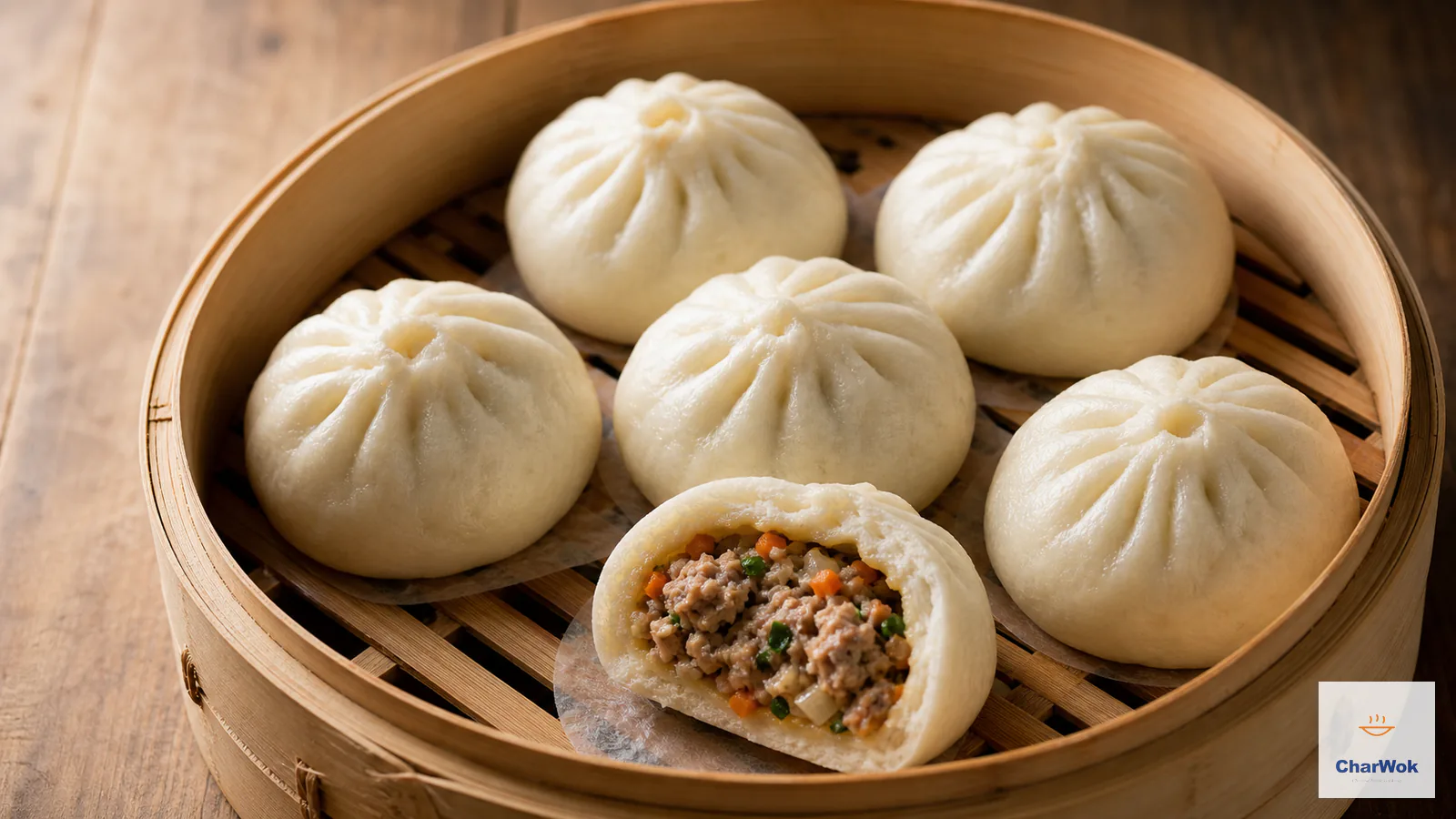
The autolyse shortcut. If you knead by hand, do not fight a fresh, shaggy dough. Mix it just until it comes together, cover it, and walk away for ten minutes. In that window the flour fully hydrates and the gluten starts to link up on its own. When you come back, a dough that felt stubborn will knead smooth in a third of the effort. I use this trick every time I make bao dough by hand, and it works here too.
Baking powder as insurance, not a crutch. A teaspoon of baking powder in a yeasted dough sounds odd, but it is a common Chinese bakery move. The yeast does the slow, deep rise. The baking powder gives a final lift the moment the rolls hit steam, which is exactly when you want maximum oven spring in a basket. Skip it and the rolls are still good, just a touch denser.
Ingredients
Ingredients at a glance
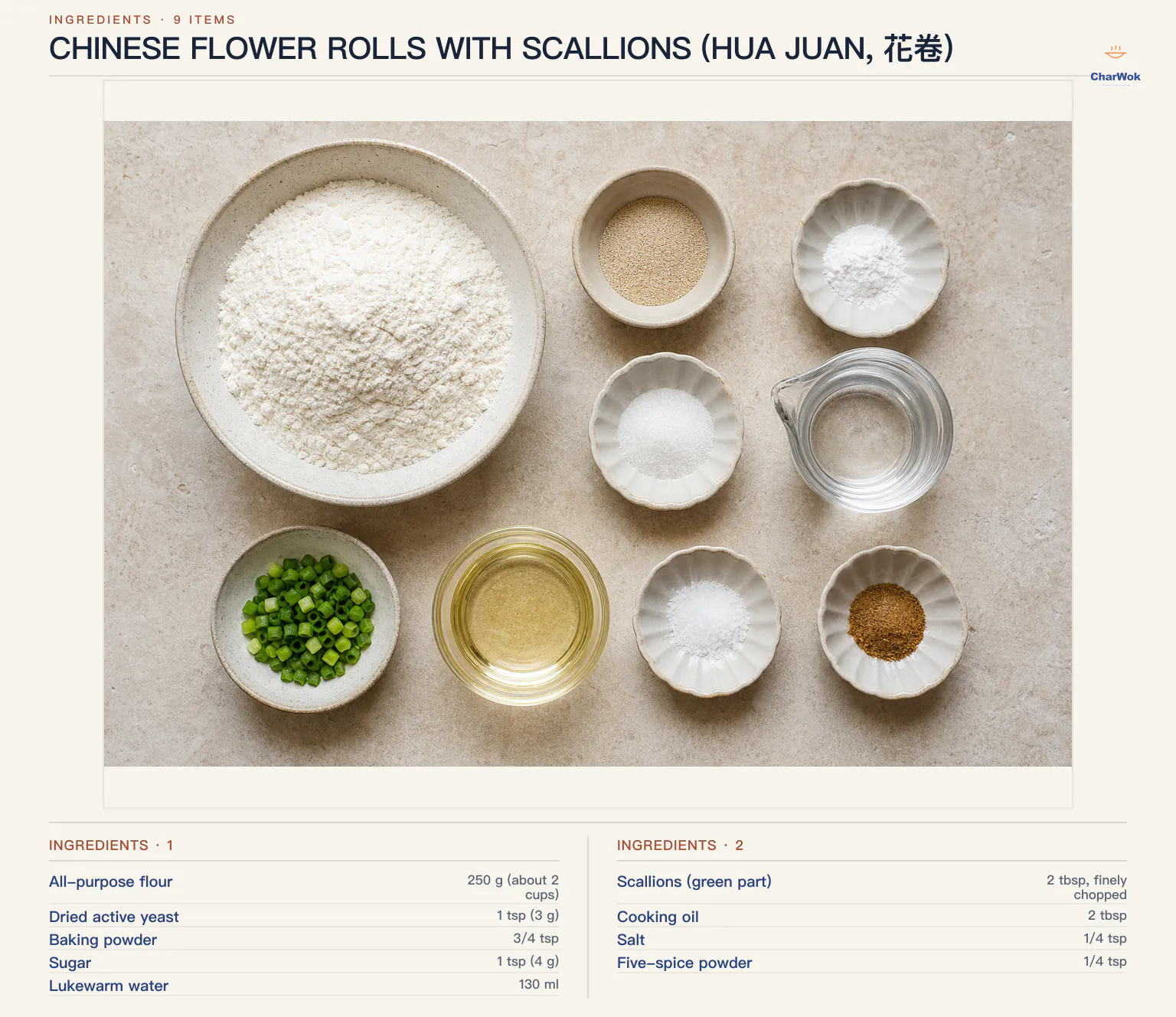
| Ingredient | Amount | Notes / substitute |
|---|---|---|
| All-purpose flour | 250 g (about 2 cups) | Plain flour, 10-11% protein. Do not use bread flour; it makes the rolls chewy in the wrong way. |
| Dried active yeast | 1 tsp (3 g) | Instant yeast works too. Proof in the water first if you are unsure yours is alive. |
| Baking powder | 3/4 tsp | Aluminum-free, so there is no metallic aftertaste. |
| Sugar | 1 tsp (4 g) | Food for the yeast, not sweetness. You will not taste it. |
| Lukewarm water | 130 ml | Body temperature, 28-32°C. Hot water kills the yeast; cold water puts it to sleep. |
| Scallions (green part) | 2 tbsp, finely chopped | Use mostly green for color. Like youtiao makers know, green holds its hue better than white when steamed. |
| Cooking oil | 2 tbsp | Neutral oil like canola or peanut. One tablespoon goes into the filling, one for the pan. |
| Salt | 1/4 tsp | Fine salt dissolves evenly. Kosher works if you crush it first. |
| Five-spice powder | 1/4 tsp | Or ground roasted Sichuan peppercorn for a numbing, citrusy note. See variations. |
Mixing and kneading the dough
- Combine the flour, yeast, baking powder, and sugar in a bowl. Pour in the lukewarm water in two or three splashes, stirring with chopsticks or a spatula until no dry flour remains. Resist adding more water; a dough that looks too dry now will release moisture as it rests.
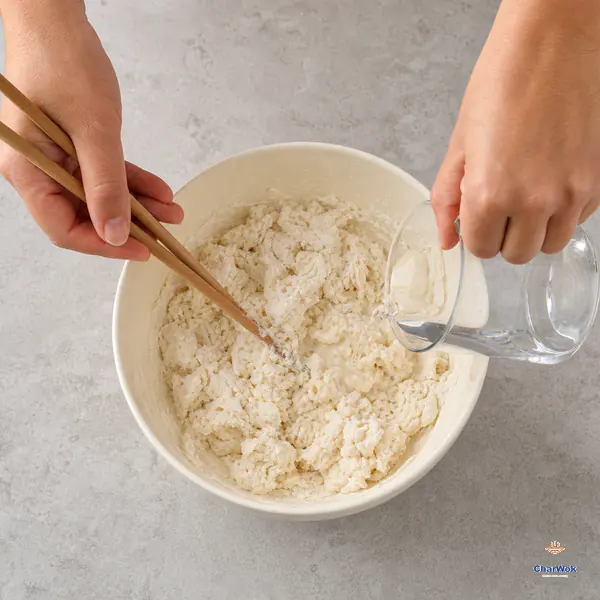
Add the lukewarm water in stages and stop mixing only when no loose flour remains; the rough mass will hydrate further during its covered rest.
- Bring the shaggy mass together into a rough ball, cover it loosely, and rest it for 10 minutes. This is the autolyse window, and it is the single biggest reason hand-kneaded dough fails to get smooth.
- Knead the rested dough on an unfloured surface for about 5 minutes, until it is smooth, springy, and not sticky. A stand mixer on low for 8 minutes does the same job. Poke it: it should spring back slowly and leave a faint dent.
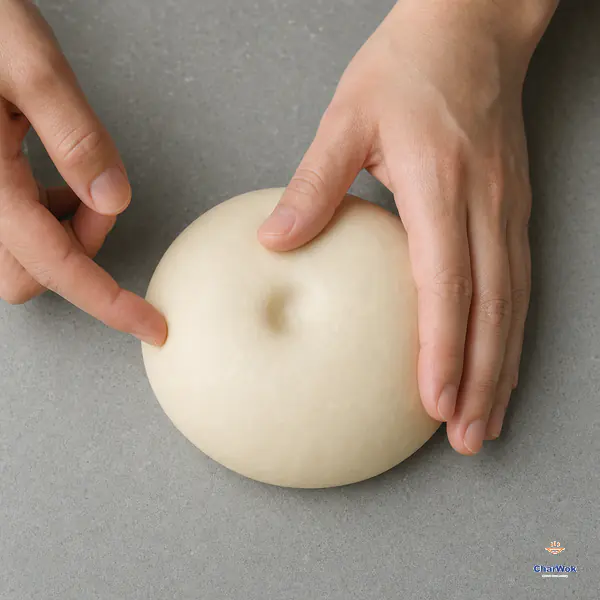
After kneading, the dough should be smooth and springy; a fingertip dent should return slowly rather than snapping back or staying collapsed.
- Round the dough into a smooth ball, put it back in the bowl, and cover it tightly. You do not need a long first rise here; the flavor work happens in the final proof. A 10-minute rest is enough before you shape.
The filling and the layering
- Put the chopped scallions, salt, and five-spice into a small heatproof bowl. Heat one tablespoon of oil in a small pan until it shimmers, then pour it straight over the scallions. You should hear a sizzle and smell the spice bloom. This flash of heat takes the raw edge off the scallion without cooking it to gray.
- Dust the counter lightly. Roll the dough into a rectangle roughly 20 by 30 cm (8 by 12 inches), about 3 mm thick. Aim for even thickness; a thick spot becomes a doughy lump in the finished roll.
- Spread the scallion-oil mixture across the surface, leaving a 1 cm (half-inch) bare border on the long edge farthest from you. That bare strip is what seals the roll, so a border matters.
- Starting from the long edge closest to you, fold the dough over in thirds, like a letter: fold the bottom third up, then fold the top third down over it. You now have a three-layer strip about 10 cm wide.
Twisting the flower shape
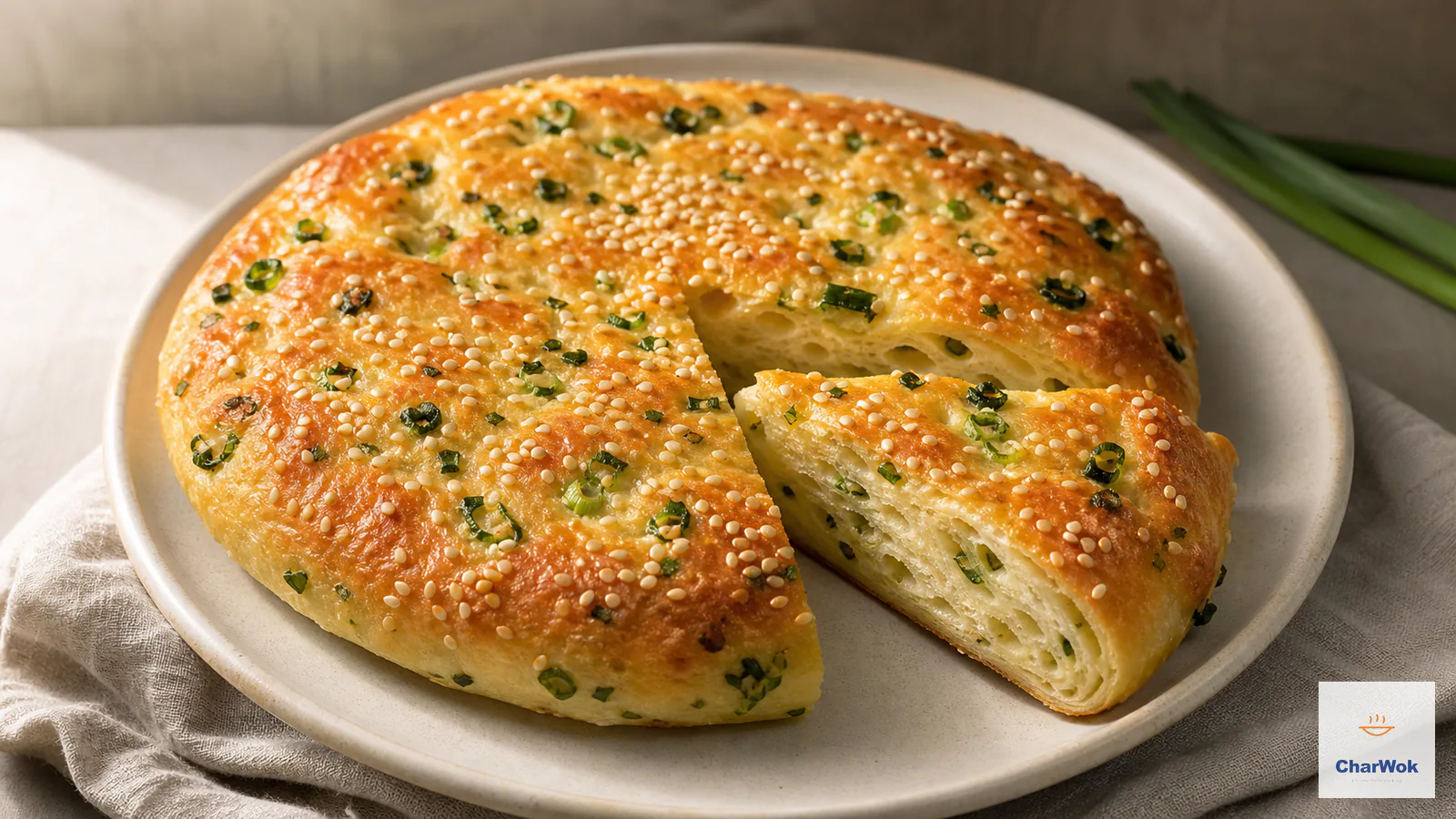
This is the step that intimidates people, and it should not. The classic chopstick twist is the prettiest, but a simpler version still gives you layered, pull-apart rolls. The same logic powers the spiral layers of a good scallion bread or a leavened scallion flatbread: create layers separated by fat, then introduce tension so steam has somewhere to push.
- Cut the folded strip crosswise into pieces about 4 cm (1.5 inches) wide. You should get about 12 pieces.
- Stack two pieces on top of each other, cut sides facing up so the layers are visible.
- Lay a chopstick lengthwise across the center of the stack and press down firmly but not all the way through. This thins the middle and forces the layers to fan out at the ends.
- Holding the chopstick in the groove, pick the dough up, stretch it gently along its length, then twist the chopstick one full turn away from you. The dough wraps around itself.
- Set it on the counter, press the chopstick down through the middle one more time to lock the twist, and slide the chopstick out. If the shape looks messy, do not worry. It will look great once it puffs.
The easy alternative: skip the chopstick. Just stretch each stacked pair slightly and fold it in half, tucking the ends under to make a tidy knot. The layers are still there.
The proof that decides everything
Arrange the shaped rolls on parchment squares or cabbage leaves in your steamer, leaving at least 2.5 cm (1 inch) between them. Cover and let them proof at room temperature for about 30 minutes. The goal is a roll that is clearly larger, soft to the touch, and slow to spring back when poked. It should not double. An over-proofed flower roll collapses in the steamer and comes out wrinkled; an under-proofed one stays dense and a little raw-tasting inside. This single window is where most failures happen, so set a timer and check at 25 minutes.
How to cook them: steam or pan-fry
Steaming is the traditional method and gives you the soft, pale, cottony roll you would see at a Chinese breakfast stall. Pan-frying gives you a crackly golden bottom and a fluffy top, closer to a pan-fried bun. I rotate between the two depending on what I am serving them with.
Steaming
- Set up your steamer. If you are new to this equipment, a bamboo steamer guide is worth a look, but any stacked steamer works.
- Fill the pot with cold water and start it on high heat. Starting cold gives the rolls a gentle, gradual warm-up, which is a second, gentle final proof. It matters.
- Once the water reaches a full boil, drop the heat to medium-low and start the clock: 10 minutes. High heat the whole time makes the rolls balloon and then collapse.
- Turn off the heat and wait 2 minutes before opening the lid. Sudden cold air on hot dough makes the surface wrinkle and shrink. This rest is non-negotiable if you want smooth rolls.
Pan-frying
- Heat one tablespoon of oil in a nonstick or cast-iron pan over medium-high. Arrange the proofed rolls with space between them.
- Let them fry undisturbed until the bottoms are deep golden, about 2 minutes. Do not rush this; the crust is the whole point.
- Pour in 200 ml (about 3/4 cup) of room-temperature water and clamp on a lid immediately. The water turns to steam and cooks the tops while the bottoms keep crisping.
- When the water has fully evaporated, you will hear the sound change from a sizzle to a crackle. Cook another 20 seconds to set the crust, then serve straight from the pan.
When things go wrong
I have wrecked more batches of these than I care to admit. Here are the failures I see most often, and what to do about them.
Dense, heavy rolls. Almost always under-proofed or under-kneaded. Next time, knead until the dough is genuinely smooth, not just combined, and proof until the roll is visibly puffier and slow to spring back. A cold kitchen can double the proof time, so trust the dough, not the clock.
Wrinkled, deflated surface. Two causes. Either you over-proofed so the structure gave out, or you ripped the lid off the steamer the instant the timer went off. Always rest 2 minutes off the heat before opening.
Scallions turn gray-brown. Steaming is brutal on fresh green herbs. Use only the green parts of the scallion, chop them no earlier than right before shaping, and do not pile extra raw scallion on top. Some color shift is normal; full gray means they were cut too far ahead or over-steamed.
Rolls welded into one block. Not enough space in the steamer. They expand a lot in the first three minutes of heat. Give them room, or cook in two batches. A cheap fix for a stuck batch: tear the block apart along the seams and pretend it was a pull-apart bread.
Raw, doughy center. The roll is too large or the heat too high. Either cut smaller pieces, or drop the steaming heat a notch and add two minutes. A toothpick should come out clean, not gummy.
Fillings leak out. You left no bare border when spreading, or you stretched the dough too thin while twisting. A 1 cm clean edge and a gentle hand solve both.
Variations and what to serve them with
Once you trust the dough, the filling is a playground. Swap the five-spice for ground toasted Sichuan peppercorn and you get a tingling, citrusy roll that pairs beautifully with anything braised. Make your own blend with homemade five-spice powder and the aroma difference is obvious.
For a richer flavor, brush the dough with scallion oil instead of plain oil before adding the chopped scallions. A smear of Chinese sesame paste under the scallions turns the roll into something close to a savory sesame bun. A pinch of chili oil or crispy fried garlic works if you want heat. The same layered technique, with brown sugar and a little lard or butter, becomes a sweet breakfast roll.
For pairings, flower rolls are built to soak up sauce and broth. They are the ideal companion to a bowl of congee or a scallion oil noodle soup. For a heartier meal, serve them alongside scallion oil chicken, where the chicken's gingery oil doubles as a dip for the roll. They also sit happily next to the pan-fried and steamed buns in a steamed bao spread.
Storing and reheating
Let the rolls cool fully on a rack before storing, or condensation turns them soggy. Put them in an airtight container or bag and refrigerate for up to 4 days, or freeze for up to 2 months. To reheat, steam refrigerated rolls for 5 minutes, or frozen rolls for 7 minutes straight from the freezer with no thawing. A covered skillet over low heat with a splash of water also revives the crust on pan-fried rolls. Microwaving works in a rush but toughens the texture, so use it only as a last resort.
The honest limitation of any leftover steamed bread is that it never quite matches fresh. The crust-steam reheat gets you close. For the best result, freeze what you will not eat within a day, because refrigeration ages the starch faster than freezing does.
Quick answers to common questions
Do I have to weigh the flour? It helps a lot. Two cups of flour can be anywhere from 240 to 290 g depending on how you scoop. If you only have cups, spoon the flour into the cup and level it off, then be ready to adjust the water a teaspoon at a time.
Can I make the dough the night before? Yes. After kneading, cover and refrigerate the dough for a slow cold rise up to 16 hours. Bring it back to room temperature for 30 minutes before shaping. The flavor actually improves.
Why cold water in the steamer to start? A gradual rise gives the rolls a final gentle proof as the water heats. Starting with boiling water shocks the dough and can cause uneven puffing.
Can I freeze the shaped raw rolls? You can, but the yeast may weaken. Freeze them after a short proof, then steam from frozen with 3-4 extra minutes. Freshly shaped, same-day rolls give the best texture.
Are flower rolls the same as scallion pancakes? No. Scallion pancakes are unleavened and pan-fried crisp. Flower rolls are yeasted and steamed (or pan-fried soft). Different dough, different result.