Xi'an food hits you with three things at once: chew, chili oil, and the smell of toasted cumin drifting off a flatbread. It is wheat-country cooking, born in a city that sat at the end of the Silk Road, where hand-pulled noodles, street dumplings, and cumin-dusted lamb skewers share the same night market lane. If you have only eaten Xi'an-style food in a strip-mall shop and wondered why the noodles there never quite match the ones you remember, the gap is almost always in the dough, not the sauce.
This is a cook's tour of the dishes that define Xi'an home and street cooking, organized by the technique that actually decides whether they succeed. I have wrecked plenty of batches of these over the years, so where a step trips people up, I will tell you the failure mode and the fix rather than hand you a flowery description. The full recipes for each dish live on their own pages; here you get the through-line that connects them.
At a glance. Xi'an cooking is wheat, chili oil, black vinegar, and cumin. The signature dishes all run on one of two techniques: a rested dough you stretch or cut, or a fast, very hot stir-fry. Give noodle dough a long rest and never cook a noodle or a stir-fry on a pan that is not yet smoking hot.
What makes Xi'an food taste like Xi'an food
Xi'an is the capital of Shaanxi province, on the loess plateau of northwest China. The climate is dry and cold half the year, so the diet leans hard on wheat, vinegar, salt-cured chili, and the warming spices that came west along the trade routes. Rice shows up rarely. Instead you eat noodles, sometimes pulled or cut by hand, breads cooked on a griddle, and dumplings by the dozen. Meat is mostly pork and lamb. Heat comes from chili oil and toasted Sichuan peppercorn; sourness from aged black vinegar; and the smoky, almost curry-like backbone from cumin, which the region adopted from its Muslim Hui community and never let go of.
Three flavors do most of the heavy lifting, and if you keep them stocked you can improvise your way through most of this cuisine. The first is you po la zi, hot oil poured over crushed chili to bloom it. The second is black vinegar, darker and more mellow than rice vinegar, which the region uses the way Italians use lemon. The third is cumin seed, toasted dry and ground, which is why a Xi'an lamb dish tastes nothing like a Sichuan one even though both are spicy.
The pantry you actually need
The compact pantry behind Xi’an dough, chili, vinegar and cumin dishes
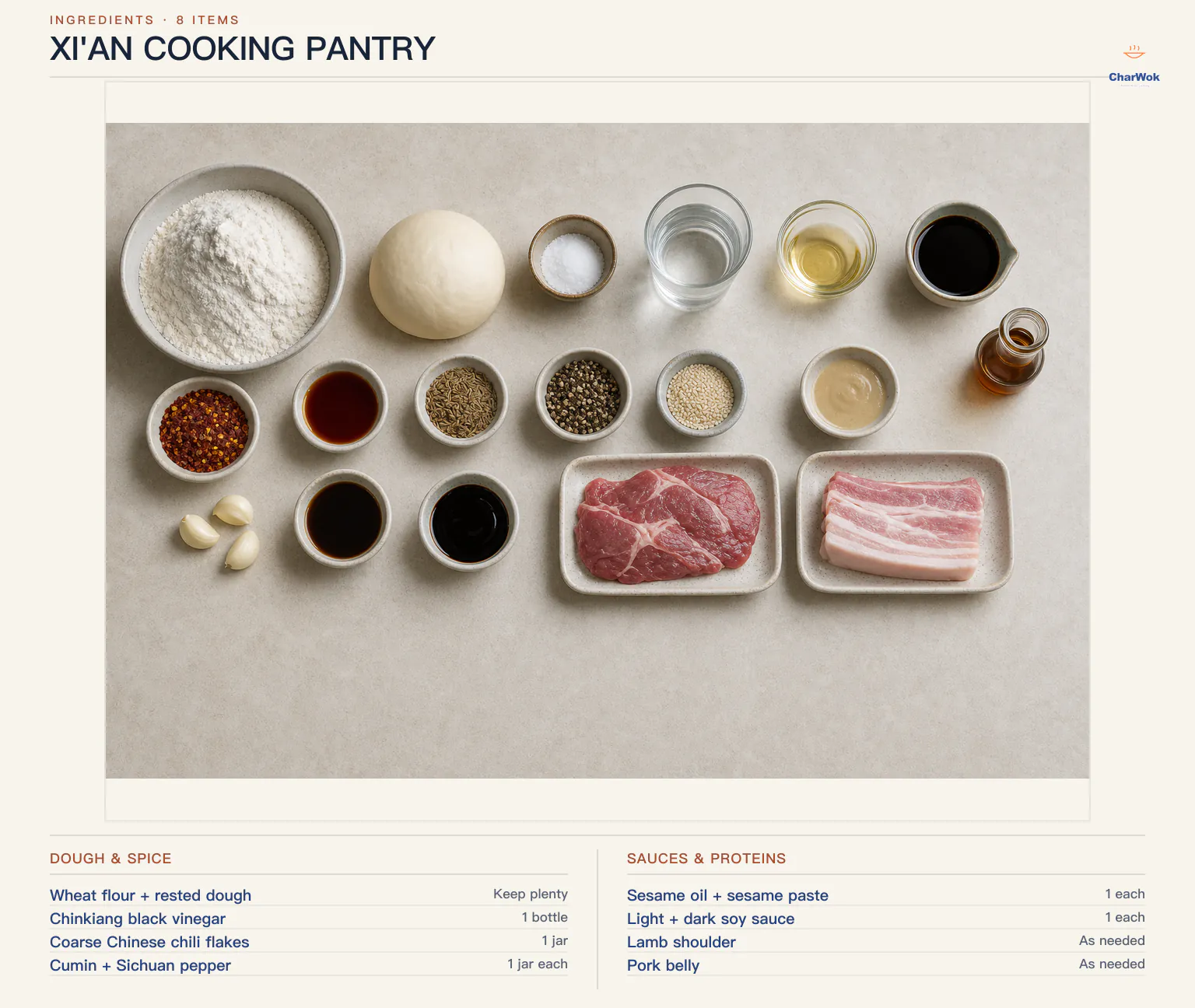
| Ingredient | Amount to keep on hand | Notes / substitute |
|---|---|---|
| All-purpose flour | Plenty | The everyday choice for Biang Biang, scissor-cut, and dumpling wrappers. Bread or Chinese noodle flour will give a slightly chewier pull if you want to push la mian. |
| Aged black vinegar (Chinkiang) | Always a bottle | The sour backbone. Balsamic is too sweet; rice vinegar too sharp. No clean substitute. |
| Chinese chili flakes (coarse) | A jar | For chili oil. Korean gochugaru is a fair stand-in if you want less heat. |
| Whole cumin seed | A jar | Toast dry, then grind fresh. Pre-ground loses its punch in weeks. |
| Sichuan peppercorn | A small jar | Toasted and ground; gives the numbing tingle. Keep sealed, it goes stale fast. |
| Toasted sesame oil and sesame paste | 1 each | Paste thinned with warm water is the base for cold-noodle sauces. Peanut butter thinned with sesame oil is a workable emergency swap. |
| Light and dark soy sauce | 1 each | Light for salt and seasoning, dark for color. |
| Lamb shoulder or pork belly | As needed | The two default meats. Beef works for the stews. |
The dishes worth learning, and the technique behind each
Rather than list recipes, I will group the signature dishes by the single skill that decides whether they come out right. Master the skill and the dish follows.
1. The stretched-wheat family: dough that fights back
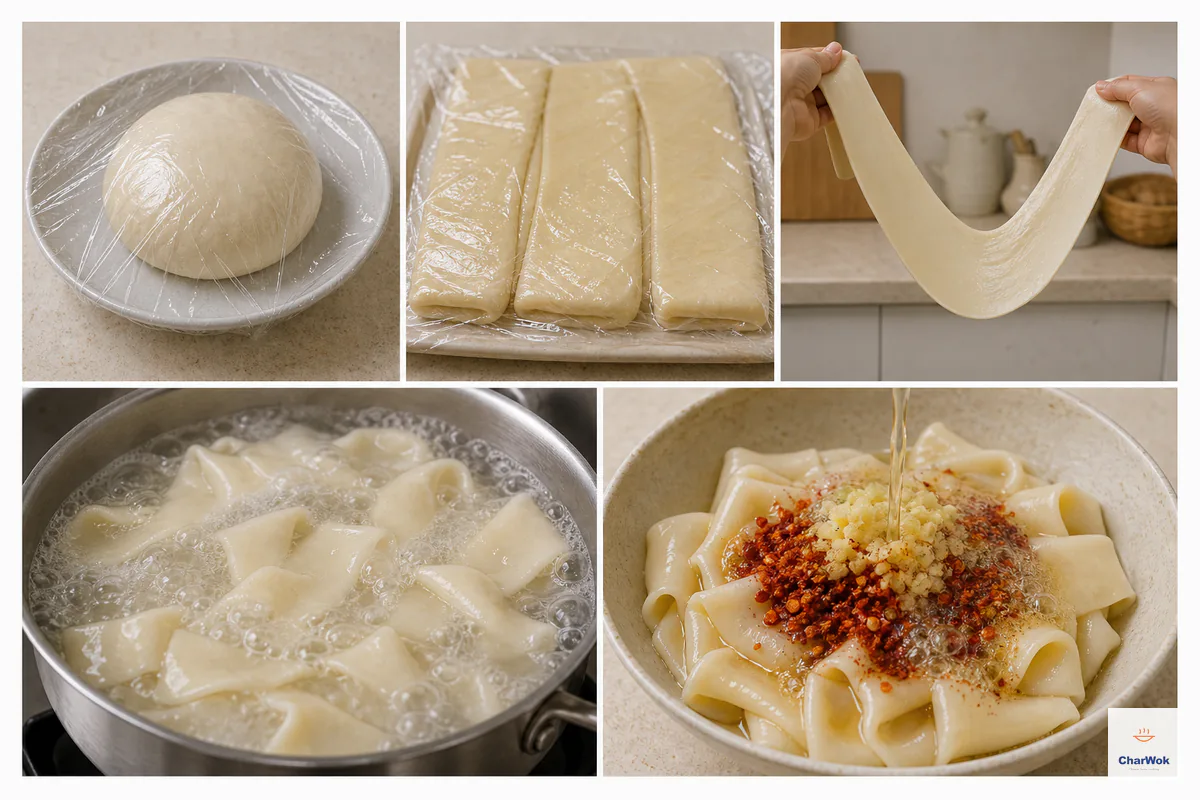
Rest is the controlling skill: relax the salted dough, rest the oiled strips again, stretch without forcing, boil the belts in abundant water, then bloom the dry toppings with hot oil.
The most famous Xi'an export is Biang Biang noodles, those broad, belt-like ribbons slapped against the counter and drowned in sizzling chili oil. People assume the difficulty is the slapping. It is not. It is the dough hydration. A dry dough will not stretch; a wet dough will not hold. The classic ratio is roughly 50 percent water by flour weight, plain all-purpose flour, with a generous pinch of salt, kneaded briefly, then rested. Resting is not optional here. It lets the gluten relax so the strands align, and aligned gluten is what stretches instead of tearing.
The same rested-dough logic powers the related noodle styles. Hand-pulled la mian demands even more protein and a brief rest between each pull. Scissor-cut noodles are the forgiving cousin: the same dough you would make for Biang Biang, but snipped straight into boiling water, so no hand-pulling skill is required. If your Biang Biang dough keeps ripping, drop the ambition to scissor-cut for the night and you will still eat well.
2. The cold-wheat family: starch, not gluten
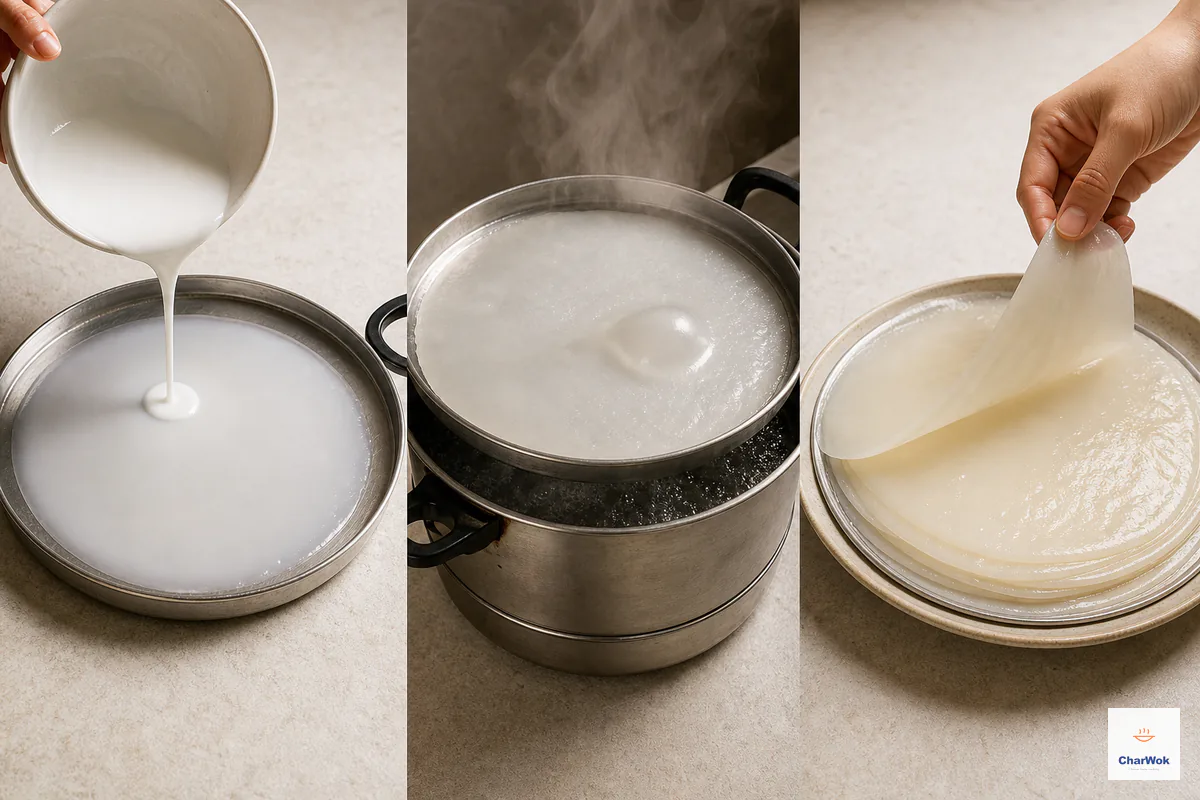
Pour only a nearly translucent film into a preheated oiled pan, steam until the sheet sets and bubbles, then cool before peeling and oiling each layer lightly.
On the other side is Liang Pi, the cold skin noodles, which removes gluten from the equation entirely. Traditional Liang Pi is made by washing a dough ball in water until the starch rinses out and the gluten stays behind as a separate chewy blob. You steam the starchy water into translucent sheets and slice them. It is a half-day project done the old way.
The shortcut skips the washing: whisk all-purpose flour and water into a thin batter, then let it rest so the flour fully hydrates and the starch settles evenly, before pouring a thin layer into a flat pan and steaming it into a sheet. The result is close enough that most home cooks, me included, never go back. The thing that ruins a beginner's batch is pouring the layer too thick. Aim for a film you can almost see through; anything thicker turns gummy instead of bouncy.
3. The filled-and-folded family: wrappers and the juice problem
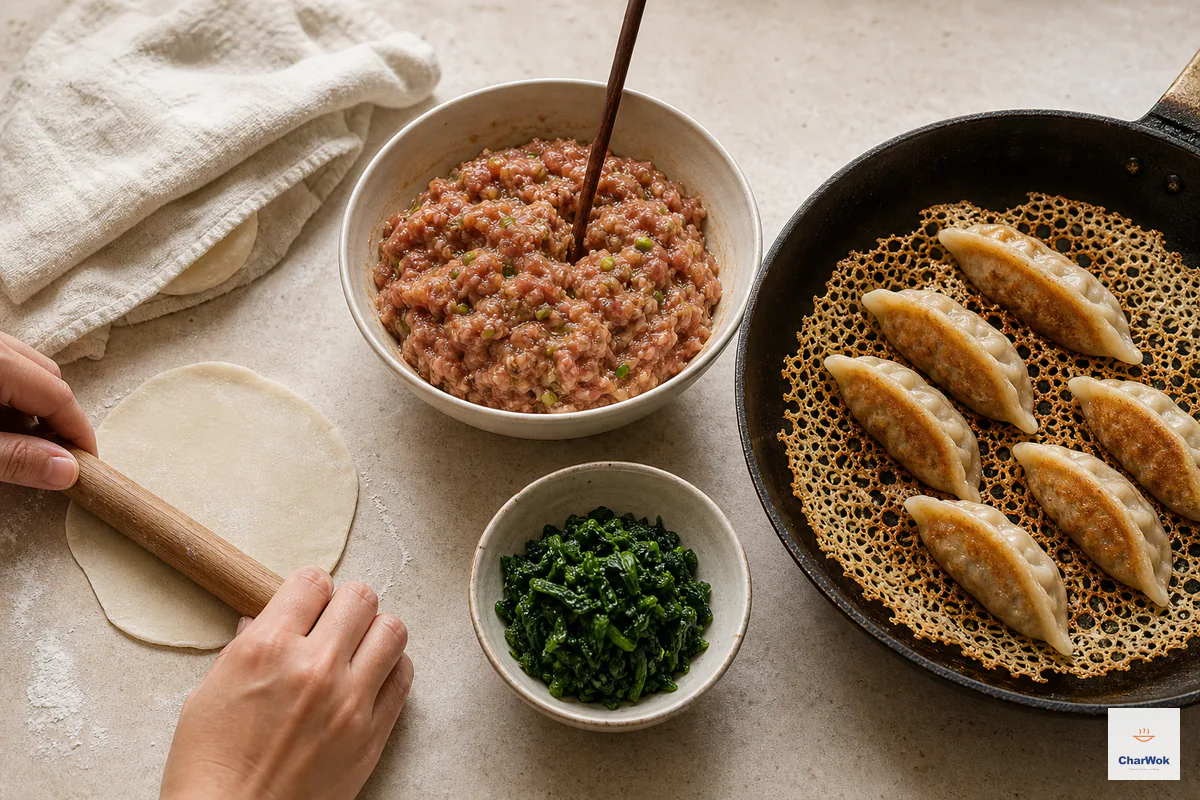
Keep unused hot-water dough covered, roll the rim thinner than the center, remove free water from the filling, and let the flour-water skirt dry completely before lifting the potstickers.
Xi'an dumpling culture is enormous. You find pan-fried potstickers with a lacy crispy skirt, flat chive pockets stuffed with chives, egg, and glass noodles, and prettily crimped vegetarian dumplings meant to look like little cabbages. The wrapper is where everyone stumbles, and the cause is always the same: too little water in the dough, or dough that has dried out while you filled the first ten.
Use hot water, just off the boil, to gelatinize some of the starch on contact. That gives a wrapper that seals cleanly and stays tender after cooking, which is why hot-water dough is the standard for boiled and pan-fried dumplings across northern China. Keep the unused dough under a damp towel the whole time, and work the edges thinner than the centers so pleats do not turn into thick chewy seams. What goes inside matters just as much; if your filling weeps water, the dumplings split. Salt vegetables ahead and squeeze them dry, or beat a little starch slurry into the meat to lock in moisture.
4. The flatbread-and-braise family: Rou Jia Mo
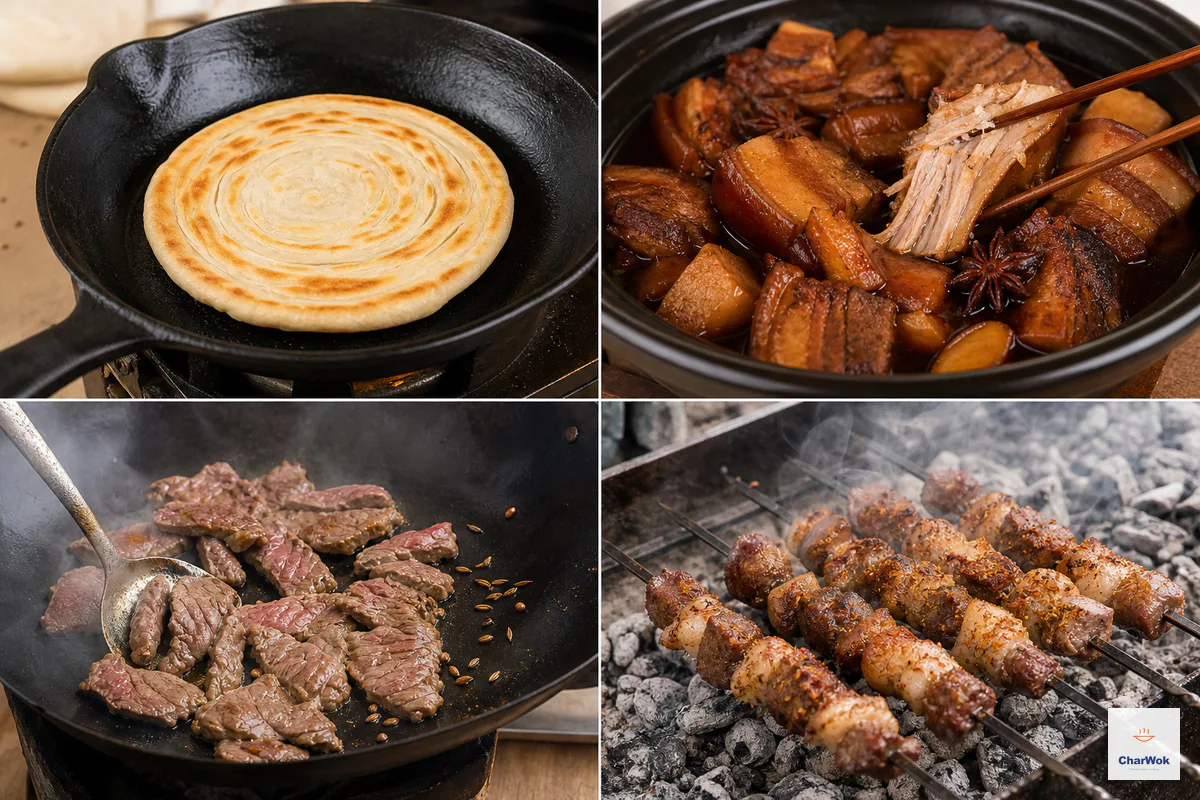
Cook the thin flatbread gently enough to stay tender, braise pork with its juices, sear lamb quickly in one layer, and keep some lamb fat between skewer pieces so charcoal heat does not dry them out.
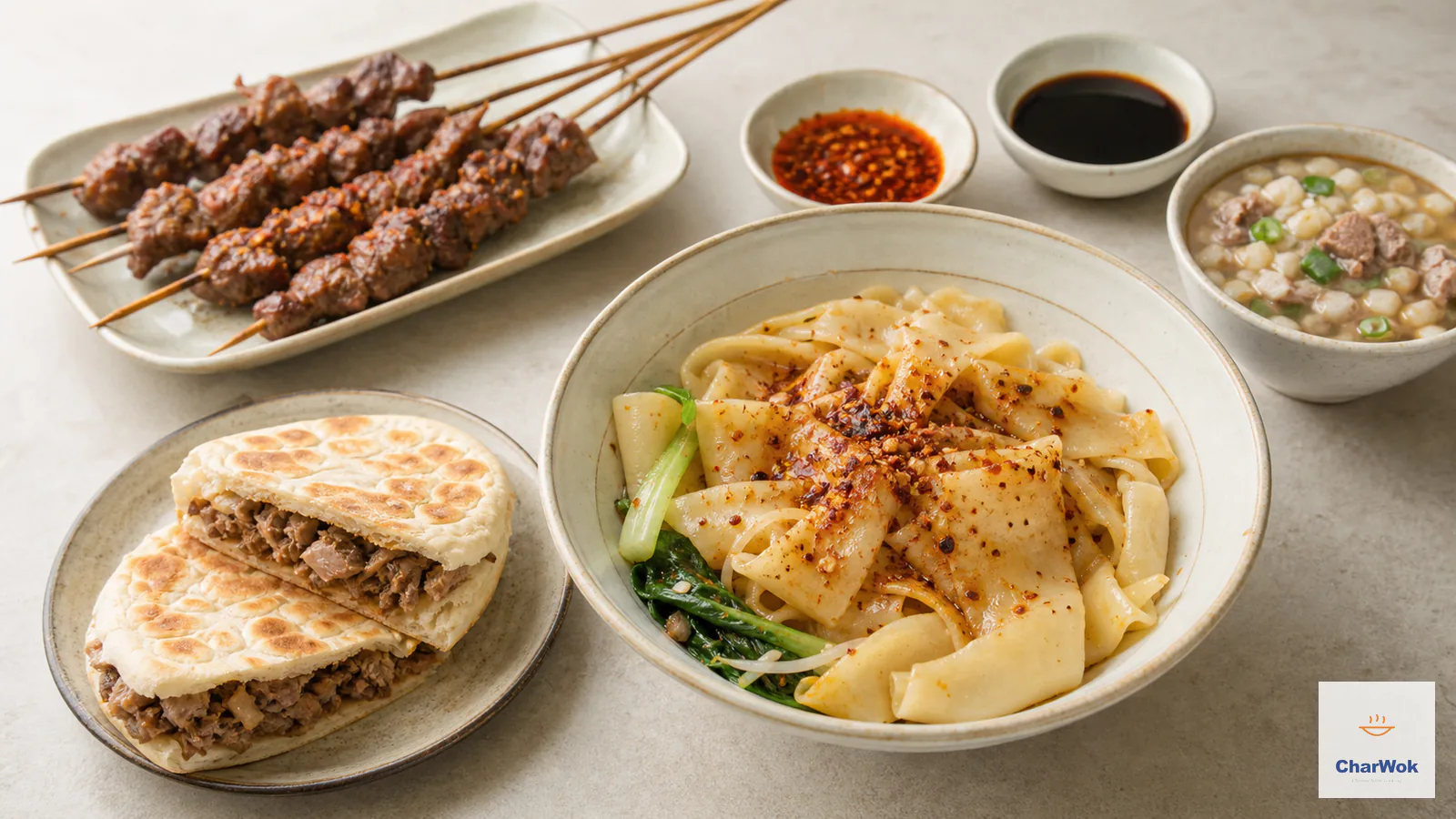
The Rou Jia Mo, or Chinese pork burger, is the sandwich that made Xi'an street food famous abroad: a small griddle-baked flatbread, split open and packed with chopped pork belly braised in a spiced master stock until it shreds at a touch. The bread is the hard part. It is a lean dough, rolled thin, cooked dry in a pan to set it, then finished so the inside stays soft enough to soak up meat juices. If your bread comes out dense and dry, you rolled it too thick and cooked it too hot; the fix is a thinner round and lower heat, like warming a tortilla, not searing a steak.
The filling is the easy part and it freezes brilliantly. Braise a big batch of pork belly in soy, rock sugar, star anise, and ginger, then portion the shredded meat with some of its cooking liquid. A scoop thawed into a fresh flatbread is a weeknight dinner in five minutes. This bread-and-stuffing logic is shared across the wider family of Chinese breads, so the skill transfers.
5. The fast-stir-fry family: heat before ingredients
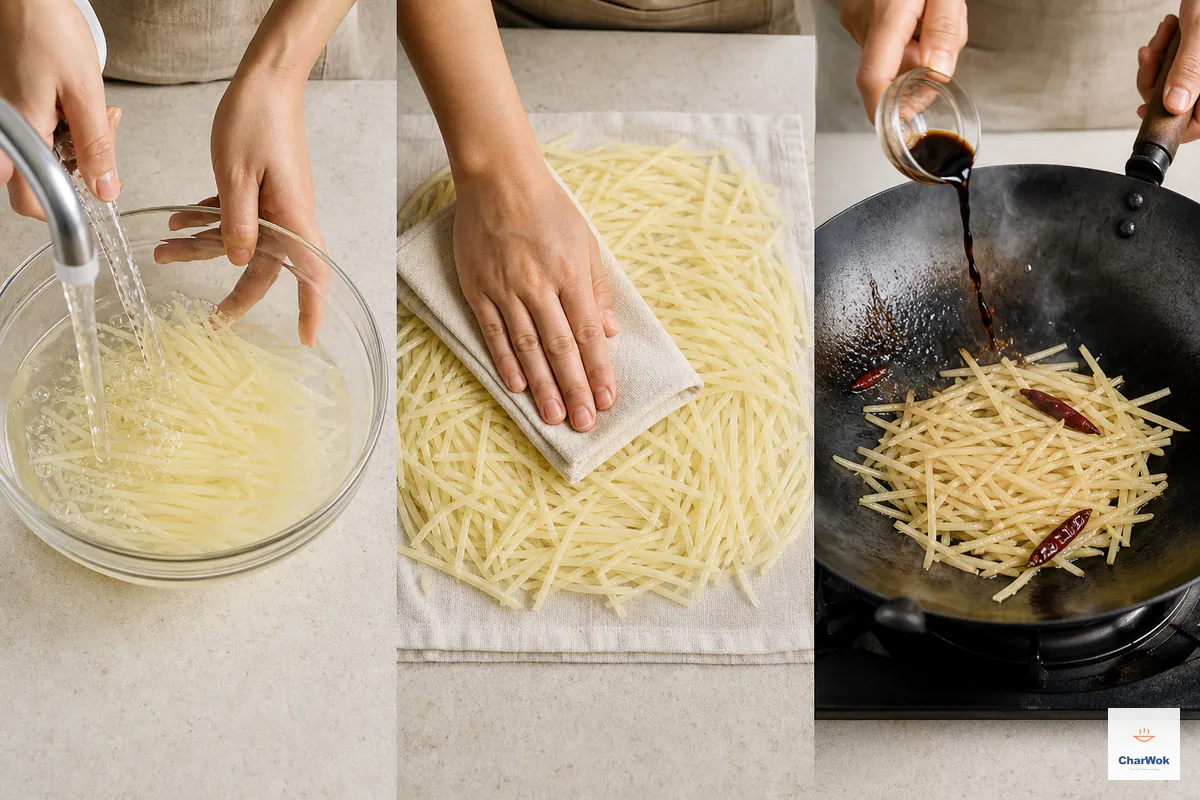
Rinse away surface starch, drain and pat the matchsticks bone dry, then cook a small batch over maximum heat and add black vinegar only at the end.
Not every Xi'an dish is a dough project. The region's hot and sour potato stir-fry is the platonic ideal of a wip-it-out weeknight vegetable: potato cut into matchsticks, rinsed of surface starch, then tossed furiously in a smoking wok with dried chili, black vinegar, and a pinch of sugar. The trick is to rinse the cut potato in cold water until the water runs clear, then drain it bone dry. Skip the rinse and you get a sticky, broken mess; skip the dry and the oil spits and the potato steams instead of frying.
The same discipline, smoke-first-then-cook, applies to the lamb side of the cuisine. Cumin lamb stir-fry and its hand-torn noodle cousin, cumin lamb noodles, both lean on a wok hot enough that the meat sears the instant it lands. Marinate the lamb with a little oil and cornstarch to coat the fibers, add it to fat that is shimmering but not yet smoking, and pull it out the moment it colors. Return it to the pan only at the end, with the cumin and chili, so the spices toast rather than burn.
6. The grilled family: cumin on a stick
No Xi'an roundup is complete without the skewer stall. Yang Rou Chuan'r, cumin and chili lamb skewers, are grilled over real charcoal in the night markets and under a broiler or on a grill pan at home. The single most common home failure is lean meat that dries to cardboard. Use lamb with some fat, or thread a cube of fat between every few pieces of meat, and do not overcook. The spice mix is dead simple and worth making extra of: toasted cumin, chili flakes, salt, and a little Sichuan peppercorn, dusted on while the meat is still hot so it sticks.
When a dish goes wrong: a troubleshooting table
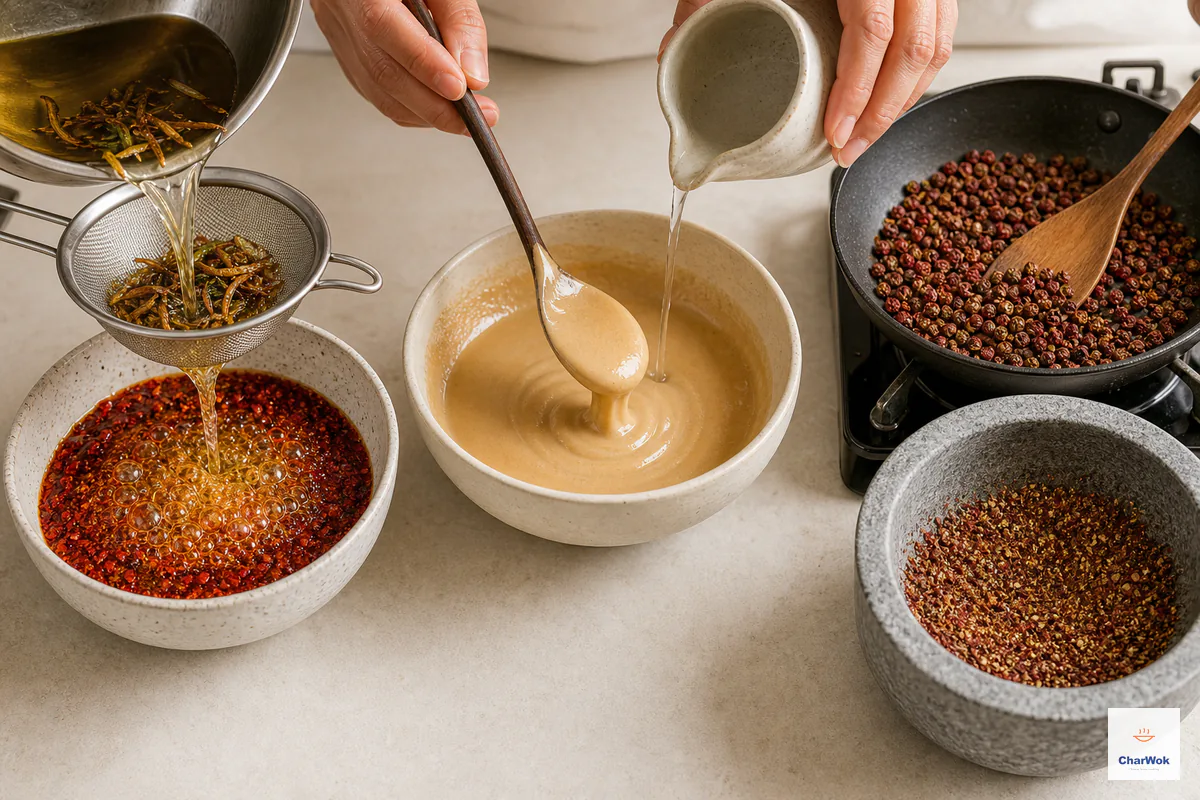
Bloom coarse chili with strained aromatic oil at about 175°C or 350°F without scorching it, loosen sesame paste gradually until glossy, and toast Sichuan pepper only until fragrant before grinding.
| Problem | Likely cause | Fix |
|---|---|---|
| Biang Biang dough rips when you pull it | Under-rested, or too dry | Cover and rest longer. If still tight, wet your hands and knead in a little water. |
| Liang Pi sheets tear when lifted | Poured too thin, or pan not hot enough before steaming | Pour a thin, even layer. Preheat the pan so the batter sets on contact. |
| Dumpling wrappers split at the seam | Edges dried out, or too thick at the pleat | Keep dough under a damp towel. Roll edges thinner than centers; pinch, do not fold, the seal. |
| Potstickers stick and the skirt tears | Skirt poured before the base set, or pan not hot enough | Wait until the bottoms are golden before adding the starch-water. Use a nonstick or well-seasoned pan. |
| Rou Jia Mo bread is dense and dry | Rolled too thick, cooked too hot | Roll thinner, cook lower and slower, finish covered to steam the inside soft. |
| Potato stir-fry turns gummy | Surface starch not rinsed, or pan crowded | Soak matchsticks, drain bone dry, cook in two batches on max heat. |
| Lamb stir-fry is tough | Overcooked, or no starch-oil coating | Velvet with cornstarch and oil; sear hot, pull early, return at the end. |
| Chili oil tastes flat, not fragrant | Oil too hot when poured, or flakes too fine | Simmer aromatics in the oil over low heat until the scallions brown, then bring the oil to 175°C / 350°F before pouring it through a strainer over the coarse flake mix. Pouring hotter than that scorches the flakes and turns the oil acrid. |
How to put a Xi'an meal together
One dough dish plus one stir-fry plus a cold plate is the shape of a good Xi'an dinner. Pull a tray of Biang Biang noodles for the centerpiece, run a quick hot-and-sour potato beside it, and open the meal with cold Liang Pi dressed in sesame and chili oil so nobody is hungry while the noodles cook. For a bigger crowd, add Rou Jia Mo as a hand-around and a plate of cumin lamb skewers off the grill. Dumplings, whether folded at the table or made ahead, fill any gap and stretch a meal to feed twice the people.
Variations and pairings
The dough techniques carry over endlessly. The same Biang Biang dough, cut into ribbons instead of pulled, becomes a base for hand-torn cumin lamb noodles. Leftover braised pork from Rou Jia Mo folds into dumplings or tops a bowl of noodles. The hot-and-sour potato method works on shredded radish, lotus root, or firm tofu in exactly the same way. And while Xi'an chili oil is its own animal, the broader Chinese noodle tradition is full of cousins worth knowing; the numbing-tingle profile of Chongqing xiao mian or a tour of regional noodle bowls will sharpen your sense of where Shaanxi sits on the map.
For dipping, skip the bottled stuff. A quick mix of black vinegar, soy, chili oil, and a little raw garlic minced into it is the classic, and a rotating set of dumpling sauces lets you change the meal without cooking anything new. Drink-wise, Xi'an food wants something cold and slightly sweet or acidic to stand up to the cumin and chili: chilled soy milk, a light lager, or a glass of dry riesling all do the job better than plain water, which just spreads the oil around your mouth.
Storage and reheating
Raw noodle and dumpling doughs keep a couple of days in the fridge if sealed tight, or freeze for a month or so; thaw overnight in the fridge, never at room temperature, or condensation makes them sticky. Cooked hand-pulled noodles reheat poorly, so cook only what you will eat. Liang Pi, by contrast, is built to be made ahead and dressed cold straight from the fridge. Braised pork belly for Rou Jia Mo keeps well for several days refrigerated and freezes for months, and like most stews it tastes better on the second day once the fat has carried the spice through the meat.
A note on honesty
I will be straight with you about one thing: the hand-pulled noodle styles, la mian in particular, are humbling. I have taught myself most of the dishes on this page to a level I am happy to serve, and la mian still hands me my hat about one Saturday in three. The flatbreads, the cold noodles, the stir-fries, and the dumplings are all genuinely weeknight-friendly. The pulled noodles are a hobby. Treat them that way and you will enjoy the process instead of cursing it.
Frequently asked questions
Is Xi'an food the same as Sichuan food? No. Both are spicy, but Xi'an heat comes from chili oil and toasted cumin with a black-vinegar sourness, while Sichuan leans on doubanjiang and the numbing buzz of Sichuan peppercorn. Xi'an is also wheat-based where Sichuan leans on rice.
Can I make the noodles without a stand mixer? Yes. The doughs here are simple enough to knead by hand. The mixer saves time on the high-protein pulled-noodle doughs, but Biang Biang and scissor-cut are well within hand-kneading range.
What if I cannot find black vinegar? Mix three parts rice vinegar with one part balsamic to approximate the dark, mellow sourness. It is a fallback, not an equal, so grab the real Chinkiang when you see it.
Are these dishes very spicy? They are as spicy as you make the chili oil. Start with a small spoonful of chili oil per portion of noodles and build up to taste. The cumin dishes read warm rather than scorching.
Can I prep the dough the night before? Yes, and you should. Rest the dough in the fridge overnight for the best texture, then let it sit out to take the chill off before stretching or rolling.