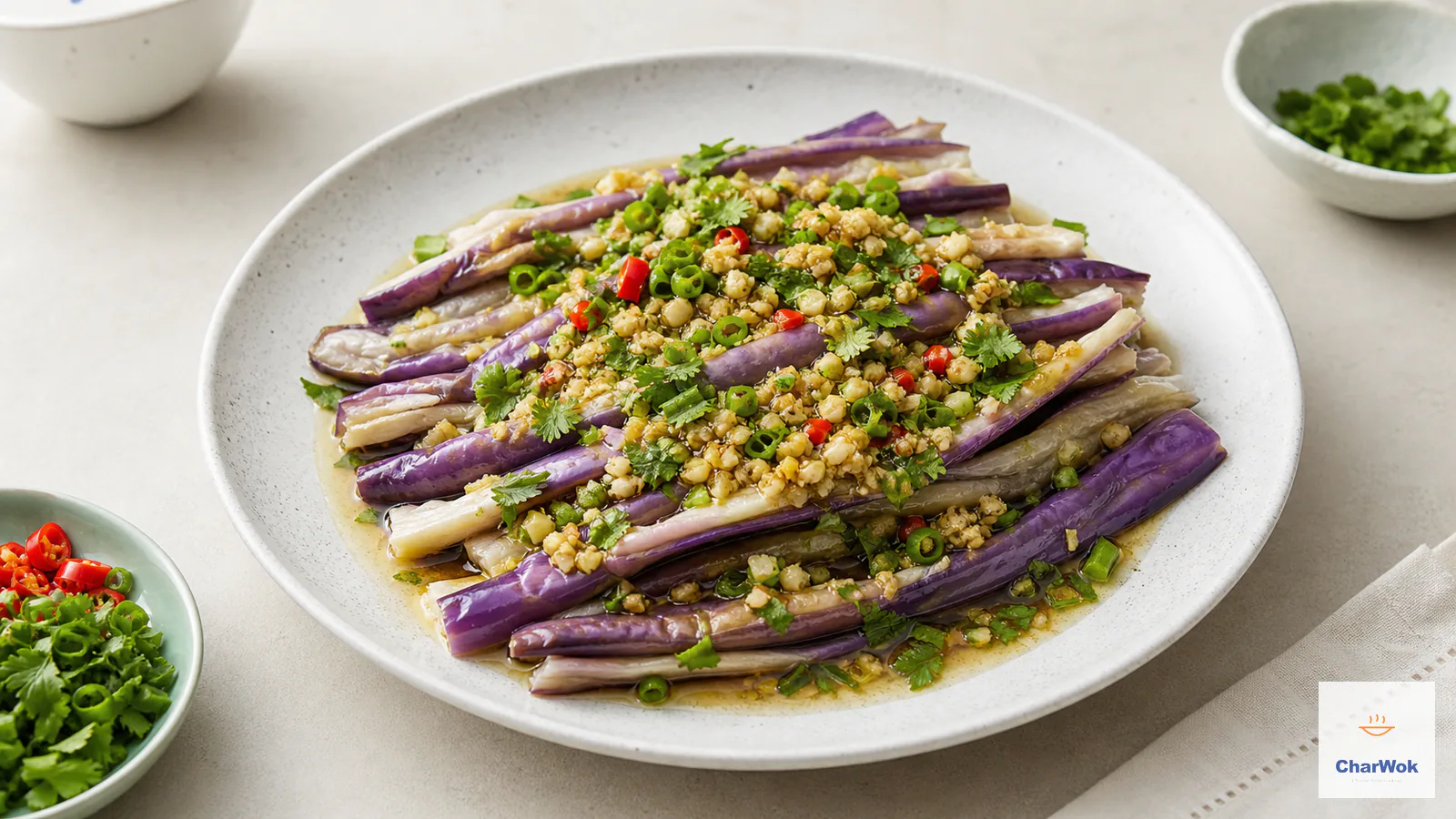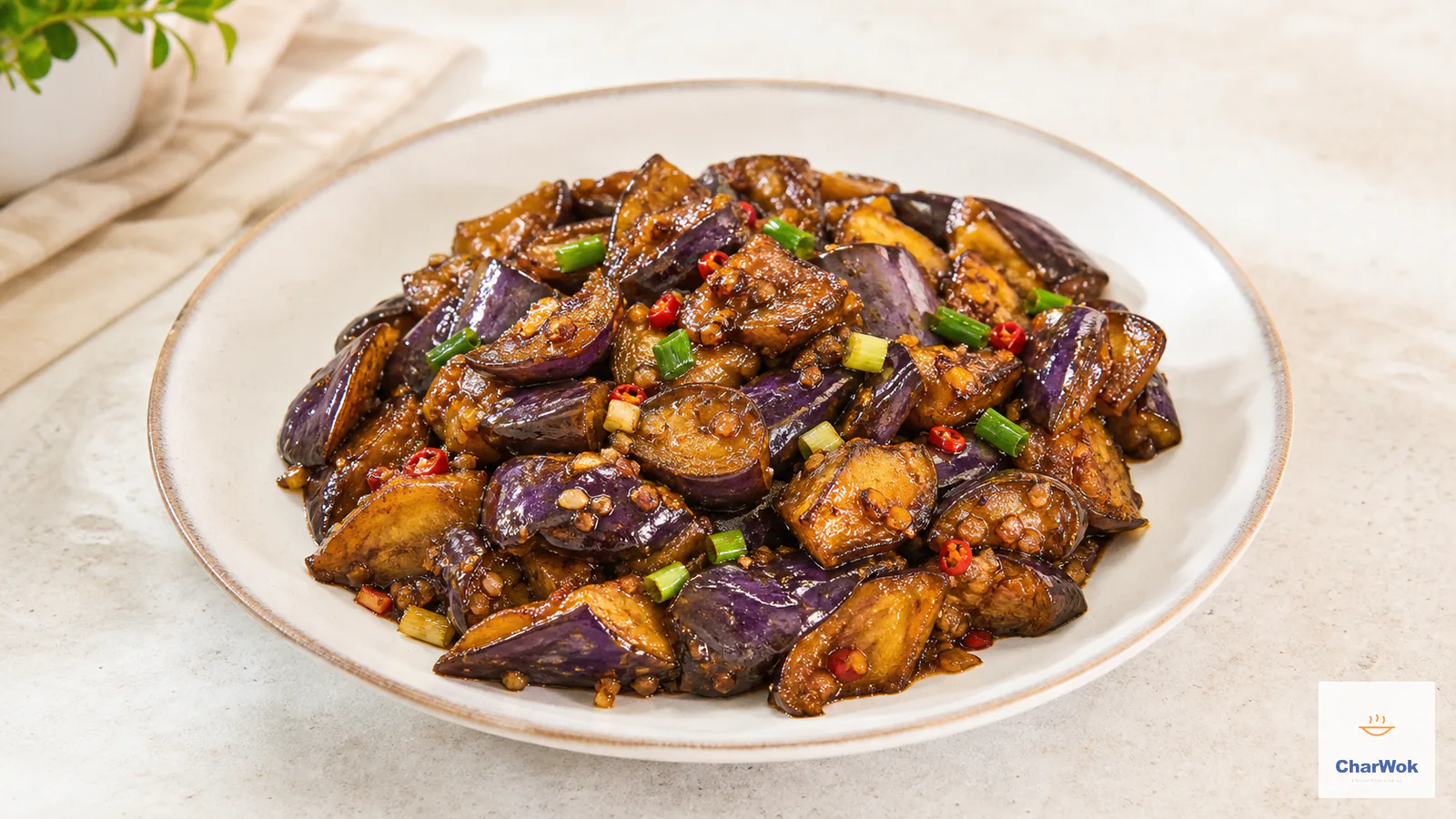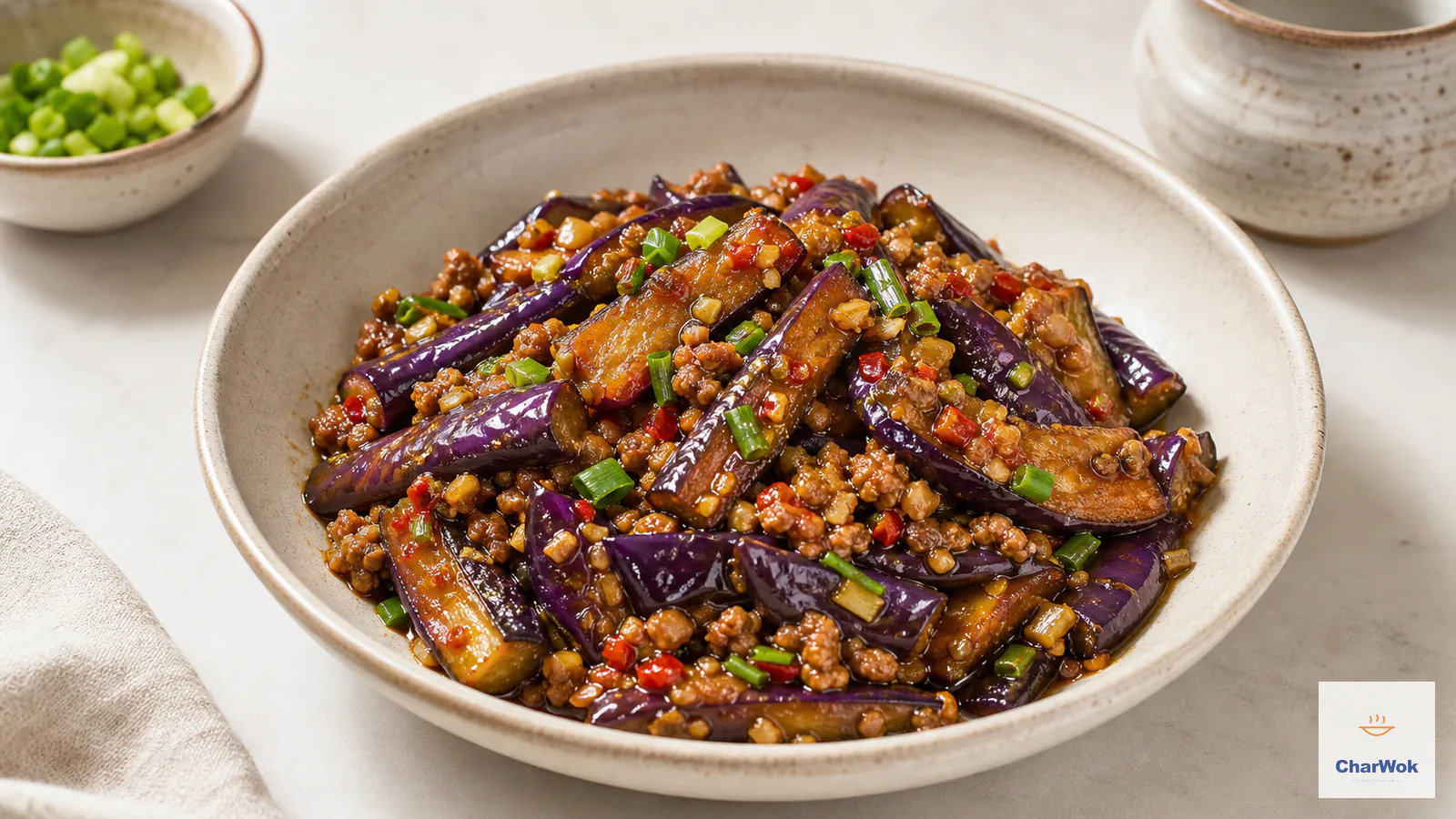
The dish lands on the table glossy, dark, and improbably rich for something built around a vegetable. Eggplant with garlic sauce, or Yu Xiang Qiezi, is the kind of Sichuan stir-fry that makes people who "don't like eggplant" quietly go back for seconds. The trick most home cooks miss isn't the sauce. It's that the eggplant itself soaks up oil like a sponge and then sits there, greasy and limp. I have served that version more times than I care to admit, and the fix turned out to be one counterintuitive step at the very start.
Cook the eggplant in boiling water first, not oil. Three minutes of blanching collapses the air pockets so the flesh absorbs flavor instead of fat, and the whole dish finishes in under 15 minutes with about 1½ tablespoons of oil for two people.
What "fish fragrance" actually means
The Chinese name Yu Xiang translates literally to "fish fragrance," and there is no fish anywhere in the recipe. The phrase refers to a seasoning template from Sichuan home cooking, a fixed ratio of pickled chili, garlic, ginger, vinegar, sugar, and soy sauce that was traditionally used to flavor fish. Cooks eventually applied the same seasoning to pork, eggplant, and mushrooms because it worked even better on ingredients mild enough to carry it. Once you internalize the ratio, you can turn out a whole family of dishes, from fish-fragrant shredded pork to fish-fragrant king oyster mushrooms and fish-fragrant tofu.
Two notes on regional honesty. This is a Sichuan dish at its core, built on the region's fermented pickled chili. Restaurants in other provinces have watered it down into a generic sweet-sour garlic glaze, and many takeout menus call any eggplant-in-reddish-sauce "Yu Xiang." If you want the real thing, the pickled chili is non-negotiable. I have tried it with sriracha and with fresh jalapeño, and the result is a different dish, pleasant but recognizable as an imitation.
Why eggplant fights you in the pan
Eggplant is mostly water trapped in a spongy network of cell walls and tiny air channels. Raw, it is light and buoyant. Drop it into hot oil and those air pockets expand, then collapse, and the flesh drinks oil until it is saturated. This is why deep-fried restaurant eggplant tastes luxurious and why the home version, stir-fried from raw, so often ends with a slick of oil pooling at the bottom of the plate.
Collapsing those air pockets before the eggplant ever sees the oil is the entire game. Blanching in salted boiling water does it cleanly and adds almost no fat. The flesh turns silky and porous in the right way, ready to soak up the sauce instead of the cooking oil. I learned this shortcut after ruining a wok full of eggplant that had drunk half a cup of peanut oil and still tasted undercooked at the center.
Picking the right eggplant
Use the long, slender Chinese or Japanese eggplant if you can find it. It has thinner skin, fewer seeds, and a sweeter, creamier flesh than the large globe eggplant that dominates American supermarkets. The color should be a uniform deep purple with a glossy, tight skin and a green calyx (the leafy cap) that looks fresh, not browned or shriveled. Pick one up: it should feel heavy for its size and firm, with no soft spots. Aged eggplant goes spongy and bitter as it sits, developing visible brown seeds inside.
Globe eggplant will work in a pinch. Peel it, because the skin on a mature globe eggplant is tough and stays leathery after a short stir-fry. I use it for other dishes like Di San Xian, where a longer cook softens everything together, but here the Chinese variety is genuinely better, not just preferable.
The ingredient list
Ingredients at a glance
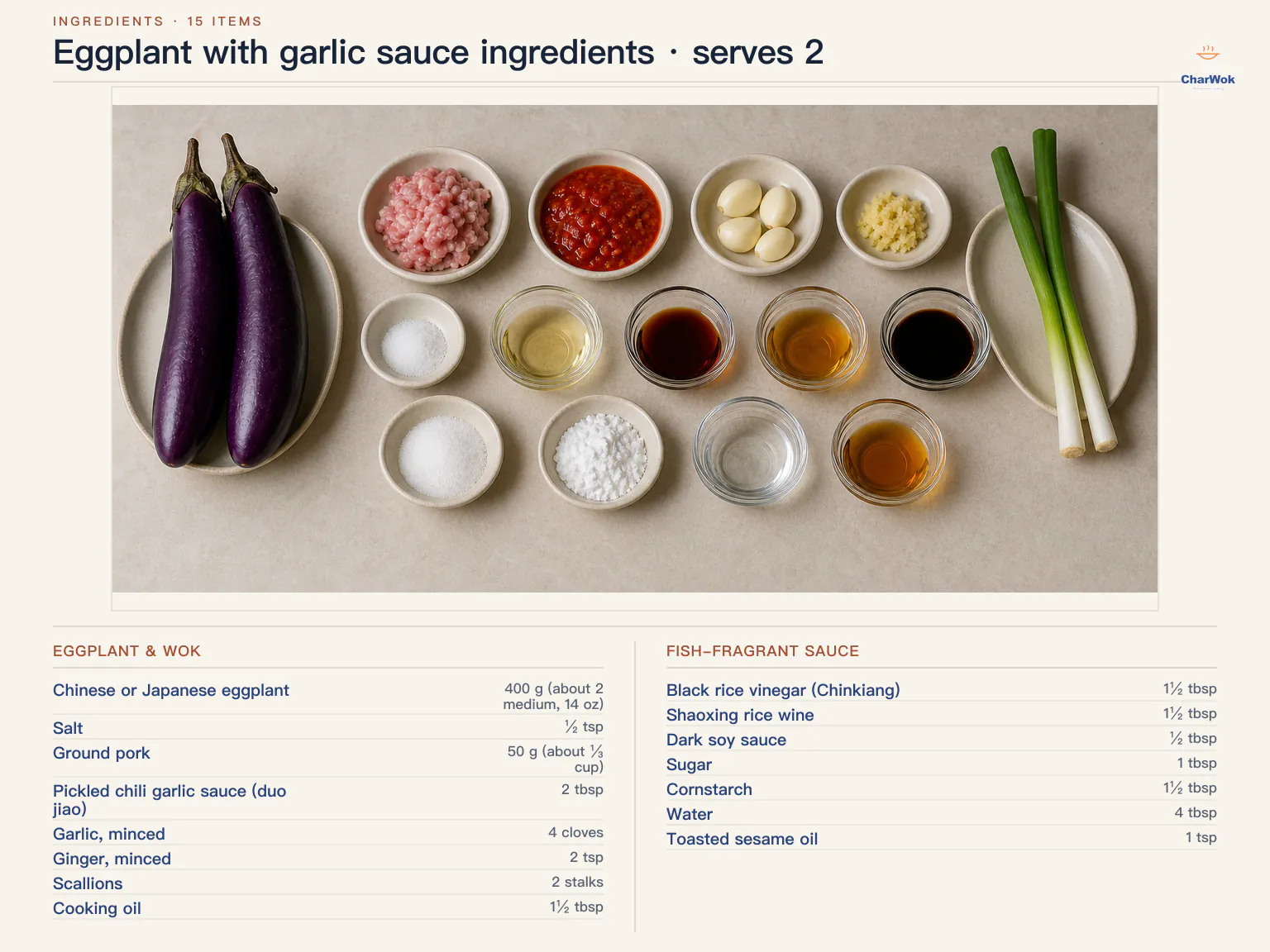
Quantities below serve two as a main with rice. I use Chinese-style tablespoon and teaspoon measures (15 ml and 5 ml). Most of the pantry items here, the black rice vinegar, Shaoxing rice wine, and dark soy sauce, keep indefinitely and pay off across dozens of dishes.
| Ingredient | Amount | Notes / substitute |
|---|---|---|
| Chinese or Japanese eggplant | 400 g (about 2 medium, 14 oz) | Globe eggplant OK if peeled |
| Salt | ½ tsp | For the blanching water |
| Ground pork | 50 g (about ⅓ cup) | Beef, chicken, or turkey work; see vegetarian swaps below |
| Pickled chili garlic sauce (duo jiao) | 2 tbsp | Or 1 tbsp Sichuan chili bean paste (doubanjiang) plus omit dark soy |
| Garlic, minced | 4 cloves | Don't skimp; this is a garlic sauce |
| Ginger, minced | 2 tsp | Fresh, not dried |
| Scallions | 2 stalks | Split into white and green parts |
| Cooking oil | 1½ tbsp | Neutral, high-smoke-point: peanut, canola |
| Black rice vinegar (Chinkiang) | 1½ tbsp | Balsamic, reduced, is the closest Western sub |
| Shaoxing rice wine | 1½ tbsp | Dry sherry or dry white wine |
| Dark soy sauce | ½ tbsp | For color; light soy lacks the molasses note |
| Sugar | 1 tbsp | Regular white sugar, or rock sugar dissolved |
| Cornstarch | 1½ tbsp | Potato starch works; see troubleshooting on thickening |
| Water | 4 tbsp | Or unsalted stock |
| Toasted sesame oil | 1 tsp | Added to the sauce for aroma; see sesame oil guide |
How to make it
- Get everything ready before the wok goes on the heat. Stir-frying happens fast; once the pan is hot there is no time to mince garlic. Mince the aromatics, mix the sauce in one bowl, and have the blanched eggplant drained and sitting next to the stove.
- Cut the eggplant into batons. Halve each eggplant lengthwise, then cut into sticks roughly the thickness of a finger, 5 to 6 cm (2 inches) long. Uniform pieces cook evenly. Drop them straight into the boiling water so they don't brown from the air.
- Blanch the eggplant for 3 to 4 minutes. Keep the pot covered. Test one baton: it should yield easily when pressed but still hold its shape, not collapse into mush. The salt in the water seasons the flesh lightly and helps set the color. Drain in a colander and press gently with a spatula to squeeze out the loose water. Skip this pressing and your finished dish will weep watery sauce.
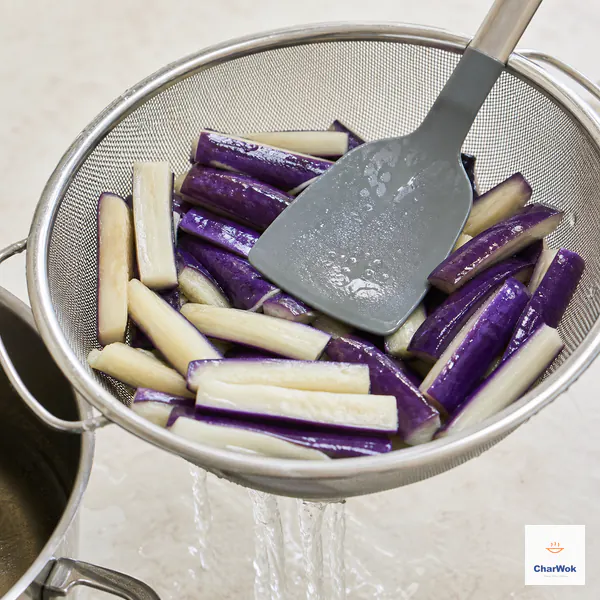
Drain and press only gently: the eggplant should bend while each baton still holds its shape
- Mix the sauce. Whisk the vinegar, rice wine, dark soy, sugar, cornstarch, water, and sesame oil together. The cornstarch will sink as it sits, so give it another stir right before pouring.
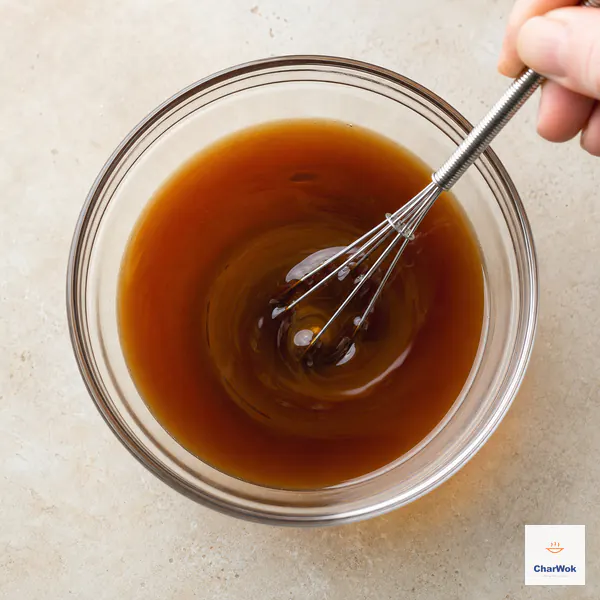
Re-stir immediately before pouring so the cornstarch is fully suspended
- Fry the pork until it loses its pink. Heat a carbon-steel wok until it just begins to smoke, add the oil, swirl, then add the ground pork. This "hot wok, cold oil" sequence keeps the meat from sticking. Break the pork up with your spatula and fry over high heat until no red remains and a little fat has rendered out. The rendered fat is where the dish gets its depth, which is why lean cuts aren't ideal here.
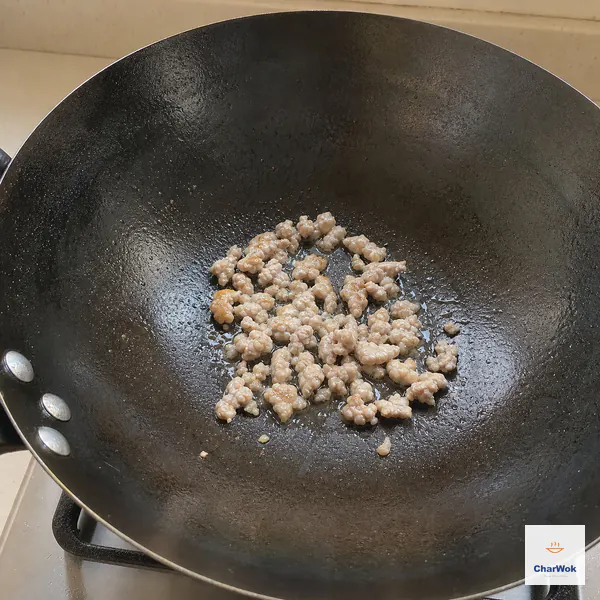
Break the pork into small crumbles and stop once no pink remains
- Bloom the aromatics. Add the pickled chili, garlic, ginger, and the white parts of the scallions. Keep the pieces moving for 20 to 30 seconds until the smell hits you. Burn the garlic and the whole dish turns bitter, so if the pan is running hot, drop the heat a notch for this step.
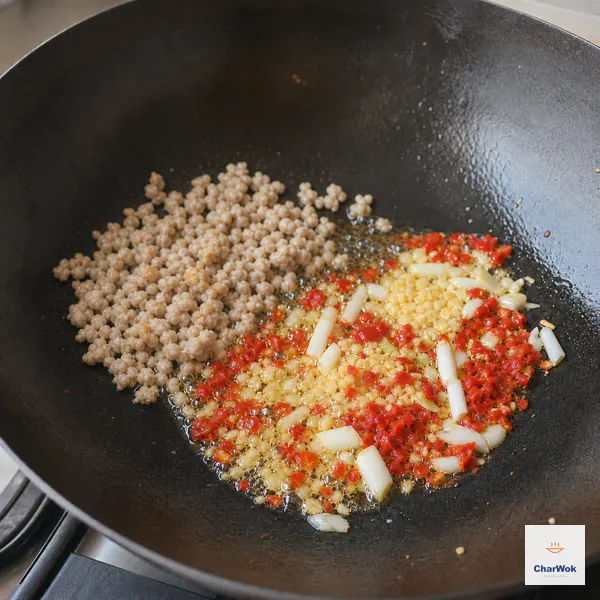
Bloom the aromatics briefly while they stay bright and moist, never scorched
- Add the eggplant and let it drink the sauce. Tip in the drained eggplant and toss until it is hot through, about a minute. Re-stir the sauce bowl and pour it around the edges of the wok, not directly on the eggplant. The liquid will hit the hot metal, come to an immediate boil, and begin to thicken. Toss continuously so each baton gets coated before the sauce sets.
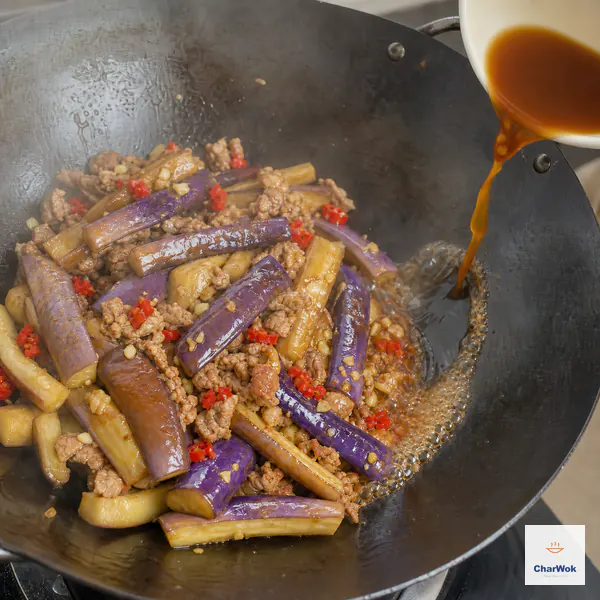
Pour around the hot rim and fold just until a thin glossy coating clings to the eggplant
- Kill the heat the moment it thickens. Cornstarch thickens in seconds and will overcook into a gummy paste if you keep going. The sauce should cling in a glossy layer, not pool. Off the heat, scatter the scallion greens and serve at once.
When it goes wrong, and how to fix it
The sauce seizes into a stiff paste the instant it hits the pan. This is the single most common complaint, and the cause is almost always the cornstarch-to-liquid ratio against how much water the eggplant is still holding. If the eggplant was poorly drained, it releases water during frying and dilutes the sauce mid-thicken. Press the blanched eggplant harder next time. To rescue a batch in progress, splash in a tablespoon of hot water and toss off the heat.
The dish tastes too sour. Black rice vinegar is assertive, and different brands vary in acidity. Taste your sauce mixture before cooking; it should read sweet first, sour second, with a spicy kick behind. If it bites, balance with another half-teaspoon of sugar rather than diluting with water.
It's swimming in oil. You either fried the eggplant instead of blanching it, or your wok wasn't hot enough when the pork went in, so the meat stewed and released fat that never emulsified. Get the wok properly hot and drain the blanched eggplant well, and the dish should finish with barely a film of oil.
The eggplant has collapsed to mush. You blanched too long or pressed too hard when draining. Next time, pull the eggplant at 3 minutes if the pieces are slim, and press gently with the back of a spoon rather than wringing.
The garlic burned and tastes bitter. Add the aromatics a half-second after the pork, not into a dry-hot pan, and keep them moving. Burnt garlic can't be rescued; start the aromatics over.
Variations and vegetarian versions
The fish-fragrant seasoning is the real protagonist, so you can swap the eggplant with confidence. Finely chopped shiitake mushrooms, rehydrated and squeezed dry, mimic the savory chew of the ground meat and pair beautifully with the sauce; dried shiitake has more flavor than fresh, and a quick tour of the shiitake guide is worth your time. Crumbled firm tofu, broken up with your fingers and fried until just golden, gives a vegan version real substance. You can also drop the eggplant entirely and apply this sauce to blanched broccoli or even leftover rice for an instant meal.
If you can't find duo jiao, the chopped Hunan-style pickled chili, substitute 1 tablespoon of Sichuan chili bean paste (doubanjiang) and leave out the dark soy sauce, since doubanjiang is saltier and carries enough color on its own. The result is earthier and less bright than the duo jiao version but still unmistakably fish-fragrant.
What to serve it with
Spoon the eggplant over freshly cooked steamed jasmine rice; the sauce is the point of the rice. For a fuller meal, build a two-dish dinner around a cooling contrast: a simple smashed cucumber salad or a bowl of egg drop soup balances the richness. Leftovers are excellent folded into noodles the next day, especially over chow mein or stirred into a bowl of plain rice noodles.
Storage and reheating
The dish keeps, covered, in the fridge for up to three days, and the flavor actually deepens overnight. Reheat it gently in a pan with a splash of water to loosen the sauce; the microwave works but tends to make the eggplant weep. It does not freeze well, as the thawed texture turns waterlogged. I usually cook only what we will eat in a sitting, since the silky-just-cooked texture is a big part of the appeal.
Frequently asked questions
Can I skip the meat entirely?
Yes. The fish-fragrant sauce carries the dish on its own. For body, substitute crumbled firm tofu or finely chopped rehydrated shiitakes fried the same way.
Is there a way to avoid deep-frying but still get a browned edge on the eggplant?
After blanching and draining well, sear the batons in a dry nonstick pan over high heat for a minute per side before stir-frying. You get a little char without the oil bath.
My sauce turned into a hard lump. What happened?
The cornstarch wasn't redistributed before pouring, or the eggplant released water and threw off the ratio. Always re-whisk the sauce, and add a tablespoon of hot water to thin a seized pan off the heat.
How spicy is this supposed to be?
Traditionally the heat is a warming hum, not a burn. Dial the pickled chili down to 1 tablespoon for a milder version, or add a pinch of ground Sichuan pepper for the classic numbing edge.
Can I make the sauce ahead?
Mix everything except the cornstarch up to a week in advance and refrigerate. Stir in the cornstarch and water right before cooking so it doesn't settle and seize.
The dish comes down to one decision made early: collapse the eggplant's structure in water before the oil ever touches it. Get that right and the rest, the hot wok, the quick bloom of aromatics, the sauce that thickens in seconds, falls into place. The version that lands on your table will be glossy and tender without the slick of grease that defines the bad ones, and that is the whole reason to cook this at home rather than order it.