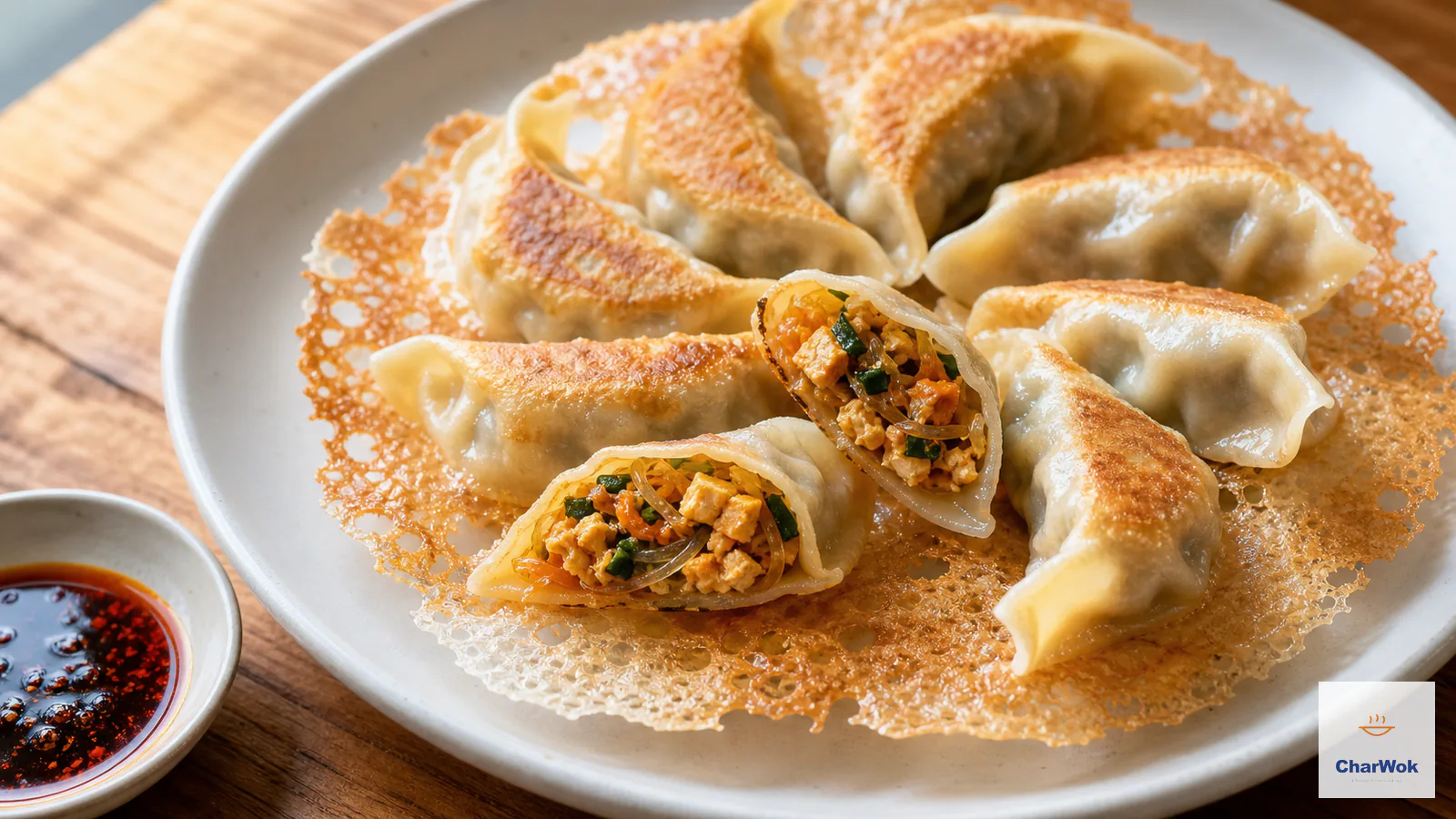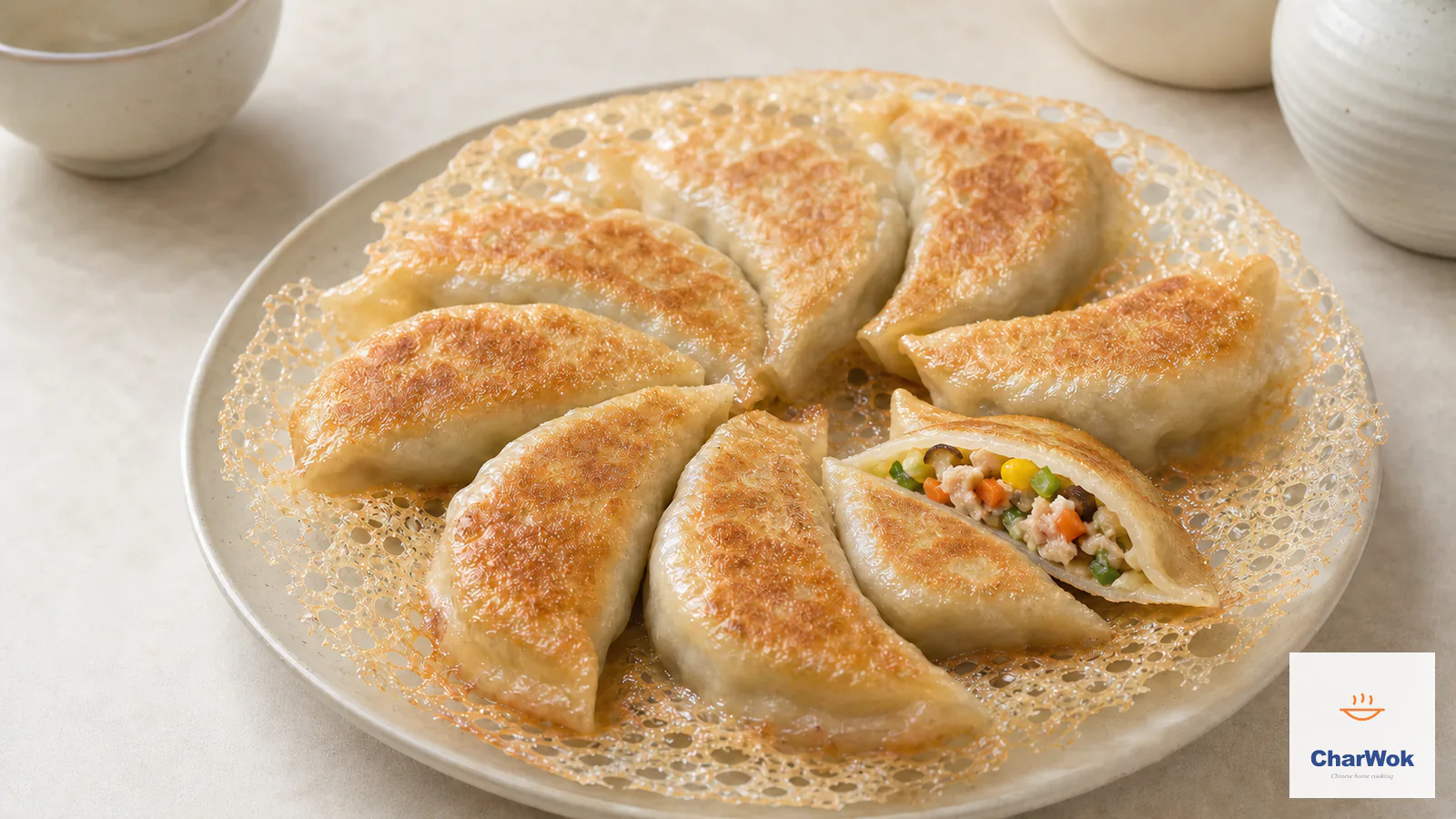
The whole point of a potsticker with a crispy skirt is the moment you flip the pan and a single, lace-like sheet of golden starch slides out, still clinging to a row of dumplings. That lacy web is the dish. A plain pan-fried dumpling is good; a skirt turns it into something you bring to the table on the skillet and let people pull apart themselves.
I make these with ground chicken because it is lean, cheap, and forgiving, but the same recipe is the reason most home cooks give up on the skirt. The filling is easy. The skirt is where things fall apart: gummy, torn, burned at the edges and raw in the middle, or stuck so hard to the pan that you scrape it off in chunks. This recipe exists to fix all of that, and to explain why each step works so you can stop following it blindly and start adjusting.
At a glance. Roughly equal parts boiling and tap water (70 g hot to 60 g cold) make a "hot-water dough" that browns without toughening. The lacy skirt comes from a thin starch slurry poured in once the dumpling bottoms are golden — a tablespoon or so of cornstarch and a little flour loosened with water and a touch of vinegar. Cook covered over high heat until the liquid is gone, then dry the lace for 30 seconds. The flour-to-starch balance in that slurry is the make-or-break detail.
What a potsticker is, and where the skirt came from
A potsticker is a dumpling that is pan-fried, then steamed in a little water in the same pan, then dried out again so the bottom crisps. The Chinese name guo tie (锅贴) literally means "pan-stuck." Open-ended, half-moon shapes are traditional for guo tie specifically, as opposed to fully sealed boiled dumplings, and that open edge matters: it lets steam escape so the wrapper stays chewy-tender rather than blowing out.
The "skirt" (bing hua, 冰花, "ice flower") is a newer, showier touch borrowed from restaurant and street-stall presentation. A starchy slurry is poured around the dumplings; as it boils down, the starch gelatinizes into a continuous sheet, then the flour and Maillard browning turn it crisp and golden. The pattern it leaves looks like frost on a window. If you have ever wondered why some pans of dumplings arrive as a single connected disc and others as loose individuals, this slurry is the entire answer.
If you are new to dumplings generally, the wider Chinese dumpling guide covers the vocabulary, and the roundup of classic dumpling recipes is a good place to see how this one fits in. For this recipe I assume you can fold a basic half-moon; if not, the folding walkthrough in part three of that series breaks this open-corner shape down step by step.
Ingredients
Ingredients at a glance
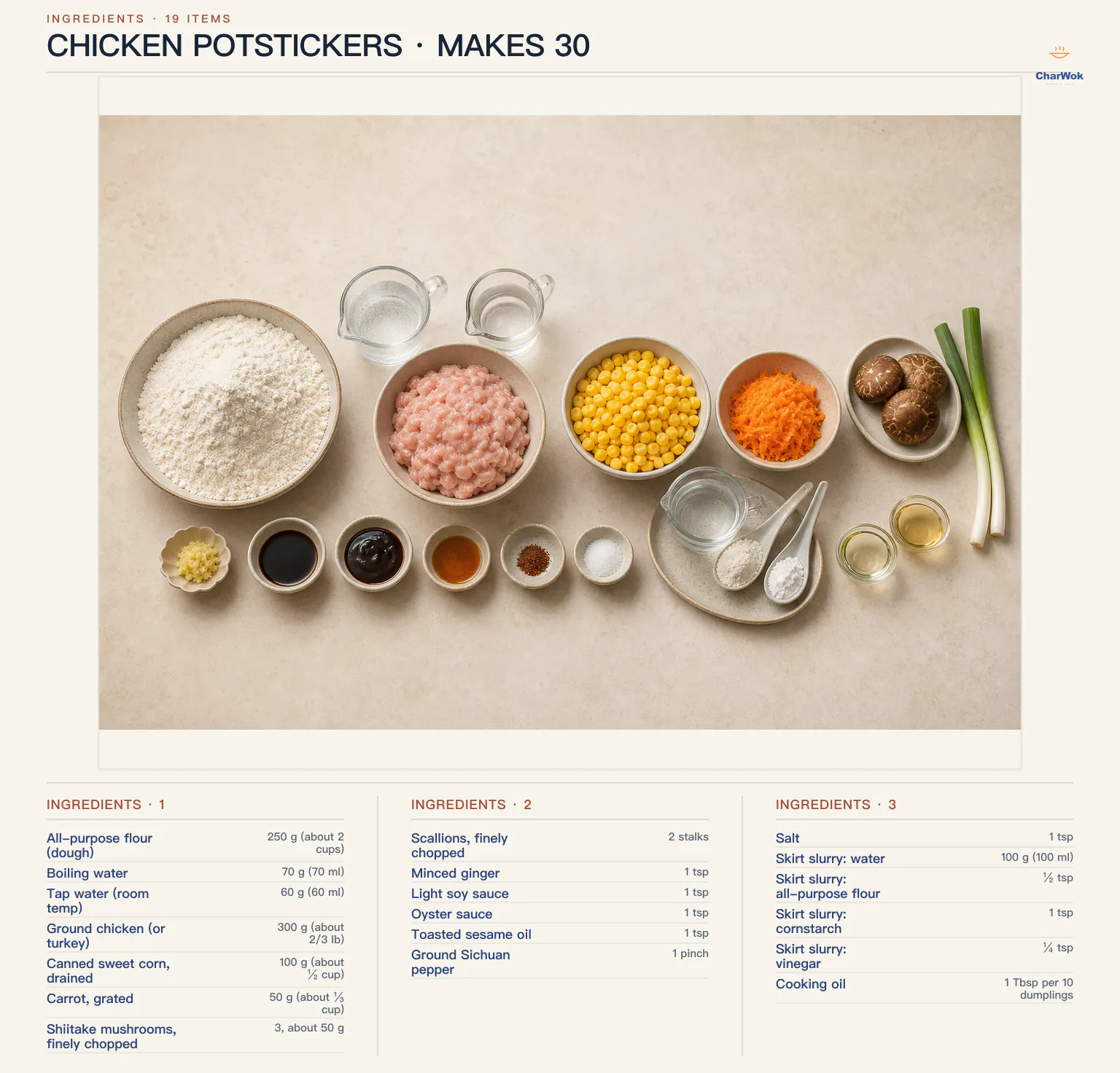
The dough is a hot-water dough, which sounds fussy and is not. All the flour goes into one bowl, and the boiling water is poured over it; that heat partially gelatinizes the starch and softens the gluten so the wrapper stays tender even after frying. The cooler tap water brings the temperature down and pulls the dough together. This is the same family of dough used for many northern wrappers; you can read the full reasoning in the homemade dumpling wrapper tutorial.
| Ingredient | Amount | Notes / substitute |
|---|---|---|
| All-purpose flour (dough) | 250 g (about 2 cups) | US all-purpose (11% protein) is ideal. Don't use bread flour; the wrapper gets tough. |
| Boiling water | 70 g (70 ml) | Right off the boil, poured onto the flour. |
| Tap water (room temp) | 60 g (60 ml) | Cold works too; the contrast with the boiling water is what matters. |
| Ground chicken (or turkey) | 300 g (about 2/3 lb) | Thigh is juicier than breast. Turkey is the original substitution and works identically. |
| Canned sweet corn, drained | 100 g (about ½ cup) | Frozen corn, thawed and patted dry, is fine. The sweetness balances the lean meat. |
| Carrot, grated | 50 g (about ⅓ cup) | Grate on the fine holes so it cooks through; coarse shreds stay crunchy. |
| Shiitake mushrooms, finely chopped | 3, about 50 g | Fresh or dried-and-rehydrated. Dried has more flavor; see the shiitake guide. |
| Scallions, finely chopped | 2 stalks | Green and white parts. |
| Minced ginger | 1 tsp | Fresh. Ginger is the main thing that keeps chicken filling from tasting flat. |
| Light soy sauce | 1 tsp | For seasoning only. Light vs. dark soy matters here; use light, not dark. |
| Oyster sauce | 1 tsp | Adds body and umami the chicken lacks. |
| Toasted sesame oil | 1 tsp | Added last so the aroma survives. Use toasted sesame oil, not the light kind. |
| Ground Sichuan pepper | 1 pinch | Five-spice powder or white pepper work. Sichuan pepper adds a faint tingle; grind it fresh. |
| Salt | 1 tsp | Adjust to taste; oyster and soy sauce are already salty. |
| Skirt slurry: water | 100 g (100 ml) | Per pan of about 10 dumplings. |
| Skirt slurry: all-purpose flour | ½ tsp | Too much flour = a thick, leathery sheet; too little = no lace. |
| Skirt slurry: cornstarch | 1 tsp | The crispness comes mostly from here, not the flour. |
| Skirt slurry: vinegar | ¼ tsp | Plain white or rice vinegar. A few drops keep the lace from turning gummy. |
| Cooking oil | 1 Tbsp per 10 dumplings | Neutral oil (canola, vegetable, peanut). |
Building the dough: why two waters, and why rest
Pour the flour into a bowl and add the boiling water in a thin stream while stirring with chopsticks or a spatula. You are not trying to knead yet; you just want the boiling water to hit as much of the flour as possible. The heat gelatinizes starch on the surface of the flour particles, which is what later gives the cooked wrapper its soft, slightly translucent chew. Then add the tap water and stir until a shaggy dough forms.
Here is the part most recipes skip: do not try to knead it smooth yet. The dough will fight you. Cover it and walk away for 10 minutes. What happens in that 10 minutes is that the flour fully hydrates and the gluten relaxes on its own. When you come back, the same dough that was ragged and resistant will knead smooth in under a minute. This is autolyse in baker's terms, and it works on dumpling dough exactly the way it works on bread.
Once smooth, cover and rest another 30 to 60 minutes. This second rest is what makes the dough soft enough to roll thin without springing back. If you are in a hurry, 30 minutes is enough. If you have the time, an hour is better. You can make the filling while you wait.
The chicken filling, and why it needs help
Chicken breast by itself makes a dry, bland dumpling. Thigh is better but still leaner than pork, which is the default for most dumpling fillings. Two things rescue it: fat and moisture built into the mix, and the small dice of corn, carrot, and mushroom that burst with juice as you bite.
Put all the filling ingredients in a bowl and mix with your hand, rubbing and pressing rather than just stirring. The rubbing action is a home version of what Cantonese cooks call "beating the meat up": it develops the myosin in the muscle so the cooked filling holds together in a tender ball instead of crumbling. After a minute of mixing the paste should look slightly sticky and pull in one mass when you lift your hand. That sticky pull is exactly what you want.
If the mix feels stiff, add a tablespoon of water and beat it in. Lean chicken can absorb a surprising amount of liquid, and that liquid is what makes the difference between a juicy and a cottony bite. Taste a tiny cooked pinch of the filling before you assemble, and adjust salt or ginger. This is the one habit that will improve your dumplings more than any technique.
Rolling and folding
Divide the dough into three pieces and keep two covered while you work the third. Roll each piece into a rope about 3 cm thick and cut it into 10 equal sections; a dough scraper or knife works. Press each piece flat with your palm, then roll it out into a thin disc, rolling from the center outward and rotating the disc a quarter turn between strokes. Aim for thinner edges than center; the thin edge is what lets you pleat without a thick lump at the seal.
Hold a wrapper in your non-dominant hand, put a scant tablespoon of filling in the middle, and fold it over into a half-moon. Pinch the top center shut, then work from the center outward along one side, then the other. For potstickers specifically, leave the two corners slightly open rather than sealing them tight. That open corner is not laziness; it is the vent that stops steam from rupturing the wrapper during the covered phase. If pleating is the hard part for you, the fold-dumplings tutorial breaks this exact open-corner shape down step by step.
Set each finished dumpling on a surface dusted with flour or lined with parchment, and keep the waiting ones covered with a damp towel. Exposed edges dry out in minutes and crack when you try to seal them later.
Cooking: the skirt, step by step
This is the section worth reading twice. First, whisk the slurry until completely smooth. Any lumps of starch will show up as pale blisters in the finished lace. Set it aside.
- Heat the pan dry, then add oil. Set a nonstick or well-seasoned skillet over high heat and let it get hot. Add about 1 Tbsp of oil for every 10 dumplings, swirl to coat, and arrange the dumplings in the pan, open edge up. They can be nearly touching; the skirt will bind them.
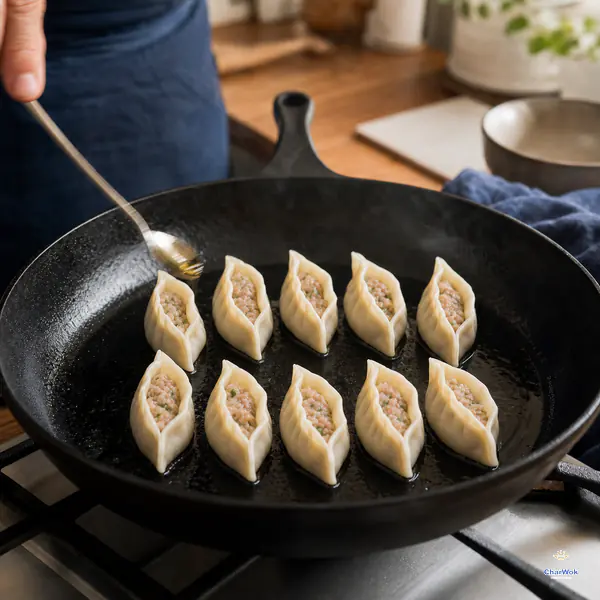
Heat the suitable pan, add about 1 tablespoon oil per 10 potstickers, and arrange exactly ten nearly touching with their pleated edges upright; no slurry goes in yet.
- Fry until the bottoms are golden. Leave them alone for 2 to 3 minutes. Lift one with a spatula to check. You want a definite golden-brown crust before the slurry goes in, because once the liquid hits, that browning stops. This is the step people rush, and it is the step that produces pale, sad potstickers.
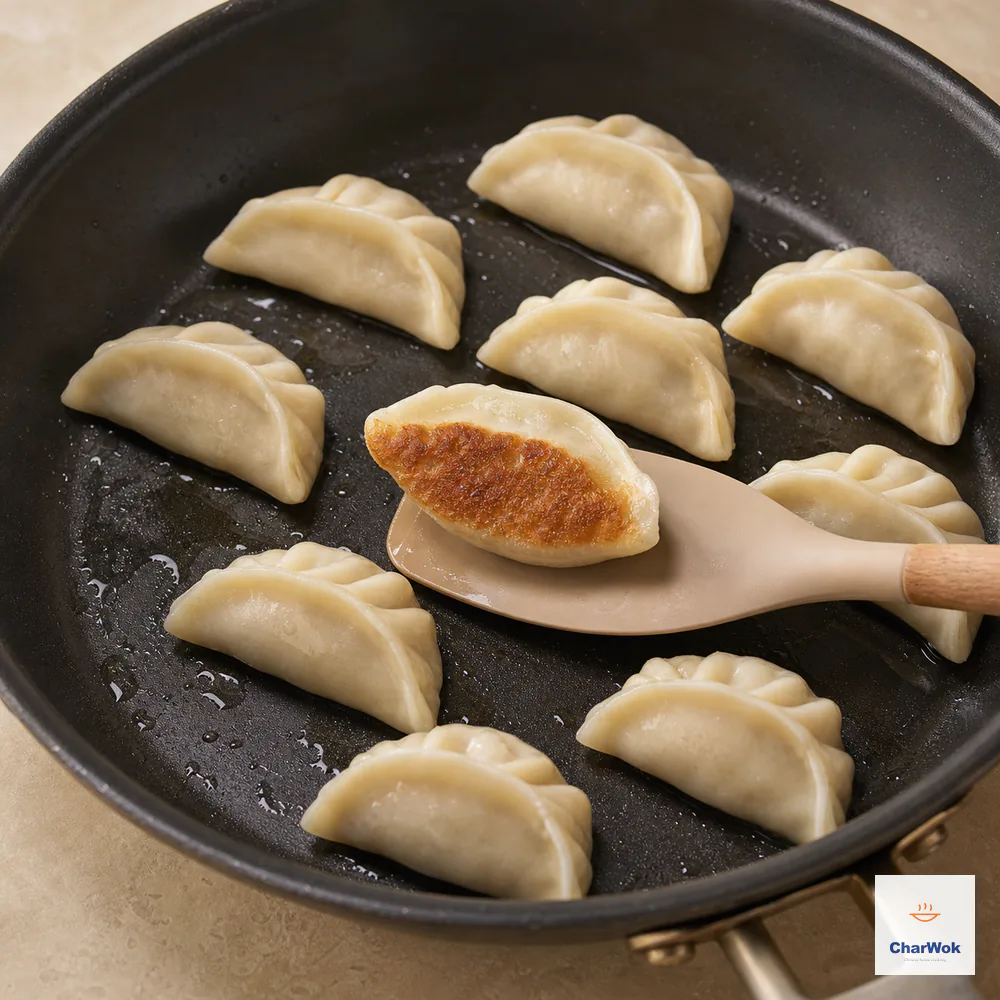
Arrange 10 potstickers in the hot oiled pan and fry until a lifted flat base is evenly golden; keep the pan dry at this checkpoint.
- Pour in the slurry and cover. Re-whisk the slurry (the starch settles fast) and pour it in around the dumplings, not directly on top. Cover with a tight lid immediately. The slurry should come about a third of the way up the dumplings, not drown them.
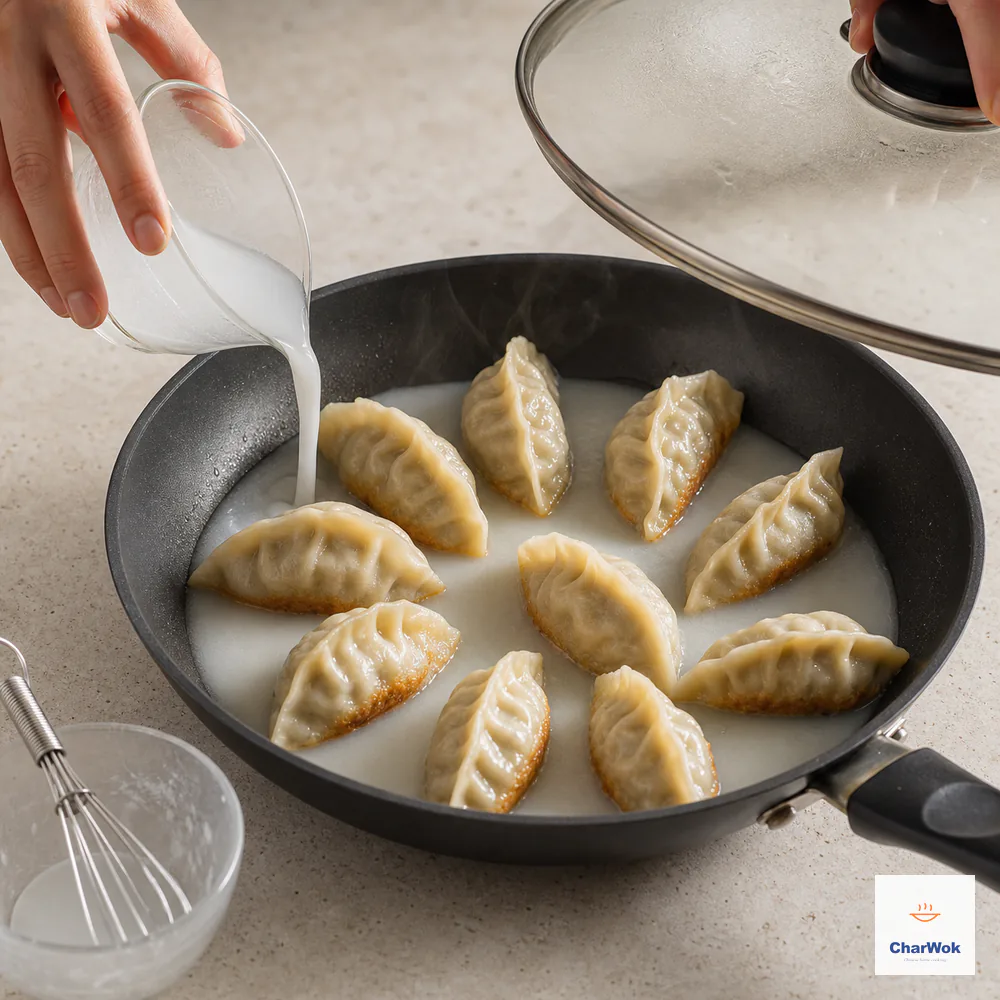
Re-whisk the flour-cornstarch slurry, pour it around rather than over the dumplings to about one-third of their height, and cover immediately.
- Steam on high until the water is nearly gone. Keep the heat high. You are boiling off the water while the starch gelatinizes into a sheet along the bottom of the pan. This takes about 5 minutes. Listen: a steady sizzle means there is still water; a quieter, crackling sound means it is almost dry. Take the lid off when you can see the lace forming between the dumplings and only a thin film of liquid remains.
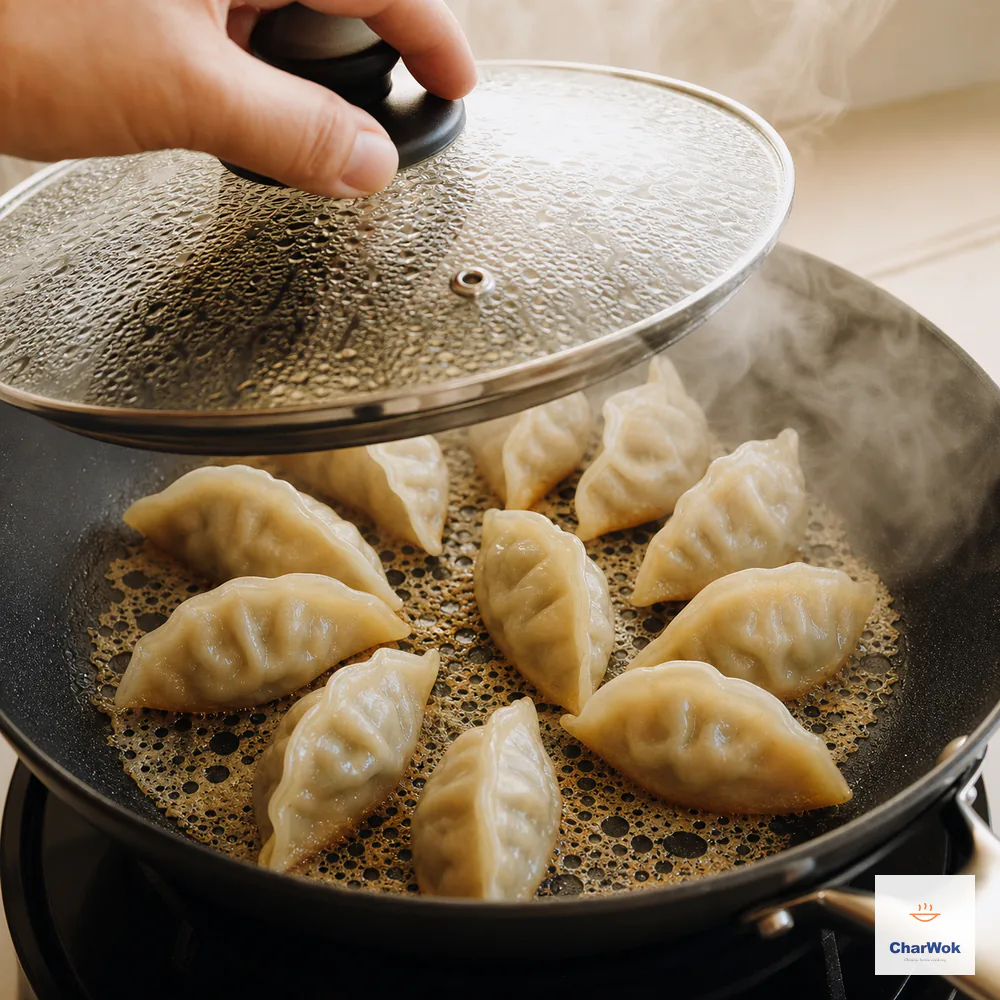
Keep the lid on over high heat until almost all water has evaporated and the slurry changes from a puddle into a connected lace network.
- Dry the lace, 30 seconds. With the lid off, let the last moisture cook off so the starch sheet goes from translucent and rubbery to golden and crisp. Watch closely; the line between "perfect" and "burned" is about 20 seconds. The vinegar helps here by slowing browning slightly, buying you a wider window.
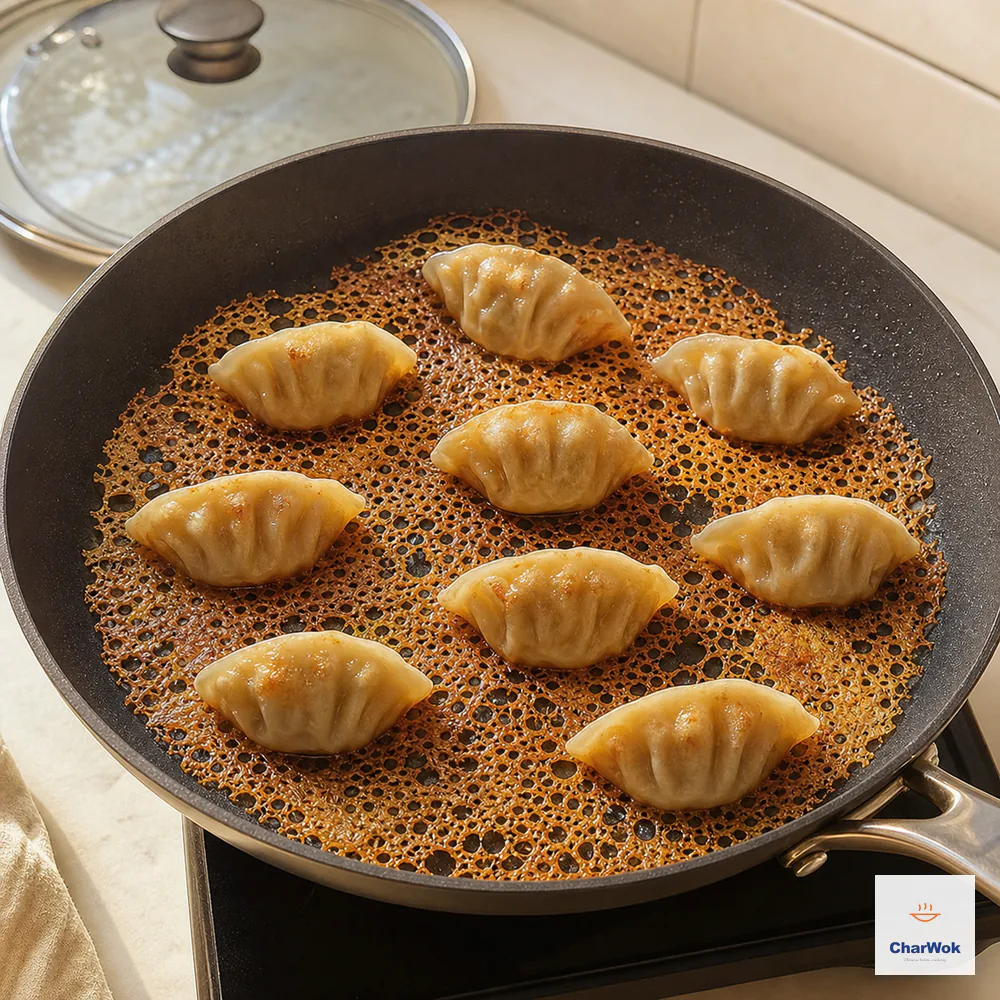
Remove the lid only when the water is nearly gone, then cook for about 30 seconds more until the entire skirt is dry, deep golden, and crisp.
- Flip onto a plate. Put a serving plate over the pan, invert the whole thing, and lift the pan away so the lacy sheet lands on top. If a dumpling sticks, slide it back onto the lace; a thin metal spatula will release it.
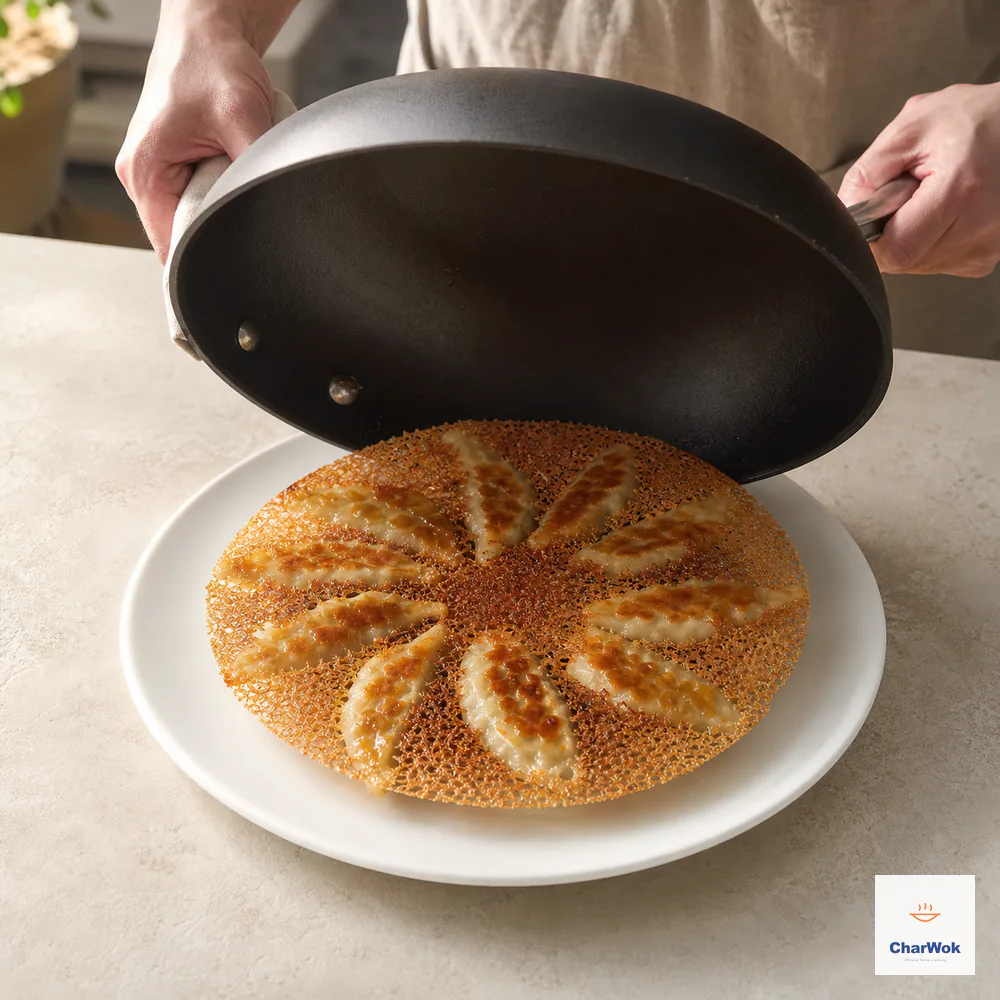
Cover the skillet with the serving plate, hold both securely, invert in one controlled motion, and lift the pan so the intact lace faces upward.
Serve right away, while the lace is still audibly crisp. It softens within minutes, and there is no way to bring it back once it goes. This is a cook-and-eat dish, not a hold dish.
When things go wrong
The skirt is a fussy thing and I have wrecked it in every way possible. Here are the failures I see most often and what actually fixes them.
- The lace tears into separate islands instead of one sheet. The slurry was too thin or you used too little. Add another ½ tsp of flour next time. Also check that the dumplings are close enough to nearly touch; if they sit far apart, the lace has nothing to bridge.
- The lace is thick and leathery, not lacy. Too much flour, or you did not dry it long enough at the end. Drop the flour to ¼ tsp and make sure you cook off the last of the water with the lid off.
- The whole thing sticks to the pan and will not release. Either the pan was not hot enough before the oil, or you tried to flip before the lace was fully dry. A stuck skirt means the starch was still gel and not yet crisp. Next time, wait those extra 20 seconds. A well-seasoned or nonstick pan is not optional for beginners here.
- The dumplings blow out at the seam. You overfilled, or you sealed the corners tight instead of leaving them open. Use less filling and leave the vents.
- The filling is dry and crumbly. You used breast and did not beat in extra water. Switch to thigh, or add water a tablespoon at a time while mixing until the paste turns sticky.
- The wrapper is tough and rubbery. You used bread flour, or skipped the second rest. Stick to all-purpose and give the dough its hour.
Variations and pairings
The chicken-and-corn filling is friendly to swaps. Replace the corn with water chestnut for crunch without sweetness, or fold in a teaspoon of doubanjiang for a spicy version. A pinch of five-spice powder in place of the Sichuan pepper pushes the filling toward a warmer, roast-y flavor that pairs well with a soy-vinegar dip.
If you would rather skip the chicken entirely, the open-corner fold and the skirt technique work on any filling. Try them with pork and chive, the classic pork and napa cabbage combination, or a vegetarian version. The same pan method also produces the crisp bottom on pan-fried pork buns (sheng jian bao), minus the lace.
For dipping, a simple mix of black vinegar, soy, and a spoon of chili oil is all you need; the dumpling sauce recipes cover six variations if you want more. On the side, a bowl of chicken and corn soup turns the dumplings into a full meal, and the sweet corn in both echoes nicely without being repetitive.
Make ahead and freeze
Assembled, uncooked potstickers freeze beautifully. Lay them out so they do not touch (on a flour-dusted or parchment-covered sheet) and open-freeze them until firm, then tip them into a sealed bag or tub for up to three months. Cook them straight from the freezer; letting them thaw only makes the wrappers crack and weep. The cook-off is the same, with one tweak: loosen the slurry with a splash more water and give the pan an extra minute under the lid.
The filling also keeps covered in the fridge for a day, and the dough rests happily overnight if wrapped tightly. If you want to spread the work over two evenings, make the dough and filling on day one and roll and fold on day two. Leftover cooked potstickers reheat well in a dry skillet over medium heat to re-crisp the bottom; the microwave will ruin them.
Frequently asked questions
See how this dish sits among other ways to cook dumplings across Chinese cooking, and keep the leftover chicken thigh for a quick stir-fry the next day.