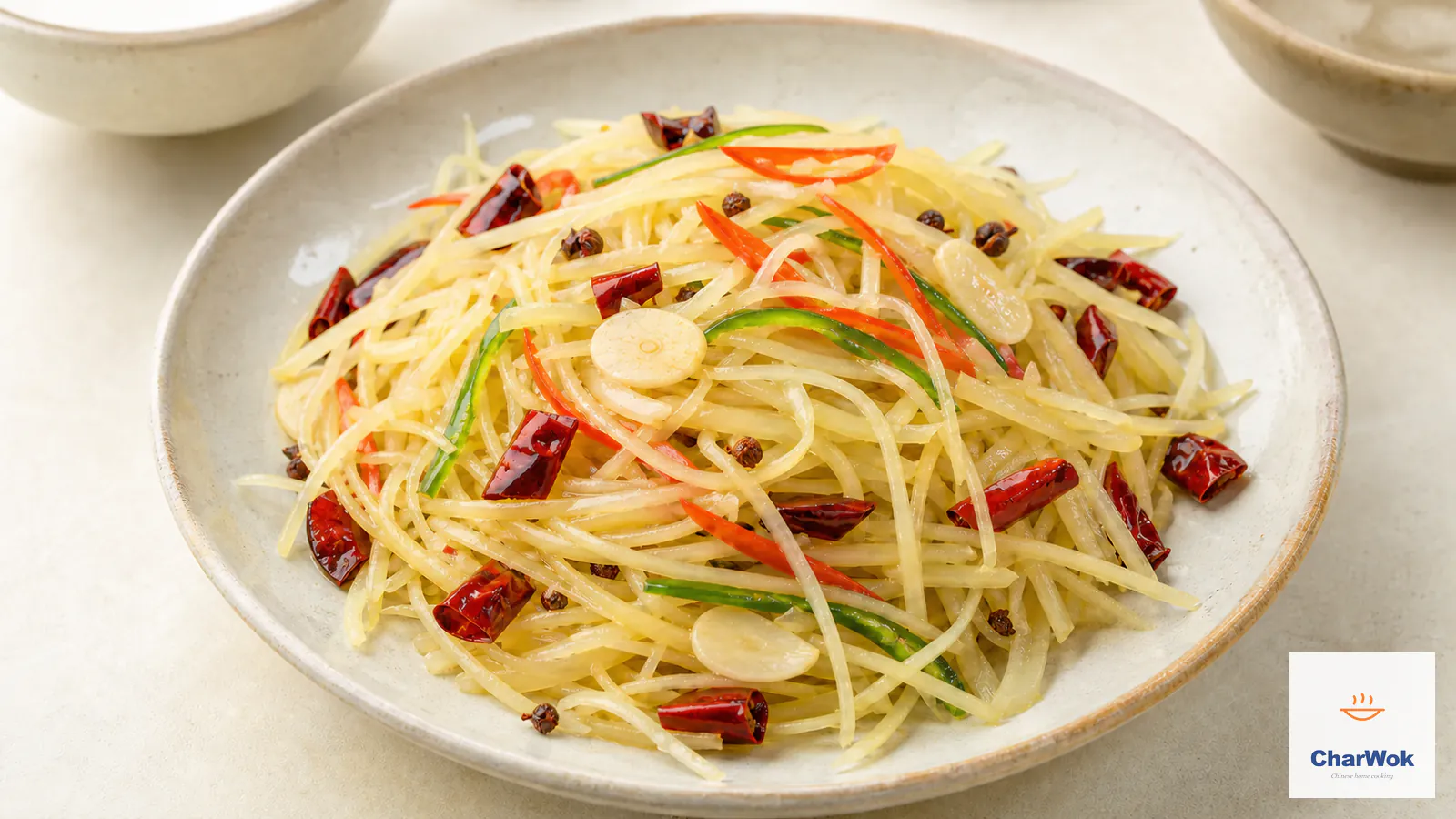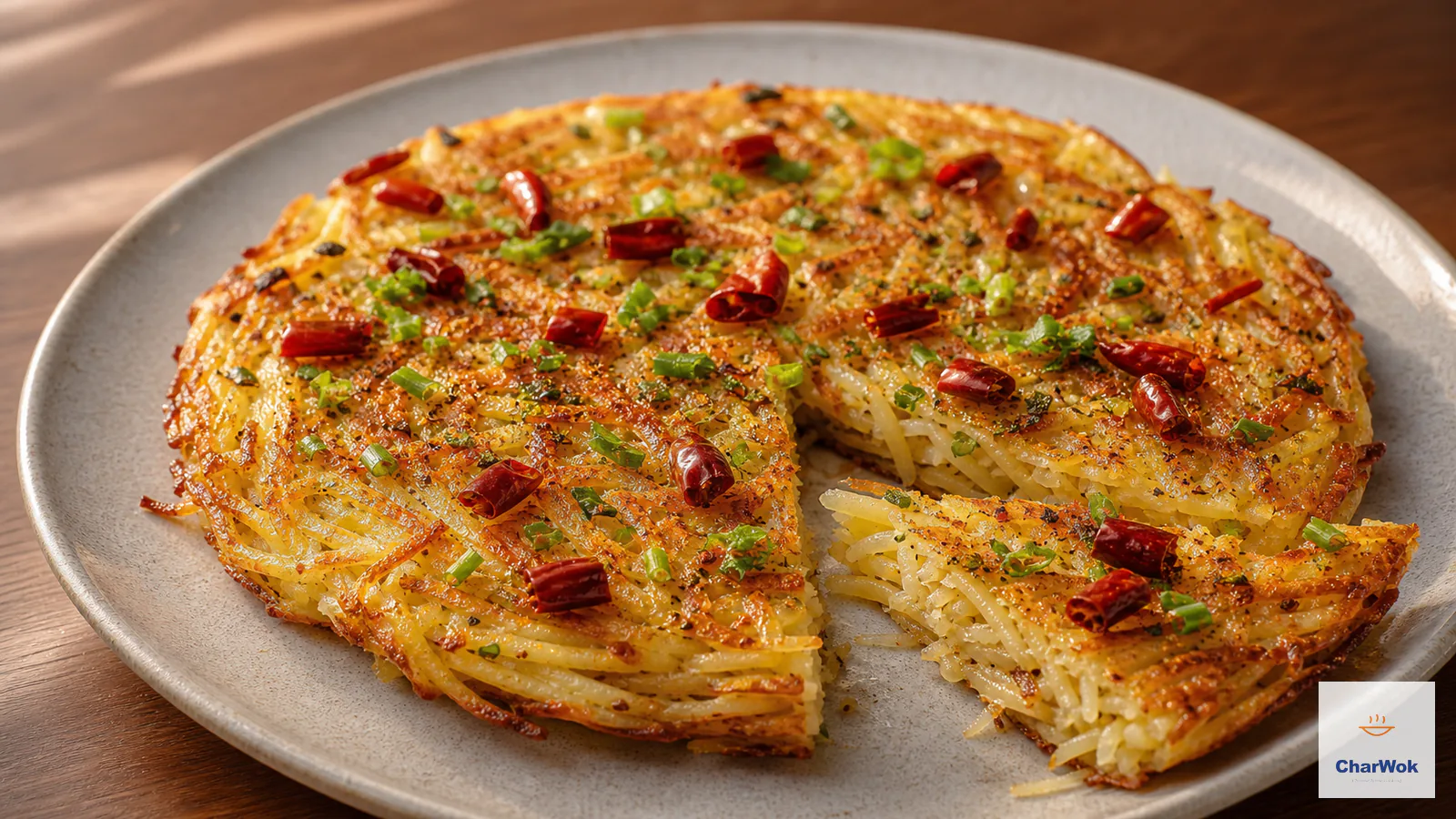
Most home cooks meet julienned potatoes through the quick hot-and-sour potato stir-fry, where the shreds stay loose and crunchy. Gan Bian Yang Yu Si (干煸洋芋丝) goes the other way. You pile the shreds into a hot pan and let the starch do the work until they fuse into one lacy, crisp cake lacquered with chili oil and ground Sichuan pepper. It is the dish I order first at any Yunnan grill house, and it is the dish I burnt to a black disc the first three times I tried it at home.
The trick is that the thing which ruins a stir-fry, surface starch, is exactly the thing this pancake depends on. Keep the starch, keep the shreds thin, hold the cake flat, and the whole thing behaves. That reversal is the whole recipe.
At a glance: Keep the starch on the shreds, do not rinse. Cut them thin as a matchstick. Medium heat, a scant 7 ml (½ tablespoon) of oil per pancake, and press flat once the strands soften. About 4 minutes per side for a deep, even mahogany crust. Russet or Idaho; never waxy. Four thin pancakes from 400 g of potato.
What this dish is, and where it comes from
The name translates plainly as "dry-fried potato strips." Gan bian (干煸) is a southwest Chinese technique, shared across Sichuan and Yunnan, in which an ingredient is pan-fried in very little oil until its moisture cooks off and its surface browns. You see it in the famous Sichuan dry-fried green beans, and in tiger-skin peppers, where the blistered, slightly charred skin is the entire point. Potatoes get the same treatment, with two possible endings: loose shreds in a stir-fry, or one fused cake, which is what we are making.
Yunnan cooks lean hard on dried chilies and roasted Sichuan pepper; northern Sichuan versions add a dusting of cumin. Both are correct. The pancake is meant to sit on the table as one of several cold-and-spicy plates alongside a meal, the way you would serve mala peanuts or a plate of spicy lotus root. Eaten with rice and a plain vegetable, it cuts through everything around it.
Pick the right potato, or accept a soggy middle
Use a floury, high-starch potato. Russet, Idaho, or Maris Piper. The starch granules on the cut surface are what weld the shreds into a single cake when heat hits them, the same gelatinization that holds a zucchini pancake together once the egg sets, except here there is no egg and no binder. The potato is the binder.
Do not use waxy potatoes. Red Bliss, new potatoes, fingerlings, the thin-skinned "boiling" potatoes. They hold too much water and too little starch, and the cake will steam itself apart instead of crisping. I learned this the expensive way, with a cake that slid back into a pile of pale strands the moment I tried to flip it.
The starch question: rinse or not?
Not. This is the one place a home cook goes wrong, because every instinct and most recipes tell you to soak julienned potatoes. That rule exists for the loose potato stir-fry, where you want each strand to separate and stay pale. Here you want the opposite. The milky starch on a freshly cut potato is your glue. Cut, dry the shreds briefly on a cloth so they are not dripping, and into the pan they go.
Ingredients
Ingredients at a glance
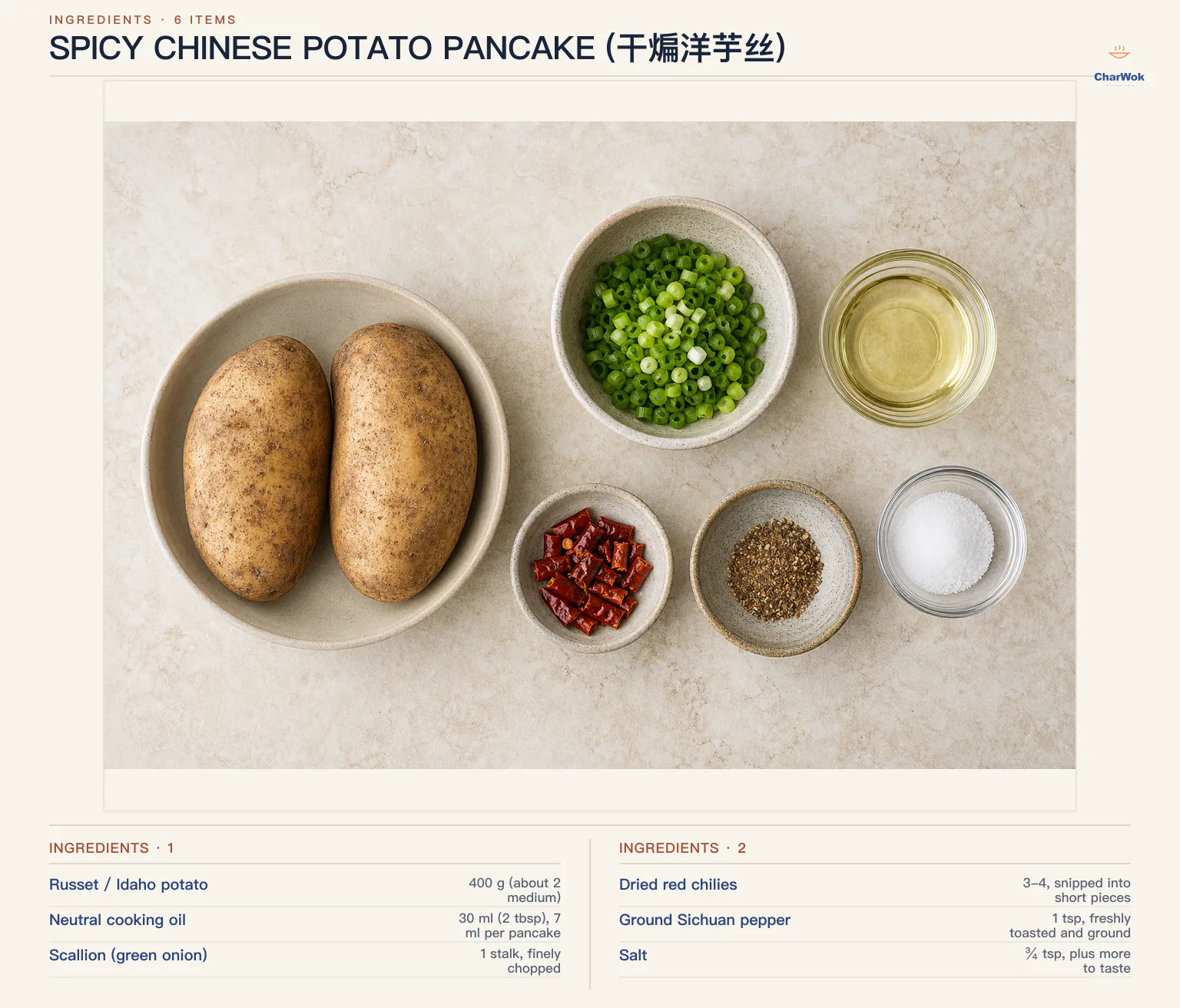
| Ingredient | Amount | Notes / substitute |
|---|---|---|
| Russet / Idaho potato | 400 g (about 2 medium) | Floury, high-starch. Avoid waxy varieties. |
| Neutral cooking oil | 30 ml (2 tbsp), 7 ml per pancake | Peanut, canola, or sunflower. |
| Scallion (green onion) | 1 stalk, finely chopped | Reserve a pinch of green for garnish. |
| Dried red chilies | 3-4, snipped into short pieces | Fresh bird's eye or Fresno, thinly sliced, if you prefer. |
| Ground Sichuan pepper | 1 tsp, freshly toasted and ground | See how to grind it; substitute ½ tsp toasted cumin for a northern profile. |
| Salt | ¾ tsp, plus more to taste | Add in two stages (see method). |
Method
- Cut the shreds as thin as you can manage. Peel the potato, slice it into 1.5 mm planks, then cut the planks into matchsticks of the same thickness. Thinner shreds soften faster and weld more readily than thick ones. A mandoline with a julienne blade is fine and faster than a knife; a box grater produces short, ragged strands that still work but give a less elegant cake.
- Do not rinse. Dry only. Spread the shreds on a clean cloth and pat once. They should feel damp with starchy water, not wet. Wet shreds lower the pan temperature and steam instead of fry.
- Heat the pan before the shreds go in. A 24 cm (10-inch) nonstick or well-seasoned cast-iron skillet, 7 ml of oil, medium heat. The oil should shimmer but not smoke, around 175-185°C (350-365°F). Add one quarter of the shreds, scatter a quarter of the scallion and chili, then dust with Sichuan pepper and a pinch of salt. The spice hitting hot oil is what blooms the aroma; adding it now, not later, is non-negotiable.
- Toss for 20 seconds, then stop touching it. Stir just long enough to coat the shreds in oil and distribute the seasonings, then spread them into an even, thin round, roughly 15 cm across. The cake has to be thin, no more than two shreds deep, or the middle stays pale and gummy while the bottom burns.
- Press and wait. Once the shreds soften and start to wilt, about 30-40 seconds in, press the whole round flat with a spatula and hold. You are gelatinizing the surface starch under pressure so it sets into a continuous crust. Leave it alone for 2.5 to 3 minutes. Nudge a corner; it should lift cleanly and show deep golden brown underneath.
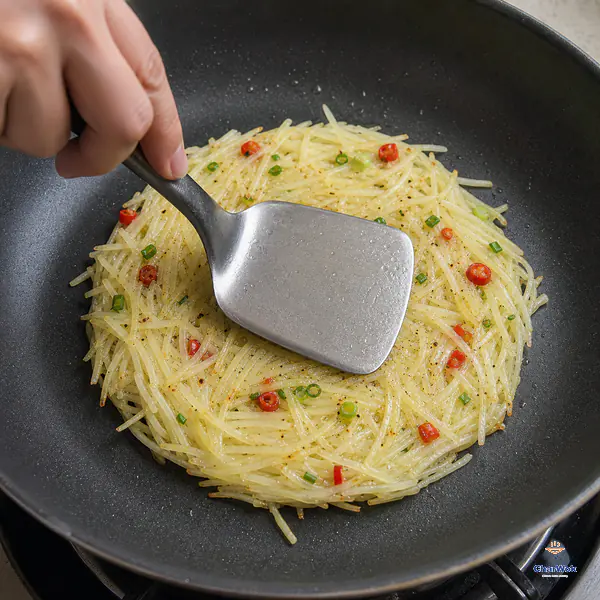
Once the shreds soften and their edges turn translucent, press the whole round firmly against the pan; keep it no more than two shreds deep so the surface starch can weld it into one crisp cake.
- Flip with confidence. If you have a nonstick pan and a thin cake, a confident wrist flip works. If anything, slide the cake onto a plate, invert the pan over it, and turn the whole thing over. Cook the second side another 2.5 to 3 minutes, pressing once more. The crust should be evenly dark, not pale-blonde.
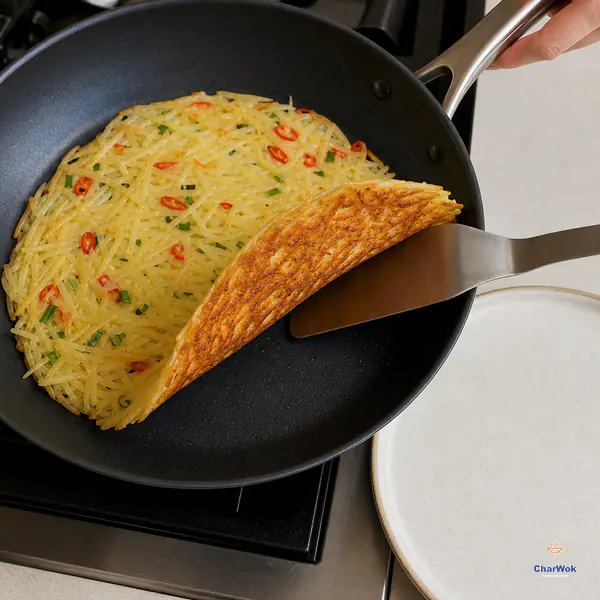
Do not flip until the cake slides as one piece and a lifted edge shows a deep, even golden crust; if needed, slide it onto the nearby plate and invert it back into the pan.
- Drain briefly, season the second time, repeat. Move the cake to a rack or paper towel. While it is still hot and the surface is slightly tacky, hit it with one more small pinch of Sichuan pepper and salt. This top-up seasoning is what makes the difference between a bland potato and the version that makes you reach for beer. Repeat for the remaining three pancakes.
When it goes wrong
The cake falls apart on the flip. Either the shreds were too thick, the layer too deep, or you flipped too early. The crust needs to fully set before it can support its own weight. Wait until the edges lift on their own and the underside is genuinely brown, not just colored. A too-thick cake will never hold together; spread it thinner next time.
The middle is raw while the bottom is black. Heat too high, or the layer too thick. Drop to medium-low and let the cake ride longer. The crust develops over minutes, not seconds.
The cake is greasy and limp, not crisp. Too much oil, or the shreds went in wet. Use less oil than feels comfortable and trust the pan. The finished cake should leave almost no oil behind on the plate.
It tastes flat. You salted once, at the start. The double seasoning, once in the pan, once on the hot finished cake, is what makes the spice sit on the surface where you taste it. The Sichuan pepper should also be freshly toasted and ground; pre-ground powder from a jar has lost most of its numbling zing.
Variations and what to serve it with
The most useful swap is the spice profile. Cumin in place of Sichuan pepper pushes the dish toward the northern, Xinjiang-adjacent style and pairs it naturally with cumin lamb and flatbread. A spoon of chili oil stirred into the pan at the end gives a glossy, restaurant-style finish. Five-spice is a milder route, closer to five-spice potatoes, and good if you are feeding people who want warmth without heat.
Texture-wise, fold a small handful of finely julienned carrot or bell pepper into one cake for color, the way Di San Xian mixes potato with eggplant and pepper. A scattering of toasted sesame on the finished cake adds a nutty note that dry-fried dishes like this and dry-pot cauliflower take well.
For a meal, treat it as a side or a snack plate, not a main. It sits happily next to plain rice, a stir-fried green, and almost anything in the Sichuan repertoire. For a quick weeknight, I will often make two of these pancakes alongside a fast one-dish dinner, or fold wedges of leftover cake into summer meals the way you would any cold, spicy plate, especially in the kind of weather that suits lighter summer dishes.
Storage and reheating
These are best eaten within ten minutes of leaving the pan; the crust softens as it sits. Leftovers will keep, covered, in the fridge for two days. Do not microwave them, that turns the crust rubbery. Reheat in a dry skillet over medium heat for about 90 seconds per side, or in an air fryer at 190°C (375°F) for 4 minutes, and most of the crunch comes back.
FAQ
Can I make one big pancake instead of four small ones?
You can, but it is harder. A larger cake needs a wider pan, a longer cook on each side, and a more confident flip. Four thin 15 cm cakes are more reliable for a home cook and give you more crust per bite, which is the best part.
Do I have to use Sichuan pepper?
No, but you lose the dish's signature numbing warmth. Toasted cumin is the standard alternative and gives a smoky, northern flavor. Plain chili and salt will still taste good, just flatter.
Why did my potato turn gray after cutting?
Oxidation. Cut potatoes discolor within minutes when exposed to air. It is harmless and the color disappears entirely once cooked, but if it bothers you, keep the shreds submerged and drain them just before frying, then accept that you will lose some surface starch in the process.
Is there a way to make it less oily?
Use a nonstick pan and the full 7 ml of oil per cake; going below that risks sticking. To finish, drain each cake briefly on a rack rather than a paper plate, so steam does not soften the underside.