Liang pi (凉皮), or "cold skin noodles," is the dish that taught me to respect a bowl of flour and water. The first time I made it, I whisked the batter, dumped it straight into a hot pan, and ended up with a gummy, tear-prone sheet that tasted like uncooked paste. What I had skipped was the one step that separates a real liang pi from a sad pancake: letting the flour settle overnight so the starch sinks and the water floats, then pouring most of that water off. Do that, and you get a noodle with the bouncy, almost gel-like chew you pay street vendors for. Skip it, and you get wallpaper paste.
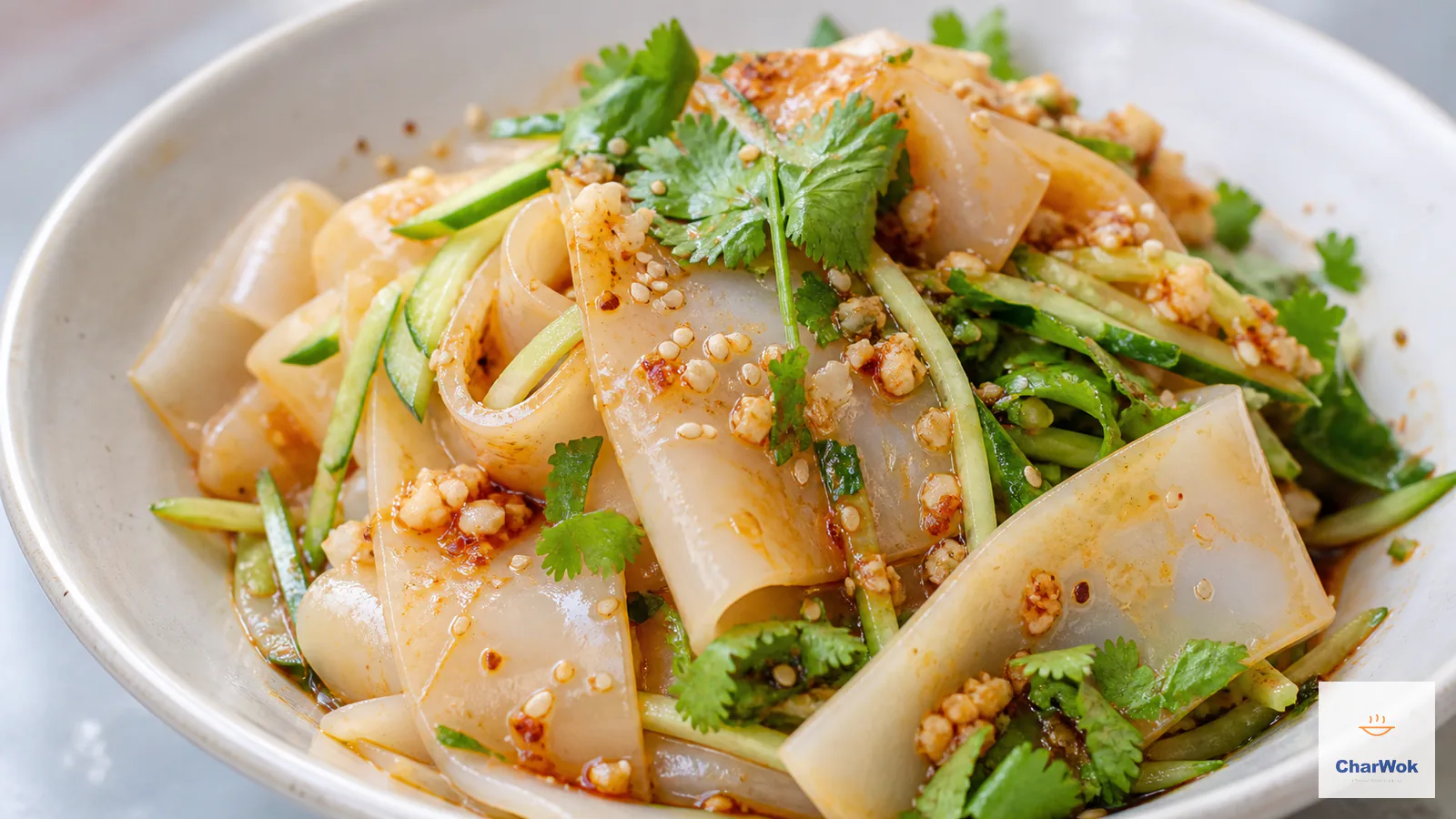
The soul of liang pi is texture, not flavor. The flavor is carried by a spiced vinegar sauce and a spoonful of chili oil you add at the end. What you are building here is a translucent wheat-starch sheet that snaps back when you bite it, stays slippery when cold, and holds a slick of sauce in its wrinkles. Get the sheet right and the rest of the dish almost makes itself.
At a glance. 300 g flour to 700 ml water, settled 8+ hours in the fridge, then most of the clear water poured off. Steam each sheet 2 minutes, shock in cold water, stack with oil. The single most common failure point is too-thick batter; aim for the consistency of heavy cream.
What liang pi actually is, and where the "skin" comes from
Liang pi is a Shaanxi street snack, sold from carts in Xi'an and copied across northern China, with a strong second life in the cold-case aisles of every Sichuan and Chongqing noodle shop. It is not the same thing as liang fen, the mung-bean jelly noodles that share the "liang" (cold) in the name, and it is not a rice noodle. The sheet is pure wheat starch, gelatinized by steam into a smooth, glassy band.
The "skin" in the name refers to the way each noodle is cooked one sheet at a time, floating on a bath of boiling water inside a shallow metal tray. That is the traditional method, and it is also the one I am giving you here because it works on a home stove with equipment you already own. There is a more "authentic" version where you knead a dough, wash the starch out of it by hand, and turn the leftover gluten into chewy mian jin to serve on top. I am leaving that out on purpose. The washed-dough route is finicky in a home sink, and the floating-tray batter method gives you 90% of the texture for 20% of the effort.
Ingredients
Ingredients at a glance
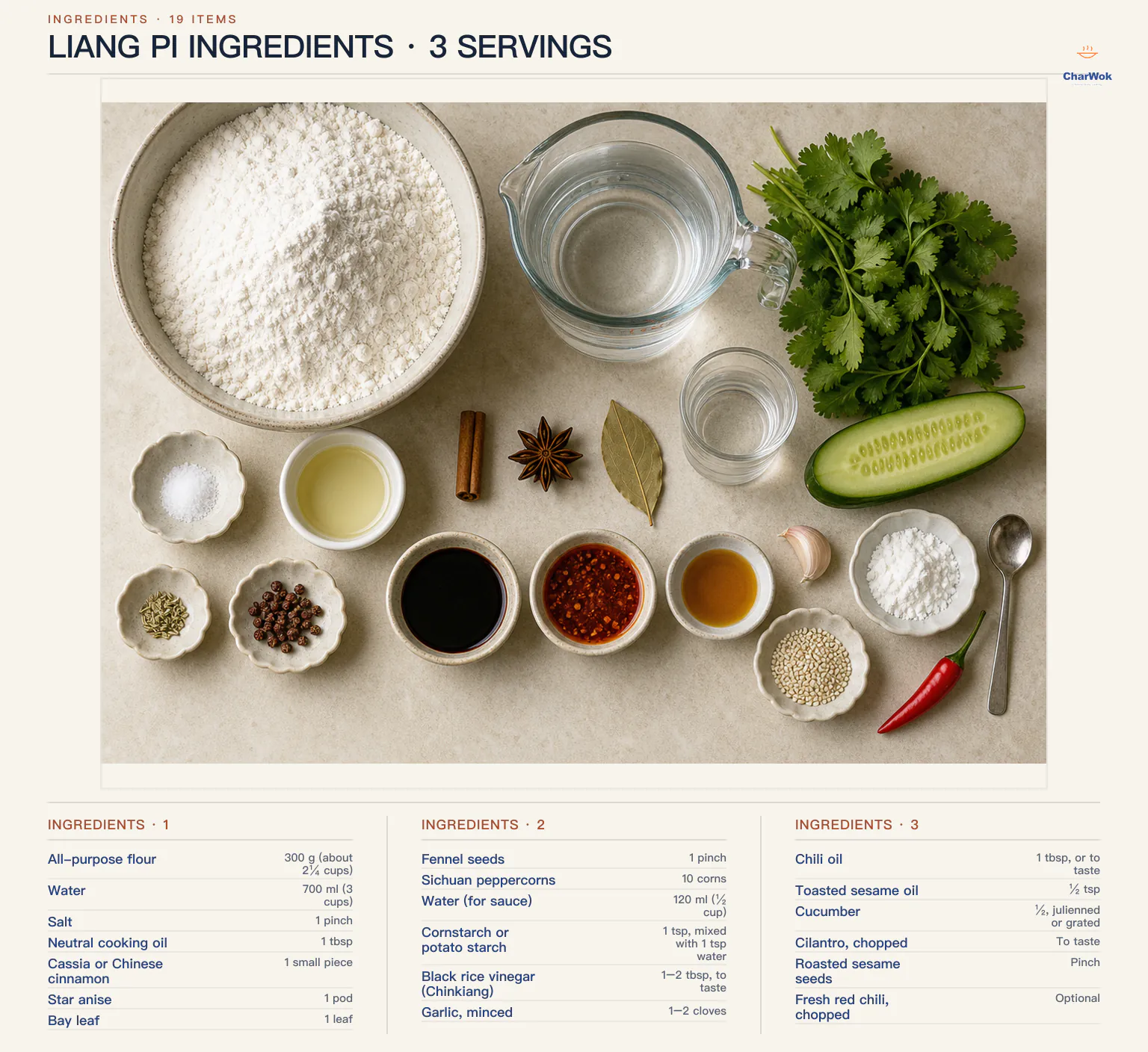
The noodles themselves are three things: flour, water, salt. Everything else is sauce and topping. I use US all-purpose flour, not bread flour; you want the protein modest so the sheet stays tender rather than turning rubbery. If you have access to actual wheat starch (look for it labeled "wheat starch" or deng mian in a Chinese grocery), you can skip the settling step entirely, but most home cooks will not, so the recipe below assumes all-purpose flour.
| Ingredient | Amount | Notes / substitute |
|---|---|---|
| All-purpose flour | 300 g (about 2¼ cups) | US AP flour works. Do not use bread flour; the sheet turns tough. |
| Water | 700 ml (3 cups) | Tap water is fine. Cold from the fridge is easier to control. |
| Salt | 1 pinch | Tightens the starch gel slightly. |
| Neutral cooking oil | 1 tbsp | For greasing the tray between sheets. Use canola or grapeseed, not a strong oil. |
| For the spiced vinegar sauce | ||
| Cassia or Chinese cinnamon | 1 small piece | Whole stick, broken. Cassia is the standard Chinese grocery cut. |
| Star anise | 1 pod | Whole. See five-spice powder if you want to understand the family. |
| Bay leaf | 1 leaf | Any bay leaf works. |
| Fennel seeds | 1 pinch | Whole, lightly crushed. |
| Sichuan peppercorns | 10 corns | Adds the low hum of numbing warmth. Read up on the pepper if it is new to you. |
| Water (for sauce) | 120 ml (½ cup) | |
| Cornstarch or potato starch | 1 tsp, mixed with 1 tsp water | Thickens the sauce so it clings to the noodles. |
| Black rice vinegar (Chinkiang) | 1–2 tbsp, to taste | This is the defining acid. Black rice vinegar has the smoky depth white vinegar cannot match. |
| Garlic, minced | 1–2 cloves | Added off the heat, raw, for bite. |
| To finish | ||
| Chili oil | 1 tbsp, or to taste | Chiu Chow chili oil gives a crunchier, fruitier result; a plain jar is fine too. |
| Toasted sesame oil | ½ tsp | A few drops. Toasted sesame oil is aromatic, not a cooking fat. |
| Cucumber | ½, julienned or grated | Cool crunch against the heat. |
| Cilantro, chopped | To taste | |
| Roasted sesame seeds | Pinch | Optional. |
| Fresh red chili, chopped | Optional | Skip if serving kids. |
The method, with the reasoning behind each step
- Make the batter and let it settle, 8 hours or overnight. Whisk the flour, water, and salt until smooth, then pour it through a fine sieve into a bowl to catch any flour lumps. Cover and refrigerate. What happens in the fridge is the whole trick: wheat starch is heavier than water, so over hours it sinks into a dense white layer while a pool of clear liquid rises above it. If you skip this, the solids never concentrate and your sheet steams up soft and tearable instead of bouncy. Eight hours is the floor; overnight is better.
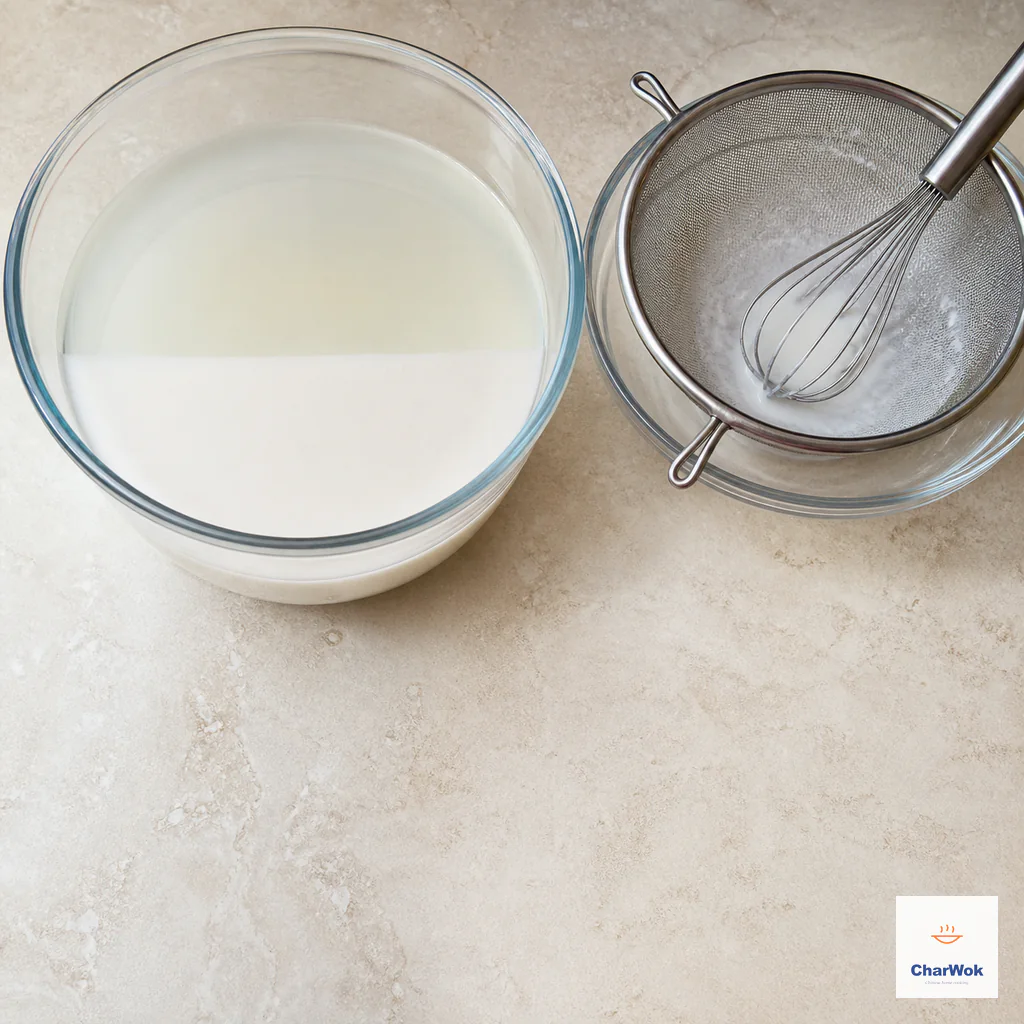
Whisk the flour, water and salt completely smooth, strain, cover and refrigerate at least eight hours until the starch forms a dense white layer.
- Pour off the clear water, but not all of it. Take the bowl out and you will see the two layers. Carefully spoon or pour off the clear water until you can see the white starch below, then stop. You are leaving just enough liquid that, once stirred, the batter moves like heavy cream. Too much water left behind and the sheet will be fragile; too little and it will be thick and cloudy. Stir the settled starch back into the remaining water very thoroughly, scraping the bottom, because the dense layer resists mixing.
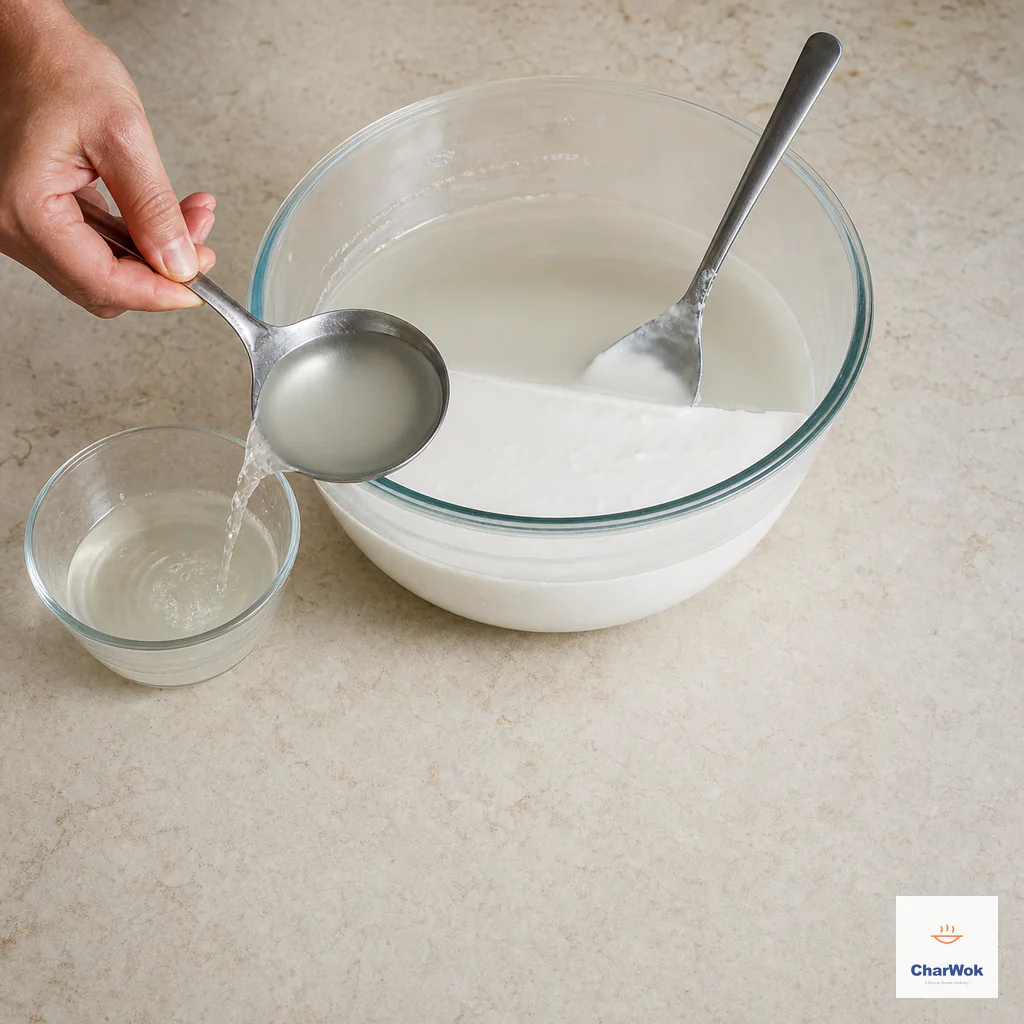
Lift away only the clear upper liquid and stop before reaching the starch, then remix the remaining heavy-cream batter thoroughly.
- Oil a light, shallow tray. Use a small metal baking sheet or a cake-pan lid; anything thin and flat that will float on a wok of boiling water. Brush a thin film of neutral oil across the bottom. The oil is the only thing standing between your noodle and the pan, so do not skimp, but do not pool it either or the batter slides into a corner.
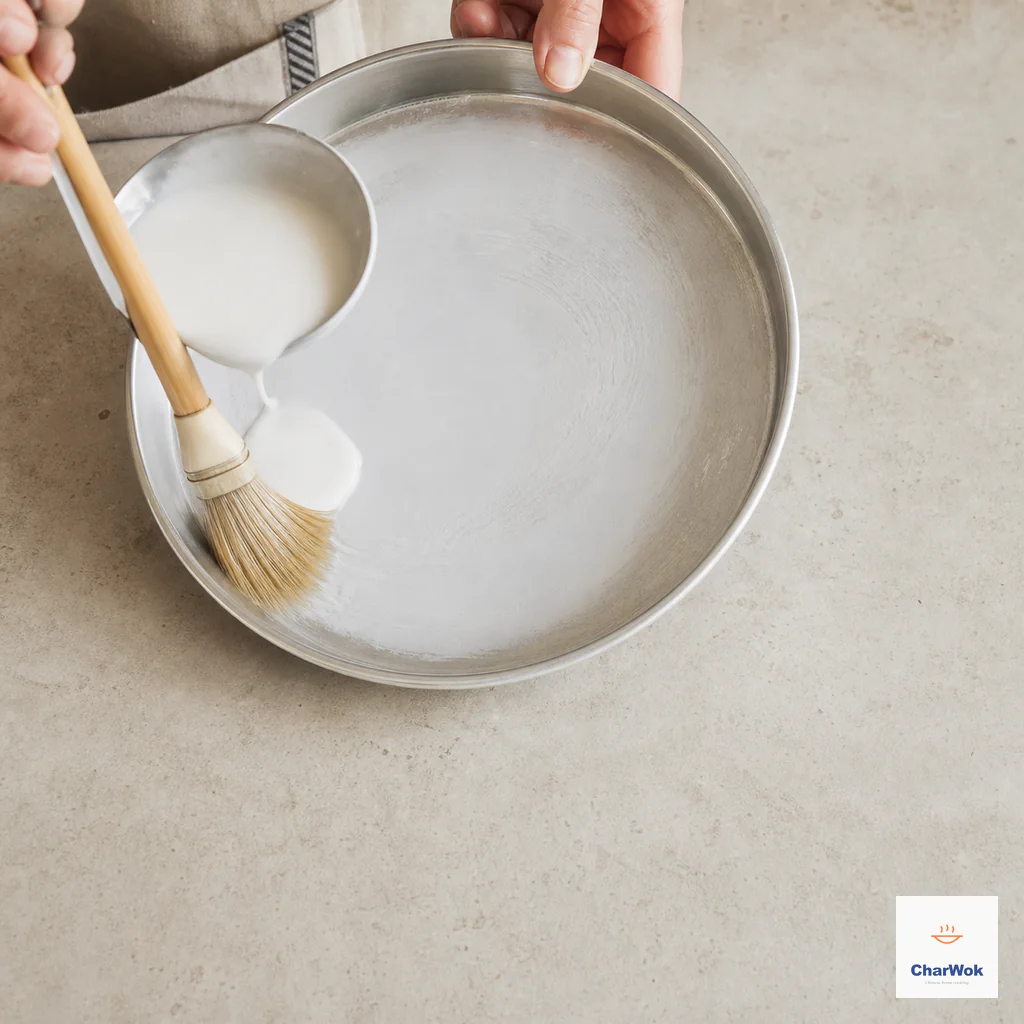
Use a flat, light, shallow tray; brush on very little oil and tilt the batter into one thin even layer.
- Pour a thin layer of batter and float the tray on boiling water. Bring a wok or deep skillet of water to a full boil over high heat. Pour just enough batter into the tray to cover the bottom in a thin, even film, then set the tray gently onto the water so it floats. Cover with a lid. You are steaming, not boiling; the sheet cooks by the steam trapped under the lid plus the heat conducted through the thin metal. Steam about 2 minutes, until the surface is no longer liquid and large bubbles puff up across it. Those bubbles are the sign the starch has fully gelatinized.
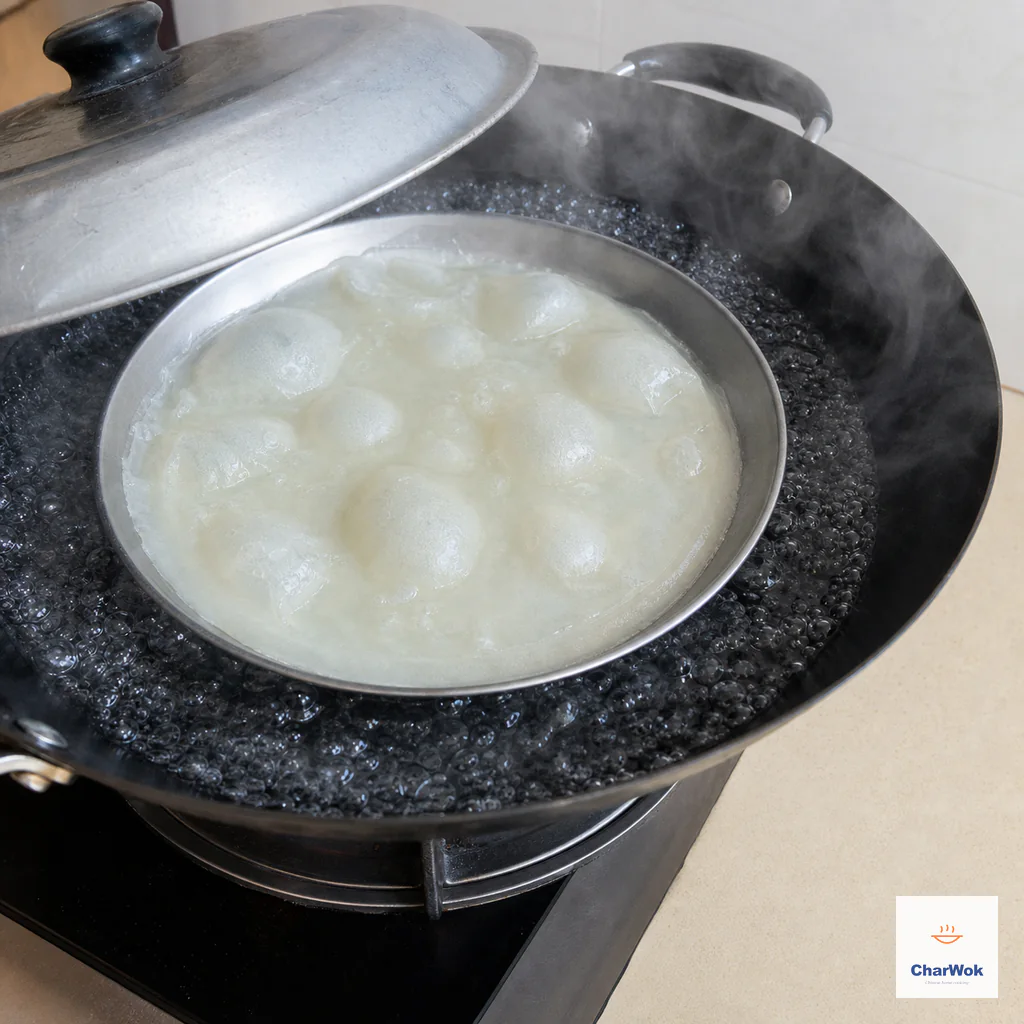
Float the tray on fully boiling water, cover for about two minutes and wait for large puffs, translucency and a non-sticky surface.
- Cool the tray on cold water before peeling. Lift the tray off and float it on cold water in the sink for about 30 seconds. This halts the cooking and shrinks the sheet slightly so it releases cleanly. Peel the sheet off with your fingers and lay it on a board. Brush the top with a little oil so the next sheet will not stick to it when you stack them. Repeat with the rest of the batter, stirring the bowl before each pour because the starch settles again fast.
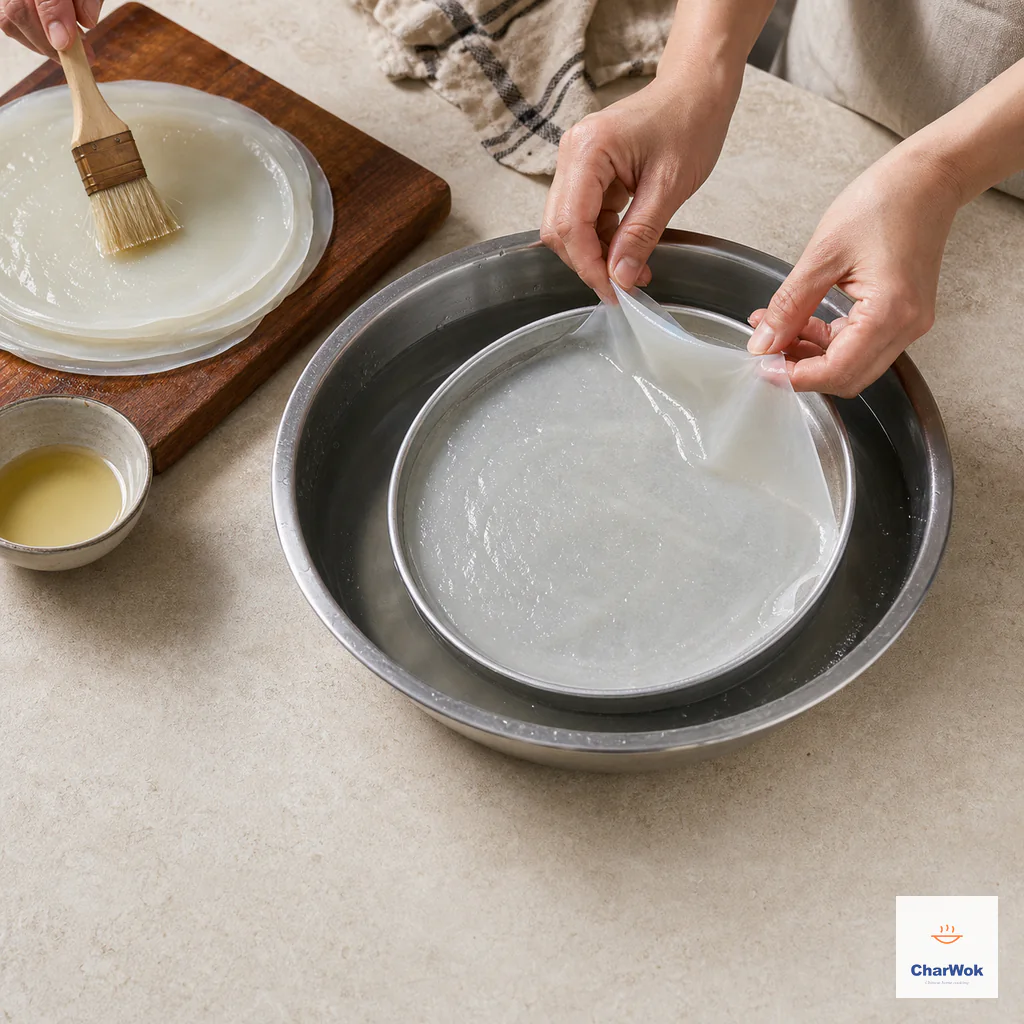
Cool the tray briefly on cold water, peel away the whole sheet and brush its top with a very thin oil film before stacking.
- Make the spiced vinegar sauce. Combine the cinnamon, star anise, bay leaf, fennel, Sichuan peppercorns, and 120 ml water in a small saucepan. Simmer 5 minutes to pull the aromatics out of the spices, then stir in the cornstarch slurry and cook just until it thickens to a light syrup. Pull it off the heat. Once fully cool, strain out the whole spices and stir in the black rice vinegar and minced garlic. Adding the garlic and vinegar off the heat keeps their sharp, fresh notes intact; boil them and the sauce goes flat.
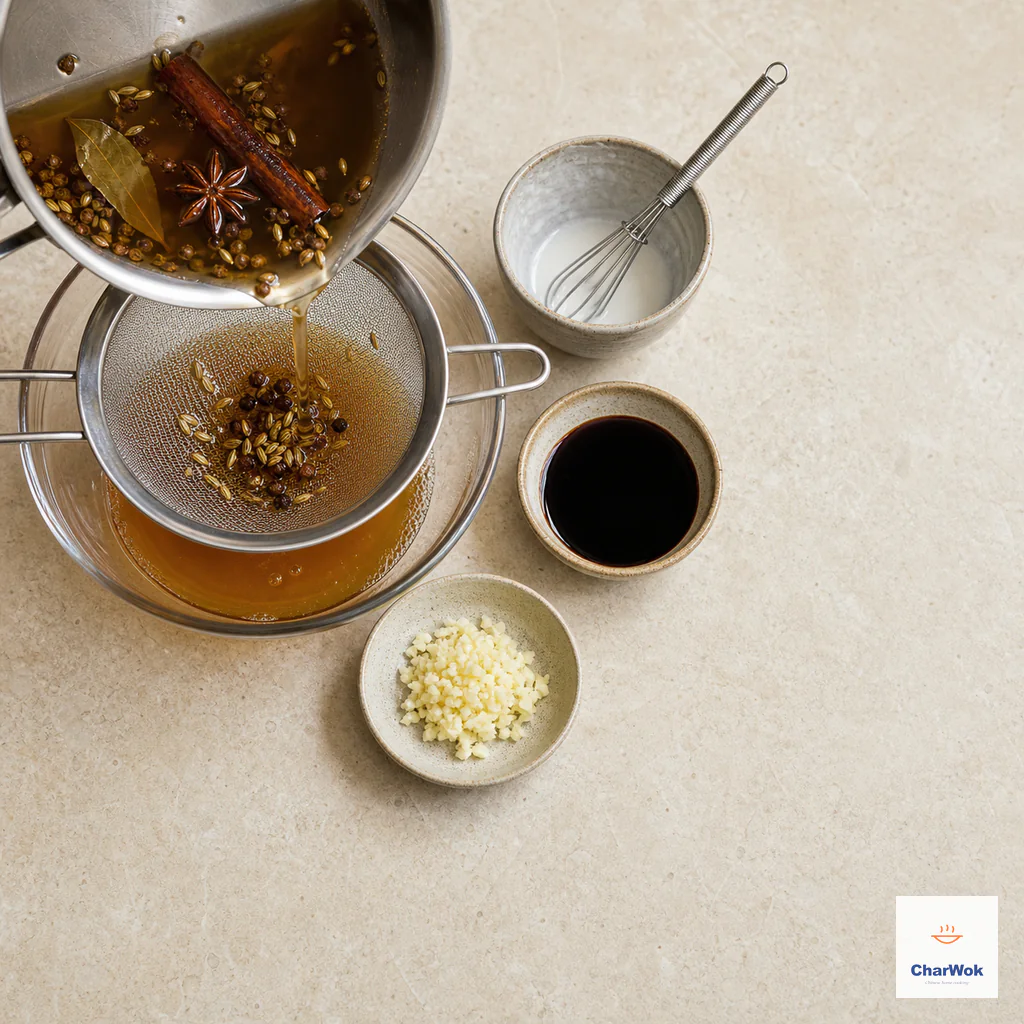
Simmer the whole spices for five minutes, thicken lightly with slurry, then strain and cool completely before stirring in black vinegar and raw garlic.
- Cut, dress, and serve cold. Slice the stacked sheets into strips as wide or narrow as you like. Pile them in bowls, top with cucumber, cilantro, fresh chili, and sesame seeds, then pour on the cooled sauce, a spoonful of chili oil, and a few drops of sesame oil. Toss at the table so the noodles stay slippery.
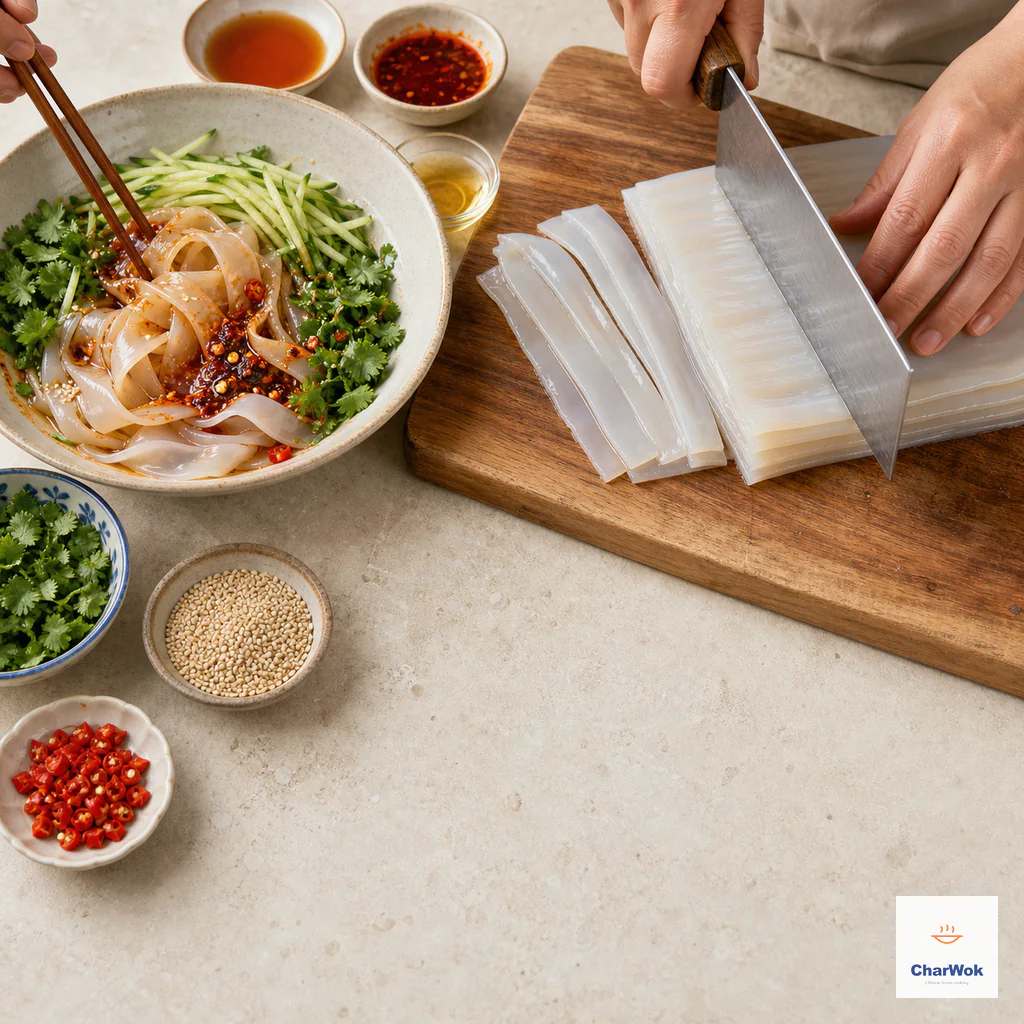
Cut the stacked sheets into ribbons, add the fresh toppings and cooled sauce, then toss with chili oil and toasted sesame oil just before serving.
Where it goes wrong, and how to fix it
I have made every one of these mistakes, most of them more than once.
The sheet tears when you peel it. Either the batter was too thin (too much water left after settling) or you did not cook it long enough. The surface should look dry and bubbly, not wet in the center. Add a minute next time, or pour a slightly thicker layer.
The noodle is gummy and pasty in the mouth. You did not let the batter settle long enough, or you did not pour off enough of the clear water. The fix is patience: a full overnight rest and a careful pour-off solve 90% of texture complaints.
The sheet is cloudy and brittle instead of translucent. Overcooked, or the tray sat in the steam too long after the bubbles formed. Pull it the moment the surface sets.
Sheets stick together in the stack. You skipped the oil brush between sheets, or the oil film was uneven. A silicone pastry brush fixes this in seconds.
The tray sinks instead of floating. The water in the wok is not deep enough, or the tray is too heavy. You want the water to come most of the way up the outside of the tray but never over the rim. Top off with boiling water from a kettle between sheets to keep the level steady.
Variations and what to serve alongside
The classic Xi'an version tops the noodles with sliced mian jin, the chewy wheat-gluten sponges left over from the washed-dough method. You can buy cooked mian jin in some Chinese grocers and add it cold; it is not required, but it does give the bowl a second, chewier texture layer.
If you want a sesame-heavy, less acidic take, steal a move from sesame noodles and loosen a spoonful of Chinese sesame paste with warm water, then swirl it through the bowl along with the vinegar sauce. The sesame rounds out the sharpness and turns the dish richer. A spoonful of smashed cucumber on the side, or any of the three-way cucumber salads, makes the bowl feel like a full meal.
For a full cold-noodle spread, liang pi sits happily next to cold Sichuan noodles, the glass noodle salad, or a plate of Bang Bang chicken. If you want heat but no chili oil, a spoonful of the sauce from Dan Dan noodles or the aromatic base of Chongqing xiao mian stirred in changes the whole register toward numbing-spicy.
One substitution worth knowing: if you cannot face steaming sheets on a weeknight, this same sauce dresses almost any cold noodle. It is excellent over the alkaline noodles you can make ahead, and it is the same family of cold, sauced, chili-oiled bowl that runs through the classic Chinese noodle recipes.
Storage and reheating
Steamed sheets keep, stacked with oil and wrapped, in the fridge for up to three days. The texture actually firms up and improves on day two. Keep the sauce separate from the noodles until the moment you serve, because once dressed the sheets soften and the cucumber weeps. Liang pi is a cold dish; do not reheat the sheets, or they turn opaque and rubbery. If they have stuck together in the fridge, a brief rinse under cold water and a toss with a few drops of oil brings them back.
FAQ
Can I skip the overnight rest? Not really. The settling is what concentrates the starch. If you rush it, you get a soft, tearable sheet. Two hours in the fridge is the absolute minimum before quality drops sharply.
Why float a tray instead of steaming in a regular pan? The thin metal tray conducts heat fast and evenly, and floating it on boiling water keeps the temperature rock-steady. A heavy pan works, but the bottom of the sheet overcooks before the top sets.
Is there a gluten-free version? Yes. Buy pure wheat starch and skip straight to the steaming step, no settling needed. Rice flour will not give the same chew; it makes something closer to cheung fun, which is delicious but is a different dish.
Can I make it less spicy? Easily. Cut the chili oil to a teaspoon, drop the fresh chili, and lean harder on the sesame and vinegar. The dish is built to be tuned at the table.
The one thing to remember
If you walk away with a single instruction, let it be this: settle the batter long enough, and pour off enough of the clear water. Every other step is forgiving. That one is not. Do it and you will have the bouncy, slippery, sauce-grabbing sheet you remember from a cart in Xi'an, or from the back of a Sichuan noodle shop, made on your own stove with a flat tray and a wok of boiling water.