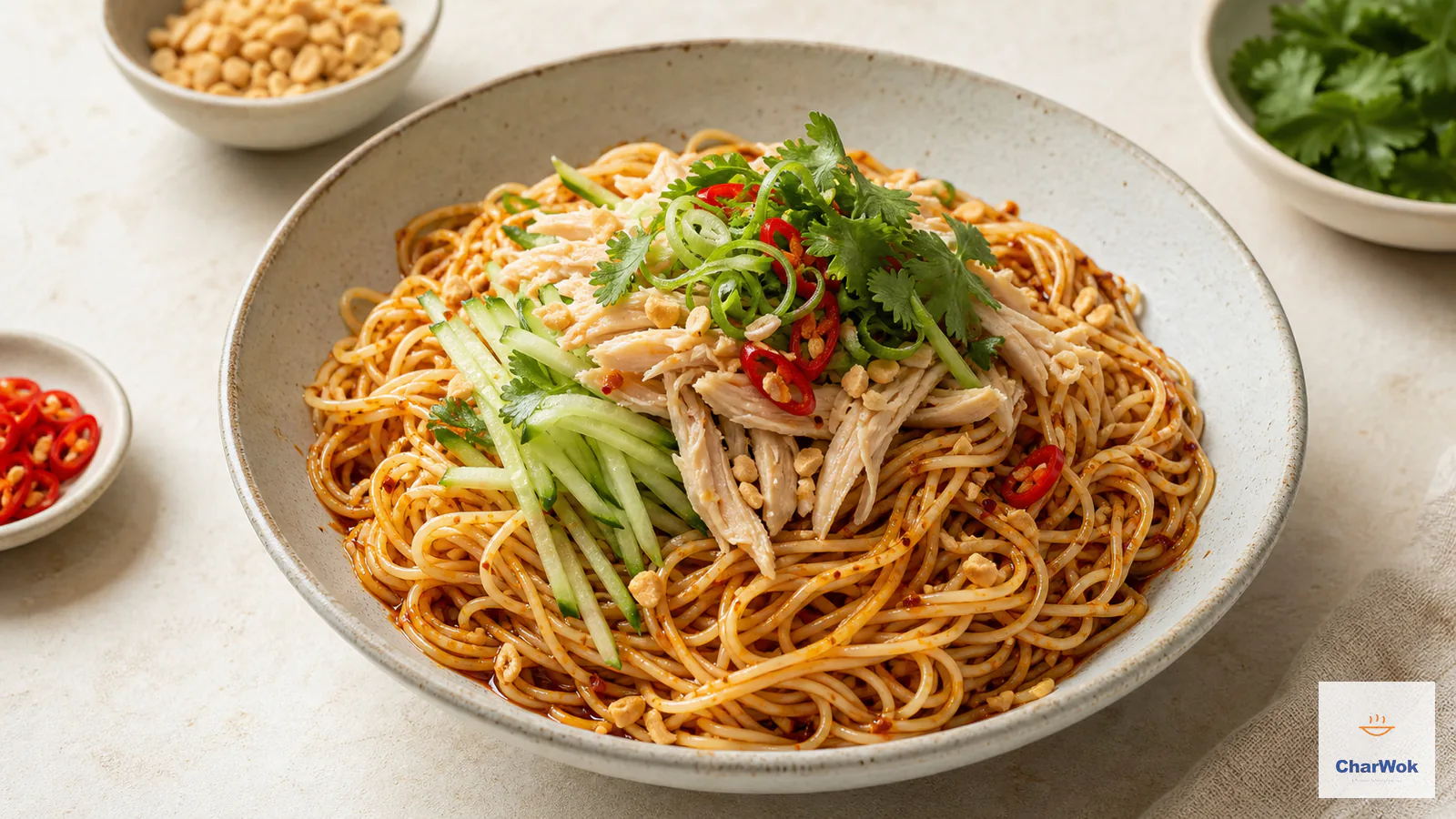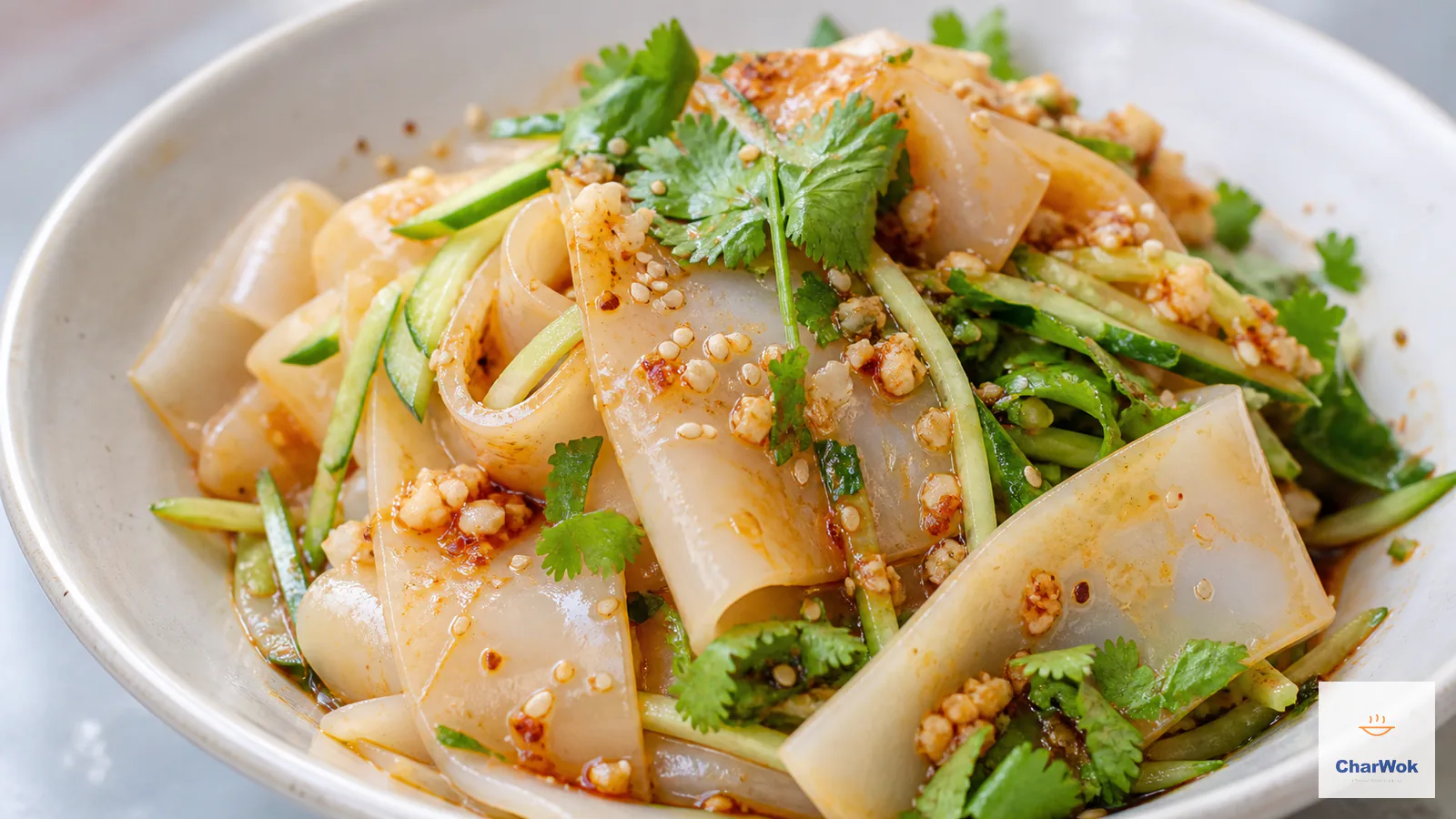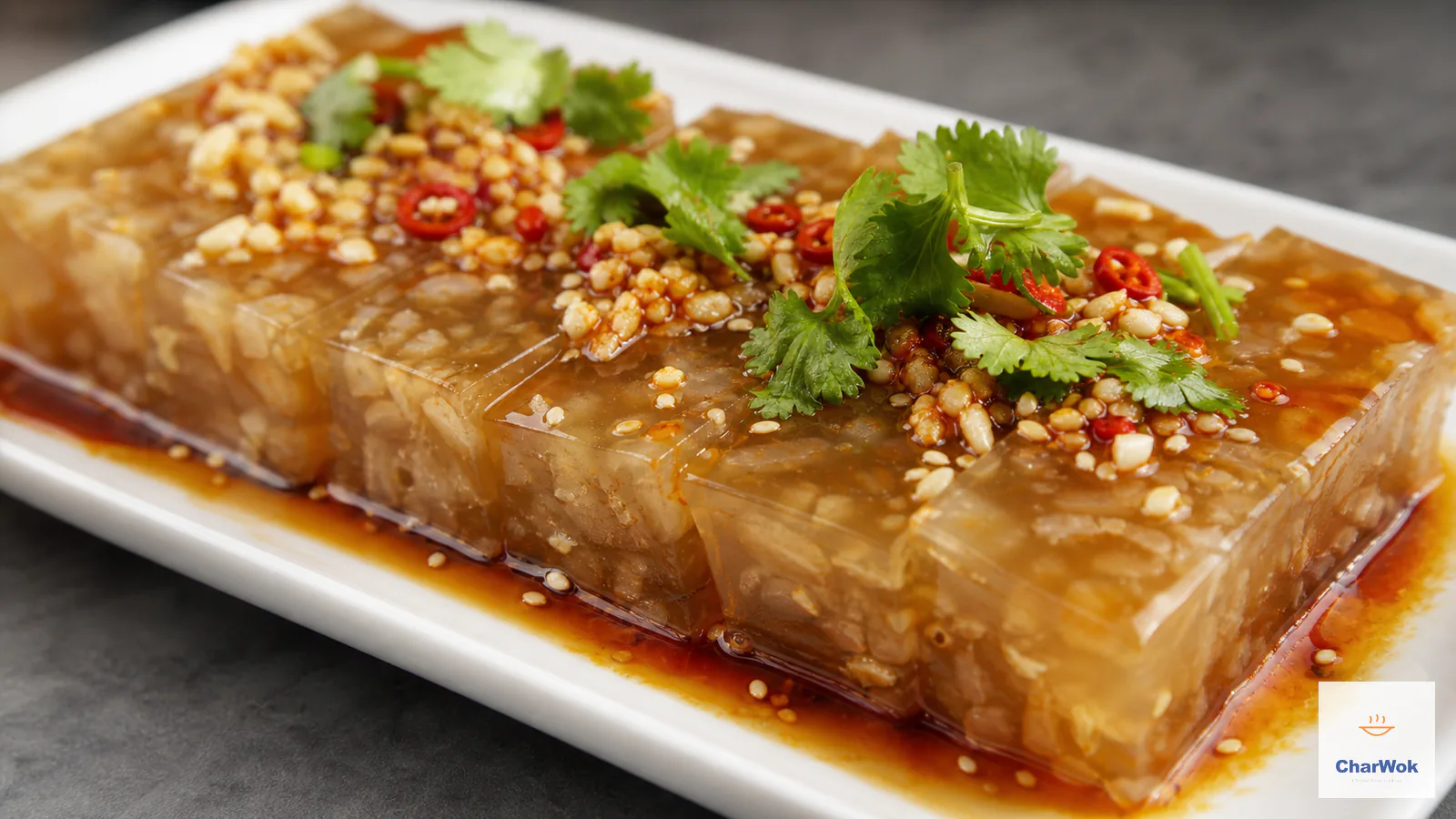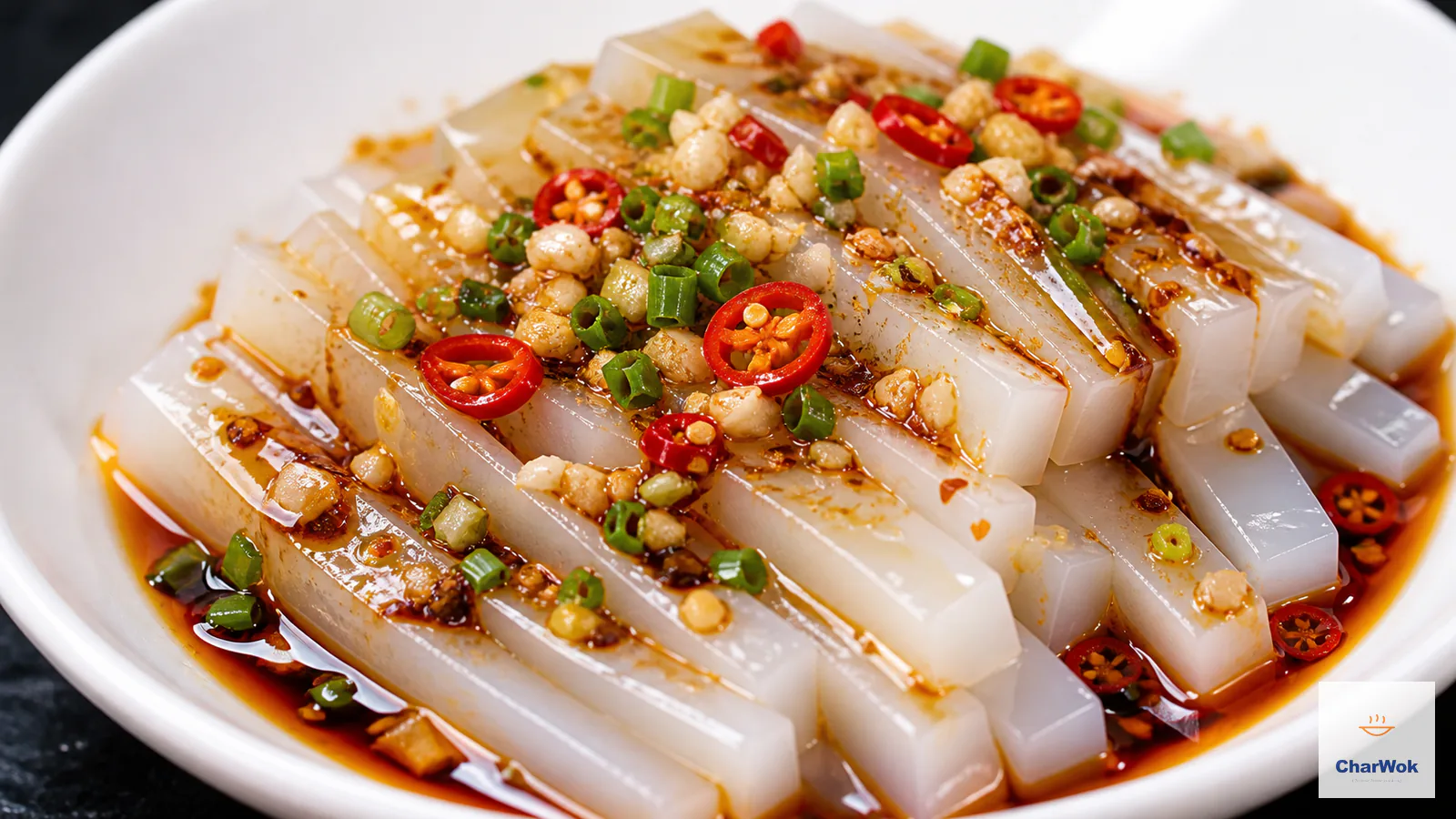
Liang fen (凉粉) is one of the most under-appreciated cold dishes in the Chinese home kitchen. It looks like nothing, just a translucent, jiggly block that you slice into slippery ribbons and drown in a garlicky, tangy dressing. But the texture is the whole point: cool, clean, bouncy enough to snap between your teeth, and slick enough to carry every drop of sauce. On a hot afternoon, a bowl of it resets you.
What trips people up is the cooking step. Mung bean starch is cheap and forgiving, but the moment you pour the slurry into hot water, the mixture can seize into rubbery lumps in seconds. I wrecked my first two batches that way, and I have met plenty of readers who gave up after one goopy pot. The good news is that the fix is mechanical, not mysterious, and once you learn the visual cue the whole thing takes about three minutes of cooking plus a long, lazy rest in the fridge.
At a glance: Use a 1:7 starch-to-water ratio by volume (½ cup starch to 3½ cups water) for a tender-but-sliceable jelly. Cook the slurry into hot, not boiling, water and stir without stopping until the paste clears and the surface heaves in fat, slow-popping bubbles. Cool to room temperature, then chill 2 to 3 hours until firm. Slice, sauce, eat cold.
What liang fen actually is
The name means "cold jelly," and across northern and western China it covers a family of dishes rather than one recipe. The version most Western cooks meet is the Sichuan and Shaanxi style: mung bean starch cooked with water into a gel, set into a block, then cut into noodles or cubes and dressed with garlic, black vinegar, soy, sesame, and chili oil. You will find it on the same table as liang pi (cold skin noodles) and cold noodles with Sichuan dressing, the trio of dishes that defines a Chinese summer spread.
There is a regional split worth knowing. In Sichuan and Chongqing the jelly is often cut into rough chunks and hit hard with chili oil and ground roasted Sichuan pepper, close cousins to the seasoning on Dan Dan Noodles. Further north, around Shaanxi and Shanxi, you see a softer hand: more black vinegar, a lighter slick of oil, sometimes a spoonful of sesame paste for body. The recipe below leans Sichuan because that is the version I cook most, but the jelly itself is neutral, so season it however your region (or your fridge) tells you to.
One point of honesty: mung bean starch jelly is not the same as the glass noodles (fensi) you find in suan la fen or glass noodle salad. Those are extruded and dried. Liang fen is fresh, soft, and perishable. Confusing the two is the most common question I get from new cooks, and it matters because you cannot substitute one for the other.
The ingredients
Mung bean jelly ingredients at a glance
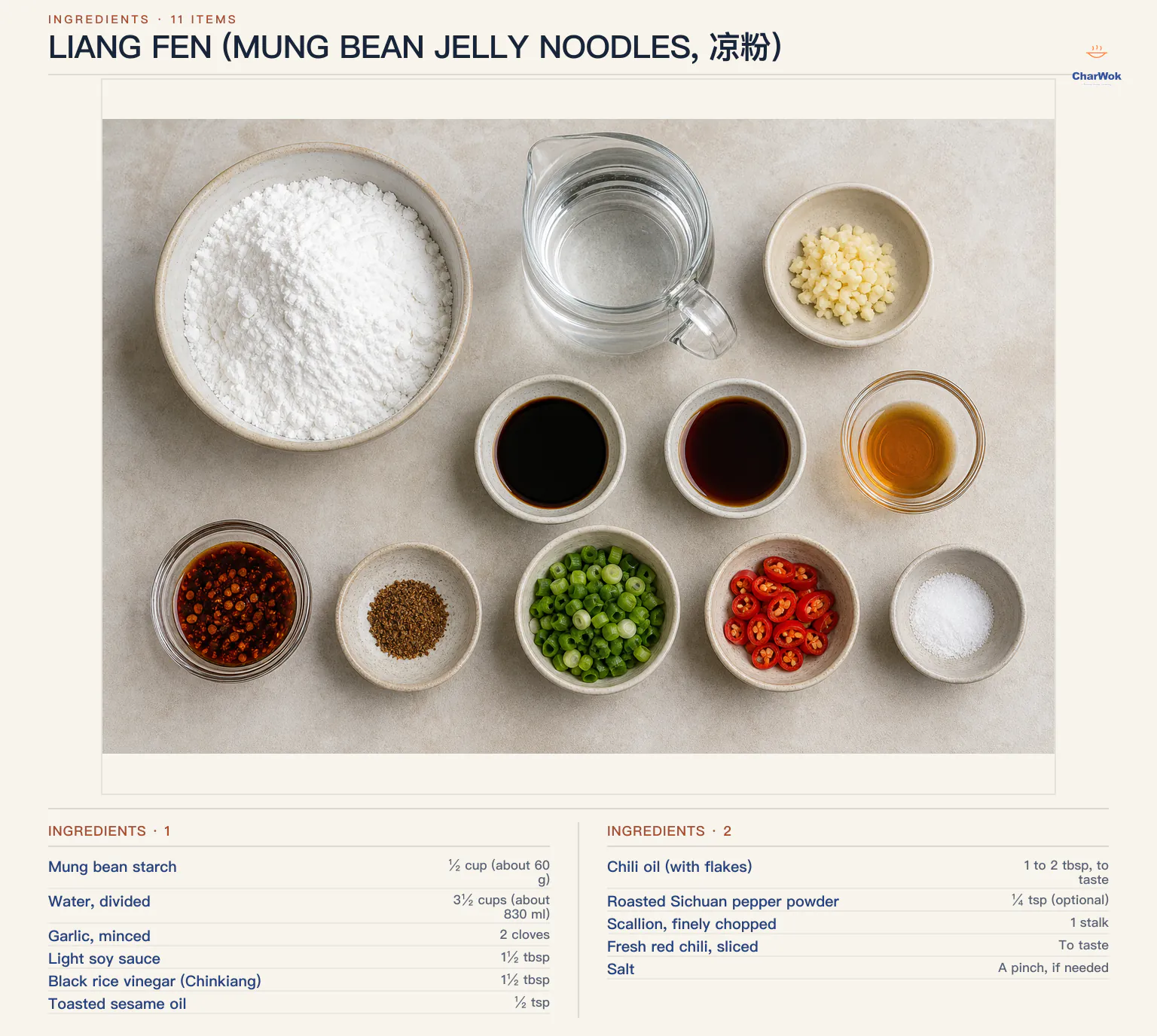
| Ingredient | Amount | Notes / substitute |
|---|---|---|
| Mung bean starch | ½ cup (about 60 g) | Pure mung bean starch, not flour. Sweet potato starch sets firmer and snappier; potato starch gives a softer, very clear, elastic gel closer to Korean naengmyeon. Cornstarch is too soft and turns cloudy, so avoid it. |
| Water, divided | 3½ cups (about 830 ml) | ½ cup to make the slurry, 3 cups to cook. Measure by volume for the ratio, not by guess. |
| Garlic, minced | 2 cloves | Mash with a pinch of salt to mellow the raw bite. |
| Light soy sauce | 1½ tbsp | See the light vs. dark soy sauce guide. Dark soy is too heavy and sweet here. |
| Black rice vinegar (Chinkiang) | 1½ tbsp | The dark, malty black rice vinegar is the right call. Plain rice vinegar is too sharp; balsamic is not a swap. |
| Toasted sesame oil | ½ tsp | A little goes far. Use a good Chinese sesame oil; the aroma is the whole point. |
| Chili oil (with flakes) | 1 to 2 tbsp, to taste | Homemade chili oil or Chiu Chow chili oil. Or a spoon of spicy doubanjiang thinned with hot water. |
| Roasted Sichuan pepper powder | ¼ tsp (optional) | Adds the classic numbing edge. Grind it yourself; see the Sichuan pepper notes. |
| Scallion, finely chopped | 1 stalk | Green parts for color, a little white for bite. |
| Fresh red chili, sliced | To taste | Optional, for heat and color. Skip if serving kids. |
| Salt | A pinch, if needed | Soy and chili oil already carry salt; taste before adding. |
Step by step: cooking the jelly
- Mix the slurry first. In a bowl, stir the mung bean starch into ½ cup of cold water until no lumps remain. Do this before you turn on the stove, because starch settles fast, and a slurry that sits untouched for a minute will be sandy at the bottom. Give it one more stir right before you pour.
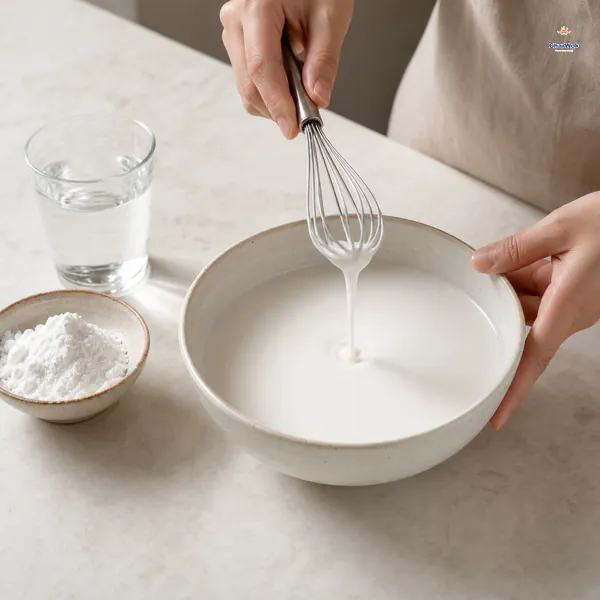
Whisk the mung bean starch with 1/2 cup cold water until completely smooth and lump-free before heating anything.
- Heat the rest of the water until it just begins to fizz, not boil. Pour the remaining 3 cups into a saucepan and warm it over medium heat. Watch the bottom of the pan: when you see a steady stream of small bubbles rising, take it off the heat. If the water hits a rolling boil, the starch will cook instantly into hard, rubbery pearls that no amount of stirring can fix. This is the single most common failure, and the only cure is to throw the pot out and start over.
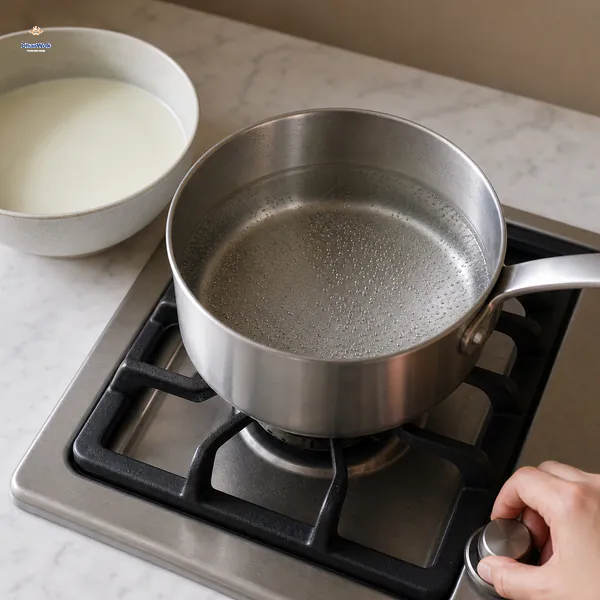
Heat the remaining 3 cups water only until tiny bubbles rise from the bottom; do not let it reach a rolling boil.
- Stream in the slurry while stirring. Drop the heat to its lowest setting. Give the slurry one final stir (it settles fast), then trickle it into the pan in a thin stream, scraping the bowl clean. Keep the spatula sweeping across the bottom and around the corners of the pan so no starch can scorch against the metal.
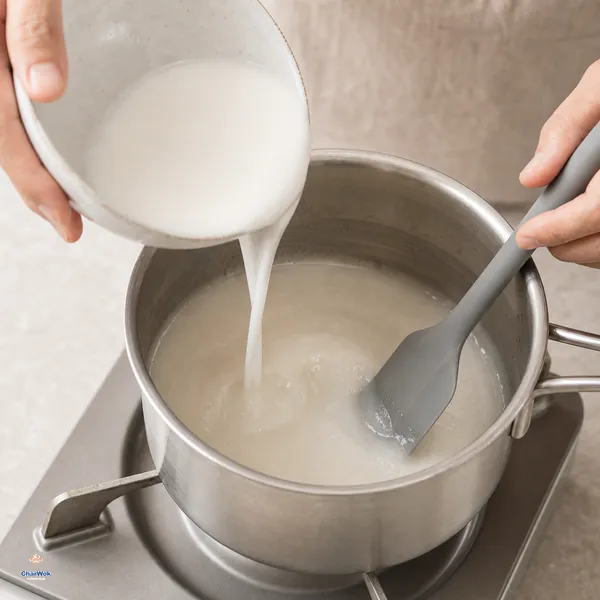
Keep the heat low, pour the slurry in a thin steady stream and stir continuously, scraping the base and corners so no lumps or scorched patches form.
- Cook, stirring constantly, until the paste clears and signals it is done. Stay on low and do not stop stirring. Over the next minute or two the milky liquid will first thicken, then lose its cloudiness and turn glossy. You will know it is ready by two signs together: when you lift the spatula the paste falls in a slow, heavy ribbon rather than a thin stream, and the surface begins to heave and erupt in fat, slow-popping bubbles. Pull the pan off the heat the instant you read both cues. Keep going and the jelly sets up leathery and sheds water later.
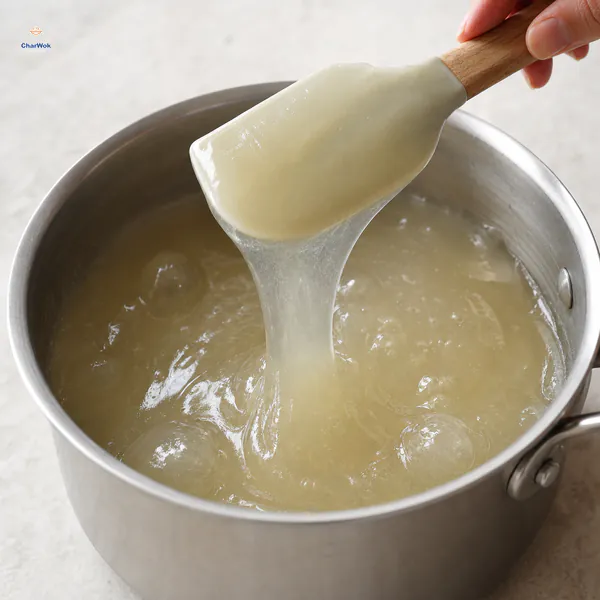
Continue stirring until the paste turns glossy and translucent, falls in a slow heavy ribbon and releases a few large, lazy bubbles, then remove it from the heat.
- Pour and cool uncovered, then chill. Scrape the just-cooked paste into a heat-safe dish (glass, ceramic, or a silicone mold all work) and level the surface. Let it stand uncovered until it is no longer warm to the touch; covering it while warm traps steam and leaves a pool on top. Once at room temperature, cover and refrigerate 2 to 3 hours, until the block is firm, white, and springs back under a fingertip. It will not fully set on the counter; the cold does real work here, and rushing it leaves you with a wobbly center.
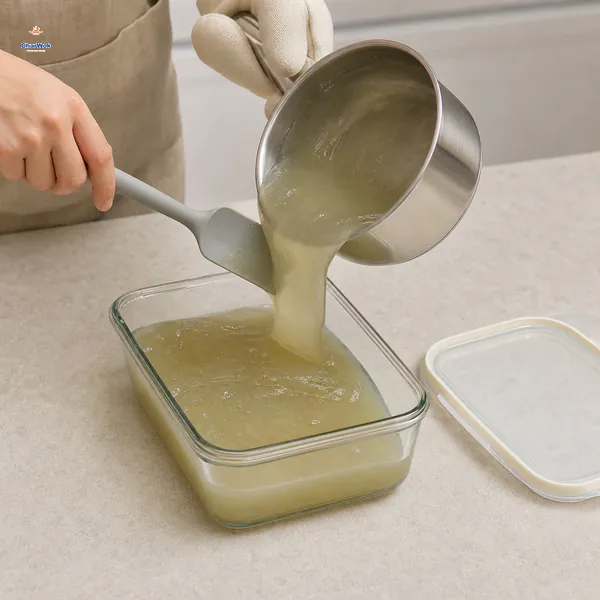
Pour the paste into a heat-safe container and level it; cool uncovered to room temperature, then cover and chill for 2 to 3 hours until firm.
Cutting and dressing
- Unmold the block. Run a thin knife around the edge to break the seal, then upend the dish over a board; the jelly should release in one clean piece. If it holds on, a ten-second dip of the dish in warm water loosens it.
- Cut into ribbons. Use a flat knife and cut the block into strips the thickness of a finger, or thinner if you want a more delicate bite. A potato ricer or a dedicated jelly-noodle press gives the round, extruded strands you see at street stalls, but a knife is honest and fast. Transfer the ribbons to a shallow bowl.
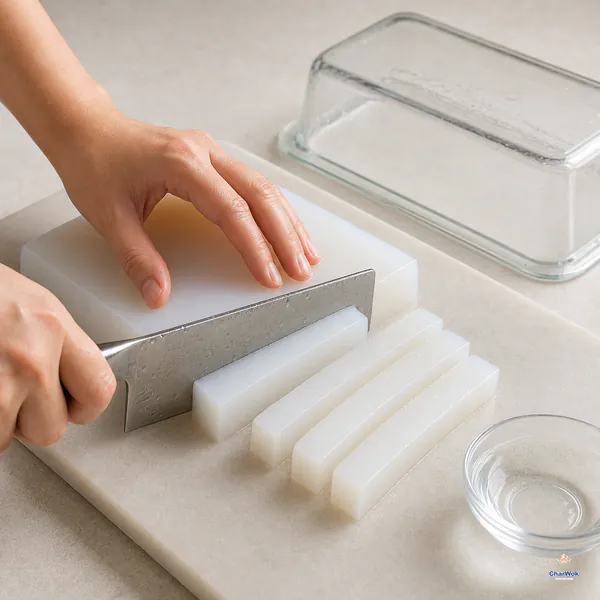
Unmold the chilled block and use a flat knife dipped in cold water to cut clean, even ribbons without crushing the springy jelly.
- Build the dressing. In a small bowl, combine the minced garlic, light soy, black rice vinegar, sesame oil, chili oil, and Sichuan pepper powder if using. Stir, then taste. The balance should tilt slightly toward sour, with a clear salty backbone and a slow chili burn, the same logic behind the dressing on Bang Bang Chicken.
- Pour, top, serve cold. Spoon the dressing over the jelly and toss gently so every ribbon is coated. Finish with chopped scallion and fresh chili. Eat it cold, the colder the better.
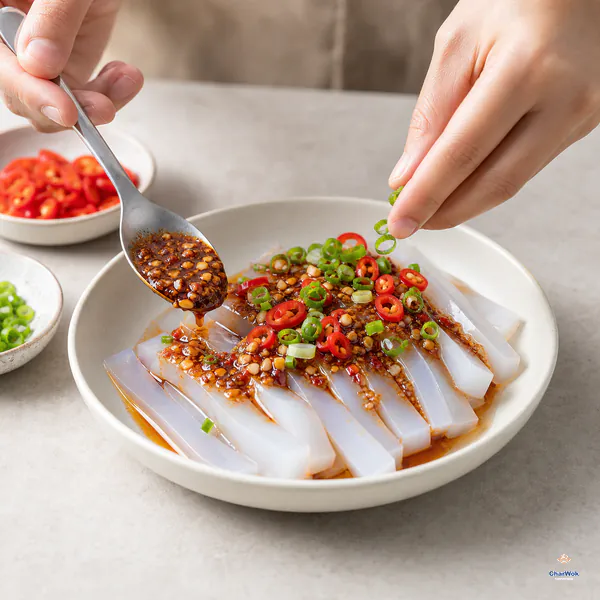
Mix the garlic, soy sauce, black rice vinegar, chili oil, sugar and salt, pour over the ribbons, finish with scallion and fresh red chili, and serve cold.
When it goes wrong (and how to save it)
Most liang fen disasters happen in the cooking minute, not the fridge. Here are the failures I see again and again.
Lumpy, rubbery paste with hard bits floating in it. The water was too hot when you added the slurry. There is no rescue mid-batch: strain out the lumps if you can, but honestly, start over and watch the bubbles next time. Medium heat, off the burner the instant it fizzes.
The jelly never sets and stays pourable after 3 hours. Either the ratio was off (you measured the water too generously), or you stopped cooking too soon, before the starch fully gelatinized. The paste must turn fully translucent and hit that big-bubble stage. Re-cook a failed soft batch over low heat, stirring, until it glosses over, then re-set it.
The block weeps a puddle of water in the fridge. This is retrogradation, the starch network squeezing out water as it ages, the same thing that stales bread. It is harmless; pour the liquid off. The same aging also tightens and toughens the gel over the first day. If you know the block will sit in the fridge past a single night, add an extra ½ cup of water to the pot at the start so the finished jelly starts out a touch softer and ages to the right texture.
Jelly falls apart into mush when sliced. Two causes: it is either under-chilled (still soft in the middle) or cut with a serrated knife that shreds rather than shears. Use a smooth-bladed knife and a single downward stroke, and give it another hour in the fridge.
Variations and pairings
The jelly is a blank canvas. A few directions worth cooking:
Sesame-paste version (ma jiang liang fen). Swap half the chili oil for a spoon of thinned Chinese sesame paste and a splash of warm water to loosen it. The result is creamy and nutty, closer to the Beijing and Shaanxi street style. This is my favorite on a day when I want something rich rather than purely sharp.
Crunch on top. Add crushed roasted peanuts or a spoon of Sichuan spicy peanuts for contrast. Jelly is soft; the dish wants something crisp. A few toasted sesame seeds or fried shallots do the same job.
What to serve it with. Liang fen opens a meal or stands in for a cold salad course. I like it next to a bowl of Chongqing xiao mian or a plate of silken tofu with scallions and soy for a fully cold spread, and it cuts through richer dishes beautifully. A bowl of smashed cucumber salad rounds out a hot-weather table: same temperature, different crunch.
Storage and reheating
Keep the unseasoned jelly block, covered, in the fridge for up to 3 days. The texture tightens and grows snappier as it ages, which is fine for slicing but less pleasant to eat, so make it the day you plan to serve it when you can. Never freeze it; the starch network collapses on thaw and you get a spongy, weepy mess. Do not dress the jelly ahead of time, because the salt and vinegar will pull water out of the ribbons and turn the bowl into a puddle. Slice and sauce to order.
Frequently asked questions
Can I use cornstarch instead of mung bean starch? No. Cornstarch sets softer and turns cloudy and pasty rather than glassy; the jelly will not hold a clean slice. Mung bean starch is the right tool. Sweet potato starch can stand in for a firmer, snappier jelly, and potato starch for a softer, elastic one, but neither behaves quite like mung bean.
Why is my jelly full of hard lumps? The slurry hit water that was already boiling, so the starch cooked on contact into rubbery pearls. Heat the water only until small bubbles rise, then take it off the burner before pouring in the slurry. A batch that has already seized cannot be smoothed out, so start fresh.
Do I have to chill it, or can I serve it warm? It must chill to set fully; the cold firms the gel. Liang fen is a cold dish by definition. If the thought of cold jelly does not appeal, the same dressing is excellent over warm noodles or tofu instead.
How do I get the round noodle shape instead of flat strips? Press the cooked, still-warm paste through a potato ricer or a colander with large holes straight into a bowl of ice water. The strands set as they fall through. A knife is simpler and works just as well for home cooking.
Can I make it ahead for a party? Yes. Cook and set the block up to a day ahead, but slice and dress only right before serving. Pre-dressed jelly weeps and goes soft within an hour.
A final word
If there is one thing to remember, it is the moment the paste clears. Hot, not boiling, water; a slurry streamed in while you stir; and pull the pan the instant the surface turns glossy and begins to heave and pop. Get that minute right and the rest is patience: a couple of hours in the fridge, a quick cut, a sharp dressing. The dish is plain on purpose; it asks the sauce to do the talking and the texture to carry the day. Make it once and you will not need the recipe again.